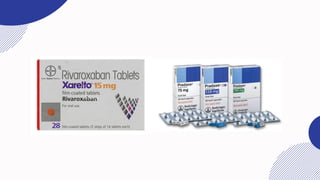
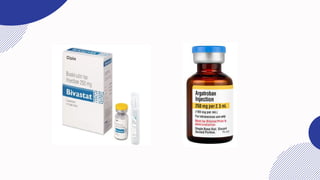
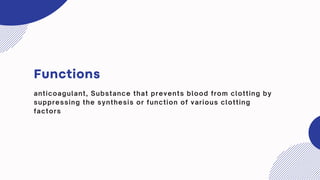
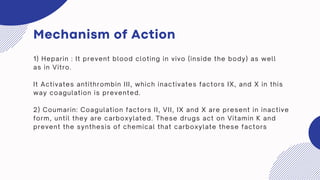
Presentation on Pharmacology
ANTI
COAGULANTS
Apollo College of Pharmacy
Anjora Durg (2022-2023)
Guided by
Subiya khan
Saurav Anand Kaushik
Khileshwari Sahu
Sukhdas Jangade
Mr. Hari Prasad Sonwani
Submitted by
Perioperative management of patients on warfarin or antiplatelet therapy
involves assessing and balancing individual risks for thromboembolism
and bleeding.
Discontinuing anticoagulant and antiplatelet therapis usually necessary
for major surgery but increases the risk of thrombotic events.
Bridge therapy -ie, the temporary use of intravenous unfractionated
heparin (IV UFH) or low-molecular- weight heparin (LMWH) prior to
surgery in place of warfarin-, is an effective means of reducing the risk
of thromboembolism but may increase the risk of bleeding.
Introduction
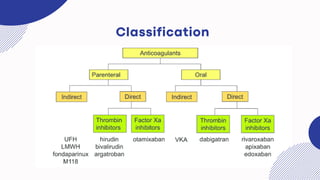
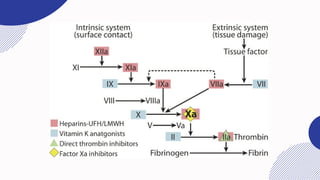
Classification
Oral
Act indirectly by interfering with the synthesis of vit K
dependent clotting factors in liver.
Apparently behave as competitive antagonists of vit K and
lower the plasma levels of functional clotting factors in a
dose-dependent manner.
they inhibit the enzyme vit K epoxide reductase (VKOR) and
interfere with regeneration of the active hydroquinone form of
vit K which acts as a cofactor for the enzyme y-glutamyl
carboxylase.
Parenteral
Parenteral anticoagulants—unfractionated and low-molecular-
weight heparin—primarily are used to prevent and treat VTE
(deep vein thrombosis [DVT] and pulmonary embolism [PE])
associated with medical conditions such as atrial fibrillation,
heart disease, and atherosclerosis; they’re also used to
prevent clotting during dialysis and extracorporeal
circulation.
Functions
anticoagulant, Substance that prevents blood from clotting by
suppressing the synthesis or function of various clotting
factors
Mechanism of Action
1) Heparin : It prevent blood cloting in vivo (inside the body) as well
as in Vitro.
It Activates antithrombin III, which inactivates factors IX, and X in this
way coagulation is prevented.
2) Coumarin: Coagulation factors II, VII, IX and X are present in inactive
form, until they are carboxylated. These drugs act on Vitamin K and
prevent the synthesis of chemical that carboxylate these factors
Indications
To treat unstable angina.
To prevent coagulation in Heart failure.
To dissolve the clot in blood vessels.
Pulmonary embolism.
To prevent clotting during open heart surgery.
Contraindications
Bleeding disorders, history of heparin induced
thrombocytopenia.
Severe hypertension, threatened abortion, piles, g.i. ulcers.
Subacute bacterial endocarditis, large malignancies,
tuberculosis.
Ocular and neurosurgery, lumbar puncture.
Chronic alcoholics, cirrhosis, renal failure.
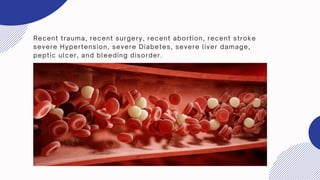
Recent trauma, recent surgery, recent abortion, recent stroke
severe Hypertension, severe Diabetes, severe liver damage,
peptic ulcer, and bleeding disorder.
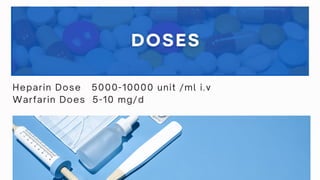
Heparin Dose 5000-10000 unit /ml i.v
Warfarin Does 5-10 mg/d
Uses
Deep vein thrombosis (DVT) and pulmonary embolism (PE)
Myocardial infarction (MI)
Unstable angina
Rheumatic heart disease; Atrial fibrillation (AF)
Cerebrovascular disease
Vascular surgery, prosthetic heart valves, retinal vessel thrombosis,
extracorporeal circulation, haemodialysis
Defibrination syndrome or 'disseminated intravascular coagulation'
Adverse Effect
Bleeding due to overdose - most serious complication.
Thrombocytopenia - mild and transient.
Transient and reversible alopecia is infrequent. Serum
transaminase levels may rise.
Osteoporosis - long-term use of relatively high doses.
Hypersensitivity reactions - rare.
HEPARIN
Heparin is a non-uniform mixture of straight chain
mucopolysaccharides with MW 10,000 to 20,000.
It contains polymers of two sulfated disaccharide units:
D-glucosamine-L-iduronic acid
D-glucosamine-D-glucuronic acid
It is present in all tissues containing mast cells; richest
sources are lung, liver and intestinal mucosa.
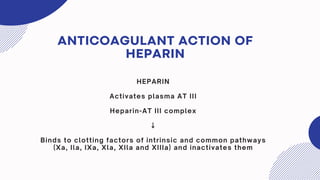
ANTICOAGULANT ACTION OF
HEPARIN
HEPARIN
Activates plasma AT III
Heparin-AT III complex
↓
Binds to clotting factors of intrinsic and common pathways
(Xa, Ila, IXa, Xla, XIla and XIIIa) and inactivates them
OTHER ACTIONS OF HEPARIN
Heparin in higher doses inhibits platelet aggregation and
prolongs bleeding time.
Heparin in lower doses helps in lipaemia clearing.
PHARMACOKINETICS
Heparin is not absorbed orally.
If Injected i.v. - acts instantaneously.
After s.c. injection anticoagulant effect develops after ~60
min.
Bioavailability of s.c. heparin is inconsistent.
Heparin does not cross blood-brain barrier or placenta (it is
the anticoagulant of choice during pregnancy).
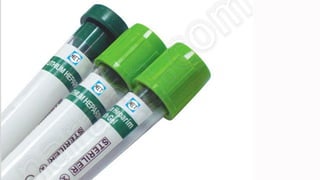
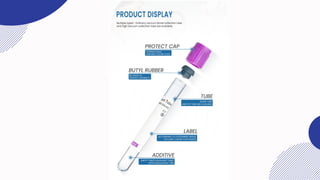
PREPARATION
Just 0.2 mL of sodium (lithium) heparin (1000 IU/mL) added to
5 mL of blood will give a final heparin concentration of 40
IU/mL blood, sufficient for anticoagulation. The principle
disadvantage of liquid heparin is a potential for error if blood
is over-diluted with heparin.
DOSAGE
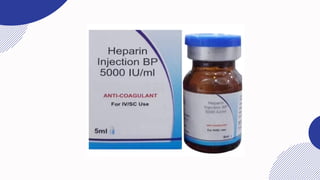
Heparin Dose 5000-10000 unit /ml i.v
THERAPEUTIC USES
Anticoagulants are medicines that help prevent
blood clots. They're given to people at a high
risk of getting clots, to reduce their chances of
developing serious conditions such as strokes
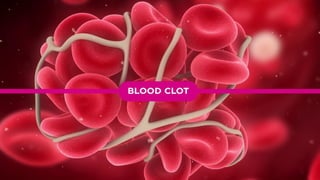
and heart attacks. A blood clot is a seal created
by the blood to stop bleeding from wounds.
SIDE EFFECTS
chest pain,
irregular heartbeats,
shortness of breath,
dizziness,
anxiety,
sweating,
unusual bleeding or bruising,
severe pain or swelling in your stomach, lower back or
growing,
dark or blue-colored skin on your hands or
feet,
nausea,
vomiting,
loss of appetite,
unusual tiredness
References
TRIPATHI, K.D.(2018). ESSENTIALS OF MEDICAL PHARMECOLOGY
(8TH ED.).JAYPEE BROTHERS MEDICAL
PHARMACOLOGY OF ANTICOAGULANTS FROM SLIDESHARE.NET
THANK
YOU

presentation pharmacology (1).pdf

  • 1.
    Presentation on Pharmacology ANTI COAGULANTS ApolloCollege of Pharmacy Anjora Durg (2022-2023) Guided by Subiya khan Saurav Anand Kaushik Khileshwari Sahu Sukhdas Jangade Mr. Hari Prasad Sonwani Submitted by
  • 2.
    Perioperative management ofpatients on warfarin or antiplatelet therapy involves assessing and balancing individual risks for thromboembolism and bleeding. Discontinuing anticoagulant and antiplatelet therapis usually necessary for major surgery but increases the risk of thrombotic events. Bridge therapy -ie, the temporary use of intravenous unfractionated heparin (IV UFH) or low-molecular- weight heparin (LMWH) prior to surgery in place of warfarin-, is an effective means of reducing the risk of thromboembolism but may increase the risk of bleeding. Introduction
  • 3.
  • 4.
    Oral Act indirectly byinterfering with the synthesis of vit K dependent clotting factors in liver. Apparently behave as competitive antagonists of vit K and lower the plasma levels of functional clotting factors in a dose-dependent manner. they inhibit the enzyme vit K epoxide reductase (VKOR) and interfere with regeneration of the active hydroquinone form of vit K which acts as a cofactor for the enzyme y-glutamyl carboxylase.
  • 6.
    Parenteral Parenteral anticoagulants—unfractionated andlow-molecular- weight heparin—primarily are used to prevent and treat VTE (deep vein thrombosis [DVT] and pulmonary embolism [PE]) associated with medical conditions such as atrial fibrillation, heart disease, and atherosclerosis; they’re also used to prevent clotting during dialysis and extracorporeal circulation.
  • 8.
    Functions anticoagulant, Substance thatprevents blood from clotting by suppressing the synthesis or function of various clotting factors
  • 9.
    Mechanism of Action 1)Heparin : It prevent blood cloting in vivo (inside the body) as well as in Vitro. It Activates antithrombin III, which inactivates factors IX, and X in this way coagulation is prevented. 2) Coumarin: Coagulation factors II, VII, IX and X are present in inactive form, until they are carboxylated. These drugs act on Vitamin K and prevent the synthesis of chemical that carboxylate these factors
  • 12.
    Indications To treat unstableangina. To prevent coagulation in Heart failure. To dissolve the clot in blood vessels. Pulmonary embolism. To prevent clotting during open heart surgery.
  • 13.
    Contraindications Bleeding disorders, historyof heparin induced thrombocytopenia. Severe hypertension, threatened abortion, piles, g.i. ulcers. Subacute bacterial endocarditis, large malignancies, tuberculosis. Ocular and neurosurgery, lumbar puncture. Chronic alcoholics, cirrhosis, renal failure.
  • 14.
    Recent trauma, recentsurgery, recent abortion, recent stroke severe Hypertension, severe Diabetes, severe liver damage, peptic ulcer, and bleeding disorder.
  • 15.
    Heparin Dose 5000-10000unit /ml i.v Warfarin Does 5-10 mg/d
  • 17.
    Uses Deep vein thrombosis(DVT) and pulmonary embolism (PE) Myocardial infarction (MI) Unstable angina Rheumatic heart disease; Atrial fibrillation (AF) Cerebrovascular disease Vascular surgery, prosthetic heart valves, retinal vessel thrombosis, extracorporeal circulation, haemodialysis Defibrination syndrome or 'disseminated intravascular coagulation'
  • 18.
    Adverse Effect Bleeding dueto overdose - most serious complication. Thrombocytopenia - mild and transient. Transient and reversible alopecia is infrequent. Serum transaminase levels may rise. Osteoporosis - long-term use of relatively high doses. Hypersensitivity reactions - rare.
  • 20.
    HEPARIN Heparin is anon-uniform mixture of straight chain mucopolysaccharides with MW 10,000 to 20,000. It contains polymers of two sulfated disaccharide units: D-glucosamine-L-iduronic acid D-glucosamine-D-glucuronic acid It is present in all tissues containing mast cells; richest sources are lung, liver and intestinal mucosa.
  • 22.
    ANTICOAGULANT ACTION OF HEPARIN HEPARIN Activatesplasma AT III Heparin-AT III complex ↓ Binds to clotting factors of intrinsic and common pathways (Xa, Ila, IXa, Xla, XIla and XIIIa) and inactivates them
  • 23.
    OTHER ACTIONS OFHEPARIN Heparin in higher doses inhibits platelet aggregation and prolongs bleeding time. Heparin in lower doses helps in lipaemia clearing.
  • 24.
    PHARMACOKINETICS Heparin is notabsorbed orally. If Injected i.v. - acts instantaneously. After s.c. injection anticoagulant effect develops after ~60 min. Bioavailability of s.c. heparin is inconsistent. Heparin does not cross blood-brain barrier or placenta (it is the anticoagulant of choice during pregnancy).
  • 25.
    PREPARATION Just 0.2 mLof sodium (lithium) heparin (1000 IU/mL) added to 5 mL of blood will give a final heparin concentration of 40 IU/mL blood, sufficient for anticoagulation. The principle disadvantage of liquid heparin is a potential for error if blood is over-diluted with heparin.
  • 26.
  • 27.
    THERAPEUTIC USES Anticoagulants aremedicines that help prevent blood clots. They're given to people at a high risk of getting clots, to reduce their chances of developing serious conditions such as strokes and heart attacks. A blood clot is a seal created by the blood to stop bleeding from wounds.
  • 29.
    SIDE EFFECTS chest pain, irregularheartbeats, shortness of breath, dizziness, anxiety, sweating,
  • 30.
    unusual bleeding orbruising, severe pain or swelling in your stomach, lower back or growing, dark or blue-colored skin on your hands or feet, nausea, vomiting, loss of appetite, unusual tiredness
  • 32.
    References TRIPATHI, K.D.(2018). ESSENTIALSOF MEDICAL PHARMECOLOGY (8TH ED.).JAYPEE BROTHERS MEDICAL PHARMACOLOGY OF ANTICOAGULANTS FROM SLIDESHARE.NET
  • 33.