
4G Integrated WiMAXA Detailed IntroductionBy BRIAN RITCHIETwitter : brianritchieFacebook : facebook.com/brianritchie
Who Am I ?Co worked on the Enterprise Architecture for some of the largest regional as well as international companiesRolled out the first official OSS Centre of Excellence strategy and implementation for a local Financial InstitutionExperience with large scale Project Management for core systemsDesigned and Implemented Research and Incubation Services for large scale corporations
AgendaIntroduction to WiMAXIntroduction to Network Access Control Layers
Before We Go Further !!!Case Study :How would you cope with the increased need for bandwidth delivered at lower costs to more subscribers ?Assume the technologies available to you are the following :EthernetWi-FiCell Towers, Base Stations, Data Centers, Traditional CDNs
What is WiMAX ?A quick standards introduction
What is WiMAX ?WiMAX =  Worldwide Interoperability for Microwave AccessAim : To provide long distance wireless broadband for applications similar to the coverage and quality of service (QOS) of cellular networksPromotes the IEEE 802.16 standards
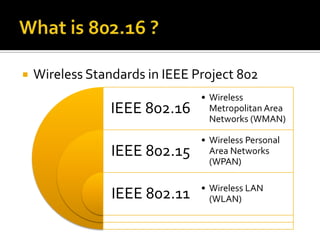
What is 802.16 ?Wireless Standards in IEEE Project 802
What is 802.16 ?IEEE 802.16 originally aimed to define fixed broadband wireless (FBW)May possibly replace the past wireless local loop (WLL) in telecommunicationsAble to deliver performance comparable to traditional cable, T1, xDSL, etc.
What is 802.16 ?Advantages of 802.16 include :Quick and easy deployment especially for areas that are difficult to be wired.No physical limitations compared to wired infrastructureCost effective for $/MB of dataIncreased security through multi-level encryptionHighly scalable with significantly higher throughout
Wireless ArchitecturesWhat are the architectures behind WiMAX deployment
Wireless ArchitecturesThere are two types of wireless deploymentPoint to Point (P2P)Point to Multipoint (PMP)How does Line of Sight (LOS) affect these architectures ?
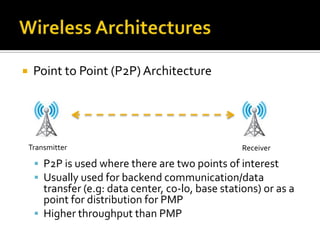
Wireless ArchitecturesPoint to Point (P2P) ArchitectureP2P is used where there are two points of interestUsually used for backend communication/data transfer (e.g: data center, co-lo, base stations) or as a point for distribution for PMPHigher throughput than PMPTransmitterReceiver
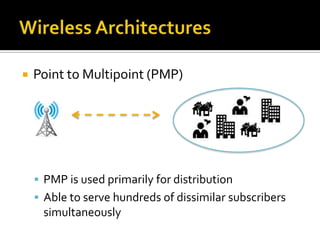
Wireless ArchitecturesPoint to Multipoint (PMP)PMP is used primarily for distributionAble to serve hundreds of dissimilar subscribers simultaneously
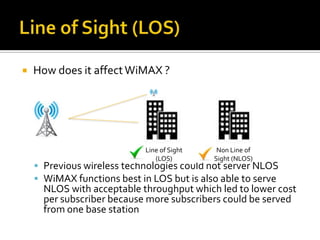
How does it affect WiMAX ?Previous wireless technologies could not server NLOSWiMAX functions best in LOS but is also able to serve NLOS with acceptable throughput which led to lower cost per subscriber because more subscribers could be served from one base stationLine of Sight (LOS)Line of Sight(LOS)Non Line of Sight (NLOS)
What is WiMAX ?Types of WiMAXdeployments and what its not
TerminologyFixed WiMAX (IEEE 802.16d / 802.16-2004)Mobile WiMAX(IEEE 802.16e / 802.16e-2005)WiMAXvsWi-Fi
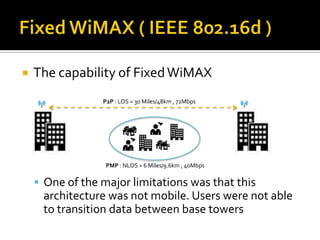
Fixed WiMAX ( IEEE 802.16d )The capability of Fixed WiMAXOne of the major limitations was that this architecture was not mobile. Users were not able to transition data between base towers P2P : LOS = 30 Miles/48km , 72MbpsPMP : NLOS = 6 Miles/9.6km , 40Mbps
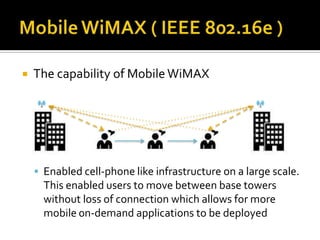
Mobile WiMAX ( IEEE 802.16e )The capability of Mobile WiMAXEnabled cell-phone like infrastructure on a large scale. This enabled users to move between base towers without loss of connection which allows for more mobile 0n-demand applications to be deployed
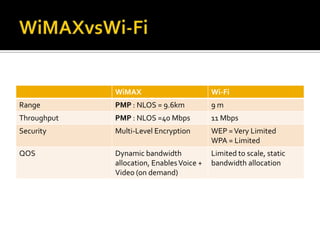
WiMAXvsWi-Fi
Hardware ArchitectureEnd to End View on WiMAX hardware and the considerations
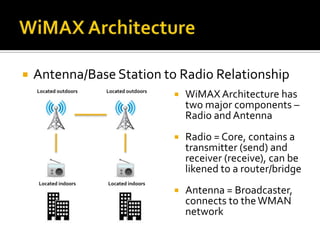
WiMAX ArchitectureAntenna/Base Station to Radio RelationshipLocated outdoorsLocated outdoorsWiMAX Architecture has two major components – Radio and Antenna
Radio = Core, contains a transmitter (send) and receiver (receive), can be likened to a router/bridge
Antenna = Broadcaster, connects to the WMAN networkLocated indoorsLocated indoors
AdvantagesAdvantage of Radio architecture – Radio is protected from weather extremes, this reduces interruptions/signal lossAdvantage of Antenna architecture – optimizes the performance of the WMAN connection between transmitter and receiver
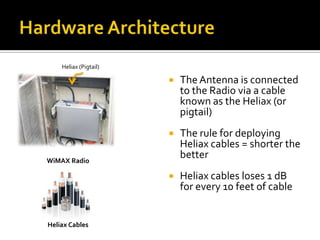
Hardware ArchitectureHeliax (Pigtail)The Antenna is connected to the Radio via a cable known as the Heliax (or pigtail)
The rule for deploying Heliax cables = shorter the better
Heliax cables loses 1 dB for every 10 feet of cableWiMAX RadioHeliax Cables
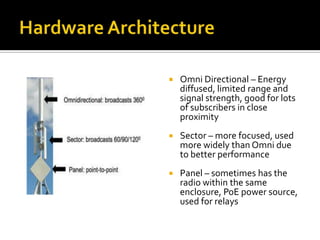
Hardware ArchitectureOmni Directional – Energy diffused, limited range and signal strength, good for lots of subscribers in close proximity
Sector – more focused, used more widely than Omni due to better performance
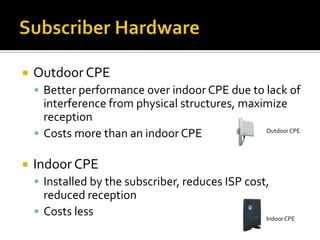
Panel – sometimes has the radio within the same enclosure, PoE power source, used for relaysSubscriber HardwareOutdoor CPEBetter performance over indoor CPE due to lack of interference from physical structures, maximize receptionCosts more than an indoor CPEIndoor CPEInstalled by the subscriber, reduces ISP cost, reduced receptionCosts lessOutdoor CPEIndoor CPE
Deployment ConsiderationsAspects to plan when deploying WiMAX technology
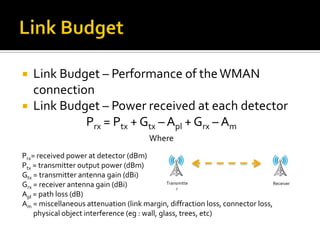
Link BudgetLink Budget – Performance of the WMAN connectionLink Budget – Power received at each detectorPrx = Ptx + Gtx – Apl + Grx – AmWherePrx= received power at detector (dBm)Ptx = transmitter output power (dBm)Gtx = transmitter antenna gain (dBi)Grx = receiver antenna gain (dBi)Apl = path loss (dB)Am = miscellaneous attenuation (link margin, diffraction loss, connector loss, physical object interference (eg : wall, glass, trees, etc)TransmitterReceiver
Frequency PlanLogic ExerciseAssuming you had a limit of three different frequencies for deployment to 9 base stations, how would you do it ?NOTE : Same frequencies in close proximity will cause interruption to your subscribers.Assume frequencies are deployed by their base station using Omni directional antennas with equal range radius
Answer : This is also how cellular/wireless operators function with limited frequencies to cover the most surface area without interference to the user Frequency Plan
Network ArchitectureHow does WiMAX work from a networks perspective
IEEE 802.16 Reference ModelScope of StandardCS SAPManagement Entity Service Specific Convergence SublayerMAC SAPManagement Entity MAC Common Parte SublayerMACNetwork Management SystemPrivacy SublayerPHY SAPManagement Entity PHY LayerPHYManagement PlaneDate/Control Plane
IEEE 802.16 MACMAC = Medium Access ControlHas a PMP network topology with support for mesh network topologyBackhaul can either be ATM = Asynchronous Transfer Mode or packet based (eg : IP Networks)
IEEE 802.16 MACHas three sub-layers in the Reference ModelService Specific Convergence Sublayer (CS) – Provides any transformation/mapping of external network data through the CS Service Access Point (CS SAP)MAC Common Part Sublayer (MAC CPS) – Classifies external network service data units (SDU) and associates these SDUs to propoer MAC Service flow and Connection Identifier (CID)Privacy (or Security) Sublayer – Supports authentication, secure key exchange and encryption

WiMAX_Intro

  • 1.
    4G Integrated WiMAXADetailed IntroductionBy BRIAN RITCHIETwitter : brianritchieFacebook : facebook.com/brianritchie
  • 2.
    Who Am I?Co worked on the Enterprise Architecture for some of the largest regional as well as international companiesRolled out the first official OSS Centre of Excellence strategy and implementation for a local Financial InstitutionExperience with large scale Project Management for core systemsDesigned and Implemented Research and Incubation Services for large scale corporations
  • 3.
    AgendaIntroduction to WiMAXIntroductionto Network Access Control Layers
  • 4.
    Before We GoFurther !!!Case Study :How would you cope with the increased need for bandwidth delivered at lower costs to more subscribers ?Assume the technologies available to you are the following :EthernetWi-FiCell Towers, Base Stations, Data Centers, Traditional CDNs
  • 5.
    What is WiMAX?A quick standards introduction
  • 6.
    What is WiMAX?WiMAX = Worldwide Interoperability for Microwave AccessAim : To provide long distance wireless broadband for applications similar to the coverage and quality of service (QOS) of cellular networksPromotes the IEEE 802.16 standards
  • 7.
    What is 802.16?Wireless Standards in IEEE Project 802
  • 8.
    What is 802.16?IEEE 802.16 originally aimed to define fixed broadband wireless (FBW)May possibly replace the past wireless local loop (WLL) in telecommunicationsAble to deliver performance comparable to traditional cable, T1, xDSL, etc.
  • 9.
    What is 802.16?Advantages of 802.16 include :Quick and easy deployment especially for areas that are difficult to be wired.No physical limitations compared to wired infrastructureCost effective for $/MB of dataIncreased security through multi-level encryptionHighly scalable with significantly higher throughout
  • 10.
    Wireless ArchitecturesWhat arethe architectures behind WiMAX deployment
  • 11.
    Wireless ArchitecturesThere aretwo types of wireless deploymentPoint to Point (P2P)Point to Multipoint (PMP)How does Line of Sight (LOS) affect these architectures ?
  • 12.
    Wireless ArchitecturesPoint toPoint (P2P) ArchitectureP2P is used where there are two points of interestUsually used for backend communication/data transfer (e.g: data center, co-lo, base stations) or as a point for distribution for PMPHigher throughput than PMPTransmitterReceiver
  • 13.
    Wireless ArchitecturesPoint toMultipoint (PMP)PMP is used primarily for distributionAble to serve hundreds of dissimilar subscribers simultaneously
  • 14.
    How does itaffect WiMAX ?Previous wireless technologies could not server NLOSWiMAX functions best in LOS but is also able to serve NLOS with acceptable throughput which led to lower cost per subscriber because more subscribers could be served from one base stationLine of Sight (LOS)Line of Sight(LOS)Non Line of Sight (NLOS)
  • 15.
    What is WiMAX?Types of WiMAXdeployments and what its not
  • 16.
    TerminologyFixed WiMAX (IEEE802.16d / 802.16-2004)Mobile WiMAX(IEEE 802.16e / 802.16e-2005)WiMAXvsWi-Fi
  • 17.
    Fixed WiMAX (IEEE 802.16d )The capability of Fixed WiMAXOne of the major limitations was that this architecture was not mobile. Users were not able to transition data between base towers P2P : LOS = 30 Miles/48km , 72MbpsPMP : NLOS = 6 Miles/9.6km , 40Mbps
  • 18.
    Mobile WiMAX (IEEE 802.16e )The capability of Mobile WiMAXEnabled cell-phone like infrastructure on a large scale. This enabled users to move between base towers without loss of connection which allows for more mobile 0n-demand applications to be deployed
  • 19.
  • 20.
    Hardware ArchitectureEnd toEnd View on WiMAX hardware and the considerations
  • 21.
    WiMAX ArchitectureAntenna/Base Stationto Radio RelationshipLocated outdoorsLocated outdoorsWiMAX Architecture has two major components – Radio and Antenna
  • 22.
    Radio = Core,contains a transmitter (send) and receiver (receive), can be likened to a router/bridge
  • 23.
    Antenna = Broadcaster,connects to the WMAN networkLocated indoorsLocated indoors
  • 24.
    AdvantagesAdvantage of Radioarchitecture – Radio is protected from weather extremes, this reduces interruptions/signal lossAdvantage of Antenna architecture – optimizes the performance of the WMAN connection between transmitter and receiver
  • 25.
    Hardware ArchitectureHeliax (Pigtail)TheAntenna is connected to the Radio via a cable known as the Heliax (or pigtail)
  • 26.
    The rule fordeploying Heliax cables = shorter the better
  • 27.
    Heliax cables loses1 dB for every 10 feet of cableWiMAX RadioHeliax Cables
  • 28.
    Hardware ArchitectureOmni Directional– Energy diffused, limited range and signal strength, good for lots of subscribers in close proximity
  • 29.
    Sector – morefocused, used more widely than Omni due to better performance
  • 30.
    Panel – sometimeshas the radio within the same enclosure, PoE power source, used for relaysSubscriber HardwareOutdoor CPEBetter performance over indoor CPE due to lack of interference from physical structures, maximize receptionCosts more than an indoor CPEIndoor CPEInstalled by the subscriber, reduces ISP cost, reduced receptionCosts lessOutdoor CPEIndoor CPE
  • 31.
    Deployment ConsiderationsAspects toplan when deploying WiMAX technology
  • 32.
    Link BudgetLink Budget– Performance of the WMAN connectionLink Budget – Power received at each detectorPrx = Ptx + Gtx – Apl + Grx – AmWherePrx= received power at detector (dBm)Ptx = transmitter output power (dBm)Gtx = transmitter antenna gain (dBi)Grx = receiver antenna gain (dBi)Apl = path loss (dB)Am = miscellaneous attenuation (link margin, diffraction loss, connector loss, physical object interference (eg : wall, glass, trees, etc)TransmitterReceiver
  • 33.
    Frequency PlanLogic ExerciseAssumingyou had a limit of three different frequencies for deployment to 9 base stations, how would you do it ?NOTE : Same frequencies in close proximity will cause interruption to your subscribers.Assume frequencies are deployed by their base station using Omni directional antennas with equal range radius
  • 34.
    Answer : Thisis also how cellular/wireless operators function with limited frequencies to cover the most surface area without interference to the user Frequency Plan
  • 35.
    Network ArchitectureHow doesWiMAX work from a networks perspective
  • 36.
    IEEE 802.16 ReferenceModelScope of StandardCS SAPManagement Entity Service Specific Convergence SublayerMAC SAPManagement Entity MAC Common Parte SublayerMACNetwork Management SystemPrivacy SublayerPHY SAPManagement Entity PHY LayerPHYManagement PlaneDate/Control Plane
  • 37.
    IEEE 802.16 MACMAC= Medium Access ControlHas a PMP network topology with support for mesh network topologyBackhaul can either be ATM = Asynchronous Transfer Mode or packet based (eg : IP Networks)
  • 38.
    IEEE 802.16 MACHasthree sub-layers in the Reference ModelService Specific Convergence Sublayer (CS) – Provides any transformation/mapping of external network data through the CS Service Access Point (CS SAP)MAC Common Part Sublayer (MAC CPS) – Classifies external network service data units (SDU) and associates these SDUs to propoer MAC Service flow and Connection Identifier (CID)Privacy (or Security) Sublayer – Supports authentication, secure key exchange and encryption

Editor's Notes

  • #7 - Before we delve in any further into WIMAX we need to understand a little more about the 802.16 standard.
  • #8 Here we can see the IEEE Project 802’S evolvement from the 802.11 WLAN to 802.16 to cope with the growing needs and demands for better bandwidth with lower cost
  • #9 It is a standard
  • #10 Why did it actually take off, what made people decide on this technology
  • #11 Here, before we delve any further into defining and understanding WIMAX, we need to take a step back and understand the different types of Wireless architectures that are required to enable this technology
  • #12 Be careful not to confuse this terms with peer to peer and/ project management professional
  • #14 Can anyone tell me why P2P has a higher throughput than PMP even though PMP has more users ?
  • #19 Imagine a user/police car/ambulance moving between towers and are still able to communicate via VOIP or Video
  • #20 [End of slide] While this gives you a brief overview of WiMAX, we will be back to go more indepth into its network Architecture. Lets first look into its Hardware Architecure
  • #25 PoE – Power over Ethernet
  • #26 CPE – Customer Premise Equipment
  • #28 Antenna gain relates the intensity of an antenna in a given direction to the intensity that would be produced by a hypothetical ideal antenna that radiates equally in all directions (isotropically) and has no losses.Although the gain of an antenna is directly related to its directivity, the antenna gain is a measure that takes into account the efficiency of the antenna as well as its directional capabilities. In contrast, directivity is defined as a measure that takes into account only the directional properties of the antenna and therefore it is only influenced by the antenna pattern. However, if we assumed an ideal antenna without losses then Antenna Gain will equal directivity as the antenna efficiency factor equals 1 (100% efficiency). In practice, the gain of an antenna is always less than its directivity.