Government Engineering College,
Bhavnagar
Assignment
Communication Skills
Presentation on
Report Writing
• Name: Prachi Ashvin Patel
• Topic: Report Writing
• Semester: 1
• Year: 2016-2017
• Enrollment Number: 160210116034
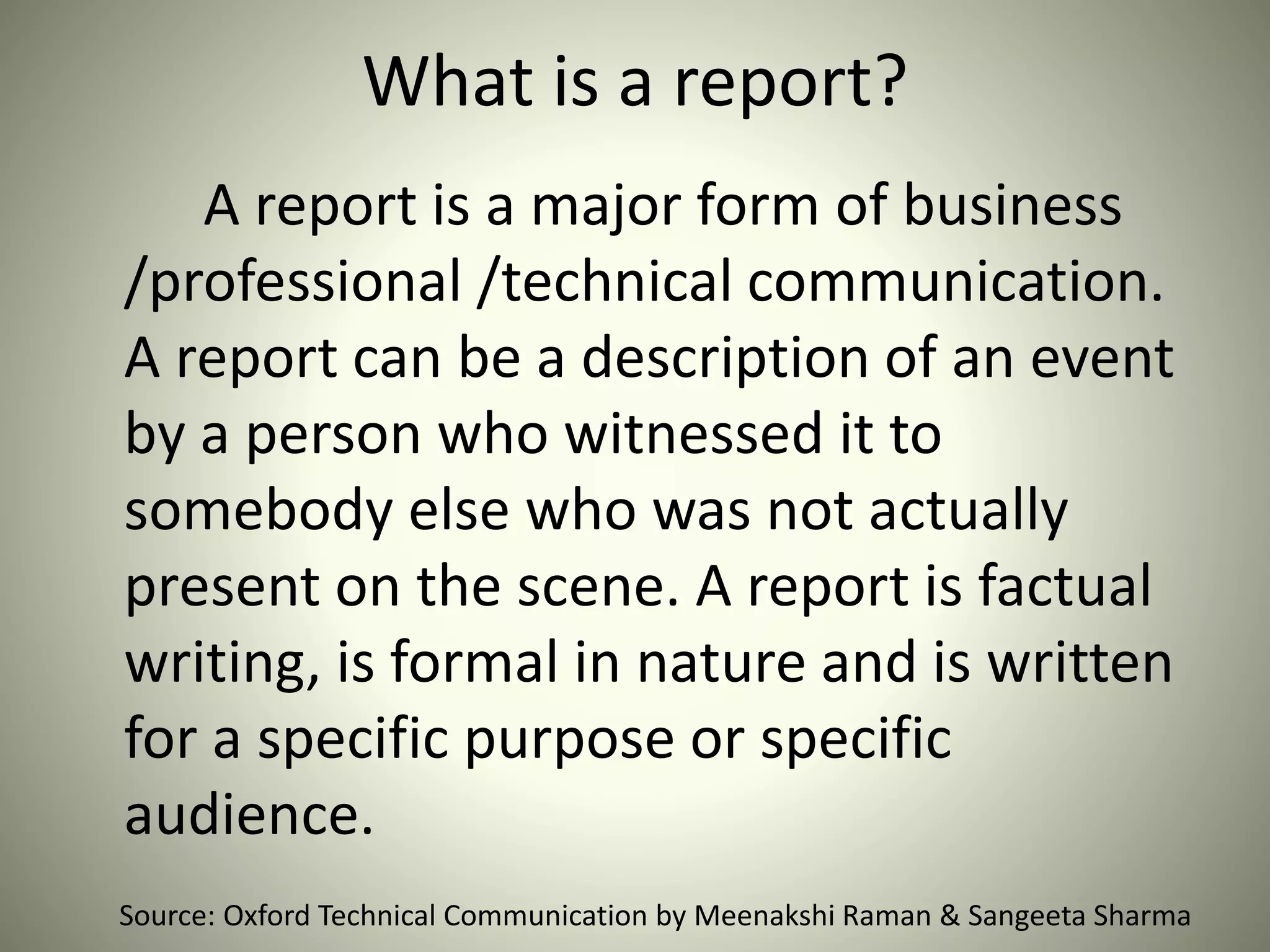
What is a report?
A report is a major form of business
/professional /technical communication.
A report can be a description of an event
by a person who witnessed it to
somebody else who was not actually
present on the scene. A report is factual
writing, is formal in nature and is written
for a specific purpose or specific
audience.
Source: Oxford Technical Communication by Meenakshi Raman & Sangeeta Sharma
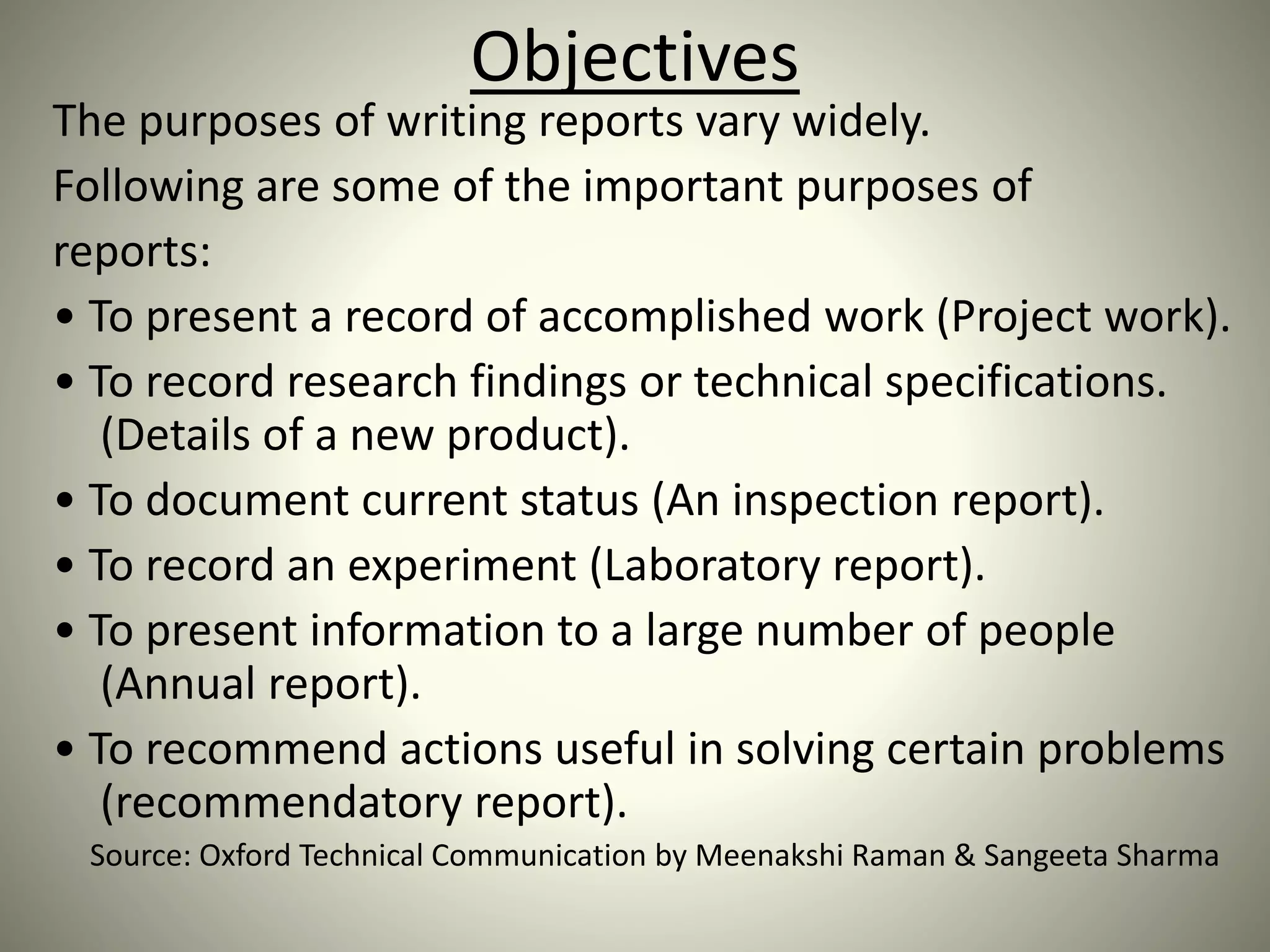
Objectives
The purposes of writing reports vary widely.
Following are some of the important purposes of
reports:
• To present a record of accomplished work (Project work).
• To record research findings or technical specifications.
(Details of a new product).
• To document current status (An inspection report).
• To record an experiment (Laboratory report).
• To present information to a large number of people
(Annual report).
• To recommend actions useful in solving certain problems
(recommendatory report).
Source: Oxford Technical Communication by Meenakshi Raman & Sangeeta Sharma
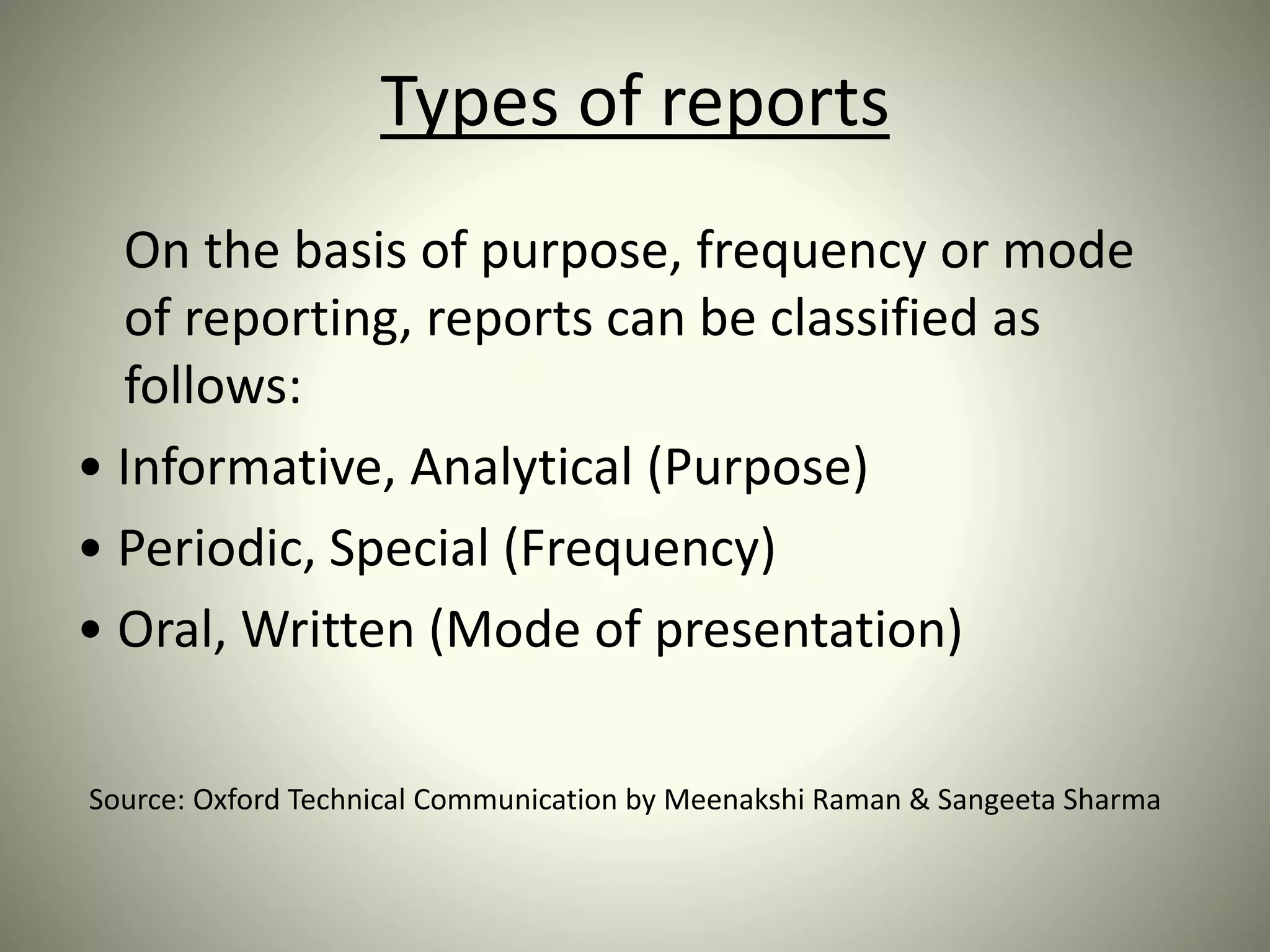
Types of reports
On the basis of purpose, frequency or mode
of reporting, reports can be classified as
follows:
• Informative, Analytical (Purpose)
• Periodic, Special (Frequency)
• Oral, Written (Mode of presentation)
Source: Oxford Technical Communication by Meenakshi Raman & Sangeeta Sharma
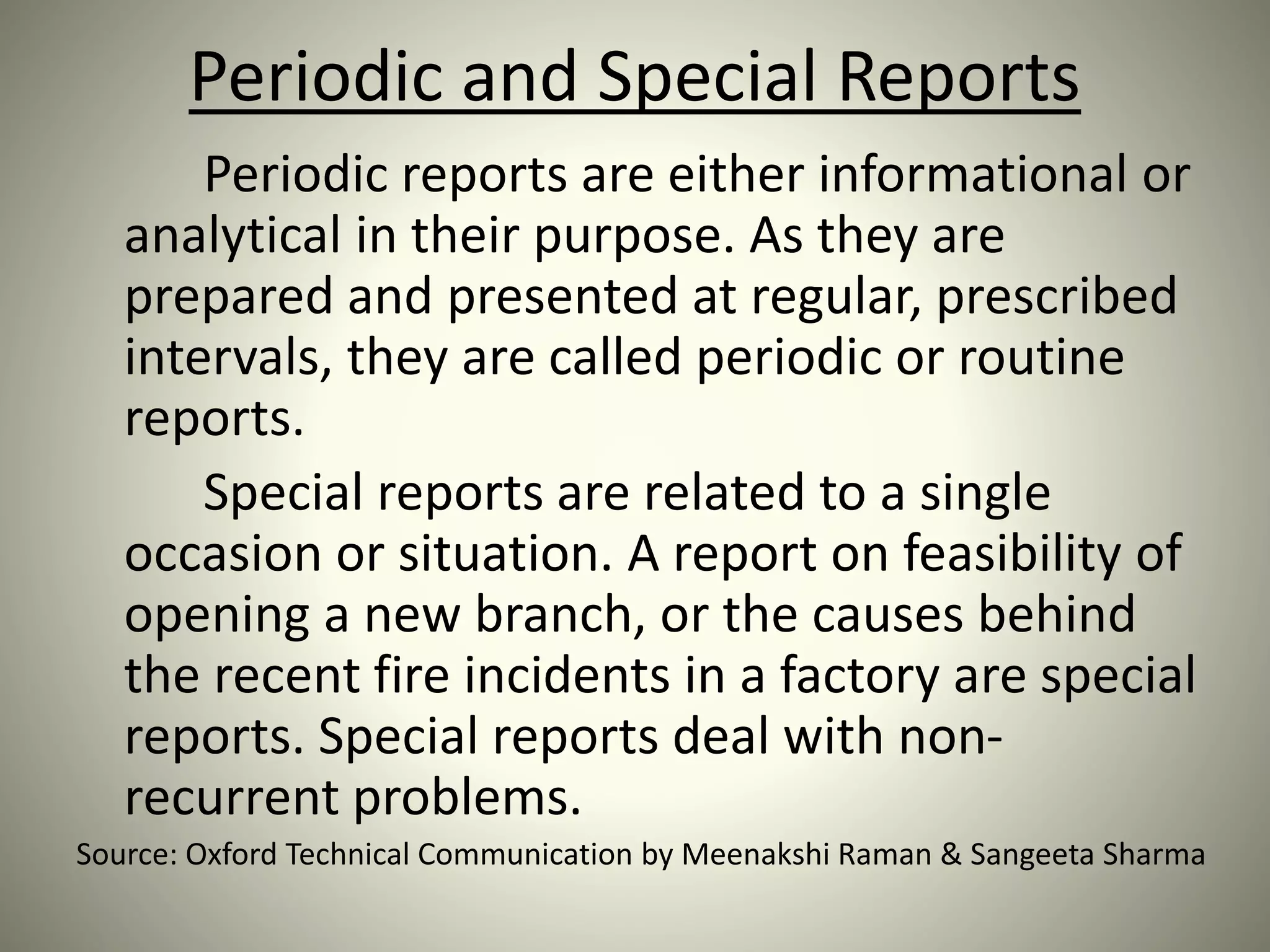
Periodic and Special Reports
Periodic reports are either informational or
analytical in their purpose. As they are
prepared and presented at regular, prescribed
intervals, they are called periodic or routine
reports.
Special reports are related to a single
occasion or situation. A report on feasibility of
opening a new branch, or the causes behind
the recent fire incidents in a factory are special
reports. Special reports deal with non-
recurrent problems.
Source: Oxford Technical Communication by Meenakshi Raman & Sangeeta Sharma
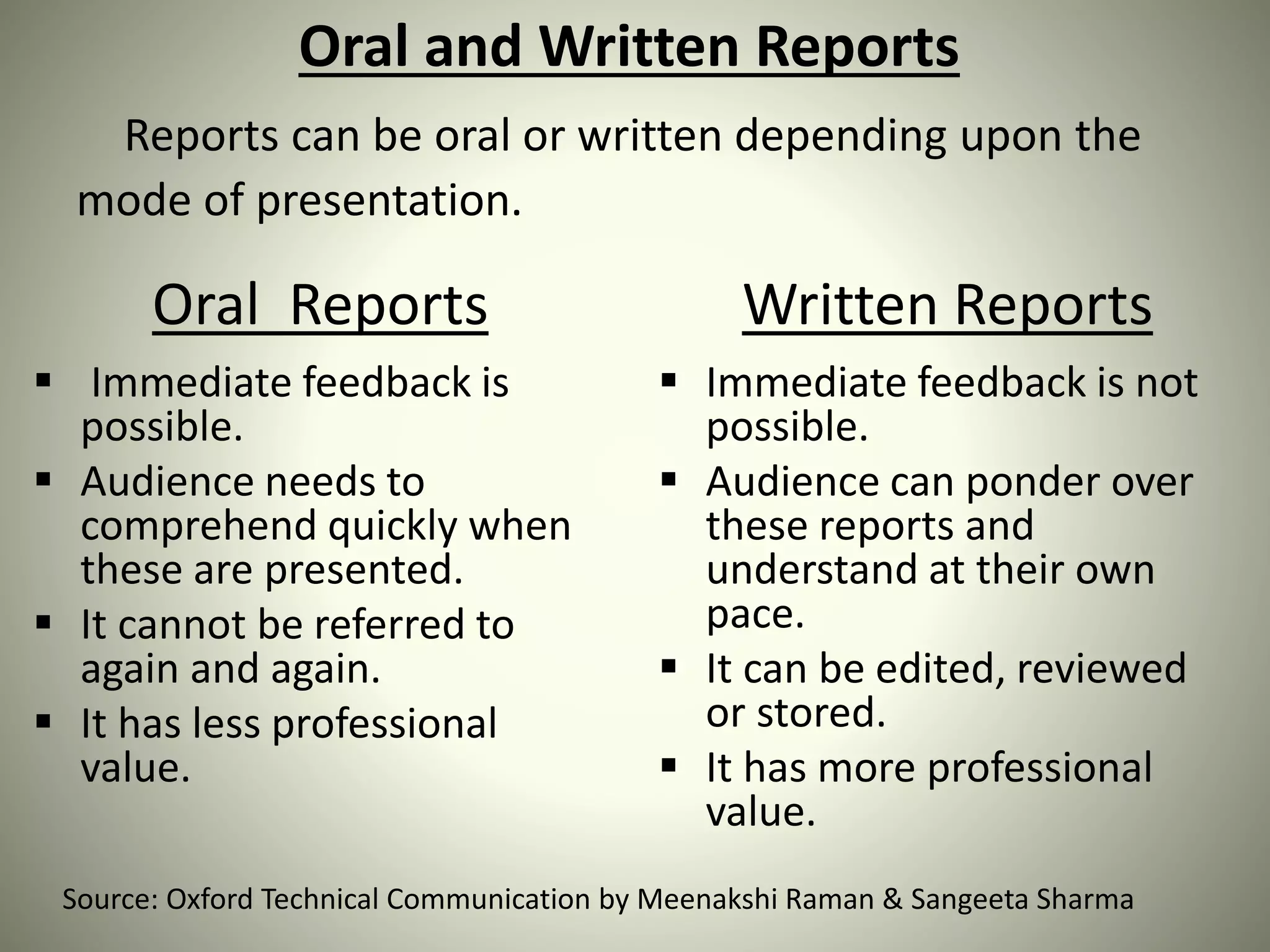
Oral and Written Reports
Reports can be oral or written depending upon the
mode of presentation.
Oral Reports
 Immediate feedback is
possible.
 Audience needs to
comprehend quickly when
these are presented.
 It cannot be referred to
again and again.
 It has less professional
value.
Written Reports
 Immediate feedback is not
possible.
 Audience can ponder over
these reports and
understand at their own
pace.
 It can be edited, reviewed
or stored.
 It has more professional
value.
Source: Oxford Technical Communication by Meenakshi Raman & Sangeeta Sharma
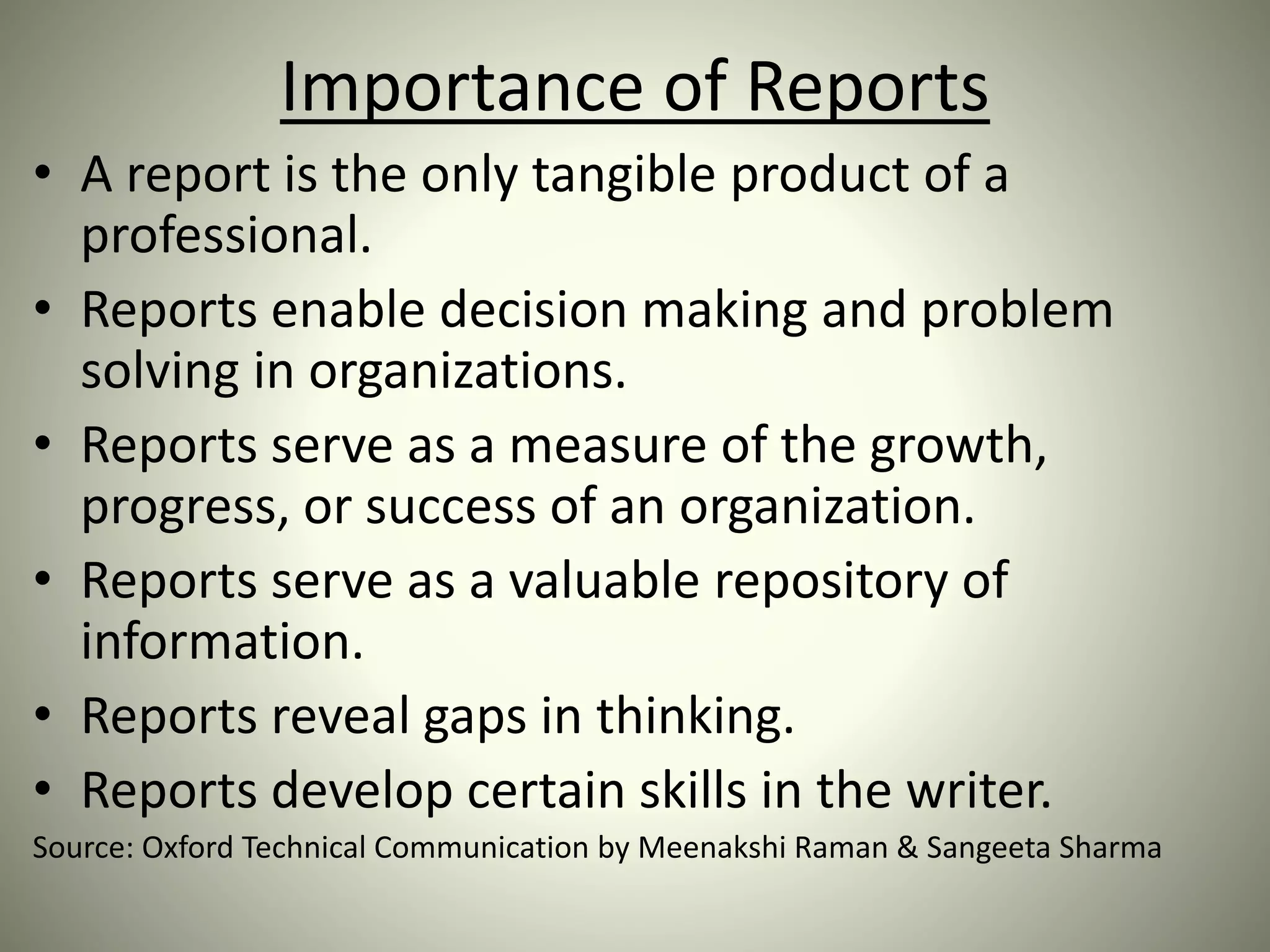
Importance of Reports
• A report is the only tangible product of a
professional.
• Reports enable decision making and problem
solving in organizations.
• Reports serve as a measure of the growth,
progress, or success of an organization.
• Reports serve as a valuable repository of
information.
• Reports reveal gaps in thinking.
• Reports develop certain skills in the writer.
Source: Oxford Technical Communication by Meenakshi Raman & Sangeeta Sharma
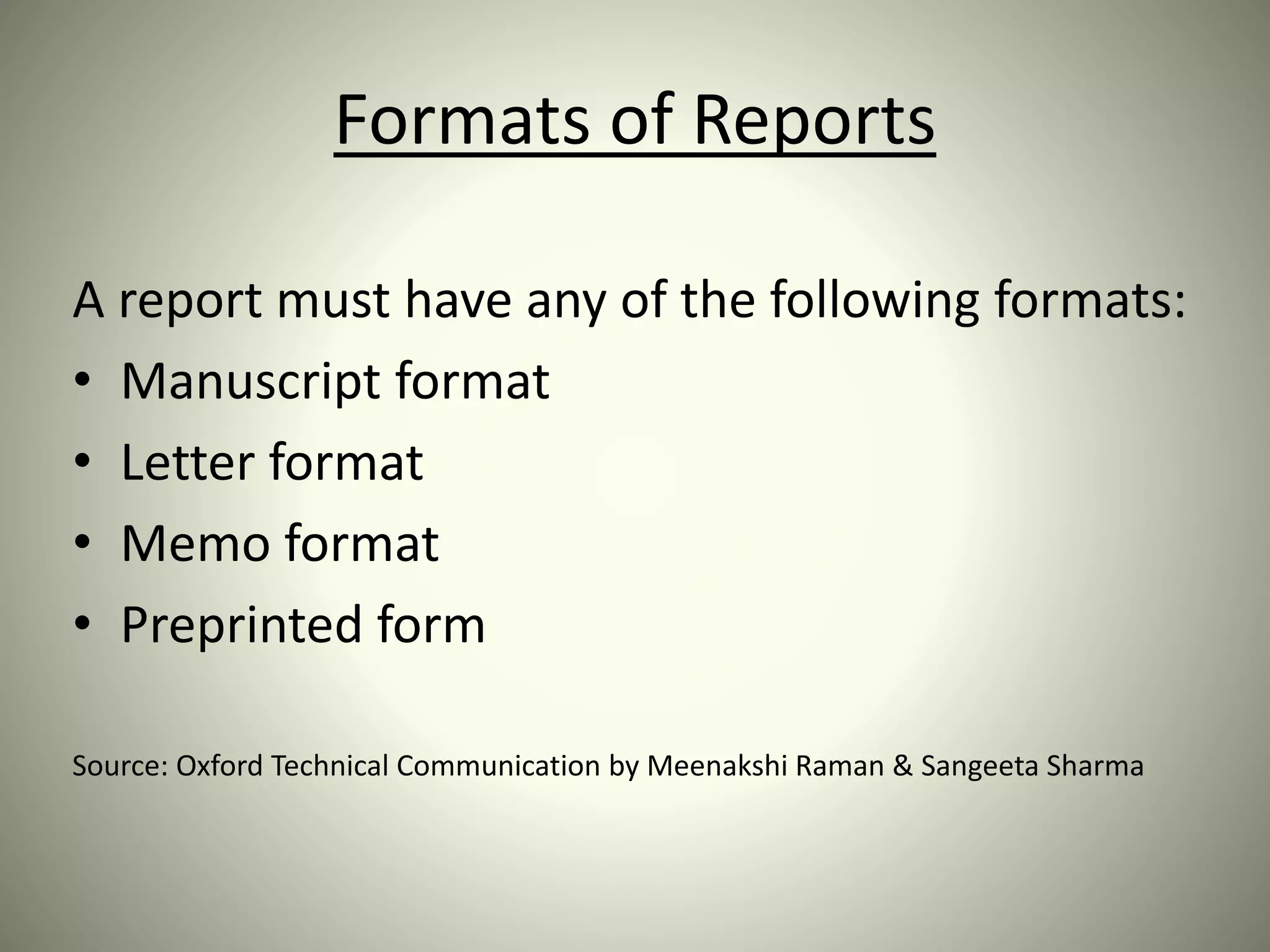
Formats of Reports
A report must have any of the following formats:
• Manuscript format
• Letter format
• Memo format
• Preprinted form
Source: Oxford Technical Communication by Meenakshi Raman & Sangeeta Sharma
Manuscript format
This is the most commonly used
format for reports and is generally
used for formal reports. Length of
such reports can range from a few
pages to several hundred pages. It can
be used for all types of reports.
Source: Oxford Technical Communication by Meenakshi Raman & Sangeeta Sharma
Memo format
A report sent to somebody within
the organization will be in a memo
format. The analysis, conclusions and
recommendations are included in the
main text part of the memorandum.
Source: Oxford Technical Communication by Meenakshi Raman & Sangeeta Sharma
Letter format
When you send short reports of a
few pages to outsiders, you can opt
for a letter format. These reports may
include headings, illustrations and
footnotes.
Source: Oxford Technical Communication by Meenakshi Raman & Sangeeta Sharma
Printed form
Reports containing routine matter
and which are periodical in nature
may be written in a form prescribed
by the organization. All we have to do
in a preprinted form is to fill in the
blanks.
Source: Oxford Technical Communication by Meenakshi Raman & Sangeeta Sharma
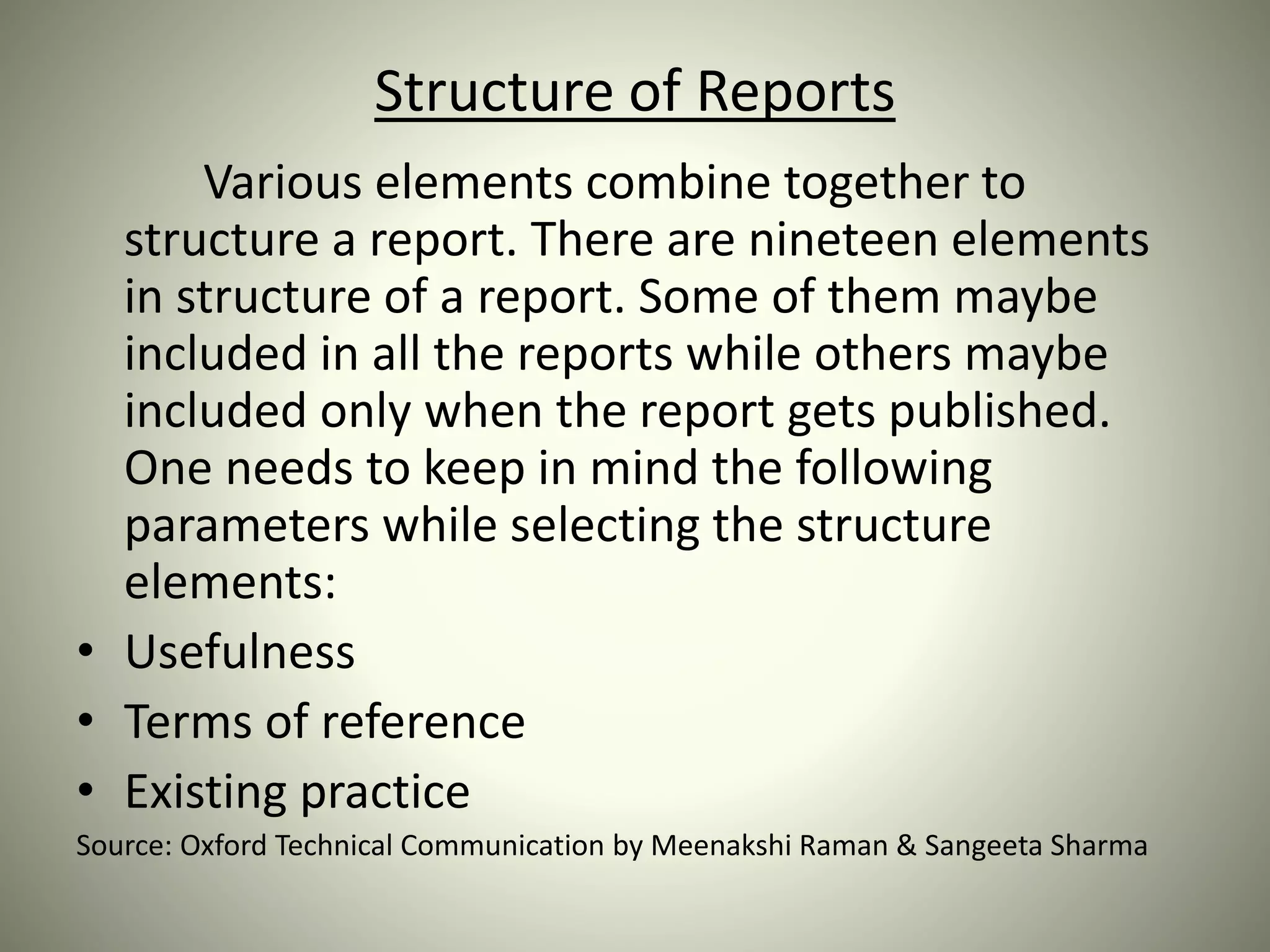
Structure of Reports
Various elements combine together to
structure a report. There are nineteen elements
in structure of a report. Some of them maybe
included in all the reports while others maybe
included only when the report gets published.
One needs to keep in mind the following
parameters while selecting the structure
elements:
• Usefulness
• Terms of reference
• Existing practice
Source: Oxford Technical Communication by Meenakshi Raman & Sangeeta Sharma
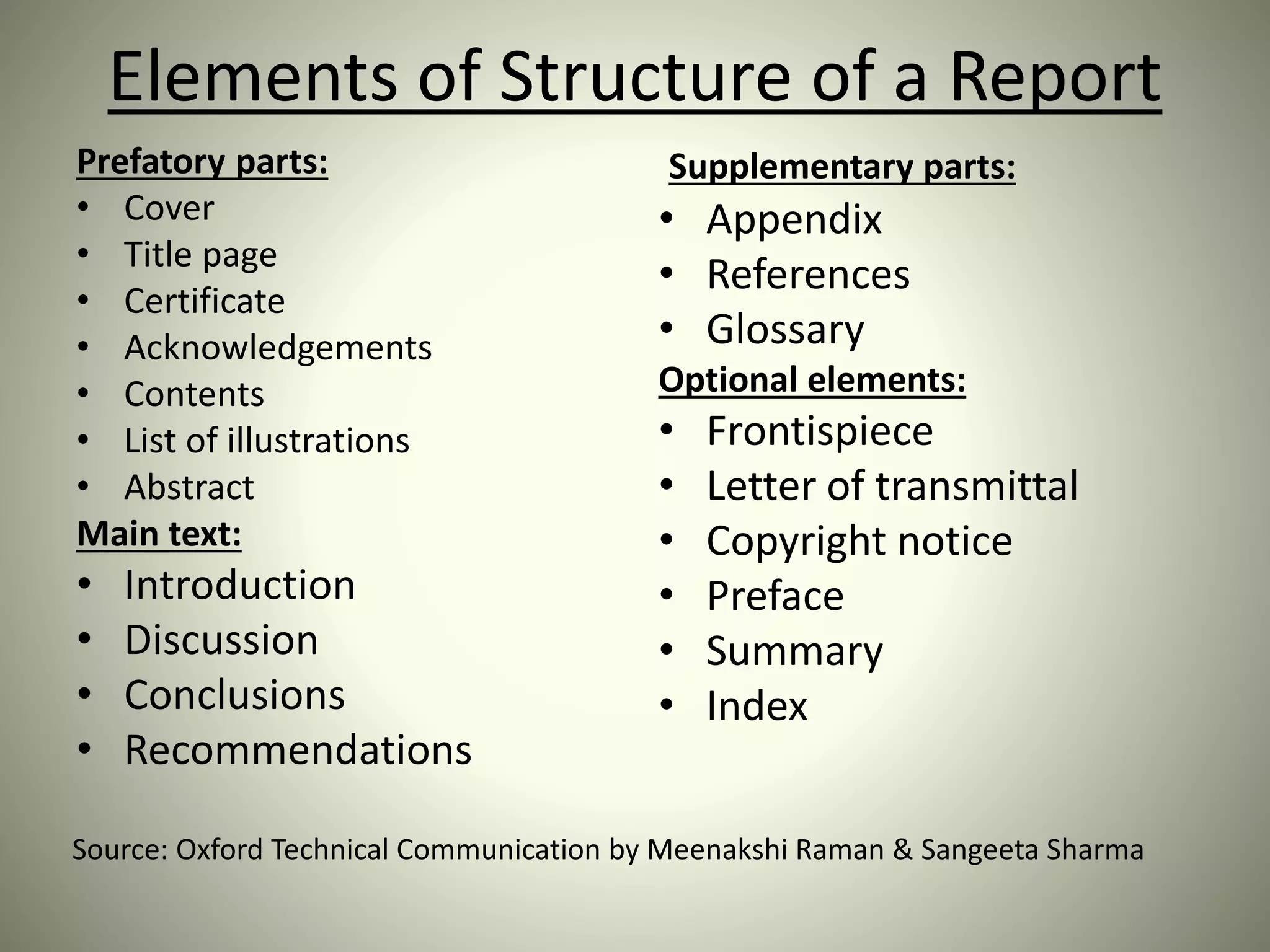
Elements of Structure of a Report
Prefatory parts:
• Cover
• Title page
• Certificate
• Acknowledgements
• Contents
• List of illustrations
• Abstract
Main text:
• Introduction
• Discussion
• Conclusions
• Recommendations
Supplementary parts:
• Appendix
• References
• Glossary
Optional elements:
• Frontispiece
• Letter of transmittal
• Copyright notice
• Preface
• Summary
• Index
Source: Oxford Technical Communication by Meenakshi Raman & Sangeeta Sharma
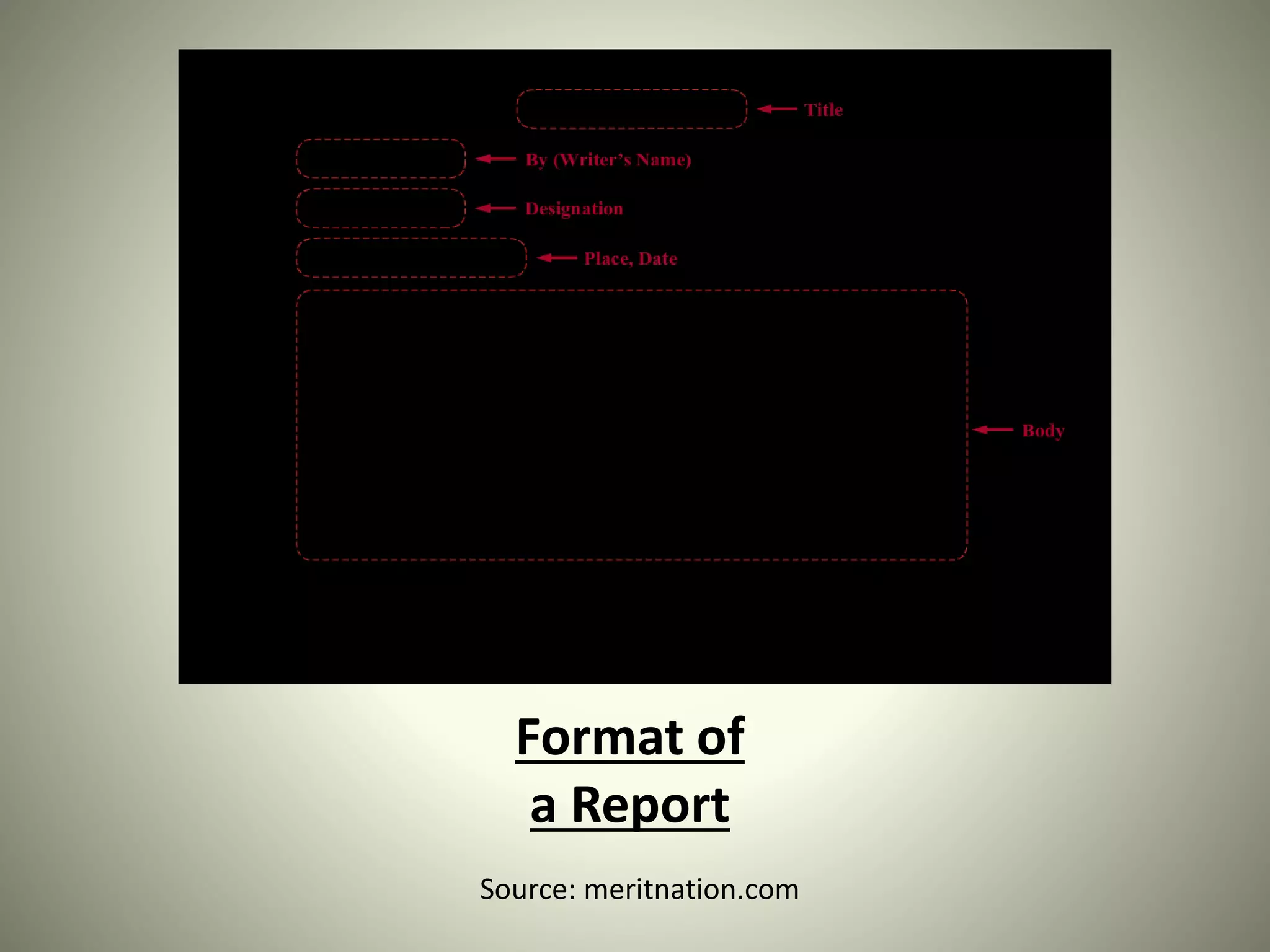
Format of
a Report
Source: meritnation.com
Thank you.

Presentation on Report Writing

  • 1.
  • 2.
    Assignment Communication Skills Presentation on ReportWriting • Name: Prachi Ashvin Patel • Topic: Report Writing • Semester: 1 • Year: 2016-2017 • Enrollment Number: 160210116034
  • 3.
    What is areport? A report is a major form of business /professional /technical communication. A report can be a description of an event by a person who witnessed it to somebody else who was not actually present on the scene. A report is factual writing, is formal in nature and is written for a specific purpose or specific audience. Source: Oxford Technical Communication by Meenakshi Raman & Sangeeta Sharma
  • 4.
    Objectives The purposes ofwriting reports vary widely. Following are some of the important purposes of reports: • To present a record of accomplished work (Project work). • To record research findings or technical specifications. (Details of a new product). • To document current status (An inspection report). • To record an experiment (Laboratory report). • To present information to a large number of people (Annual report). • To recommend actions useful in solving certain problems (recommendatory report). Source: Oxford Technical Communication by Meenakshi Raman & Sangeeta Sharma
  • 5.
    Types of reports Onthe basis of purpose, frequency or mode of reporting, reports can be classified as follows: • Informative, Analytical (Purpose) • Periodic, Special (Frequency) • Oral, Written (Mode of presentation) Source: Oxford Technical Communication by Meenakshi Raman & Sangeeta Sharma
  • 6.
    Periodic and SpecialReports Periodic reports are either informational or analytical in their purpose. As they are prepared and presented at regular, prescribed intervals, they are called periodic or routine reports. Special reports are related to a single occasion or situation. A report on feasibility of opening a new branch, or the causes behind the recent fire incidents in a factory are special reports. Special reports deal with non- recurrent problems. Source: Oxford Technical Communication by Meenakshi Raman & Sangeeta Sharma
  • 7.
    Oral and WrittenReports Reports can be oral or written depending upon the mode of presentation. Oral Reports  Immediate feedback is possible.  Audience needs to comprehend quickly when these are presented.  It cannot be referred to again and again.  It has less professional value. Written Reports  Immediate feedback is not possible.  Audience can ponder over these reports and understand at their own pace.  It can be edited, reviewed or stored.  It has more professional value. Source: Oxford Technical Communication by Meenakshi Raman & Sangeeta Sharma
  • 8.
    Importance of Reports •A report is the only tangible product of a professional. • Reports enable decision making and problem solving in organizations. • Reports serve as a measure of the growth, progress, or success of an organization. • Reports serve as a valuable repository of information. • Reports reveal gaps in thinking. • Reports develop certain skills in the writer. Source: Oxford Technical Communication by Meenakshi Raman & Sangeeta Sharma
  • 9.
    Formats of Reports Areport must have any of the following formats: • Manuscript format • Letter format • Memo format • Preprinted form Source: Oxford Technical Communication by Meenakshi Raman & Sangeeta Sharma
  • 10.
    Manuscript format This isthe most commonly used format for reports and is generally used for formal reports. Length of such reports can range from a few pages to several hundred pages. It can be used for all types of reports. Source: Oxford Technical Communication by Meenakshi Raman & Sangeeta Sharma
  • 11.
    Memo format A reportsent to somebody within the organization will be in a memo format. The analysis, conclusions and recommendations are included in the main text part of the memorandum. Source: Oxford Technical Communication by Meenakshi Raman & Sangeeta Sharma
  • 12.
    Letter format When yousend short reports of a few pages to outsiders, you can opt for a letter format. These reports may include headings, illustrations and footnotes. Source: Oxford Technical Communication by Meenakshi Raman & Sangeeta Sharma
  • 13.
    Printed form Reports containingroutine matter and which are periodical in nature may be written in a form prescribed by the organization. All we have to do in a preprinted form is to fill in the blanks. Source: Oxford Technical Communication by Meenakshi Raman & Sangeeta Sharma
  • 14.
    Structure of Reports Variouselements combine together to structure a report. There are nineteen elements in structure of a report. Some of them maybe included in all the reports while others maybe included only when the report gets published. One needs to keep in mind the following parameters while selecting the structure elements: • Usefulness • Terms of reference • Existing practice Source: Oxford Technical Communication by Meenakshi Raman & Sangeeta Sharma
  • 15.
    Elements of Structureof a Report Prefatory parts: • Cover • Title page • Certificate • Acknowledgements • Contents • List of illustrations • Abstract Main text: • Introduction • Discussion • Conclusions • Recommendations Supplementary parts: • Appendix • References • Glossary Optional elements: • Frontispiece • Letter of transmittal • Copyright notice • Preface • Summary • Index Source: Oxford Technical Communication by Meenakshi Raman & Sangeeta Sharma
  • 16.
  • 17.