Load Rating of Riveted Steel
Arch Bridge Connections
David V. Jauregui, PhD, PE
November 28th, 2013
Sapienza University of Rome
Overview
• Introduction
• Load Rating Method
• Load Rating of: StringersSplices
Stringer Splices
Spandrel Splices
Column Splices
Arch RibsSplices
Rib Splices
• Conclusions & Recommendations
Introduction Bridge Background
• Name: The Los Alamos Canyon Bridge
(a.k.a. the Omega Bridge)
• Steel arch riveted bridge
• Designed & built in 1951 following 1944 AASHTO
specifications
• Carries traffic from town of Los Alamos and the LANL
(Los Alamos National Laboratory)
• Bridge reduced the travel distance from 1.9 miles on a
steep grade to 820 ft: critical for emergency vehicles
• Owned and maintained by the LANL
Introduction Research Objectives
Connections commonly assumed to have equal or greater
capacity than the members they adjoin
Failure of connections could be critical
• Provide the LANL with up-to-date rating factors for the
Omega Bridge splice connections
LRFD is the required method of design by FHWA since
October 2007: Need for rating methodology consistent
with the design method.
No guidance in rating connections
• Provide guidance in load rating connections using LRFR
method to bridge engineers
Introduction Research Aids
• 2003 AASHTO Manual for Condition Evaluation and Load
and Resistance Factor Rating of Highway Bridges
• Research by Tuyen (2005)
• RISA for structural analysis
• MathCAD to calculate rating factors
• Others: Original plans of the bridge, AISC steel manual, etc.
Load Rating Method:
LRFR
Load Rating Method LRFR
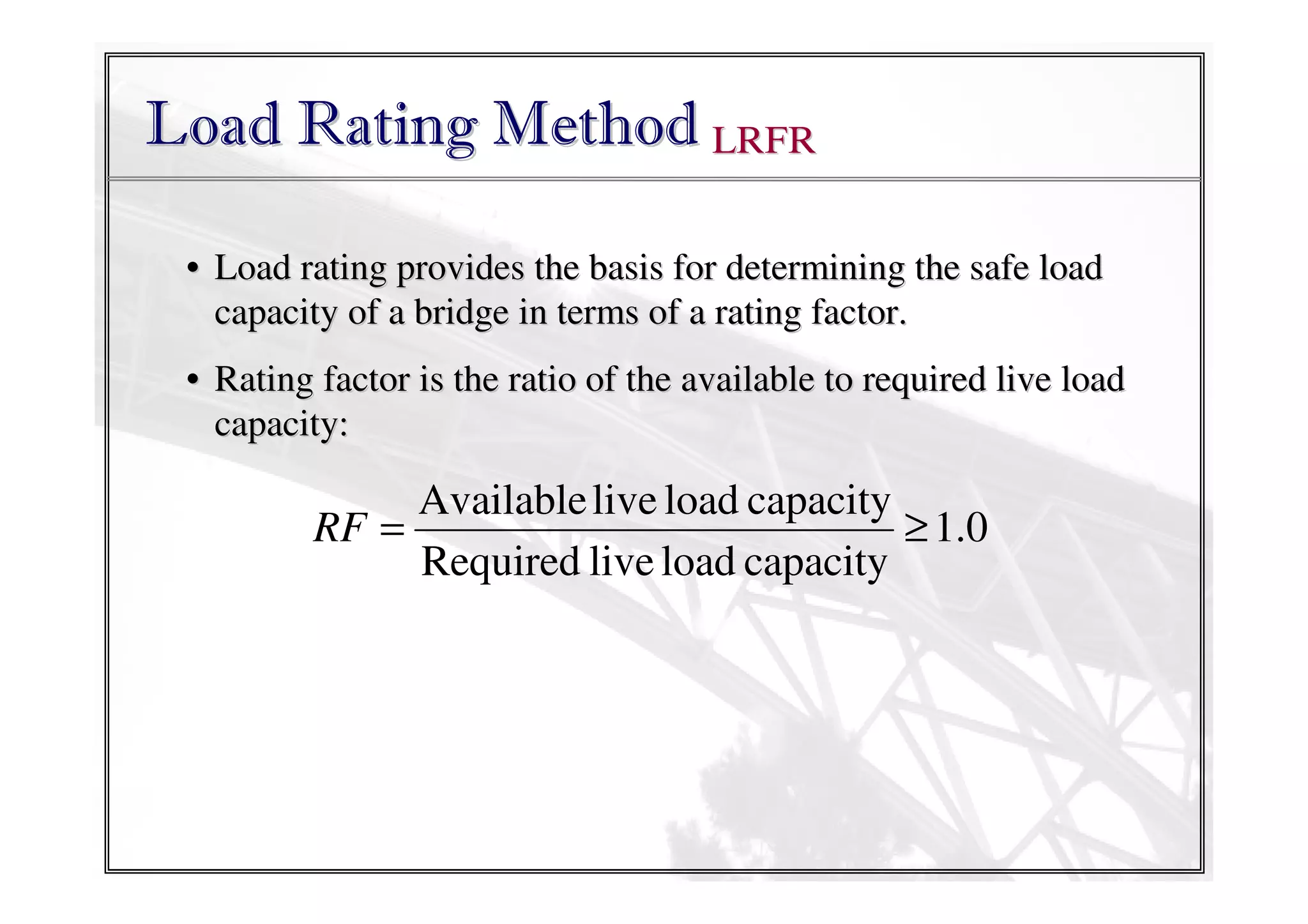
• Load rating provides the basis for determining the safe load
capacity of a bridge in terms of a rating factor.
• Rating factor is the ratio of the available to required live load
capacity:

Available live load capacity
RF =
≥ 1.0
Required live load capacity
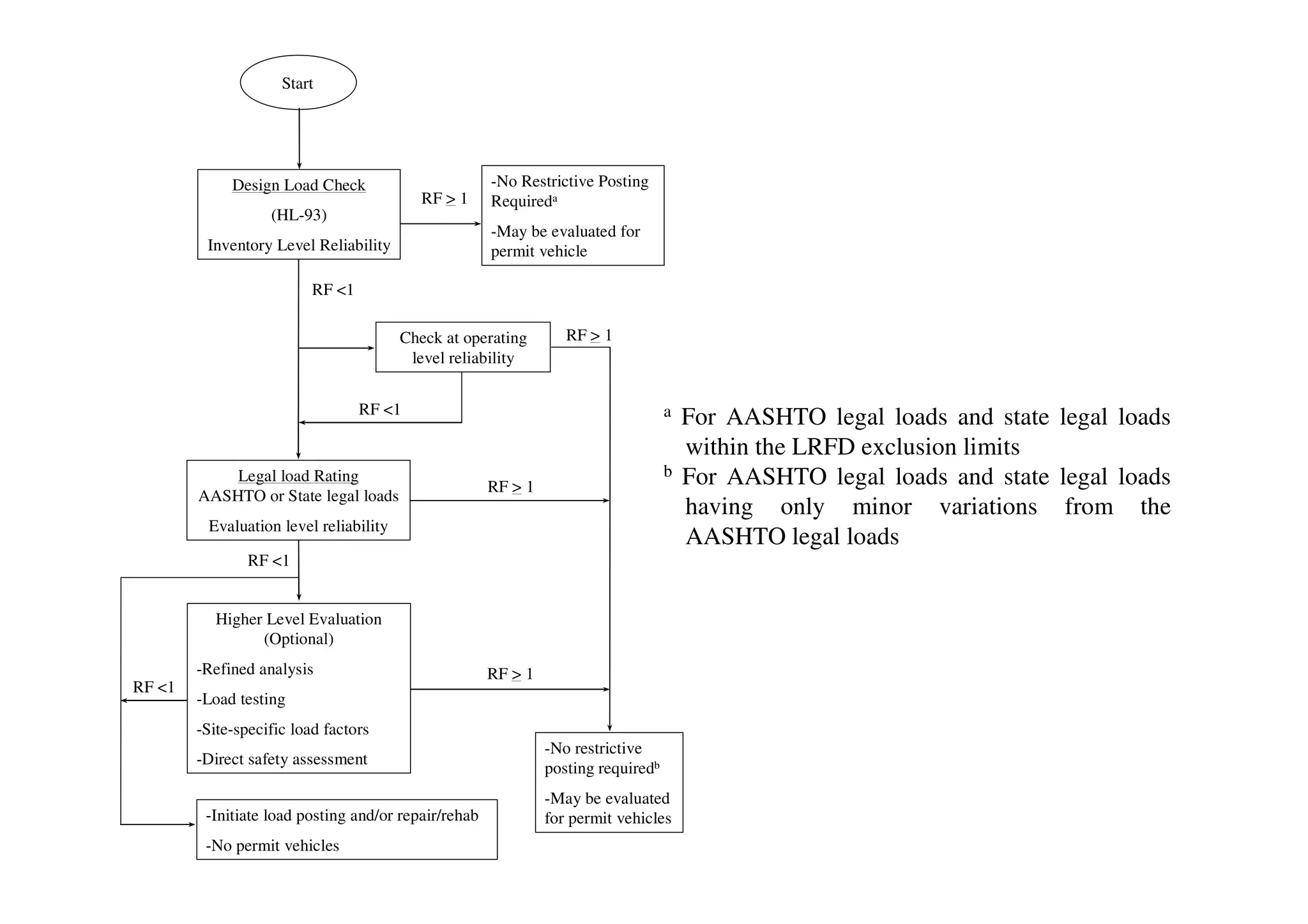
Start

Load Rating Method LRFR
Design Load Check

RF > 1

(HL-93)

-No Restrictive Posting
Requireda
-May be evaluated for
permit vehicle

Inventory Level Reliability

• Three Stages of load rating in LRFR: Design Load Rating
RF <1
Check at operating
level reliability
RF <1

Legal load Rating
AASHTO or State legal loads

Legal Load Rating

RF > 1

a

b
RF > 1

Evaluation level reliability
RF <1

Higher Level Evaluation
(Optional)
-Refined analysis
RF <1

RF > 1

-Load testing
-Site-specific load factors
-Direct safety assessment
-Initiate load posting and/or repair/rehab
-No permit vehicles

-No restrictive
posting requiredb
-May be evaluated
for permit vehicles

Permit Load Rating

For AASHTO legal loads and state legal loads
within the LRFD exclusion limits
For AASHTO legal loads and state legal loads
having only minor variations from the
AASHTO legal loads
Load Rating Method LRFR
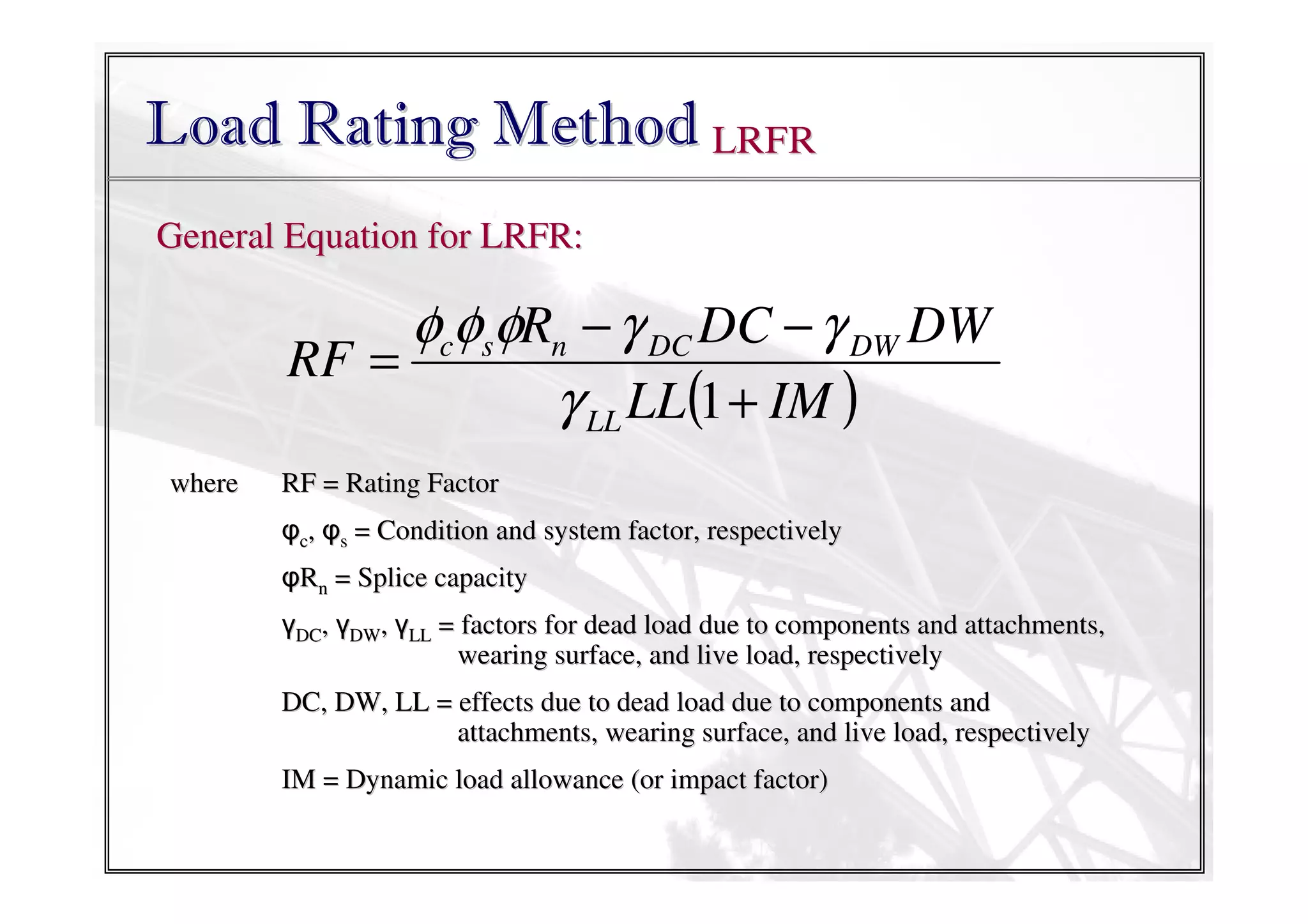
General Equation for LRFR:

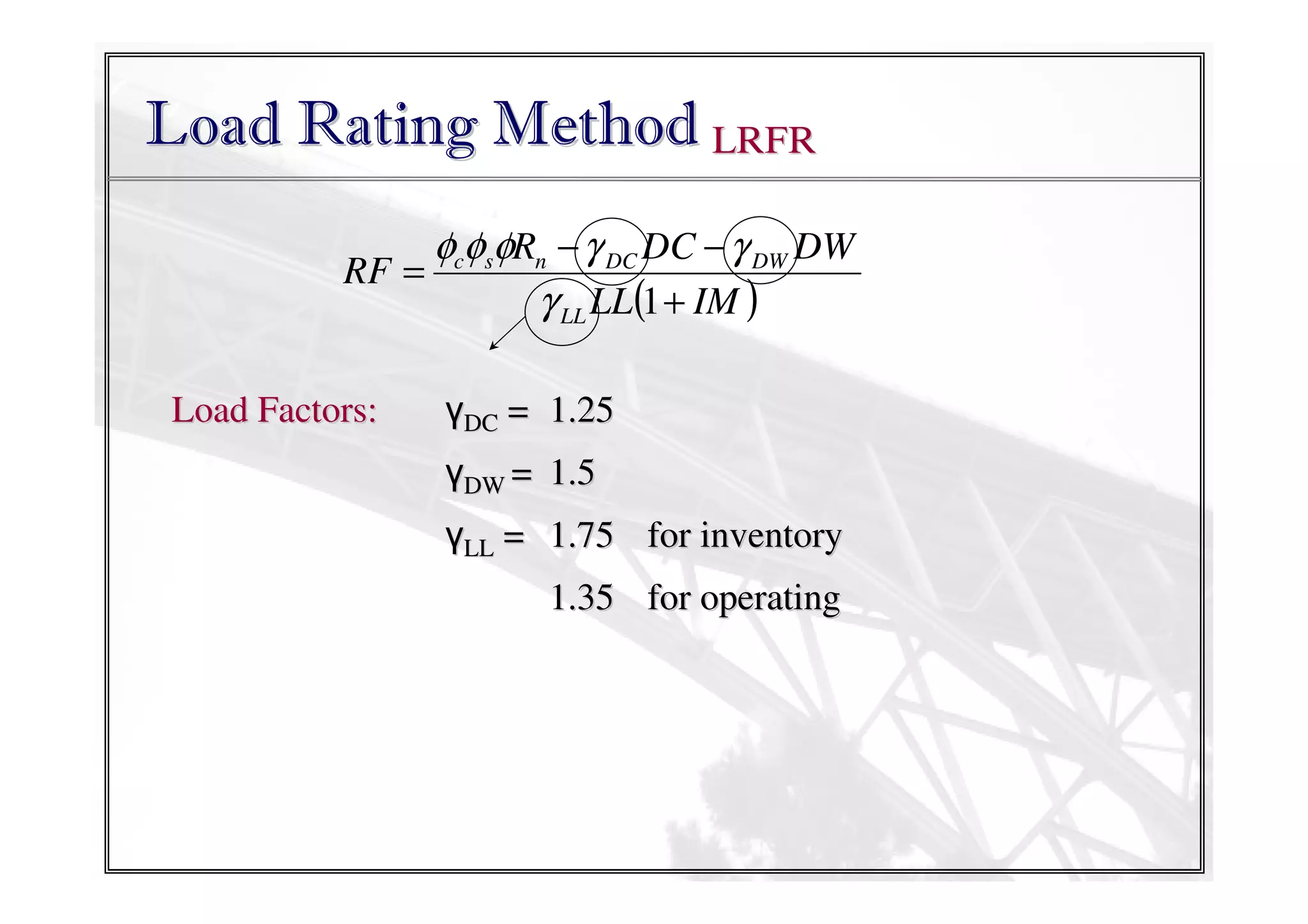
φcφsφRn − γ DC DC − γ DW DW
RF =
γ LL LL(1 + IM )
where

RF = Rating Factor
φc, φs = Condition and system factor, respectively
φRn = Splice capacity
γDC, γDW, γLL = factors for dead load due to components and attachments,
wearing surface, and live load, respectively
DC, DW, LL = effects due to dead load due to components and
attachments, wearing surface, and live load, respectively
IM = Dynamic load allowance (or impact factor)
Load Rating Method LRFR
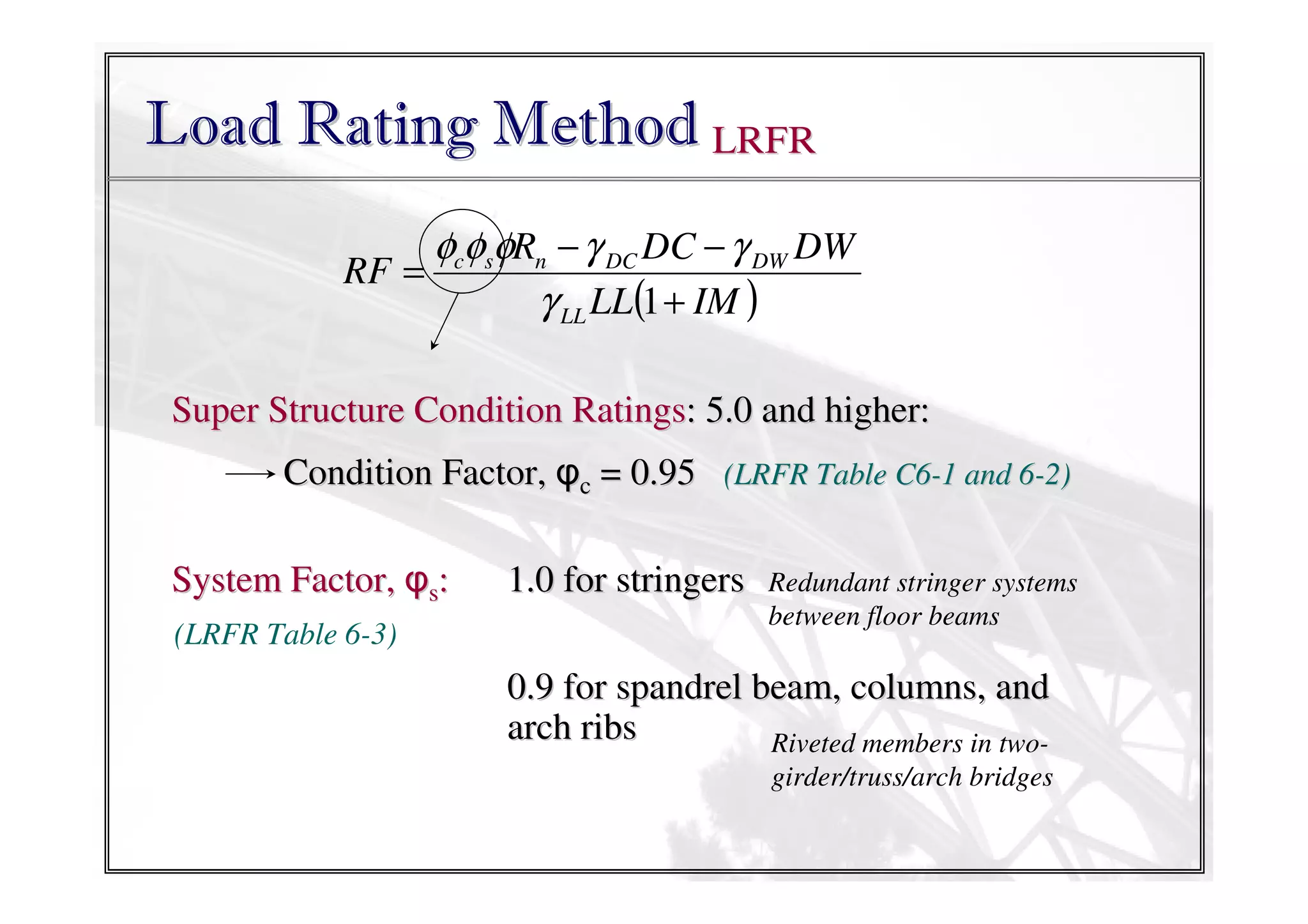
φcφsφRn − γ DC DC − γ DW DW
RF =
γ LL LL(1 + IM )
Super Structure Condition Ratings: 5.0 and higher:
Condition Factor, φc = 0.95 (LRFR Table C6-1 and 6-2)
System Factor, φs:
(LRFR Table 6-3)

1.0 for stringers

Redundant stringer systems
between floor beams

0.9 for spandrel beam, columns, and
arch ribs
Riveted members in twogirder/truss/arch bridges
Load Rating Method LRFR
φcφsφRn − γ DC DC − γ DW DW
RF =
γ LL LL(1 + IM )
Load Factors:

γDC = 1.25
γDW = 1.5
γLL = 1.75 for inventory
1.35 for operating
Load Rating Method LRFR
(a) TRUCK LOADS: HS-20 and Design Tandem

8k

φcφsφRn − γ DC DC − γ DW DW
RF = 32k
32k
25k
γ LL LL(1 + IM )

25k

For each member, distribution factor for different force effects
must be applied: i.e., to 30moment or DFshear
4 ft
14ft
14 DF ft
Live Load Effect = γ LL DF [Lane + Design Tandem IM)]
Truck (1 + (Longitudinal)
HS-20 (Longitudinal)
(b) LANE LOAD

Controlled by larger effect between HS-20 or Design Tandem
Lane Load = 0.64 klf
Load Rating Method LRFR
• Three Stages of load rating in LRFR: Design Load Rating
Legal Load Rating
Permit Load Rating
Load Rating of
Stringer Splice
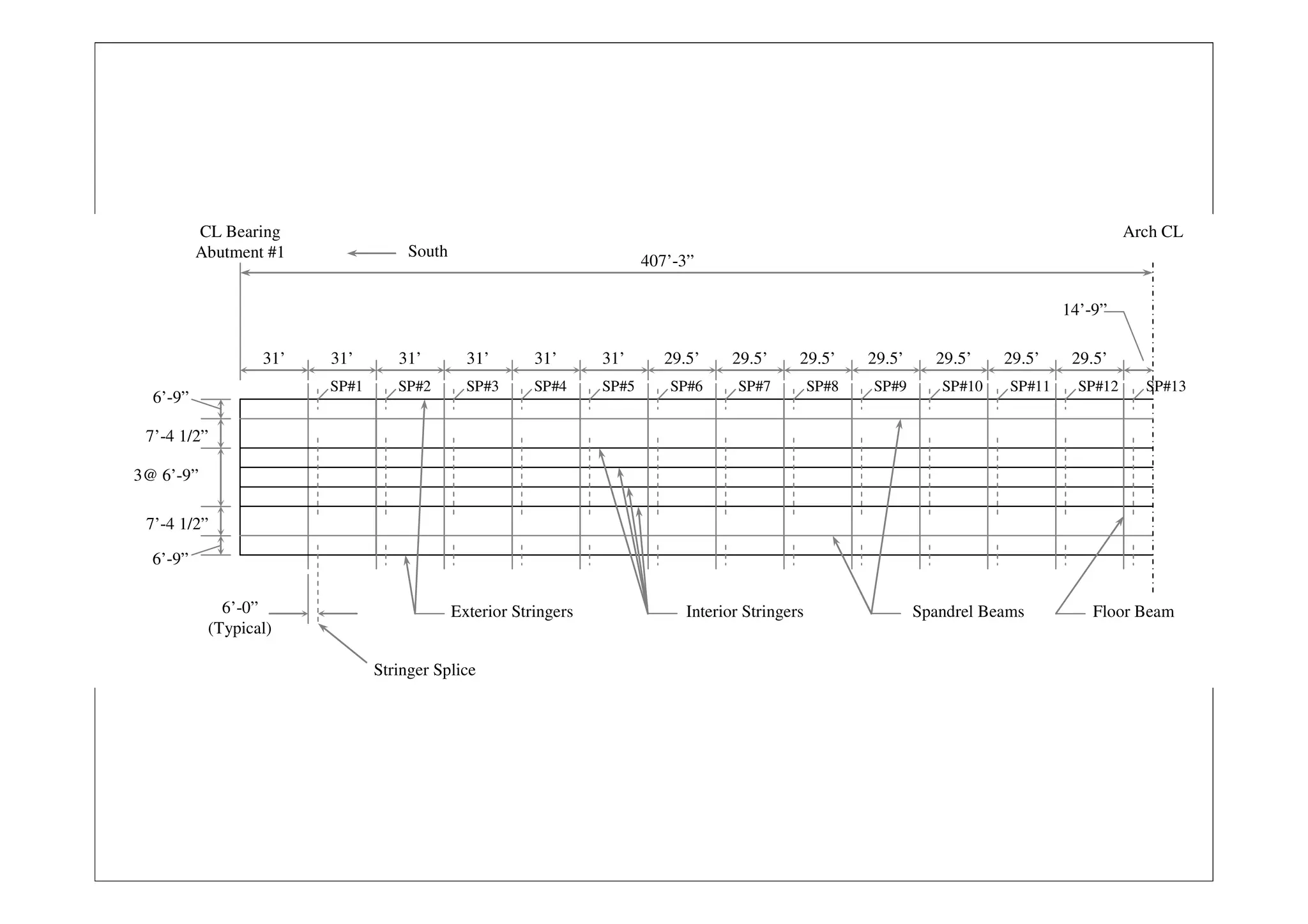
Rating Stringer Splice Basic Information
CL Bearing
Abutment #1

Arch CL
South

407’-3”
• 2 Exterior Stringers: ASTM A36 Steel (Fy = 36 ksi) – W21x83
14’-9”

• 4 Interior Stringers: 31’ASTM A7 Steel 29.5’ y = 33 29.5’ ) – W21x62
(F 29.5’ ksi 29.5’ 29.5’ 29.5’
31’
31’
31’
31’
31’
29.5’
SP#1

SP#2

• Total of 27 spans:
6’-9”

SP#3

SP#4

SP#5

SP#6

SP#7

SP#8

SP#9

SP#10

SP#11

SP#12

Six approach spans of 31 ft on each end

SP#13

7’-4 1/2”

15 interior spans of 29.5 ft over arch

3@ 6’-9”
7’-4 1/2”

• 6’-9”
Total of 26 splices: 6 ft from the floor beam supports
6’-0”
(Typical)

Exterior Stringers

Stringer Splice

Interior Stringers

Spandrel Beams

Floor Beam
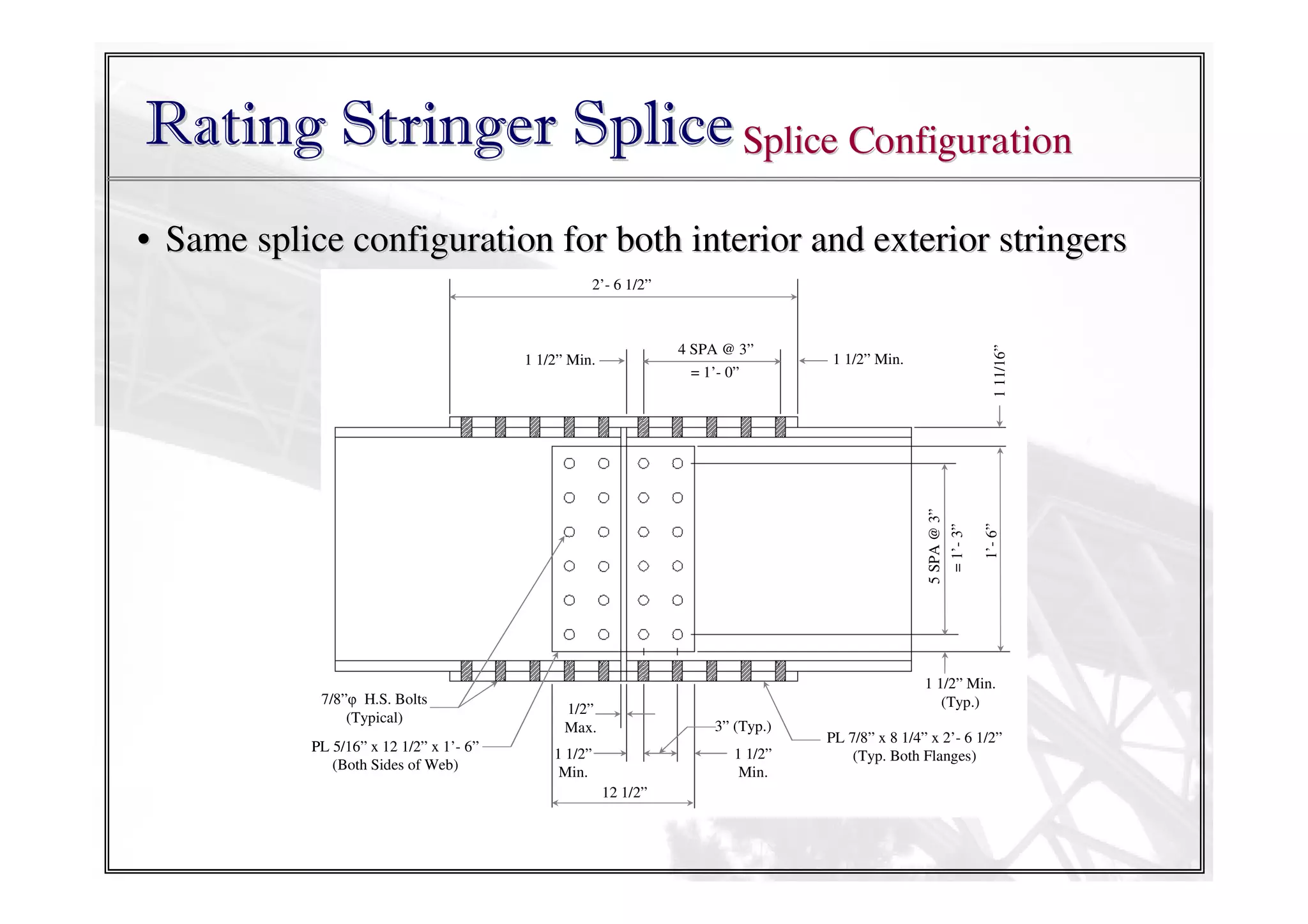
Rating Stringer Splice Splice Configuration
• Same splice configuration for both interior and exterior stringers

5 SPA @ 3”
= 1’- 3”

1 1/2” Min.

7/8”φ H.S. Bolts
(Typical)
PL 5/16” x 12 1/2” x 1’- 6”
(Both Sides of Web)

1’- 6”

4 SPA @ 3”
= 1’- 0”

1 1/2” Min.

1 11/16”

2’- 6 1/2”

1 1/2” Min.
(Typ.)

1/2”
Max.

3” (Typ.)

1 1/2”
Min.

1 1/2”
Min.
12 1/2”

PL 7/8” x 8 1/4” x 2’- 6 1/2”
(Typ. Both Flanges)
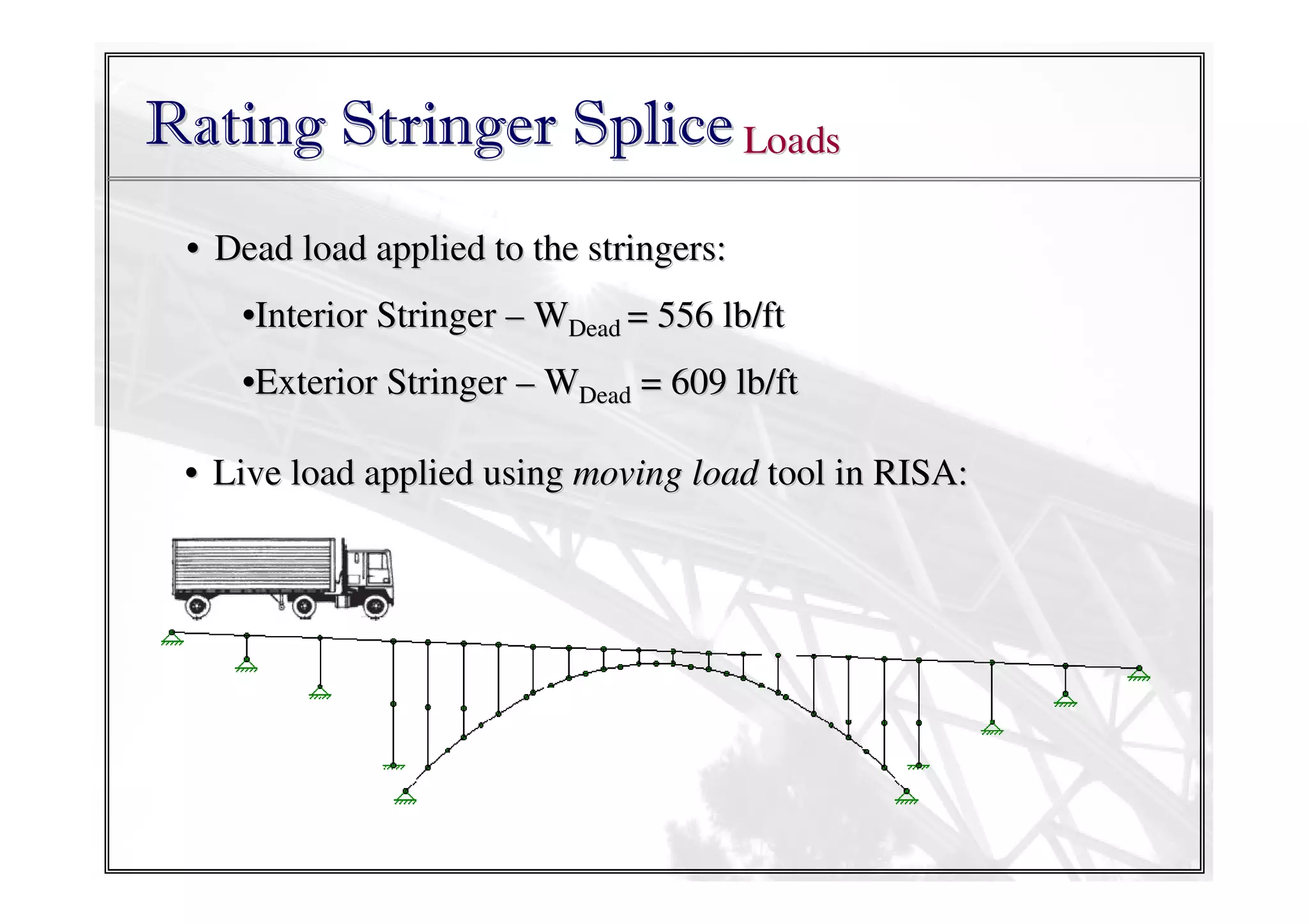
Rating Stringer Splice Loads
• Dead load applied to the stringers:
•Interior Stringer – WDead = 556 lb/ft
•Exterior Stringer – WDead = 609 lb/ft
• Live load applied using moving load tool in RISA:
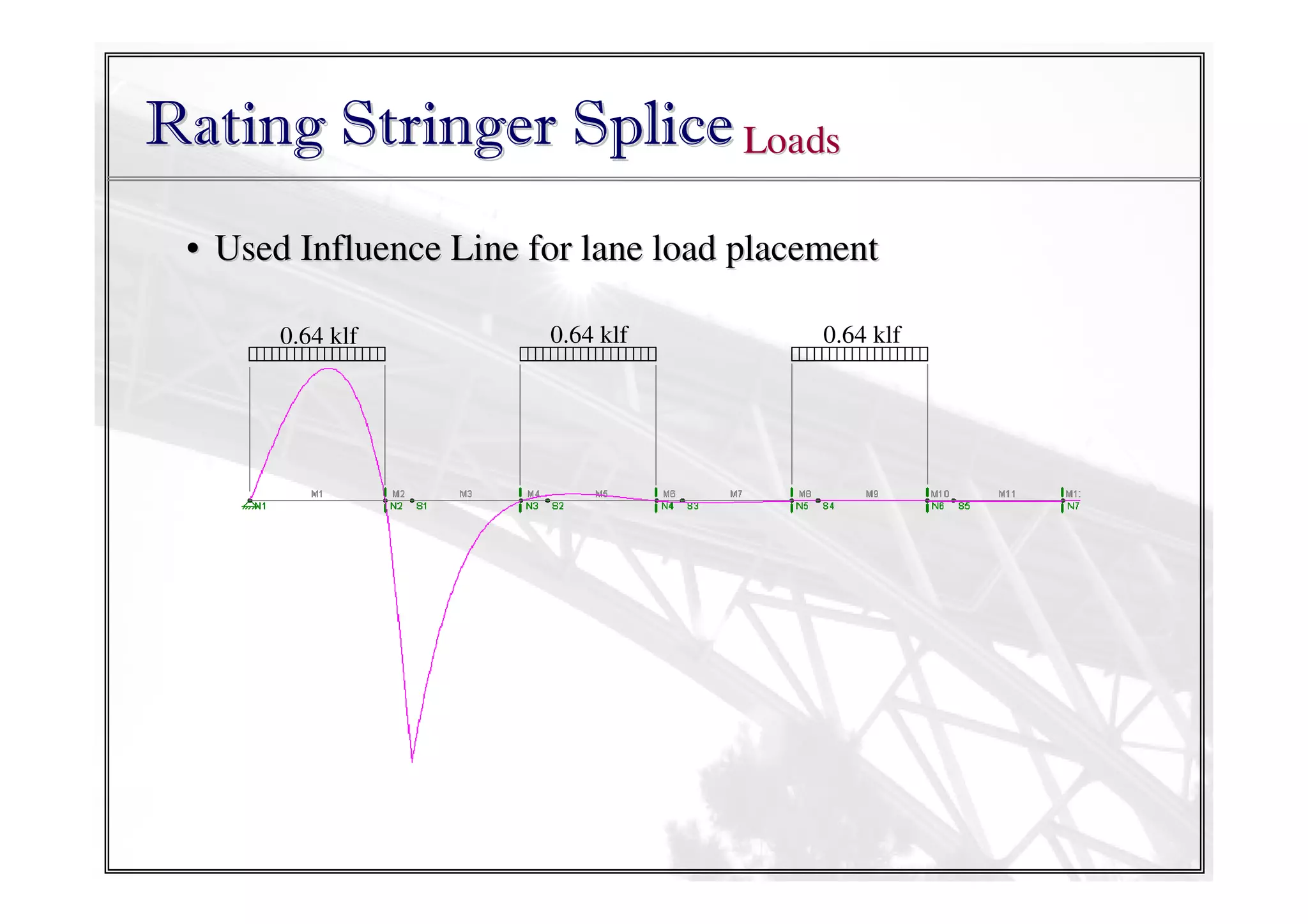
Rating Stringer Splice Loads
• Used Influence Line for lane load placement
0.64 klf

0.64 klf

0.64 klf
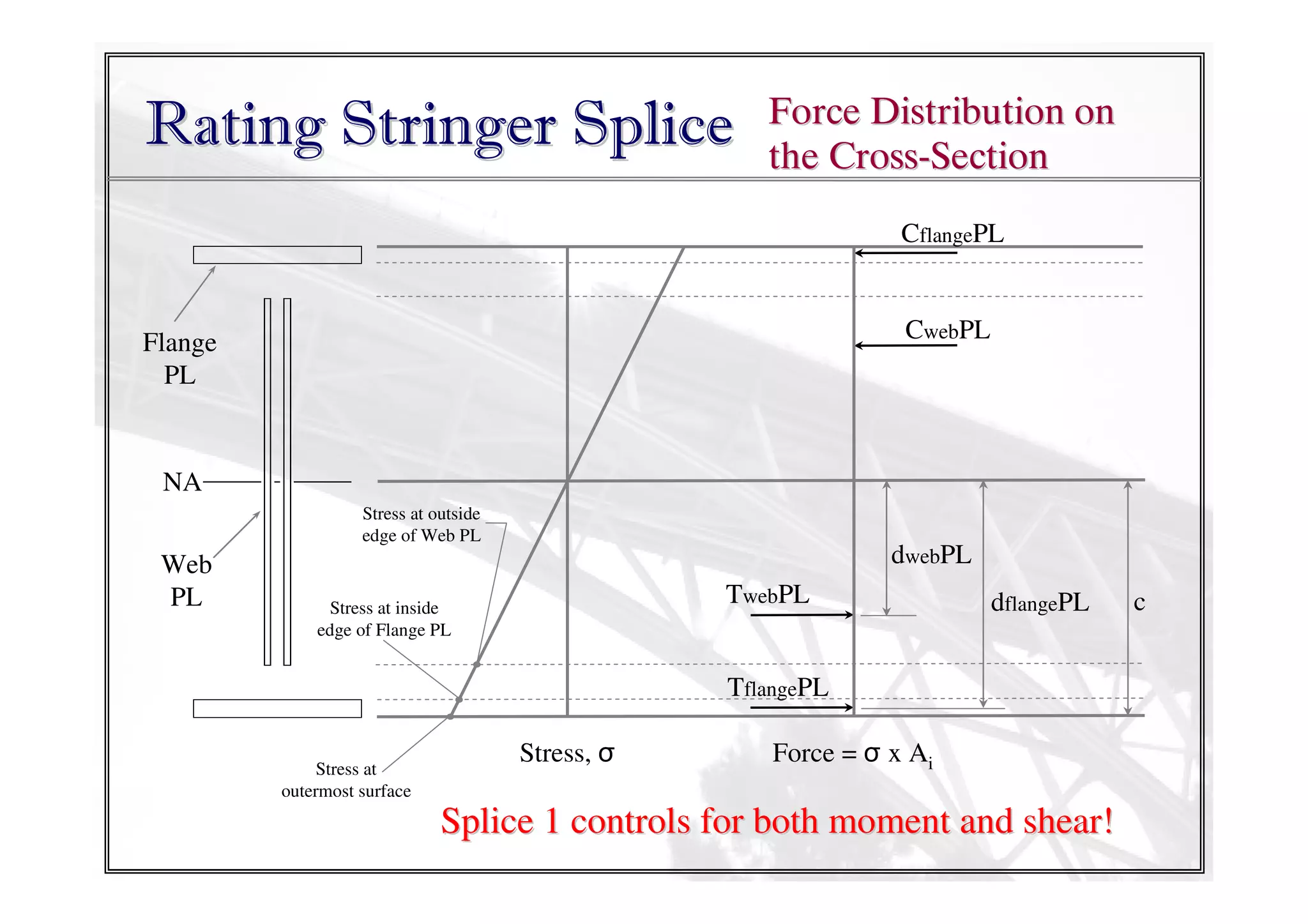
Rating Stringer Splice

Force Distribution on
the Cross-Section
CflangePL

CwebPL

Flange
PL

NA
Stress at outside
edge of Web PL

Web
PL

dwebPL
TwebPL

Stress at inside
edge of Flange PL

dflangePL

TflangePL
Stress at
outermost surface

Stress, σ

Force = σ x Ai

Splice 1 controls for both moment and shear!

c
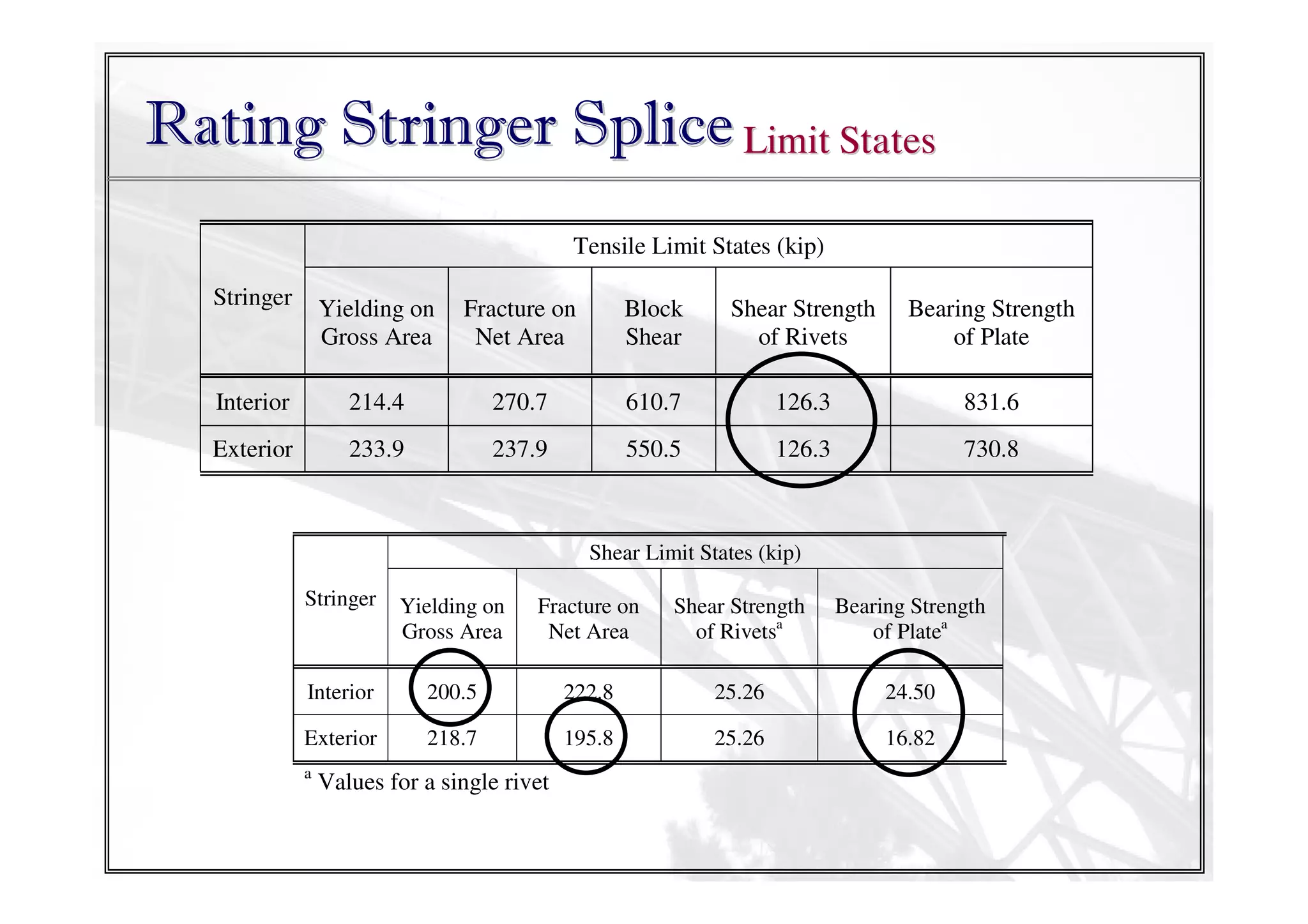
Rating Stringer Splice Limit States
• Limit States for the Flange PL Group:
Yielding on the gross section
Fracture on the net section
Block Shear
Shear strength of the rivets
Bearing strength of the plates
• Limit States for the Web PL Group:
Yielding on the gross section
Fracture on the net section
Shear strength of the rivets (for a single rivet)
Bearing strength of the plates (for a single rivet)
Rating Stringer Splice Limit States
Tensile Limit States (kip)
Stringer

Yielding on
Gross Area

Fracture on
Net Area

Block
Shear

Shear Strength
of Rivets

Bearing Strength
of Plate

Interior

214.4

270.7

610.7

126.3

831.6

Exterior

233.9

237.9

550.5

126.3

730.8

Shear Limit States (kip)
Stringer

Yielding on
Gross Area

Fracture on
Net Area

Shear Strength
of Rivetsa

Bearing Strength
of Platea

Interior

200.5

222.8

25.26

24.50

Exterior

218.7

195.8

25.26

16.82

a

Values for a single rivet
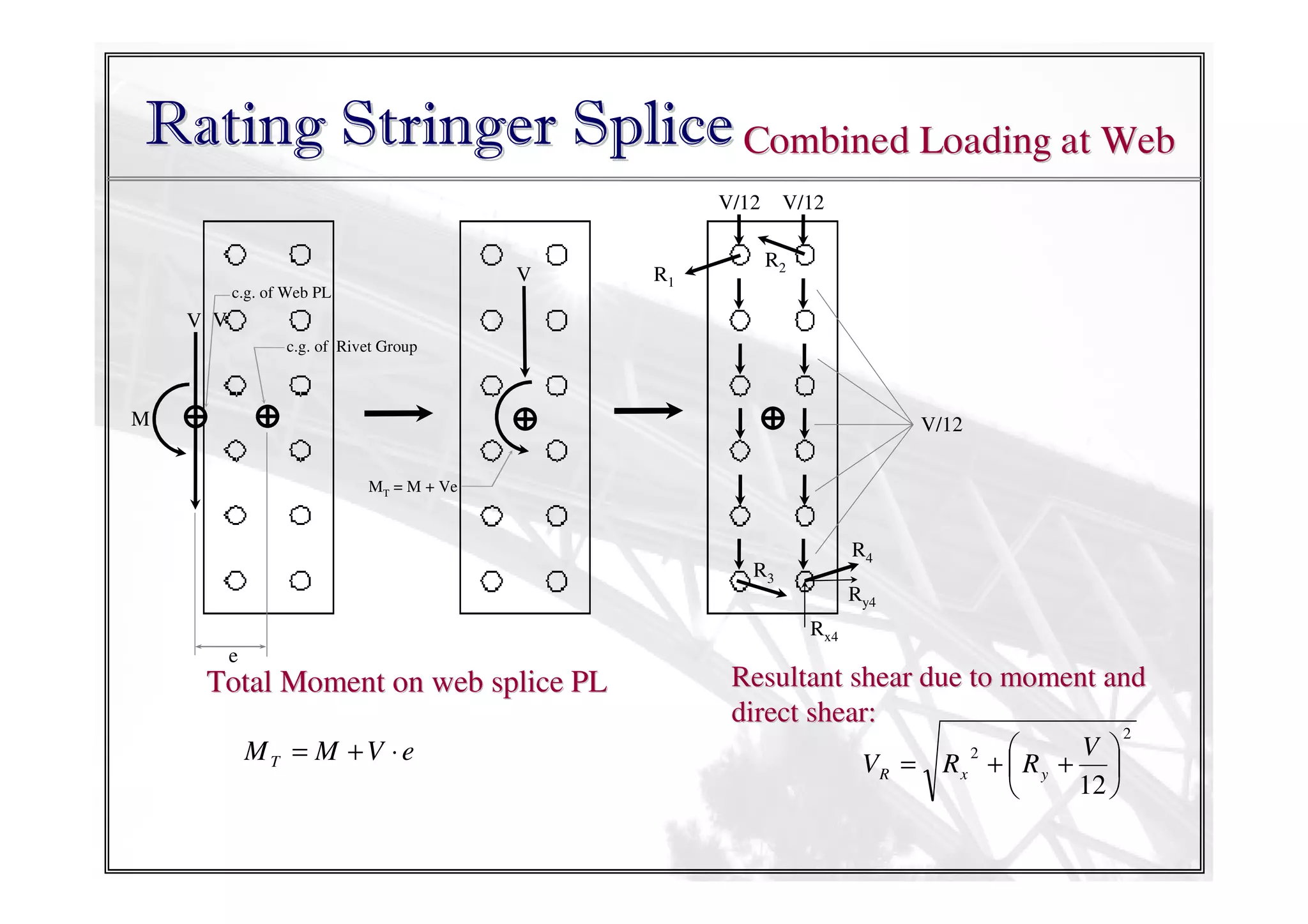
Rating Stringer Splice Combined Loading at Web
V/12

V
c.g. of Web PL

R1

V/12
R2

V V
c.g. of Rivet Group

M

V/12
MT = M + Ve

R4

R3

Ry4
Rx4
e

Total Moment on web splice PL
MT = M +V ⋅e

Resultant shear due to moment and
direct shear:
VR = Rx

2

V 

+  Ry + 
12 


2
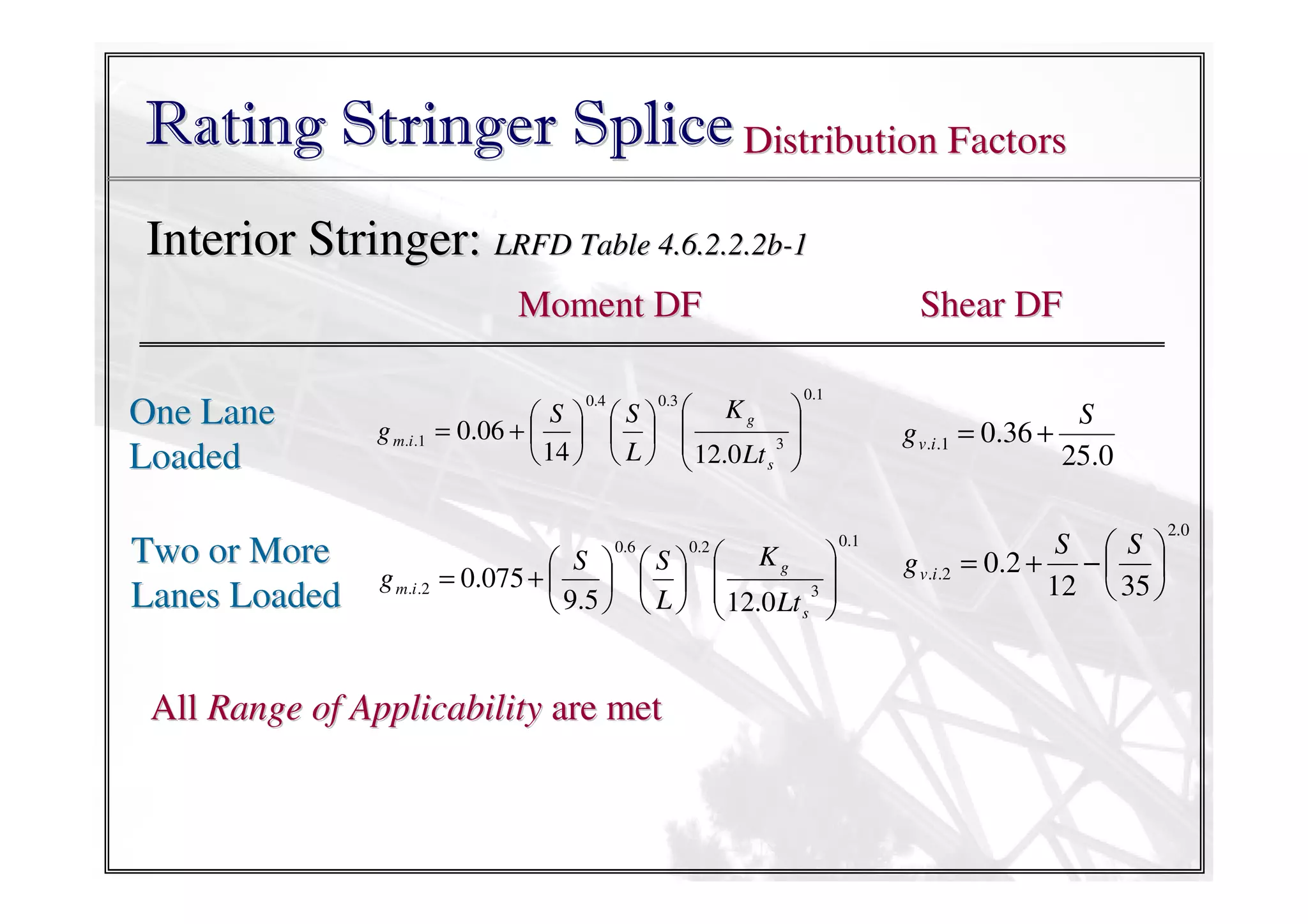
Rating Stringer Splice Distribution Factors
Interior Stringer: LRFD Table 4.6.2.2.2b-1
Shear DF

Moment DF
One Lane
Loaded
Two or More
Lanes Loaded

0.1

g m.i.1

0.4
0.3
 S   S   Kg 

= 0.06 +     
 12.0 Lt 3 
 14   L  
s 

g m.i.2

 S   S   Kg 

= 0.075 + 
   
 12.0 Lt 3 
 9 .5   L  
s 
0.6

All Range of Applicability are met

0.2

g v.i.1 = 0.36 +

0.1

g v.i.2

S
25.0

S S 
= 0 .2 + −  
12  35 

2.0
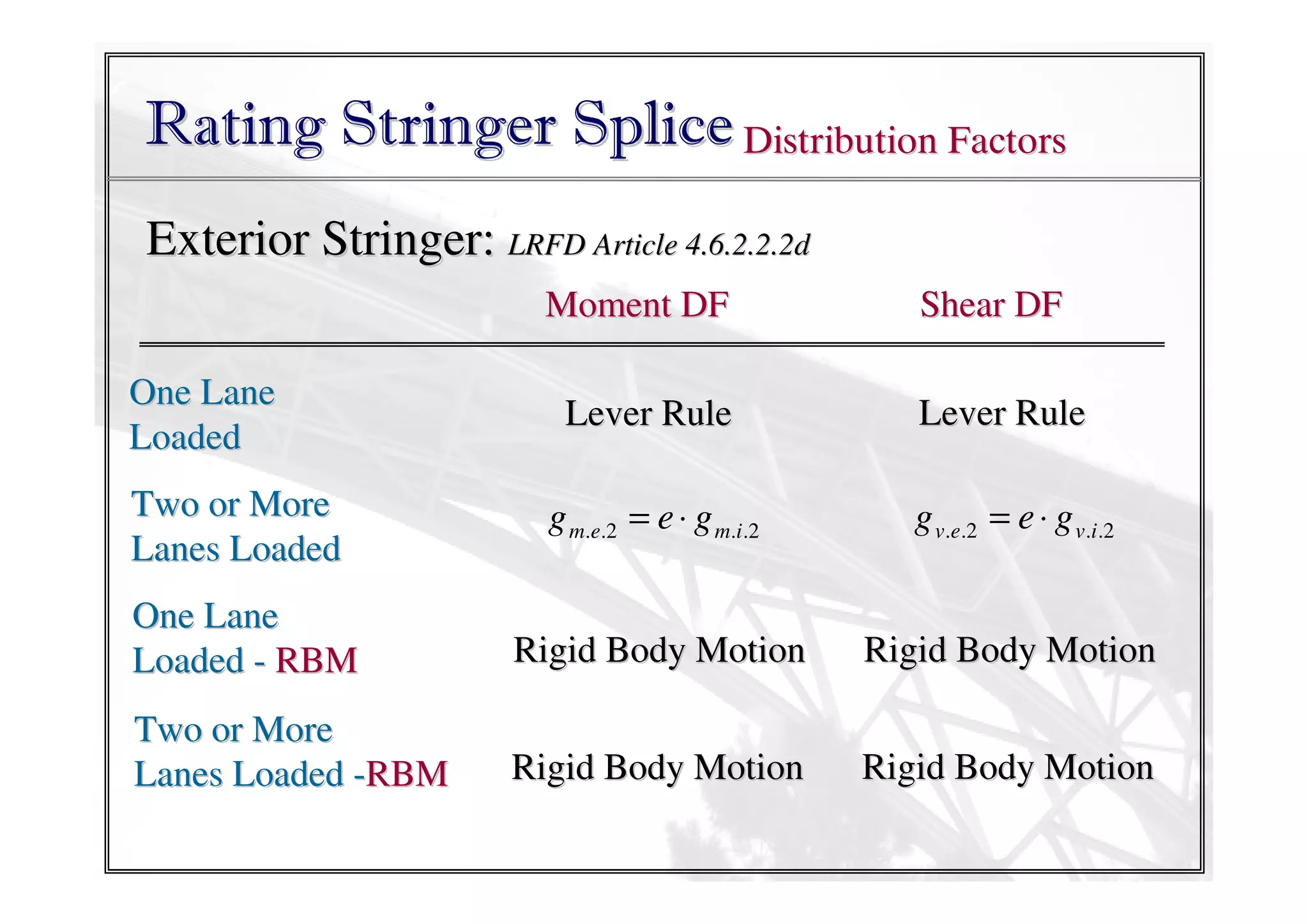
Rating Stringer Splice Distribution Factors
Exterior Stringer: LRFD Article 4.6.2.2.2d
Moment DF
One Lane
Loaded

Lever Rule

Shear DF
Lever Rule

Two or More
Lanes Loaded

g m.e.2 = e ⋅ g m.i.2

g v.e.2 = e ⋅ g v.i.2

One Lane
Loaded - RBM

Rigid Body Motion

Rigid Body Motion

Two or More
Lanes Loaded -RBM

Rigid Body Motion

Rigid Body Motion
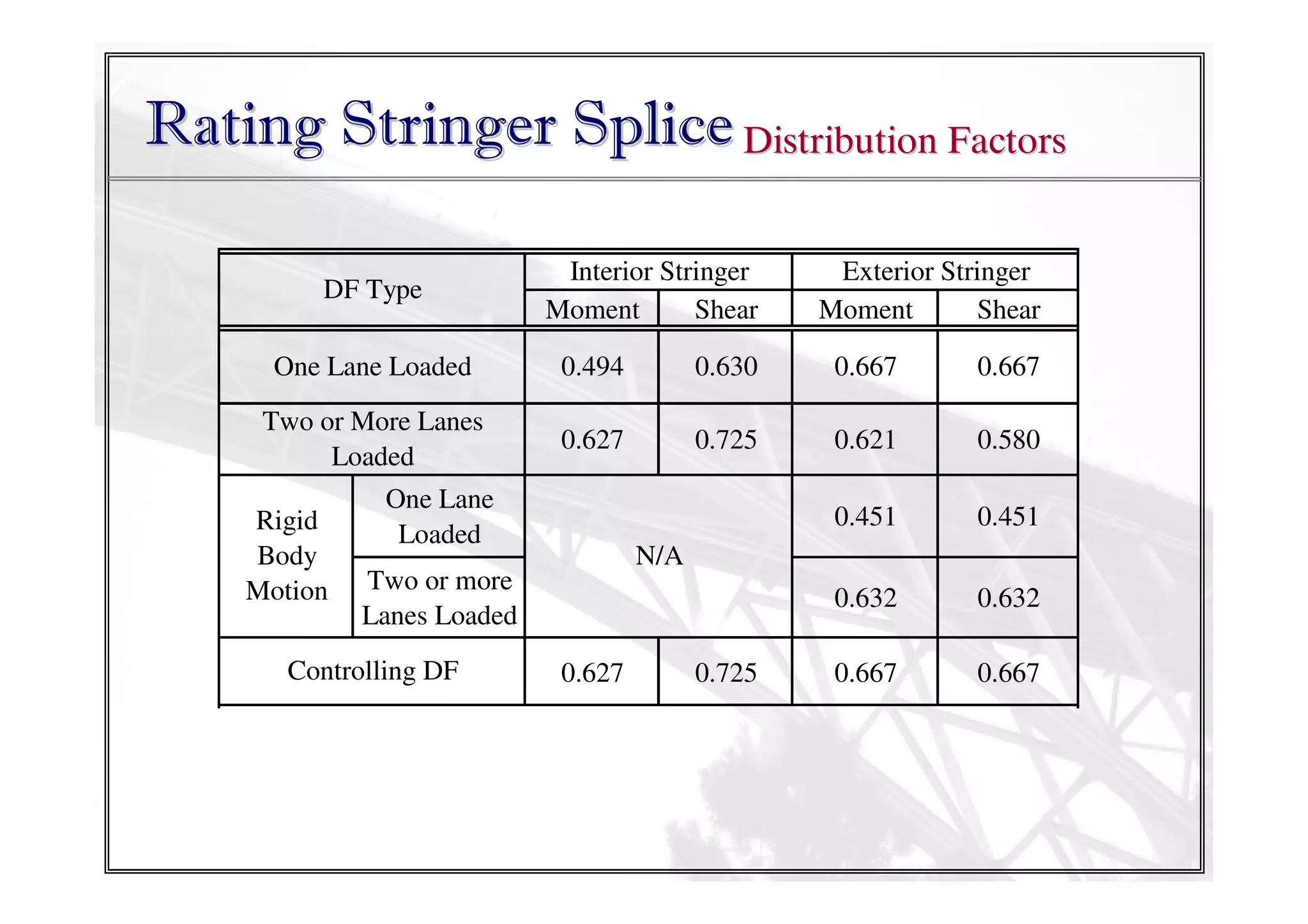
Rating Stringer Splice Distribution Factors
DF Type

Interior Stringer
Moment
Shear

Exterior Stringer
Moment
Shear

One Lane Loaded

0.494

0.630

0.667

0.667

Two or More Lanes
Loaded

0.627

0.725

0.621

0.580

0.451

0.451

0.632

0.632

0.667

0.667

Rigid
Body
Motion

One Lane
Loaded

N/A

Two or more
Lanes Loaded

Controlling DF

0.627

0.725
Rating Stringer Splice Rating Factors
Stringer

Moment
(Flange Splice Plates)

Shear
Web splice plates

Single Rivet

Inventory Operating Inventory Operating Inventory Operating
Interior

1.10

1.43

2.30

2.98

1.19

1.54

Exterior

1.02

1.32

2.43

3.15

1.33

1.72
Load Rating of
Spandrel Splice
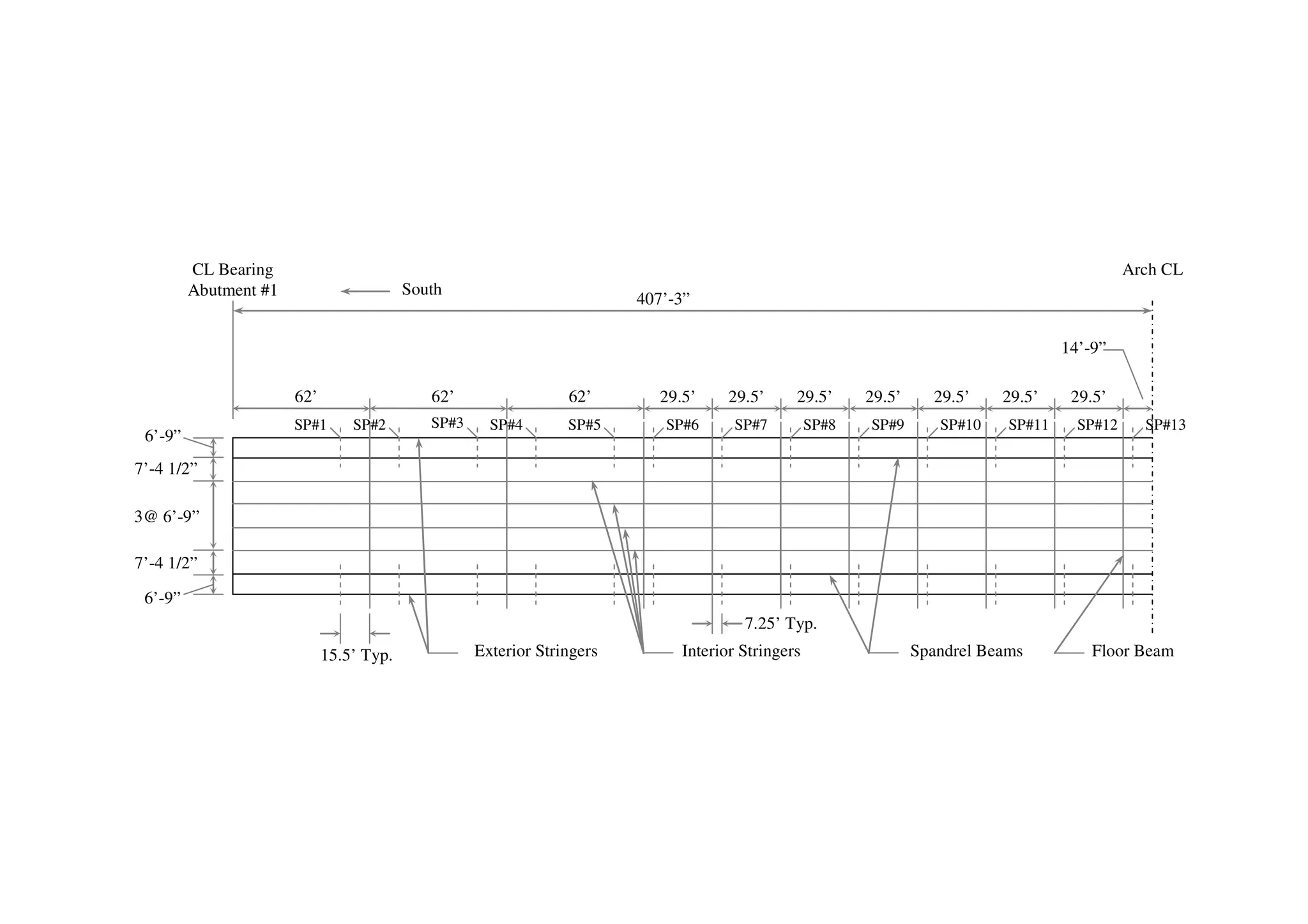
Rating Spandrel Splice Basic Information
CL Bearing
• 2 Abutment #1 Beams:
Spandrel
South

ASTM A7 Steel (Fy = 33 ksi)

• Total of 21 spans:

Three approach spans of 62 ft on each 14’-9”
end

62’
6’-9”

62’

SP#1

SP#2

SP#3

Arch CL

407’-3”

62’
29.5’
15 interior spans29.5’ 29.5ft29.5’ 29.5’ 29.5’
of 29.5’ SP#9 SP#10 SP#11
over arch
SP#4
SP#5
SP#6
SP#7
SP#8

29.5’
SP#12

SP#13

7’-4 1/2”

• Total of 26 splices: First five splices: 15.5 ft from pier and
3@ 6’-9”
skewback column supports
7’-4 1/2”
6’-9”
15.5’ Typ.

Remaining splices: 7.25 ft from arch column
7.25’ Typ.
supports
Exterior Stringers
Spandrel Beams
Floor Beam
Interior Stringers
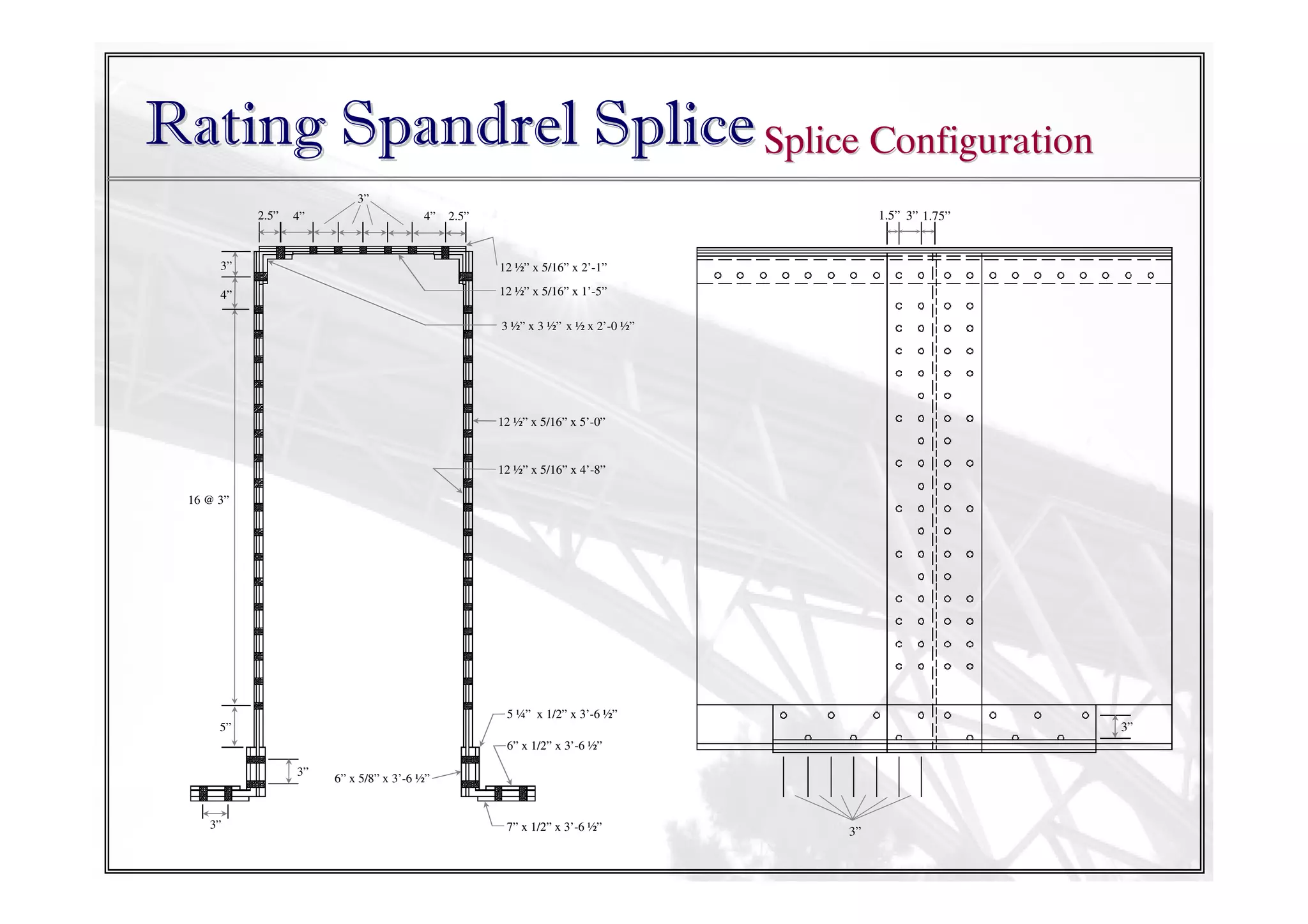
Rating Spandrel Splice Splice Configuration
3”
2.5”

4”

4”

1.5” 3” 1.75”

2.5”

3”

12 ½” x 5/16” x 2’-1”

4”

12 ½” x 5/16” x 1’-5”
3 ½” x 3 ½” x ½ x 2’-0 ½”

12 ½” x 5/16” x 5’-0”

12 ½” x 5/16” x 4’-8”
16 @ 3”

5 ¼” x 1/2” x 3’-6 ½”

3”

5”
6” x 1/2” x 3’-6 ½”
3”

3”

6” x 5/8” x 3’-6 ½”

7” x 1/2” x 3’-6 ½”

3”
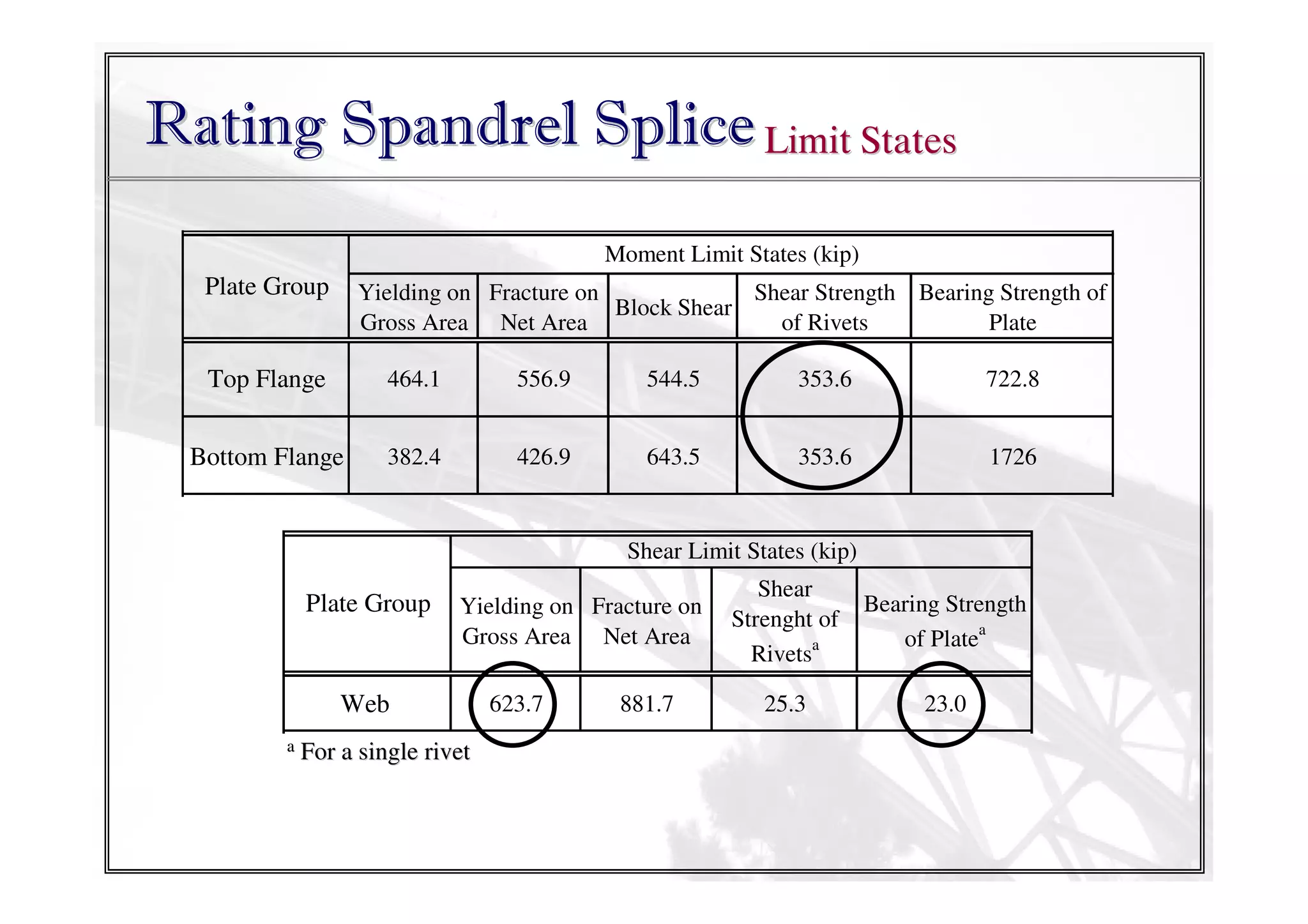
Rating Spandrel Splice Limit States
Moment Limit States (kip)

Plate Group

Yielding on Fracture on
Shear Strength Bearing Strength of
Block Shear
Gross Area Net Area
of Rivets
Plate

Top Flange

464.1

556.9

544.5

353.6

722.8

Bottom Flange

382.4

426.9

643.5

353.6

1726

Shear Limit States (kip)

Plate Group

Yielding on Fracture on
Gross Area Net Area

Web
a

For a single rivet

623.7

881.7

Shear
Strenght of
Rivetsa

Bearing Strength
of Platea

25.3

23.0
Rating Spandrel Splice Distribution Factors
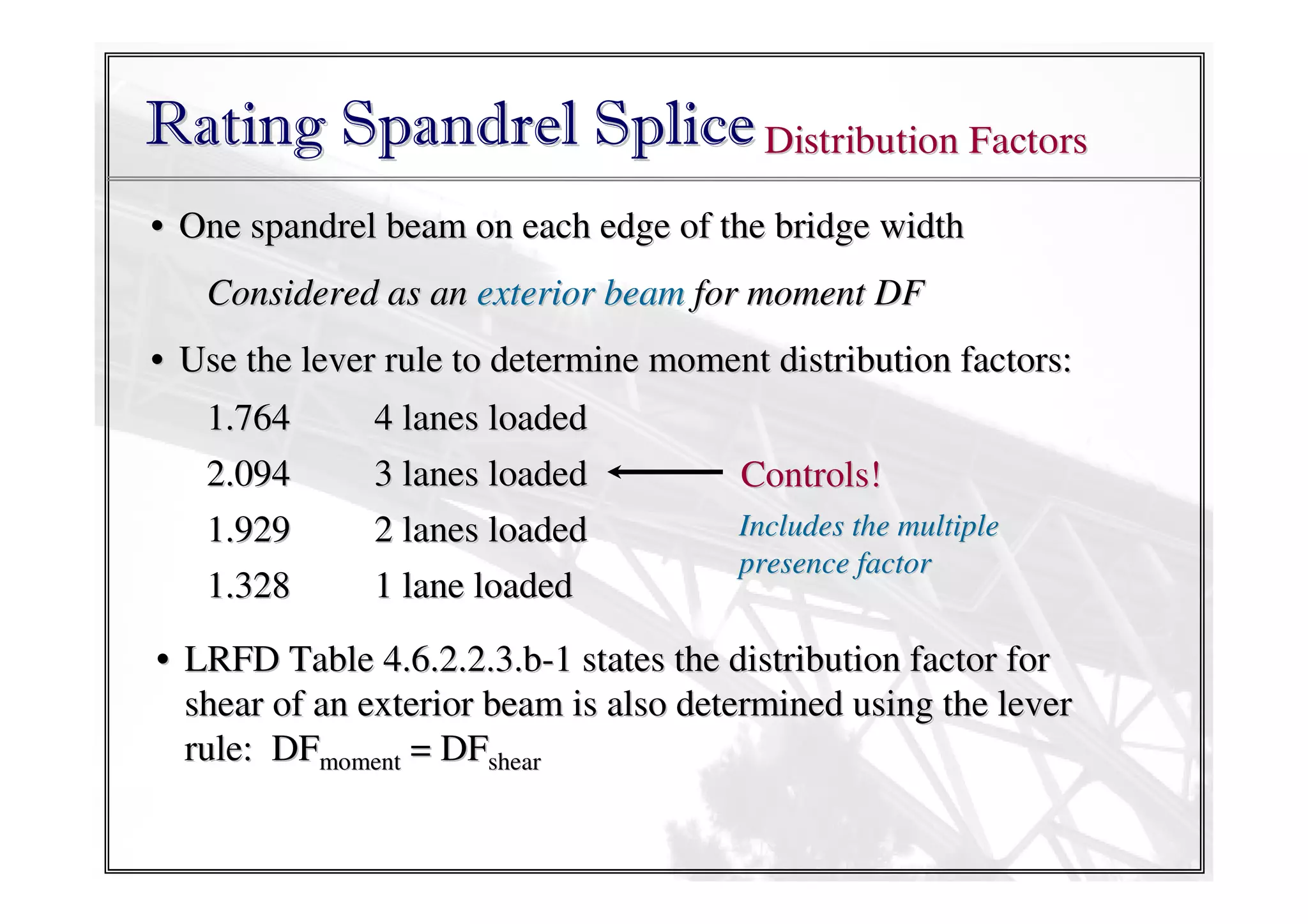
• One spandrel beam on each edge of the bridge width
Considered as an exterior beam for moment DF
• Use the lever rule to determine moment distribution factors:
1.764
2.094
1.929
1.328

4 lanes loaded
3 lanes loaded
2 lanes loaded
1 lane loaded

Controls!
Includes the multiple
presence factor

• LRFD Table 4.6.2.2.3.b-1 states the distribution factor for
shear of an exterior beam is also determined using the lever
rule: DFmoment = DFshear
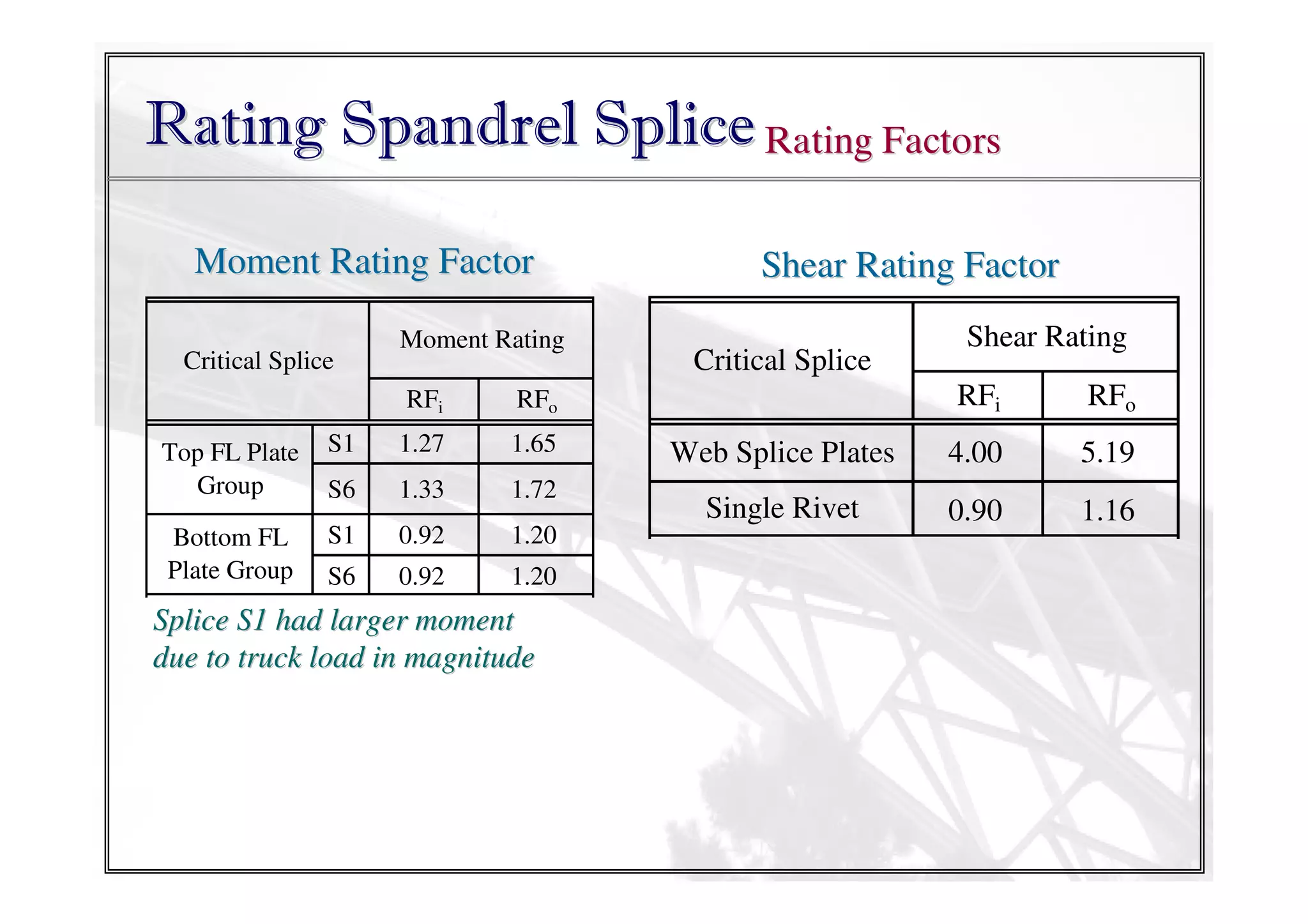
Rating Spandrel Splice Rating Factors
Moment Rating Factor
Critical Splice

Moment Rating
RFi

Shear Rating Factor
Critical Splice

RFi

RFo

Web Splice Plates

4.00

5.19

Single Rivet

0.90

1.16

RFo

Top FL Plate
Group

S1

1.27

1.65

S6

1.33

1.72

Bottom FL
Plate Group

S1

0.92

1.20

S6

0.92

1.20

Splice S1 had larger moment
due to truck load in magnitude

Shear Rating
Load Rating of
Column Splice
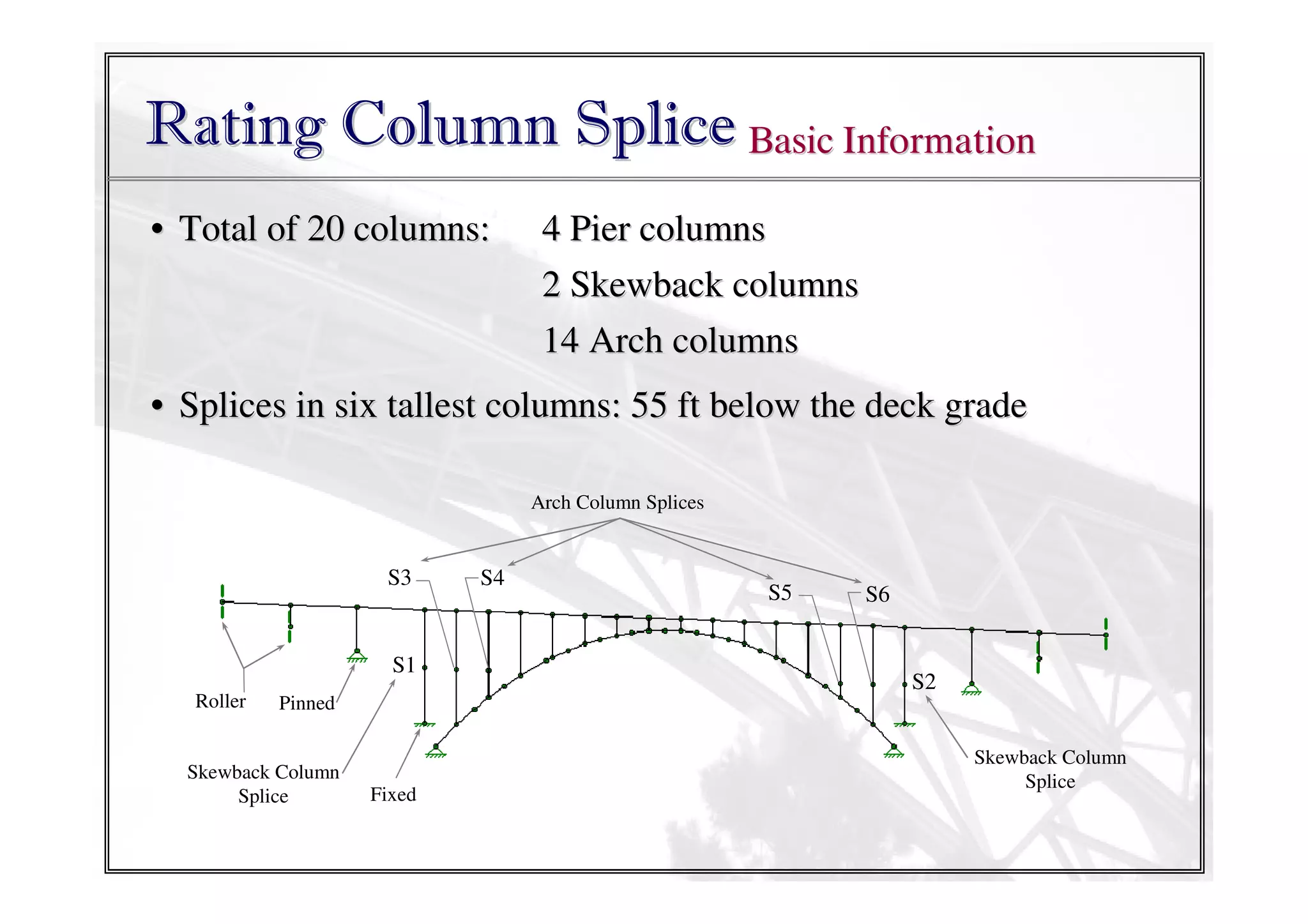
Rating Column Splice Basic Information
• Total of 20 columns:

4 Pier columns
2 Skewback columns
14 Arch columns

• Splices in six tallest columns: 55 ft below the deck grade
Arch Column Splices

S3

S1
Roller

S4

S5

S6

S2

Pinned

Skewback Column
Splice

Fixed

Skewback Column
Splice
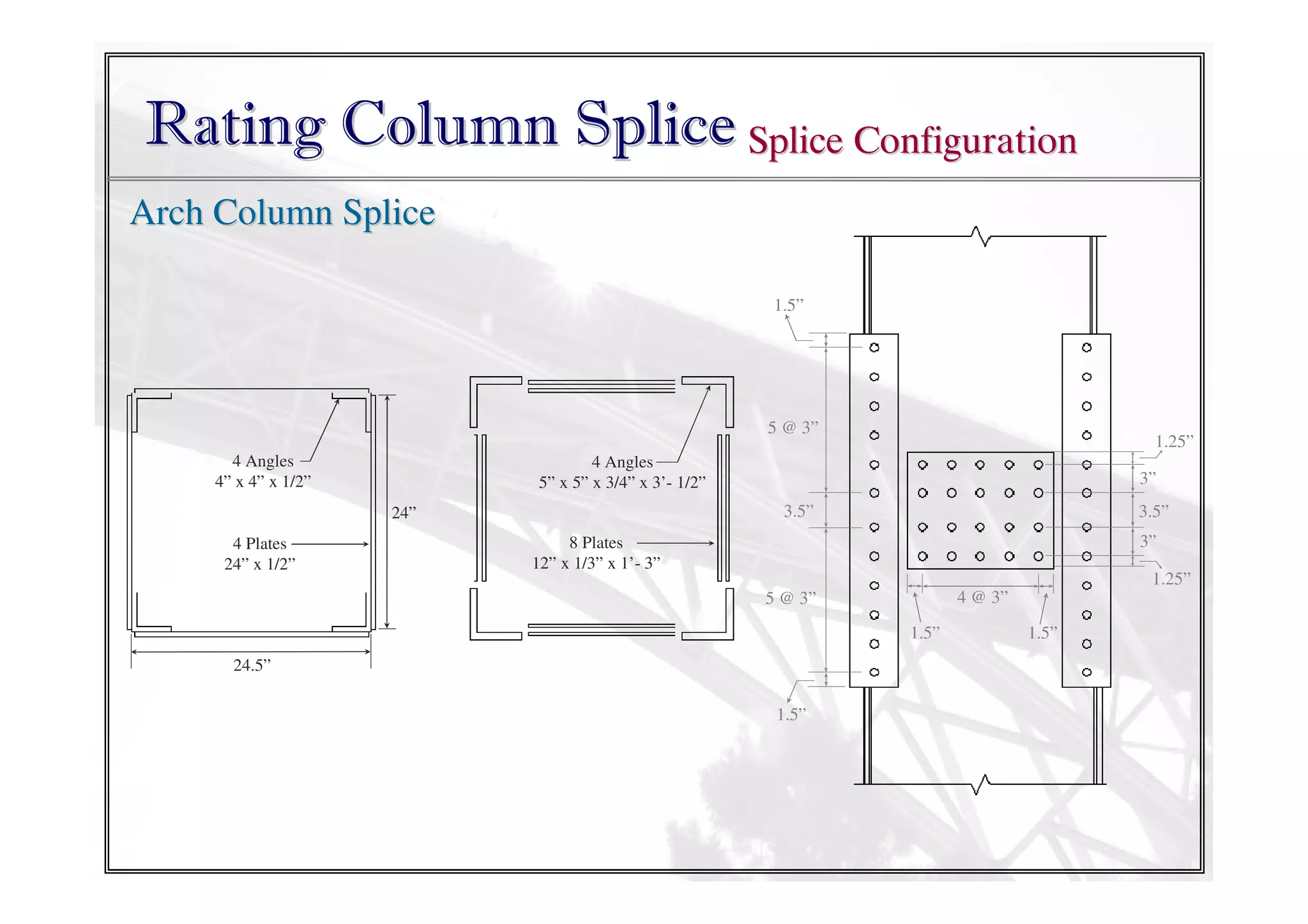
Rating Column Splice Splice Configuration
Arch Column Splice
1.5”

5 @ 3”
4 Angles
4” x 4” x 1/2”

4 Angles
5” x 5” x 3/4” x 3’- 1/2”

3”
3.5”

24”
4 Plates
24” x 1/2”

1.25”

3.5”
3”

8 Plates
12” x 1/3” x 1’- 3”

1.25”
4 @ 3”

5 @ 3”
1.5”
24.5”

1.5”

1.5”
Rating Column Splice Splice Configuration
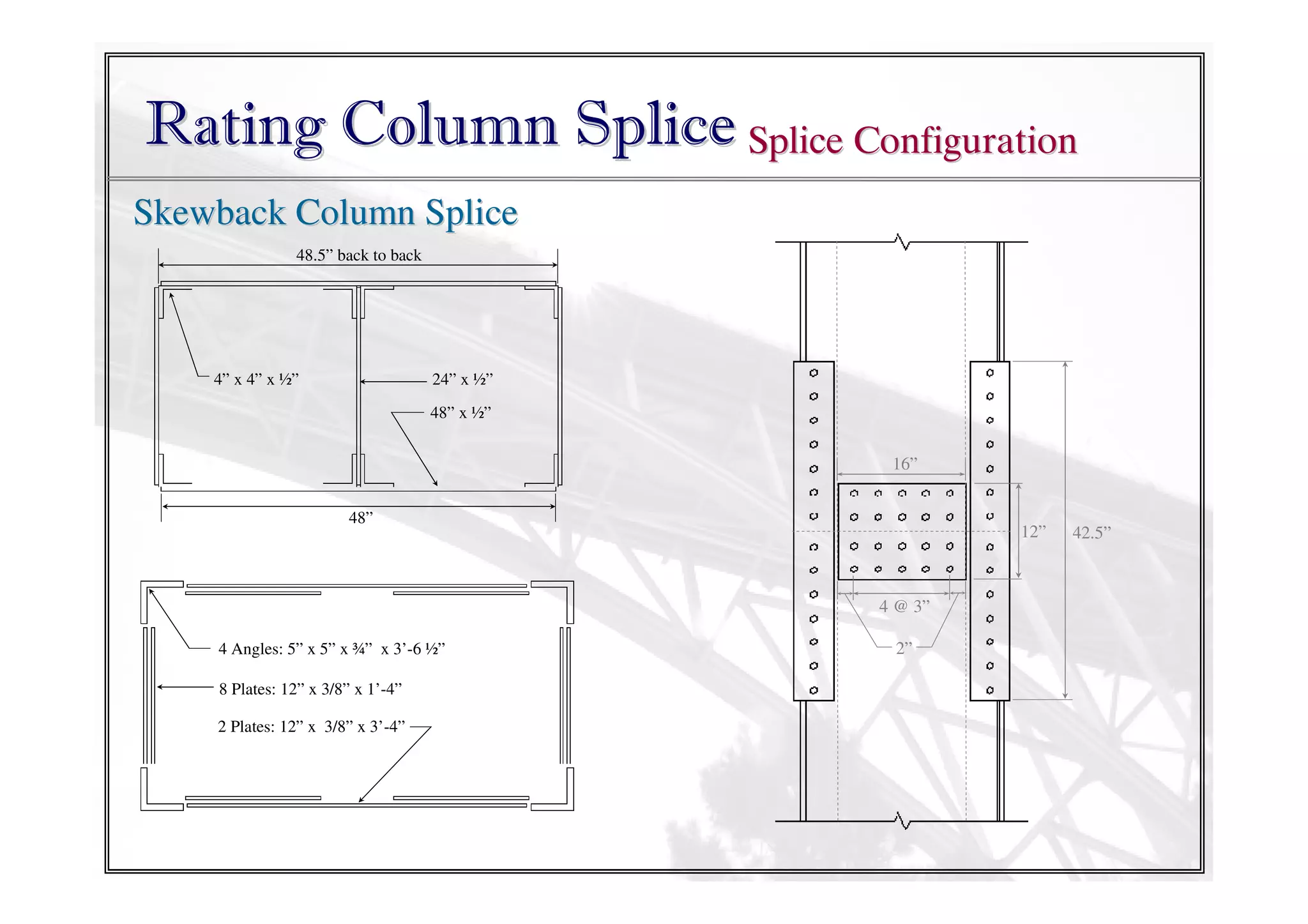
Skewback Column Splice
48.5” back to back

4” x 4” x ½”

24” x ½”
48” x ½”

16”
48”

12”

4 @ 3”
4 Angles: 5” x 5” x ¾” x 3’-6 ½”
8 Plates: 12” x 3/8” x 1’-4”
2 Plates: 12” x 3/8” x 3’-4”

2”

42.5”
Rating Column Splice Modeling: Member
• The riveted connection stiffness is uncertain
• Two models: COLUMN and BEAM-COLUMN
• Actual connection stiffness somewhere in between COLUMN
and BEAM-COLUMN models
• Previous work found that BEAM-COLUMN model yielded
significantly smaller rating factors: thus, chosen as critical model.
Rating Column Splice Limit States
Flange Plates:
Gross yielding
PL based
Limit States Net fracture
Block shear
Rivet based Shear strength of rivets
Limit States Bearing strength of PL
Total Capacity = smaller of
[φRnFlangePL + φRnAngles]PL-Based
[φRnFlangePL + φRnAngles]Rivet-Based

Angles:
Gross yielding
Net fracture
Block shear
Shear strength of rivets
Bearing strength of PL
Rating Column Splice Limit States
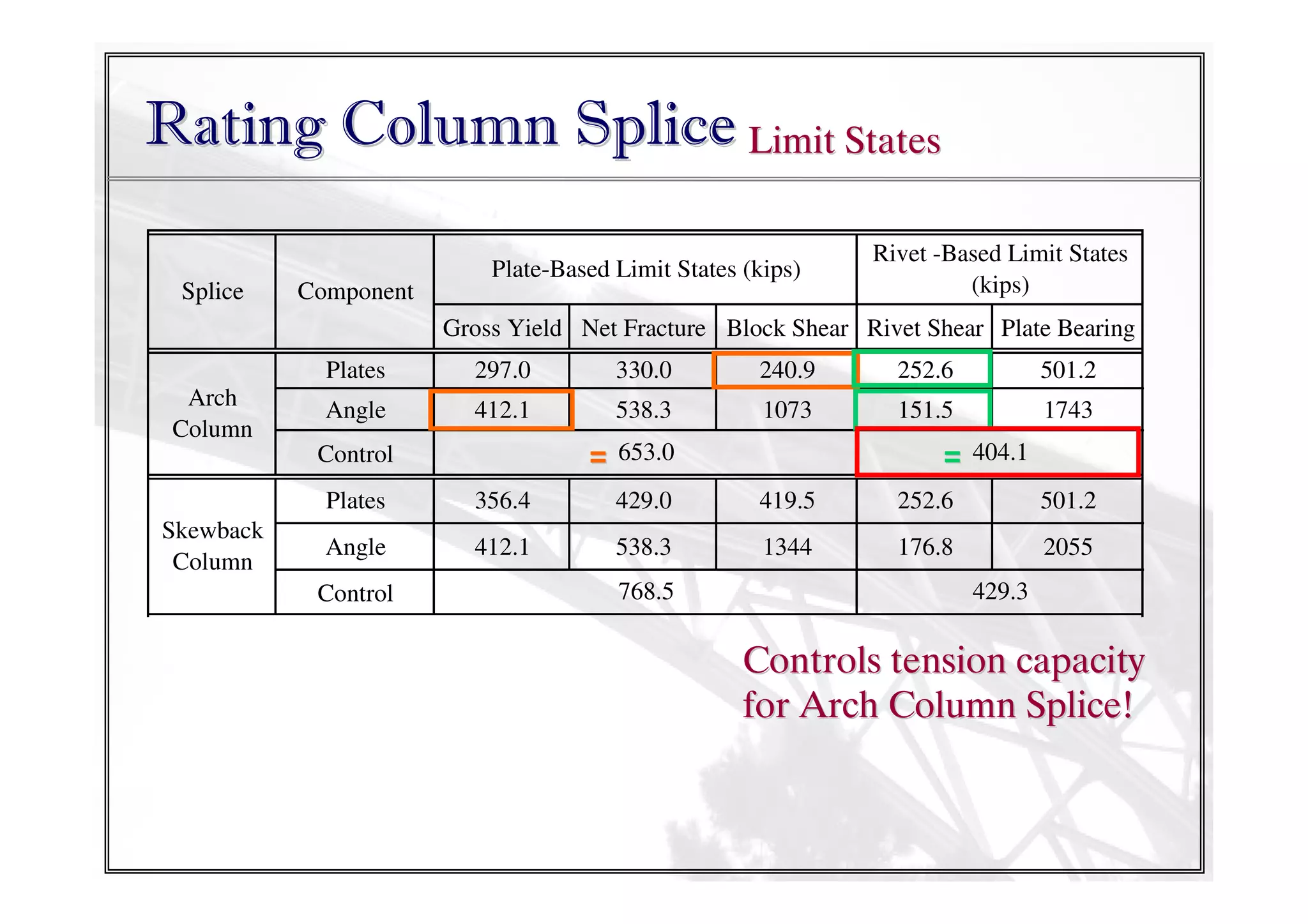
Splice

Component

Plate-Based Limit States (kips)

Rivet -Based Limit States
(kips)

Gross Yield Net Fracture Block Shear Rivet Shear Plate Bearing
Plates
Arch
Column

297.0

330.0

240.9

252.6

501.2

Angle

412.1

538.3

1073

151.5

1743

Control

=

653.0

=

404.1

Plates
Skewback
Column

356.4

429.0

419.5

252.6

501.2

Angle

412.1

538.3

1344

176.8

2055

Control

768.5

429.3

Controls tension capacity
for Arch Column Splice!
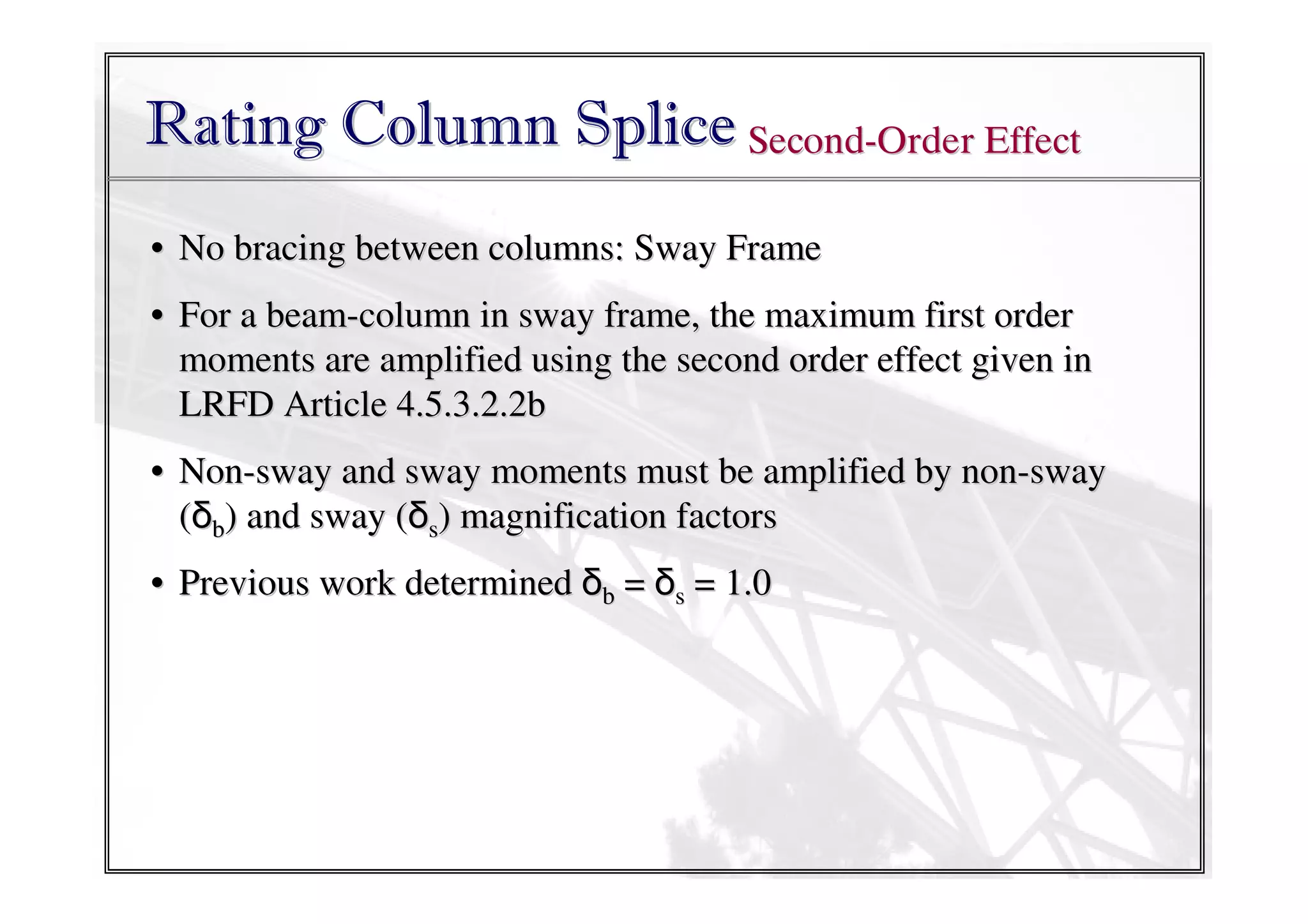
Rating Column Splice Second-Order Effect
• No bracing between columns: Sway Frame
• For a beam-column in sway frame, the maximum first order
moments are amplified using the second order effect given in
LRFD Article 4.5.3.2.2b
• Non-sway and sway moments must be amplified by non-sway
(δb) and sway (δs) magnification factors
• Previous work determined δb = δs = 1.0
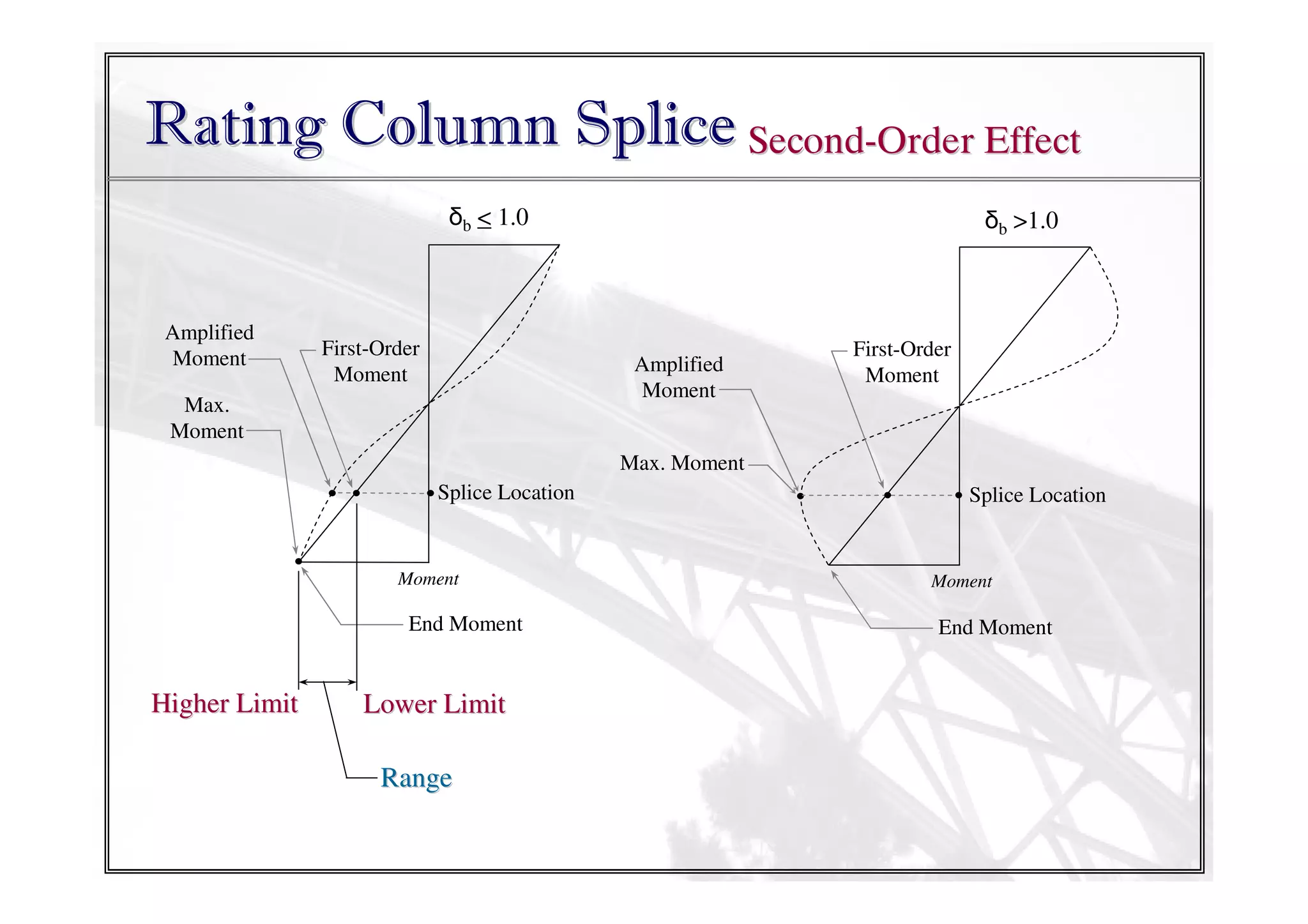
Rating Column Splice Second-Order Effect
δb < 1.0

Amplified
Moment

First-Order
Moment

δb >1.0

Amplified
Moment

Max.
Moment

First-Order
Moment

Max. Moment
Splice Location

Moment

End Moment

Higher Limit

Lower Limit
Range

Splice Location

Moment

End Moment
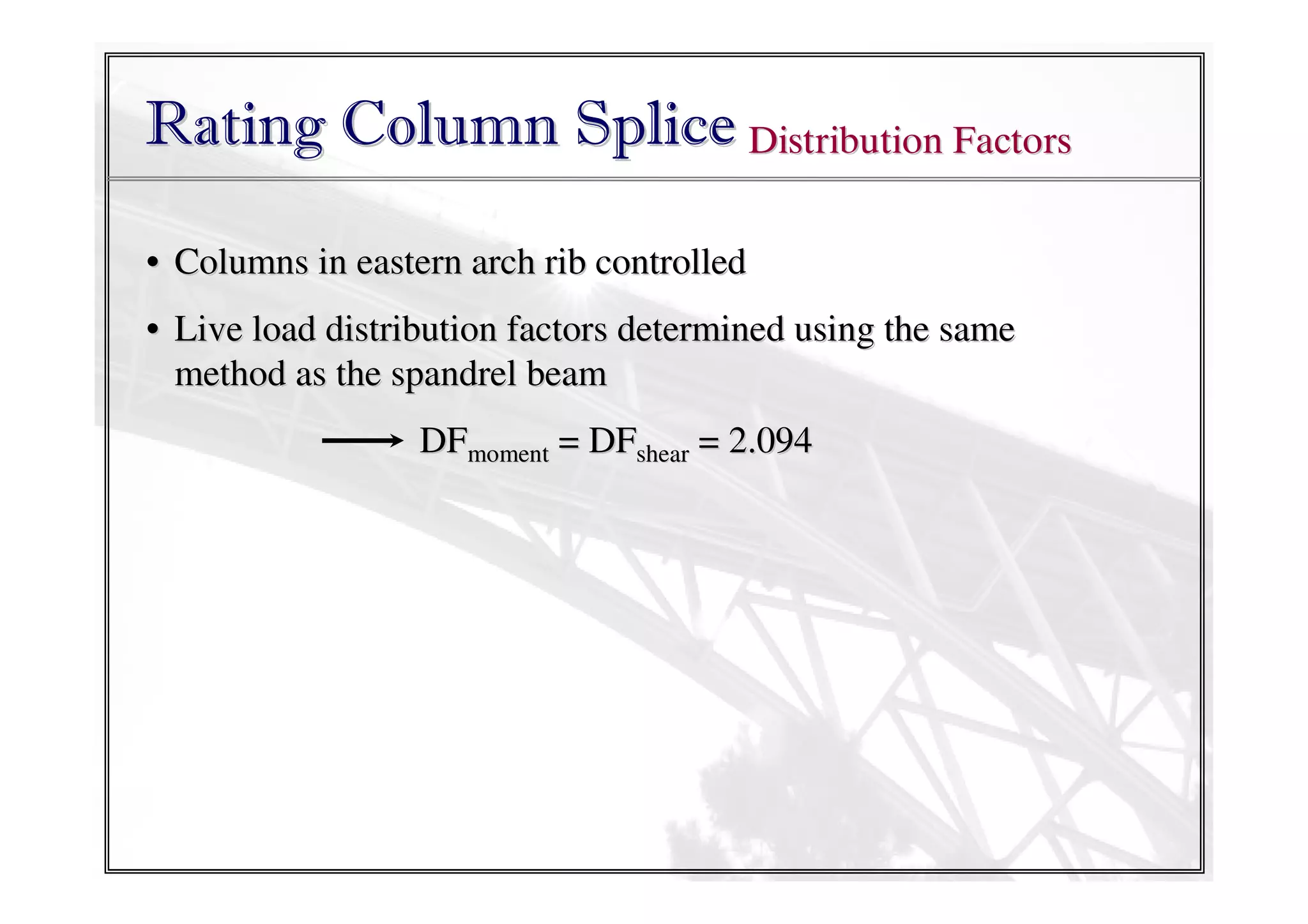
Rating Column Splice Distribution Factors
• Columns in eastern arch rib controlled
• Live load distribution factors determined using the same
method as the spandrel beam
DFmoment = DFshear = 2.094
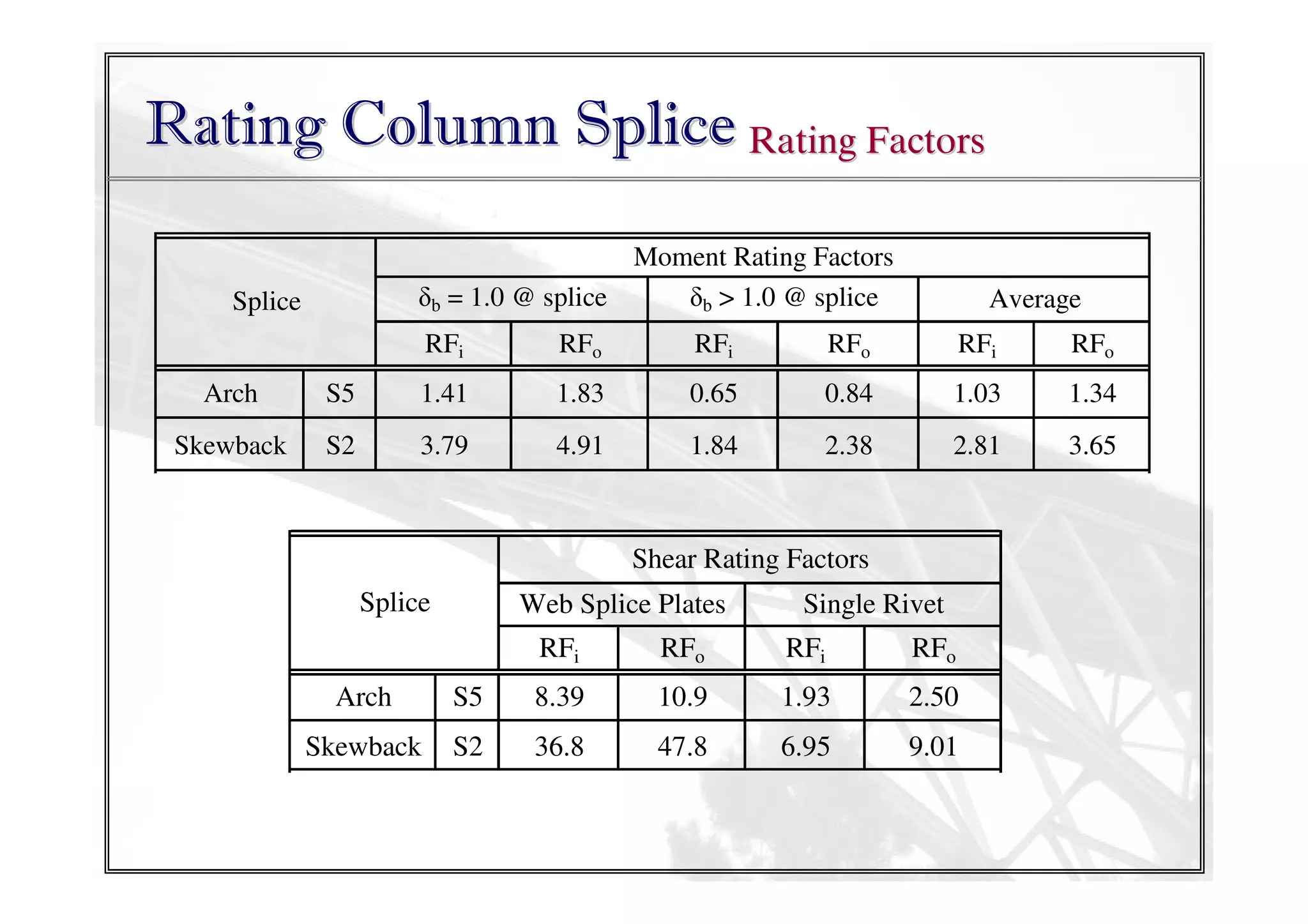
Rating Column Splice Rating Factors
Moment Rating Factors
δb = 1.0 @ splice
δb > 1.0 @ splice

Splice

Average

RFi

RFo

RFi

RFo

RFi

RFo

Arch

S5

1.41

1.83

0.65

0.84

1.03

1.34

Skewback

S2

3.79

4.91

1.84

2.38

2.81

3.65

Shear Rating Factors
Splice

Web Splice Plates

Single Rivet

RFi

RFo

RFi

RFo

Arch

S5

8.39

10.9

1.93

2.50

Skewback

S2

36.8

47.8

6.95

9.01
Load Rating of
Arch Rib Splice
Rating Arch Rib Splice Basic Information
• Total of 15 arch rib segments per arch plane
• Center 13 arch rib segments are spliced
(Labeled as S7 through S19 below)
South
North

9

10

13 14
11 12
15

16

17
18

8

19

7

Pinned

Pinned
Arch Rib Splice #
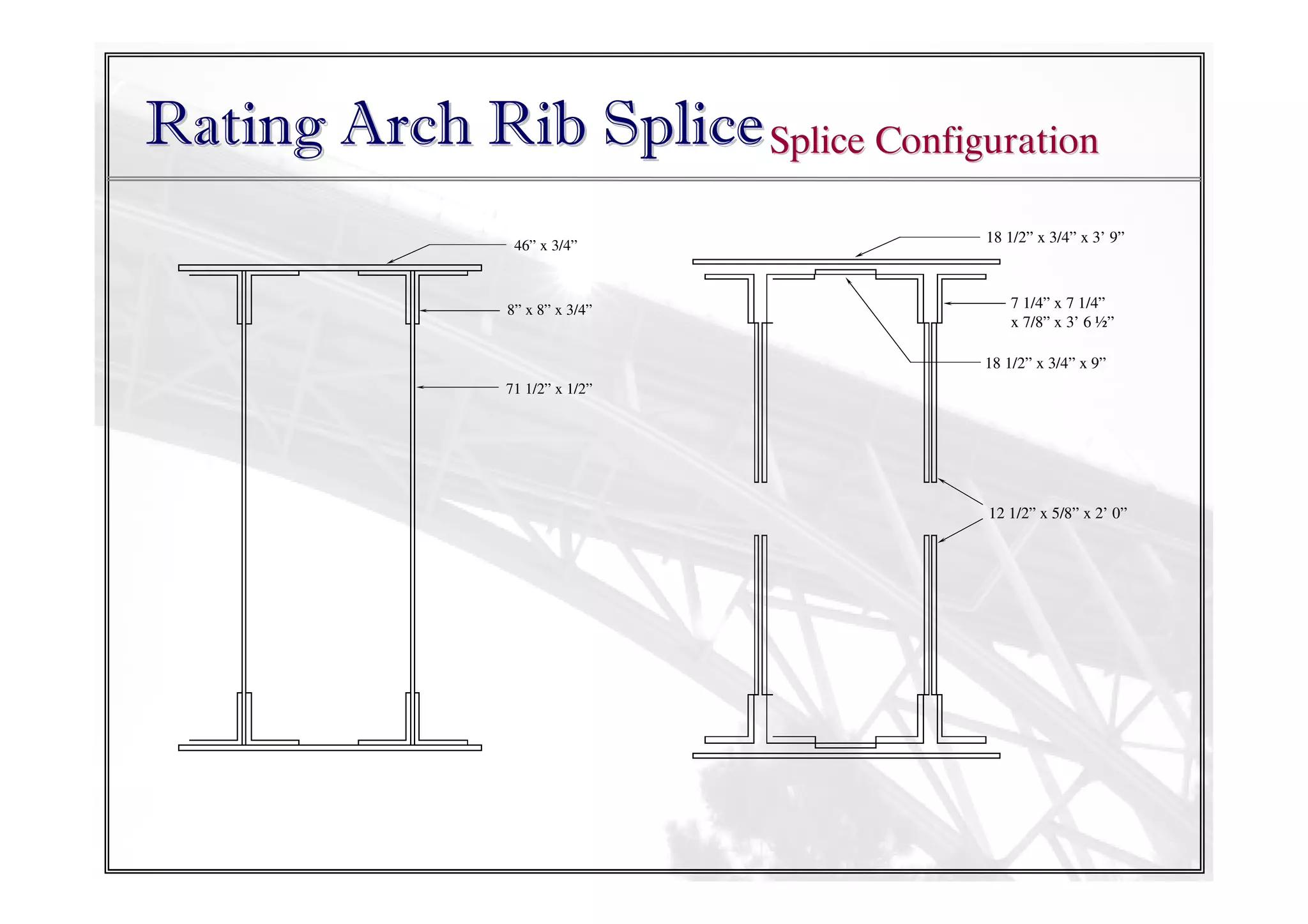
Rating Arch Rib Splice Splice Configuration
46” x 3/4”

8” x 8” x 3/4”

18 1/2” x 3/4” x 3’ 9”

7 1/4” x 7 1/4”
x 7/8” x 3’ 6 ½”
18 1/2” x 3/4” x 9”

71 1/2” x 1/2”

12 1/2” x 5/8” x 2’ 0”
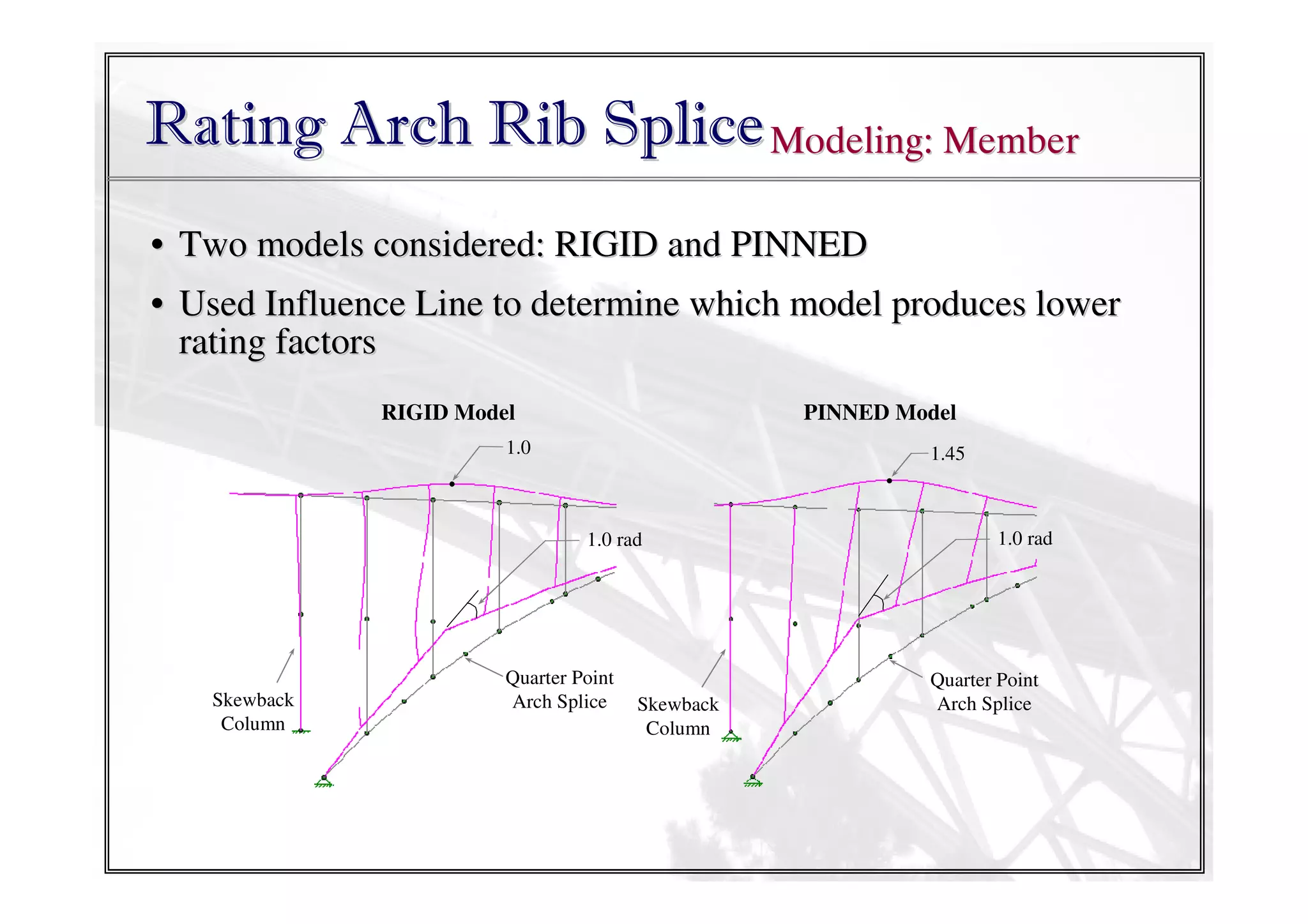
Rating Arch Rib Splice Modeling: Member
• Two models considered: RIGID and PINNED
• Used Influence Line to determine which model produces lower
rating factors
RIGID Model

PINNED Model

1.0

1.45

1.0 rad

Skewback
Column

Quarter Point
Arch Splice

Skewback
Column

1.0 rad

Quarter Point
Arch Splice
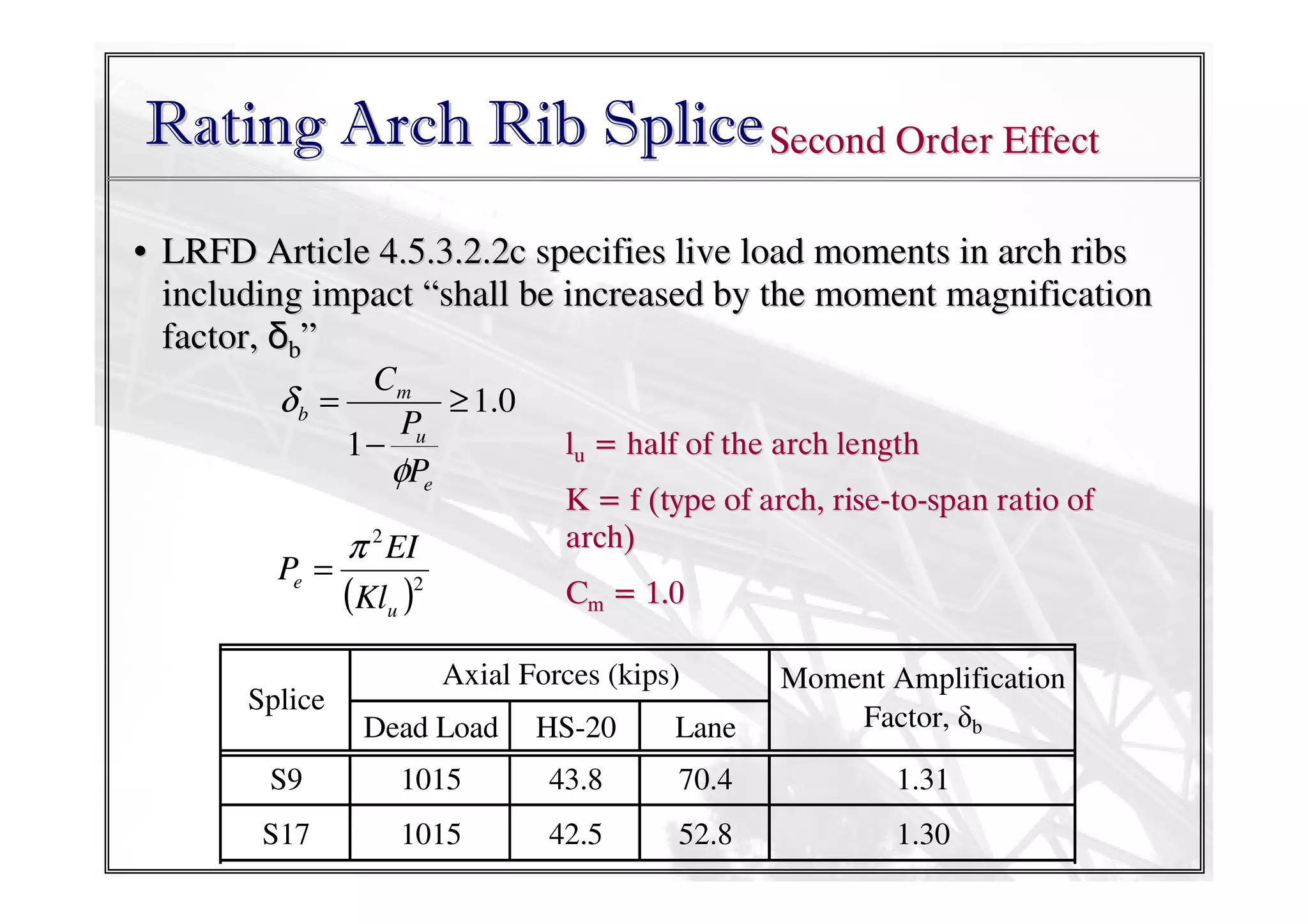
Rating Arch Rib Splice Second Order Effect
• LRFD Article 4.5.3.2.2c specifies live load moments in arch ribs
including impact “shall be increased by the moment magnification
factor, δb”
Cm
δb =
≥ 1.0
Pu
1−
φPe
Pe =

lu = half of the arch length

π 2 EI

K = f (type of arch, rise-to-span ratio of
arch)

(Klu )2

Cm = 1.0
Axial Forces (kips)

Dead Load

HS-20

Lane

Moment Amplification
Factor, δb

S9

1015

43.8

70.4

1.31

S17

1015

42.5

52.8

1.30

Splice
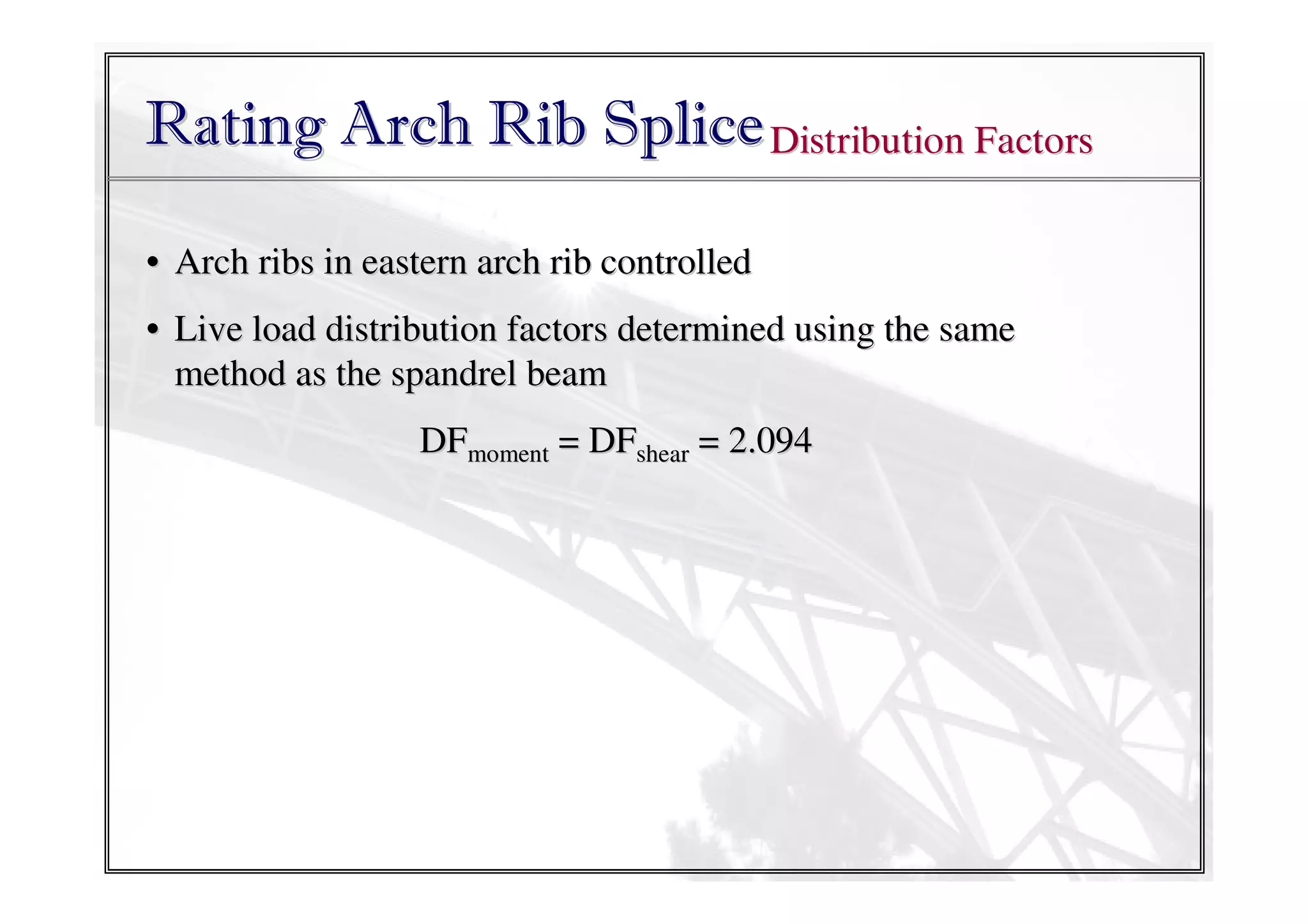
Rating Arch Rib Splice Distribution Factors
• Arch ribs in eastern arch rib controlled
• Live load distribution factors determined using the same
method as the spandrel beam
DFmoment = DFshear = 2.094
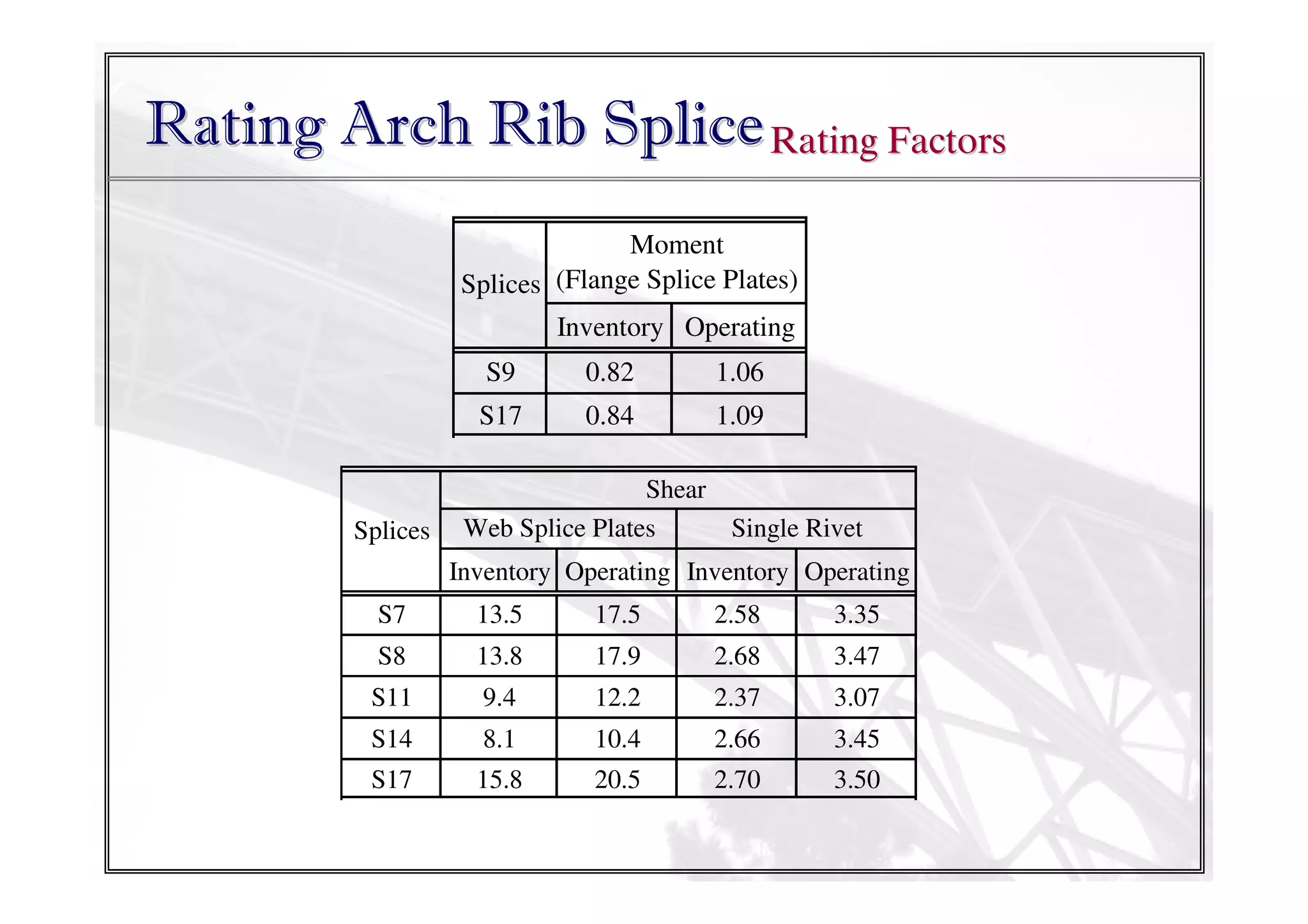
Rating Arch Rib Splice Rating Factors
Moment
Splices (Flange Splice Plates)
Inventory Operating
S9

1.06

S17

Splices

0.82
0.84

1.09

Shear
Web Splice Plates
Single Rivet
Inventory Operating Inventory Operating

S7

13.5

17.5

2.58

3.35

S8

13.8

17.9

2.68

3.47

S11

9.4

12.2

2.37

3.07

S14

8.1

10.4

2.66

3.45

S17

15.8

20.5

2.70

3.50
Conclusions &
Recommendations
Conclusions Floor System
Splice

Moment

Shear
Web Splice Plates
Single Rivet

RFi

RFo

RFi

RFo

RFi

RFo

Interior Stringer

1.10

1.43

2.30

2.98

1.19

1.54

Exterior Stringer

1.02

1.32

2.43

3.15

1.33

1.72

Spandrel Beam

0.92

1.20

4.00

5.19

0.90

1.16

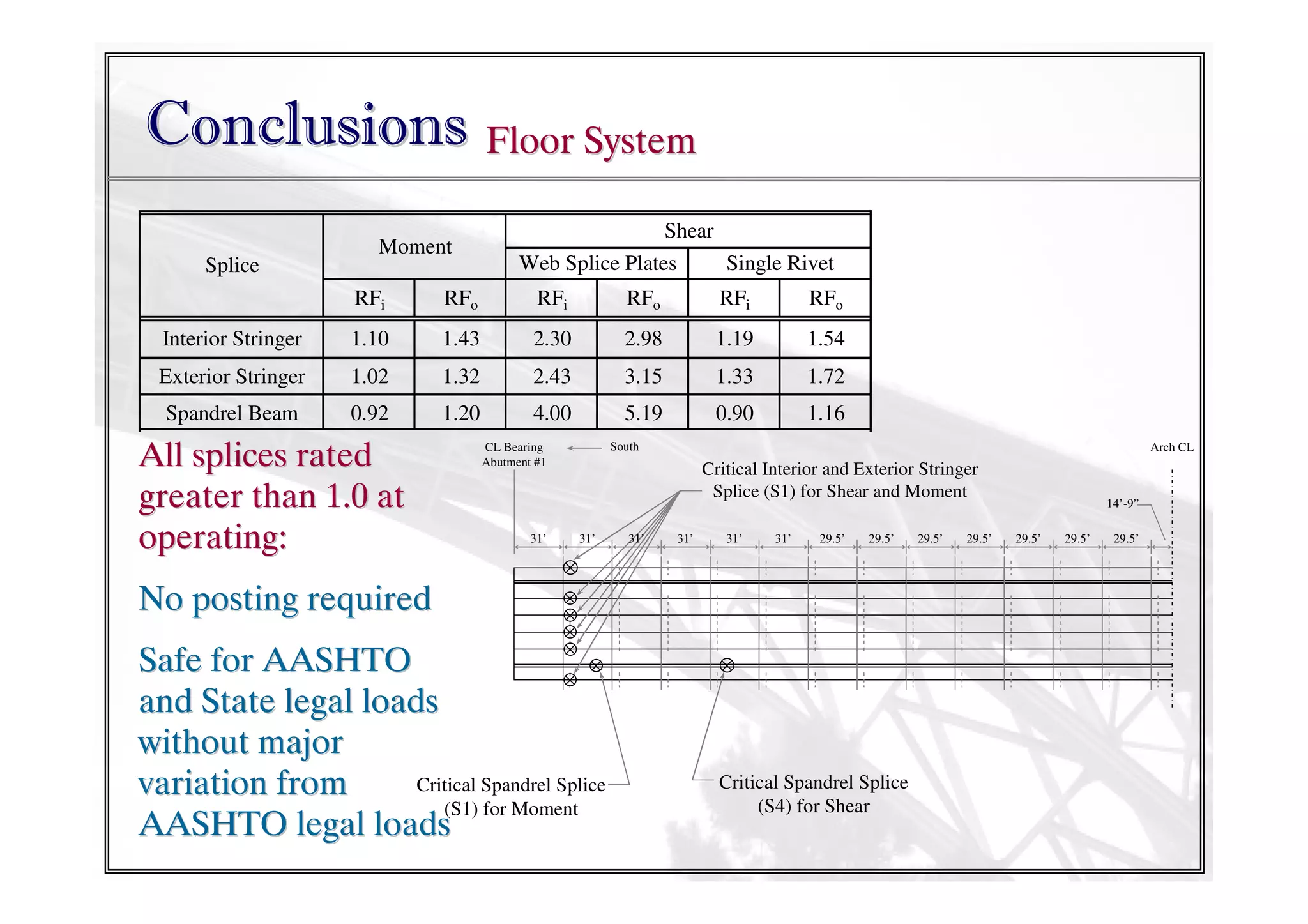
All splices rated
greater than 1.0 at
operating:

South

CL Bearing
Abutment #1

31’

Arch CL

Critical Interior and Exterior Stringer
Splice (S1) for Shear and Moment
31’

31’

31’

31’

31’

29.5’

29.5’

No posting required
Safe for AASHTO
and State legal loads
without major
Critical Spandrel Splice
variation from
(S1) for Moment
AASHTO legal loads

Critical Spandrel Splice
(S4) for Shear

29.5’

29.5’

14’-9”
29.5’

29.5’

29.5’
Conclusions Columns & Arch Ribs
Splice

Moment

Shear
Web Splice Plates
Single Rivet
RFi
RFo
RFi
RFo

RFi

RFo

Arch Column

1.03

1.34

8.39

10.88

1.93

2.50

Skewback Column

2.81

3.65

36.85

47.77

6.95

9.01

Arch Rib

0.82

1.06

8.05

10.4

2.37

3.07

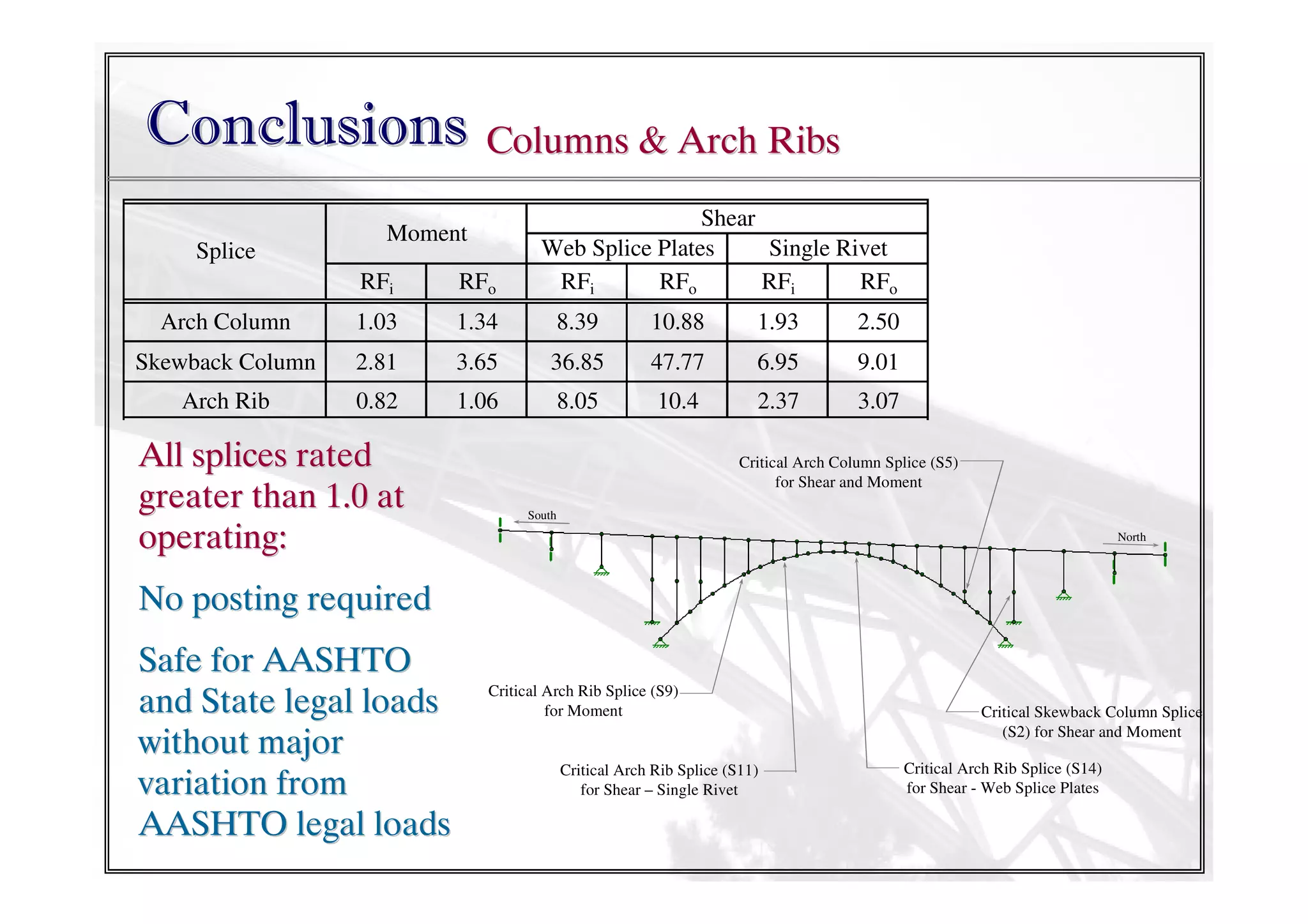
All splices rated
greater than 1.0 at
operating:

Critical Arch Column Splice (S5)
for Shear and Moment
South
North

No posting required
Safe for AASHTO
and State legal loads
without major
variation from
AASHTO legal loads

Critical Arch Rib Splice (S9)
for Moment

Critical Arch Rib Splice (S11)
for Shear – Single Rivet

Critical Skewback Column Splice
(S2) for Shear and Moment
Critical Arch Rib Splice (S14)
for Shear - Web Splice Plates
Recommendations
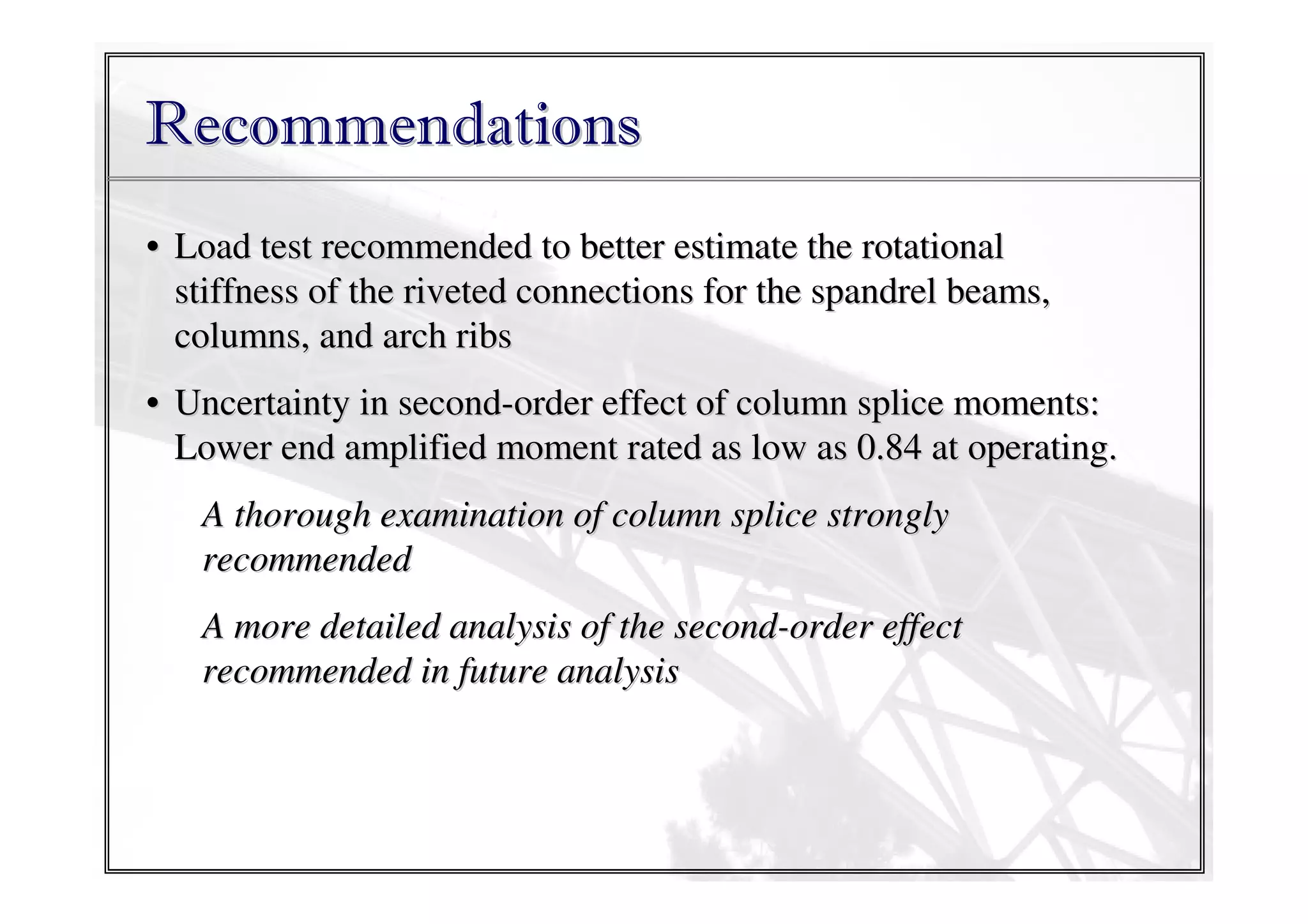
• Load test recommended to better estimate the rotational
stiffness of the riveted connections for the spandrel beams,
columns, and arch ribs
• Uncertainty in second-order effect of column splice moments:
Lower end amplified moment rated as low as 0.84 at operating.
A thorough examination of column splice strongly
recommended
A more detailed analysis of the second-order effect
recommended in future analysis
Recommendations
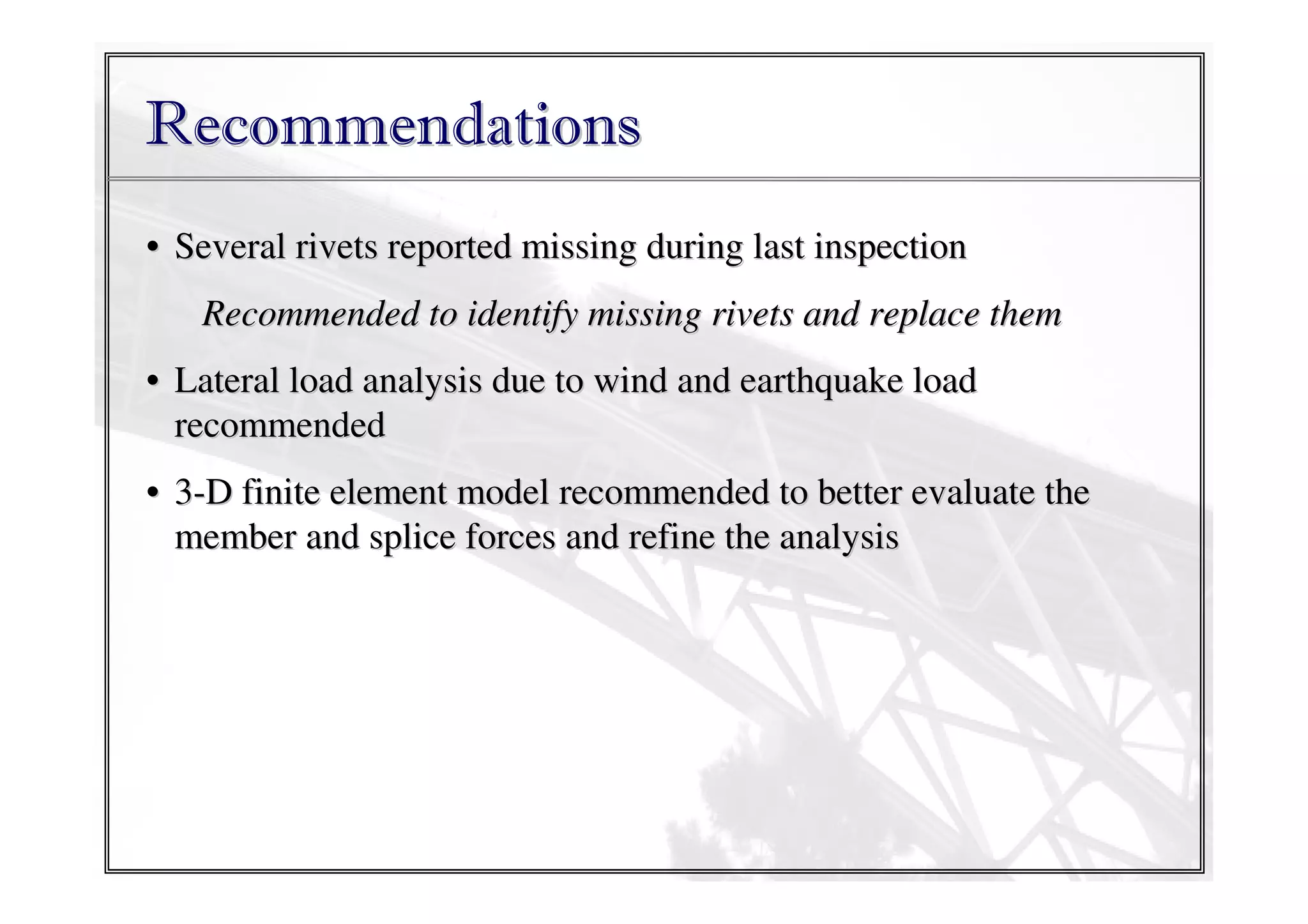
• Several rivets reported missing during last inspection
Recommended to identify missing rivets and replace them
• Lateral load analysis due to wind and earthquake load
recommended
• 3-D finite element model recommended to better evaluate the
member and splice forces and refine the analysis
References
American Association of State Highway and Transportation Officials (AASHTO). (2003). Manual for Condition Evaluation
and Load and Resistance Factor Rating (LRFR) of Highway Bridges, Washington, DC.
American Association of State Highway and Transportation Officials (AASHTO). (2004). LRFD Bridge Design Specifications,
3rd Edition, Washington, DC.
American Institute of Steel Construction (AISC). (2001). Manual of Steel Construction: Load and Resistance Factor Design,
3rd Edition, Chicago, IL.
FDOT (Florida Department of Transportation). 2007. 24 August 2007
<http:www.dot.state.fl.us/structures/LoadRatingSummit/AskTheProfessor.htm>
Garrett, Gregory P. “Analytical Load Rating of an Open-Spandrel Arch Bridge: Case Study.” Journal of Bridge Engineering
(January/February 2007): 13-20.
Gaylord, Edwin H., Charles Gaylord, and James Stallmeyer. Design of Steel Structures, 3rd Edition. New York: McGraw-Hill,
1992
McCormac, Jack C., and James K. Nelson Jr. Structural Steel Design: LRFD Method, 3rd Edition.Upper Saddle River, NJ:
Prentice Hall, 2002
Salmon, Charles G. and John E. Johnson. Steel Structures: Design and Behavior, 4th Edition. New York: Harper Collins, 1996
Tuyen, Nguyenngoc. Load Rating of a Riveted Steel Arch Bridge. Las Cruces, NM: New Mexico State University, 2005
Vinnakota, Sriramulu. Steel Structures: Behavior and LRFD. New York: McGraw-Hill, 2006
Questions?

CM - Jauregui - Sapienza University of Rome (60 min, part ii, connections modified)

  • 1.
    Load Rating ofRiveted Steel Arch Bridge Connections David V. Jauregui, PhD, PE November 28th, 2013 Sapienza University of Rome
  • 2.
    Overview • Introduction • LoadRating Method • Load Rating of: StringersSplices Stringer Splices Spandrel Splices Column Splices Arch RibsSplices Rib Splices • Conclusions & Recommendations
  • 3.
    Introduction Bridge Background •Name: The Los Alamos Canyon Bridge (a.k.a. the Omega Bridge) • Steel arch riveted bridge • Designed & built in 1951 following 1944 AASHTO specifications • Carries traffic from town of Los Alamos and the LANL (Los Alamos National Laboratory) • Bridge reduced the travel distance from 1.9 miles on a steep grade to 820 ft: critical for emergency vehicles • Owned and maintained by the LANL
  • 4.
    Introduction Research Objectives Connectionscommonly assumed to have equal or greater capacity than the members they adjoin Failure of connections could be critical • Provide the LANL with up-to-date rating factors for the Omega Bridge splice connections LRFD is the required method of design by FHWA since October 2007: Need for rating methodology consistent with the design method. No guidance in rating connections • Provide guidance in load rating connections using LRFR method to bridge engineers
  • 5.
    Introduction Research Aids •2003 AASHTO Manual for Condition Evaluation and Load and Resistance Factor Rating of Highway Bridges • Research by Tuyen (2005) • RISA for structural analysis • MathCAD to calculate rating factors • Others: Original plans of the bridge, AISC steel manual, etc.
  • 6.
  • 7.
    Load Rating MethodLRFR • Load rating provides the basis for determining the safe load capacity of a bridge in terms of a rating factor. • Rating factor is the ratio of the available to required live load capacity: Available live load capacity RF = ≥ 1.0 Required live load capacity
  • 8.
    Start Load Rating MethodLRFR Design Load Check RF > 1 (HL-93) -No Restrictive Posting Requireda -May be evaluated for permit vehicle Inventory Level Reliability • Three Stages of load rating in LRFR: Design Load Rating RF <1 Check at operating level reliability RF <1 Legal load Rating AASHTO or State legal loads Legal Load Rating RF > 1 a b RF > 1 Evaluation level reliability RF <1 Higher Level Evaluation (Optional) -Refined analysis RF <1 RF > 1 -Load testing -Site-specific load factors -Direct safety assessment -Initiate load posting and/or repair/rehab -No permit vehicles -No restrictive posting requiredb -May be evaluated for permit vehicles Permit Load Rating For AASHTO legal loads and state legal loads within the LRFD exclusion limits For AASHTO legal loads and state legal loads having only minor variations from the AASHTO legal loads
  • 9.
    Load Rating MethodLRFR General Equation for LRFR: φcφsφRn − γ DC DC − γ DW DW RF = γ LL LL(1 + IM ) where RF = Rating Factor φc, φs = Condition and system factor, respectively φRn = Splice capacity γDC, γDW, γLL = factors for dead load due to components and attachments, wearing surface, and live load, respectively DC, DW, LL = effects due to dead load due to components and attachments, wearing surface, and live load, respectively IM = Dynamic load allowance (or impact factor)
  • 10.
    Load Rating MethodLRFR φcφsφRn − γ DC DC − γ DW DW RF = γ LL LL(1 + IM ) Super Structure Condition Ratings: 5.0 and higher: Condition Factor, φc = 0.95 (LRFR Table C6-1 and 6-2) System Factor, φs: (LRFR Table 6-3) 1.0 for stringers Redundant stringer systems between floor beams 0.9 for spandrel beam, columns, and arch ribs Riveted members in twogirder/truss/arch bridges
  • 11.
    Load Rating MethodLRFR φcφsφRn − γ DC DC − γ DW DW RF = γ LL LL(1 + IM ) Load Factors: γDC = 1.25 γDW = 1.5 γLL = 1.75 for inventory 1.35 for operating
  • 12.
    Load Rating MethodLRFR (a) TRUCK LOADS: HS-20 and Design Tandem 8k φcφsφRn − γ DC DC − γ DW DW RF = 32k 32k 25k γ LL LL(1 + IM ) 25k For each member, distribution factor for different force effects must be applied: i.e., to 30moment or DFshear 4 ft 14ft 14 DF ft Live Load Effect = γ LL DF [Lane + Design Tandem IM)] Truck (1 + (Longitudinal) HS-20 (Longitudinal) (b) LANE LOAD Controlled by larger effect between HS-20 or Design Tandem Lane Load = 0.64 klf
  • 13.
    Load Rating MethodLRFR • Three Stages of load rating in LRFR: Design Load Rating Legal Load Rating Permit Load Rating
  • 14.
  • 15.
    Rating Stringer SpliceBasic Information CL Bearing Abutment #1 Arch CL South 407’-3” • 2 Exterior Stringers: ASTM A36 Steel (Fy = 36 ksi) – W21x83 14’-9” • 4 Interior Stringers: 31’ASTM A7 Steel 29.5’ y = 33 29.5’ ) – W21x62 (F 29.5’ ksi 29.5’ 29.5’ 29.5’ 31’ 31’ 31’ 31’ 31’ 29.5’ SP#1 SP#2 • Total of 27 spans: 6’-9” SP#3 SP#4 SP#5 SP#6 SP#7 SP#8 SP#9 SP#10 SP#11 SP#12 Six approach spans of 31 ft on each end SP#13 7’-4 1/2” 15 interior spans of 29.5 ft over arch 3@ 6’-9” 7’-4 1/2” • 6’-9” Total of 26 splices: 6 ft from the floor beam supports 6’-0” (Typical) Exterior Stringers Stringer Splice Interior Stringers Spandrel Beams Floor Beam
  • 16.
    Rating Stringer SpliceSplice Configuration • Same splice configuration for both interior and exterior stringers 5 SPA @ 3” = 1’- 3” 1 1/2” Min. 7/8”φ H.S. Bolts (Typical) PL 5/16” x 12 1/2” x 1’- 6” (Both Sides of Web) 1’- 6” 4 SPA @ 3” = 1’- 0” 1 1/2” Min. 1 11/16” 2’- 6 1/2” 1 1/2” Min. (Typ.) 1/2” Max. 3” (Typ.) 1 1/2” Min. 1 1/2” Min. 12 1/2” PL 7/8” x 8 1/4” x 2’- 6 1/2” (Typ. Both Flanges)
  • 17.
    Rating Stringer SpliceLoads • Dead load applied to the stringers: •Interior Stringer – WDead = 556 lb/ft •Exterior Stringer – WDead = 609 lb/ft • Live load applied using moving load tool in RISA:
  • 18.
    Rating Stringer SpliceLoads • Used Influence Line for lane load placement 0.64 klf 0.64 klf 0.64 klf
  • 19.
    Rating Stringer Splice ForceDistribution on the Cross-Section CflangePL CwebPL Flange PL NA Stress at outside edge of Web PL Web PL dwebPL TwebPL Stress at inside edge of Flange PL dflangePL TflangePL Stress at outermost surface Stress, σ Force = σ x Ai Splice 1 controls for both moment and shear! c
  • 20.
    Rating Stringer SpliceLimit States • Limit States for the Flange PL Group: Yielding on the gross section Fracture on the net section Block Shear Shear strength of the rivets Bearing strength of the plates • Limit States for the Web PL Group: Yielding on the gross section Fracture on the net section Shear strength of the rivets (for a single rivet) Bearing strength of the plates (for a single rivet)
  • 21.
    Rating Stringer SpliceLimit States Tensile Limit States (kip) Stringer Yielding on Gross Area Fracture on Net Area Block Shear Shear Strength of Rivets Bearing Strength of Plate Interior 214.4 270.7 610.7 126.3 831.6 Exterior 233.9 237.9 550.5 126.3 730.8 Shear Limit States (kip) Stringer Yielding on Gross Area Fracture on Net Area Shear Strength of Rivetsa Bearing Strength of Platea Interior 200.5 222.8 25.26 24.50 Exterior 218.7 195.8 25.26 16.82 a Values for a single rivet
  • 22.
    Rating Stringer SpliceCombined Loading at Web V/12 V c.g. of Web PL R1 V/12 R2 V V c.g. of Rivet Group M V/12 MT = M + Ve R4 R3 Ry4 Rx4 e Total Moment on web splice PL MT = M +V ⋅e Resultant shear due to moment and direct shear: VR = Rx 2 V   +  Ry +  12   2
  • 23.
    Rating Stringer SpliceDistribution Factors Interior Stringer: LRFD Table 4.6.2.2.2b-1 Shear DF Moment DF One Lane Loaded Two or More Lanes Loaded 0.1 g m.i.1 0.4 0.3  S   S   Kg   = 0.06 +       12.0 Lt 3   14   L   s  g m.i.2  S   S   Kg   = 0.075 +       12.0 Lt 3   9 .5   L   s  0.6 All Range of Applicability are met 0.2 g v.i.1 = 0.36 + 0.1 g v.i.2 S 25.0 S S  = 0 .2 + −   12  35  2.0
  • 24.
    Rating Stringer SpliceDistribution Factors Exterior Stringer: LRFD Article 4.6.2.2.2d Moment DF One Lane Loaded Lever Rule Shear DF Lever Rule Two or More Lanes Loaded g m.e.2 = e ⋅ g m.i.2 g v.e.2 = e ⋅ g v.i.2 One Lane Loaded - RBM Rigid Body Motion Rigid Body Motion Two or More Lanes Loaded -RBM Rigid Body Motion Rigid Body Motion
  • 25.
    Rating Stringer SpliceDistribution Factors DF Type Interior Stringer Moment Shear Exterior Stringer Moment Shear One Lane Loaded 0.494 0.630 0.667 0.667 Two or More Lanes Loaded 0.627 0.725 0.621 0.580 0.451 0.451 0.632 0.632 0.667 0.667 Rigid Body Motion One Lane Loaded N/A Two or more Lanes Loaded Controlling DF 0.627 0.725
  • 26.
    Rating Stringer SpliceRating Factors Stringer Moment (Flange Splice Plates) Shear Web splice plates Single Rivet Inventory Operating Inventory Operating Inventory Operating Interior 1.10 1.43 2.30 2.98 1.19 1.54 Exterior 1.02 1.32 2.43 3.15 1.33 1.72
  • 27.
  • 28.
    Rating Spandrel SpliceBasic Information CL Bearing • 2 Abutment #1 Beams: Spandrel South ASTM A7 Steel (Fy = 33 ksi) • Total of 21 spans: Three approach spans of 62 ft on each 14’-9” end 62’ 6’-9” 62’ SP#1 SP#2 SP#3 Arch CL 407’-3” 62’ 29.5’ 15 interior spans29.5’ 29.5ft29.5’ 29.5’ 29.5’ of 29.5’ SP#9 SP#10 SP#11 over arch SP#4 SP#5 SP#6 SP#7 SP#8 29.5’ SP#12 SP#13 7’-4 1/2” • Total of 26 splices: First five splices: 15.5 ft from pier and 3@ 6’-9” skewback column supports 7’-4 1/2” 6’-9” 15.5’ Typ. Remaining splices: 7.25 ft from arch column 7.25’ Typ. supports Exterior Stringers Spandrel Beams Floor Beam Interior Stringers
  • 29.
    Rating Spandrel SpliceSplice Configuration 3” 2.5” 4” 4” 1.5” 3” 1.75” 2.5” 3” 12 ½” x 5/16” x 2’-1” 4” 12 ½” x 5/16” x 1’-5” 3 ½” x 3 ½” x ½ x 2’-0 ½” 12 ½” x 5/16” x 5’-0” 12 ½” x 5/16” x 4’-8” 16 @ 3” 5 ¼” x 1/2” x 3’-6 ½” 3” 5” 6” x 1/2” x 3’-6 ½” 3” 3” 6” x 5/8” x 3’-6 ½” 7” x 1/2” x 3’-6 ½” 3”
  • 30.
    Rating Spandrel SpliceLimit States Moment Limit States (kip) Plate Group Yielding on Fracture on Shear Strength Bearing Strength of Block Shear Gross Area Net Area of Rivets Plate Top Flange 464.1 556.9 544.5 353.6 722.8 Bottom Flange 382.4 426.9 643.5 353.6 1726 Shear Limit States (kip) Plate Group Yielding on Fracture on Gross Area Net Area Web a For a single rivet 623.7 881.7 Shear Strenght of Rivetsa Bearing Strength of Platea 25.3 23.0
  • 31.
    Rating Spandrel SpliceDistribution Factors • One spandrel beam on each edge of the bridge width Considered as an exterior beam for moment DF • Use the lever rule to determine moment distribution factors: 1.764 2.094 1.929 1.328 4 lanes loaded 3 lanes loaded 2 lanes loaded 1 lane loaded Controls! Includes the multiple presence factor • LRFD Table 4.6.2.2.3.b-1 states the distribution factor for shear of an exterior beam is also determined using the lever rule: DFmoment = DFshear
  • 32.
    Rating Spandrel SpliceRating Factors Moment Rating Factor Critical Splice Moment Rating RFi Shear Rating Factor Critical Splice RFi RFo Web Splice Plates 4.00 5.19 Single Rivet 0.90 1.16 RFo Top FL Plate Group S1 1.27 1.65 S6 1.33 1.72 Bottom FL Plate Group S1 0.92 1.20 S6 0.92 1.20 Splice S1 had larger moment due to truck load in magnitude Shear Rating
  • 33.
  • 34.
    Rating Column SpliceBasic Information • Total of 20 columns: 4 Pier columns 2 Skewback columns 14 Arch columns • Splices in six tallest columns: 55 ft below the deck grade Arch Column Splices S3 S1 Roller S4 S5 S6 S2 Pinned Skewback Column Splice Fixed Skewback Column Splice
  • 35.
    Rating Column SpliceSplice Configuration Arch Column Splice 1.5” 5 @ 3” 4 Angles 4” x 4” x 1/2” 4 Angles 5” x 5” x 3/4” x 3’- 1/2” 3” 3.5” 24” 4 Plates 24” x 1/2” 1.25” 3.5” 3” 8 Plates 12” x 1/3” x 1’- 3” 1.25” 4 @ 3” 5 @ 3” 1.5” 24.5” 1.5” 1.5”
  • 36.
    Rating Column SpliceSplice Configuration Skewback Column Splice 48.5” back to back 4” x 4” x ½” 24” x ½” 48” x ½” 16” 48” 12” 4 @ 3” 4 Angles: 5” x 5” x ¾” x 3’-6 ½” 8 Plates: 12” x 3/8” x 1’-4” 2 Plates: 12” x 3/8” x 3’-4” 2” 42.5”
  • 37.
    Rating Column SpliceModeling: Member • The riveted connection stiffness is uncertain • Two models: COLUMN and BEAM-COLUMN • Actual connection stiffness somewhere in between COLUMN and BEAM-COLUMN models • Previous work found that BEAM-COLUMN model yielded significantly smaller rating factors: thus, chosen as critical model.
  • 38.
    Rating Column SpliceLimit States Flange Plates: Gross yielding PL based Limit States Net fracture Block shear Rivet based Shear strength of rivets Limit States Bearing strength of PL Total Capacity = smaller of [φRnFlangePL + φRnAngles]PL-Based [φRnFlangePL + φRnAngles]Rivet-Based Angles: Gross yielding Net fracture Block shear Shear strength of rivets Bearing strength of PL
  • 39.
    Rating Column SpliceLimit States Splice Component Plate-Based Limit States (kips) Rivet -Based Limit States (kips) Gross Yield Net Fracture Block Shear Rivet Shear Plate Bearing Plates Arch Column 297.0 330.0 240.9 252.6 501.2 Angle 412.1 538.3 1073 151.5 1743 Control = 653.0 = 404.1 Plates Skewback Column 356.4 429.0 419.5 252.6 501.2 Angle 412.1 538.3 1344 176.8 2055 Control 768.5 429.3 Controls tension capacity for Arch Column Splice!
  • 40.
    Rating Column SpliceSecond-Order Effect • No bracing between columns: Sway Frame • For a beam-column in sway frame, the maximum first order moments are amplified using the second order effect given in LRFD Article 4.5.3.2.2b • Non-sway and sway moments must be amplified by non-sway (δb) and sway (δs) magnification factors • Previous work determined δb = δs = 1.0
  • 41.
    Rating Column SpliceSecond-Order Effect δb < 1.0 Amplified Moment First-Order Moment δb >1.0 Amplified Moment Max. Moment First-Order Moment Max. Moment Splice Location Moment End Moment Higher Limit Lower Limit Range Splice Location Moment End Moment
  • 42.
    Rating Column SpliceDistribution Factors • Columns in eastern arch rib controlled • Live load distribution factors determined using the same method as the spandrel beam DFmoment = DFshear = 2.094
  • 43.
    Rating Column SpliceRating Factors Moment Rating Factors δb = 1.0 @ splice δb > 1.0 @ splice Splice Average RFi RFo RFi RFo RFi RFo Arch S5 1.41 1.83 0.65 0.84 1.03 1.34 Skewback S2 3.79 4.91 1.84 2.38 2.81 3.65 Shear Rating Factors Splice Web Splice Plates Single Rivet RFi RFo RFi RFo Arch S5 8.39 10.9 1.93 2.50 Skewback S2 36.8 47.8 6.95 9.01
  • 44.
  • 45.
    Rating Arch RibSplice Basic Information • Total of 15 arch rib segments per arch plane • Center 13 arch rib segments are spliced (Labeled as S7 through S19 below) South North 9 10 13 14 11 12 15 16 17 18 8 19 7 Pinned Pinned Arch Rib Splice #
  • 46.
    Rating Arch RibSplice Splice Configuration 46” x 3/4” 8” x 8” x 3/4” 18 1/2” x 3/4” x 3’ 9” 7 1/4” x 7 1/4” x 7/8” x 3’ 6 ½” 18 1/2” x 3/4” x 9” 71 1/2” x 1/2” 12 1/2” x 5/8” x 2’ 0”
  • 47.
    Rating Arch RibSplice Modeling: Member • Two models considered: RIGID and PINNED • Used Influence Line to determine which model produces lower rating factors RIGID Model PINNED Model 1.0 1.45 1.0 rad Skewback Column Quarter Point Arch Splice Skewback Column 1.0 rad Quarter Point Arch Splice
  • 48.
    Rating Arch RibSplice Second Order Effect • LRFD Article 4.5.3.2.2c specifies live load moments in arch ribs including impact “shall be increased by the moment magnification factor, δb” Cm δb = ≥ 1.0 Pu 1− φPe Pe = lu = half of the arch length π 2 EI K = f (type of arch, rise-to-span ratio of arch) (Klu )2 Cm = 1.0 Axial Forces (kips) Dead Load HS-20 Lane Moment Amplification Factor, δb S9 1015 43.8 70.4 1.31 S17 1015 42.5 52.8 1.30 Splice
  • 49.
    Rating Arch RibSplice Distribution Factors • Arch ribs in eastern arch rib controlled • Live load distribution factors determined using the same method as the spandrel beam DFmoment = DFshear = 2.094
  • 50.
    Rating Arch RibSplice Rating Factors Moment Splices (Flange Splice Plates) Inventory Operating S9 1.06 S17 Splices 0.82 0.84 1.09 Shear Web Splice Plates Single Rivet Inventory Operating Inventory Operating S7 13.5 17.5 2.58 3.35 S8 13.8 17.9 2.68 3.47 S11 9.4 12.2 2.37 3.07 S14 8.1 10.4 2.66 3.45 S17 15.8 20.5 2.70 3.50
  • 51.
  • 52.
    Conclusions Floor System Splice Moment Shear WebSplice Plates Single Rivet RFi RFo RFi RFo RFi RFo Interior Stringer 1.10 1.43 2.30 2.98 1.19 1.54 Exterior Stringer 1.02 1.32 2.43 3.15 1.33 1.72 Spandrel Beam 0.92 1.20 4.00 5.19 0.90 1.16 All splices rated greater than 1.0 at operating: South CL Bearing Abutment #1 31’ Arch CL Critical Interior and Exterior Stringer Splice (S1) for Shear and Moment 31’ 31’ 31’ 31’ 31’ 29.5’ 29.5’ No posting required Safe for AASHTO and State legal loads without major Critical Spandrel Splice variation from (S1) for Moment AASHTO legal loads Critical Spandrel Splice (S4) for Shear 29.5’ 29.5’ 14’-9” 29.5’ 29.5’ 29.5’
  • 53.
    Conclusions Columns &Arch Ribs Splice Moment Shear Web Splice Plates Single Rivet RFi RFo RFi RFo RFi RFo Arch Column 1.03 1.34 8.39 10.88 1.93 2.50 Skewback Column 2.81 3.65 36.85 47.77 6.95 9.01 Arch Rib 0.82 1.06 8.05 10.4 2.37 3.07 All splices rated greater than 1.0 at operating: Critical Arch Column Splice (S5) for Shear and Moment South North No posting required Safe for AASHTO and State legal loads without major variation from AASHTO legal loads Critical Arch Rib Splice (S9) for Moment Critical Arch Rib Splice (S11) for Shear – Single Rivet Critical Skewback Column Splice (S2) for Shear and Moment Critical Arch Rib Splice (S14) for Shear - Web Splice Plates
  • 54.
    Recommendations • Load testrecommended to better estimate the rotational stiffness of the riveted connections for the spandrel beams, columns, and arch ribs • Uncertainty in second-order effect of column splice moments: Lower end amplified moment rated as low as 0.84 at operating. A thorough examination of column splice strongly recommended A more detailed analysis of the second-order effect recommended in future analysis
  • 55.
    Recommendations • Several rivetsreported missing during last inspection Recommended to identify missing rivets and replace them • Lateral load analysis due to wind and earthquake load recommended • 3-D finite element model recommended to better evaluate the member and splice forces and refine the analysis
  • 56.
    References American Association ofState Highway and Transportation Officials (AASHTO). (2003). Manual for Condition Evaluation and Load and Resistance Factor Rating (LRFR) of Highway Bridges, Washington, DC. American Association of State Highway and Transportation Officials (AASHTO). (2004). LRFD Bridge Design Specifications, 3rd Edition, Washington, DC. American Institute of Steel Construction (AISC). (2001). Manual of Steel Construction: Load and Resistance Factor Design, 3rd Edition, Chicago, IL. FDOT (Florida Department of Transportation). 2007. 24 August 2007 <http:www.dot.state.fl.us/structures/LoadRatingSummit/AskTheProfessor.htm> Garrett, Gregory P. “Analytical Load Rating of an Open-Spandrel Arch Bridge: Case Study.” Journal of Bridge Engineering (January/February 2007): 13-20. Gaylord, Edwin H., Charles Gaylord, and James Stallmeyer. Design of Steel Structures, 3rd Edition. New York: McGraw-Hill, 1992 McCormac, Jack C., and James K. Nelson Jr. Structural Steel Design: LRFD Method, 3rd Edition.Upper Saddle River, NJ: Prentice Hall, 2002 Salmon, Charles G. and John E. Johnson. Steel Structures: Design and Behavior, 4th Edition. New York: Harper Collins, 1996 Tuyen, Nguyenngoc. Load Rating of a Riveted Steel Arch Bridge. Las Cruces, NM: New Mexico State University, 2005 Vinnakota, Sriramulu. Steel Structures: Behavior and LRFD. New York: McGraw-Hill, 2006
  • 57.