MATERIALS FOR
BRIDGE
CONSTRUCTION
Presented by
B.BALA SUBRAHMANYAM M.Tech
Assistant professor
INTRODUCTIONINTRODUCTION
Use of advanced composites in repair of
bridge columns and other supporting
elements to improve their ductility for
seismic resistance.
EPOXY IMPREGNATED
FIBERGLASS
CARBON FIBER
ADVANCED COMPOSITES IN BRIDGEADVANCED COMPOSITES IN BRIDGE
APPLICATIONSAPPLICATIONS
To develop techniques for utilizing epoxy
impregnated fiberglass sheets to wrap around older,
non-ductile concrete bridge columns as an alternative
to the already proven steel jacket technique.
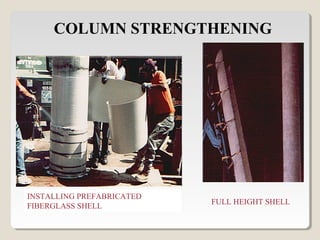
COLUMN STRENGTHENING
INSTALLING PREFABRICATED
FIBERGLASS SHELL
FULL HEIGHT SHELL
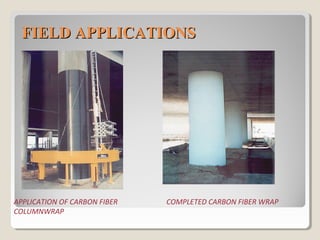
FIELD APPLICATIONSFIELD APPLICATIONS
APPLICATION OF CARBON FIBER
COLUMNWRAP
COMPLETED CARBON FIBER WRAP
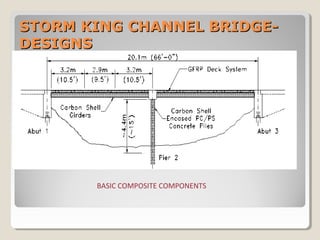
STORM KING CHANNEL BRIDGE-STORM KING CHANNEL BRIDGE-
DESIGNSDESIGNS
BASIC COMPOSITE COMPONENTS
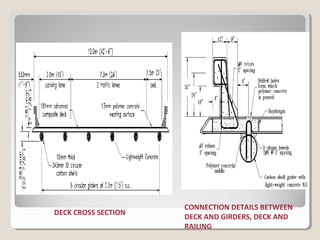
DECK CROSS SECTION
CONNECTION DETAILS BETWEEN
DECK AND GIRDERS, DECK AND
RAILING
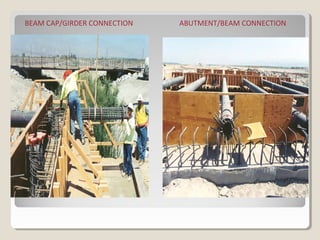
BEAM CAP/GIRDER CONNECTION ABUTMENT/BEAM CONNECTION
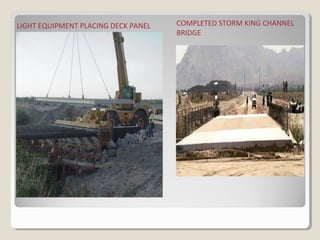
LIGHT EQUIPMENT PLACING DECK PANEL COMPLETED STORM KING CHANNEL
BRIDGE
DESIGN ISSUES AND DURABILITYDESIGN ISSUES AND DURABILITY
CONCERNSCONCERNS
• Product documentation consistent with application
• Process Control
• Material Selection Criteria
• Material physical properties
• Long term durability (chemical and physical) testing of the
composite against:
•Moisture
•Salt attack
•Alkali attack
•Ozone
•High/low temperature extremes
•Ultra violet
•Other
• Quality control in manufacturing, mixing and applying
• Fiber content, voids, resin ratio
• Design guidelines for the specific composite
• Safety factors
• Damage and failure modes
• Adequate specifications
• Repeatability and consistency
• Acceptable field erection methods
• Effect of fatigue on bond behavior
• Performance under dynamic load
• Testing under sustained loading
• Qualifications of suppliers and product designers
• Cure temperature
• Transportation, handling
• Maintenance issues
OVERVIEWOVERVIEW
Primarily focuses on two areas of applications:
1 - Seismic retrofit of bridges.
2 - Bridge strengthening and rehabilitation methods.
CONCLUSIONCONCLUSION
Utilize the advanced composite materials in seismic
retrofit strengthening of bridge columns and other
structural members. The goal is to increase
the shear capacity and develop ductile performance
in these members during a seismic event.
Composite materials for bridge construction

Composite materials for bridge construction

  • 1.
    MATERIALS FOR BRIDGE CONSTRUCTION Presented by B.BALASUBRAHMANYAM M.Tech Assistant professor
  • 2.
  • 3.
    Use of advancedcomposites in repair of bridge columns and other supporting elements to improve their ductility for seismic resistance. EPOXY IMPREGNATED FIBERGLASS CARBON FIBER
  • 4.
    ADVANCED COMPOSITES INBRIDGEADVANCED COMPOSITES IN BRIDGE APPLICATIONSAPPLICATIONS To develop techniques for utilizing epoxy impregnated fiberglass sheets to wrap around older, non-ductile concrete bridge columns as an alternative to the already proven steel jacket technique.
  • 5.
  • 7.
    FIELD APPLICATIONSFIELD APPLICATIONS APPLICATIONOF CARBON FIBER COLUMNWRAP COMPLETED CARBON FIBER WRAP
  • 8.
    STORM KING CHANNELBRIDGE-STORM KING CHANNEL BRIDGE- DESIGNSDESIGNS BASIC COMPOSITE COMPONENTS
  • 9.
    DECK CROSS SECTION CONNECTIONDETAILS BETWEEN DECK AND GIRDERS, DECK AND RAILING
  • 10.
    BEAM CAP/GIRDER CONNECTIONABUTMENT/BEAM CONNECTION
  • 11.
    LIGHT EQUIPMENT PLACINGDECK PANEL COMPLETED STORM KING CHANNEL BRIDGE
  • 12.
    DESIGN ISSUES ANDDURABILITYDESIGN ISSUES AND DURABILITY CONCERNSCONCERNS • Product documentation consistent with application • Process Control • Material Selection Criteria • Material physical properties • Long term durability (chemical and physical) testing of the composite against: •Moisture •Salt attack •Alkali attack •Ozone •High/low temperature extremes •Ultra violet •Other
  • 13.
    • Quality controlin manufacturing, mixing and applying • Fiber content, voids, resin ratio • Design guidelines for the specific composite • Safety factors • Damage and failure modes • Adequate specifications • Repeatability and consistency • Acceptable field erection methods • Effect of fatigue on bond behavior • Performance under dynamic load • Testing under sustained loading • Qualifications of suppliers and product designers • Cure temperature • Transportation, handling • Maintenance issues
  • 14.
    OVERVIEWOVERVIEW Primarily focuses ontwo areas of applications: 1 - Seismic retrofit of bridges. 2 - Bridge strengthening and rehabilitation methods.
  • 15.
    CONCLUSIONCONCLUSION Utilize the advancedcomposite materials in seismic retrofit strengthening of bridge columns and other structural members. The goal is to increase the shear capacity and develop ductile performance in these members during a seismic event.