CONTENTS
• INTRODUCTION
• HISTORY
• MECHANISM
- Auxin
- Gene action
- Phototropins
• Five models of auxin distribution
• CONCLUSION
31-05-2017 3
INTRODUCTION
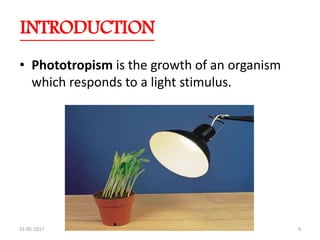
• Phototropism is the growth of an organism
which responds to a light stimulus.
31-05-2017 4
31-05-2017 5
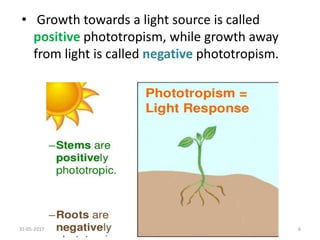
• Growth towards a light source is called
positive phototropism, while growth away
from light is called negative phototropism.
31-05-2017 6
• Most plant shoots exhibit positive
phototropism, and rearrange their chloroplasts
in the leaves to maximize photosynthetic energy
and promote growth.
• Roots usually exhibit negative phototropism,
although gravitropism may play a larger role in
root behavior and growth.
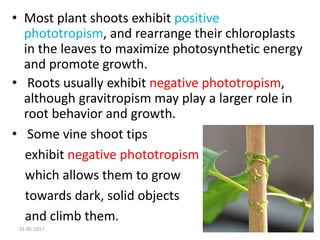
• Some vine shoot tips
exhibit negative phototropism
which allows them to grow
towards dark, solid objects
and climb them.
31-05-2017 7
HISTORY OF PHOTOPERIODISM
• The best known early research on phototropism
was by Charles Darwin, who reported his
experiments in a book published in 1880, The
Power of Movement in Plants.
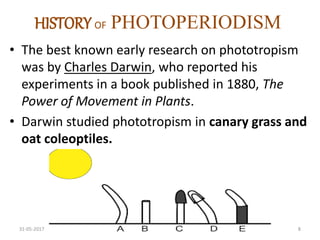
• Darwin studied phototropism in canary grass and
oat coleoptiles.
31-05-2017 8
Darwin conclusions
• The tip of the coleoptile is the most
photosensitive region.
• The middle of the coleoptile is responsible for
most of the bending.
• An influence which causes bending is transmitted
from the top to the middle of the coleoptile.
31-05-2017 9
Boysen-Jensen’s experiment (1913)
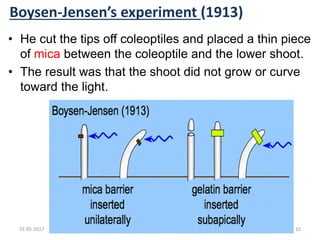
• He cut the tips off coleoptiles and placed a thin piece
of mica between the coleoptile and the lower shoot.
• The result was that the shoot did not grow or curve
toward the light.
31-05-2017 10
• When he repeated the experiment using a block of
agar instead, the result was that the shoot grew and
curved towards the light.
Conclusion,
• The chemical signal was a growth stimulant as the
phototropic response involves faster cell elongation
on the shady side than on the illuminated side.
31-05-2017 11
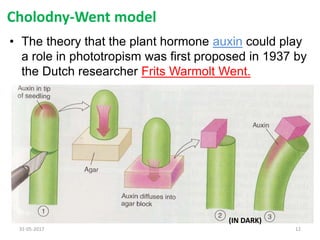
Cholodny-Went model
• The theory that the plant hormone auxin could play
a role in phototropism was first proposed in 1937 by
the Dutch researcher Frits Warmolt Went.
31-05-2017 12
(IN DARK)
• When the agar block was centred on top the
coleoptile grew straight.
• If the agar block was offset, resulting in an uneven
distribution of the chemical on one side, the shoot
would curve as though it was growing towards a light
source.
Conclusions,
• This proved that the response was due to a water
soluble chemical that diffused from the tip of the plant
down the dark / shaded side of the coleoptile causing
it to curve towards the light.
• Went repeated the experiment with agar that had not
been treated, which produced no growth.
31-05-2017 13
MECHANISM
• Several of signaling molecules - determine where
the light source - activates several genes - change
the hormone gradients - allowing the plant to grow
towards the light
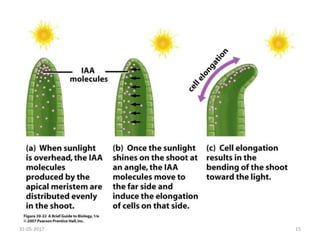
• Tip of the plant coleoptile - light sensing occcur
• The middle portion of coleoptile - shoot curvature occurs
• Asymmetric light - AUXIN - move towards the shaded side
and promote elongation of the cells on that side to cause
the plant to curve towards the light source
31-05-2017 14
31-05-2017 15
31-05-2017 16
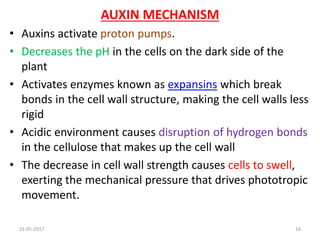
AUXIN MECHANISM
• Auxins activate proton pumps.
• Decreases the pH in the cells on the dark side of the
plant
• Activates enzymes known as expansins which break
bonds in the cell wall structure, making the cell walls less
rigid
• Acidic environment causes disruption of hydrogen bonds
in the cellulose that makes up the cell wall
• The decrease in cell wall strength causes cells to swell,
exerting the mechanical pressure that drives phototropic
movement.
GENE ACTION
PIN genes
• are auxin transporters - responsible for the
polarization of auxin.
• PIN3 - the primary auxin carrier.
• Receptors receive light and inhibit the activity of
PINOID kinase (PID), which then promotes the
activity of PIN3.
• This activation of PIN3 leads to asymmetric
distribution of auxin, which then leads to asymmetric
elongation of cells in the stem.
31-05-2017 17
31-05-2017 18
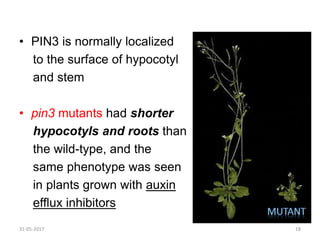
• PIN3 is normally localized
to the surface of hypocotyl
and stem
• pin3 mutants had shorter
hypocotyls and roots than
the wild-type, and the
same phenotype was seen
in plants grown with auxin
efflux inhibitors
PHOTOTROPINS
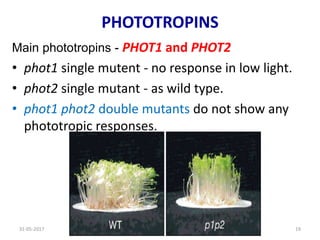
Main phototropins - PHOT1 and PHOT2
• phot1 single mutent - no response in low light.
• phot2 single mutant - as wild type.
• phot1 phot2 double mutants do not show any
phototropic responses.
31-05-2017 19
31-05-2017 20
• The amounts of PHOT1 and PHOT2 present
depend on the age of the plant and the intensity of
the light.
• AT HIGH LIGHT INTENSITY
-downregulation of PHOT1 transcript
-upregulation of PHOT2 transcript
• Phototropin expression levels change with the
maturation of the leaves (chloroplast rearrangement) –
maximise photosynthesis efficiency.
NPH1 and NPL1 gene
• They are both involved in chloroplast
rearrangement.
• The nph1 and npl1 double mutants were
found to have reduced phototropic responses.
• The two genes are both redundant in
determining the curvature of the stem.
31-05-2017 21
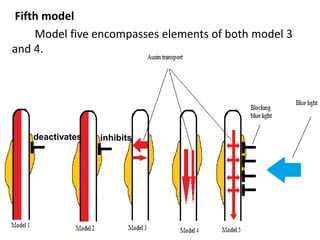
Five models of Auxin distribution in phototropism
by Sakai and Haga (2012) on Arabidopsis thaliana
First model
Incoming light deactivates auxin on the light side of
the plant allowing the shaded part to continue growing
and eventually bend the plant over towards the light.
Second model
Light inhibits auxin biosynthesis on the light side of
the plant, thus decreasing the concentration of auxin
relative to the unaffected side.
31-05-2017 22
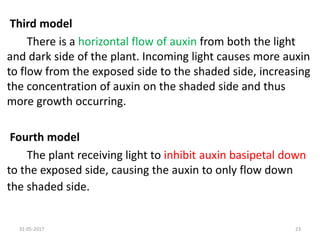
Third model
There is a horizontal flow of auxin from both the light
and dark side of the plant. Incoming light causes more auxin
to flow from the exposed side to the shaded side, increasing
the concentration of auxin on the shaded side and thus
more growth occurring.
Fourth model
The plant receiving light to inhibit auxin basipetal down
to the exposed side, causing the auxin to only flow down
the shaded side.
31-05-2017 23
Fifth model
Model five encompasses elements of both model 3
and 4.
31-05-2017 24
deactivates inhibits
Effect of Wavelength
• Stem tips exhibit positive phototropic reactions
to blue light, while root tips exhibit negative
phototropic reactions to blue light.
(cryptochromes)
• Both root tips and most stem tips exhibit positive
phototropism to red light (phytochromes )
• Together phytochromes and cryptochromes
inhibit gravitropism in hypocotyls and contribute
to phototropism.
31-05-2017 25
31-05-2017 26

Phototropism ppt

  • 3.
    CONTENTS • INTRODUCTION • HISTORY •MECHANISM - Auxin - Gene action - Phototropins • Five models of auxin distribution • CONCLUSION 31-05-2017 3
  • 4.
    INTRODUCTION • Phototropism isthe growth of an organism which responds to a light stimulus. 31-05-2017 4
  • 5.
  • 6.
    • Growth towardsa light source is called positive phototropism, while growth away from light is called negative phototropism. 31-05-2017 6
  • 7.
    • Most plantshoots exhibit positive phototropism, and rearrange their chloroplasts in the leaves to maximize photosynthetic energy and promote growth. • Roots usually exhibit negative phototropism, although gravitropism may play a larger role in root behavior and growth. • Some vine shoot tips exhibit negative phototropism which allows them to grow towards dark, solid objects and climb them. 31-05-2017 7
  • 8.
    HISTORY OF PHOTOPERIODISM •The best known early research on phototropism was by Charles Darwin, who reported his experiments in a book published in 1880, The Power of Movement in Plants. • Darwin studied phototropism in canary grass and oat coleoptiles. 31-05-2017 8
  • 9.
    Darwin conclusions • Thetip of the coleoptile is the most photosensitive region. • The middle of the coleoptile is responsible for most of the bending. • An influence which causes bending is transmitted from the top to the middle of the coleoptile. 31-05-2017 9
  • 10.
    Boysen-Jensen’s experiment (1913) •He cut the tips off coleoptiles and placed a thin piece of mica between the coleoptile and the lower shoot. • The result was that the shoot did not grow or curve toward the light. 31-05-2017 10
  • 11.
    • When herepeated the experiment using a block of agar instead, the result was that the shoot grew and curved towards the light. Conclusion, • The chemical signal was a growth stimulant as the phototropic response involves faster cell elongation on the shady side than on the illuminated side. 31-05-2017 11
  • 12.
    Cholodny-Went model • Thetheory that the plant hormone auxin could play a role in phototropism was first proposed in 1937 by the Dutch researcher Frits Warmolt Went. 31-05-2017 12 (IN DARK)
  • 13.
    • When theagar block was centred on top the coleoptile grew straight. • If the agar block was offset, resulting in an uneven distribution of the chemical on one side, the shoot would curve as though it was growing towards a light source. Conclusions, • This proved that the response was due to a water soluble chemical that diffused from the tip of the plant down the dark / shaded side of the coleoptile causing it to curve towards the light. • Went repeated the experiment with agar that had not been treated, which produced no growth. 31-05-2017 13
  • 14.
    MECHANISM • Several ofsignaling molecules - determine where the light source - activates several genes - change the hormone gradients - allowing the plant to grow towards the light • Tip of the plant coleoptile - light sensing occcur • The middle portion of coleoptile - shoot curvature occurs • Asymmetric light - AUXIN - move towards the shaded side and promote elongation of the cells on that side to cause the plant to curve towards the light source 31-05-2017 14
  • 15.
  • 16.
    31-05-2017 16 AUXIN MECHANISM •Auxins activate proton pumps. • Decreases the pH in the cells on the dark side of the plant • Activates enzymes known as expansins which break bonds in the cell wall structure, making the cell walls less rigid • Acidic environment causes disruption of hydrogen bonds in the cellulose that makes up the cell wall • The decrease in cell wall strength causes cells to swell, exerting the mechanical pressure that drives phototropic movement.
  • 17.
    GENE ACTION PIN genes •are auxin transporters - responsible for the polarization of auxin. • PIN3 - the primary auxin carrier. • Receptors receive light and inhibit the activity of PINOID kinase (PID), which then promotes the activity of PIN3. • This activation of PIN3 leads to asymmetric distribution of auxin, which then leads to asymmetric elongation of cells in the stem. 31-05-2017 17
  • 18.
    31-05-2017 18 • PIN3is normally localized to the surface of hypocotyl and stem • pin3 mutants had shorter hypocotyls and roots than the wild-type, and the same phenotype was seen in plants grown with auxin efflux inhibitors
  • 19.
    PHOTOTROPINS Main phototropins -PHOT1 and PHOT2 • phot1 single mutent - no response in low light. • phot2 single mutant - as wild type. • phot1 phot2 double mutants do not show any phototropic responses. 31-05-2017 19
  • 20.
    31-05-2017 20 • Theamounts of PHOT1 and PHOT2 present depend on the age of the plant and the intensity of the light. • AT HIGH LIGHT INTENSITY -downregulation of PHOT1 transcript -upregulation of PHOT2 transcript • Phototropin expression levels change with the maturation of the leaves (chloroplast rearrangement) – maximise photosynthesis efficiency.
  • 21.
    NPH1 and NPL1gene • They are both involved in chloroplast rearrangement. • The nph1 and npl1 double mutants were found to have reduced phototropic responses. • The two genes are both redundant in determining the curvature of the stem. 31-05-2017 21
  • 22.
    Five models ofAuxin distribution in phototropism by Sakai and Haga (2012) on Arabidopsis thaliana First model Incoming light deactivates auxin on the light side of the plant allowing the shaded part to continue growing and eventually bend the plant over towards the light. Second model Light inhibits auxin biosynthesis on the light side of the plant, thus decreasing the concentration of auxin relative to the unaffected side. 31-05-2017 22
  • 23.
    Third model There isa horizontal flow of auxin from both the light and dark side of the plant. Incoming light causes more auxin to flow from the exposed side to the shaded side, increasing the concentration of auxin on the shaded side and thus more growth occurring. Fourth model The plant receiving light to inhibit auxin basipetal down to the exposed side, causing the auxin to only flow down the shaded side. 31-05-2017 23
  • 24.
    Fifth model Model fiveencompasses elements of both model 3 and 4. 31-05-2017 24 deactivates inhibits
  • 25.
    Effect of Wavelength •Stem tips exhibit positive phototropic reactions to blue light, while root tips exhibit negative phototropic reactions to blue light. (cryptochromes) • Both root tips and most stem tips exhibit positive phototropism to red light (phytochromes ) • Together phytochromes and cryptochromes inhibit gravitropism in hypocotyls and contribute to phototropism. 31-05-2017 25
  • 26.