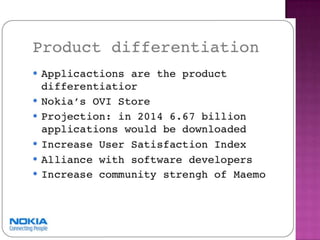
BY
ASHA priya goud
Gitam institute of management
Gitam university.
Nokia Corporation is a Finnish multinational
communications corporation.
 Focused on wired and wireless telecommunications.
 It is the world's largest manufacturer of mobile
telephones.




A leading end-to-end infrastructure supplier



World's largest manufacturer of mobile phones



More than 55 000 employees



Net sales USD 20 billion 1999



Market capitalization value over USD 200 billion
Industry: Telecommunications,



Nokia connects people to each other

Internet, Computer software





Nokia is a world leader in mobile




Products: Mobile phones, Smart

communications and manufacturer

Founded: Tampere, Finland (1865)


The information easy-to-use and

phones, Mobile Computers,
Networks,


innovative products like mobile
phones, devices and solutions for
imaging, games, media and

Services: Software, Online services

businesses.


Revenue: ▼ €40.99 billion (2009)




Operating income: ▼ €1.197 billion

and services to network operators

(2009)


Net income: ▼ €891 million (2009)



Employees: 125,859 (March 31, 2010)

and corporations.

Total assets: ▼ €35.74 billion (2009)



Nokia provides equipment, solutions



It has held the most market share

since 1998.


In 2009, Nokia global annual revenue
of €41 billion and operating profit of
€1.2 billion.


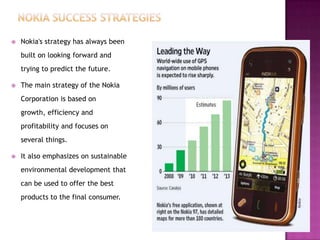
Nokia's strategy has always been
built on looking forward and
trying to predict the future.



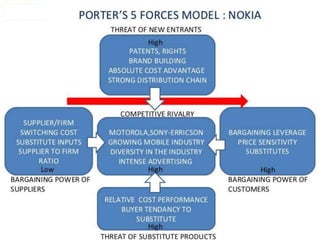
The main strategy of the Nokia
Corporation is based on
growth, efficiency and
profitability and focuses on

several things.


It also emphasizes on sustainable
environmental development that
can be used to offer the best
products to the final consumer.
•

•
•

•

•

•

•
•

Nokia’s industry dominance is behavioral, not
structural
Upstream innovation
Open standards, strategic coalitions, and skillful
supplier channel and partner management
Solidified own strengths and weakened powerful
competitors
Downstream innovation
Segmentation, branding and design Filled shelves with
new and innovative products to dominate categories,
become ubiquitous, and used its brand to sell new
products and help penetrate new markets
Utilized preemptive strategies
Co-opted with most of its actual or potential rivals


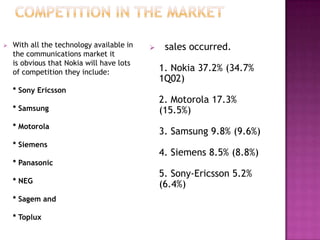
With all the technology available in
the communications market it
is obvious that Nokia will have lots
of competition they include:
* Sony Ericsson
* Samsung
* Motorola
* Siemens



sales occurred.
1. Nokia 37.2% (34.7%
1Q02)
2. Motorola 17.3%
(15.5%)
3. Samsung 9.8% (9.6%)
4. Siemens 8.5% (8.8%)

* Panasonic
* NEG
* Sagem and
* Toplux

5. Sony-Ericsson 5.2%
(6.4%)
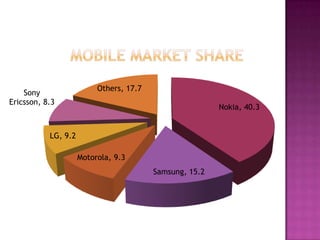
Sony
Ericsson, 8.3

Others, 17.7
Nokia, 40.3

LG, 9.2
Motorola, 9.3
Samsung, 15.2
 #1:

Failure of Symbian OS and Wrong
Deal with Windows
 #2: NOKIA Became Laggard in
Smartphone Market
 #3. Losing Market Share on Both Ends.
 #4. Failure to Implement the Right
Umbrella Branding Strategy
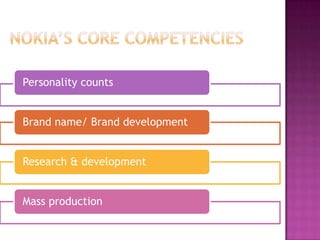
Personality counts
Brand name/ Brand development
Research & development
Mass production
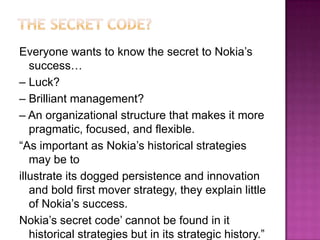
Everyone wants to know the secret to Nokia’s
success…
– Luck?
– Brilliant management?
– An organizational structure that makes it more
pragmatic, focused, and flexible.
“As important as Nokia’s historical strategies
may be to
illustrate its dogged persistence and innovation
and bold first mover strategy, they explain little
of Nokia’s success.
Nokia’s secret code’ cannot be found in it
historical strategies but in its strategic history.”
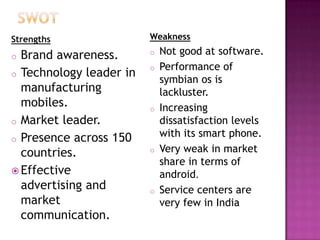
Strengths

Weakness

Brand awareness.
o Technology leader in
manufacturing
mobiles.
o Market leader.
o Presence across 150
countries.
 Effective
advertising and
market
communication.

o

o

o

o

o

o

Not good at software.
Performance of
symbian os is
lackluster.
Increasing
dissatisfaction levels
with its smart phone.
Very weak in market
share in terms of
android.
Service centers are
very few in India
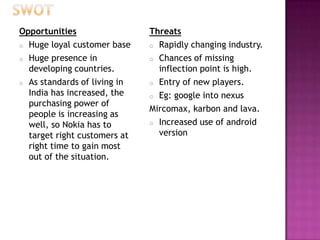
Opportunities
o Huge loyal customer base
o Huge presence in
developing countries.
o As standards of living in
India has increased, the
purchasing power of
people is increasing as
well, so Nokia has to
target right customers at
right time to gain most
out of the situation.

Threats
o Rapidly changing industry.
o Chances of missing
inflection point is high.
o Entry of new players.
o Eg: google into nexus
Mircomax, karbon and lava.
o Increased use of android
version


Smart phones are the future, and Nokia is basically nowhere in smart
phones



Mobile is a platform business, and Microsoft's Windows Phone
platform is basically nowhere



Nokia's business and culture are entirely different than
Microsoft's, and Nokia is massive.



Nokia doesn't (yet) make tablets, which are another big growth area.



Nokia and Microsoft are both losing money on their mobile
businesses.



Becoming a hardware maker is a major change of strategy for
Microsoft, and it will likely kill any remaining hope that Windows can
become a ubiquitous smart phone platform like Android.
 Limited

Mobiles can be released.
 OS has to be user-friendly.
 More no of application have to be free of
cost.
 Upgrade their technology and also use winwin strategy.
 Nokia should adopted the new technology in
touch plus making new application like
android.
 Nokia should adopt the new styles and using
fancy bodies for their mobile sets with
beautiful colors.
 Too

often, companies mistake their
values, assets or internal processes for a core
competence
 A core competence is a bundle of
skills, technologies and/or strategic assets
that is integral to success
 Nokia focused on identifying its core
competencies, looking for opportunities
beyond the boundaries of its current
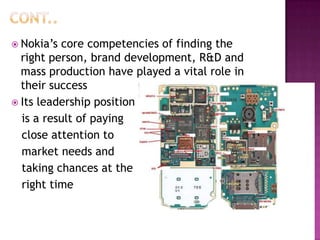
 Nokia’s

core competencies of finding the
right person, brand development, R&D and
mass production have played a vital role in
their success
 Its leadership position
is a result of paying
close attention to
market needs and
taking chances at the
right time

Nokia final

  • 1.
    BY ASHA priya goud Gitaminstitute of management Gitam university.
  • 2.
    Nokia Corporation isa Finnish multinational communications corporation.  Focused on wired and wireless telecommunications.  It is the world's largest manufacturer of mobile telephones.   A leading end-to-end infrastructure supplier  World's largest manufacturer of mobile phones  More than 55 000 employees  Net sales USD 20 billion 1999  Market capitalization value over USD 200 billion
  • 3.
    Industry: Telecommunications,  Nokia connectspeople to each other Internet, Computer software   Nokia is a world leader in mobile   Products: Mobile phones, Smart communications and manufacturer Founded: Tampere, Finland (1865)  The information easy-to-use and phones, Mobile Computers, Networks,  innovative products like mobile phones, devices and solutions for imaging, games, media and Services: Software, Online services businesses.  Revenue: ▼ €40.99 billion (2009)   Operating income: ▼ €1.197 billion and services to network operators (2009)  Net income: ▼ €891 million (2009)  Employees: 125,859 (March 31, 2010) and corporations. Total assets: ▼ €35.74 billion (2009)  Nokia provides equipment, solutions  It has held the most market share since 1998.  In 2009, Nokia global annual revenue of €41 billion and operating profit of €1.2 billion.
  • 4.
     Nokia's strategy hasalways been built on looking forward and trying to predict the future.  The main strategy of the Nokia Corporation is based on growth, efficiency and profitability and focuses on several things.  It also emphasizes on sustainable environmental development that can be used to offer the best products to the final consumer.
  • 5.
    • • • • • • • • Nokia’s industry dominanceis behavioral, not structural Upstream innovation Open standards, strategic coalitions, and skillful supplier channel and partner management Solidified own strengths and weakened powerful competitors Downstream innovation Segmentation, branding and design Filled shelves with new and innovative products to dominate categories, become ubiquitous, and used its brand to sell new products and help penetrate new markets Utilized preemptive strategies Co-opted with most of its actual or potential rivals
  • 6.
     With all thetechnology available in the communications market it is obvious that Nokia will have lots of competition they include: * Sony Ericsson * Samsung * Motorola * Siemens  sales occurred. 1. Nokia 37.2% (34.7% 1Q02) 2. Motorola 17.3% (15.5%) 3. Samsung 9.8% (9.6%) 4. Siemens 8.5% (8.8%) * Panasonic * NEG * Sagem and * Toplux 5. Sony-Ericsson 5.2% (6.4%)
  • 7.
    Sony Ericsson, 8.3 Others, 17.7 Nokia,40.3 LG, 9.2 Motorola, 9.3 Samsung, 15.2
  • 8.
     #1: Failure ofSymbian OS and Wrong Deal with Windows  #2: NOKIA Became Laggard in Smartphone Market  #3. Losing Market Share on Both Ends.  #4. Failure to Implement the Right Umbrella Branding Strategy
  • 9.
    Personality counts Brand name/Brand development Research & development Mass production
  • 10.
    Everyone wants toknow the secret to Nokia’s success… – Luck? – Brilliant management? – An organizational structure that makes it more pragmatic, focused, and flexible. “As important as Nokia’s historical strategies may be to illustrate its dogged persistence and innovation and bold first mover strategy, they explain little of Nokia’s success. Nokia’s secret code’ cannot be found in it historical strategies but in its strategic history.”
  • 11.
    Strengths Weakness Brand awareness. o Technologyleader in manufacturing mobiles. o Market leader. o Presence across 150 countries.  Effective advertising and market communication. o o o o o o Not good at software. Performance of symbian os is lackluster. Increasing dissatisfaction levels with its smart phone. Very weak in market share in terms of android. Service centers are very few in India
  • 12.
    Opportunities o Huge loyalcustomer base o Huge presence in developing countries. o As standards of living in India has increased, the purchasing power of people is increasing as well, so Nokia has to target right customers at right time to gain most out of the situation. Threats o Rapidly changing industry. o Chances of missing inflection point is high. o Entry of new players. o Eg: google into nexus Mircomax, karbon and lava. o Increased use of android version
  • 21.
     Smart phones arethe future, and Nokia is basically nowhere in smart phones  Mobile is a platform business, and Microsoft's Windows Phone platform is basically nowhere  Nokia's business and culture are entirely different than Microsoft's, and Nokia is massive.  Nokia doesn't (yet) make tablets, which are another big growth area.  Nokia and Microsoft are both losing money on their mobile businesses.  Becoming a hardware maker is a major change of strategy for Microsoft, and it will likely kill any remaining hope that Windows can become a ubiquitous smart phone platform like Android.
  • 22.
     Limited Mobiles canbe released.  OS has to be user-friendly.  More no of application have to be free of cost.  Upgrade their technology and also use winwin strategy.  Nokia should adopted the new technology in touch plus making new application like android.  Nokia should adopt the new styles and using fancy bodies for their mobile sets with beautiful colors.
  • 24.
     Too often, companiesmistake their values, assets or internal processes for a core competence  A core competence is a bundle of skills, technologies and/or strategic assets that is integral to success  Nokia focused on identifying its core competencies, looking for opportunities beyond the boundaries of its current
  • 25.
     Nokia’s core competenciesof finding the right person, brand development, R&D and mass production have played a vital role in their success  Its leadership position is a result of paying close attention to market needs and taking chances at the right time

Editor's Notes

  • #6 The main strategy of the Nokia Corporation is based on growth, efficiency and profitability and focuses on several things.
  • #8 Initial market share and it rapidly fell off
  • #9 Laggard: a person who makes slow progress and falls behind others.
  • #13 a change in the form of a word (typically the ending) to express a grammatical function or attribute such as tense, mood, person, number, case, and gender.
  • #22 Notespls check docu.
  • #23 1.nokia should launc android phones.. 2.apps on lumia is less...so it should be increase... 3.in apps u can't share video..eg.whats app....:) 4.peoples need update at least once in 2 months... reduce operating costs so they are able to be more flexible/profitable with the price of products.