 Nokia owns a company nokia solutions and networks, which provides
telecommunication networks equipement and services
 Nokia was the world’s largest vendor of mobile phones from 1998 to 2012
 However, over the past five years its market shares declined as a result of
growing use of touch screen smart phones from other vendors-principally
the iphone, by apple, and devices running on android, an operating system
created by google—in which nokia did not take enough advantage of
 As a result, the corporation’s share price fell from a high of US$40 in late
2007 to under US$2 in mid-2012
 As of 2012,nokia employs 101,982 people across 120 countries, conducts
sales more than 150 countries, and reports annual revenues of around€30
billion.
 By 2012,it was the world’s second largest mobile phone maker in terms of
unit sales(after Samsung), with a global market share of 18.0% in the
fourth quarter of that year.
 Nokia is a public limited-liability company listed on the Helsinki stock
exchange and new York stock exchange.
 It is the world’s 274th largest company measured by 2013 revenues
according to the fortune global 500.
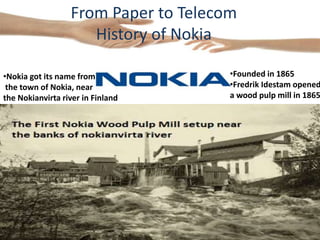
•Founded in 1865
•Fredrik Idestam opened
a wood pulp mill in 1865
•Nokia got its name from
the town of Nokia, near
the Nokianvirta river in Finland
From Paper to Telecom
History of Nokia
• In 1868, Idestam built a second mill
•1871 Idestam, and Leo Mechelin, transformed his firm into a
share company, founding Nokia Ab.
•In 1898 Nokia acquired a rubber factory, Finnish Rubber Works
•In 1912 Eduard Polon started Finnish Cable Works
•In 1967 Nokia Ab,Finnish Rubber and Cable works merged to
form Nokia Corporation
NOKIA PRODUCTS OVER THE TIME
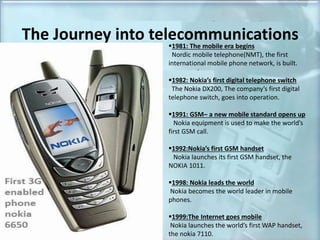
The Journey into telecommunications1981: The mobile era begins
Nordic mobile telephone(NMT), the first
international mobile phone network, is built.
1982: Nokia’s first digital telephone switch
The Nokia DX200, The company’s first digital
telephone switch, goes into operation.
1991: GSM– a new mobile standard opens up
Nokia equipment is used to make the world’s
first GSM call.
1992:Nokia’s first GSM handset
Nokia launches its first GSM handset, the
NOKIA 1011.
1998: Nokia leads the world
Nokia becomes the world leader in mobile
phones.
1999:The Internet goes mobile
Nokia launches the world’s first WAP handset,
the nokia 7110.
Advantage of telecom boom
•In Early 1990s Nokia took the
advantage of telecom boom.
Nokia decided to stick to
telecommunications products.
•Nokia made a key decision in
1990 to increase its research and
development in global marketing.
•The company started to enter
other countries, Nokia began its
India operations in 1995
Nokia India innovations and operations
In 1998, the company introduced its
first Indian ringtone – “Saare Jahan Se
Accha”– on a Nokia 5110 handset.
Nokia in 2000 introduced its first
phone with a user menu in Hindi, on
its Nokia 3210
In 2002, the company introduced its
first camera phone – Nokia 7650, and
a year later it introduced its Nokia
1100 – the company’s first made-for-
India phone.
In 2006, the Finnish company was the
first firm to set up a manufacturing
unit for mobile phones at
Sriperumbudur, near the southern
Indian city of Chennai in Tamil Nadu.
Creating climate strategy to protect environment The packaging
of all their phones are made from recycled paper. Clear instructions
are also provided for correct disposal of used batteries with every
handset.
International programme of employee volunteering called
'Helping Hands‘ are centered on education, corporate giving and
disaster relief.
Nokia India is involved with an NGO working with children with
disabilities in Delhi. Nokia's employees provide support to the
NGO in terms of help and training.
Creating a recycling cultre across the world to promote recyling.
Nokia and Oxfam call for innovations to improve maternal health
in low—income countries
NOKIA HR Practices
• Nokia people policies at one time played a key role in
helping the company to reach its 40 percent share of the
global handset market and industry-leading profit
margins of 20 to 25 percent.
• Number of employees in India (Dec 2010) were
approx. 132,430
• Nokia’s Hiring Process:
– Nokia relied on traditional screening techniques
and regional assessment and development centers and
in final stage relies heavily on behavioral interviewing (role
plays, group exercises and one-on-one behavioral
interviews
Contd..
• Training & Development:
– Nokia had the 70-20-10 approach to training
1. On-the job learning (70%)
2. Mentoring & Individual coaching (20%)
3. Classroom training & e-learning (10%)
• Appraisal:
– Rewards employees competitively through a global
reward framework
– Nokia rewards employees for good performance,
competence development, and for overall company
success
Thank you

Nokia (1)

  • 1.
     Nokia ownsa company nokia solutions and networks, which provides telecommunication networks equipement and services  Nokia was the world’s largest vendor of mobile phones from 1998 to 2012  However, over the past five years its market shares declined as a result of growing use of touch screen smart phones from other vendors-principally the iphone, by apple, and devices running on android, an operating system created by google—in which nokia did not take enough advantage of  As a result, the corporation’s share price fell from a high of US$40 in late 2007 to under US$2 in mid-2012
  • 2.
     As of2012,nokia employs 101,982 people across 120 countries, conducts sales more than 150 countries, and reports annual revenues of around€30 billion.  By 2012,it was the world’s second largest mobile phone maker in terms of unit sales(after Samsung), with a global market share of 18.0% in the fourth quarter of that year.  Nokia is a public limited-liability company listed on the Helsinki stock exchange and new York stock exchange.  It is the world’s 274th largest company measured by 2013 revenues according to the fortune global 500.
  • 3.
    •Founded in 1865 •FredrikIdestam opened a wood pulp mill in 1865 •Nokia got its name from the town of Nokia, near the Nokianvirta river in Finland From Paper to Telecom History of Nokia
  • 4.
    • In 1868,Idestam built a second mill •1871 Idestam, and Leo Mechelin, transformed his firm into a share company, founding Nokia Ab. •In 1898 Nokia acquired a rubber factory, Finnish Rubber Works •In 1912 Eduard Polon started Finnish Cable Works •In 1967 Nokia Ab,Finnish Rubber and Cable works merged to form Nokia Corporation
  • 5.
  • 6.
    The Journey intotelecommunications1981: The mobile era begins Nordic mobile telephone(NMT), the first international mobile phone network, is built. 1982: Nokia’s first digital telephone switch The Nokia DX200, The company’s first digital telephone switch, goes into operation. 1991: GSM– a new mobile standard opens up Nokia equipment is used to make the world’s first GSM call. 1992:Nokia’s first GSM handset Nokia launches its first GSM handset, the NOKIA 1011. 1998: Nokia leads the world Nokia becomes the world leader in mobile phones. 1999:The Internet goes mobile Nokia launches the world’s first WAP handset, the nokia 7110.
  • 7.
    Advantage of telecomboom •In Early 1990s Nokia took the advantage of telecom boom. Nokia decided to stick to telecommunications products. •Nokia made a key decision in 1990 to increase its research and development in global marketing. •The company started to enter other countries, Nokia began its India operations in 1995
  • 8.
    Nokia India innovationsand operations In 1998, the company introduced its first Indian ringtone – “Saare Jahan Se Accha”– on a Nokia 5110 handset. Nokia in 2000 introduced its first phone with a user menu in Hindi, on its Nokia 3210 In 2002, the company introduced its first camera phone – Nokia 7650, and a year later it introduced its Nokia 1100 – the company’s first made-for- India phone. In 2006, the Finnish company was the first firm to set up a manufacturing unit for mobile phones at Sriperumbudur, near the southern Indian city of Chennai in Tamil Nadu.
  • 9.
    Creating climate strategyto protect environment The packaging of all their phones are made from recycled paper. Clear instructions are also provided for correct disposal of used batteries with every handset. International programme of employee volunteering called 'Helping Hands‘ are centered on education, corporate giving and disaster relief. Nokia India is involved with an NGO working with children with disabilities in Delhi. Nokia's employees provide support to the NGO in terms of help and training. Creating a recycling cultre across the world to promote recyling. Nokia and Oxfam call for innovations to improve maternal health in low—income countries
  • 10.
    NOKIA HR Practices •Nokia people policies at one time played a key role in helping the company to reach its 40 percent share of the global handset market and industry-leading profit margins of 20 to 25 percent. • Number of employees in India (Dec 2010) were approx. 132,430 • Nokia’s Hiring Process: – Nokia relied on traditional screening techniques and regional assessment and development centers and in final stage relies heavily on behavioral interviewing (role plays, group exercises and one-on-one behavioral interviews
  • 11.
    Contd.. • Training &Development: – Nokia had the 70-20-10 approach to training 1. On-the job learning (70%) 2. Mentoring & Individual coaching (20%) 3. Classroom training & e-learning (10%) • Appraisal: – Rewards employees competitively through a global reward framework – Nokia rewards employees for good performance, competence development, and for overall company success
  • 13.