By Fantastic Four team:
Sylwia Kaluzna
Gabriele Gasperoni
Gonzalo Sofont
CONTENTS
• general information
• history
• organizational structure
• mission and strategy
• products & services
• implementing the strategy – overview of the 10 OM decisions
product design
• summary
Company Name: NOKIA CORPORATION
Address: Nokia Spain
CM CERRO DE LOS GAMOS 1 ED, 3
28224 POZUELO DE ALARCON
SPAIN
Tel. +34 91/2010314
Nokia Head Office
KEILALAHDENTIE 2-4
P.O. BOX 226
FIN-00045 NOKIA GROUP
FINLAND
TEL. +358 (0) 7180 08000
GeneralGeneral information
Location: ALL AROUND THE WORLD.
They sell in more than 130 countries,
have R&D facilities in 11 countries
and production facilities in 8
countries.
Market Position: THE WORLD'S LARGEST
MANUFACTURER OF MOBILE
DEVICES
One out of three mobile phones was
made by Nokia.
GeneralGeneral
informationinformation
1865 – From the foundations to becoming a major industrial1865 – From the foundations to becoming a major industrial
forceforce
Nokia Ab. was created inNokia Ab. was created in 18651865, when Fredrik Idestam established a, when Fredrik Idestam established a
paper mill at the Tammerkoski Rapids in south-western Finland.at the Tammerkoski Rapids in south-western Finland.
Nokia was named for the river, next to which the pulp mill wasNokia was named for the river, next to which the pulp mill was
created.created.
1967- a merger with Rubber Works and Finnish Cable Works
Nokia Ab, Finnish Rubber Works (1882) and Finnish Cable (1912)Nokia Ab, Finnish Rubber Works (1882) and Finnish Cable (1912)
Works (jointly owned since 1922) formally merge to create NokiaWorks (jointly owned since 1922) formally merge to create Nokia
Corporation. At the time,Corporation. At the time, Nokia Ab was the smallestNokia Ab was the smallest of the three.of the three.
Since then, the process of integration of five businesses (rubber,Since then, the process of integration of five businesses (rubber,
cable, forestry, electronics, power generation) started.cable, forestry, electronics, power generation) started.
History 1865-1967History 1865-1967
1968-1991 for a pioneering role in the early evolution of
mobile communications
The newly formed Nokia Corporation was ideally positioned for a
pioneering role in the early evolution of mobile communications. As
European telecommunications markets were deregulated and
mobile networks became global, Nokia led the way with some iconic
products, like:
1987 - Nokia launches the Mobira Cityman, the first handheld NMT phone
(Nordic Mobile Telephone, the first mobile phone network ever)
1991 - Nokia equipment is used to make the world’s first GSM call.
HistoryHistory 1968-19911968-1991
19921992 essential strategic decisionsessential strategic decisions
Nokia decided to focus on its telecommunications business. ThisNokia decided to focus on its telecommunications business. This
was probably the most important strategic decision in its historywas probably the most important strategic decision in its history..
1994 - first satellite call1994 - first satellite call
The world’s first satellite call is made, using a Nokia GSM handset.The world’s first satellite call is made, using a Nokia GSM handset.
19971997 -- Nokia’s Snake GameNokia’s Snake Game
Nokia 6110 is the first phone to feature Nokia’s Snake Game. SnakeNokia 6110 is the first phone to feature Nokia’s Snake Game. Snake
and its successors are now available on an estimatedand its successors are now available on an estimated 350 million350 million
mobile phonesmobile phones..
History 1992-….History 1992-….
19981998 -- NOKIA BECOMES THE WORLD’S LEADER IN MOBILENOKIA BECOMES THE WORLD’S LEADER IN MOBILE
PHONES.PHONES.
1999 –1999 – thethe first WAP handsetfirst WAP handset
Nokia launches the Nokia 7110Nokia launches the Nokia 7110,, the world's first WAP handsetthe world's first WAP handset..
2002 –2002 – the first 3G phonethe first 3G phone
Nokia launches the Nokia 6650Nokia launches the Nokia 6650,, its first 3G phoneits first 3G phone..
2005 -2005 - billionth phonebillionth phone
Nokia sells its billionth phone – a Nokia 1100 in Nigeria. GlobalNokia sells its billionth phone – a Nokia 1100 in Nigeria. Global
mobile phone subscriptions pass 2 billion.mobile phone subscriptions pass 2 billion.
History 1992-….History 1992-….
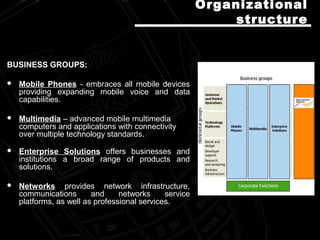
BUSINESS GROUPS:
 Mobile Phones - embraces all mobile devices
providing expanding mobile voice and data
capabilities.
 Multimedia – advanced mobile multimedia
computers and applications with connectivity
over multiple technology standards.
 Enterprise Solutions offers businesses and
institutions a broad range of products and
solutions.
 Networks provides network infrastructure,
communications and networks service
platforms, as well as professional services.
OrganiOrganizzationalational
structurestructure
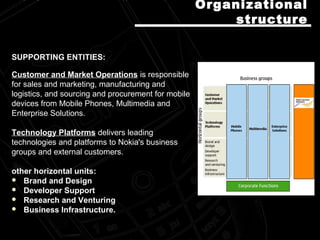
SUPPORTING ENTITIES:
Customer and Market Operations is responsible
for sales and marketing, manufacturing and
logistics, and sourcing and procurement for mobile
devices from Mobile Phones, Multimedia and
Enterprise Solutions.
Technology Platforms delivers leading
technologies and platforms to Nokia's business
groups and external customers.
other horizontal units:
 Brand and Design
 Developer Support
 Research and Venturing
 Business Infrastructure.
OrganiOrganizzationalational
structurestructure
Connecting PeopleConnecting People
“Connecting is about helping
people to feel close to what
matters. If we focus on people,
and use technology to help
people feel close to what
matters, then growth will follow.
In a world where everyone can
be connected, Nokia takes a
very human approach to
technology.”
July 2006July 2006
MISSIONMISSION
"Wherever, whenever, we believe in
communicating, sharing and in the awesome
potential of connecting the 2 billion who do,
with the 4 billion who don't."
 At Nokia, customers remain their top priority.
Customer focus and consumer understanding
must always drive their day-to-day business
behavior.
 Nokia’s priority is to be the most preferred
partner to operators, retailers and enterprises.
STRATEGY –customers-STRATEGY –customers-
In line with these priorities, Nokia’s business portfolio strategy focusesIn line with these priorities, Nokia’s business portfolio strategy focuses
on five areas, with each having long-term objectives:on five areas, with each having long-term objectives:
 Create winning devicesCreate winning devices
 Embrace consumer Internet servicesEmbrace consumer Internet services
 Deliver enterprise solutionsDeliver enterprise solutions
 Build scale in networksBuild scale in networks
 Expand professional servicesExpand professional services
There are three strategic assets that Nokia will invest in and prioritize:There are three strategic assets that Nokia will invest in and prioritize:
 Brand and designBrand and design
 Customer engagement and fulfillmentCustomer engagement and fulfillment
 Technology and architectureTechnology and architecture
CONCLUSION:CONCLUSION:
competitcompetitiive advantage builve advantage builtt onon differentiation (quality)differentiation (quality)
STRATEGY – businessSTRATEGY – business
--
• Mobile Phones and accesories (car sets, bluetooth kit sets
etc.)
• Mobile multimedia experiences, as well as share their
experiences with others through a range of radio
technologies (GPS car systems, Ultra Mobile PC etc.)
• Enterprise solutions for businesses and institutions.
• Network infrastructure, communications and networks
service platforms, as well as professional services to
operators and service providers.
Products and serviceProducts and service
delivereddelivered
Quality - „the heart of Nokia’s brand promise”Quality - „the heart of Nokia’s brand promise”
 Not only meeting the expectations but exceeding themNot only meeting the expectations but exceeding them
 Holistical approach to quality – „The quality of products and customerHolistical approach to quality – „The quality of products and customer
experiences depends on the quality of processes, which in turn is tied to theexperiences depends on the quality of processes, which in turn is tied to the
quality of management”quality of management”
 Getting acquainted with customer requirements is the starting point ofGetting acquainted with customer requirements is the starting point of
managing the qualitymanaging the quality
 processes are continuously improved based on the measures and theprocesses are continuously improved based on the measures and the
feedback we receive from our customers.feedback we receive from our customers.
 Quality in management is a key point in managing the innovations globallyQuality in management is a key point in managing the innovations globally
 „„Self-Regulating Management System” – key framework for managementSelf-Regulating Management System” – key framework for management
practices that allow to run the business in a consistent, effective manner.practices that allow to run the business in a consistent, effective manner.
 „„Take quality personally!”Take quality personally!”
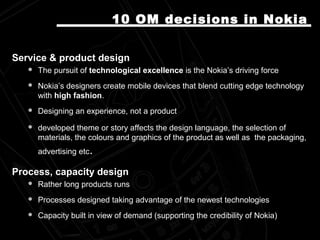
10 OM10 OM decisions in Nokiadecisions in Nokia
Service & product designService & product design
 The pursuit ofThe pursuit of technological excellencetechnological excellence is the Nokia’s driving forceis the Nokia’s driving force
 Nokia’s designers create mobile devices that blend cutting edge technologyNokia’s designers create mobile devices that blend cutting edge technology
withwith high fashionhigh fashion..
 Designing an experienceDesigning an experience,, not a productnot a product
 developdevelopeded theme or storytheme or story affects the design language, the selection ofaffects the design language, the selection of
materials, the colours and graphicsmaterials, the colours and graphics of theof the productproduct as well asas well as the packaging,the packaging,
advertising etcadvertising etc..
Process, capacity designProcess, capacity design
 Rather long products runsRather long products runs
 Processes designed taking advantage oProcesses designed taking advantage of thef the newest technologiesnewest technologies
 Capacity built in view of demand (Capacity built in view of demand (supporting the credibility of Nokia)supporting the credibility of Nokia)
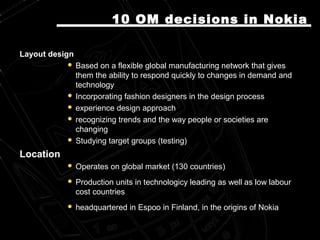
10 OM10 OM decisions in Nokiadecisions in Nokia
Layout designLayout design
 Based on a flexible global manufacturing network that givesBased on a flexible global manufacturing network that gives
them the ability to respond quickly to changes in demandthem the ability to respond quickly to changes in demand andand
technologytechnology
 Incorporating fashion designers in the design processIncorporating fashion designers in the design process
 experience design approachexperience design approach
 recognizing trends and the way people or societies arerecognizing trends and the way people or societies are
changingchanging
 Studying target groups (testing)Studying target groups (testing)
LocationLocation
 Operates on global market (130 countries)Operates on global market (130 countries)
 Production units in technologicy leading as well as low labourProduction units in technologicy leading as well as low labour
cost countriescost countries
 headquartered in Espooheadquartered in Espoo inin FinlandFinland, in the origins of Nokia, in the origins of Nokia
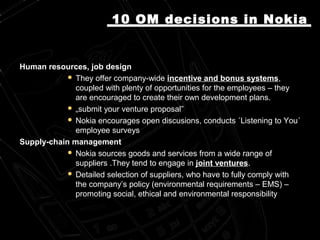
10 OM10 OM decisions in Nokiadecisions in Nokia
Human resources, job designHuman resources, job design
 They offer company-wideThey offer company-wide incentive and bonus systemsincentive and bonus systems,,
coupled with plenty of opportunities for the employees – theycoupled with plenty of opportunities for the employees – they
are encouraged to create their own development plans.are encouraged to create their own development plans.
 „„submit your venture proposal”submit your venture proposal”
 Nokia encourages open discusions, conductsNokia encourages open discusions, conducts ´Listening to You´´Listening to You´
employee surveyemployee surveyss
Supply-chain managementSupply-chain management
 Nokia sources goods and services from a wide range ofNokia sources goods and services from a wide range of
suppliers .They tend to engage insuppliers .They tend to engage in joint venturesjoint ventures..
 Detailed selection of suppliers, who have to fully comply withDetailed selection of suppliers, who have to fully comply with
the company’s policy (environmental requirements – EMS) –the company’s policy (environmental requirements – EMS) –
promoting social, ethical and environmental responspromoting social, ethical and environmental responsiibilitybility
10 OM10 OM decisions in Nokiadecisions in Nokia
 SchedulingScheduling
 They use their own home-developed software.They use their own home-developed software.
 Inventory managementInventory management
 MaintenanceMaintenance
10 OM10 OM decisions in Nokiadecisions in Nokia
 Was launched as an industrial companyWas launched as an industrial company
 Competitive advantage by differentiationCompetitive advantage by differentiation
 Gained its strong position on the market by ”Being the firstGained its strong position on the market by ”Being the first
who…”who…”
 Fashion x Technology = PerfectFashion x Technology = Perfect
 Quality in each detailQuality in each detail
 R&D – exceeding customers needsR&D – exceeding customers needs
 Targeted at maintaining the credibility and buildingTargeted at maintaining the credibility and building
consumer’s loyaltyconsumer’s loyalty
Executive summaryExecutive summary
THANK YOUTHANK YOU
FOR YOUR ATENTIONFOR YOUR ATENTION
sylwia126461@o2.plsylwia126461@o2.pl
gabriele.gaperoni@email.itsgabriele.gaperoni@email.its
lukasanzion@hotmail.comlukasanzion@hotmail.com
THE ENDTHE END

Nokia2

  • 1.
    By Fantastic Fourteam: Sylwia Kaluzna Gabriele Gasperoni Gonzalo Sofont
  • 2.
    CONTENTS • general information •history • organizational structure • mission and strategy • products & services • implementing the strategy – overview of the 10 OM decisions product design • summary
  • 3.
    Company Name: NOKIACORPORATION Address: Nokia Spain CM CERRO DE LOS GAMOS 1 ED, 3 28224 POZUELO DE ALARCON SPAIN Tel. +34 91/2010314 Nokia Head Office KEILALAHDENTIE 2-4 P.O. BOX 226 FIN-00045 NOKIA GROUP FINLAND TEL. +358 (0) 7180 08000 GeneralGeneral information
  • 4.
    Location: ALL AROUNDTHE WORLD. They sell in more than 130 countries, have R&D facilities in 11 countries and production facilities in 8 countries. Market Position: THE WORLD'S LARGEST MANUFACTURER OF MOBILE DEVICES One out of three mobile phones was made by Nokia. GeneralGeneral informationinformation
  • 5.
    1865 – Fromthe foundations to becoming a major industrial1865 – From the foundations to becoming a major industrial forceforce Nokia Ab. was created inNokia Ab. was created in 18651865, when Fredrik Idestam established a, when Fredrik Idestam established a paper mill at the Tammerkoski Rapids in south-western Finland.at the Tammerkoski Rapids in south-western Finland. Nokia was named for the river, next to which the pulp mill wasNokia was named for the river, next to which the pulp mill was created.created. 1967- a merger with Rubber Works and Finnish Cable Works Nokia Ab, Finnish Rubber Works (1882) and Finnish Cable (1912)Nokia Ab, Finnish Rubber Works (1882) and Finnish Cable (1912) Works (jointly owned since 1922) formally merge to create NokiaWorks (jointly owned since 1922) formally merge to create Nokia Corporation. At the time,Corporation. At the time, Nokia Ab was the smallestNokia Ab was the smallest of the three.of the three. Since then, the process of integration of five businesses (rubber,Since then, the process of integration of five businesses (rubber, cable, forestry, electronics, power generation) started.cable, forestry, electronics, power generation) started. History 1865-1967History 1865-1967
  • 6.
    1968-1991 for apioneering role in the early evolution of mobile communications The newly formed Nokia Corporation was ideally positioned for a pioneering role in the early evolution of mobile communications. As European telecommunications markets were deregulated and mobile networks became global, Nokia led the way with some iconic products, like: 1987 - Nokia launches the Mobira Cityman, the first handheld NMT phone (Nordic Mobile Telephone, the first mobile phone network ever) 1991 - Nokia equipment is used to make the world’s first GSM call. HistoryHistory 1968-19911968-1991
  • 7.
    19921992 essential strategicdecisionsessential strategic decisions Nokia decided to focus on its telecommunications business. ThisNokia decided to focus on its telecommunications business. This was probably the most important strategic decision in its historywas probably the most important strategic decision in its history.. 1994 - first satellite call1994 - first satellite call The world’s first satellite call is made, using a Nokia GSM handset.The world’s first satellite call is made, using a Nokia GSM handset. 19971997 -- Nokia’s Snake GameNokia’s Snake Game Nokia 6110 is the first phone to feature Nokia’s Snake Game. SnakeNokia 6110 is the first phone to feature Nokia’s Snake Game. Snake and its successors are now available on an estimatedand its successors are now available on an estimated 350 million350 million mobile phonesmobile phones.. History 1992-….History 1992-….
  • 8.
    19981998 -- NOKIABECOMES THE WORLD’S LEADER IN MOBILENOKIA BECOMES THE WORLD’S LEADER IN MOBILE PHONES.PHONES. 1999 –1999 – thethe first WAP handsetfirst WAP handset Nokia launches the Nokia 7110Nokia launches the Nokia 7110,, the world's first WAP handsetthe world's first WAP handset.. 2002 –2002 – the first 3G phonethe first 3G phone Nokia launches the Nokia 6650Nokia launches the Nokia 6650,, its first 3G phoneits first 3G phone.. 2005 -2005 - billionth phonebillionth phone Nokia sells its billionth phone – a Nokia 1100 in Nigeria. GlobalNokia sells its billionth phone – a Nokia 1100 in Nigeria. Global mobile phone subscriptions pass 2 billion.mobile phone subscriptions pass 2 billion. History 1992-….History 1992-….
  • 9.
    BUSINESS GROUPS:  MobilePhones - embraces all mobile devices providing expanding mobile voice and data capabilities.  Multimedia – advanced mobile multimedia computers and applications with connectivity over multiple technology standards.  Enterprise Solutions offers businesses and institutions a broad range of products and solutions.  Networks provides network infrastructure, communications and networks service platforms, as well as professional services. OrganiOrganizzationalational structurestructure
  • 10.
    SUPPORTING ENTITIES: Customer andMarket Operations is responsible for sales and marketing, manufacturing and logistics, and sourcing and procurement for mobile devices from Mobile Phones, Multimedia and Enterprise Solutions. Technology Platforms delivers leading technologies and platforms to Nokia's business groups and external customers. other horizontal units:  Brand and Design  Developer Support  Research and Venturing  Business Infrastructure. OrganiOrganizzationalational structurestructure
  • 11.
    Connecting PeopleConnecting People “Connectingis about helping people to feel close to what matters. If we focus on people, and use technology to help people feel close to what matters, then growth will follow. In a world where everyone can be connected, Nokia takes a very human approach to technology.” July 2006July 2006 MISSIONMISSION
  • 12.
    "Wherever, whenever, webelieve in communicating, sharing and in the awesome potential of connecting the 2 billion who do, with the 4 billion who don't."  At Nokia, customers remain their top priority. Customer focus and consumer understanding must always drive their day-to-day business behavior.  Nokia’s priority is to be the most preferred partner to operators, retailers and enterprises. STRATEGY –customers-STRATEGY –customers-
  • 13.
    In line withthese priorities, Nokia’s business portfolio strategy focusesIn line with these priorities, Nokia’s business portfolio strategy focuses on five areas, with each having long-term objectives:on five areas, with each having long-term objectives:  Create winning devicesCreate winning devices  Embrace consumer Internet servicesEmbrace consumer Internet services  Deliver enterprise solutionsDeliver enterprise solutions  Build scale in networksBuild scale in networks  Expand professional servicesExpand professional services There are three strategic assets that Nokia will invest in and prioritize:There are three strategic assets that Nokia will invest in and prioritize:  Brand and designBrand and design  Customer engagement and fulfillmentCustomer engagement and fulfillment  Technology and architectureTechnology and architecture CONCLUSION:CONCLUSION: competitcompetitiive advantage builve advantage builtt onon differentiation (quality)differentiation (quality) STRATEGY – businessSTRATEGY – business --
  • 14.
    • Mobile Phonesand accesories (car sets, bluetooth kit sets etc.) • Mobile multimedia experiences, as well as share their experiences with others through a range of radio technologies (GPS car systems, Ultra Mobile PC etc.) • Enterprise solutions for businesses and institutions. • Network infrastructure, communications and networks service platforms, as well as professional services to operators and service providers. Products and serviceProducts and service delivereddelivered
  • 15.
    Quality - „theheart of Nokia’s brand promise”Quality - „the heart of Nokia’s brand promise”  Not only meeting the expectations but exceeding themNot only meeting the expectations but exceeding them  Holistical approach to quality – „The quality of products and customerHolistical approach to quality – „The quality of products and customer experiences depends on the quality of processes, which in turn is tied to theexperiences depends on the quality of processes, which in turn is tied to the quality of management”quality of management”  Getting acquainted with customer requirements is the starting point ofGetting acquainted with customer requirements is the starting point of managing the qualitymanaging the quality  processes are continuously improved based on the measures and theprocesses are continuously improved based on the measures and the feedback we receive from our customers.feedback we receive from our customers.  Quality in management is a key point in managing the innovations globallyQuality in management is a key point in managing the innovations globally  „„Self-Regulating Management System” – key framework for managementSelf-Regulating Management System” – key framework for management practices that allow to run the business in a consistent, effective manner.practices that allow to run the business in a consistent, effective manner.  „„Take quality personally!”Take quality personally!” 10 OM10 OM decisions in Nokiadecisions in Nokia
  • 16.
    Service & productdesignService & product design  The pursuit ofThe pursuit of technological excellencetechnological excellence is the Nokia’s driving forceis the Nokia’s driving force  Nokia’s designers create mobile devices that blend cutting edge technologyNokia’s designers create mobile devices that blend cutting edge technology withwith high fashionhigh fashion..  Designing an experienceDesigning an experience,, not a productnot a product  developdevelopeded theme or storytheme or story affects the design language, the selection ofaffects the design language, the selection of materials, the colours and graphicsmaterials, the colours and graphics of theof the productproduct as well asas well as the packaging,the packaging, advertising etcadvertising etc.. Process, capacity designProcess, capacity design  Rather long products runsRather long products runs  Processes designed taking advantage oProcesses designed taking advantage of thef the newest technologiesnewest technologies  Capacity built in view of demand (Capacity built in view of demand (supporting the credibility of Nokia)supporting the credibility of Nokia) 10 OM10 OM decisions in Nokiadecisions in Nokia
  • 17.
    Layout designLayout design Based on a flexible global manufacturing network that givesBased on a flexible global manufacturing network that gives them the ability to respond quickly to changes in demandthem the ability to respond quickly to changes in demand andand technologytechnology  Incorporating fashion designers in the design processIncorporating fashion designers in the design process  experience design approachexperience design approach  recognizing trends and the way people or societies arerecognizing trends and the way people or societies are changingchanging  Studying target groups (testing)Studying target groups (testing) LocationLocation  Operates on global market (130 countries)Operates on global market (130 countries)  Production units in technologicy leading as well as low labourProduction units in technologicy leading as well as low labour cost countriescost countries  headquartered in Espooheadquartered in Espoo inin FinlandFinland, in the origins of Nokia, in the origins of Nokia 10 OM10 OM decisions in Nokiadecisions in Nokia
  • 18.
    Human resources, jobdesignHuman resources, job design  They offer company-wideThey offer company-wide incentive and bonus systemsincentive and bonus systems,, coupled with plenty of opportunities for the employees – theycoupled with plenty of opportunities for the employees – they are encouraged to create their own development plans.are encouraged to create their own development plans.  „„submit your venture proposal”submit your venture proposal”  Nokia encourages open discusions, conductsNokia encourages open discusions, conducts ´Listening to You´´Listening to You´ employee surveyemployee surveyss Supply-chain managementSupply-chain management  Nokia sources goods and services from a wide range ofNokia sources goods and services from a wide range of suppliers .They tend to engage insuppliers .They tend to engage in joint venturesjoint ventures..  Detailed selection of suppliers, who have to fully comply withDetailed selection of suppliers, who have to fully comply with the company’s policy (environmental requirements – EMS) –the company’s policy (environmental requirements – EMS) – promoting social, ethical and environmental responspromoting social, ethical and environmental responsiibilitybility 10 OM10 OM decisions in Nokiadecisions in Nokia
  • 19.
     SchedulingScheduling  Theyuse their own home-developed software.They use their own home-developed software.  Inventory managementInventory management  MaintenanceMaintenance 10 OM10 OM decisions in Nokiadecisions in Nokia
  • 20.
     Was launchedas an industrial companyWas launched as an industrial company  Competitive advantage by differentiationCompetitive advantage by differentiation  Gained its strong position on the market by ”Being the firstGained its strong position on the market by ”Being the first who…”who…”  Fashion x Technology = PerfectFashion x Technology = Perfect  Quality in each detailQuality in each detail  R&D – exceeding customers needsR&D – exceeding customers needs  Targeted at maintaining the credibility and buildingTargeted at maintaining the credibility and building consumer’s loyaltyconsumer’s loyalty Executive summaryExecutive summary
  • 21.
    THANK YOUTHANK YOU FORYOUR ATENTIONFOR YOUR ATENTION sylwia126461@o2.plsylwia126461@o2.pl gabriele.gaperoni@email.itsgabriele.gaperoni@email.its lukasanzion@hotmail.comlukasanzion@hotmail.com THE ENDTHE END