Presentation on Needle
and Syringe.
- RIYA SANJAY BAGHEL
- NAGPUR
Introduction
 Parenteral product are medication or
other preparation intended for
adminstration by injection, either
through the skin or gastrointestinal
tract(GI) tract.
 Parenteral adminstration allows the
active ingrediant to be delivered to an
organ, a lesion, a muscle, a nerve or
another body tissues. In addition to
medication, fluids, electrolytes and
nutrients may be adminstered
parenterally.
Introductionto
Needle
 A hypodermic needle, one of the
category of medical tools which enter
the skin, called sharps is a very thin,
hollow tube with one sharp tip. It is
commonly used with a syringe.
 A hypodermic needle is used for rapid
delivery of liquids, or when the injected
substance cannot be ingested, either
because it would harm the liver. It is
also useful to deliver certain
medications that cannot be delivered
orally due to vomiting.
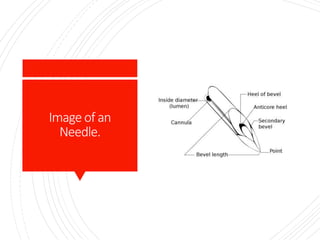
Image of an
Needle.
Anatomyof Needle
 Needle Gauge
 Refer to the diameter of the needle
 The Point
 The Sharp end of the needle
Anatomyof Needle
 The Bevel
 The bevel is the flat, slanted surface
near the point.
 The Lumen
 The hollow core of the needle that form
an oval shaped opening at the beveled
point.
Anatomyof Needle
 The Shaft
 The hollow steele tube that runs the
entire length of the needle.
 The Hub
 The end of the needle that attaches the
syringe
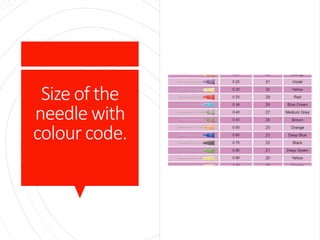
Size of the
needle with
colour code.
PenetrationPoint
In theBody.
 Intravenous
 Drugs can be administered into almost
any part of the body, including a vein
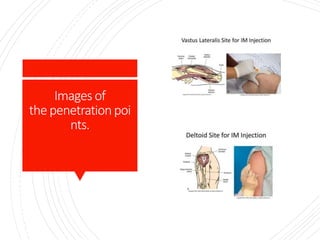
 Intramuscular
 IM injection are administered deep into
skeletal muscle.
PenetrationPoint
In theBody.
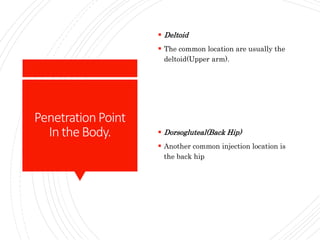
 Deltoid
 The common location are usually the
deltoid(Upper arm).
 Dorsogluteal(Back Hip)
 Another common injection location is
the back hip
PenetrationPoint
In theBody.
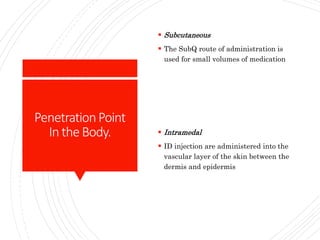
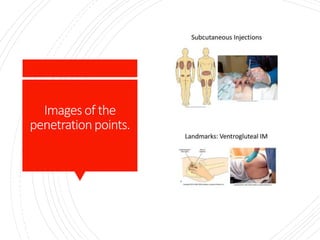
 Subcutaneous
 The SubQ route of administration is
used for small volumes of medication
 Intramedal
 ID injection are administered into the
vascular layer of the skin between the
dermis and epidermis
Images of the
penetrationpoints.
Images of
the penetrationpoi
nts.
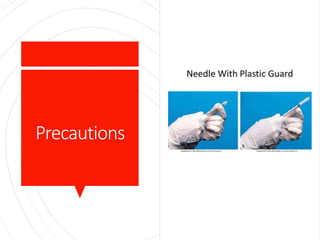
Precautions
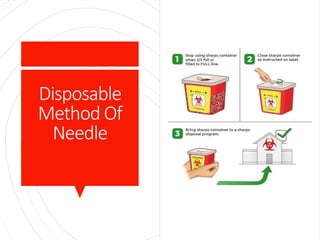
Disposable
Method Of
Needle
Syringe
 A syringe is a single pump consisting
of a plunger that fits tightly in a tube
to assist the liquid or solids into an
object either to through a needle,
tubing
 The most common use of syringe is to
administer injections into the body.
Syringe
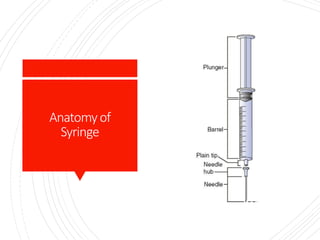
 A syringe consists of barrel, plunger
and a tip
Anatomyof
Syringe
Informationabout
SyringeParts.
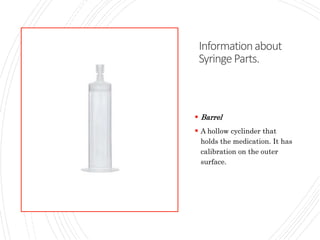
 Barrel
 A hollow cyclinder that
holds the medication. It has
calibration on the outer
surface.
Informationabout
SyringeParts.
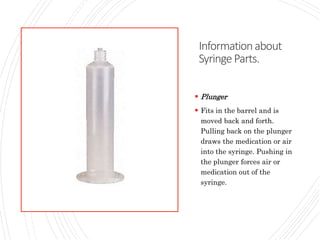
 Plunger
 Fits in the barrel and is
moved back and forth.
Pulling back on the plunger
draws the medication or air
into the syringe. Pushing in
the plunger forces air or
medication out of the
syringe.
Informationabout
SyringeParts.
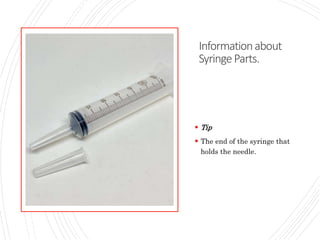
 Tip
 The end of the syringe that
holds the needle.
Typesof Syringes
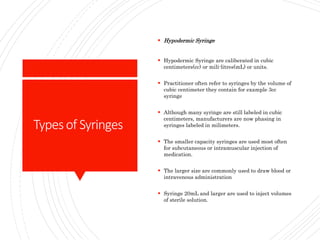
 Hypodermic Syringe
 Hypodermic Syringe are caliberated in cubic
centimeters(cc) or mili-litres(mL) or units.
 Practitioner often refer to syringes by the volume of
cubic centimeter they contain for example 3cc
syringe
 Although many syringe are still labeled in cubic
centimeters, manufacturers are now phasing in
syringes labeled in milimeters.
 The smaller capacity syringes are used most often
for subcutaneous or intramuscular injection of
medication.
 The larger size are commonly used to draw blood or
intravenous administration
 Syringe 20mL and larger are used to inject volumes
of sterile solution.
Typesof Syringes
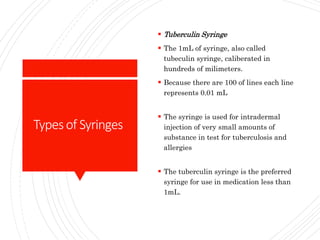
 Tuberculin Syringe
 The 1mL of syringe, also called
tubeculin syringe, caliberated in
hundreds of milimeters.
 Because there are 100 of lines each line
represents 0.01 mL
 The syringe is used for intradermal
injection of very small amounts of
substance in test for tuberculosis and
allergies
 The tuberculin syringe is the preferred
syringe for use in medication less than
1mL.
Typesof Syringes
 Insulin Syringes.
 It used for the subcutaneous injection
of insulin and are caliberated in units
rather than milimeters.
 The most commonly prepared
concentration of insulin is 100 units
per milliliter
 100 units= 1ml
Typesof Syringes
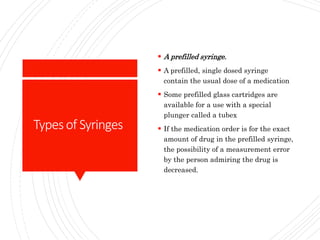
 A prefilled syringe.
 A prefilled, single dosed syringe
contain the usual dose of a medication
 Some prefilled glass cartridges are
available for a use with a special
plunger called a tubex
 If the medication order is for the exact
amount of drug in the prefilled syringe,
the possibility of a measurement error
by the person admiring the drug is
decreased.
Typesof Syringes
 Safety Syringes.
 In order to prevent the transmission of
blood borne infections from contaminated
needles, many syringes are now
manufactured with various types of safety
devices.
 For example a syringe may contain a
protective sheath that can be used to
protect the needle sterility.
 The sheath is then pulled forward and
locked into the place to provide a
permanent needle shield for disposal
following injection
 Other may have a needle that
automatically retracts into the barrel
after injection
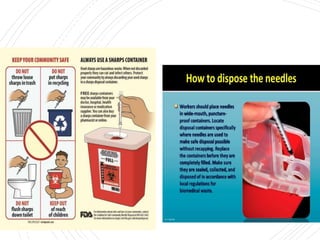
DisposalOf
Needles
THANK YOU.

Presentation on needle and syringe

  • 1.
    Presentation on Needle andSyringe. - RIYA SANJAY BAGHEL - NAGPUR
  • 2.
    Introduction  Parenteral productare medication or other preparation intended for adminstration by injection, either through the skin or gastrointestinal tract(GI) tract.  Parenteral adminstration allows the active ingrediant to be delivered to an organ, a lesion, a muscle, a nerve or another body tissues. In addition to medication, fluids, electrolytes and nutrients may be adminstered parenterally.
  • 3.
    Introductionto Needle  A hypodermicneedle, one of the category of medical tools which enter the skin, called sharps is a very thin, hollow tube with one sharp tip. It is commonly used with a syringe.  A hypodermic needle is used for rapid delivery of liquids, or when the injected substance cannot be ingested, either because it would harm the liver. It is also useful to deliver certain medications that cannot be delivered orally due to vomiting.
  • 4.
  • 6.
    Anatomyof Needle  NeedleGauge  Refer to the diameter of the needle  The Point  The Sharp end of the needle
  • 7.
    Anatomyof Needle  TheBevel  The bevel is the flat, slanted surface near the point.  The Lumen  The hollow core of the needle that form an oval shaped opening at the beveled point.
  • 8.
    Anatomyof Needle  TheShaft  The hollow steele tube that runs the entire length of the needle.  The Hub  The end of the needle that attaches the syringe
  • 9.
    Size of the needlewith colour code.
  • 10.
    PenetrationPoint In theBody.  Intravenous Drugs can be administered into almost any part of the body, including a vein  Intramuscular  IM injection are administered deep into skeletal muscle.
  • 11.
    PenetrationPoint In theBody.  Deltoid The common location are usually the deltoid(Upper arm).  Dorsogluteal(Back Hip)  Another common injection location is the back hip
  • 12.
    PenetrationPoint In theBody.  Subcutaneous The SubQ route of administration is used for small volumes of medication  Intramedal  ID injection are administered into the vascular layer of the skin between the dermis and epidermis
  • 13.
  • 14.
  • 16.
  • 17.
  • 18.
    Syringe  A syringeis a single pump consisting of a plunger that fits tightly in a tube to assist the liquid or solids into an object either to through a needle, tubing  The most common use of syringe is to administer injections into the body.
  • 19.
    Syringe  A syringeconsists of barrel, plunger and a tip
  • 20.
  • 21.
    Informationabout SyringeParts.  Barrel  Ahollow cyclinder that holds the medication. It has calibration on the outer surface.
  • 22.
    Informationabout SyringeParts.  Plunger  Fitsin the barrel and is moved back and forth. Pulling back on the plunger draws the medication or air into the syringe. Pushing in the plunger forces air or medication out of the syringe.
  • 23.
    Informationabout SyringeParts.  Tip  Theend of the syringe that holds the needle.
  • 24.
    Typesof Syringes  HypodermicSyringe  Hypodermic Syringe are caliberated in cubic centimeters(cc) or mili-litres(mL) or units.  Practitioner often refer to syringes by the volume of cubic centimeter they contain for example 3cc syringe  Although many syringe are still labeled in cubic centimeters, manufacturers are now phasing in syringes labeled in milimeters.  The smaller capacity syringes are used most often for subcutaneous or intramuscular injection of medication.  The larger size are commonly used to draw blood or intravenous administration  Syringe 20mL and larger are used to inject volumes of sterile solution.
  • 25.
    Typesof Syringes  TuberculinSyringe  The 1mL of syringe, also called tubeculin syringe, caliberated in hundreds of milimeters.  Because there are 100 of lines each line represents 0.01 mL  The syringe is used for intradermal injection of very small amounts of substance in test for tuberculosis and allergies  The tuberculin syringe is the preferred syringe for use in medication less than 1mL.
  • 26.
    Typesof Syringes  InsulinSyringes.  It used for the subcutaneous injection of insulin and are caliberated in units rather than milimeters.  The most commonly prepared concentration of insulin is 100 units per milliliter  100 units= 1ml
  • 27.
    Typesof Syringes  Aprefilled syringe.  A prefilled, single dosed syringe contain the usual dose of a medication  Some prefilled glass cartridges are available for a use with a special plunger called a tubex  If the medication order is for the exact amount of drug in the prefilled syringe, the possibility of a measurement error by the person admiring the drug is decreased.
  • 28.
    Typesof Syringes  SafetySyringes.  In order to prevent the transmission of blood borne infections from contaminated needles, many syringes are now manufactured with various types of safety devices.  For example a syringe may contain a protective sheath that can be used to protect the needle sterility.  The sheath is then pulled forward and locked into the place to provide a permanent needle shield for disposal following injection  Other may have a needle that automatically retracts into the barrel after injection
  • 29.
  • 30.