Math and Dosage Calculations for Health Care  Third Edition Booth & Whaley McGraw-Hill 4- Chapter 4: Equipment for Dosage Measurement Edited by B. Holmes MSN/Ed, RN
Learning Outcomes Identify equipment used to administer medication. Indicate the appropriate equipment for delivering various types of medicine. Measure medications using the calibrations on the equipment. Describe the method of administration appropriate for each piece of measuring equipment. 4-
Introduction To prepare the correct dosage, it is important to be familiar with and use equipment properly. Accurately read the dosage markings Administration routes Oral Parenteral – bypassing the digestive tract Topical / transdermal Drops, sprays, and mists Vaginal and rectal  4-
Oral Administration Measuring devices are calibrated or marked at varying intervals. Calibrations   are used to Measure the amount of liquid in the container Compare to desired dose Match physician’s order units If container and order do not match, convert order to units of measurement to be used. 4-
Oral Administration  (cont.) Equipment Medicine cups  Droppers Calibrated spoons Oral syringes 4-
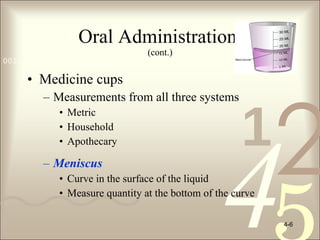
Oral Administration  (cont.) Medicine cups Measurements from all three systems Metric  Household  Apothecary Meniscus   Curve in the surface of the liquid Measure quantity at the bottom of the curve 4-
Oral Administration  (cont.) Rule 4 - 1   Do not use medicine cups for doses less than 5 mL, even if the cup has calibrations smaller than 5 mL. To ensure accuracy use a dropper a calibrated spoon an oral syringe 4-
Droppers Uses Measure and administer small amounts of oral liquid medication Deliver medication to the eyes, ears, and nose Oral pediatric doses Units of measurement vary with dropper Packaged with product Do not interchange droppers Do not put the dropper in the patient’s mouth 4-
Calibrated Spoons Used with pediatric and elderly patients Administer medication directly into the mouth or into food or beverage 4-
Oral Syringes Used for quantities less than 5 mL Safety features Eccentric  tips Tinted Not sterile 4-
Oral Syringes  (cont.) Rule 4 – 2  1. Never attach a hypodermic needle to an oral syringe. 2. Never inject an oral dose. 3. In emergencies, you may use a hypodermic syringe without a needle to measure and administer liquid oral doses, but never while its needle is attached. 4-
Oral Administration  (cont.) When a patient cannot take medication orally, medications can be administered through a tube to the stomach. Types Nasogastric  tube PEG tube Jejunostomy tube 4-
Error Alert! Utensil used must provide the calibration needed to accurately measure the dose. 4- Example Which would you select to administer ½ tsp. of a liquid medication? Yes! No!
Practice Determine if the statements below are true. 1. You may use a hypodermic syringe with a needle to measure liquid for oral administration. 2. Oral and hypodermic syringes are identical in appearance. 3. Measuring spoons used for baking are acceptable for measuring liquid medications. 4- False False True
Practice 4. Oral medication comes in a bottle labeled 200 mg/5 cc. The dose to be administered is 600 mg. Which of the following is the correct dose?  1 tsp 2 tsp 1 tbsp  = 15mL 2 tbsp 4-
Hypodermic Syringes Parenteral  administration  Administer medications by injection Intravenous ( IV )  Intramuscular ( IM ) Intradermal ( ID ) Subcutaneous ( Sub-Q ) 4-
Standard Syringes Calibrated in milliliters (mL) Metric system is used most   often May be marked in minims  Allow for measurement of   small doses 3-mL syringe most common 4-
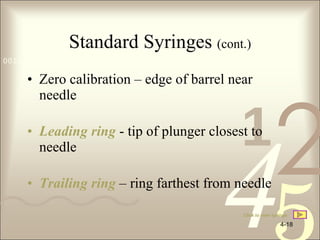
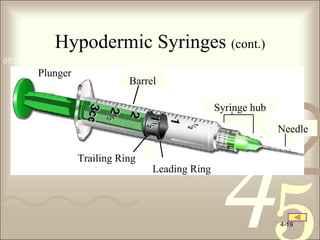
Standard Syringes  (cont.) Zero calibration – edge of barrel near needle Leading ring  - tip of plunger closest to needle Trailing ring  – ring farthest from needle 4- Click to view syringe
Hypodermic Syringes  (cont.) 4- Trailing Ring Leading Ring Plunger Leading Ring Trailing Ring Leading Ring Barrel Syringe hub Needle Trailing Ring Leading Ring Plunger
Safety Syringes Same components as standard syringe Safety shields protect needle Reduce the chance of needlestick injury 4- 3 mL syringe with retractable needle
Prefilled Syringes A single, standard dose of medication Use once and discard Usually marked in tenths of a mL Measure the dose carefully Discard any  excess  medication  prior to injection 4-
Prefilled Syringes Rule 4 - 3 When using a prefilled syringe, always examine the markings to determine whether the syringe is calibrated in milliliters or milligrams and calculate the dose accordingly. 4-
Insulin Syringes  (cont.) Used only to measure and administer  insulin Calibrated in units  Insulin doses order in units U-100 insulin most common form 100 units of insulin per 1 mL Syringes available in 30, 50, and 100 Unit   capacities 4-
Insulin Syringes   (cont.) 4- 100 Unit Insulin Syringe 50 Unit Insulin Syringe
Insulin Syringes  (cont.) 4- Comparison of insulin syringes: 50 unit syringe  100 unit syringe
Insulin Syringes  (cont.) Rule 4 - 4 Never use any type of syringe other than an insulin syringe to measure and administer insulin. 4-
Tuberculin Syringes Used for doses less than 1 mL Calibrated in hundredths of a mL Requires careful measurement Examples: PPD skin test Vaccines Heparin Pediatric   medicines Allergen extracts 4-
Tuberculin Syringes  (cont.) 4- 1 mL Tuberculin Syringe 0.5 mL Tuberculin Syringe
Tuberculin Syringes  (cont.) 4- Comparison of tuberculin syringes: 0.5 mL  syringe  1 mL  syringe
Syringes for Established IV Lines  Used to administer medication and fluids directly into a patient’s vein Uses the injection port of an IV line Advantages Eliminates repeated punctures for the patient Decreased risk of needlestick injuries Compatible drugs can be administered together Enables drug delivery on a periodic basis  Enables dilution of the medication 4-
Syringes for Established IV Lines  (cont.) 4- Plastic injection tip  Injection  port on IV line
Large-Capacity Syringes Not all medication can be delivered in doses of 3 mL or less. Syringes with 5 mL, 10mL, 20 mL are available  Volume is measured in milliliters but calibrations between may vary. Look carefully at the marks to measure an accurate amount of medication. 4-
Large-Capacity Syringes  (cont.) 4- 10 mL syringe
Error Alert! Pay close attention to the calibration of any syringe you use. Check the marks carefully. Always align the leading ring with  calibration. 4-
Ampules, Vials, and Cartridges 4- Cartridge Vial Ampule
Cartridges Prefilled container shaped like a syringe barrel One dose of medication Fits a reusable syringe Examples Tubex ® Carpuject ® 4-
Ampule Sealed container holding one dose of medication Snaps open Use a standard syringe to withdraw the medication Use a paper towel to snap the top of the ampule Change needle after withdrawing the medication 4-
Vials Container covered with a rubber stopper  Contain one or more doses of medication Either liquid or powder form of medication that must be reconstituted 4-
Preparing the Syringe Rule 4 - 5   In most circumstances, the person who prepares a syringe for injection should deliver the injection.   Exceptions include: 1. Pharmacy technicians who prefill syringes for nurses, medical assistants, or patients 2. Nurses or medical assistants preparing a syringe for a physician 3. Health-care workers teaching a patient to administer his or her own medication 4-
Needle Gauge and Length Choose appropriate needle for injection Gauge Interior diameter Smaller gauges correspond to larger diameters Use larger needles for more viscous drugs and deeper injections 4-
Needle Gauge and Length  (cont.) Needle choice (cont.) Length The injection site determines length. Such as the size of your patient Length must be long enough to reach the desired area of tissue. Length must not be so long that it penetrates beyond the desired area. 4-
Needle Gauge and Length  (cont.) 4- Type of Injection Needle Gauge Length (inches) for Adults Intradermal 25-26 3/8 – 5/6 Subcutaneous 23 - 27 ½ - 5/8 Intramuscular 18 - 23 1 - 2
Practice Identify the parts of this syringe: 4- A.  B.  C. D. E. F. Barrel Syringe hub Needle Trailing Ring Leading Ring Plunger
Practice You have an order to administer 1.5 mL of a medication.  It comes in a 3 mL prefilled syringe. What should you do? 4- ANSWER   Carefully check the calibration and discard the excess medication prior to giving the injection.  In this case, you would discard 1.5 mL medication. You should NEVER attempt to inject the correct dose without removing the excess medication first.
Topical Medications Gels, creams, ointments, and pastes Apply directly to the skin Use a glove, tongue blade, or cotton-tipped applicator Avoid contact your own skin Wear non-sterile gloves   to apply or remove 4-
Transdermal Medications Form of topical medication absorbed through the skin. Use a self-adhesive patch. Place patch on clean, dry, hairless skin with no rash or irritation and with good circulation. Rotate placement sites. Remove older patches and dispose of them properly. Mark each new patch with your initials, the date, and the time. 4-
Transdermal Medications  (cont.) Maintain a consistent level of medication in the blood. Bypass GI system. Uses  Cardiovascular drugs Hormones Allergy medications Pain medications 4-
Drops, Sprays, and Mists Drops Instillations Nose, eyes, and ears Use the equipment that comes with the drug to administer the medication. Mists Inhaled by patient Vaporizers –  water used to create mist Nebulizers and  metered dose inhalers  (MDIs)  Sprays  Nose and throat 4-
Vaginal and Rectal Medications Vaginal Suppositories Tablets Douches for liquid forms of medication Creams and foams Rectal Suppositories Enemas for liquid  forms of medication Creams and foams 4-
Apply Your Knowledge Which type of delivery device is used to administer medication to the eyes and ears? 4- ANSWER   Dropper What instructions should you provide a patient who is starting a new medication delivered by a transdermal patch? ANSWER   The patch should be put  on clean, dry, hairless skin with no rash or irritation. Placement sites should be rotated. Older patches should be removed and disposes of properly.
Apply your Knowledge What kind of syringe is used to deliver vaccinations? 4- ANSWER   Tuberculin
Apply your Knowledge How many mL are indicated on this syringe? 4- ANSWER   1.6 mL
End of Chapter 4 4- Nothing will work unless you do.  ~Maya Angelou

Medication Devices

  • 1.
    Math and DosageCalculations for Health Care Third Edition Booth & Whaley McGraw-Hill 4- Chapter 4: Equipment for Dosage Measurement Edited by B. Holmes MSN/Ed, RN
  • 2.
    Learning Outcomes Identifyequipment used to administer medication. Indicate the appropriate equipment for delivering various types of medicine. Measure medications using the calibrations on the equipment. Describe the method of administration appropriate for each piece of measuring equipment. 4-
  • 3.
    Introduction To preparethe correct dosage, it is important to be familiar with and use equipment properly. Accurately read the dosage markings Administration routes Oral Parenteral – bypassing the digestive tract Topical / transdermal Drops, sprays, and mists Vaginal and rectal 4-
  • 4.
    Oral Administration Measuringdevices are calibrated or marked at varying intervals. Calibrations are used to Measure the amount of liquid in the container Compare to desired dose Match physician’s order units If container and order do not match, convert order to units of measurement to be used. 4-
  • 5.
    Oral Administration (cont.) Equipment Medicine cups Droppers Calibrated spoons Oral syringes 4-
  • 6.
    Oral Administration (cont.) Medicine cups Measurements from all three systems Metric Household Apothecary Meniscus Curve in the surface of the liquid Measure quantity at the bottom of the curve 4-
  • 7.
    Oral Administration (cont.) Rule 4 - 1 Do not use medicine cups for doses less than 5 mL, even if the cup has calibrations smaller than 5 mL. To ensure accuracy use a dropper a calibrated spoon an oral syringe 4-
  • 8.
    Droppers Uses Measureand administer small amounts of oral liquid medication Deliver medication to the eyes, ears, and nose Oral pediatric doses Units of measurement vary with dropper Packaged with product Do not interchange droppers Do not put the dropper in the patient’s mouth 4-
  • 9.
    Calibrated Spoons Usedwith pediatric and elderly patients Administer medication directly into the mouth or into food or beverage 4-
  • 10.
    Oral Syringes Usedfor quantities less than 5 mL Safety features Eccentric tips Tinted Not sterile 4-
  • 11.
    Oral Syringes (cont.) Rule 4 – 2 1. Never attach a hypodermic needle to an oral syringe. 2. Never inject an oral dose. 3. In emergencies, you may use a hypodermic syringe without a needle to measure and administer liquid oral doses, but never while its needle is attached. 4-
  • 12.
    Oral Administration (cont.) When a patient cannot take medication orally, medications can be administered through a tube to the stomach. Types Nasogastric tube PEG tube Jejunostomy tube 4-
  • 13.
    Error Alert! Utensilused must provide the calibration needed to accurately measure the dose. 4- Example Which would you select to administer ½ tsp. of a liquid medication? Yes! No!
  • 14.
    Practice Determine ifthe statements below are true. 1. You may use a hypodermic syringe with a needle to measure liquid for oral administration. 2. Oral and hypodermic syringes are identical in appearance. 3. Measuring spoons used for baking are acceptable for measuring liquid medications. 4- False False True
  • 15.
    Practice 4. Oralmedication comes in a bottle labeled 200 mg/5 cc. The dose to be administered is 600 mg. Which of the following is the correct dose? 1 tsp 2 tsp 1 tbsp = 15mL 2 tbsp 4-
  • 16.
    Hypodermic Syringes Parenteral administration Administer medications by injection Intravenous ( IV ) Intramuscular ( IM ) Intradermal ( ID ) Subcutaneous ( Sub-Q ) 4-
  • 17.
    Standard Syringes Calibratedin milliliters (mL) Metric system is used most often May be marked in minims Allow for measurement of small doses 3-mL syringe most common 4-
  • 18.
    Standard Syringes (cont.) Zero calibration – edge of barrel near needle Leading ring - tip of plunger closest to needle Trailing ring – ring farthest from needle 4- Click to view syringe
  • 19.
    Hypodermic Syringes (cont.) 4- Trailing Ring Leading Ring Plunger Leading Ring Trailing Ring Leading Ring Barrel Syringe hub Needle Trailing Ring Leading Ring Plunger
  • 20.
    Safety Syringes Samecomponents as standard syringe Safety shields protect needle Reduce the chance of needlestick injury 4- 3 mL syringe with retractable needle
  • 21.
    Prefilled Syringes Asingle, standard dose of medication Use once and discard Usually marked in tenths of a mL Measure the dose carefully Discard any excess medication prior to injection 4-
  • 22.
    Prefilled Syringes Rule4 - 3 When using a prefilled syringe, always examine the markings to determine whether the syringe is calibrated in milliliters or milligrams and calculate the dose accordingly. 4-
  • 23.
    Insulin Syringes (cont.) Used only to measure and administer insulin Calibrated in units Insulin doses order in units U-100 insulin most common form 100 units of insulin per 1 mL Syringes available in 30, 50, and 100 Unit capacities 4-
  • 24.
    Insulin Syringes (cont.) 4- 100 Unit Insulin Syringe 50 Unit Insulin Syringe
  • 25.
    Insulin Syringes (cont.) 4- Comparison of insulin syringes: 50 unit syringe 100 unit syringe
  • 26.
    Insulin Syringes (cont.) Rule 4 - 4 Never use any type of syringe other than an insulin syringe to measure and administer insulin. 4-
  • 27.
    Tuberculin Syringes Usedfor doses less than 1 mL Calibrated in hundredths of a mL Requires careful measurement Examples: PPD skin test Vaccines Heparin Pediatric medicines Allergen extracts 4-
  • 28.
    Tuberculin Syringes (cont.) 4- 1 mL Tuberculin Syringe 0.5 mL Tuberculin Syringe
  • 29.
    Tuberculin Syringes (cont.) 4- Comparison of tuberculin syringes: 0.5 mL syringe 1 mL syringe
  • 30.
    Syringes for EstablishedIV Lines Used to administer medication and fluids directly into a patient’s vein Uses the injection port of an IV line Advantages Eliminates repeated punctures for the patient Decreased risk of needlestick injuries Compatible drugs can be administered together Enables drug delivery on a periodic basis Enables dilution of the medication 4-
  • 31.
    Syringes for EstablishedIV Lines (cont.) 4- Plastic injection tip Injection port on IV line
  • 32.
    Large-Capacity Syringes Notall medication can be delivered in doses of 3 mL or less. Syringes with 5 mL, 10mL, 20 mL are available Volume is measured in milliliters but calibrations between may vary. Look carefully at the marks to measure an accurate amount of medication. 4-
  • 33.
    Large-Capacity Syringes (cont.) 4- 10 mL syringe
  • 34.
    Error Alert! Payclose attention to the calibration of any syringe you use. Check the marks carefully. Always align the leading ring with calibration. 4-
  • 35.
    Ampules, Vials, andCartridges 4- Cartridge Vial Ampule
  • 36.
    Cartridges Prefilled containershaped like a syringe barrel One dose of medication Fits a reusable syringe Examples Tubex ® Carpuject ® 4-
  • 37.
    Ampule Sealed containerholding one dose of medication Snaps open Use a standard syringe to withdraw the medication Use a paper towel to snap the top of the ampule Change needle after withdrawing the medication 4-
  • 38.
    Vials Container coveredwith a rubber stopper Contain one or more doses of medication Either liquid or powder form of medication that must be reconstituted 4-
  • 39.
    Preparing the SyringeRule 4 - 5 In most circumstances, the person who prepares a syringe for injection should deliver the injection. Exceptions include: 1. Pharmacy technicians who prefill syringes for nurses, medical assistants, or patients 2. Nurses or medical assistants preparing a syringe for a physician 3. Health-care workers teaching a patient to administer his or her own medication 4-
  • 40.
    Needle Gauge andLength Choose appropriate needle for injection Gauge Interior diameter Smaller gauges correspond to larger diameters Use larger needles for more viscous drugs and deeper injections 4-
  • 41.
    Needle Gauge andLength (cont.) Needle choice (cont.) Length The injection site determines length. Such as the size of your patient Length must be long enough to reach the desired area of tissue. Length must not be so long that it penetrates beyond the desired area. 4-
  • 42.
    Needle Gauge andLength (cont.) 4- Type of Injection Needle Gauge Length (inches) for Adults Intradermal 25-26 3/8 – 5/6 Subcutaneous 23 - 27 ½ - 5/8 Intramuscular 18 - 23 1 - 2
  • 43.
    Practice Identify theparts of this syringe: 4- A. B. C. D. E. F. Barrel Syringe hub Needle Trailing Ring Leading Ring Plunger
  • 44.
    Practice You havean order to administer 1.5 mL of a medication. It comes in a 3 mL prefilled syringe. What should you do? 4- ANSWER Carefully check the calibration and discard the excess medication prior to giving the injection. In this case, you would discard 1.5 mL medication. You should NEVER attempt to inject the correct dose without removing the excess medication first.
  • 45.
    Topical Medications Gels,creams, ointments, and pastes Apply directly to the skin Use a glove, tongue blade, or cotton-tipped applicator Avoid contact your own skin Wear non-sterile gloves to apply or remove 4-
  • 46.
    Transdermal Medications Formof topical medication absorbed through the skin. Use a self-adhesive patch. Place patch on clean, dry, hairless skin with no rash or irritation and with good circulation. Rotate placement sites. Remove older patches and dispose of them properly. Mark each new patch with your initials, the date, and the time. 4-
  • 47.
    Transdermal Medications (cont.) Maintain a consistent level of medication in the blood. Bypass GI system. Uses Cardiovascular drugs Hormones Allergy medications Pain medications 4-
  • 48.
    Drops, Sprays, andMists Drops Instillations Nose, eyes, and ears Use the equipment that comes with the drug to administer the medication. Mists Inhaled by patient Vaporizers – water used to create mist Nebulizers and metered dose inhalers (MDIs) Sprays Nose and throat 4-
  • 49.
    Vaginal and RectalMedications Vaginal Suppositories Tablets Douches for liquid forms of medication Creams and foams Rectal Suppositories Enemas for liquid forms of medication Creams and foams 4-
  • 50.
    Apply Your KnowledgeWhich type of delivery device is used to administer medication to the eyes and ears? 4- ANSWER Dropper What instructions should you provide a patient who is starting a new medication delivered by a transdermal patch? ANSWER The patch should be put on clean, dry, hairless skin with no rash or irritation. Placement sites should be rotated. Older patches should be removed and disposes of properly.
  • 51.
    Apply your KnowledgeWhat kind of syringe is used to deliver vaccinations? 4- ANSWER Tuberculin
  • 52.
    Apply your KnowledgeHow many mL are indicated on this syringe? 4- ANSWER 1.6 mL
  • 53.
    End of Chapter4 4- Nothing will work unless you do. ~Maya Angelou