Multi Protocol Label Switching(MPLS)
By : Reza Farahani
INTRODUCTION
 Traditional Routing Mechanism
 Limitations of Traditional Routing
 MPLS Solution by attach LABEL
 MPLS VPN  LABEL Attach as for Customer ID
 MPLS TE LABEL Attach by load Link
 MPLS QoS  LABEL Attach by QoS
Switching Methods
 Circuit Switching PSTN
Connection Setup : address for reserve path
Data Forwarding : nothing
 Packet SwitchingInternet
Connection Setup : nothing
Data Forwarding : global address
 Label SwitchingMPLS,ATM,FR
Connection Setup : global address
Data Forwarding : local address
CEF
For each packet, the router finds the matching FIB entry,
then finds the adjacency table entry referenced by the
matching FIB entry, and forwards the packet.
CEF optimizes the organization of the FIB so that the
router spends very little time to find the correct FIB entry,
resulting in a smaller forwarding delay and a higher volume
of packets per second through a router.
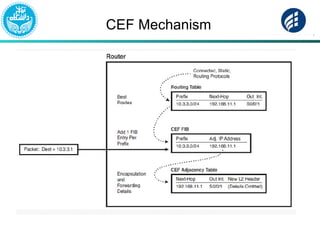
CEF Mechanism
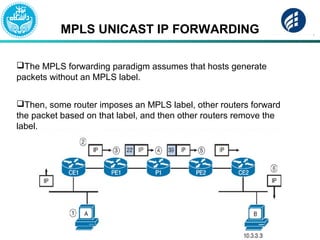
MPLS UNICAST IP FORWARDING
The MPLS forwarding paradigm assumes that hosts generate
packets without an MPLS label.
Then, some router imposes an MPLS label, other routers forward
the packet based on that label, and then other routers remove the
label.
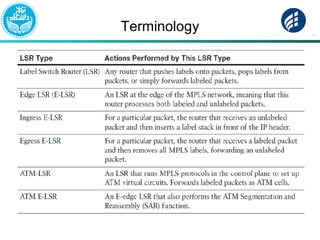
Terminology
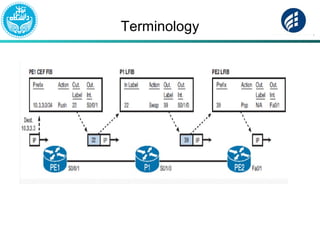
Terminology
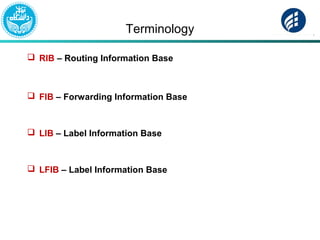
 RIB – Routing Information Base
 FIB – Forwarding Information Base
 LIB – Label Information Base
 LFIB – Label Information Base
Terminology
THE MPLS HEADER AND LABEL
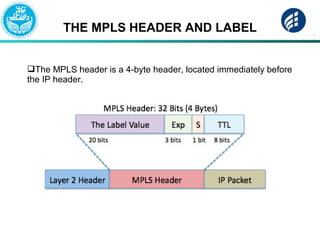
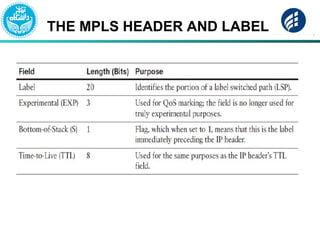
The MPLS header is a 4-byte header, located immediately before
the IP header.
THE MPLS HEADER AND LABEL
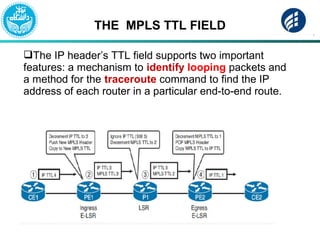
THE MPLS TTL FIELD
The IP header’s TTL field supports two important
features: a mechanism to identify looping packets and
a method for the traceroute command to find the IP
address of each router in a particular end-to-end route.
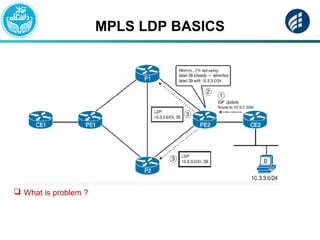
MPLS LDP BASICS
The earliest pre-standard version of LDP was called Tag Distribution Protocol
(TDP).
Label Distribution Protocol (LDP) is a protocol in which routers capable of
Multiprotocol Label Switching (MPLS) exchange label mapping information.
The Label Distribution Protocol (LDP) is a protocol defined by the IETF (RFC 5036)
for the purpose of distributing labels in an MPLS environment.
MPLS LDP BASICS
LDP defines a set of procedures and messages by which one LSR (Label
Switched Router) informs another of the label bindings it has made.
LDP multicasts the Hellos to IP address 224.0.0.2, using UDP port number 646
for LDP (TDP uses UDP port 711).
MPLS LDP BASICS
 LDP provides a standard methodology for hop-by-hop, or dynamic label, distribution
in an MPLS network by assigning labels to routes that have been chosen by the
underlying Interior Gateway Protocol (IGP) routing protocols.

MPLS LDP BASICS
 What is problem ?
Penultimate hop popping (PHP)
 PHP on the other hand means that the penultimate LSR really
removes the top label and sends the rest.
 Label 0-15 reserved for special purpose
 Label=3 is Implicit null
 The one disadvantage in implicit null approach is if the network
is configured for QoS based on MPLS EXP bits, then QoS is
lost between penultimate router and last hop router. In this case,
we can make use of Explicit null which means penultimate hop
router does not pop the label.
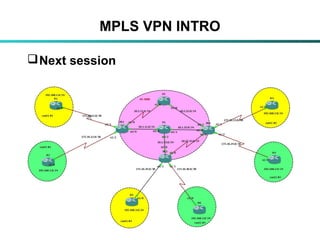
MPLS VPN INTRO
Next session
•
Question ?

MPLS & BASIC LDP

  • 1.
    Multi Protocol LabelSwitching(MPLS) By : Reza Farahani
  • 2.
    INTRODUCTION  Traditional RoutingMechanism  Limitations of Traditional Routing  MPLS Solution by attach LABEL  MPLS VPN  LABEL Attach as for Customer ID  MPLS TE LABEL Attach by load Link  MPLS QoS  LABEL Attach by QoS
  • 3.
    Switching Methods  CircuitSwitching PSTN Connection Setup : address for reserve path Data Forwarding : nothing  Packet SwitchingInternet Connection Setup : nothing Data Forwarding : global address  Label SwitchingMPLS,ATM,FR Connection Setup : global address Data Forwarding : local address
  • 4.
    CEF For each packet,the router finds the matching FIB entry, then finds the adjacency table entry referenced by the matching FIB entry, and forwards the packet. CEF optimizes the organization of the FIB so that the router spends very little time to find the correct FIB entry, resulting in a smaller forwarding delay and a higher volume of packets per second through a router.
  • 5.
  • 6.
    MPLS UNICAST IPFORWARDING The MPLS forwarding paradigm assumes that hosts generate packets without an MPLS label. Then, some router imposes an MPLS label, other routers forward the packet based on that label, and then other routers remove the label.
  • 7.
  • 8.
    Terminology  RIB –Routing Information Base  FIB – Forwarding Information Base  LIB – Label Information Base  LFIB – Label Information Base
  • 9.
  • 10.
    THE MPLS HEADERAND LABEL The MPLS header is a 4-byte header, located immediately before the IP header.
  • 11.
    THE MPLS HEADERAND LABEL
  • 12.
    THE MPLS TTLFIELD The IP header’s TTL field supports two important features: a mechanism to identify looping packets and a method for the traceroute command to find the IP address of each router in a particular end-to-end route.
  • 13.
    MPLS LDP BASICS Theearliest pre-standard version of LDP was called Tag Distribution Protocol (TDP). Label Distribution Protocol (LDP) is a protocol in which routers capable of Multiprotocol Label Switching (MPLS) exchange label mapping information. The Label Distribution Protocol (LDP) is a protocol defined by the IETF (RFC 5036) for the purpose of distributing labels in an MPLS environment.
  • 14.
    MPLS LDP BASICS LDPdefines a set of procedures and messages by which one LSR (Label Switched Router) informs another of the label bindings it has made. LDP multicasts the Hellos to IP address 224.0.0.2, using UDP port number 646 for LDP (TDP uses UDP port 711).
  • 15.
    MPLS LDP BASICS LDP provides a standard methodology for hop-by-hop, or dynamic label, distribution in an MPLS network by assigning labels to routes that have been chosen by the underlying Interior Gateway Protocol (IGP) routing protocols. 
  • 16.
    MPLS LDP BASICS What is problem ?
  • 17.
    Penultimate hop popping(PHP)  PHP on the other hand means that the penultimate LSR really removes the top label and sends the rest.  Label 0-15 reserved for special purpose  Label=3 is Implicit null  The one disadvantage in implicit null approach is if the network is configured for QoS based on MPLS EXP bits, then QoS is lost between penultimate router and last hop router. In this case, we can make use of Explicit null which means penultimate hop router does not pop the label.
  • 18.
  • 19.