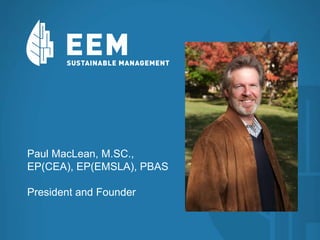
Paul MacLean, M.SC.,
EP(CEA), EP(EMSLA), PBAS
President and Founder
• In business since 1993
• More than 100 active clients
• 12 bilingual consultants
• Headquartered in Montreal
• Work mainly in Quebec and Canada, with projects in the U.S., Africa, Asia,
Europe, and Latin America
• Sectors:
- Mining & Metals
- Aboriginal / First Nations
- Aerospace
- Energy
- Infrastructure &
Construction
- Manufacturing
- Media
- Waste management
- Government
- Pharmaceuticals
- Printing
- Tourism & Events
- Non-profit Organizations
- Education
OUR SERVICES
CSR STRATEGY COMMUNITIES ENVIRONMENT
• Assessment and Planning of
the Approach
• Embedding
• Performance Evaluation
• Communication and
Reporting
• Social Impact Assessment
• Community Relations
• Participatory Planning and
Development
• Socio-economic Studies
• Management System for
Environment, Health and
Safety (EHS)
• Regulatory Support
• Outsourcing of Resources
• Evaluation and Miscellaneous
Analyses of Environmental
Impacts
CHANGES TO ISO 14001
A review and explanation of changes to the ISO 14001
standard, based on the July 2015 FDIS, and how it may
affect EMS based on ISO 14001:2004.
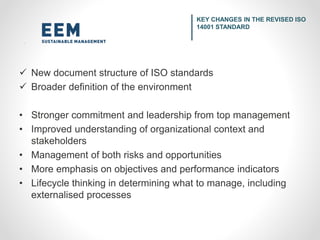
 New document structure of ISO standards
 Broader definition of the environment
• Stronger commitment and leadership from top management
• Improved understanding of organizational context and
stakeholders
• Management of both risks and opportunities
• More emphasis on objectives and performance indicators
• Lifecycle thinking in determining what to manage, including
externalised processes
KEY CHANGES IN THE REVISED ISO
14001 STANDARD
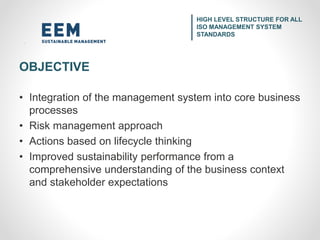
• Integration of the management system into core business
processes
• Risk management approach
• Actions based on lifecycle thinking
• Improved sustainability performance from a
comprehensive understanding of the business context
and stakeholder expectations
HIGH LEVEL STRUCTURE FOR ALL
ISO MANAGEMENT SYSTEM
STANDARDS
OBJECTIVE
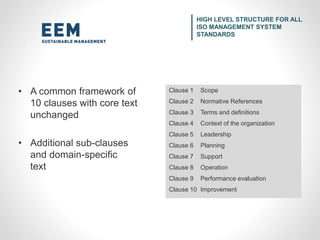
• A common framework of
10 clauses with core text
unchanged
• Additional sub-clauses
and domain-specific
text
HIGH LEVEL STRUCTURE FOR ALL
ISO MANAGEMENT SYSTEM
STANDARDS
Clause 1 Scope
Clause 2 Normative References
Clause 3 Terms and definitions
Clause 4 Context of the organization
Clause 5 Leadership
Clause 6 Planning
Clause 7 Support
Clause 8 Operation
Clause 9 Performance evaluation
Clause 10 Improvement
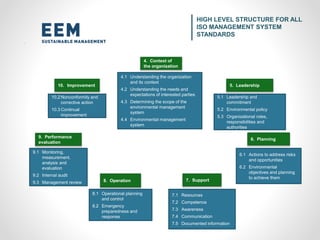
4. Context of
the organization
5. Leadership
6. Planning
7. Support8. Operation
9. Performance
evaluation
10. Improvement
10.2 Nonconformity and
corrective action
10.3 Continual
improvement
4.1 Understanding the organization
and its context
4.2 Understanding the needs and
expectations of interested parties
4.3 Determining the scope of the
environmental management
system
4.4 Environmental management
system
5.1 Leadership and
commitment
5.2 Environmental policy
5.3 Organizational roles,
responsibilities and
authorities
6.1 Actions to address risks
and opportunities
6.2 Environmental
objectives and planning
to achieve them
7.1 Resources
7.2 Competence
7.3 Awareness
7.4 Communication
7.5 Documented information
8.1 Operational planning
and control
8.2 Emergency
preparedness and
response
9.1 Monitoring,
measurement,
analysis and
evaluation
9.2 Internal audit
9.3 Management review
HIGH LEVEL STRUCTURE FOR ALL
ISO MANAGEMENT SYSTEM
STANDARDS
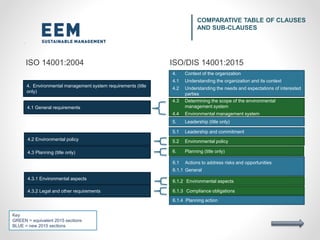
COMPARATIVE TABLE OF CLAUSES
AND SUB-CLAUSES
4. Context of the organization
4.1 Understanding the organization and its context
4.2 Understanding the needs and expectations of interested
parties
6.1 Actions to address risks and opportunities
6.1.1 General
4. Environmental management system requirements (title
only)
4.1 General requirements
4.3 Determining the scope of the environmental
management system
4.4 Environmental management system
5. Leadership (title only)
5.1 Leadership and commitment
4.2 Environmental policy 5.2 Environmental policy
6. Planning (title only)4.3 Planning (title only)
4.3.1 Environmental aspects
6.1.2 Environmental aspects
4.3.2 Legal and other requirements 6.1.3 Compliance obligations
6.1.4 Planning action
ISO 14001:2004 ISO/DIS 14001:2015
Key
GREEN = equivalent 2015 sections
BLUE = new 2015 sections
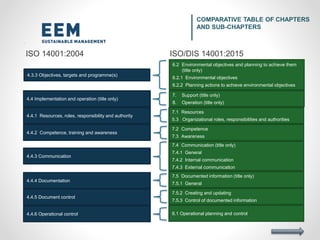
ISO 14001:2004 ISO/DIS 14001:2015
6.2 Environmental objectives and planning to achieve them
(title only)
6.2.1 Environmental objectives
6.2.2 Planning actions to achieve environmental objectives
4.4 Implementation and operation (title only)
7. Support (title only)
8. Operation (title only)
4.4.1 Resources, roles, responsibility and authority
7.1 Resources
5.3 Organizational roles, responsibilities and authorities
4.4.2 Competence, training and awareness
7.2 Competence
7.3 Awareness
4.4.3 Communication
7.4 Communication (title only)
7.4.1 General
7.4.2 Internal communication
7.4.3 External communication
4.3.3 Objectives, targets and programme(s)
4.4.4 Documentation
7.5 Documented information (title only)
7.5.1 General
4.4.5 Document control
7.5.2 Creating and updating
7.5.3 Control of documented information
4.4.6 Operational control 8.1 Operational planning and control
COMPARATIVE TABLE OF CHAPTERS
AND SUB-CHAPTERS
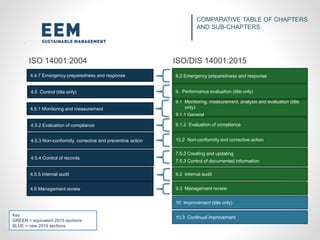
4.4.7 Emergency preparedness and response 8.2 Emergency preparedness and response
4.5 Control (title only) 9. Performance evaluation (title only)
4.5.1 Monitoring and measurement
9.1 Monitoring, measurement, analysis and evaluation (title
only)
9.1.1 General
4.5.2 Evaluation of compliance 9.1.2 Evaluation of compliance
4.5.3 Non-conformity, corrective and preventive action 10.2 Non-conformity and corrective action
4.5.4 Control of records
7.5.2 Creating and updating
7.5.3 Control of documented information
4.5.5 Internal audit 9.2 Internal audit
4.6 Management review 9.3 Management review
10 Improvement (title only)
10.3 Continual improvement
ISO 14001:2004 ISO/DIS 14001:2015
COMPARATIVE TABLE OF CHAPTERS
AND SUB-CHAPTERS
Key
GREEN = equivalent 2015 sections
BLUE = new 2015 sections
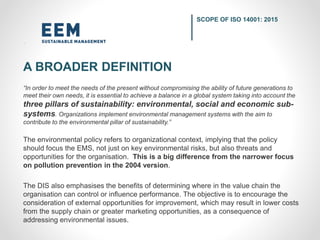
“In order to meet the needs of the present without compromising the ability of future generations to
meet their own needs, it is essential to achieve a balance in a global system taking into account the
three pillars of sustainability: environmental, social and economic sub-
systems. Organizations implement environmental management systems with the aim to
contribute to the environmental pillar of sustainability.”
The environmental policy refers to organizational context, implying that the policy
should focus the EMS, not just on key environmental risks, but also threats and
opportunities for the organisation. This is a big difference from the narrower focus
on pollution prevention in the 2004 version.
The DIS also emphasises the benefits of determining where in the value chain the
organisation can control or influence performance. The objective is to encourage the
consideration of external opportunities for improvement, which may result in lower costs
from the supply chain or greater marketing opportunities, as a consequence of
addressing environmental issues.
SCOPE OF ISO 14001: 2015
A BROADER DEFINITION
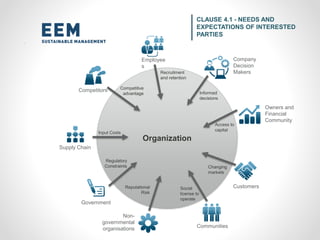
CLAUSE 4.1 - NEEDS AND
EXPECTATIONS OF INTERESTED
PARTIES
Organization
Employee
s
Competitors
Supply Chain
Government
Non-
governmental
organisations Communities
Customers
Owners and
Financial
Community
Company
Decision
MakersRecruitment
and retention
Access to
capital
Changing
markets
Informed
decisions
Social
license to
operate
Reputational
Risk
Regulatory
Constraints
Input Costs
Competitive
advantage
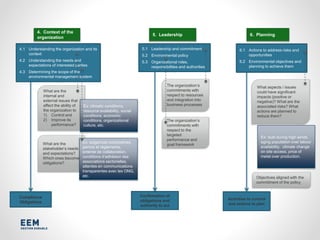
What are the
internal and
external issues that
affect the ability of
the organization to
1) Control and
2) Improve its
performance?
What are the
stakeholder’s needs
and expectations?
Which ones become
obligations?
Compliance
Obligations
Ex: climatic conditions,
resource availability, social
conditions, economic
conditions, organizational
culture, etc.
Ex: exigences corporatives,
permis et règlements,
entente de collaboration,
conditions d’adhésion des
associations sectorielles,
attentes en communications
transparentes avec les ONG,
etc.
Confirmation of
obligations and
authority to act
Activities to control
and actions to plan
4. Context of the
organization
4.1 Understanding the organization and its
context
4.2 Understanding the needs and
expectations of interested parties
4.3 Determining the scope of the
environmental management system
5. Leadership
5.1 Leadership and commitment
5.2 Environmental policy
5.3 Organizational roles,
responsibilities and authorities
6. Planning
6.1 Actions to address risks and
opportunities
6.2 Environmental objectives and
planning to achieve them
The organization’s
commitments with
respect to the
targeted
performance and
goal framework
The organization’s
commitments with
respect to resources
and integration into
business processes
What aspects / issues
could have significant
impacts (positive or
negative)? What are the
associated risks? What
actions are planned to
reduce them?
Ex: dust during high winds,
aging population over labour
availability, climate change
on site access, price of
metal over production.
Objectives aligned with the
commitment of the policy
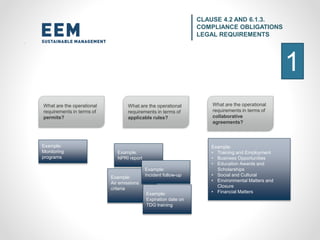
CLAUSE 4.2 AND 6.1.3.
COMPLIANCE OBLIGATIONS
LEGAL REQUIREMENTS
What are the operational
requirements in terms of
permits?
Example:
Monitoring
programs
Example:
• Training and Employment
• Business Opportunities
• Education Awards and
Scholarships
• Social and Cultural
• Environmental Matters and
Closure
• Financial Matters
What are the operational
requirements in terms of
applicable rules?
What are the operational
requirements in terms of
collaborative
agreements?
Example:
NPRI report
Example:
Air emissions
criteria
Example:
Incident follow-up
Example:
Expiration date on
TDG training
1
CLAUSE 4.2 AND 6.1.3.
COMPLIANCE OBLIGATIONS
CORPORATE REQUIREMENTS
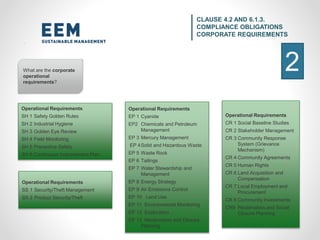
What are the corporate
operational
requirements?
Operational Requirements
SS 1 Security/Theft Management
SS 2 Product Security/Theft
Operational Requirements
SH 1 Safety Golden Rules
SH 2 Industrial Hygiene
SH 3 Golden Eye Review
SH 4 Field Monitoring
SH 5 Preventive Safety
SH 6 Continuous Improvement Plan
Operational Requirements
CR 1 Social Baseline Studies
CR 2 Stakeholder Management
CR 3 Community Response
System (Grievance
Mechanism)
CR 4 Community Agreements
CR 5 Human Rights
CR 6 Land Acquisition and
Compensation
CR 7 Local Employment and
Procurement
CR 8 Community Investments
CR9 Reclamation and Social
Closure Planning
Operational Requirements
EP 1 Cyanide
EP2 Chemicals and Petroleum
Management
EP 3 Mercury Management
EP 4Solid and Hazardous Waste
EP 5 Waste Rock
EP 6 Tailings
EP 7 Water Stewardship and
Management
EP 8 Energy Strategy
EP 9 Air Emissions Control
EP 10 Land Use
EP 11 Environmental Monitoring
EP 12 Exploration
EP 13 Reclamation and Closure
Planning
2
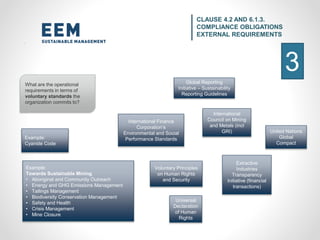
CLAUSE 4.2 AND 6.1.3.
COMPLIANCE OBLIGATIONS
EXTERNAL REQUIREMENTS
What are the operational
requirements in terms of
voluntary standards the
organization commits to?
Example:
Cyanide Code
Example:
Towards Sustainable Mining
• Aboriginal and Community Outreach
• Energy and GHG Emissions Management
• Tailings Management
• Biodiversity Conservation Management
• Safety and Health
• Crisis Management
• Mine Closure
3
Extractive
Industries
Transparency
Initiative (financial
transactions)
Global Reporting
Initiative – Sustainability
Reporting Guidelines
International
Council on Mining
and Metals (incl
GRI) United Nations
Global
Compact
Universal
Declaration
of Human
Rights
Voluntary Principles
on Human Rights
and Security
International Finance
Corporation’s
Environmental and Social
Performance Standards
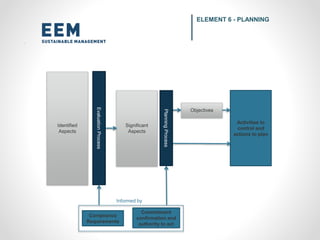
Activities to
control and
actions to plan
Significant
Aspects
EvaluationProcess
Identified
Aspects
Objectives
Compliance
Requirements
ELEMENT 6 - PLANNING
Commitment
confirmation and
authority to act
PlanningProcess
Informed by
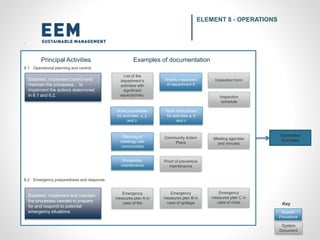
ELEMENT 8 - OPERATIONS
Controlled
Activities
8.1 Operational planning and control
8.2 Emergency preparedness and response.
Emergency
measures plan A in
case of fire
Weekly inspection
of department X
Emergency
measures plan B in
case of spillage
Emergency
measures plan C in
case of crisis
List of the
department’s
activities with
significant
aspects/risks.
Inspection form
Inspection
schedule
Work procedures
for activities x, y
and z
Work instructions
for activities a, b
and c
Planning of
meetings with
communities
Community Action
Plans
Preventive
maintenance
Proof of preventive
maintenance
Meeting agendas
and minutes
System
Document
System
Procedure
Key
Establish, implement control and
maintain the processes… to
implement the actions determined
in 6.1 and 6.2.
Establish, implement and maintain
the processes needed to prepare
for and respond to potential
emergency situations.
Principal Activities Examples of documentation
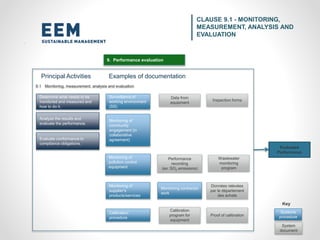
Evaluated
Performance
9. Performance evaluation
9.1 Monitoring, measurement, analysis and evaluation
Calibration
program for
equipment
Data from
equipment
Proof of calibration
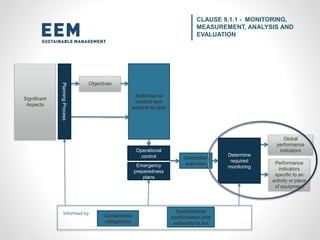
CLAUSE 9.1 - MONITORING,
MEASUREMENT, ANALYSIS AND
EVALUATION
Monitoring of
community
engagement (in
collaborative
agreement)
Monitoring of
pollution control
equipment
Determine what needs to be
monitored and measured and
how to do it.
Evaluate conformance to
compliance obligations.
Analyze the results and
evaluate the performance.
Calibration
procedure
Surveillance of
working environment
(SS)
Performance
recording
(ex: SO2 emissions)
Monitoring contractor
work
Inspection forms
Données relevées
par le département
des achats
Monitoring of
supplier’s
products/services
Wastewater
monitoring
program
Principal Activities
System
document
Systems
procedure
Examples of documentation
Key
Activities to
control and
actions to plan
Significant
Aspects
Objectives
Compliance
obligations
CLAUSE 9.1.1 - MONITORING,
MEASUREMENT, ANALYSIS AND
EVALUATION
Commitment
confirmation and
authority to act
PlanningProcess
Informed by
Operational
control
Emergency
preparedness
plans
Global
performance
indicators
Performance
indicators
specific to an
activity or piece
of equipment
Controlled
activities
Determine
required
monitoring
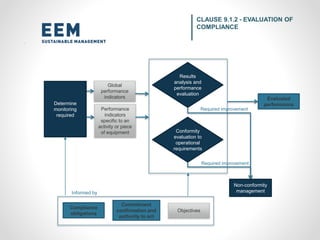
Compliance
obligations
Commitment
confirmation and
authority to act
Informed by
Global
performance
indicators
Performance
indicators
specific to an
activity or piece
of equipment
Determine
monitoring
required
Results
analysis and
performance
evaluation
Conformity
evaluation to
operational
requirements
Objectives
Evaluated
performance
Non-conformity
management
Required improvement
CLAUSE 9.1.2 - EVALUATION OF
COMPLIANCE
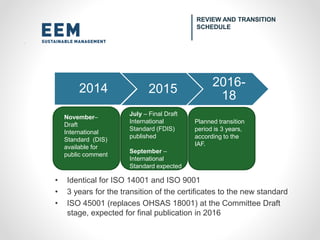
• Identical for ISO 14001 and ISO 9001
• 3 years for the transition of the certificates to the new standard
• ISO 45001 (replaces OHSAS 18001) at the Committee Draft
stage, expected for final publication in 2016
2014 2015
2016-
18
November–
Draft
International
Standard (DIS)
available for
public comment
July – Final Draft
International
Standard (FDIS)
published
September –
International
Standard expected
Planned transition
period is 3 years,
according to the
IAF.
REVIEW AND TRANSITION
SCHEDULE
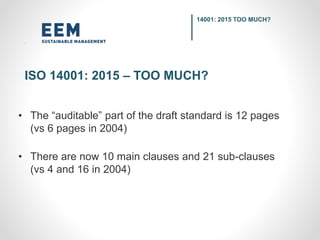
• The “auditable” part of the draft standard is 12 pages
(vs 6 pages in 2004)
• There are now 10 main clauses and 21 sub-clauses
(vs 4 and 16 in 2004)
14001: 2015 TOO MUCH?
ISO 14001: 2015 – TOO MUCH?
• Without a management system representative, responsibility for the EMS
will be distributed at the top level of organizations (e.g., CSR/Environment,
Finance, Operations, Procurement, Public Relations)
• Given the importance of external stakeholders to the EMS, system audits
may extend to include them.
• The definition of “appropriate”, “adequate” or “deemed necessary” level of
system documentation leaves much for interpretation. This may be a
contentious point during system audits.
• Operational controls associated with significant aspects are not necessarily
documented procedures anymore. Organizations will need to define how
control is achieved.
ISO 14001: 2015
IMPORTANT POINTS
Changes to ISO 14001 2015 in Plain Language

Changes to ISO 14001 2015 in Plain Language

  • 1.
    Paul MacLean, M.SC., EP(CEA),EP(EMSLA), PBAS President and Founder
  • 2.
    • In businesssince 1993 • More than 100 active clients • 12 bilingual consultants • Headquartered in Montreal • Work mainly in Quebec and Canada, with projects in the U.S., Africa, Asia, Europe, and Latin America • Sectors: - Mining & Metals - Aboriginal / First Nations - Aerospace - Energy - Infrastructure & Construction - Manufacturing - Media - Waste management - Government - Pharmaceuticals - Printing - Tourism & Events - Non-profit Organizations - Education
  • 3.
    OUR SERVICES CSR STRATEGYCOMMUNITIES ENVIRONMENT • Assessment and Planning of the Approach • Embedding • Performance Evaluation • Communication and Reporting • Social Impact Assessment • Community Relations • Participatory Planning and Development • Socio-economic Studies • Management System for Environment, Health and Safety (EHS) • Regulatory Support • Outsourcing of Resources • Evaluation and Miscellaneous Analyses of Environmental Impacts
  • 4.
    CHANGES TO ISO14001 A review and explanation of changes to the ISO 14001 standard, based on the July 2015 FDIS, and how it may affect EMS based on ISO 14001:2004.
  • 5.
     New documentstructure of ISO standards  Broader definition of the environment • Stronger commitment and leadership from top management • Improved understanding of organizational context and stakeholders • Management of both risks and opportunities • More emphasis on objectives and performance indicators • Lifecycle thinking in determining what to manage, including externalised processes KEY CHANGES IN THE REVISED ISO 14001 STANDARD
  • 6.
    • Integration ofthe management system into core business processes • Risk management approach • Actions based on lifecycle thinking • Improved sustainability performance from a comprehensive understanding of the business context and stakeholder expectations HIGH LEVEL STRUCTURE FOR ALL ISO MANAGEMENT SYSTEM STANDARDS OBJECTIVE
  • 7.
    • A commonframework of 10 clauses with core text unchanged • Additional sub-clauses and domain-specific text HIGH LEVEL STRUCTURE FOR ALL ISO MANAGEMENT SYSTEM STANDARDS Clause 1 Scope Clause 2 Normative References Clause 3 Terms and definitions Clause 4 Context of the organization Clause 5 Leadership Clause 6 Planning Clause 7 Support Clause 8 Operation Clause 9 Performance evaluation Clause 10 Improvement
  • 8.
    4. Context of theorganization 5. Leadership 6. Planning 7. Support8. Operation 9. Performance evaluation 10. Improvement 10.2 Nonconformity and corrective action 10.3 Continual improvement 4.1 Understanding the organization and its context 4.2 Understanding the needs and expectations of interested parties 4.3 Determining the scope of the environmental management system 4.4 Environmental management system 5.1 Leadership and commitment 5.2 Environmental policy 5.3 Organizational roles, responsibilities and authorities 6.1 Actions to address risks and opportunities 6.2 Environmental objectives and planning to achieve them 7.1 Resources 7.2 Competence 7.3 Awareness 7.4 Communication 7.5 Documented information 8.1 Operational planning and control 8.2 Emergency preparedness and response 9.1 Monitoring, measurement, analysis and evaluation 9.2 Internal audit 9.3 Management review HIGH LEVEL STRUCTURE FOR ALL ISO MANAGEMENT SYSTEM STANDARDS
  • 9.
    COMPARATIVE TABLE OFCLAUSES AND SUB-CLAUSES 4. Context of the organization 4.1 Understanding the organization and its context 4.2 Understanding the needs and expectations of interested parties 6.1 Actions to address risks and opportunities 6.1.1 General 4. Environmental management system requirements (title only) 4.1 General requirements 4.3 Determining the scope of the environmental management system 4.4 Environmental management system 5. Leadership (title only) 5.1 Leadership and commitment 4.2 Environmental policy 5.2 Environmental policy 6. Planning (title only)4.3 Planning (title only) 4.3.1 Environmental aspects 6.1.2 Environmental aspects 4.3.2 Legal and other requirements 6.1.3 Compliance obligations 6.1.4 Planning action ISO 14001:2004 ISO/DIS 14001:2015 Key GREEN = equivalent 2015 sections BLUE = new 2015 sections
  • 10.
    ISO 14001:2004 ISO/DIS14001:2015 6.2 Environmental objectives and planning to achieve them (title only) 6.2.1 Environmental objectives 6.2.2 Planning actions to achieve environmental objectives 4.4 Implementation and operation (title only) 7. Support (title only) 8. Operation (title only) 4.4.1 Resources, roles, responsibility and authority 7.1 Resources 5.3 Organizational roles, responsibilities and authorities 4.4.2 Competence, training and awareness 7.2 Competence 7.3 Awareness 4.4.3 Communication 7.4 Communication (title only) 7.4.1 General 7.4.2 Internal communication 7.4.3 External communication 4.3.3 Objectives, targets and programme(s) 4.4.4 Documentation 7.5 Documented information (title only) 7.5.1 General 4.4.5 Document control 7.5.2 Creating and updating 7.5.3 Control of documented information 4.4.6 Operational control 8.1 Operational planning and control COMPARATIVE TABLE OF CHAPTERS AND SUB-CHAPTERS
  • 11.
    4.4.7 Emergency preparednessand response 8.2 Emergency preparedness and response 4.5 Control (title only) 9. Performance evaluation (title only) 4.5.1 Monitoring and measurement 9.1 Monitoring, measurement, analysis and evaluation (title only) 9.1.1 General 4.5.2 Evaluation of compliance 9.1.2 Evaluation of compliance 4.5.3 Non-conformity, corrective and preventive action 10.2 Non-conformity and corrective action 4.5.4 Control of records 7.5.2 Creating and updating 7.5.3 Control of documented information 4.5.5 Internal audit 9.2 Internal audit 4.6 Management review 9.3 Management review 10 Improvement (title only) 10.3 Continual improvement ISO 14001:2004 ISO/DIS 14001:2015 COMPARATIVE TABLE OF CHAPTERS AND SUB-CHAPTERS Key GREEN = equivalent 2015 sections BLUE = new 2015 sections
  • 12.
    “In order tomeet the needs of the present without compromising the ability of future generations to meet their own needs, it is essential to achieve a balance in a global system taking into account the three pillars of sustainability: environmental, social and economic sub- systems. Organizations implement environmental management systems with the aim to contribute to the environmental pillar of sustainability.” The environmental policy refers to organizational context, implying that the policy should focus the EMS, not just on key environmental risks, but also threats and opportunities for the organisation. This is a big difference from the narrower focus on pollution prevention in the 2004 version. The DIS also emphasises the benefits of determining where in the value chain the organisation can control or influence performance. The objective is to encourage the consideration of external opportunities for improvement, which may result in lower costs from the supply chain or greater marketing opportunities, as a consequence of addressing environmental issues. SCOPE OF ISO 14001: 2015 A BROADER DEFINITION
  • 13.
    CLAUSE 4.1 -NEEDS AND EXPECTATIONS OF INTERESTED PARTIES Organization Employee s Competitors Supply Chain Government Non- governmental organisations Communities Customers Owners and Financial Community Company Decision MakersRecruitment and retention Access to capital Changing markets Informed decisions Social license to operate Reputational Risk Regulatory Constraints Input Costs Competitive advantage
  • 14.
    What are the internaland external issues that affect the ability of the organization to 1) Control and 2) Improve its performance? What are the stakeholder’s needs and expectations? Which ones become obligations? Compliance Obligations Ex: climatic conditions, resource availability, social conditions, economic conditions, organizational culture, etc. Ex: exigences corporatives, permis et règlements, entente de collaboration, conditions d’adhésion des associations sectorielles, attentes en communications transparentes avec les ONG, etc. Confirmation of obligations and authority to act Activities to control and actions to plan 4. Context of the organization 4.1 Understanding the organization and its context 4.2 Understanding the needs and expectations of interested parties 4.3 Determining the scope of the environmental management system 5. Leadership 5.1 Leadership and commitment 5.2 Environmental policy 5.3 Organizational roles, responsibilities and authorities 6. Planning 6.1 Actions to address risks and opportunities 6.2 Environmental objectives and planning to achieve them The organization’s commitments with respect to the targeted performance and goal framework The organization’s commitments with respect to resources and integration into business processes What aspects / issues could have significant impacts (positive or negative)? What are the associated risks? What actions are planned to reduce them? Ex: dust during high winds, aging population over labour availability, climate change on site access, price of metal over production. Objectives aligned with the commitment of the policy
  • 15.
    CLAUSE 4.2 AND6.1.3. COMPLIANCE OBLIGATIONS LEGAL REQUIREMENTS What are the operational requirements in terms of permits? Example: Monitoring programs Example: • Training and Employment • Business Opportunities • Education Awards and Scholarships • Social and Cultural • Environmental Matters and Closure • Financial Matters What are the operational requirements in terms of applicable rules? What are the operational requirements in terms of collaborative agreements? Example: NPRI report Example: Air emissions criteria Example: Incident follow-up Example: Expiration date on TDG training 1
  • 16.
    CLAUSE 4.2 AND6.1.3. COMPLIANCE OBLIGATIONS CORPORATE REQUIREMENTS What are the corporate operational requirements? Operational Requirements SS 1 Security/Theft Management SS 2 Product Security/Theft Operational Requirements SH 1 Safety Golden Rules SH 2 Industrial Hygiene SH 3 Golden Eye Review SH 4 Field Monitoring SH 5 Preventive Safety SH 6 Continuous Improvement Plan Operational Requirements CR 1 Social Baseline Studies CR 2 Stakeholder Management CR 3 Community Response System (Grievance Mechanism) CR 4 Community Agreements CR 5 Human Rights CR 6 Land Acquisition and Compensation CR 7 Local Employment and Procurement CR 8 Community Investments CR9 Reclamation and Social Closure Planning Operational Requirements EP 1 Cyanide EP2 Chemicals and Petroleum Management EP 3 Mercury Management EP 4Solid and Hazardous Waste EP 5 Waste Rock EP 6 Tailings EP 7 Water Stewardship and Management EP 8 Energy Strategy EP 9 Air Emissions Control EP 10 Land Use EP 11 Environmental Monitoring EP 12 Exploration EP 13 Reclamation and Closure Planning 2
  • 17.
    CLAUSE 4.2 AND6.1.3. COMPLIANCE OBLIGATIONS EXTERNAL REQUIREMENTS What are the operational requirements in terms of voluntary standards the organization commits to? Example: Cyanide Code Example: Towards Sustainable Mining • Aboriginal and Community Outreach • Energy and GHG Emissions Management • Tailings Management • Biodiversity Conservation Management • Safety and Health • Crisis Management • Mine Closure 3 Extractive Industries Transparency Initiative (financial transactions) Global Reporting Initiative – Sustainability Reporting Guidelines International Council on Mining and Metals (incl GRI) United Nations Global Compact Universal Declaration of Human Rights Voluntary Principles on Human Rights and Security International Finance Corporation’s Environmental and Social Performance Standards
  • 18.
    Activities to control and actionsto plan Significant Aspects EvaluationProcess Identified Aspects Objectives Compliance Requirements ELEMENT 6 - PLANNING Commitment confirmation and authority to act PlanningProcess Informed by
  • 19.
    ELEMENT 8 -OPERATIONS Controlled Activities 8.1 Operational planning and control 8.2 Emergency preparedness and response. Emergency measures plan A in case of fire Weekly inspection of department X Emergency measures plan B in case of spillage Emergency measures plan C in case of crisis List of the department’s activities with significant aspects/risks. Inspection form Inspection schedule Work procedures for activities x, y and z Work instructions for activities a, b and c Planning of meetings with communities Community Action Plans Preventive maintenance Proof of preventive maintenance Meeting agendas and minutes System Document System Procedure Key Establish, implement control and maintain the processes… to implement the actions determined in 6.1 and 6.2. Establish, implement and maintain the processes needed to prepare for and respond to potential emergency situations. Principal Activities Examples of documentation
  • 20.
    Evaluated Performance 9. Performance evaluation 9.1Monitoring, measurement, analysis and evaluation Calibration program for equipment Data from equipment Proof of calibration CLAUSE 9.1 - MONITORING, MEASUREMENT, ANALYSIS AND EVALUATION Monitoring of community engagement (in collaborative agreement) Monitoring of pollution control equipment Determine what needs to be monitored and measured and how to do it. Evaluate conformance to compliance obligations. Analyze the results and evaluate the performance. Calibration procedure Surveillance of working environment (SS) Performance recording (ex: SO2 emissions) Monitoring contractor work Inspection forms Données relevées par le département des achats Monitoring of supplier’s products/services Wastewater monitoring program Principal Activities System document Systems procedure Examples of documentation Key
  • 21.
    Activities to control and actionsto plan Significant Aspects Objectives Compliance obligations CLAUSE 9.1.1 - MONITORING, MEASUREMENT, ANALYSIS AND EVALUATION Commitment confirmation and authority to act PlanningProcess Informed by Operational control Emergency preparedness plans Global performance indicators Performance indicators specific to an activity or piece of equipment Controlled activities Determine required monitoring
  • 22.
    Compliance obligations Commitment confirmation and authority toact Informed by Global performance indicators Performance indicators specific to an activity or piece of equipment Determine monitoring required Results analysis and performance evaluation Conformity evaluation to operational requirements Objectives Evaluated performance Non-conformity management Required improvement Required improvement CLAUSE 9.1.2 - EVALUATION OF COMPLIANCE
  • 23.
    • Identical forISO 14001 and ISO 9001 • 3 years for the transition of the certificates to the new standard • ISO 45001 (replaces OHSAS 18001) at the Committee Draft stage, expected for final publication in 2016 2014 2015 2016- 18 November– Draft International Standard (DIS) available for public comment July – Final Draft International Standard (FDIS) published September – International Standard expected Planned transition period is 3 years, according to the IAF. REVIEW AND TRANSITION SCHEDULE
  • 24.
    • The “auditable”part of the draft standard is 12 pages (vs 6 pages in 2004) • There are now 10 main clauses and 21 sub-clauses (vs 4 and 16 in 2004) 14001: 2015 TOO MUCH? ISO 14001: 2015 – TOO MUCH?
  • 25.
    • Without amanagement system representative, responsibility for the EMS will be distributed at the top level of organizations (e.g., CSR/Environment, Finance, Operations, Procurement, Public Relations) • Given the importance of external stakeholders to the EMS, system audits may extend to include them. • The definition of “appropriate”, “adequate” or “deemed necessary” level of system documentation leaves much for interpretation. This may be a contentious point during system audits. • Operational controls associated with significant aspects are not necessarily documented procedures anymore. Organizations will need to define how control is achieved. ISO 14001: 2015 IMPORTANT POINTS