Diesel
Diesel
Gas Oil
Gas Oil
CrudeOil
Crude Oil
Bitumen
Bitumen
Roads
Long Chain Molecules
Long Chain Molecules
Gas treatment
Gas treatment
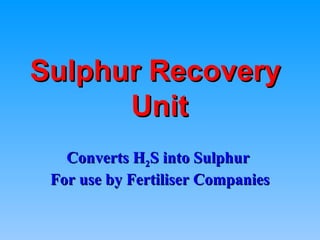
Sulphur
Sulphur
Recovery
Recovery Sulphur
Sulphur
H
H2
2S
S H
H2
2S
S
Waxy Distillate
Waxy Distillate
Butane
Butane
De-asphalting
De-asphalting
Asphalt
Asphalt Fuel oil
Fuel oil
De-asphalted oil DAO
De-asphalted oil DAO
Desulphurisation
Desulphurisation
Kerosine
Kerosine
Shorter Chain Molecules
Shorter Chain Molecules
Hydrogen
Hydrogen
Manufacturing
Manufacturing
Unit
Unit
Hyrdrocracker
Hyrdrocracker
Hydrogen
Hydrogen
High Vacuum
High Vacuum
Separation
Separation
Vacuum Gas Oil
Vacuum Gas Oil
Long Residue
Long Residue
Distillation
Distillation
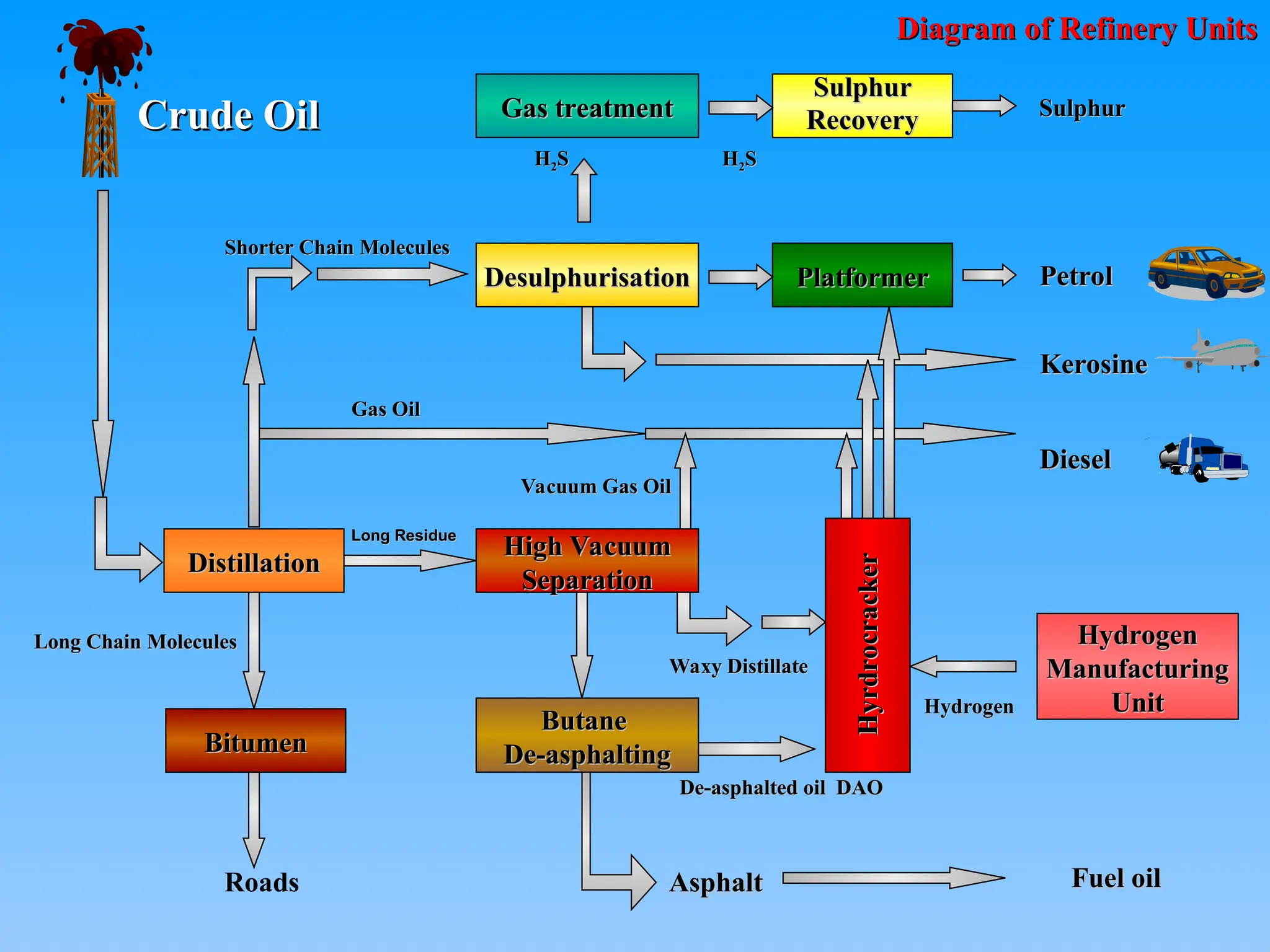
Diagram of Refinery Units
Diagram of Refinery Units
Platformer
Platformer Petrol
Petrol
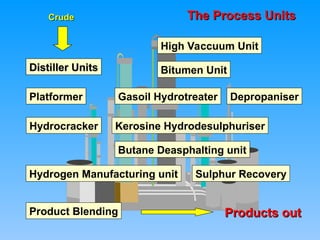
Distiller Units
Distiller Units
Platformer
Hydrocracker
GasoilHydrotreater
Kerosine Hydrodesulphuriser
Depropaniser
Hydrogen Manufacturing unit
High Vaccuum Unit
Butane Deasphalting unit
Bitumen Unit
Sulphur Recovery
Product Blending
Crude
Crude
Products out
Products out
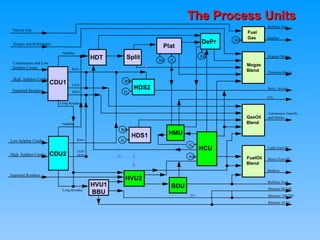
The Process Units
The Process Units
5.
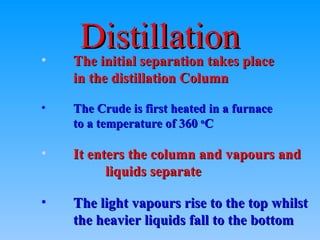
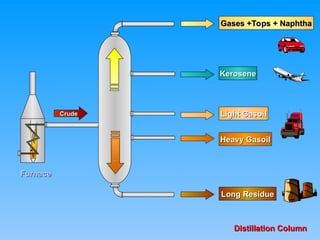
Distillation
Distillation
• The initialseparation takes place
The initial separation takes place
in the distillation Column
in the distillation Column
• The Crude is first heated in a furnace
The Crude is first heated in a furnace
to a temperature of 360
to a temperature of 360 o
o
C
C
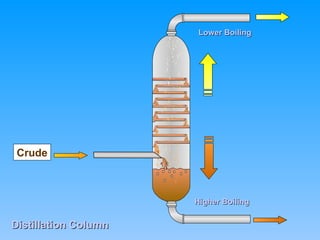
• It enters the column and vapours and
It enters the column and vapours and
liquids separate
liquids separate
• The light vapours rise to the top whilst
The light vapours rise to the top whilst
the heavier liquids fall to the bottom
the heavier liquids fall to the bottom
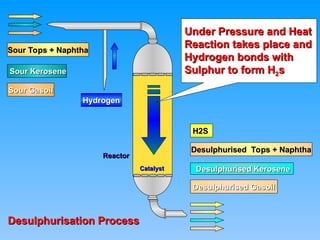
Hydrogen
Hydrogen
Under Pressure andHeat
Under Pressure and Heat
Reaction takes place and
Reaction takes place and
Hydrogen bonds with
Hydrogen bonds with
Sulphur to form H
Sulphur to form H2
2s
s
Desulphurisation Process
Desulphurisation Process
Reactor
Reactor
Catalyst
Catalyst
Sour Tops + Naphtha
Sour Tops + Naphtha
Sour Gasoil
Sour Gasoil
Sour Kerosene
Sour Kerosene
Desulphurised Kerosene
Desulphurised Kerosene
Desulphurised Tops + Naphtha
Desulphurised Tops + Naphtha
Desulphurised Gasoil
Desulphurised Gasoil
H2S
H2S
10.
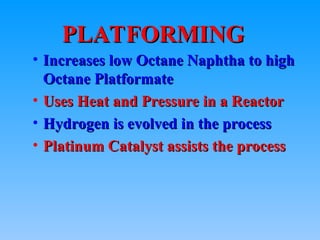
• Increases lowOctane Naphtha to high
Increases low Octane Naphtha to high
Octane Platformate
Octane Platformate
• Uses Heat and Pressure in a Reactor
Uses Heat and Pressure in a Reactor
• Hydrogen is evolved in the process
Hydrogen is evolved in the process
• Platinum Catalyst assists the process
Platinum Catalyst assists the process
PLATFORMING
PLATFORMING
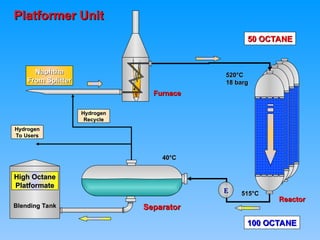
High Octane
High Octane
Platformate
Platformate
Naphtha
Naphtha
FromSplitter
From Splitter
Hydrogen
Hydrogen
Recycle
Recycle
Hydrogen
Hydrogen
To Users
To Users
Reactor
Reactor
Furnace
Furnace
Separator
Separator
50 OCTANE
50 OCTANE
100 OCTANE
100 OCTANE
520°C
520°C
18 barg
18 barg
515°C
515°C
40°C
40°C
E
E
Platformer Unit
Platformer Unit
Blending Tank
Blending Tank
Bitumen Feed Tanks
BitumenFeed Tanks
Long Residue
Long Residue
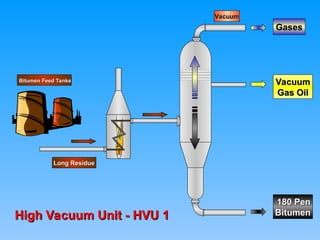
High Vacuum Unit - HVU 1
High Vacuum Unit - HVU 1
Vacuum
Vacuum
Gases
Gases
Vacuum
Vacuum
Gas Oil
Gas Oil
180 Pen
180 Pen
Bitumen
Bitumen
15.
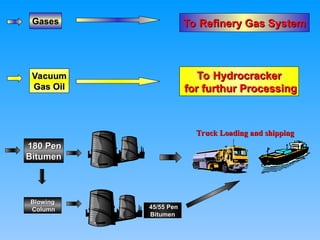
To Hydrocracker
To Hydrocracker
forfurthur Processing
for furthur Processing
Gases
Gases
Vacuum
Vacuum
Gas Oil
Gas Oil
180 Pen
180 Pen
Bitumen
Bitumen
Blowing
Blowing
Column
Column
To Refinery Gas System
To Refinery Gas System
Truck Loading and shipping
Truck Loading and shipping
45/55 Pen
45/55 Pen
Bitumen
Bitumen
What is Hydrocracking??
What is Hydrocracking ??
Production of
Production of high quality light products
high quality light products
from heavy oils,
from heavy oils,
in the presence of Hydrogen.
in the presence of Hydrogen.
18.
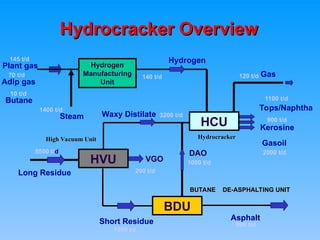
Hydrocracker Overview
Hydrocracker Overview
HCU
LongResidue
5500 t/d
HVU VGO
200 t/d
3200 t/d
Waxy Distilate
BDU
Asphalt
900 t/d
Asphalt
10 t/d
70 t/d
Butane
145 t/d
Plant gas
Adip gas
Steam
1400 t/d
Hydrogen
140 t/d
Tops/Naphtha
Gasoil
Gas
120 t/d
1100 t/d
2000 t/d
900 t/d
Kerosine
Short Residue
1900 t/d
DAO
1000 t/d
Hydrogen
Manufacturing
Unit
Hydrocracker
Hydrocracker
High Vacuum Unit
High Vacuum Unit
BUTANE DE-ASPHALTING UNIT
BUTANE DE-ASPHALTING UNIT
Sulphur Pit
Sulphur Pit
H
H2
2SFeed
S Feed Main Furnace
Main Furnace
Coalescer
Coalescer
Stack
Stack
Line Burner
Line Burner
Incinerator
Incinerator
Reactor
Reactor
Reactor
Reactor
Waste Heat
Waste Heat
Boiler
Boiler
Line Burner
Line Burner
Fuel Gas
Fuel
Gas
Line Burner
Line Burner
Fuel Gas
Liquid Sulphur
Liquid Sulphur 59%
59%
A
A
A
A
B
B C
C
D
D
C
C
B
B D
D
Liquid Sulphur
Liquid Sulphur
Liquid Sulphur
Liquid Sulphur
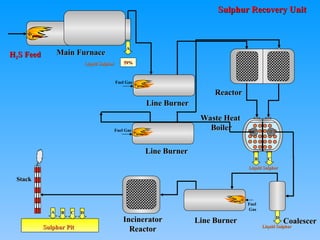
Sulphur Recovery Unit
Sulphur Recovery Unit
Reactor
Reactor
Waste Heat Boiler
WasteHeat Boiler
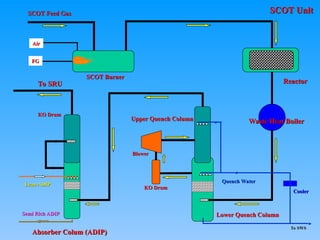
Upper Quench Column
Upper Quench Column
To SWS
To SWS
Quench Water
Quench Water
Cooler
Cooler
Lower Quench Column
Lower Quench Column
Blower
Blower
KO
KO Drum
Drum
SCOT Feed Gas
SCOT Feed Gas
SCOT Burner
SCOT Burner
FG
FG
Air
Air
SCOT Unit
SCOT Unit
Absorber Colum (ADIP)
Absorber Colum (ADIP)
To SRU
To SRU
KO
KO Drum
Drum
Lean ADIP
Lean ADIP
Semi Rich ADIP
Semi Rich ADIP
Editor's Notes
#16 SLIDE 1. Hydro-cracking
INTRODUCTION
Basic presentation
Interactive
Ask Questions
If anything is not understood - ask.
#17 SLIDE 2. Hydro-cracking
What is Hydro-cracking??
Hydro-cracking is a process that UPGRADES
heavy oil, into lighter oils,
in a Hydrogen rich atmosphere.
------------------------------------
Produces high quality, light products from
heavy oils,
in the presence of hydrogen.
#18 SLIDE 9. HCU Overview
We take this LONG RESIDUE, and pass it through a couple of
downstream Units, to extract oils, that provide us with feed for
the Hydro-Cracker Unit.
One of these units is called a HIGH VACUUM UNIT
and the other is called a BUTANE De-ASPHALTING UNIT.
--------------------------------------------------------------
As has been already mentioned,the Hydro-cracking takes place in a
HYDROGEN RICH ATMOSPHERE,
so we need a supply of Hydrogen, of high quality and purity.
This is provided by another unit called a
HYDROGEN MANUFACTURING UNIT.
Lets now have a look at these 3 Units in a bit more detail.




![[Deck] What's New in Spark-Iceberg Integration via DSV2.pptx](https://cdn.slidesharecdn.com/ss_thumbnails/deckwhatsnewinspark-icebergintegrationviadsv2-260210005337-25955b12-thumbnail.jpg?width=640&height=640&fit=bounds)


