Programming Language

    Marisa Paryasto
OBJECTIVES

n    Explain the differences among the categories of
      programming languages
n    Identify programming languages commonly used
      today
n    Identify the uses of application generators,
      macros, and RAD tools
n    Describe various Web page development tools,
      including HTML, DHTML, and XML
WHAT IS A COMPUTER
PROGRAM?

n    A set of instructions that directs a computer
      to perform the tasks necessary to process
      data into information
PROGRAMMING LANGUAGES
n    Programming language
      n    Set of words, symbols, and codes that enables a
            programmer to communicate a solution
            algorithm to the computer
PROGRAM DEVELOPMENT
              TOOLS
n    User-friendly software products
      designed to assist in the creation of
      information system solutions
CATEGORIES OF PROGRAMMING
        LANGUAGES

n    Machine languages
n    Assembly languages
n    Third-generation languages
n    Fourth-generation languages (4GL)
n    Natural languages
Low Level Versus High Level
n    Low level
      n    is written to run on one particular
            computer
n    High level
      n    can run on many different types of
            computers
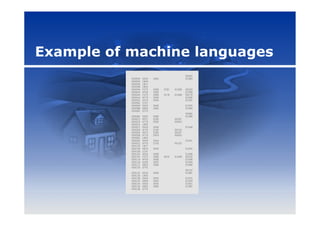
Machine languages
n    Also known as first-generation language
n    Machine language is referred to as level languages
n    Instructions use a series of binary digits (1s and 0s)
n    The only language that the computer directly
      understand
n    Disadvantage
      n    Tedious to code program
      n    Time consuming
      n    Program is machine dependent
Example of machine languages
Assembly languages
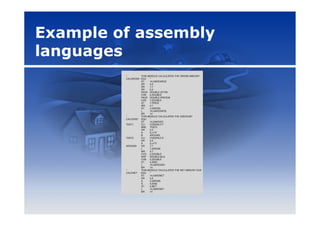
n    instructions are written using abbreviations and codes
n    Also referred as low-level languages

n    Writes codes such as A for addition, C for compare
n    Programmer can refer to storage locations with symbolic addresses
n    Machine dependent
n    Source program
      n    Program containing the assembly language code
n    Macros
      n    Generate more than one machine language instruction
n    Needs translator (assembler) to convert program into machine codes
Example of assembly
languages
Third-generation languages
n    Instructions, which use a series of English-like
      words
n    Are procedural languages because the computer
      must be told what to accomplish and how to do it.
n    Needs translator to convert program into machine
      codes
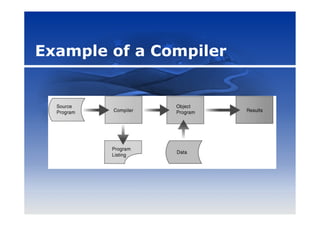
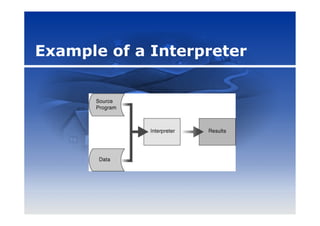
      n    Compilers
      n    Interpreters
n    Object code or object program
      n    The machine language version that results from the
            compiling the 3GL
Example of a Compiler
Example of a Interpreter
Fourth-Generation
Languages (4GL)
n    Which also uses English-like statements
n    Is a nonprocedural language because a
      programmer only specifies what the program
      should accomplish without explaining how.
n    Syntax (rules of the language) are to be
      followed
n    Machine independent
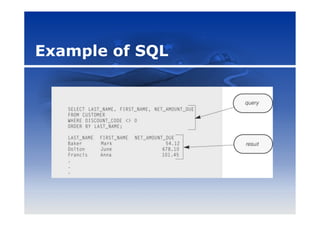
Example of SQL
Natural languages
n    Is a type of query language that allows
      the user to enter requests resembling
      human speech.
OBJECT-ORIENTED
PROGRAM DEVELOPMENT
n    Programmers create objects
n    Classes
n    Subclasses
n    Superclasses
n    Inheritance
OBJECT-ORIENTED
PROGRAM DEVELOPMENT
n    Object-Oriented Programming
      n   Object-oriented programming (OOP)
          language
      n  Event-driven
POPULAR PROGRAMMING
LANGUAGES
n    BASIC
n    Visual Basic
      n    Design the graphical user interface
      n    Write code for program events
      n    Generate the application
n    COBOL
POPULAR PROGRAMMING
LANGUAGES
n    C
n    C++
n    FORTRAN
n    Pascal
n    Ada
n    RPG (Report Program Generator)
n    Other programming languages
PROGRAM DEVELOPMENT
TOOLS
n    Application generators (program generators)
      n    Form builders (screen painters)
      n    Menu generator
PROGRAM DEVELOPMENT
TOOLS
n    Macros
      n    Recording macros
      n    Writing macros
      n    Running macros
n    RAD Tools: Visual Basic, Delphi, and
      PowerBuilder
      n    Visual Basic
      n    Delphi
      n    PowerBuilder
WEB PAGE PROGRAM
DEVELOPMENT
n    HTML
      n    Hypertext markup language (HTML)
      n    Tags (markups)
      n    Resulting Web page
n    Scripts, Applets, and Servlets
      n    Common gateway interface (CGI)
      n    Counter
      n    Image map
      n    Processing form
WEB PAGE PROGRAM
DEVELOPMENT
n    Java, JavaScript, and Perl
      n    Java
      n    JavaScript
      n    Perl
n    Dynamic HTML (DHMTL)
      n    Allows more graphical interest and interactivity in Web
            pages
      n    Style sheets
n    XML
      n    eXtensible Markup Language
      n    May replace HTML
MULTIMEDIA PROGRAM
DEVELOPMENT
n    Multimedia authoring software
n    Used to display text, graphics,
      animation, audio, and video into an
      electronic interactive presentation
SELECTING A PROGRAMMING
LANGUAGE OR PROGRAM
DEVELOPMENT TOOL

n    Standards of the organization
n    Interface with other programs
n    Suitability of the language to the
      application
n    Portability to other systems
SUMMARY OF PROGRAMMING
LANGUAGES
n    Categories of programming languages
n    Object-oriented program development
n    Popular programming languages
n    Program development tools
n    Web page program development
n    Multimedia program development

Programming language

  • 1.
    Programming Language Marisa Paryasto
  • 2.
    OBJECTIVES n  Explain the differences among the categories of programming languages n  Identify programming languages commonly used today n  Identify the uses of application generators, macros, and RAD tools n  Describe various Web page development tools, including HTML, DHTML, and XML
  • 3.
    WHAT IS ACOMPUTER PROGRAM? n  A set of instructions that directs a computer to perform the tasks necessary to process data into information
  • 4.
    PROGRAMMING LANGUAGES n  Programming language n  Set of words, symbols, and codes that enables a programmer to communicate a solution algorithm to the computer
  • 5.
    PROGRAM DEVELOPMENT TOOLS n  User-friendly software products designed to assist in the creation of information system solutions
  • 6.
    CATEGORIES OF PROGRAMMING LANGUAGES n  Machine languages n  Assembly languages n  Third-generation languages n  Fourth-generation languages (4GL) n  Natural languages
  • 7.
    Low Level VersusHigh Level n  Low level n  is written to run on one particular computer n  High level n  can run on many different types of computers
  • 8.
    Machine languages n  Also known as first-generation language n  Machine language is referred to as level languages n  Instructions use a series of binary digits (1s and 0s) n  The only language that the computer directly understand n  Disadvantage n  Tedious to code program n  Time consuming n  Program is machine dependent
  • 9.
  • 10.
    Assembly languages n  instructions are written using abbreviations and codes n  Also referred as low-level languages n  Writes codes such as A for addition, C for compare n  Programmer can refer to storage locations with symbolic addresses n  Machine dependent n  Source program n  Program containing the assembly language code n  Macros n  Generate more than one machine language instruction n  Needs translator (assembler) to convert program into machine codes
  • 11.
  • 12.
    Third-generation languages n  Instructions, which use a series of English-like words n  Are procedural languages because the computer must be told what to accomplish and how to do it. n  Needs translator to convert program into machine codes n  Compilers n  Interpreters n  Object code or object program n  The machine language version that results from the compiling the 3GL
  • 13.
    Example of aCompiler
  • 14.
    Example of aInterpreter
  • 15.
    Fourth-Generation Languages (4GL) n  Which also uses English-like statements n  Is a nonprocedural language because a programmer only specifies what the program should accomplish without explaining how. n  Syntax (rules of the language) are to be followed n  Machine independent
  • 16.
  • 17.
    Natural languages n  Is a type of query language that allows the user to enter requests resembling human speech.
  • 18.
    OBJECT-ORIENTED PROGRAM DEVELOPMENT n  Programmers create objects n  Classes n  Subclasses n  Superclasses n  Inheritance
  • 19.
    OBJECT-ORIENTED PROGRAM DEVELOPMENT n  Object-Oriented Programming n  Object-oriented programming (OOP) language n  Event-driven
  • 20.
    POPULAR PROGRAMMING LANGUAGES n  BASIC n  Visual Basic n  Design the graphical user interface n  Write code for program events n  Generate the application n  COBOL
  • 21.
    POPULAR PROGRAMMING LANGUAGES n  C n  C++ n  FORTRAN n  Pascal n  Ada n  RPG (Report Program Generator) n  Other programming languages
  • 22.
    PROGRAM DEVELOPMENT TOOLS n  Application generators (program generators) n  Form builders (screen painters) n  Menu generator
  • 23.
    PROGRAM DEVELOPMENT TOOLS n  Macros n  Recording macros n  Writing macros n  Running macros n  RAD Tools: Visual Basic, Delphi, and PowerBuilder n  Visual Basic n  Delphi n  PowerBuilder
  • 24.
    WEB PAGE PROGRAM DEVELOPMENT n  HTML n  Hypertext markup language (HTML) n  Tags (markups) n  Resulting Web page n  Scripts, Applets, and Servlets n  Common gateway interface (CGI) n  Counter n  Image map n  Processing form
  • 25.
    WEB PAGE PROGRAM DEVELOPMENT n  Java, JavaScript, and Perl n  Java n  JavaScript n  Perl n  Dynamic HTML (DHMTL) n  Allows more graphical interest and interactivity in Web pages n  Style sheets n  XML n  eXtensible Markup Language n  May replace HTML
  • 26.
    MULTIMEDIA PROGRAM DEVELOPMENT n  Multimedia authoring software n  Used to display text, graphics, animation, audio, and video into an electronic interactive presentation
  • 27.
    SELECTING A PROGRAMMING LANGUAGEOR PROGRAM DEVELOPMENT TOOL n  Standards of the organization n  Interface with other programs n  Suitability of the language to the application n  Portability to other systems
  • 28.
    SUMMARY OF PROGRAMMING LANGUAGES n  Categories of programming languages n  Object-oriented program development n  Popular programming languages n  Program development tools n  Web page program development n  Multimedia program development