COMPUTER LANGUAGES
Ashwini K S
INTRODUCTION
 To explain the computer about how to perform a
task, the computer programmer writes a set of
instructions and it is called a program.
 Hence “ A set of instructions written to perform
a particular task is called a program”
 “Process of writing the program is called
programming”
 A set of programs written to instruct a computer is
called the software.
 These programs are written in any computer
language.
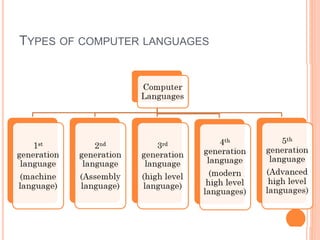
TYPES OF COMPUTER LANGUAGES
FIRST GENERATION LANGUAGE
 It is also known as binary or machine language.
 These binary languages are mostly based on 0&1.
 These languages are quite difficult to understand.
 To develop a program in first generation language
is a complicated task.
 It is machine dependent language.
 It is also known as low level language (lll).
 The programs written on binary language get
executed very fast.
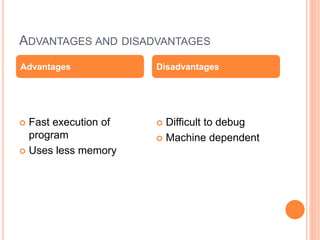
ADVANTAGES AND DISADVANTAGES
 Fast execution of
program
 Uses less memory
 Difficult to debug
 Machine dependent
Advantages Disadvantages
SECOND GENERATION LANGUAGE
 These languages are also belong to the category of
low level language (lll).
 Second generation language were also known as
assembly language.
 The binary digits o&1 were replaced by some
special codes known as Mnemonics eg:-sub = -,
add=+,div=/,sav=save.
 This language is machine dependent language.
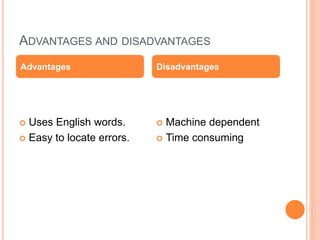
ADVANTAGES AND DISADVANTAGES
 Uses English words.
 Easy to locate errors.
 Machine dependent
 Time consuming
Advantages Disadvantages
THIRD GENERATION LANGUAGES
 They are also known as high level language (HLL).
 In this the commands written are in simple English
language.
 Third generation language were portable.
 As the commands written are in simple language so
special software were develop which are known as
Language processor.
 For example:-LOGO, PASCAL,COBOL,JAVA etc….
FEATURES
 it is user friendly
 Machine independent
 Uses English words and mathematical operators.
FORTH GENERATION LANGUAGES
 As 3rd generation languages were based on certain
syntax ,which a programmer has to follow during
developing a program which is known as
procedural language.
 To overcome from this problem fourth generation
language were evolved.
 These programs were written in non-procedural
way
 For example SQL, Wave, Python etc…
FEATURES
 Its more programmer friendly.
 Needs less efforts.
 Possess high speed execution
 Enhances the programming efficiency.
FIFTH GENERATION LANGUAGES
 5th generation languages are advanced high level
languages.
 These languages are used in AI research
 Here the language develops the program solution
by itself.
 The program has to dictate the problem and how
the solution should look like.
 These languages are still in development.
 Examples of 5GL are Prolog,OPS5 and Mercury.
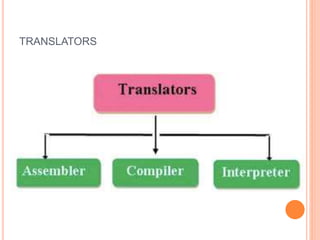
TRANSLATORS
ASSEMBLER
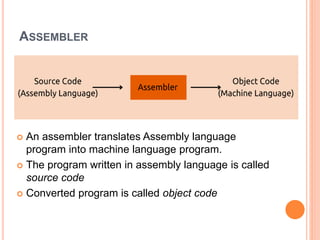
 An assembler translates Assembly language
program into machine language program.
 The program written in assembly language is called
source code
 Converted program is called object code
COMPILER
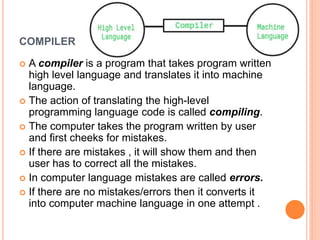
 A compiler is a program that takes program written
high level language and translates it into machine
language.

 The action of translating the high-level
programming language code is called compiling.
 The computer takes the program written by user
and first cheeks for mistakes.
 If there are mistakes , it will show them and then
user has to correct all the mistakes.
 In computer language mistakes are called errors.
 If there are no mistakes/errors then it converts it
into computer machine language in one attempt .
INTERPRETER
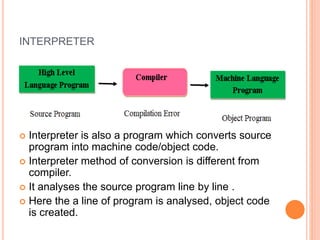
 Interpreter is also a program which converts source
program into machine code/object code.
 Interpreter method of conversion is different from
compiler.
 It analyses the source program line by line .
 Here the a line of program is analysed, object code
is created.
Computer languages that are used in different generations

Computer languages that are used in different generations

  • 1.
  • 2.
    INTRODUCTION  To explainthe computer about how to perform a task, the computer programmer writes a set of instructions and it is called a program.  Hence “ A set of instructions written to perform a particular task is called a program”  “Process of writing the program is called programming”  A set of programs written to instruct a computer is called the software.  These programs are written in any computer language.
  • 3.
  • 4.
    FIRST GENERATION LANGUAGE It is also known as binary or machine language.  These binary languages are mostly based on 0&1.  These languages are quite difficult to understand.  To develop a program in first generation language is a complicated task.  It is machine dependent language.  It is also known as low level language (lll).  The programs written on binary language get executed very fast.
  • 5.
    ADVANTAGES AND DISADVANTAGES Fast execution of program  Uses less memory  Difficult to debug  Machine dependent Advantages Disadvantages
  • 6.
    SECOND GENERATION LANGUAGE These languages are also belong to the category of low level language (lll).  Second generation language were also known as assembly language.  The binary digits o&1 were replaced by some special codes known as Mnemonics eg:-sub = -, add=+,div=/,sav=save.  This language is machine dependent language.
  • 7.
    ADVANTAGES AND DISADVANTAGES Uses English words.  Easy to locate errors.  Machine dependent  Time consuming Advantages Disadvantages
  • 8.
    THIRD GENERATION LANGUAGES They are also known as high level language (HLL).  In this the commands written are in simple English language.  Third generation language were portable.  As the commands written are in simple language so special software were develop which are known as Language processor.  For example:-LOGO, PASCAL,COBOL,JAVA etc….
  • 9.
    FEATURES  it isuser friendly  Machine independent  Uses English words and mathematical operators.
  • 10.
    FORTH GENERATION LANGUAGES As 3rd generation languages were based on certain syntax ,which a programmer has to follow during developing a program which is known as procedural language.  To overcome from this problem fourth generation language were evolved.  These programs were written in non-procedural way  For example SQL, Wave, Python etc…
  • 11.
    FEATURES  Its moreprogrammer friendly.  Needs less efforts.  Possess high speed execution  Enhances the programming efficiency.
  • 12.
    FIFTH GENERATION LANGUAGES 5th generation languages are advanced high level languages.  These languages are used in AI research  Here the language develops the program solution by itself.  The program has to dictate the problem and how the solution should look like.  These languages are still in development.  Examples of 5GL are Prolog,OPS5 and Mercury.
  • 13.
  • 14.
    ASSEMBLER  An assemblertranslates Assembly language program into machine language program.  The program written in assembly language is called source code  Converted program is called object code
  • 15.
    COMPILER  A compileris a program that takes program written high level language and translates it into machine language.  The action of translating the high-level programming language code is called compiling.  The computer takes the program written by user and first cheeks for mistakes.  If there are mistakes , it will show them and then user has to correct all the mistakes.  In computer language mistakes are called errors.  If there are no mistakes/errors then it converts it into computer machine language in one attempt .

  • 16.
    INTERPRETER  Interpreter isalso a program which converts source program into machine code/object code.  Interpreter method of conversion is different from compiler.  It analyses the source program line by line .  Here the a line of program is analysed, object code is created.