EVALUTION OF COMPUTER LANGAGES
GROUP A
Introduction
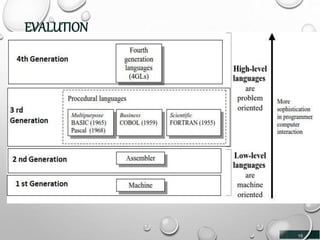
 Programming languages specially developed so that
you could pass your data and instructions to the
computer to do specific job
 There are two major types of programming languages,
 Low Level Languages
 High Level Languages
 Low Level languages are further divided in to
Machine language and Assembly language .
 High Level Languages are, for scientific application
FORTRAN and C languages are used. On the other
hand COBOL is used for business applications.
2
3
Low-level language
4
5
MACHINE LANGUAGE
 It is also known as binary or machine language.
 These binary languages are mostly based on 0&1.
 These languages are quite difficult to understand.
 To develop a program in first generation language is
complicated task.
 They are machine dependent language.
 They are also known as low level language (lll).
 The programs written on binary language used to
executed very fast.
 Machine language is machine dependent. That is each
computer has their own machine language that specific to
them.
• Assembly language uses the same instructions and
structure as machine language but the programmer is
able to use meaningful names or abbreviations instead
of numbers.
• Assembly language is referred to as a second
generation programming language.
Assembly language
• Since machine code is very difficult for us programmers
and just about everyone else!) to understand, some parts
of the binary code that represents instructions (like add,
move, store etc.) are coded to help us understand them.
We call this Assembly Language.
6
Advantages:
• Assembly Language is easier to understand and
saves a lot of time and effort.
• It is easier to correct errors and modify program
instructions.
• Assembly Language has the same efficiency of
execution as the machine level language
Disadvantages:
• Assembly language is machine dependent. A
program written for one computer might not run
in other computers with different hardware
configuration.
7
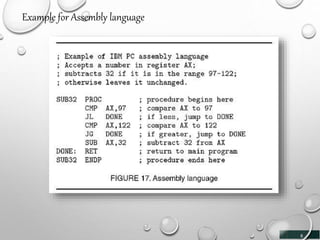
Example for Assembly language
8
9
• High-level programming languages, are often referred to
as third generation programming languages (3GL),
were first developed in the late 1950s.
High-level programminglanguages
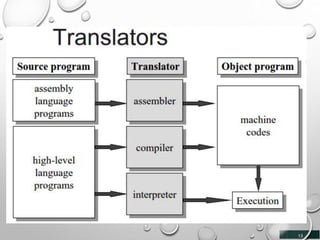
• In order for the computer to understand a program
written in a high-level language, programmers convert
the source code into machine language using a
• COMPILER
• INTERPRETER.
10
• High-level programming languages have English-like
instructions and are easier to use than machine
language.
11
• They are also known as high level language (H.L.L).
• In this the commands written are in simple English
language.
• Third generation language were portable.
• As the commands written are in simple language so
special software were develop which are known as
Language processor.
• For example:-LOGO, PASCAL;
• COBOL,JAVA etc….
Third Generation Languages
12
• As 3GL were based on certain syntax ,which a
programmer has to follow during developing a program
which is known as procedural language.
• To overcome from this problem fourth generation
language were evolved.
• These programs were written in non-procedural way
• For example SQL , LIPS, PROLOG etc……
fourthGeneration Languages
IN 5THGENERATION
• They use Artificial Intelligence languages as 5th
Generation.
For example - PROLOG , MERCURY
13
COMPILER INTERPRETER
USE FOR
It is a program translator that
translates the instruction of a
higher level language to
machine language
An interpreter is another
type of program translator
used for translating higher
level language into machine
language.
TRANSLATION OF
SOURCE PROGRAM
The whole program before
execution
One line at a time when it is
run
FREQUENCY OF
TRANSLATION
Each line is translated once
Has to be translated every
time it is executed - slower
OBJECT PROGRAM
Can be saved for execution
without the source program
No object programs is
generated, so source
program must be present for
execution
Different between Compiler & interpreter
EVALUTION
15
INDICATORS LOW LEVEL LANGUAGES HIGH LEVEL LANGUAGES
PROGRAM DEVELOPMENT
TIME
Long Relatively short
PROGRAMMERS SKILL
REQUIRED
High Much lower
ORIENTATION Towards computers Towards humans
EASE OF MODIFICATION Difficult Very easy
SPEED OF PROCESSING Very high Slower
MEMORY REQUIREMENTS Minimum Often significant
PORTABILITY OF
PROGRAMS
Programs are confined
to machine.
Can be moved between
different types of computers
APPLICATIONS Operating Systems (OS) Language
processors and utilities
Application programs
Modification
Programs in low-level languages
are difficult to modify.
Programs in high-level
languages are easy to modify.
Knowledge of hardware
Deep
Deep knowledge of hardware is
required to write programs.
Knowledge of hardware is not
required to write programs.
 PIUMI RAJAPAKSHA
 PRIYANAKARA BANDARA
 NOOR HAMEED SALLAY
 W.G.N.K.WICKRAMASINGHE
 NALIN SENEVIRATHNE
17
18

EVALUTION OF COMPUTER LANGAGES

  • 1.
    EVALUTION OF COMPUTERLANGAGES GROUP A
  • 2.
    Introduction  Programming languagesspecially developed so that you could pass your data and instructions to the computer to do specific job  There are two major types of programming languages,  Low Level Languages  High Level Languages  Low Level languages are further divided in to Machine language and Assembly language .  High Level Languages are, for scientific application FORTRAN and C languages are used. On the other hand COBOL is used for business applications. 2
  • 3.
  • 4.
  • 5.
    5 MACHINE LANGUAGE  Itis also known as binary or machine language.  These binary languages are mostly based on 0&1.  These languages are quite difficult to understand.  To develop a program in first generation language is complicated task.  They are machine dependent language.  They are also known as low level language (lll).  The programs written on binary language used to executed very fast.  Machine language is machine dependent. That is each computer has their own machine language that specific to them.
  • 6.
    • Assembly languageuses the same instructions and structure as machine language but the programmer is able to use meaningful names or abbreviations instead of numbers. • Assembly language is referred to as a second generation programming language. Assembly language • Since machine code is very difficult for us programmers and just about everyone else!) to understand, some parts of the binary code that represents instructions (like add, move, store etc.) are coded to help us understand them. We call this Assembly Language. 6
  • 7.
    Advantages: • Assembly Languageis easier to understand and saves a lot of time and effort. • It is easier to correct errors and modify program instructions. • Assembly Language has the same efficiency of execution as the machine level language Disadvantages: • Assembly language is machine dependent. A program written for one computer might not run in other computers with different hardware configuration. 7
  • 8.
  • 9.
  • 10.
    • High-level programminglanguages, are often referred to as third generation programming languages (3GL), were first developed in the late 1950s. High-level programminglanguages • In order for the computer to understand a program written in a high-level language, programmers convert the source code into machine language using a • COMPILER • INTERPRETER. 10 • High-level programming languages have English-like instructions and are easier to use than machine language.
  • 11.
    11 • They arealso known as high level language (H.L.L). • In this the commands written are in simple English language. • Third generation language were portable. • As the commands written are in simple language so special software were develop which are known as Language processor. • For example:-LOGO, PASCAL; • COBOL,JAVA etc…. Third Generation Languages
  • 12.
    12 • As 3GLwere based on certain syntax ,which a programmer has to follow during developing a program which is known as procedural language. • To overcome from this problem fourth generation language were evolved. • These programs were written in non-procedural way • For example SQL , LIPS, PROLOG etc…… fourthGeneration Languages IN 5THGENERATION • They use Artificial Intelligence languages as 5th Generation. For example - PROLOG , MERCURY
  • 13.
  • 14.
    COMPILER INTERPRETER USE FOR Itis a program translator that translates the instruction of a higher level language to machine language An interpreter is another type of program translator used for translating higher level language into machine language. TRANSLATION OF SOURCE PROGRAM The whole program before execution One line at a time when it is run FREQUENCY OF TRANSLATION Each line is translated once Has to be translated every time it is executed - slower OBJECT PROGRAM Can be saved for execution without the source program No object programs is generated, so source program must be present for execution Different between Compiler & interpreter

  • 15.
  • 16.
    INDICATORS LOW LEVELLANGUAGES HIGH LEVEL LANGUAGES PROGRAM DEVELOPMENT TIME Long Relatively short PROGRAMMERS SKILL REQUIRED High Much lower ORIENTATION Towards computers Towards humans EASE OF MODIFICATION Difficult Very easy SPEED OF PROCESSING Very high Slower MEMORY REQUIREMENTS Minimum Often significant PORTABILITY OF PROGRAMS Programs are confined to machine. Can be moved between different types of computers APPLICATIONS Operating Systems (OS) Language processors and utilities Application programs Modification Programs in low-level languages are difficult to modify. Programs in high-level languages are easy to modify. Knowledge of hardware Deep Deep knowledge of hardware is required to write programs. Knowledge of hardware is not required to write programs.
  • 17.
     PIUMI RAJAPAKSHA PRIYANAKARA BANDARA  NOOR HAMEED SALLAY  W.G.N.K.WICKRAMASINGHE  NALIN SENEVIRATHNE 17
  • 18.