Presented By:
Mr. Rohan S. Kale
Introduction- What is ETC System?
Objectives of ETCS
Problems in Barcodes
Need for RFID
RFID
RFID Tags
Types of RFID Tags
Reader
In Lane Computer
Schematic of ETC System
Working
Advantages
Limitations
Conclusion
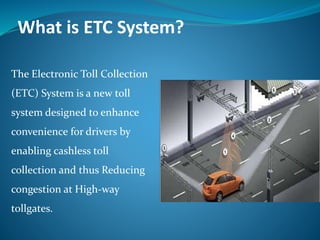
What is ETC System?
The Electronic Toll Collection
(ETC) System is a new toll
system designed to enhance
convenience for drivers by
enabling cashless toll
collection and thus Reducing
congestion at High-way
tollgates.
Avoid the fuel loss.
Saving of time in collecting toll.
Avoid financial loss.
Reduce longer waiting time in a toll queue
Provide traveler ease of toll payment
Reduce illegal toll gate entry
Transmission of data is performed optically- hence, clear line of
sight is required
Information storage is limited (upto 1 Mb)
Read only one tag at a time
Read capability can be affected by dirt, water and scuffing
Reduced security
Communicates through radio waves, line of sight not required
RFID tags store significantly more information (upto 2 Mb)
RFID is dynamic and information can be added or deleted at every
step in the supply chain
Increased functionality: covert and difficult to counterfeit
Read multiple tags at once
RFID is a technology to identify and authenticate tags that are us
attached on vehicles.
Each user holds a unique id for his vehicle, when user scans his
ID, some amount is charged from his account depending upon his
vehicle category.
This system depends on three devices
Tag: Transponder
RF Reader: Antenna
In-Lane Computer
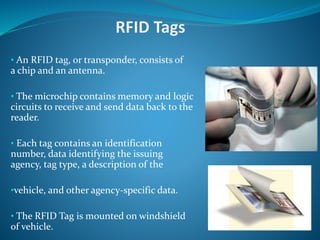
• An RFID tag, or transponder, consists of
a chip and an antenna.
• The microchip contains memory and logic
circuits to receive and send data back to the
reader.
• Each tag contains an identification
number, data identifying the issuing
agency, tag type, a description of the
•vehicle, and other agency-specific data.
• The RFID Tag is mounted on windshield
of vehicle.
Active Tags
• Tag transmits radio signal
• Battery powered memory,
radio & circuitry
• High Read Range (100
meters)
• Bulky, Expensive
• Can last over 10 years
Passive Tags
• Tag reflects radio signal
from reader
• Reader powered
• Shorter Read Range (10cm –
5 meters)
• Can be packed small, light,
inexpensive
• Can last generally from 2 to
7 years
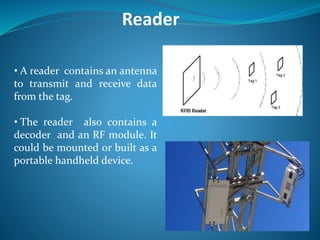
Reader
• A reader contains an antenna
to transmit and receive data
from the tag.
• The reader also contains a
decoder and an RF module. It
could be mounted or built as a
portable handheld device.
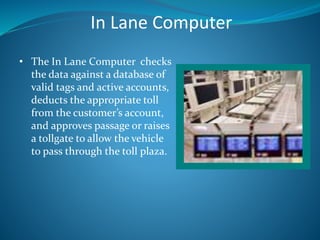
In Lane Computer
• The In Lane Computer checks
the data against a database of
valid tags and active accounts,
deducts the appropriate toll
from the customer’s account,
and approves passage or raises
a tollgate to allow the vehicle
to pass through the toll plaza.
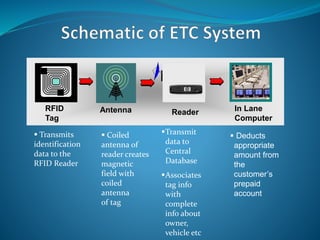
RFID
Tag
ReaderAntenna In Lane
Computer
 Transmits
identification
data to the
RFID Reader
 Coiled
antenna of
reader creates
magnetic
field with
coiled
antenna
of tag
Transmit
data to
Central
Database
Associates
tag info
with
complete
info about
owner,
vehicle etc
 Deducts
appropriate
amount from
the
customer’s
prepaid
account
Working
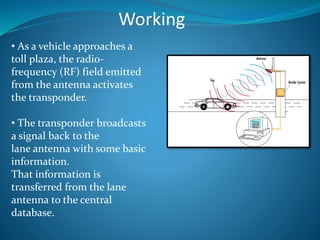
• As a vehicle approaches a
toll plaza, the radio-
frequency (RF) field emitted
from the antenna activates
the transponder.
• The transponder broadcasts
a signal back to the
lane antenna with some basic
information.
That information is
transferred from the lane
antenna to the central
database.
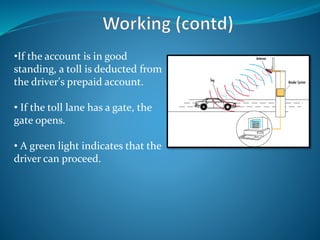
•If the account is in good
standing, a toll is deducted from
the driver's prepaid account.
• If the toll lane has a gate, the
gate opens.
• A green light indicates that the
driver can proceed.
Entire process takes a matter of seconds to complete.
Electronic system records transaction, including the time,
date, plaza and toll charge of each vehicle.
Safe Transaction (Less chances of Corruption)
•If RFID fails whole system fails. The RFID system we are
here using for detecting the vehicle number means the
vehicle identity which we are further using for storing
into memory & also to display on the LCD.
•If the RFID fails to detect the correct identity of the
vehicle the data regarding the vehicle will be wrong which
will may create many problems & system fails.
By doing automation of toll plaza we can have the best solution
over money loss at toll plaza by reducing the man power required
for collection of money and also can reduce the traffic indirectly
resulting in reduction of time at toll plaza.
In our paper, we have introduced the techniques such as Radio
Frequency Identification. This technique will include the RFID tag
& reader which in coordination with each other can be used to
detect the vehicle identity.
By effectively utilizing this technique at different stages of our
project we are able to represent the automation in toll plaza which
will reduce the complete processing time by few seconds which is
very important as well as helps to reduce money leakage in a very
cost effective manner.
[1] RFID based toll collection system,2011 IEEE third
international Conference
[2] D. M. Grimes and T. O. Jones, ―Automotive radar: A brief
review, ǁ Proc. IEEE, vol. 62, no. 6, pp. 804–822, Jun. 1974.
[3] ActiveWaveInc. http://www.activewaveinc.co
[4] Smart key Access Control System http://www.smartkey-
rfid.com
[5] D. M. Grimes and T. O. Jones, ―Automotive radar: A brief
review,ǁ Proc. IEEE, vol. 62, no. 6, pp. 804–822, Jun. 1974.
Automatic toll collection system (presentation)

Automatic toll collection system (presentation)

  • 1.
  • 2.
    Introduction- What isETC System? Objectives of ETCS Problems in Barcodes Need for RFID RFID RFID Tags Types of RFID Tags Reader In Lane Computer Schematic of ETC System Working Advantages Limitations Conclusion
  • 3.
    What is ETCSystem? The Electronic Toll Collection (ETC) System is a new toll system designed to enhance convenience for drivers by enabling cashless toll collection and thus Reducing congestion at High-way tollgates.
  • 4.
    Avoid the fuelloss. Saving of time in collecting toll. Avoid financial loss. Reduce longer waiting time in a toll queue Provide traveler ease of toll payment Reduce illegal toll gate entry
  • 5.
    Transmission of datais performed optically- hence, clear line of sight is required Information storage is limited (upto 1 Mb) Read only one tag at a time Read capability can be affected by dirt, water and scuffing Reduced security
  • 6.
    Communicates through radiowaves, line of sight not required RFID tags store significantly more information (upto 2 Mb) RFID is dynamic and information can be added or deleted at every step in the supply chain Increased functionality: covert and difficult to counterfeit Read multiple tags at once
  • 7.
    RFID is atechnology to identify and authenticate tags that are us attached on vehicles. Each user holds a unique id for his vehicle, when user scans his ID, some amount is charged from his account depending upon his vehicle category. This system depends on three devices Tag: Transponder RF Reader: Antenna In-Lane Computer
  • 8.
    • An RFIDtag, or transponder, consists of a chip and an antenna. • The microchip contains memory and logic circuits to receive and send data back to the reader. • Each tag contains an identification number, data identifying the issuing agency, tag type, a description of the •vehicle, and other agency-specific data. • The RFID Tag is mounted on windshield of vehicle.
  • 9.
    Active Tags • Tagtransmits radio signal • Battery powered memory, radio & circuitry • High Read Range (100 meters) • Bulky, Expensive • Can last over 10 years Passive Tags • Tag reflects radio signal from reader • Reader powered • Shorter Read Range (10cm – 5 meters) • Can be packed small, light, inexpensive • Can last generally from 2 to 7 years
  • 10.
    Reader • A readercontains an antenna to transmit and receive data from the tag. • The reader also contains a decoder and an RF module. It could be mounted or built as a portable handheld device.
  • 11.
    In Lane Computer •The In Lane Computer checks the data against a database of valid tags and active accounts, deducts the appropriate toll from the customer’s account, and approves passage or raises a tollgate to allow the vehicle to pass through the toll plaza.
  • 12.
    RFID Tag ReaderAntenna In Lane Computer Transmits identification data to the RFID Reader  Coiled antenna of reader creates magnetic field with coiled antenna of tag Transmit data to Central Database Associates tag info with complete info about owner, vehicle etc  Deducts appropriate amount from the customer’s prepaid account
  • 13.
    Working • As avehicle approaches a toll plaza, the radio- frequency (RF) field emitted from the antenna activates the transponder. • The transponder broadcasts a signal back to the lane antenna with some basic information. That information is transferred from the lane antenna to the central database.
  • 14.
    •If the accountis in good standing, a toll is deducted from the driver's prepaid account. • If the toll lane has a gate, the gate opens. • A green light indicates that the driver can proceed.
  • 15.
    Entire process takesa matter of seconds to complete. Electronic system records transaction, including the time, date, plaza and toll charge of each vehicle. Safe Transaction (Less chances of Corruption)
  • 16.
    •If RFID failswhole system fails. The RFID system we are here using for detecting the vehicle number means the vehicle identity which we are further using for storing into memory & also to display on the LCD. •If the RFID fails to detect the correct identity of the vehicle the data regarding the vehicle will be wrong which will may create many problems & system fails.
  • 17.
    By doing automationof toll plaza we can have the best solution over money loss at toll plaza by reducing the man power required for collection of money and also can reduce the traffic indirectly resulting in reduction of time at toll plaza. In our paper, we have introduced the techniques such as Radio Frequency Identification. This technique will include the RFID tag & reader which in coordination with each other can be used to detect the vehicle identity. By effectively utilizing this technique at different stages of our project we are able to represent the automation in toll plaza which will reduce the complete processing time by few seconds which is very important as well as helps to reduce money leakage in a very cost effective manner.
  • 18.
    [1] RFID basedtoll collection system,2011 IEEE third international Conference [2] D. M. Grimes and T. O. Jones, ―Automotive radar: A brief review, ǁ Proc. IEEE, vol. 62, no. 6, pp. 804–822, Jun. 1974. [3] ActiveWaveInc. http://www.activewaveinc.co [4] Smart key Access Control System http://www.smartkey- rfid.com [5] D. M. Grimes and T. O. Jones, ―Automotive radar: A brief review,ǁ Proc. IEEE, vol. 62, no. 6, pp. 804–822, Jun. 1974.