ELECTRONIC
TOLL COLLECTION
Brand of
www.rfenergie.com
The RFID system is a proven asset tracking technology. The highlight of an RFID system is that it allows for contactless tracking
within a few meters, making it ideal for tracking and transacting with moveable assets or vehicles. RFIDs are used for toll
collection, parking fees collection, and track containers across the globe by leveraging contactless technology. Developed and
developing countries are embracing this technology in order to decrease traffic bottlenecks and achieve seamless vehicle
movement. Recently, the government of India has mandated the use of RFID tags (FASTags) on all vehicles to automate toll
collection, every vehicle in the country will have a FASTag.
There are 566 toll plazas on the national highways of India, excluding state highways. These toll plazas act as a bottleneck in
traffic during peak times, the long queue of vehicles is a problem for both public and toll collectors. These queues cost people
precious time, fuel, money, and health (long traffic causes pollution). Truck delays in toll plazas cost the Indian economy 60,000
crores each year, according to the joint research undertaken by the Transport Corporation of India and IIM Kolkata. To fight
these problems, in 2014 Ministry of transportation began implementing Electronic Toll Collection (ETC) system in India.
ETC is an electronic payment system that allows drivers to pay the toll without stopping vehicles at the toll booth. The
technology will eventually decongest toll plazas while also improving the government's transparency in toll collection. The
Hon'ble Minister of Transport, Nitin Gadkari, stated in 2014 at IIM Kolkata that deploying the ETC system across the country may
save the government 86000 crore.
Introduction
Every toll booth spends time trying to fetch change and settle the commuters. The situation is the same; even if commuters use
credit or debit cards, processing takes time. Another solution is to employ a smart card system similar to those used in metro
train travel. It's also unsuitable for roads since vehicles must stop to tap the smartcard against the PoS device. These payment
options are also subject to tax and banking fees.
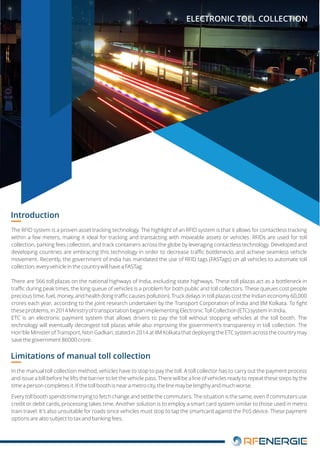
In the manual toll collection method, vehicles have to stop to pay the toll. A toll collector has to carry out the payment process
and issue a bill before he lifts the barrier to let the vehicle pass. There will be a line of vehicles ready to repeat these steps by the
time a person completes it. If the toll booth is near a metro city, the line may be lengthy and much worse.
Limitations of manual toll collection
ELECTRONIC TOLL COLLECTION
Electronic Toll Collection (ETC) is a method that collects toll payments electronically. This technology is used all over the globe to
reduce traffic congestion at toll booths. There are several types of ETC systems that automatically verify a vehicle and digitally
collect toll payments. Concerning the heavy traffic on Indian roads and the need for contactless payment, the RFID technology-
based ETC system is used under the brand name FASTag.
In India, the National Electronic Toll Collection (NETC) scheme was launched in collaboration with the National Payment
Corporation of India (NPCI) by the Ministry of Road Transport and Highways. India Highway Management LTD (IHML) manages
the ETC system in India.
Electronic Toll Collection system
If the tag is removed or out of balance, a camera installed at the toll plaza will catch the vehicle's front and rear number plates.
Every vehicle registration ID is linked to the user's bank account, and the toll will be deducted from the account bank, directly.
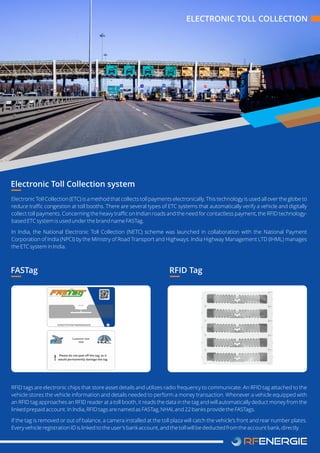
RFID tags are electronic chips that store asset details and utilizes radio frequency to communicate. An RFID tag attached to the
vehicle stores the vehicle information and details needed to perform a money transaction. Whenever a vehicle equipped with
an RFID tag approaches an RFID reader at a toll booth, it reads the data in the tag and will automatically deduct money from the
linked prepaid account. In India, RFID tags are named as FASTag, NHAI, and 22 banks provide the FASTags.
FASTag
ELECTRONIC TOLL COLLECTION
RFID Tag
Working of FASTag
ELECTRONIC TOLL COLLECTION
RFID Reader
RFID Tag
RFID Software
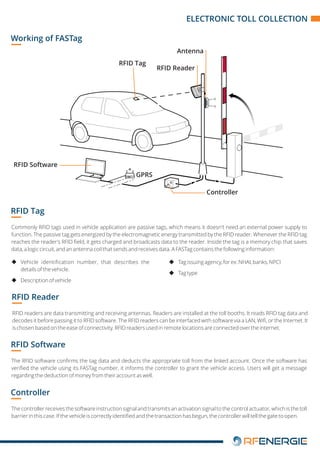
Commonly RFID tags used in vehicle application are passive tags, which means it doesn't need an external power supply to
function. The passive tag gets energized by the electromagnetic energy transmitted by the RFID reader. Whenever the RFID tag
reaches the reader's RFID field, it gets charged and broadcasts data to the reader. Inside the tag is a memory chip that saves
data, a logic circuit, and an antenna coil that sends and receives data. A FASTag contains the following information:
RFID Tag
u Description of vehicle
u Tag type
u Tag issuing agency, for ex: NHAI, banks, NPCI
u Vehicle identification number, that describes the
details of the vehicle.
RFID readers are data transmitting and receiving antennas. Readers are installed at the toll booths. It reads RFID tag data and
decodes it before passing it to RFID software. The RFID readers can be interfaced with software via a LAN, Wifi, or the Internet. It
is chosen based on the ease of connectivity. RFID readers used in remote locations are connected over the internet.
RFID Reader
The RFID software confirms the tag data and deducts the appropriate toll from the linked account. Once the software has
verified the vehicle using its FASTag number, it informs the controller to grant the vehicle access. Users will get a message
regarding the deduction of money from their account as well.
RFID Software
Controller
The controller receives the software instruction signal and transmits an activation signal to the control actuator, which is the toll
barrier in this case. If the vehicle is correctly identified and the transaction has begun, the controller will tell the gate to open.
Controller
GPRS
Antenna
Benefits of FASTag
u Provide driver ease of toll payment, no need to carry
cash.
u Users can recharge RFID reader via internet banking
and payment apps like Paytm and Phonepe
u RFID tags can lower the fuel cost by offering nearly
nonstop movement of vehicles.
u Reduce the travel time through the national highways
as RFID readers automatically deducts toll payments.
u Reduce illegal toll gate entry
u SMS notification for each toll payment and low balance
u Durable tags, FASTag withstand in a temperature range
of -25°C to +75°C.
u Reduce the cost of the toll management system.
u Records details like transaction time, date, and charge
of each vehicle.
u Improve the transparency of toll collection
u Many banks and payments services offer cashback on
RFID recharge.
u Environment friendly, reduce pollution at toll gates and
reduce the use of paper.
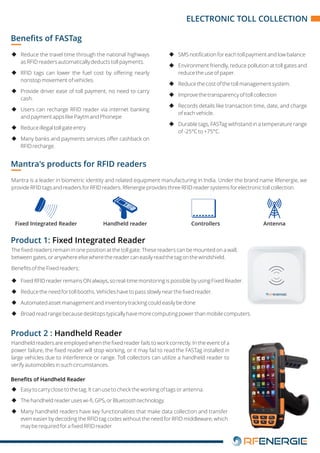
Mantra is a leader in biometric identity and related equipment manufacturing in India. Under the brand name Rfenergie, we
provide RFID tags and readers for RFID readers. Rfenergie provides three RFID reader systems for electronic toll collection.
Mantra's products for RFID readers
Fixed Integrated Reader Handheld reader Controllers
Product 1: Fixed Integrated Reader
The fixed readers remain in one position at the toll gate. These readers can be mounted on a wall,
between gates, or anywhere else where the reader can easily read the tag on the windshield.
Benefits of the Fixed readers:
u Reduce the need for toll booths. Vehicles have to pass slowly near the fixed reader.
u Fixed RFID reader remains ON always, so real-time monitoring is possible by using Fixed Reader.
u Broad read range because desktops typically have more computing power than mobile computers.
u Automated asset management and inventory tracking could easily be done
Product 2 : Handheld Reader
Handheld readers are employed when the fixed reader fails to work correctly. In the event of a
power failure, the fixed reader will stop working, or it may fail to read the FASTag installed in
large vehicles due to interference or range. Toll collectors can utilize a handheld reader to
verify automobiles in such circumstances.
u Easy to carry close to the tag. It can use to check the working of tags or antenna.
u The handheld reader uses wi-fi, GPS, or Bluetooth technology.
u Many handheld readers have key functionalities that make data collection and transfer
even easier by decoding the RFID tag codes without the need for RFID middleware, which
may be required for a fixed RFID reader
Benefits of Handheld Reader
ELECTRONIC TOLL COLLECTION
Antenna
Product 3: Controller
Mantra's controller comes with an inbuilt RFID reader and antenna. The four-port
controller can perform the access control actions such as instruct the barrier to
open or close, restrict or report the movement of unauthorized vehicles, and
capture the picture of the unauthorized vehicle's number plate.
ELECTRONIC TOLL COLLECTION
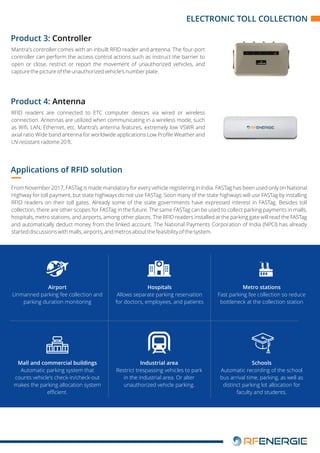
From November 2017, FASTag is made mandatory for every vehicle registering in India. FASTag has been used only on National
Highway for toll payment, but state highways do not use FASTag. Soon many of the state highways will use FASTag by installing
RFID readers on their toll gates. Already some of the state governments have expressed interest in FASTag. Besides toll
collection, there are other scopes for FASTag in the future. The same FASTag can be used to collect parking payments in malls,
hospitals, metro stations, and airports, among other places. The RFID readers installed at the parking gate will read the FASTag
and automatically deduct money from the linked account. The National Payments Corporation of India (NPCI) has already
started discussions with malls, airports, and metros about the feasibility of the system.
Applications of RFID solution
Product 4: Antenna
RFID readers are connected to ETC computer devices via wired or wireless
connection. Antennas are utilized when communicating in a wireless mode, such
as Wifi, LAN, Ethernet, etc. Mantra’s antenna features, extremely low VSWR and
axial ratio Wide band antenna for worldwide applications Low Profile Weather and
UV resistant radome 20 ft.
Airport
Unmanned parking fee collection and
parking duration monitoring
Mall and commercial buildings
Automatic parking system that
counts vehicle's check-in/check-out
makes the parking allocation system
efficient.
Hospitals
Allows separate parking reservation
for doctors, employees, and patients
Metro stations
Fast parking fee collection so reduce
bottleneck at the collection station
Industrial area
Restrict trespassing vehicles to park
in the industrial area. Or alter
unauthorized vehicle parking.
Schools
Automatic recording of the school
bus arrival time, parking, as well as
distinct parking lot allocation for
faculty and students.
+91-079-49068001
sales@mantratec.com
Copyrights Mantra So ech (India) Pvt Ltd. All Rights Reserved.
Brand of
www.rfenergie.com

Electronic_toll_collection_version_1.3 (1).pdf

  • 1.
  • 2.
    The RFID systemis a proven asset tracking technology. The highlight of an RFID system is that it allows for contactless tracking within a few meters, making it ideal for tracking and transacting with moveable assets or vehicles. RFIDs are used for toll collection, parking fees collection, and track containers across the globe by leveraging contactless technology. Developed and developing countries are embracing this technology in order to decrease traffic bottlenecks and achieve seamless vehicle movement. Recently, the government of India has mandated the use of RFID tags (FASTags) on all vehicles to automate toll collection, every vehicle in the country will have a FASTag. There are 566 toll plazas on the national highways of India, excluding state highways. These toll plazas act as a bottleneck in traffic during peak times, the long queue of vehicles is a problem for both public and toll collectors. These queues cost people precious time, fuel, money, and health (long traffic causes pollution). Truck delays in toll plazas cost the Indian economy 60,000 crores each year, according to the joint research undertaken by the Transport Corporation of India and IIM Kolkata. To fight these problems, in 2014 Ministry of transportation began implementing Electronic Toll Collection (ETC) system in India. ETC is an electronic payment system that allows drivers to pay the toll without stopping vehicles at the toll booth. The technology will eventually decongest toll plazas while also improving the government's transparency in toll collection. The Hon'ble Minister of Transport, Nitin Gadkari, stated in 2014 at IIM Kolkata that deploying the ETC system across the country may save the government 86000 crore. Introduction Every toll booth spends time trying to fetch change and settle the commuters. The situation is the same; even if commuters use credit or debit cards, processing takes time. Another solution is to employ a smart card system similar to those used in metro train travel. It's also unsuitable for roads since vehicles must stop to tap the smartcard against the PoS device. These payment options are also subject to tax and banking fees. In the manual toll collection method, vehicles have to stop to pay the toll. A toll collector has to carry out the payment process and issue a bill before he lifts the barrier to let the vehicle pass. There will be a line of vehicles ready to repeat these steps by the time a person completes it. If the toll booth is near a metro city, the line may be lengthy and much worse. Limitations of manual toll collection ELECTRONIC TOLL COLLECTION
  • 3.
    Electronic Toll Collection(ETC) is a method that collects toll payments electronically. This technology is used all over the globe to reduce traffic congestion at toll booths. There are several types of ETC systems that automatically verify a vehicle and digitally collect toll payments. Concerning the heavy traffic on Indian roads and the need for contactless payment, the RFID technology- based ETC system is used under the brand name FASTag. In India, the National Electronic Toll Collection (NETC) scheme was launched in collaboration with the National Payment Corporation of India (NPCI) by the Ministry of Road Transport and Highways. India Highway Management LTD (IHML) manages the ETC system in India. Electronic Toll Collection system If the tag is removed or out of balance, a camera installed at the toll plaza will catch the vehicle's front and rear number plates. Every vehicle registration ID is linked to the user's bank account, and the toll will be deducted from the account bank, directly. RFID tags are electronic chips that store asset details and utilizes radio frequency to communicate. An RFID tag attached to the vehicle stores the vehicle information and details needed to perform a money transaction. Whenever a vehicle equipped with an RFID tag approaches an RFID reader at a toll booth, it reads the data in the tag and will automatically deduct money from the linked prepaid account. In India, RFID tags are named as FASTag, NHAI, and 22 banks provide the FASTags. FASTag ELECTRONIC TOLL COLLECTION RFID Tag
  • 4.
    Working of FASTag ELECTRONICTOLL COLLECTION RFID Reader RFID Tag RFID Software Commonly RFID tags used in vehicle application are passive tags, which means it doesn't need an external power supply to function. The passive tag gets energized by the electromagnetic energy transmitted by the RFID reader. Whenever the RFID tag reaches the reader's RFID field, it gets charged and broadcasts data to the reader. Inside the tag is a memory chip that saves data, a logic circuit, and an antenna coil that sends and receives data. A FASTag contains the following information: RFID Tag u Description of vehicle u Tag type u Tag issuing agency, for ex: NHAI, banks, NPCI u Vehicle identification number, that describes the details of the vehicle. RFID readers are data transmitting and receiving antennas. Readers are installed at the toll booths. It reads RFID tag data and decodes it before passing it to RFID software. The RFID readers can be interfaced with software via a LAN, Wifi, or the Internet. It is chosen based on the ease of connectivity. RFID readers used in remote locations are connected over the internet. RFID Reader The RFID software confirms the tag data and deducts the appropriate toll from the linked account. Once the software has verified the vehicle using its FASTag number, it informs the controller to grant the vehicle access. Users will get a message regarding the deduction of money from their account as well. RFID Software Controller The controller receives the software instruction signal and transmits an activation signal to the control actuator, which is the toll barrier in this case. If the vehicle is correctly identified and the transaction has begun, the controller will tell the gate to open. Controller GPRS Antenna
  • 5.
    Benefits of FASTag uProvide driver ease of toll payment, no need to carry cash. u Users can recharge RFID reader via internet banking and payment apps like Paytm and Phonepe u RFID tags can lower the fuel cost by offering nearly nonstop movement of vehicles. u Reduce the travel time through the national highways as RFID readers automatically deducts toll payments. u Reduce illegal toll gate entry u SMS notification for each toll payment and low balance u Durable tags, FASTag withstand in a temperature range of -25°C to +75°C. u Reduce the cost of the toll management system. u Records details like transaction time, date, and charge of each vehicle. u Improve the transparency of toll collection u Many banks and payments services offer cashback on RFID recharge. u Environment friendly, reduce pollution at toll gates and reduce the use of paper. Mantra is a leader in biometric identity and related equipment manufacturing in India. Under the brand name Rfenergie, we provide RFID tags and readers for RFID readers. Rfenergie provides three RFID reader systems for electronic toll collection. Mantra's products for RFID readers Fixed Integrated Reader Handheld reader Controllers Product 1: Fixed Integrated Reader The fixed readers remain in one position at the toll gate. These readers can be mounted on a wall, between gates, or anywhere else where the reader can easily read the tag on the windshield. Benefits of the Fixed readers: u Reduce the need for toll booths. Vehicles have to pass slowly near the fixed reader. u Fixed RFID reader remains ON always, so real-time monitoring is possible by using Fixed Reader. u Broad read range because desktops typically have more computing power than mobile computers. u Automated asset management and inventory tracking could easily be done Product 2 : Handheld Reader Handheld readers are employed when the fixed reader fails to work correctly. In the event of a power failure, the fixed reader will stop working, or it may fail to read the FASTag installed in large vehicles due to interference or range. Toll collectors can utilize a handheld reader to verify automobiles in such circumstances. u Easy to carry close to the tag. It can use to check the working of tags or antenna. u The handheld reader uses wi-fi, GPS, or Bluetooth technology. u Many handheld readers have key functionalities that make data collection and transfer even easier by decoding the RFID tag codes without the need for RFID middleware, which may be required for a fixed RFID reader Benefits of Handheld Reader ELECTRONIC TOLL COLLECTION Antenna
  • 6.
    Product 3: Controller Mantra'scontroller comes with an inbuilt RFID reader and antenna. The four-port controller can perform the access control actions such as instruct the barrier to open or close, restrict or report the movement of unauthorized vehicles, and capture the picture of the unauthorized vehicle's number plate. ELECTRONIC TOLL COLLECTION From November 2017, FASTag is made mandatory for every vehicle registering in India. FASTag has been used only on National Highway for toll payment, but state highways do not use FASTag. Soon many of the state highways will use FASTag by installing RFID readers on their toll gates. Already some of the state governments have expressed interest in FASTag. Besides toll collection, there are other scopes for FASTag in the future. The same FASTag can be used to collect parking payments in malls, hospitals, metro stations, and airports, among other places. The RFID readers installed at the parking gate will read the FASTag and automatically deduct money from the linked account. The National Payments Corporation of India (NPCI) has already started discussions with malls, airports, and metros about the feasibility of the system. Applications of RFID solution Product 4: Antenna RFID readers are connected to ETC computer devices via wired or wireless connection. Antennas are utilized when communicating in a wireless mode, such as Wifi, LAN, Ethernet, etc. Mantra’s antenna features, extremely low VSWR and axial ratio Wide band antenna for worldwide applications Low Profile Weather and UV resistant radome 20 ft. Airport Unmanned parking fee collection and parking duration monitoring Mall and commercial buildings Automatic parking system that counts vehicle's check-in/check-out makes the parking allocation system efficient. Hospitals Allows separate parking reservation for doctors, employees, and patients Metro stations Fast parking fee collection so reduce bottleneck at the collection station Industrial area Restrict trespassing vehicles to park in the industrial area. Or alter unauthorized vehicle parking. Schools Automatic recording of the school bus arrival time, parking, as well as distinct parking lot allocation for faculty and students.
  • 7.
    +91-079-49068001 sales@mantratec.com Copyrights Mantra Soech (India) Pvt Ltd. All Rights Reserved. Brand of www.rfenergie.com