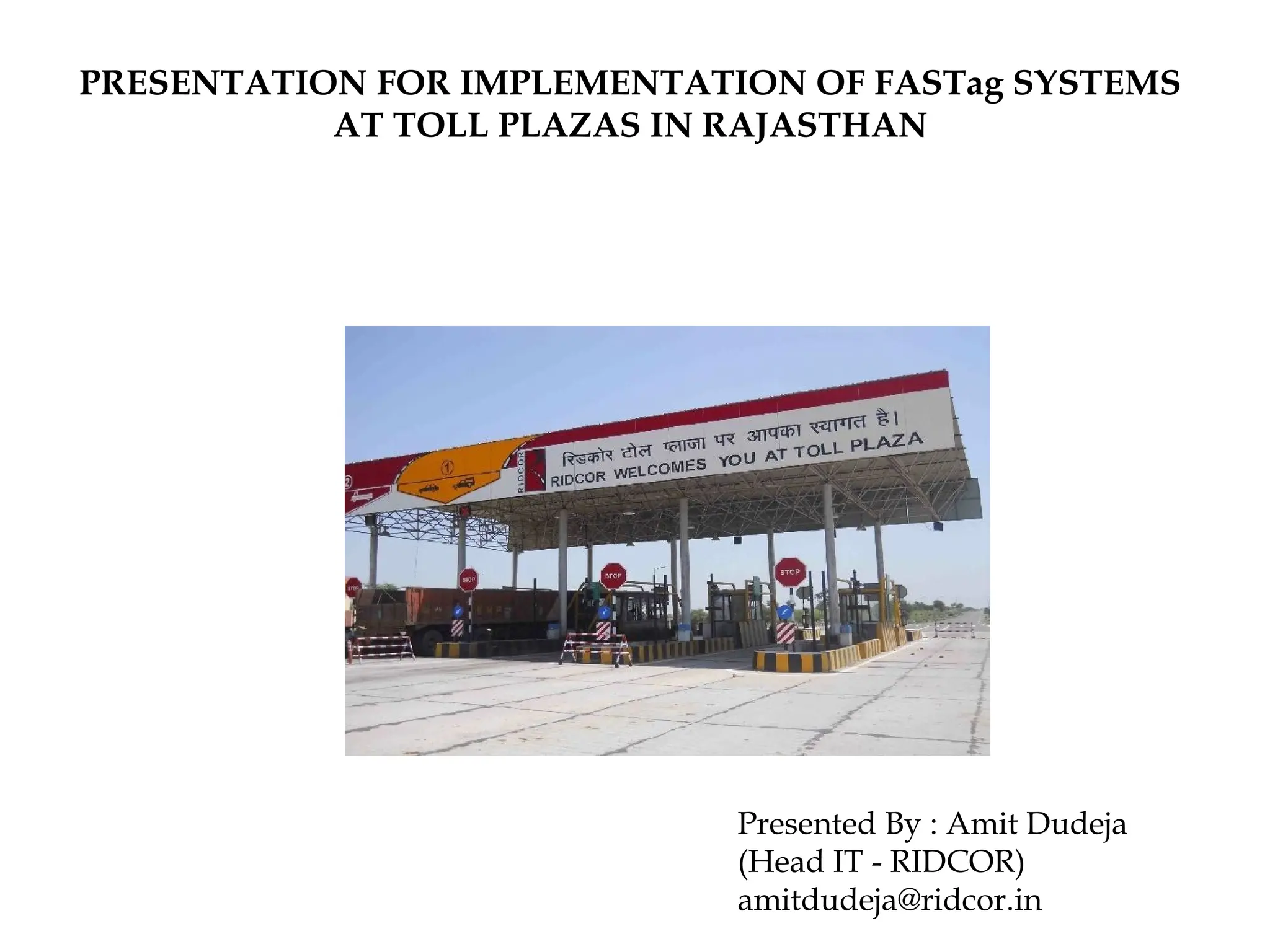
PRESENTATION FOR IMPLEMENTATION OF FASTag SYSTEMS
AT TOLL PLAZAS IN RAJASTHAN
Presented By : Amit Dudeja
(Head IT - RIDCOR)
amitdudeja@ridcor.in
BACK GROUND
(Source : PWD, Rajasthan)
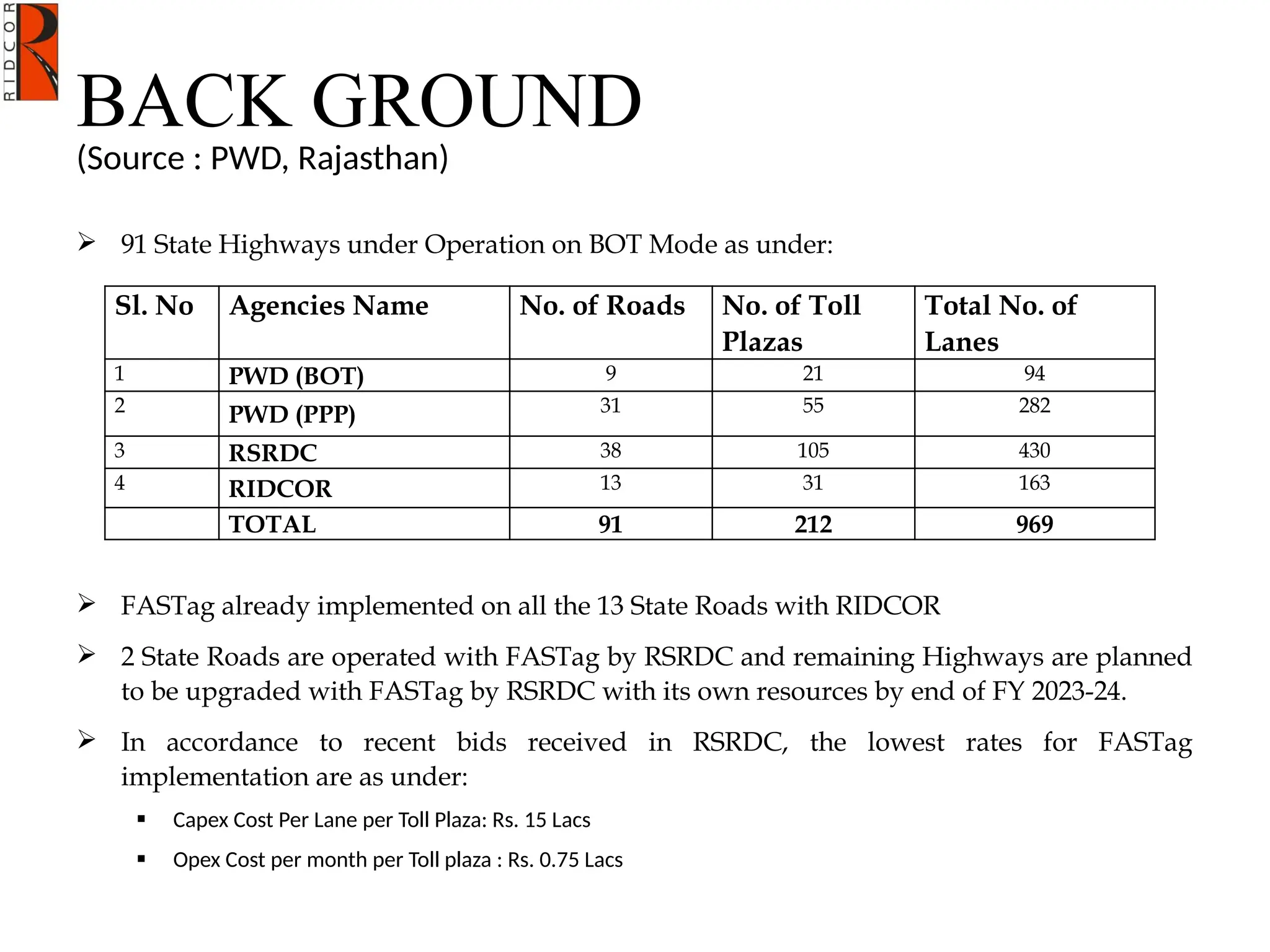
 91 State Highways under Operation on BOT Mode as under:
 FASTag already implemented on all the 13 State Roads with RIDCOR
 2 State Roads are operated with FASTag by RSRDC and remaining Highways are planned
to be upgraded with FASTag by RSRDC with its own resources by end of FY 2023-24.
 In accordance to recent bids received in RSRDC, the lowest rates for FASTag
implementation are as under:
 Capex Cost Per Lane per Toll Plaza: Rs. 15 Lacs
 Opex Cost per month per Toll plaza : Rs. 0.75 Lacs
Sl. No Agencies Name No. of Roads No. of Toll
Plazas
Total No. of
Lanes
1 PWD (BOT) 9 21 94
2 PWD (PPP) 31 55 282
3 RSRDC 38 105 430
4 RIDCOR 13 31 163
TOTAL 91 212 969
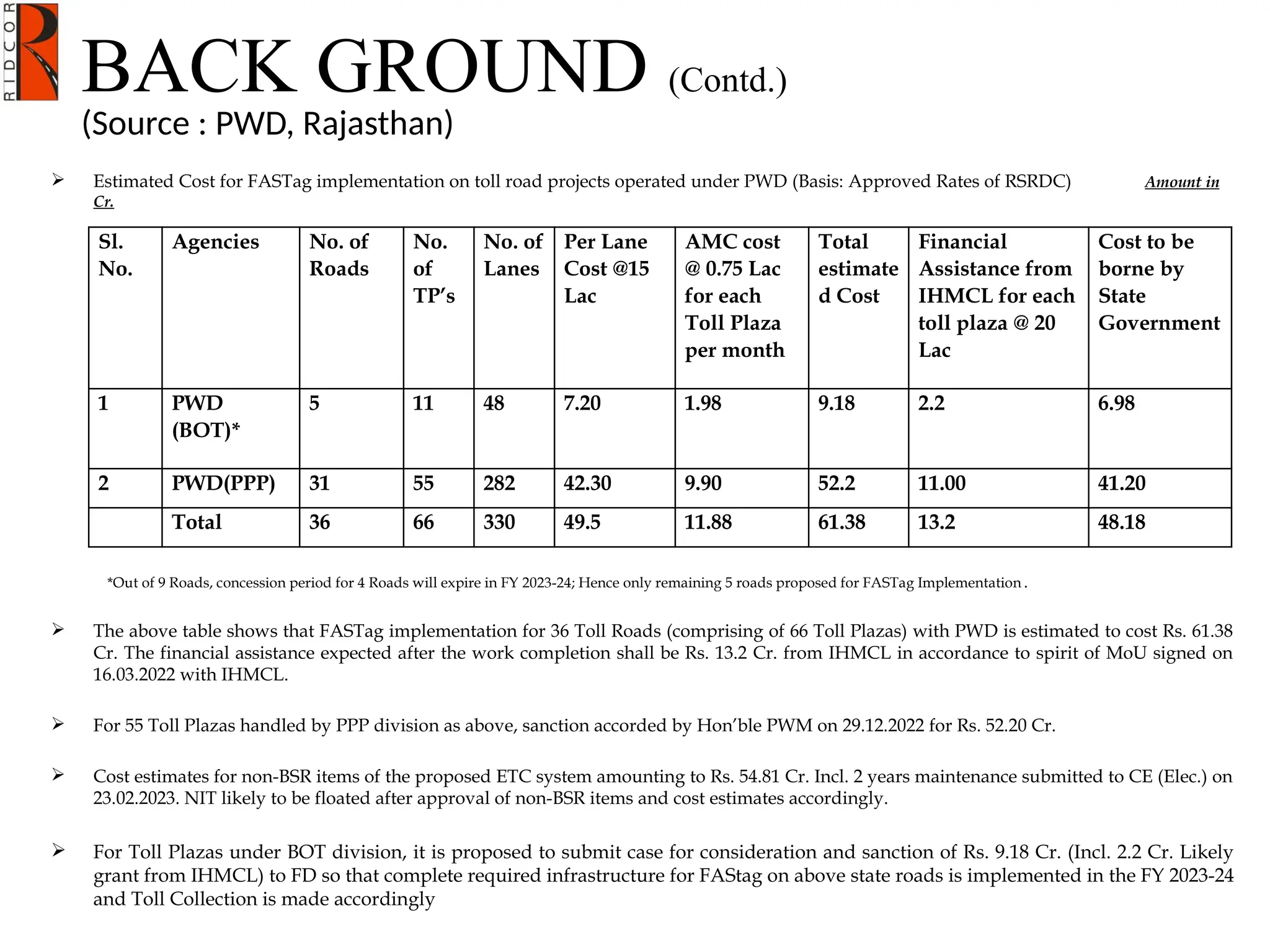
 Estimated Cost for FASTag implementation on toll road projects operated under PWD (Basis: Approved Rates of RSRDC) Amount in
Cr.
*Out of 9 Roads, concession period for 4 Roads will expire in FY 2023-24; Hence only remaining 5 roads proposed for FASTag Implementation .
 The above table shows that FASTag implementation for 36 Toll Roads (comprising of 66 Toll Plazas) with PWD is estimated to cost Rs. 61.38
Cr. The financial assistance expected after the work completion shall be Rs. 13.2 Cr. from IHMCL in accordance to spirit of MoU signed on
16.03.2022 with IHMCL.
 For 55 Toll Plazas handled by PPP division as above, sanction accorded by Hon’ble PWM on 29.12.2022 for Rs. 52.20 Cr.
 Cost estimates for non-BSR items of the proposed ETC system amounting to Rs. 54.81 Cr. Incl. 2 years maintenance submitted to CE (Elec.) on
23.02.2023. NIT likely to be floated after approval of non-BSR items and cost estimates accordingly.
 For Toll Plazas under BOT division, it is proposed to submit case for consideration and sanction of Rs. 9.18 Cr. (Incl. 2.2 Cr. Likely
grant from IHMCL) to FD so that complete required infrastructure for FAStag on above state roads is implemented in the FY 2023-24
and Toll Collection is made accordingly
Sl.
No.
Agencies No. of
Roads
No.
of
TP’s
No. of
Lanes
Per Lane
Cost @15
Lac
AMC cost
@ 0.75 Lac
for each
Toll Plaza
per month
Total
estimate
d Cost
Financial
Assistance from
IHMCL for each
toll plaza @ 20
Lac
Cost to be
borne by
State
Government
1 PWD
(BOT)*
5 11 48 7.20 1.98 9.18 2.2 6.98
2 PWD(PPP) 31 55 282 42.30 9.90 52.2 11.00 41.20
Total 36 66 330 49.5 11.88 61.38 13.2 48.18
BACK GROUND (Contd.)
(Source : PWD, Rajasthan)
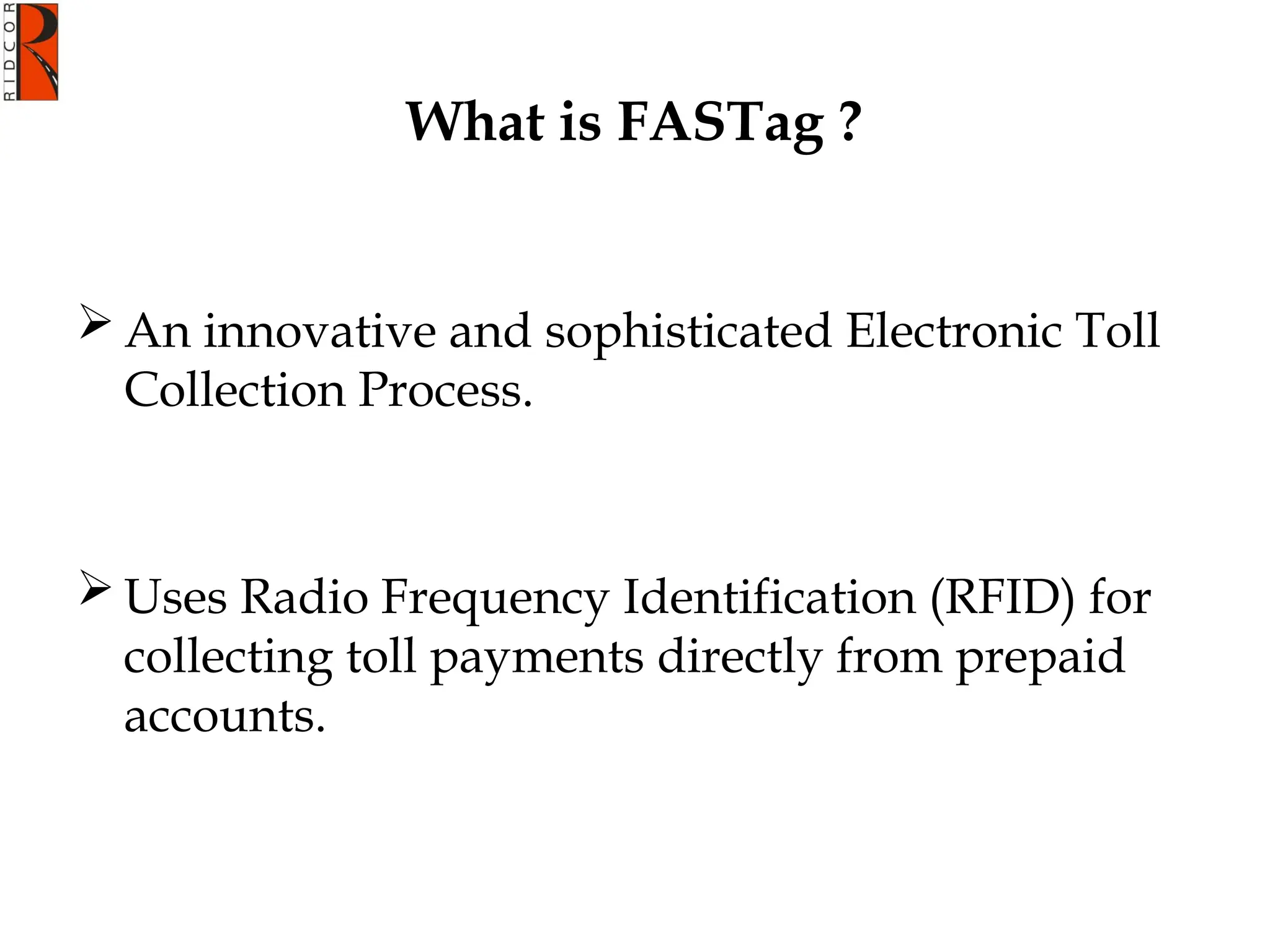
What is FASTag ?
 An innovative and sophisticated Electronic Toll
Collection Process.
 Uses Radio Frequency Identification (RFID) for
collecting toll payments directly from prepaid
accounts.
WHY FASTag
A. REGULATORY REQUIREMENTS
 FASTag made mandatory by NHAI and MoRTH in Feb 2021; 80% vehicles already
mapped.
 No third party vehicle insurance from 1st
April, 2021 in absence of FASTag.
 Budget announcement of the State Govt. for FASTag implementation on state roads in
the year 2023-24.
 Incentive for promoting digital payment by the Central Govt.: Maximum 20 Lakhs per
toll plaza for 2 lanes (for infrastructure development).
WHY FASTag
B. BENEFITS
Authority
 The collected revenue shall be verifiable / auditable.
 Reduces the dependency of Authority on Toll Collection Agencies.
 Cash handling at Toll lanes will be minimized.
 Increase the Vehicle processing capacity per lane.
 Central Real Time Monitoring of Toll Operations.
Road User
 Human Intervention in Vehicle Classification will be reduced
 Lesser wait time
 Ease of payment - No need to carry cash for the toll transactions saves time.
Socio-economic
 Non-stop movement of vehicles leading to lower fuel cost.
 Environmental benefit i.e. reduced air pollution and less use of paper
 Social benefit like no human intervention required and less time in transactions
 Mode of Payment is only cash; existing TMS software not
compatible with Digital Payment.
 Toll Plazas running on Stand alone mode.
 No Centralized Database; consolidate revenue report not
available.
 Dependency on third party for auditing of data through Video
Count Survey whenever required. Thus not very reliable.
LIMITATIONS WITH TRADITIONAL TOLLING SYSTEM
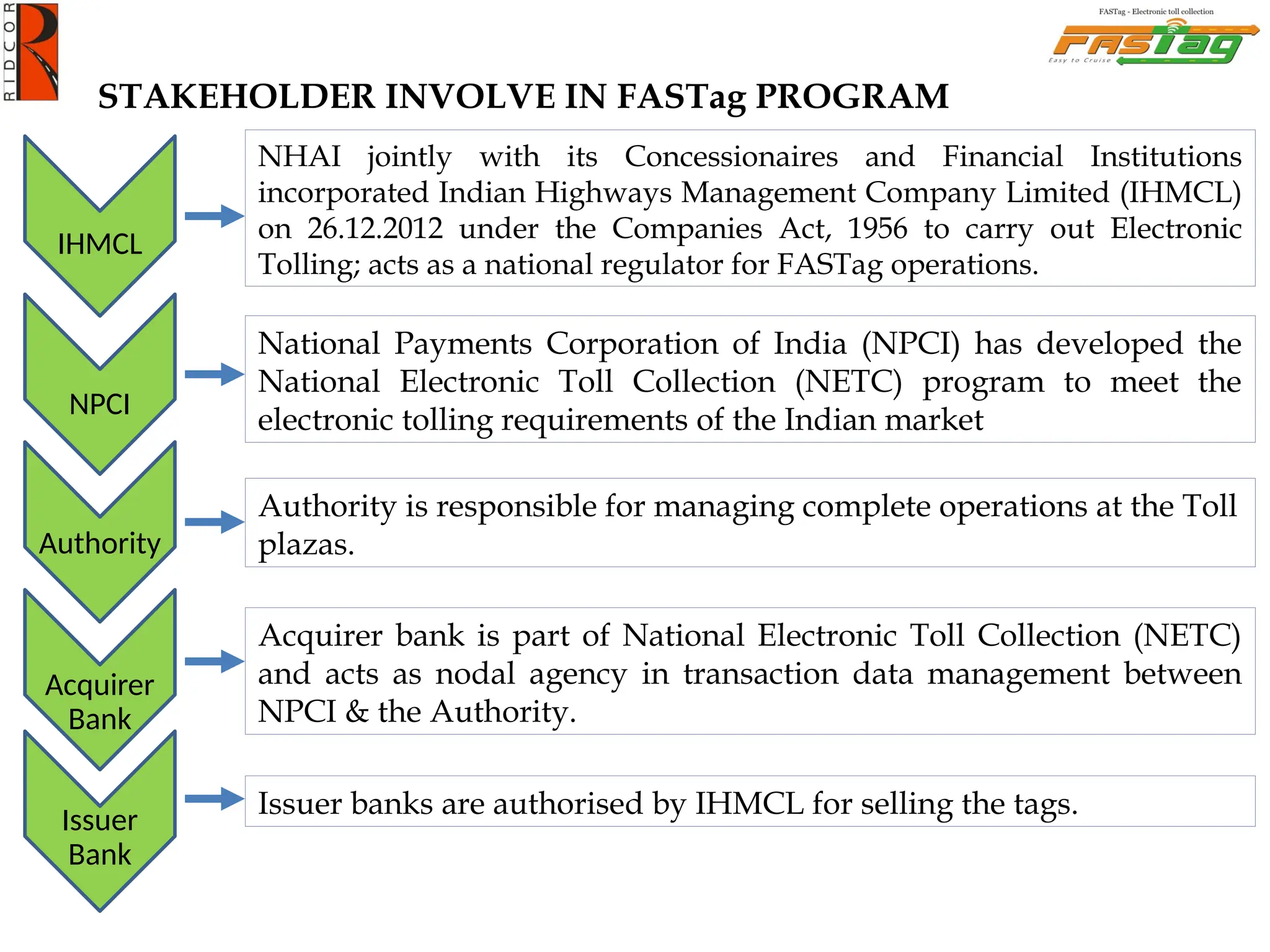
IHMCL
NPCI
Acquirer
Bank
Issuer
Bank
National Payments Corporation of India (NPCI) has developed the
National Electronic Toll Collection (NETC) program to meet the
electronic tolling requirements of the Indian market
Authority
NHAI jointly with its Concessionaires and Financial Institutions
incorporated Indian Highways Management Company Limited (IHMCL)
on 26.12.2012 under the Companies Act, 1956 to carry out Electronic
Tolling; acts as a national regulator for FASTag operations.
Authority is responsible for managing complete operations at the Toll
plazas.
Acquirer bank is part of National Electronic Toll Collection (NETC)
and acts as nodal agency in transaction data management between
NPCI & the Authority.
Issuer banks are authorised by IHMCL for selling the tags.
STAKEHOLDER INVOLVE IN FASTag PROGRAM
IMPLEMENTATION AT DIFFERENT LEVELS
Toll Plaza - Lane Level
Toll Plaza – Backoffice Level
HO Level - Headquarter Monitoring System (HQMS)
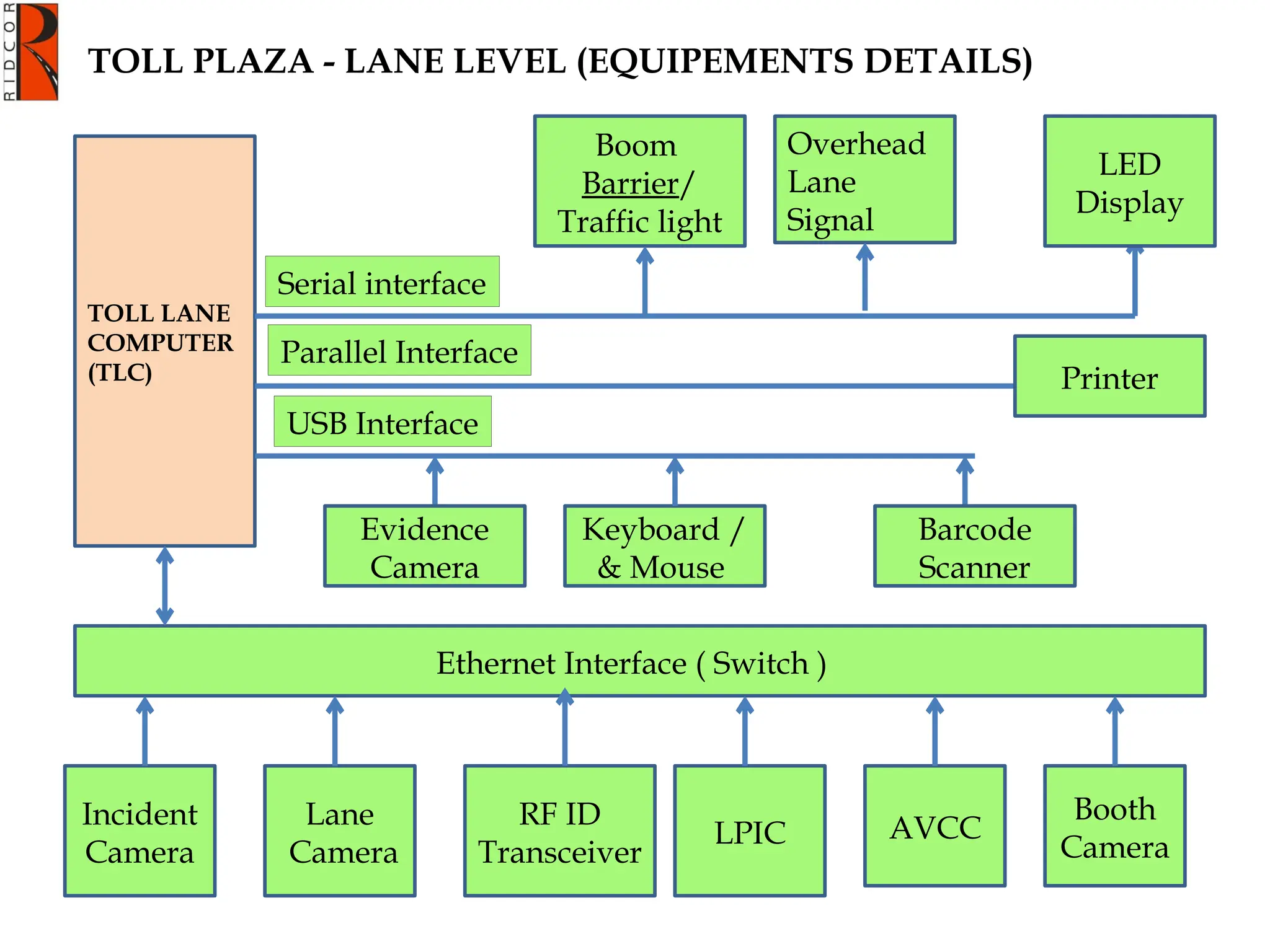
TOLL PLAZA - LANE LEVEL (EQUIPEMENTS DETAILS)
Ethernet Interface ( Switch )
TOLL LANE
COMPUTER
(TLC)
AVCC
LPIC
RF ID
Transceiver
Lane
Camera
Incident
Camera
Boom
Barrier/
Traffic light
Serial interface
Parallel Interface
USB Interface
Barcode
Scanner
Printer
LED
Display
Keyboard /
& Mouse
Overhead
Lane
Signal
Booth
Camera
Evidence
Camera
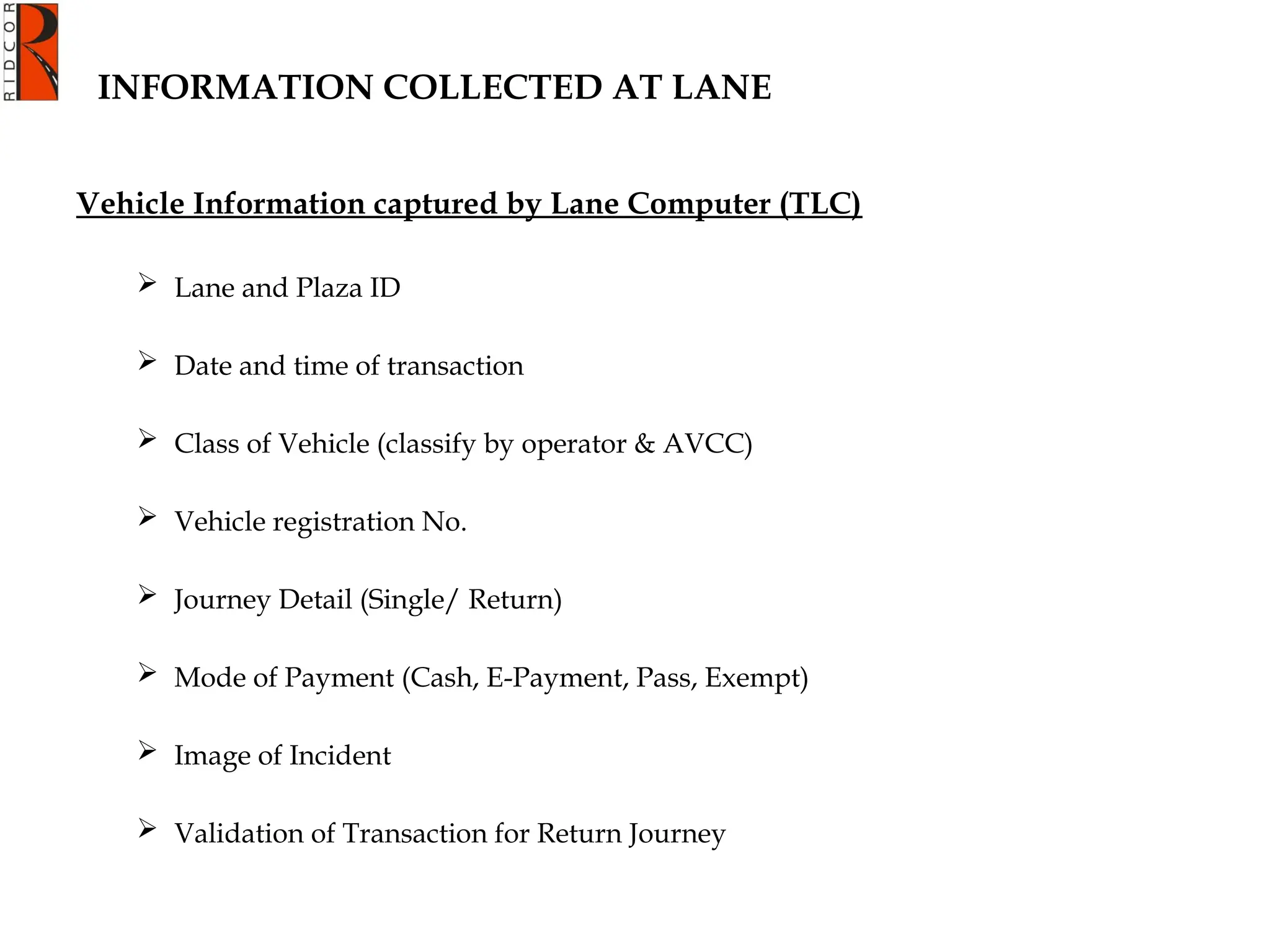
INFORMATION COLLECTED AT LANE
Vehicle Information captured by Lane Computer (TLC)
 Lane and Plaza ID
 Date and time of transaction
 Class of Vehicle (classify by operator & AVCC)
 Vehicle registration No.
 Journey Detail (Single/ Return)
 Mode of Payment (Cash, E-Payment, Pass, Exempt)
 Image of Incident
 Validation of Transaction for Return Journey
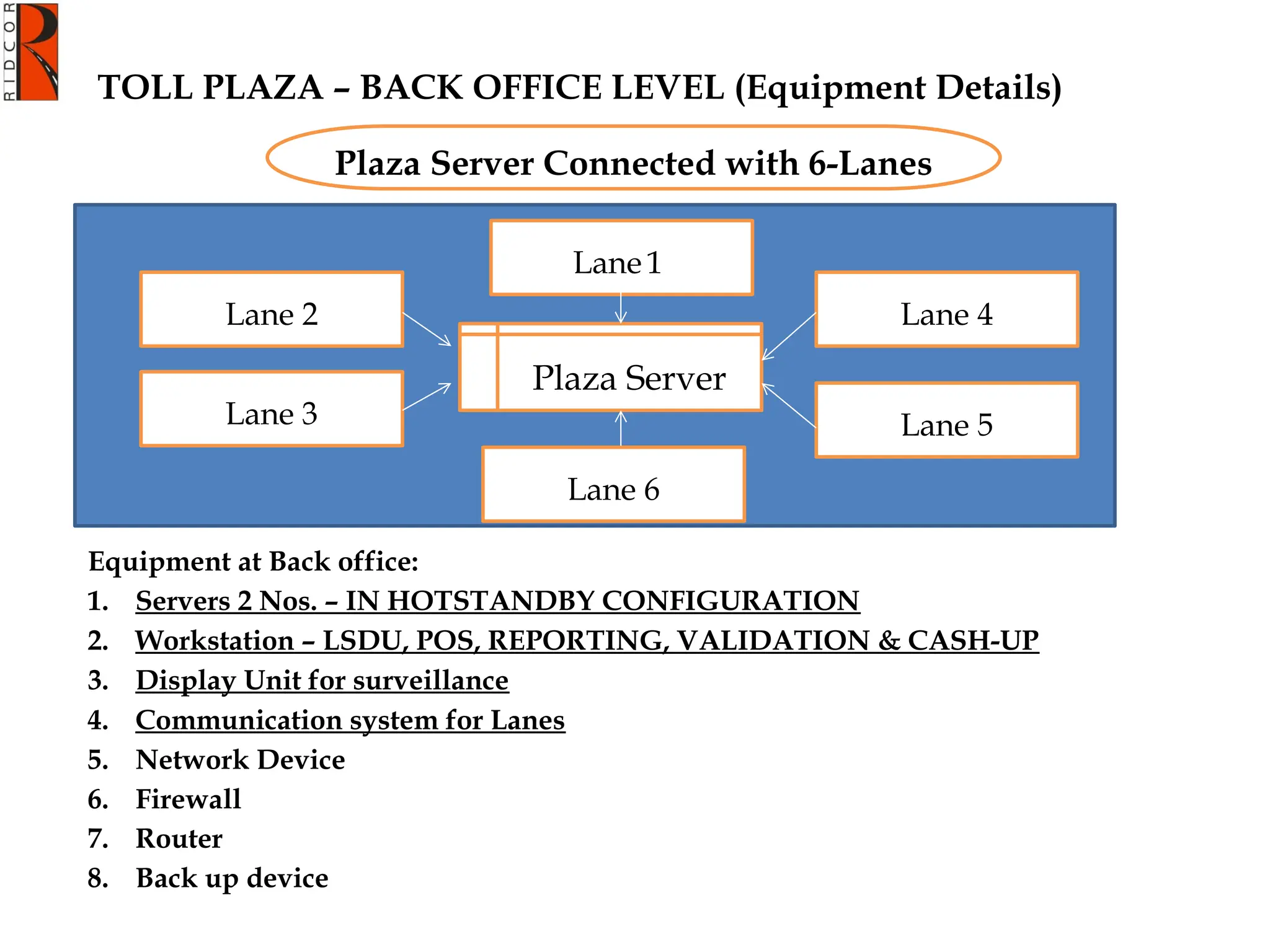
TOLL PLAZA – BACK OFFICE LEVEL (Equipment Details)
Equipment at Back office:
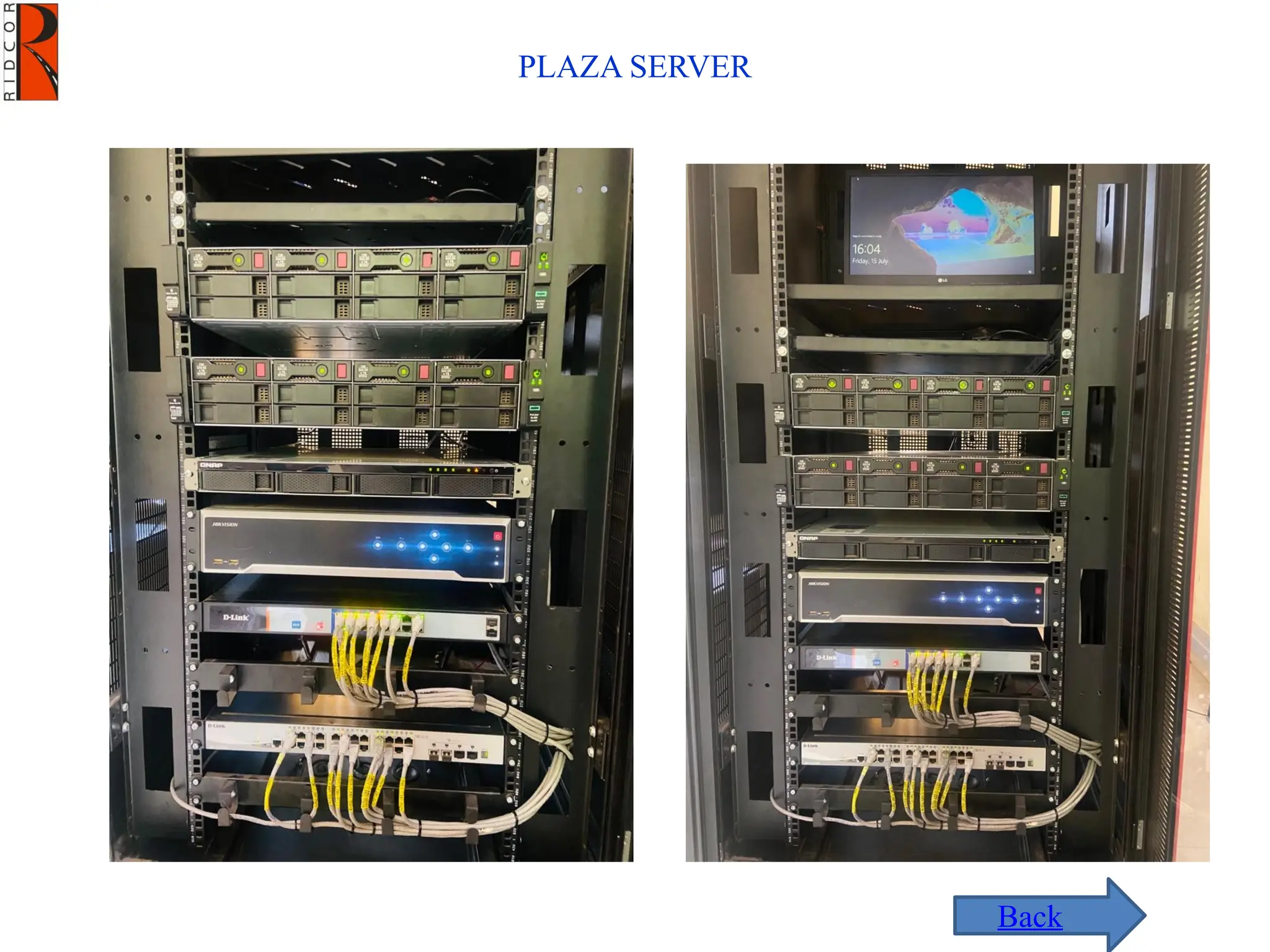
1. Servers 2 Nos. – IN HOTSTANDBY CONFIGURATION
2. Workstation – LSDU, POS, REPORTING, VALIDATION & CASH-UP
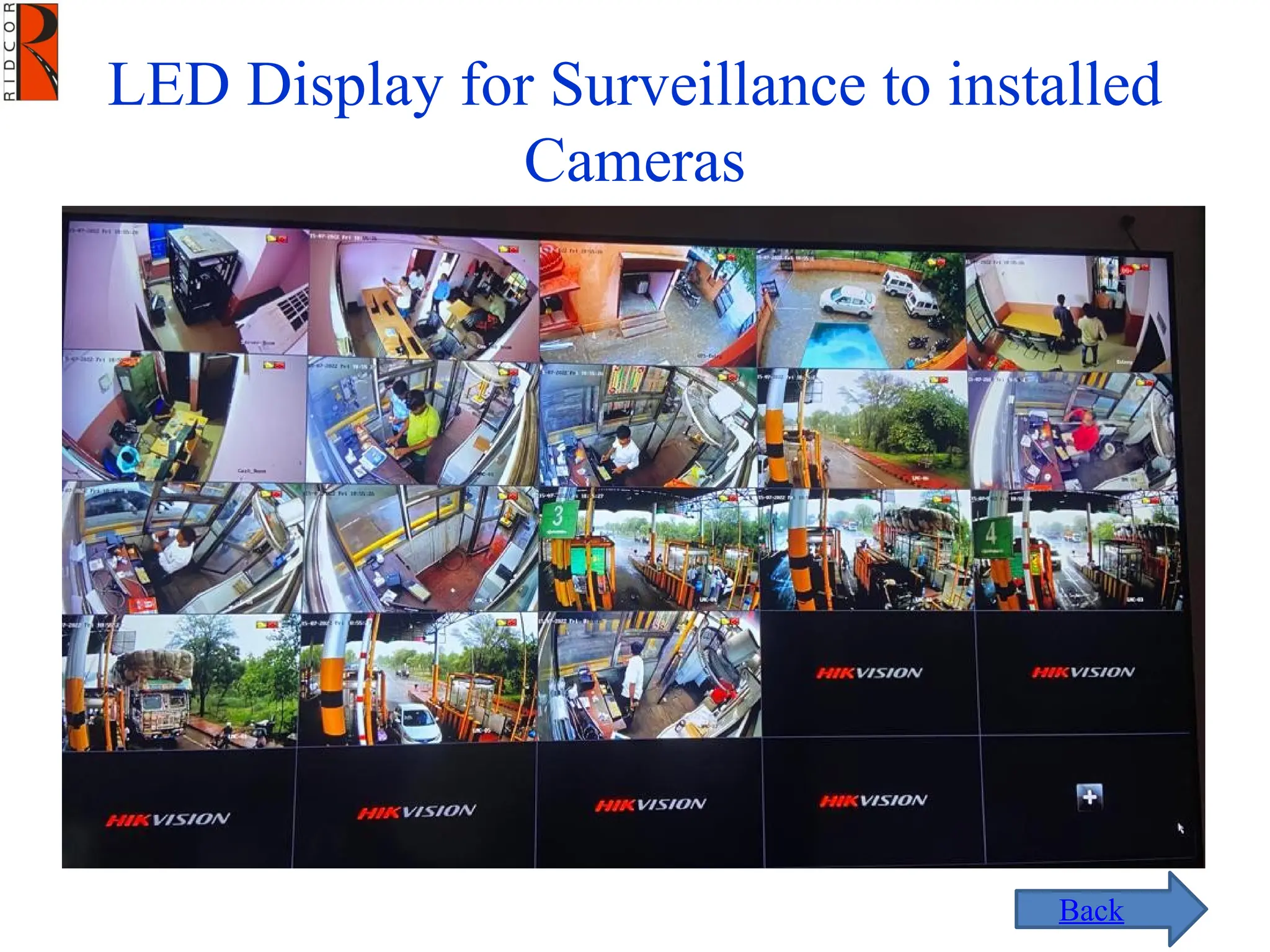
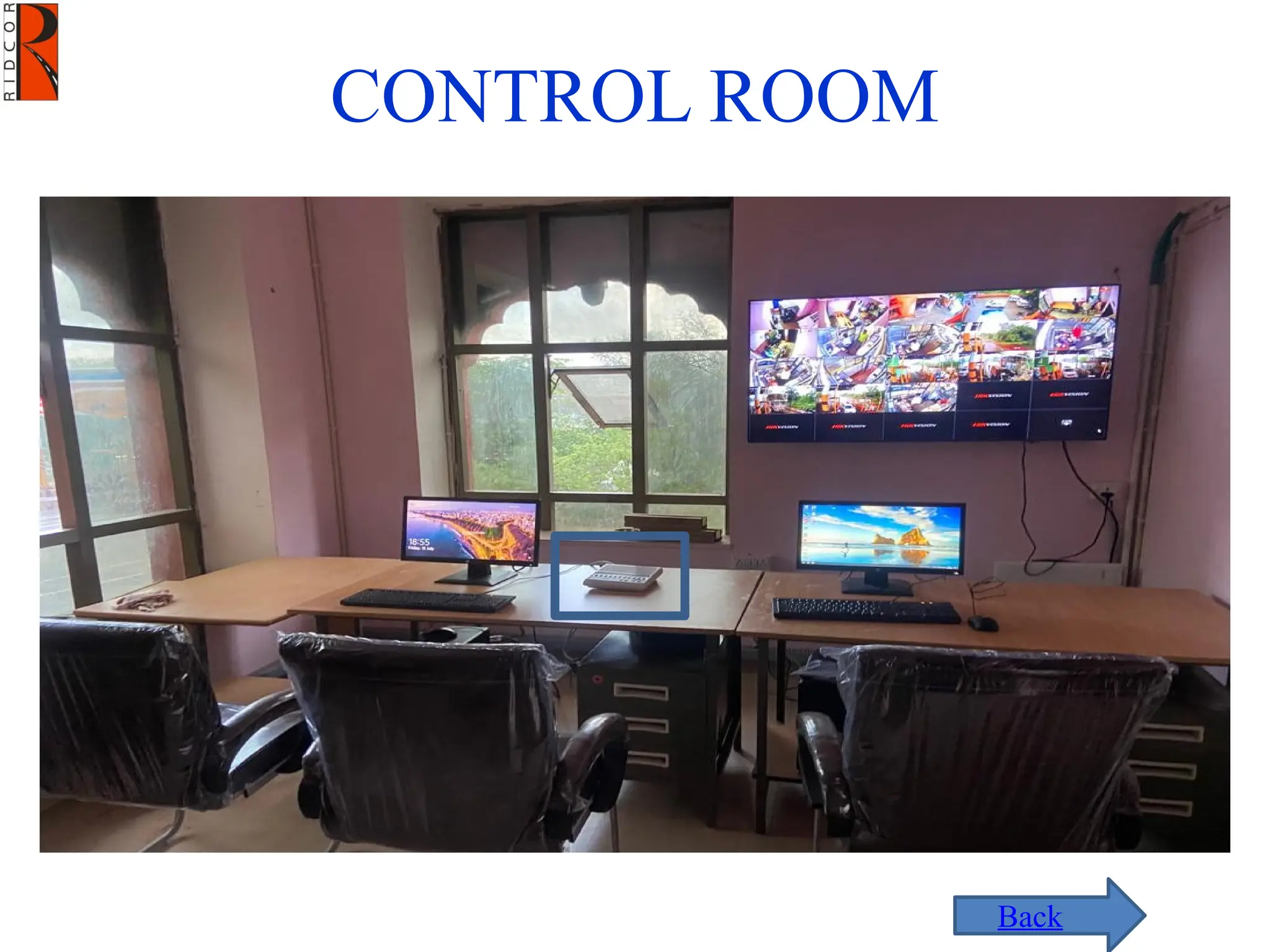
3. Display Unit for surveillance
4. Communication system for Lanes
5. Network Device
6. Firewall
7. Router
8. Back up device
Lane 1
Lane 2
Lane 3
Lane 6
Lane 5
Lane 4
Plaza Server
Plaza Server Connected with 6-Lanes
TOLL PLAZA – BACK OFFICE LEVEL (FLOW CHART)
 Toll Plaza Server : Controls all TMS activities & records all
transactions happening at the lanes. FASTag transaction
monitoring and reconciliation.
 Lane status display Unit : Real Time Lane Updates
 Point of Sale: For recharges of tags
 Reporting Terminal: Reporting
 Validation Terminal: Data Validation & Control
 Cash up/Cashier Terminal: Declaration and verification of
collected versus collectable cash
 Back Up Device: Back up services
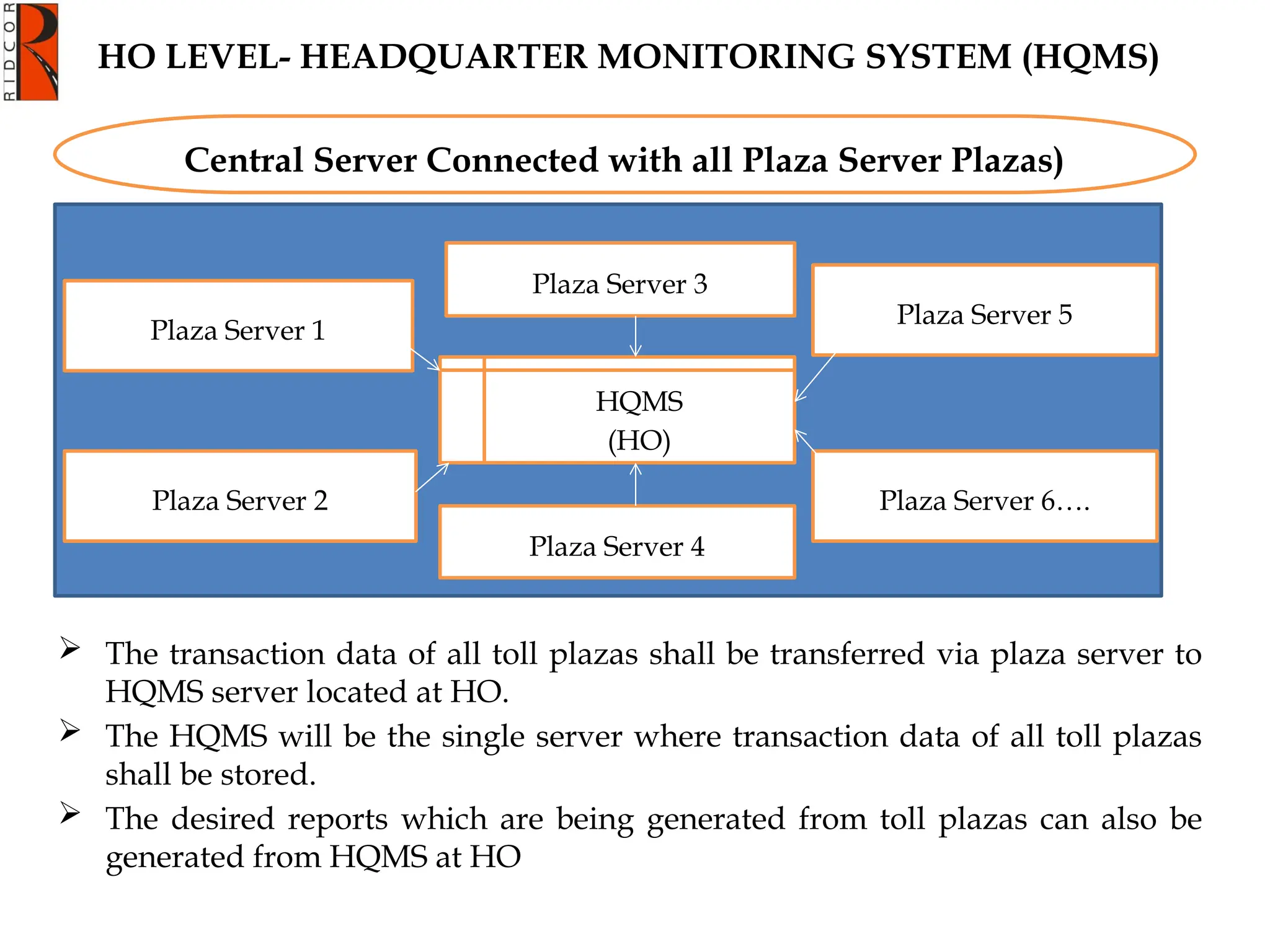
HO LEVEL- HEADQUARTER MONITORING SYSTEM (HQMS)
 The transaction data of all toll plazas shall be transferred via plaza server to
HQMS server located at HO.
 The HQMS will be the single server where transaction data of all toll plazas
shall be stored.
 The desired reports which are being generated from toll plazas can also be
generated from HQMS at HO
Plaza Server 3
Plaza Server 1
Plaza Server 2
Plaza Server 4
Plaza Server 6….
Plaza Server 5
HQMS
(HO)
Central Server Connected with all Plaza Server Plazas)
HYBRID ETC SYSTEM UP-GRADATION
REQUIREMENT
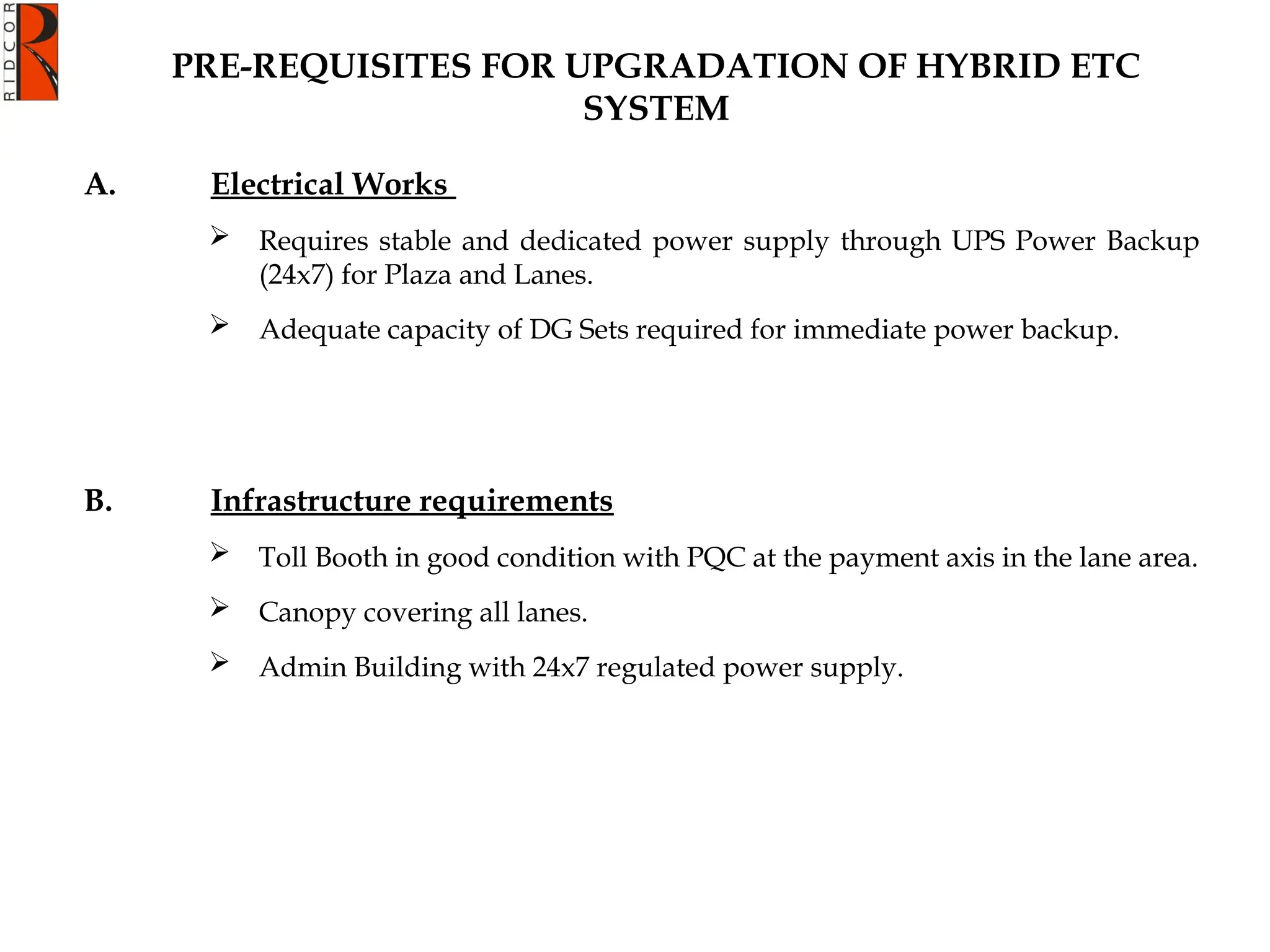
A. Electrical Works
 Requires stable and dedicated power supply through UPS Power Backup
(24x7) for Plaza and Lanes.
 Adequate capacity of DG Sets required for immediate power backup.
B. Infrastructure requirements
 Toll Booth in good condition with PQC at the payment axis in the lane area.
 Canopy covering all lanes.
 Admin Building with 24x7 regulated power supply.
PRE-REQUISITES FOR UPGRADATION OF HYBRID ETC
SYSTEM
A. SOFTWARE
 Operating Software – Latest Version
 TMS Software – New/Upgraded Ver. with FASTag integration at Lane and Plaza
level
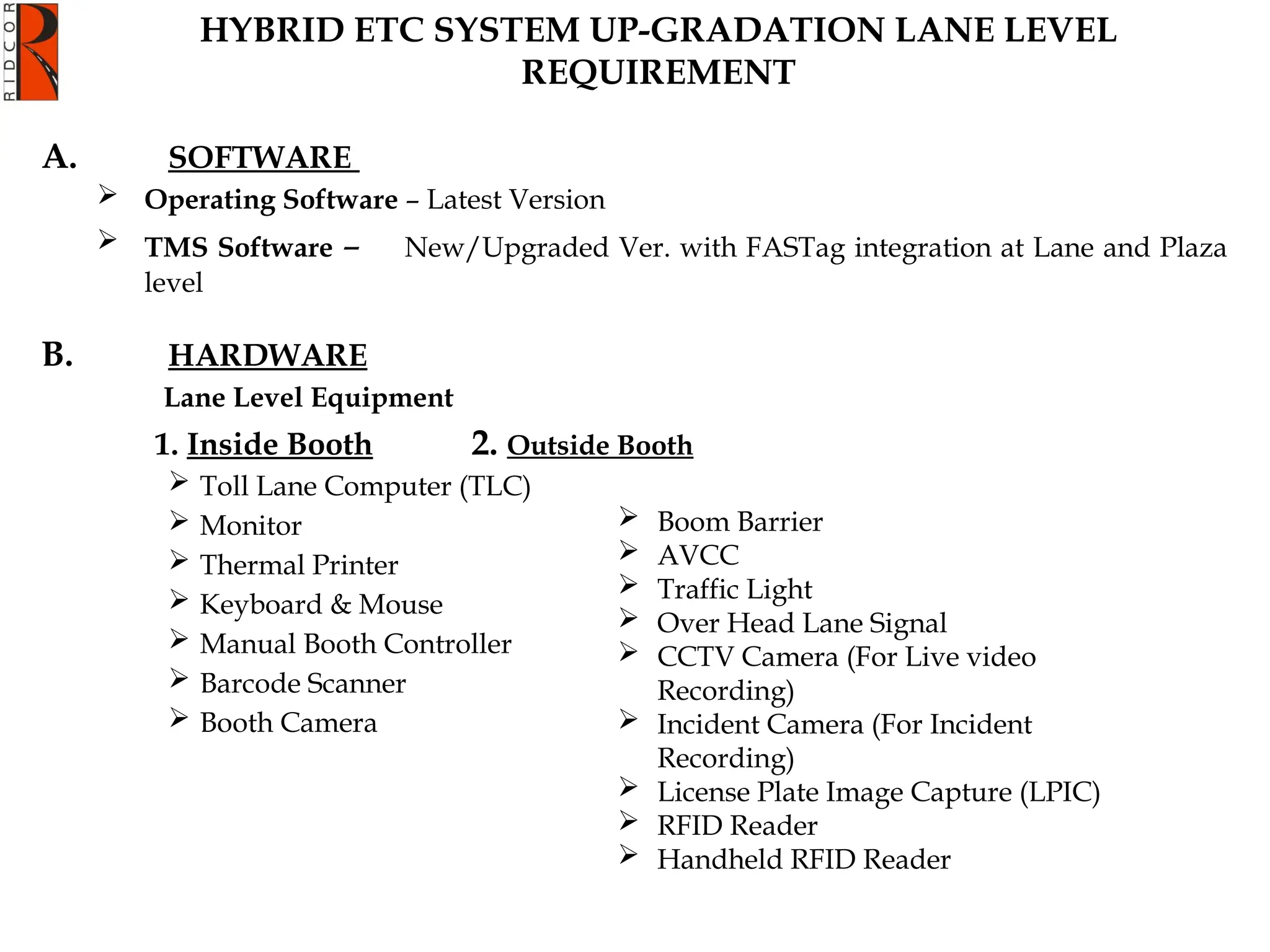
B. HARDWARE
Lane Level Equipment
1. Inside Booth 2. Outside Booth
 Toll Lane Computer (TLC)
 Monitor
 Thermal Printer
 Keyboard & Mouse
 Manual Booth Controller
 Barcode Scanner
 Booth Camera
HYBRID ETC SYSTEM UP-GRADATION LANE LEVEL
REQUIREMENT
 Boom Barrier
 AVCC
 Traffic Light
 Over Head Lane Signal
 CCTV Camera (For Live video
Recording)
 Incident Camera (For Incident
Recording)
 License Plate Image Capture (LPIC)
 RFID Reader
 Handheld RFID Reader
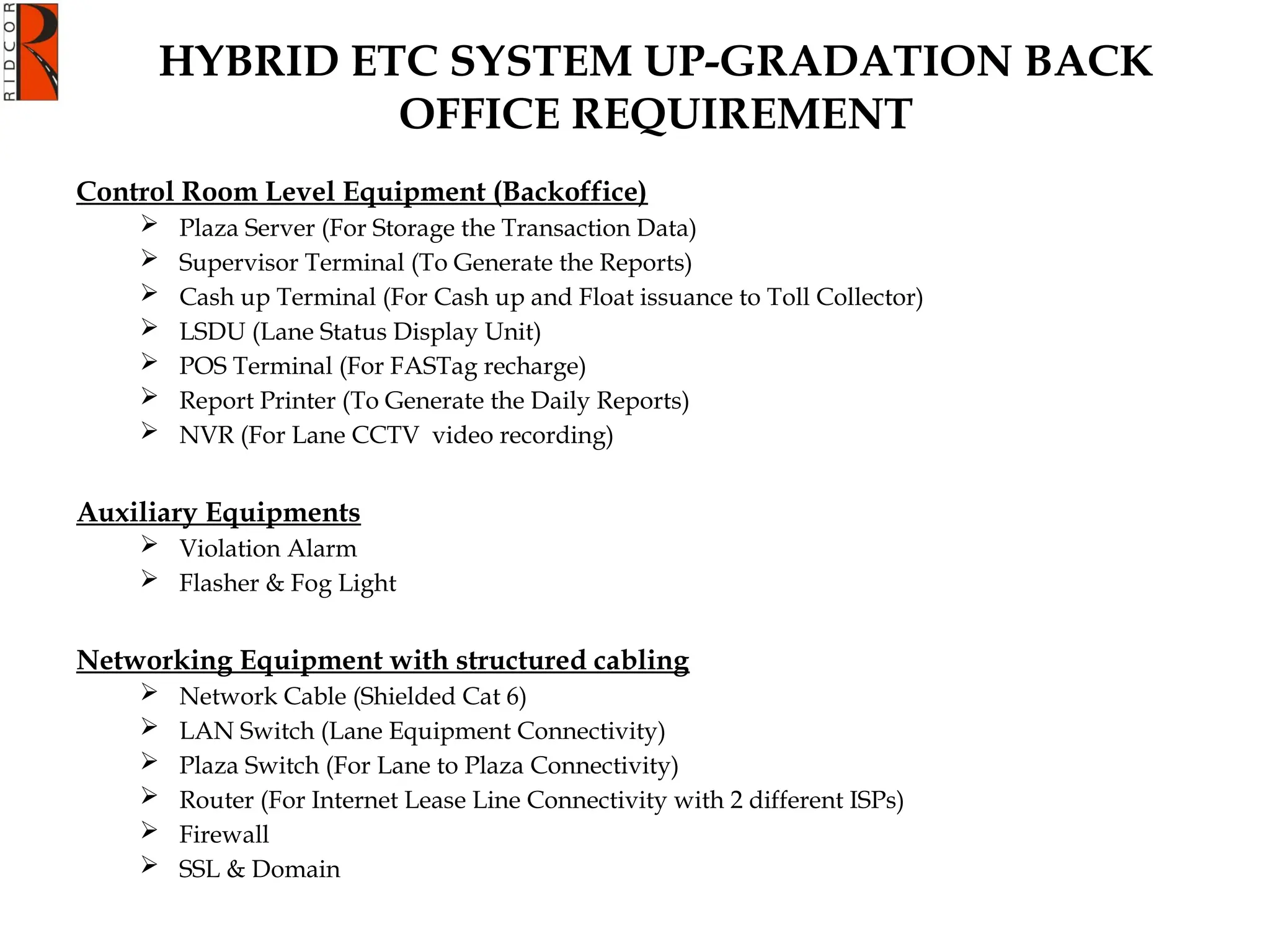
Control Room Level Equipment (Backoffice)
 Plaza Server (For Storage the Transaction Data)
 Supervisor Terminal (To Generate the Reports)
 Cash up Terminal (For Cash up and Float issuance to Toll Collector)
 LSDU (Lane Status Display Unit)
 POS Terminal (For FASTag recharge)
 Report Printer (To Generate the Daily Reports)
 NVR (For Lane CCTV video recording)
Auxiliary Equipments
 Violation Alarm
 Flasher & Fog Light
Networking Equipment with structured cabling
 Network Cable (Shielded Cat 6)
 LAN Switch (Lane Equipment Connectivity)
 Plaza Switch (For Lane to Plaza Connectivity)
 Router (For Internet Lease Line Connectivity with 2 different ISPs)
 Firewall
 SSL & Domain
HYBRID ETC SYSTEM UP-GRADATION BACK
OFFICE REQUIREMENT
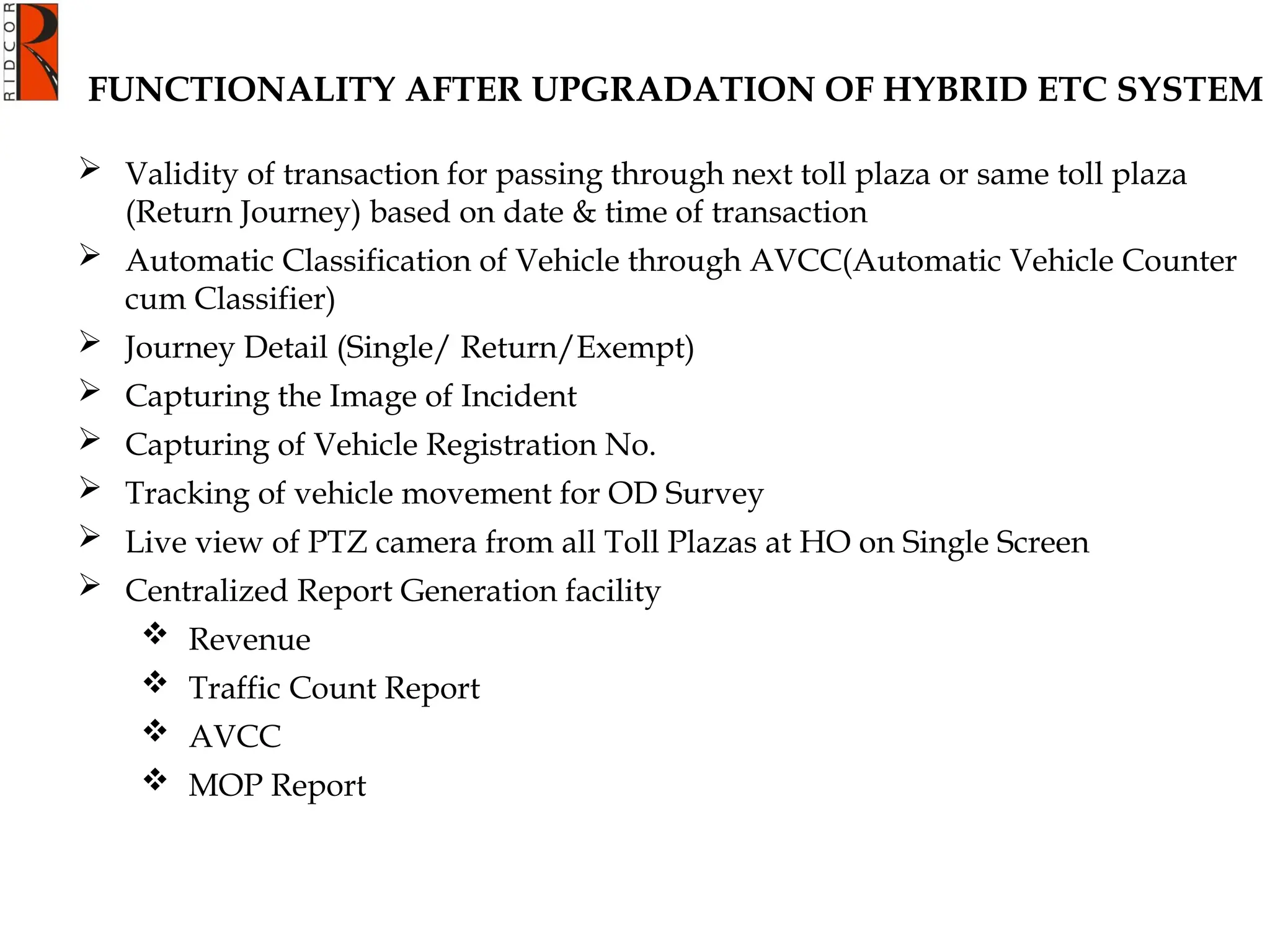
FUNCTIONALITY AFTER UPGRADATION OF HYBRID ETC SYSTEM
 Validity of transaction for passing through next toll plaza or same toll plaza
(Return Journey) based on date & time of transaction
 Automatic Classification of Vehicle through AVCC(Automatic Vehicle Counter
cum Classifier)
 Journey Detail (Single/ Return/Exempt)
 Capturing the Image of Incident
 Capturing of Vehicle Registration No.
 Tracking of vehicle movement for OD Survey
 Live view of PTZ camera from all Toll Plazas at HO on Single Screen
 Centralized Report Generation facility
 Revenue
 Traffic Count Report
 AVCC
 MOP Report
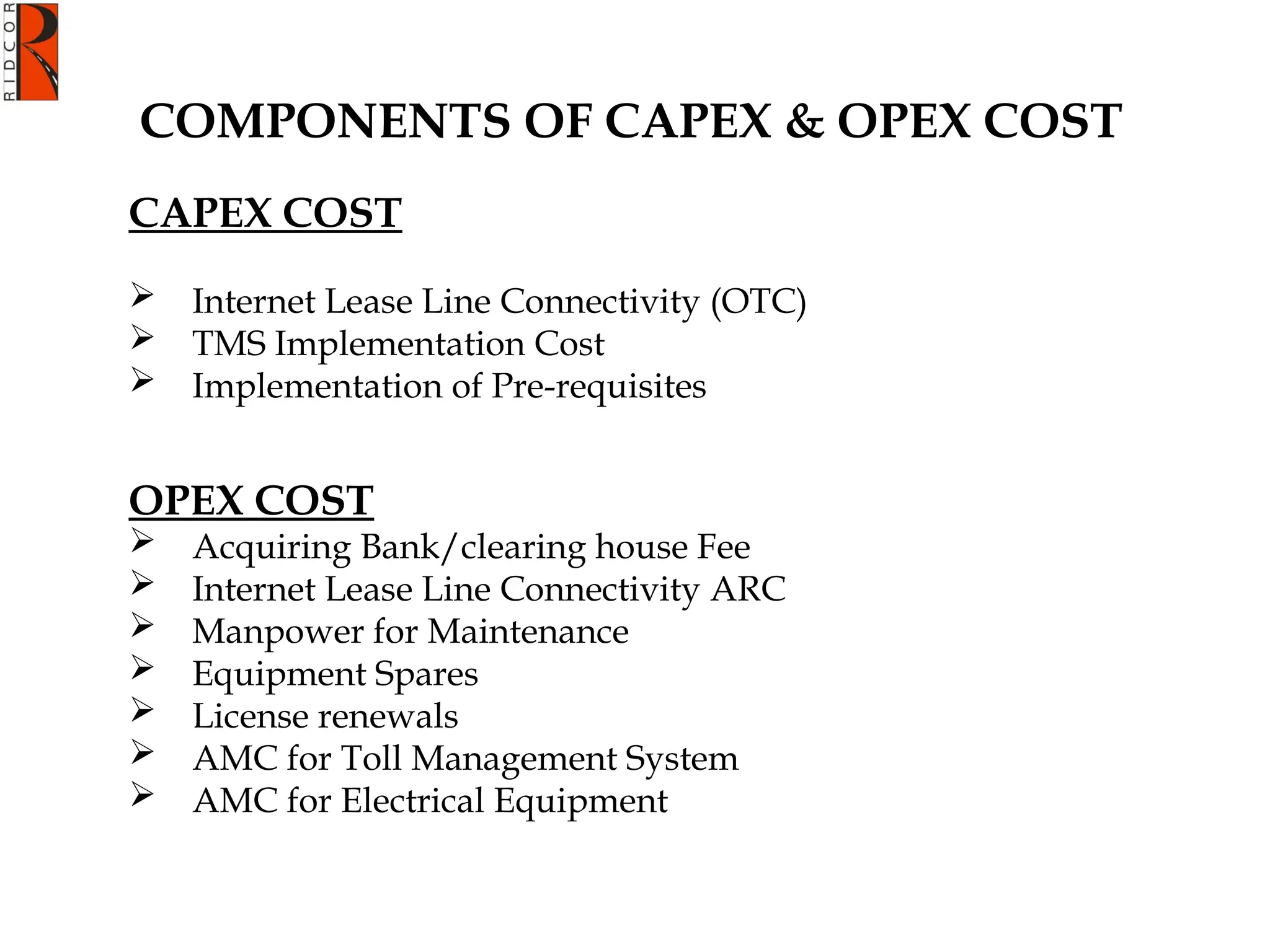
COMPONENTS OF CAPEX & OPEX COST
CAPEX COST
 Internet Lease Line Connectivity (OTC)
 TMS Implementation Cost
 Implementation of Pre-requisites
OPEX COST
 Acquiring Bank/clearing house Fee
 Internet Lease Line Connectivity ARC
 Manpower for Maintenance
 Equipment Spares
 License renewals
 AMC for Toll Management System
 AMC for Electrical Equipment
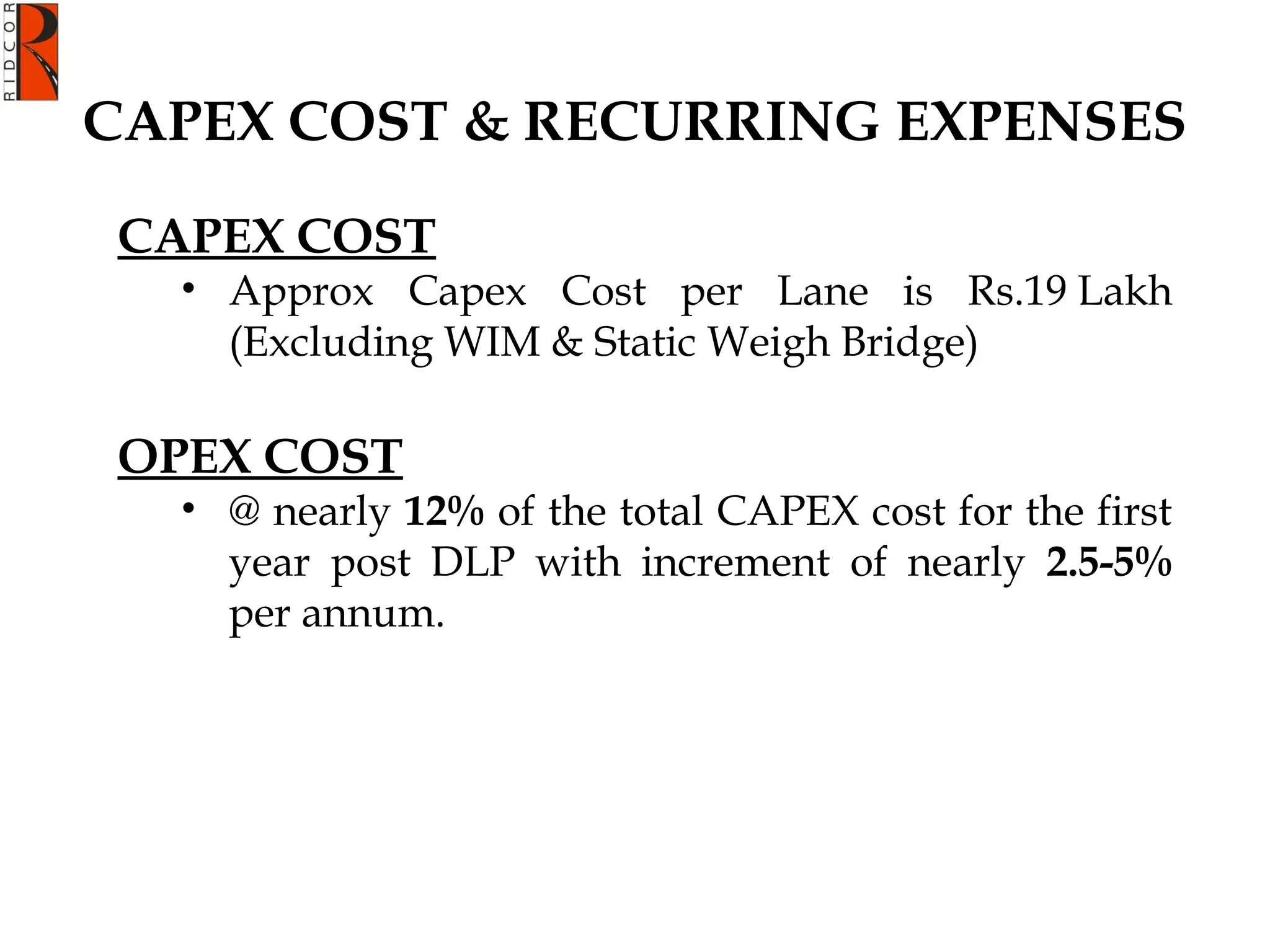
CAPEX COST & RECURRING EXPENSES
CAPEX COST
• Approx Capex Cost per Lane is Rs.19 Lakh
(Excluding WIM & Static Weigh Bridge)
OPEX COST
• @ nearly 12% of the total CAPEX cost for the first
year post DLP with increment of nearly 2.5-5%
per annum.
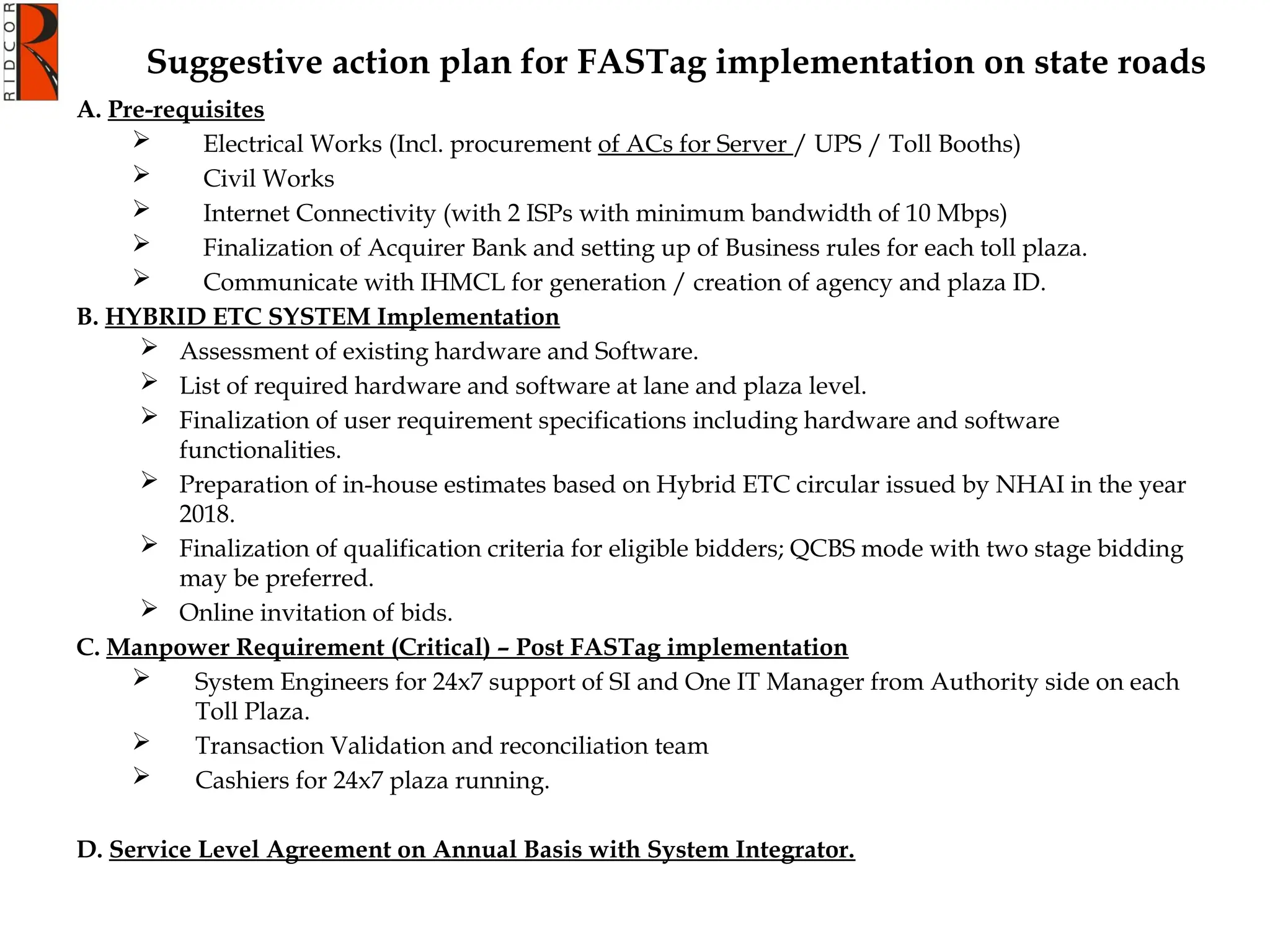
Suggestive action plan for FASTag implementation on state roads
A. Pre-requisites
 Electrical Works (Incl. procurement of ACs for Server / UPS / Toll Booths)
 Civil Works
 Internet Connectivity (with 2 ISPs with minimum bandwidth of 10 Mbps)
 Finalization of Acquirer Bank and setting up of Business rules for each toll plaza.
 Communicate with IHMCL for generation / creation of agency and plaza ID.
B. HYBRID ETC SYSTEM Implementation
 Assessment of existing hardware and Software.
 List of required hardware and software at lane and plaza level.
 Finalization of user requirement specifications including hardware and software
functionalities.
 Preparation of in-house estimates based on Hybrid ETC circular issued by NHAI in the year
2018.
 Finalization of qualification criteria for eligible bidders; QCBS mode with two stage bidding
may be preferred.
 Online invitation of bids.
C. Manpower Requirement (Critical) – Post FASTag implementation
 System Engineers for 24x7 support of SI and One IT Manager from Authority side on each
Toll Plaza.
 Transaction Validation and reconciliation team
 Cashiers for 24x7 plaza running.
D. Service Level Agreement on Annual Basis with System Integrator.
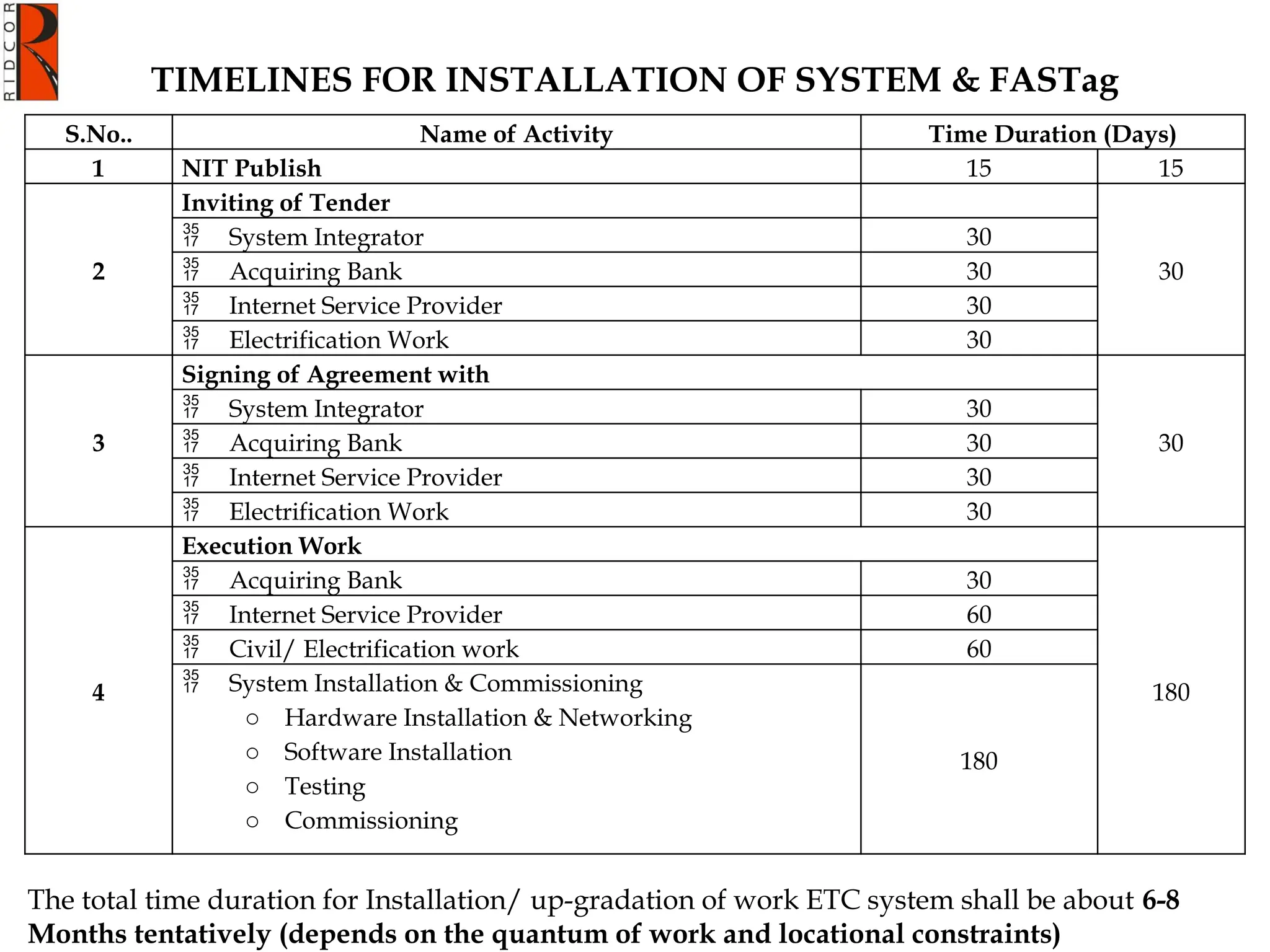
TIMELINES FOR INSTALLATION OF SYSTEM & FASTag
S.No.. Name of Activity Time Duration (Days)
1 NIT Publish 15 15
2
Inviting of Tender
30
 System Integrator 30
 Acquiring Bank 30
 Internet Service Provider 30
 Electrification Work 30
3
Signing of Agreement with
30
 System Integrator 30
 Acquiring Bank 30
 Internet Service Provider 30
 Electrification Work 30
4
Execution Work
180
 Acquiring Bank 30
 Internet Service Provider 60
 Civil/ Electrification work 60
 System Installation & Commissioning
o Hardware Installation & Networking
o Software Installation
o Testing
o Commissioning
180
The total time duration for Installation/ up-gradation of work ETC system shall be about 6-8
Months tentatively (depends on the quantum of work and locational constraints)
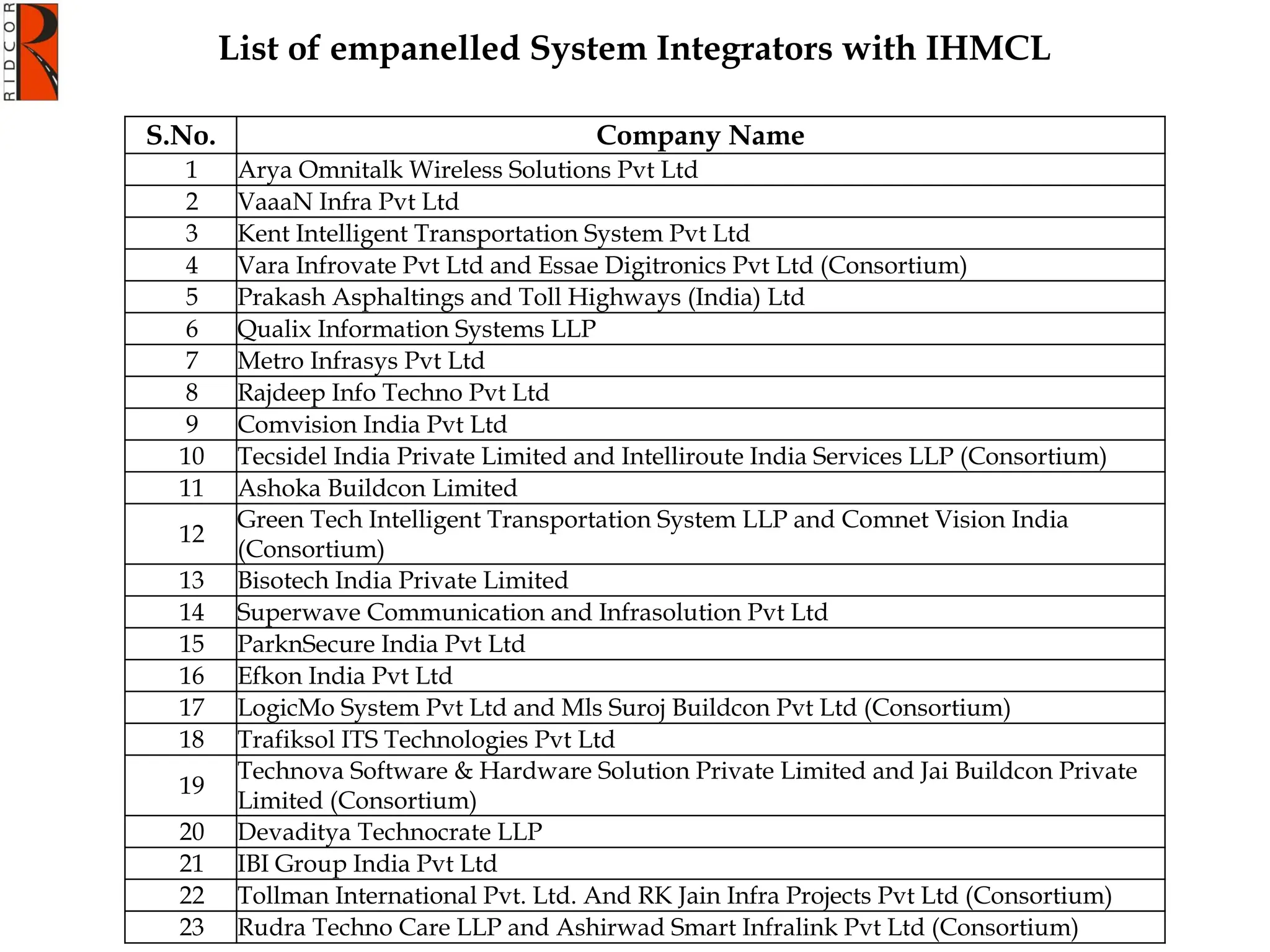
List of empanelled System Integrators with IHMCL
S.No. Company Name
1 Arya Omnitalk Wireless Solutions Pvt Ltd
2 VaaaN Infra Pvt Ltd
3 Kent Intelligent Transportation System Pvt Ltd
4 Vara Infrovate Pvt Ltd and Essae Digitronics Pvt Ltd (Consortium)
5 Prakash Asphaltings and Toll Highways (India) Ltd
6 Qualix Information Systems LLP
7 Metro Infrasys Pvt Ltd
8 Rajdeep Info Techno Pvt Ltd
9 Comvision India Pvt Ltd
10 Tecsidel India Private Limited and Intelliroute India Services LLP (Consortium)
11 Ashoka Buildcon Limited
12
Green Tech Intelligent Transportation System LLP and Comnet Vision India
(Consortium)
13 Bisotech India Private Limited
14 Superwave Communication and Infrasolution Pvt Ltd
15 ParknSecure India Pvt Ltd
16 Efkon India Pvt Ltd
17 LogicMo System Pvt Ltd and Mls Suroj Buildcon Pvt Ltd (Consortium)
18 Trafiksol ITS Technologies Pvt Ltd
19
Technova Software & Hardware Solution Private Limited and Jai Buildcon Private
Limited (Consortium)
20 Devaditya Technocrate LLP
21 IBI Group India Pvt Ltd
22 Tollman International Pvt. Ltd. And RK Jain Infra Projects Pvt Ltd (Consortium)
23 Rudra Techno Care LLP and Ashirwad Smart Infralink Pvt Ltd (Consortium)
THANK YOU
Some Illustrative Snaps of Hybrid
ETC Equipment
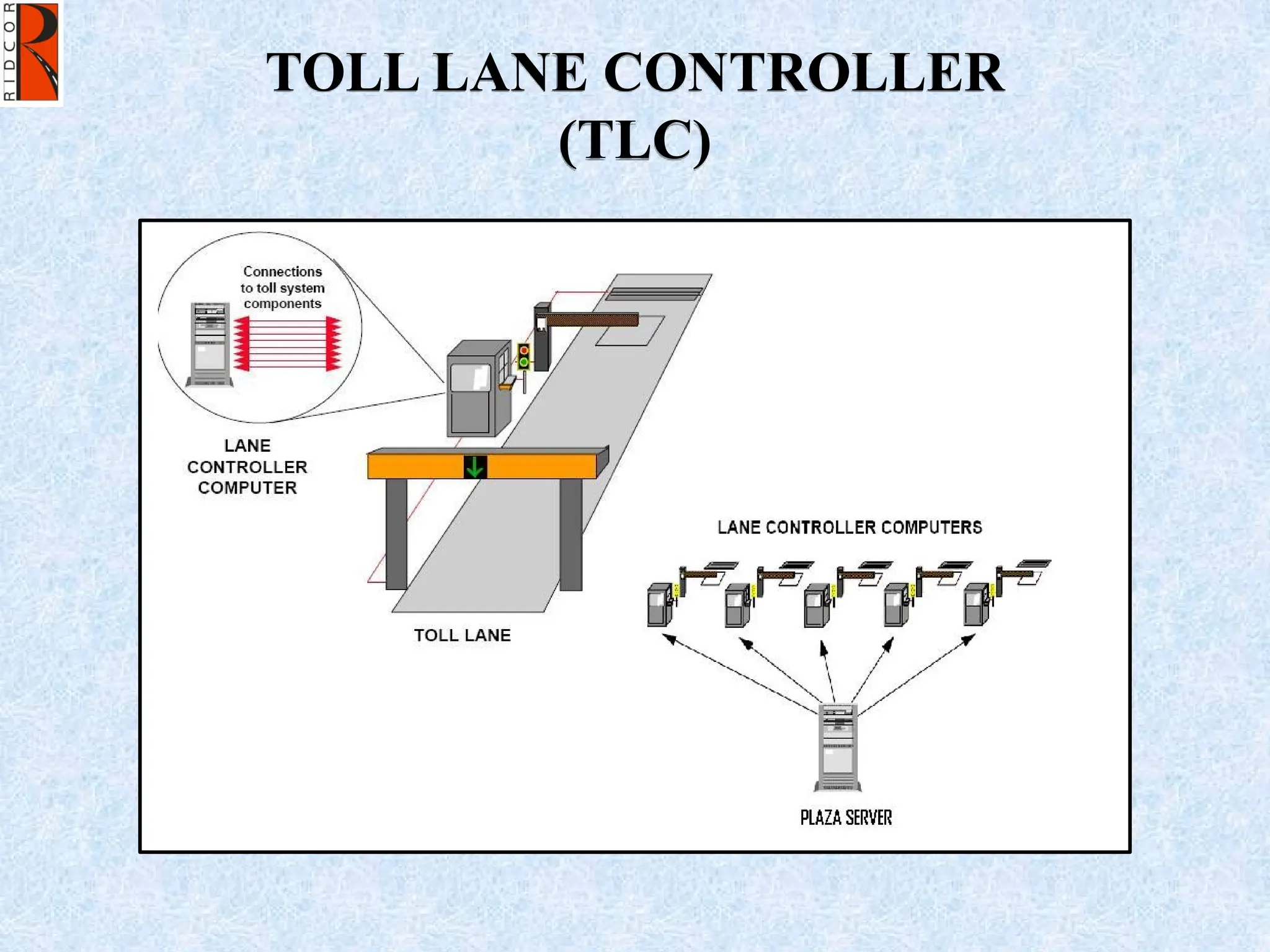
TOLL LANE CONTROLLER
(TLC)
1. The per lane cost RIDCOR & RSRDC is as below:
 RIDCOR :- Rs. 19.32 Lac per lane (Averaged based on 163 lanes)
 RSRDC : - Rs. 15.04 Lac per lane (Averaged based on 16 lanes)
2. The per lane cost of RIDCOR is higher side due to following items are additional to
BOQ of RSRDC- having additional cost implication of Rs. 4.54 lakh per lane:
• Centralized UPS (Only lane wise UPS provision in RSRDC BOQ)
• PTZ Camera
• ID Scanner Camera
• Additional Electrical works
• Handheld RFID Reader
• PMC & FAT (Project Management Cost)
• NAS (Network attached storage) for data backup
• Spares
• Fog Light
• Firewall
Cost Comparison of RIDCOR & RSRDC HES (Hybrid ETC System)
Back
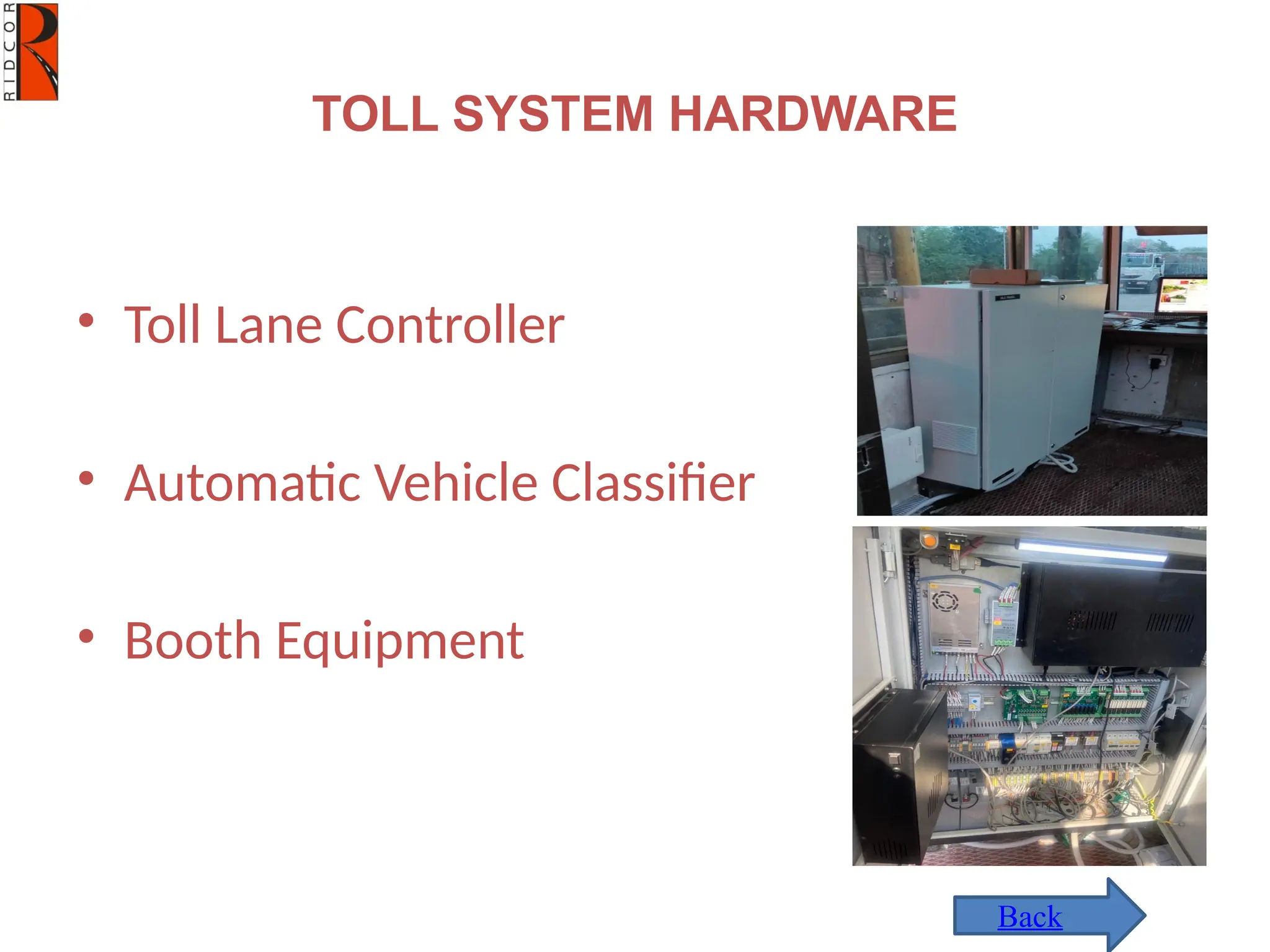
TOLL SYSTEM HARDWARE
• Toll Lane Controller
• Automatic Vehicle Classifier
• Booth Equipment
Back
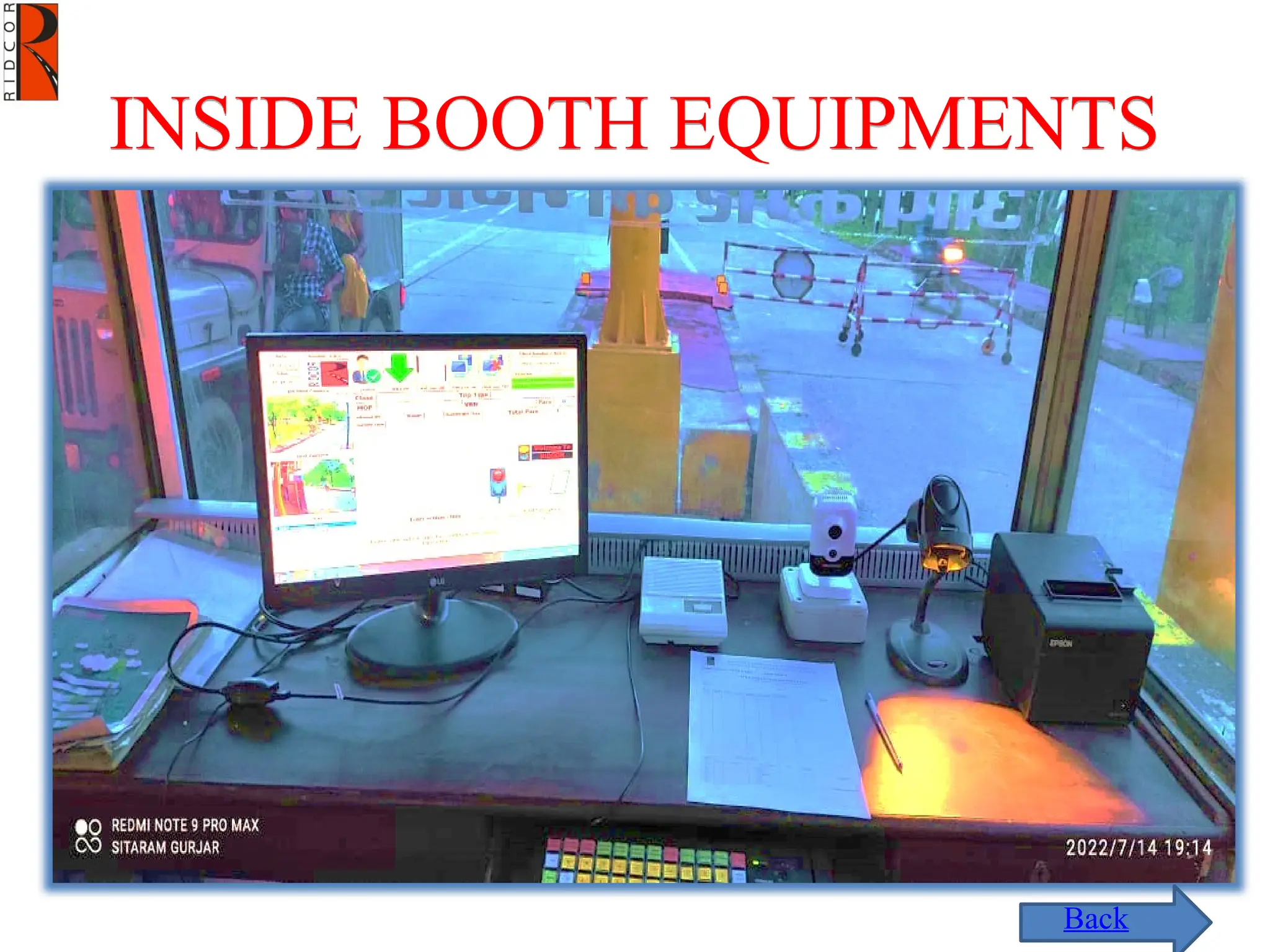
INSIDE BOOTH EQUIPMENTS
Toll Collector
Display Unit
Receipt Printer
Toll Collector
Terminal
Manual Booth
Controller
Back
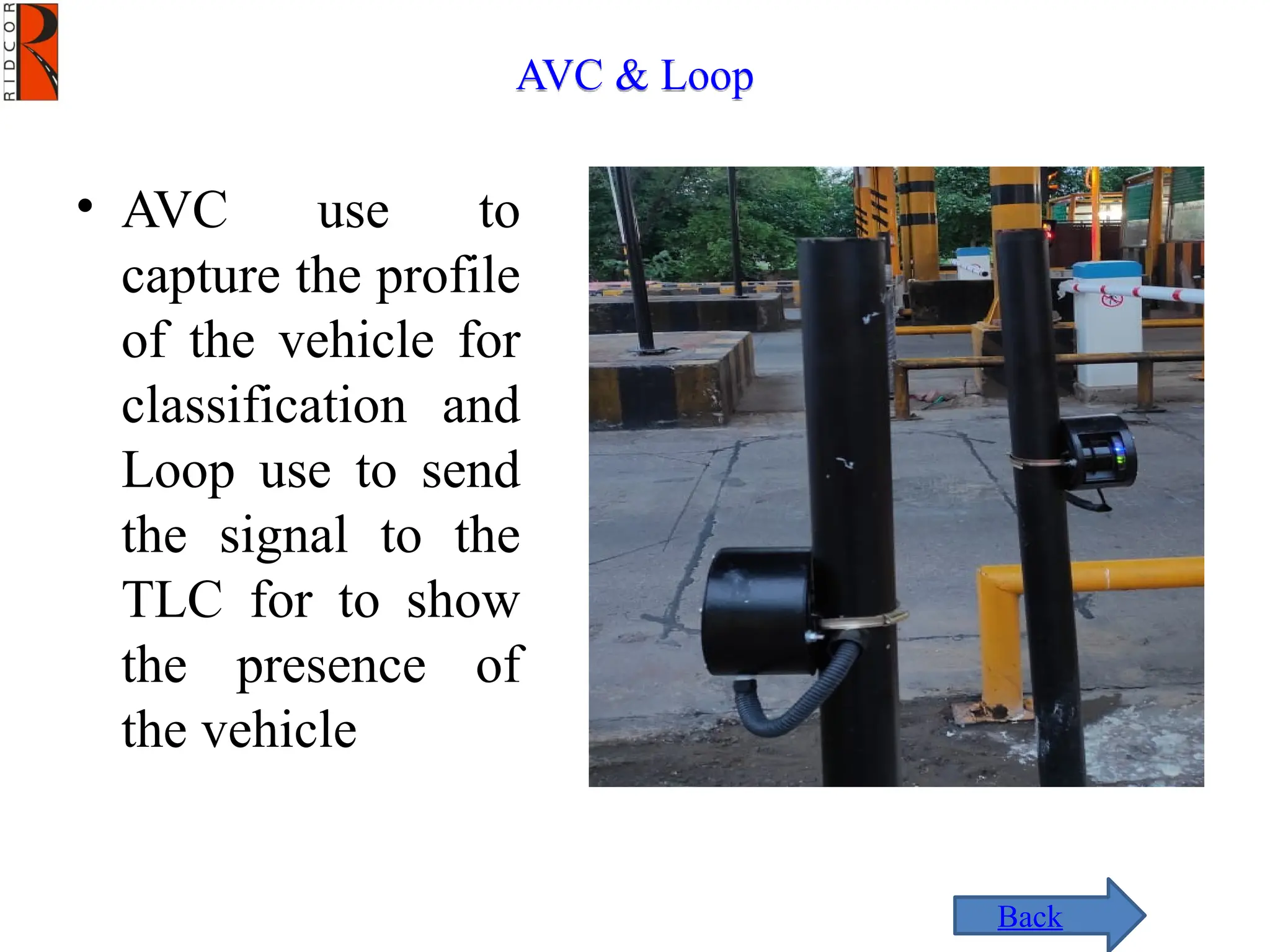
AVC & Loop
• AVC use to
capture the profile
of the vehicle for
classification and
Loop use to send
the signal to the
TLC for to show
the presence of
the vehicle
Back
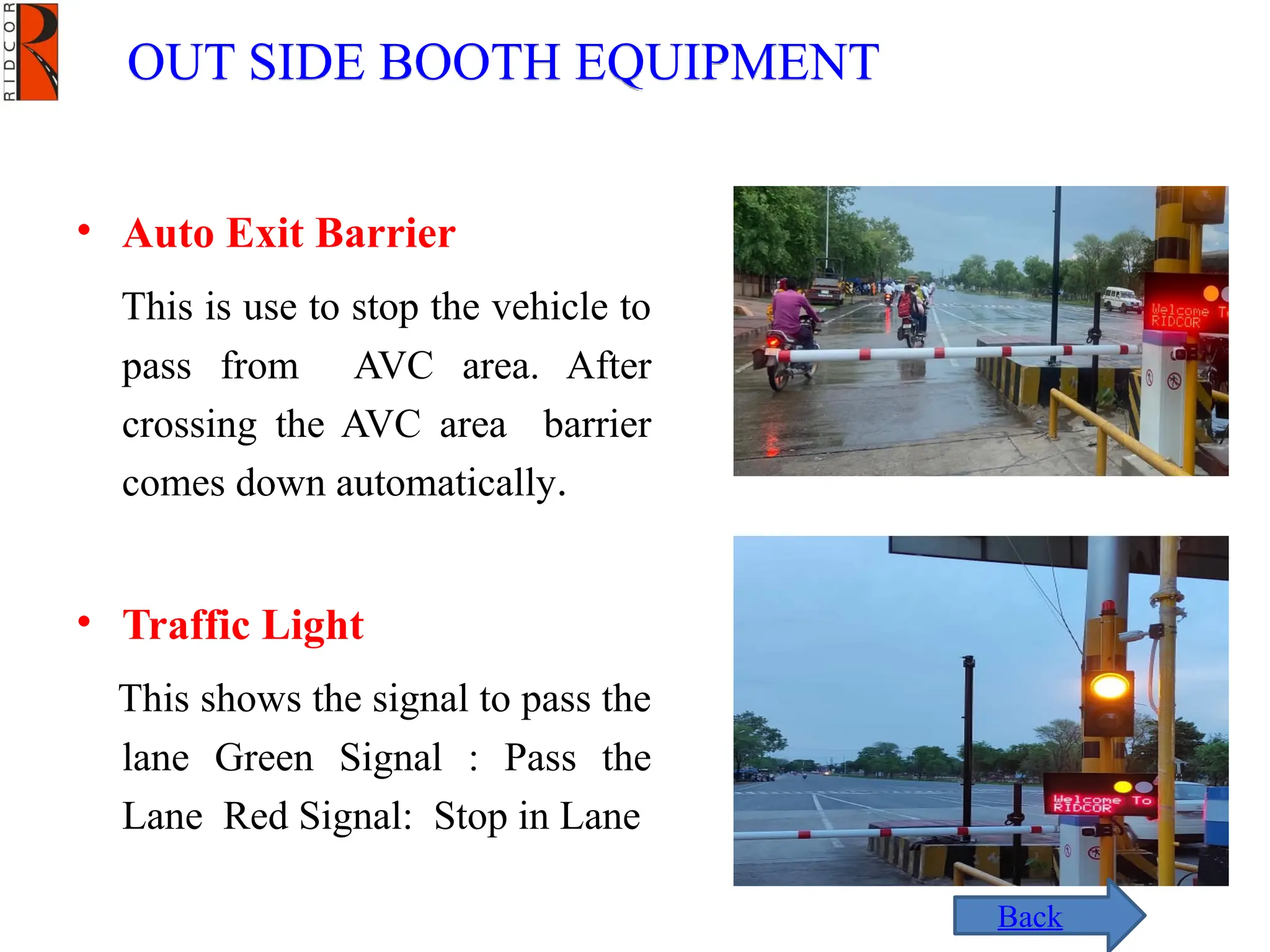
OUT SIDE BOOTH EQUIPMENT
• Auto Exit Barrier
This is use to stop the vehicle to
pass from AVC area. After
crossing the AVC area barrier
comes down automatically.
• Traffic Light
This shows the signal to pass the
lane Green Signal : Pass the
Lane Red Signal: Stop in Lane
Back
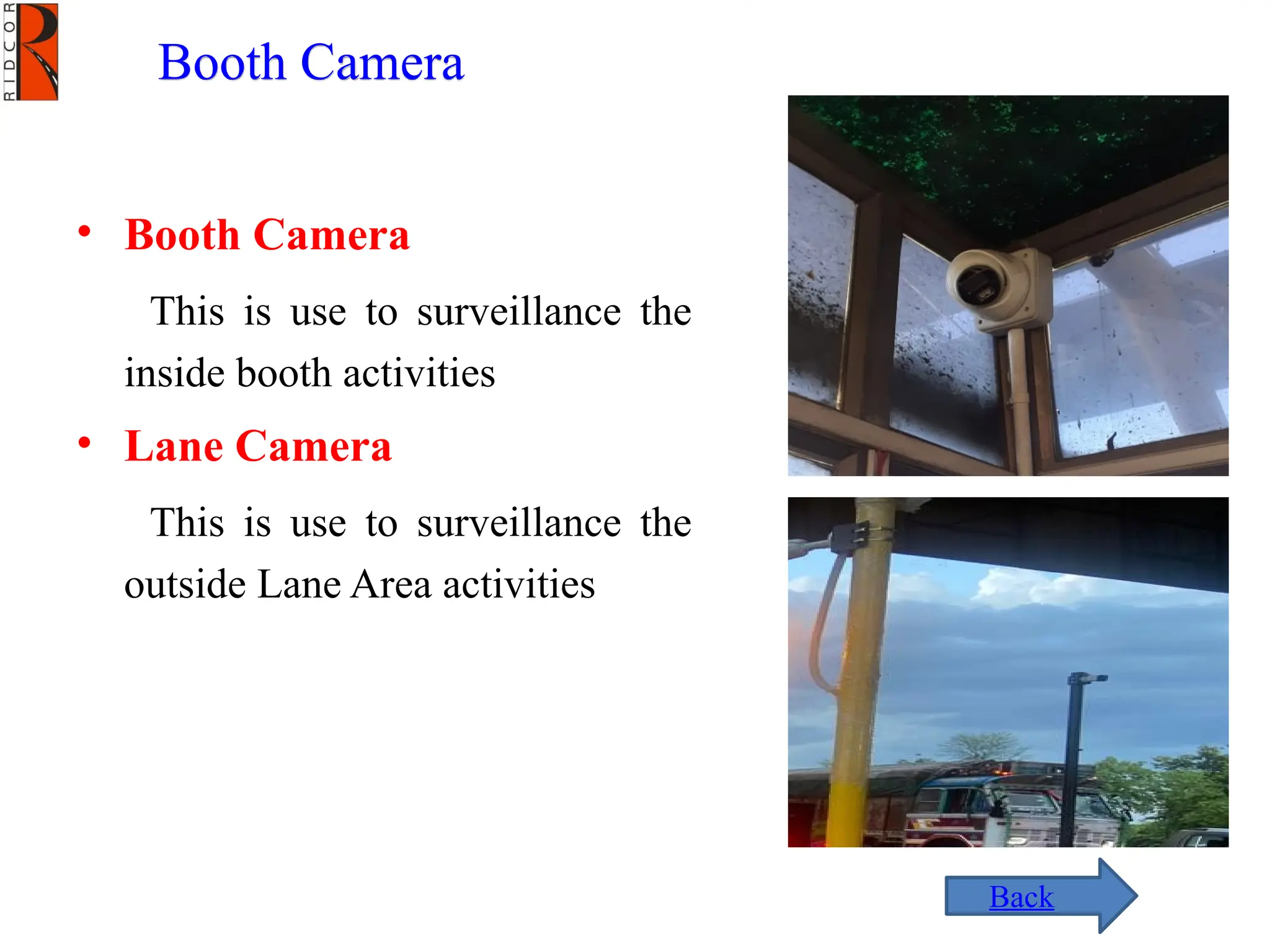
Booth Camera
• Booth Camera
This is use to surveillance the
inside booth activities
• Lane Camera
This is use to surveillance the
outside Lane Area activities
Back
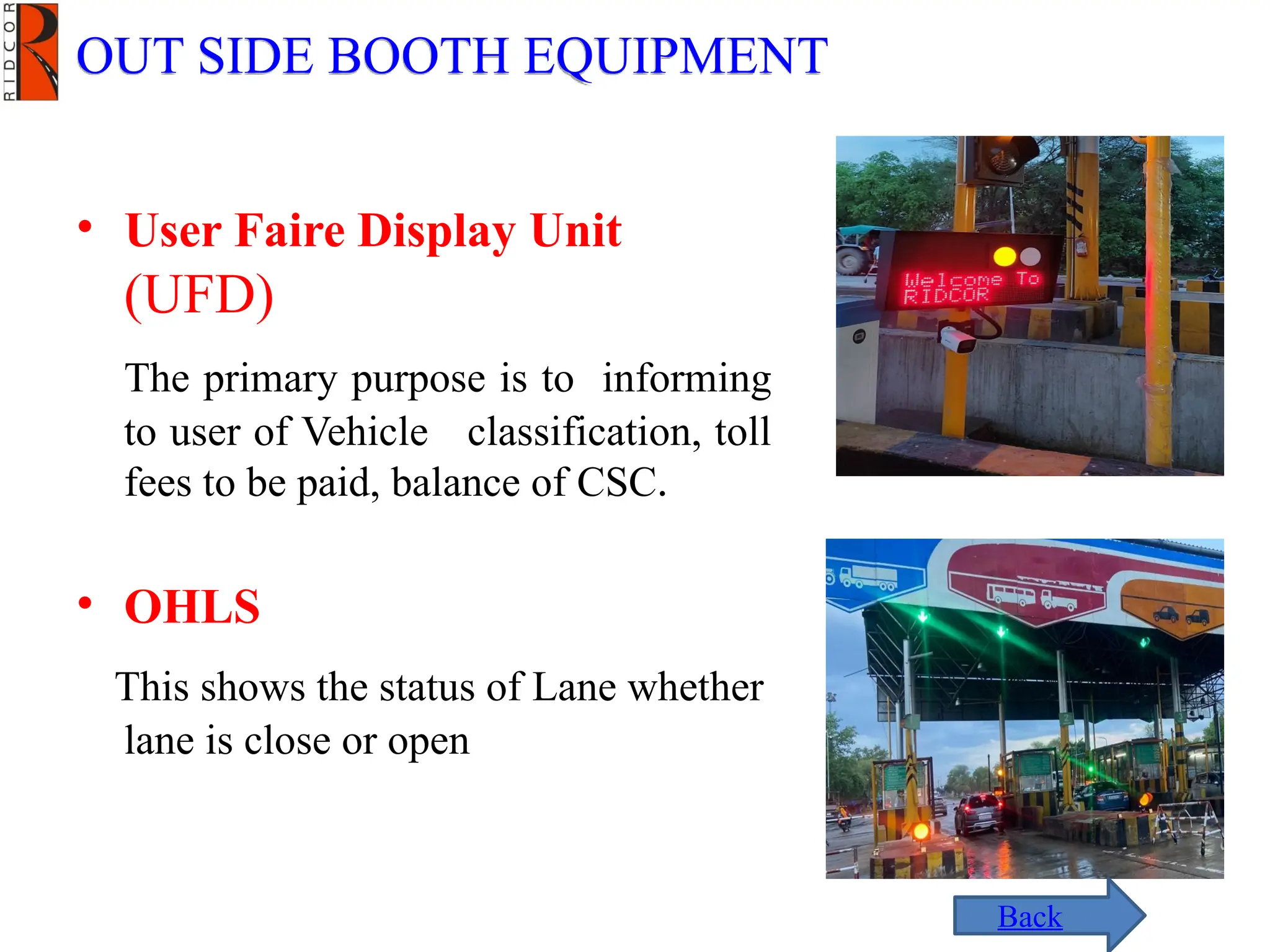
• User Faire Display Unit
(UFD)
The primary purpose is to informing
to user of Vehicle classification, toll
fees to be paid, balance of CSC.
• OHLS
This shows the status of Lane whether
lane is close or open
OUT SIDE BOOTH EQUIPMENT
Back
RFID TRANSCEIVER
Back
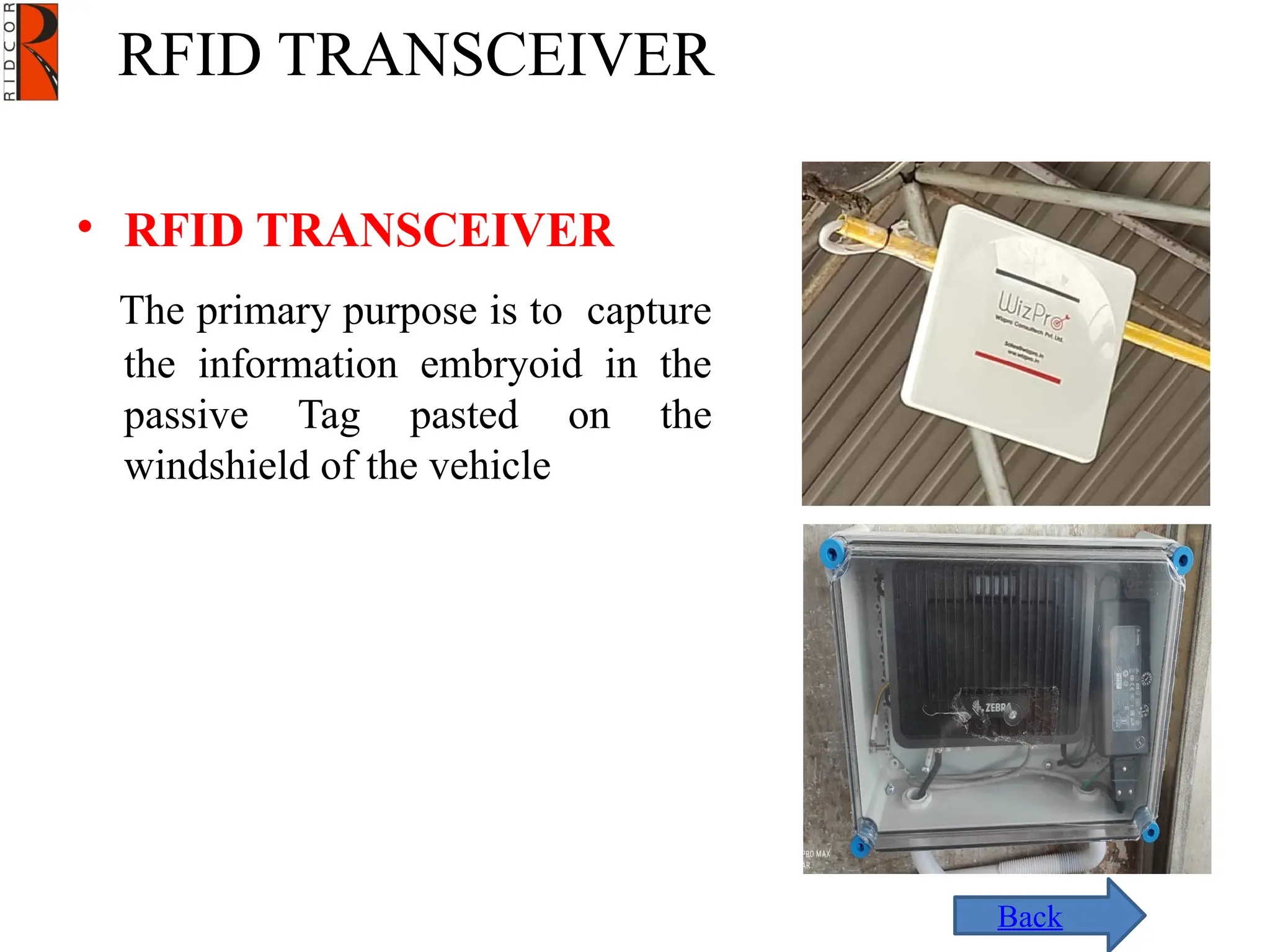
• RFID TRANSCEIVER
The primary purpose is to capture
the information embryoid in the
passive Tag pasted on the
windshield of the vehicle
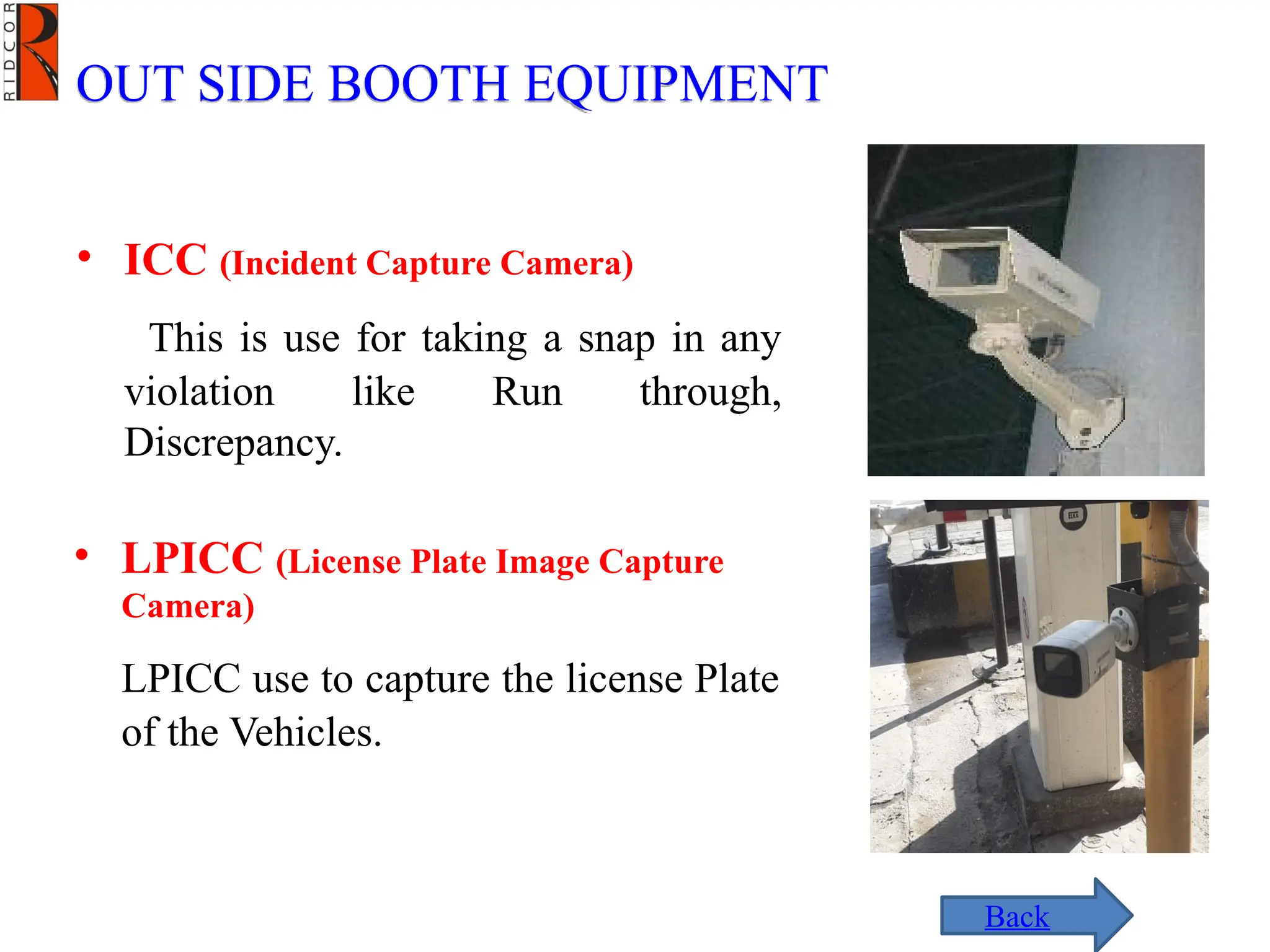
• ICC (Incident Capture Camera)
This is use for taking a snap in any
violation like Run through,
Discrepancy.
• LPICC (License Plate Image Capture
Camera)
LPICC use to capture the license Plate
of the Vehicles.
OUT SIDE BOOTH EQUIPMENT
Back
LED Display for Surveillance to installed
Cameras
Back
CONTROL ROOM
Back
PLAZA SERVER
Back
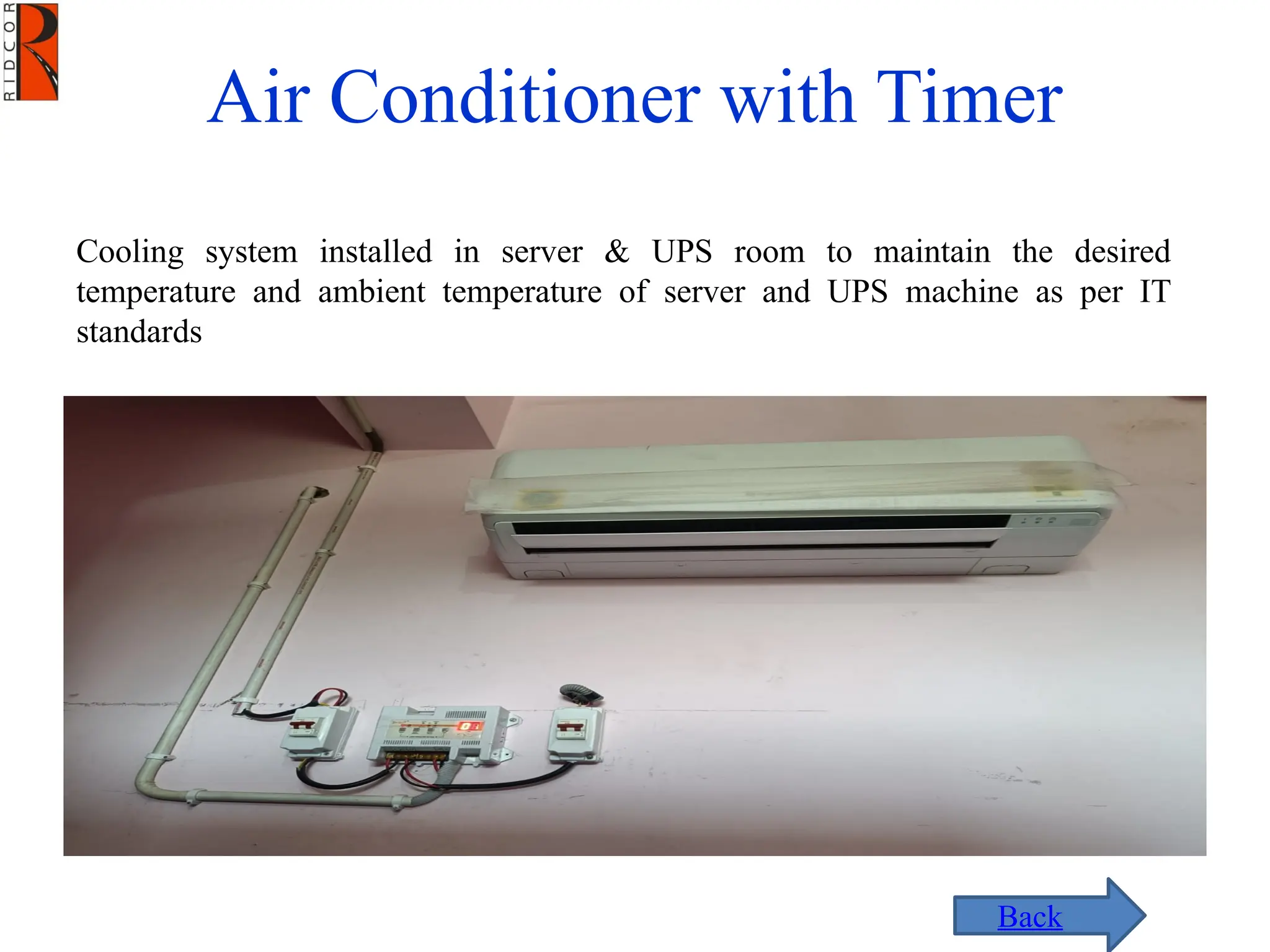
Air Conditioner with Timer
Cooling system installed in server & UPS room to maintain the desired
temperature and ambient temperature of server and UPS machine as per IT
standards
Back

Fastag Process Flow for PWD and installation

  • 1.
    PRESENTATION FOR IMPLEMENTATIONOF FASTag SYSTEMS AT TOLL PLAZAS IN RAJASTHAN Presented By : Amit Dudeja (Head IT - RIDCOR) amitdudeja@ridcor.in
  • 2.
    BACK GROUND (Source :PWD, Rajasthan)  91 State Highways under Operation on BOT Mode as under:  FASTag already implemented on all the 13 State Roads with RIDCOR  2 State Roads are operated with FASTag by RSRDC and remaining Highways are planned to be upgraded with FASTag by RSRDC with its own resources by end of FY 2023-24.  In accordance to recent bids received in RSRDC, the lowest rates for FASTag implementation are as under:  Capex Cost Per Lane per Toll Plaza: Rs. 15 Lacs  Opex Cost per month per Toll plaza : Rs. 0.75 Lacs Sl. No Agencies Name No. of Roads No. of Toll Plazas Total No. of Lanes 1 PWD (BOT) 9 21 94 2 PWD (PPP) 31 55 282 3 RSRDC 38 105 430 4 RIDCOR 13 31 163 TOTAL 91 212 969
  • 3.
     Estimated Costfor FASTag implementation on toll road projects operated under PWD (Basis: Approved Rates of RSRDC) Amount in Cr. *Out of 9 Roads, concession period for 4 Roads will expire in FY 2023-24; Hence only remaining 5 roads proposed for FASTag Implementation .  The above table shows that FASTag implementation for 36 Toll Roads (comprising of 66 Toll Plazas) with PWD is estimated to cost Rs. 61.38 Cr. The financial assistance expected after the work completion shall be Rs. 13.2 Cr. from IHMCL in accordance to spirit of MoU signed on 16.03.2022 with IHMCL.  For 55 Toll Plazas handled by PPP division as above, sanction accorded by Hon’ble PWM on 29.12.2022 for Rs. 52.20 Cr.  Cost estimates for non-BSR items of the proposed ETC system amounting to Rs. 54.81 Cr. Incl. 2 years maintenance submitted to CE (Elec.) on 23.02.2023. NIT likely to be floated after approval of non-BSR items and cost estimates accordingly.  For Toll Plazas under BOT division, it is proposed to submit case for consideration and sanction of Rs. 9.18 Cr. (Incl. 2.2 Cr. Likely grant from IHMCL) to FD so that complete required infrastructure for FAStag on above state roads is implemented in the FY 2023-24 and Toll Collection is made accordingly Sl. No. Agencies No. of Roads No. of TP’s No. of Lanes Per Lane Cost @15 Lac AMC cost @ 0.75 Lac for each Toll Plaza per month Total estimate d Cost Financial Assistance from IHMCL for each toll plaza @ 20 Lac Cost to be borne by State Government 1 PWD (BOT)* 5 11 48 7.20 1.98 9.18 2.2 6.98 2 PWD(PPP) 31 55 282 42.30 9.90 52.2 11.00 41.20 Total 36 66 330 49.5 11.88 61.38 13.2 48.18 BACK GROUND (Contd.) (Source : PWD, Rajasthan)
  • 4.
    What is FASTag?  An innovative and sophisticated Electronic Toll Collection Process.  Uses Radio Frequency Identification (RFID) for collecting toll payments directly from prepaid accounts.
  • 5.
    WHY FASTag A. REGULATORYREQUIREMENTS  FASTag made mandatory by NHAI and MoRTH in Feb 2021; 80% vehicles already mapped.  No third party vehicle insurance from 1st April, 2021 in absence of FASTag.  Budget announcement of the State Govt. for FASTag implementation on state roads in the year 2023-24.  Incentive for promoting digital payment by the Central Govt.: Maximum 20 Lakhs per toll plaza for 2 lanes (for infrastructure development).
  • 6.
    WHY FASTag B. BENEFITS Authority The collected revenue shall be verifiable / auditable.  Reduces the dependency of Authority on Toll Collection Agencies.  Cash handling at Toll lanes will be minimized.  Increase the Vehicle processing capacity per lane.  Central Real Time Monitoring of Toll Operations. Road User  Human Intervention in Vehicle Classification will be reduced  Lesser wait time  Ease of payment - No need to carry cash for the toll transactions saves time. Socio-economic  Non-stop movement of vehicles leading to lower fuel cost.  Environmental benefit i.e. reduced air pollution and less use of paper  Social benefit like no human intervention required and less time in transactions
  • 7.
     Mode ofPayment is only cash; existing TMS software not compatible with Digital Payment.  Toll Plazas running on Stand alone mode.  No Centralized Database; consolidate revenue report not available.  Dependency on third party for auditing of data through Video Count Survey whenever required. Thus not very reliable. LIMITATIONS WITH TRADITIONAL TOLLING SYSTEM
  • 8.
    IHMCL NPCI Acquirer Bank Issuer Bank National Payments Corporationof India (NPCI) has developed the National Electronic Toll Collection (NETC) program to meet the electronic tolling requirements of the Indian market Authority NHAI jointly with its Concessionaires and Financial Institutions incorporated Indian Highways Management Company Limited (IHMCL) on 26.12.2012 under the Companies Act, 1956 to carry out Electronic Tolling; acts as a national regulator for FASTag operations. Authority is responsible for managing complete operations at the Toll plazas. Acquirer bank is part of National Electronic Toll Collection (NETC) and acts as nodal agency in transaction data management between NPCI & the Authority. Issuer banks are authorised by IHMCL for selling the tags. STAKEHOLDER INVOLVE IN FASTag PROGRAM
  • 9.
    IMPLEMENTATION AT DIFFERENTLEVELS Toll Plaza - Lane Level Toll Plaza – Backoffice Level HO Level - Headquarter Monitoring System (HQMS)
  • 10.
    TOLL PLAZA -LANE LEVEL (EQUIPEMENTS DETAILS) Ethernet Interface ( Switch ) TOLL LANE COMPUTER (TLC) AVCC LPIC RF ID Transceiver Lane Camera Incident Camera Boom Barrier/ Traffic light Serial interface Parallel Interface USB Interface Barcode Scanner Printer LED Display Keyboard / & Mouse Overhead Lane Signal Booth Camera Evidence Camera
  • 11.
    INFORMATION COLLECTED ATLANE Vehicle Information captured by Lane Computer (TLC)  Lane and Plaza ID  Date and time of transaction  Class of Vehicle (classify by operator & AVCC)  Vehicle registration No.  Journey Detail (Single/ Return)  Mode of Payment (Cash, E-Payment, Pass, Exempt)  Image of Incident  Validation of Transaction for Return Journey
  • 12.
    TOLL PLAZA –BACK OFFICE LEVEL (Equipment Details) Equipment at Back office: 1. Servers 2 Nos. – IN HOTSTANDBY CONFIGURATION 2. Workstation – LSDU, POS, REPORTING, VALIDATION & CASH-UP 3. Display Unit for surveillance 4. Communication system for Lanes 5. Network Device 6. Firewall 7. Router 8. Back up device Lane 1 Lane 2 Lane 3 Lane 6 Lane 5 Lane 4 Plaza Server Plaza Server Connected with 6-Lanes
  • 13.
    TOLL PLAZA –BACK OFFICE LEVEL (FLOW CHART)  Toll Plaza Server : Controls all TMS activities & records all transactions happening at the lanes. FASTag transaction monitoring and reconciliation.  Lane status display Unit : Real Time Lane Updates  Point of Sale: For recharges of tags  Reporting Terminal: Reporting  Validation Terminal: Data Validation & Control  Cash up/Cashier Terminal: Declaration and verification of collected versus collectable cash  Back Up Device: Back up services
  • 14.
    HO LEVEL- HEADQUARTERMONITORING SYSTEM (HQMS)  The transaction data of all toll plazas shall be transferred via plaza server to HQMS server located at HO.  The HQMS will be the single server where transaction data of all toll plazas shall be stored.  The desired reports which are being generated from toll plazas can also be generated from HQMS at HO Plaza Server 3 Plaza Server 1 Plaza Server 2 Plaza Server 4 Plaza Server 6…. Plaza Server 5 HQMS (HO) Central Server Connected with all Plaza Server Plazas)
  • 15.
    HYBRID ETC SYSTEMUP-GRADATION REQUIREMENT
  • 16.
    A. Electrical Works Requires stable and dedicated power supply through UPS Power Backup (24x7) for Plaza and Lanes.  Adequate capacity of DG Sets required for immediate power backup. B. Infrastructure requirements  Toll Booth in good condition with PQC at the payment axis in the lane area.  Canopy covering all lanes.  Admin Building with 24x7 regulated power supply. PRE-REQUISITES FOR UPGRADATION OF HYBRID ETC SYSTEM
  • 17.
    A. SOFTWARE  OperatingSoftware – Latest Version  TMS Software – New/Upgraded Ver. with FASTag integration at Lane and Plaza level B. HARDWARE Lane Level Equipment 1. Inside Booth 2. Outside Booth  Toll Lane Computer (TLC)  Monitor  Thermal Printer  Keyboard & Mouse  Manual Booth Controller  Barcode Scanner  Booth Camera HYBRID ETC SYSTEM UP-GRADATION LANE LEVEL REQUIREMENT  Boom Barrier  AVCC  Traffic Light  Over Head Lane Signal  CCTV Camera (For Live video Recording)  Incident Camera (For Incident Recording)  License Plate Image Capture (LPIC)  RFID Reader  Handheld RFID Reader
  • 18.
    Control Room LevelEquipment (Backoffice)  Plaza Server (For Storage the Transaction Data)  Supervisor Terminal (To Generate the Reports)  Cash up Terminal (For Cash up and Float issuance to Toll Collector)  LSDU (Lane Status Display Unit)  POS Terminal (For FASTag recharge)  Report Printer (To Generate the Daily Reports)  NVR (For Lane CCTV video recording) Auxiliary Equipments  Violation Alarm  Flasher & Fog Light Networking Equipment with structured cabling  Network Cable (Shielded Cat 6)  LAN Switch (Lane Equipment Connectivity)  Plaza Switch (For Lane to Plaza Connectivity)  Router (For Internet Lease Line Connectivity with 2 different ISPs)  Firewall  SSL & Domain HYBRID ETC SYSTEM UP-GRADATION BACK OFFICE REQUIREMENT
  • 19.
    FUNCTIONALITY AFTER UPGRADATIONOF HYBRID ETC SYSTEM  Validity of transaction for passing through next toll plaza or same toll plaza (Return Journey) based on date & time of transaction  Automatic Classification of Vehicle through AVCC(Automatic Vehicle Counter cum Classifier)  Journey Detail (Single/ Return/Exempt)  Capturing the Image of Incident  Capturing of Vehicle Registration No.  Tracking of vehicle movement for OD Survey  Live view of PTZ camera from all Toll Plazas at HO on Single Screen  Centralized Report Generation facility  Revenue  Traffic Count Report  AVCC  MOP Report
  • 20.
    COMPONENTS OF CAPEX& OPEX COST CAPEX COST  Internet Lease Line Connectivity (OTC)  TMS Implementation Cost  Implementation of Pre-requisites OPEX COST  Acquiring Bank/clearing house Fee  Internet Lease Line Connectivity ARC  Manpower for Maintenance  Equipment Spares  License renewals  AMC for Toll Management System  AMC for Electrical Equipment
  • 21.
    CAPEX COST &RECURRING EXPENSES CAPEX COST • Approx Capex Cost per Lane is Rs.19 Lakh (Excluding WIM & Static Weigh Bridge) OPEX COST • @ nearly 12% of the total CAPEX cost for the first year post DLP with increment of nearly 2.5-5% per annum.
  • 22.
    Suggestive action planfor FASTag implementation on state roads A. Pre-requisites  Electrical Works (Incl. procurement of ACs for Server / UPS / Toll Booths)  Civil Works  Internet Connectivity (with 2 ISPs with minimum bandwidth of 10 Mbps)  Finalization of Acquirer Bank and setting up of Business rules for each toll plaza.  Communicate with IHMCL for generation / creation of agency and plaza ID. B. HYBRID ETC SYSTEM Implementation  Assessment of existing hardware and Software.  List of required hardware and software at lane and plaza level.  Finalization of user requirement specifications including hardware and software functionalities.  Preparation of in-house estimates based on Hybrid ETC circular issued by NHAI in the year 2018.  Finalization of qualification criteria for eligible bidders; QCBS mode with two stage bidding may be preferred.  Online invitation of bids. C. Manpower Requirement (Critical) – Post FASTag implementation  System Engineers for 24x7 support of SI and One IT Manager from Authority side on each Toll Plaza.  Transaction Validation and reconciliation team  Cashiers for 24x7 plaza running. D. Service Level Agreement on Annual Basis with System Integrator.
  • 23.
    TIMELINES FOR INSTALLATIONOF SYSTEM & FASTag S.No.. Name of Activity Time Duration (Days) 1 NIT Publish 15 15 2 Inviting of Tender 30  System Integrator 30  Acquiring Bank 30  Internet Service Provider 30  Electrification Work 30 3 Signing of Agreement with 30  System Integrator 30  Acquiring Bank 30  Internet Service Provider 30  Electrification Work 30 4 Execution Work 180  Acquiring Bank 30  Internet Service Provider 60  Civil/ Electrification work 60  System Installation & Commissioning o Hardware Installation & Networking o Software Installation o Testing o Commissioning 180 The total time duration for Installation/ up-gradation of work ETC system shall be about 6-8 Months tentatively (depends on the quantum of work and locational constraints)
  • 24.
    List of empanelledSystem Integrators with IHMCL S.No. Company Name 1 Arya Omnitalk Wireless Solutions Pvt Ltd 2 VaaaN Infra Pvt Ltd 3 Kent Intelligent Transportation System Pvt Ltd 4 Vara Infrovate Pvt Ltd and Essae Digitronics Pvt Ltd (Consortium) 5 Prakash Asphaltings and Toll Highways (India) Ltd 6 Qualix Information Systems LLP 7 Metro Infrasys Pvt Ltd 8 Rajdeep Info Techno Pvt Ltd 9 Comvision India Pvt Ltd 10 Tecsidel India Private Limited and Intelliroute India Services LLP (Consortium) 11 Ashoka Buildcon Limited 12 Green Tech Intelligent Transportation System LLP and Comnet Vision India (Consortium) 13 Bisotech India Private Limited 14 Superwave Communication and Infrasolution Pvt Ltd 15 ParknSecure India Pvt Ltd 16 Efkon India Pvt Ltd 17 LogicMo System Pvt Ltd and Mls Suroj Buildcon Pvt Ltd (Consortium) 18 Trafiksol ITS Technologies Pvt Ltd 19 Technova Software & Hardware Solution Private Limited and Jai Buildcon Private Limited (Consortium) 20 Devaditya Technocrate LLP 21 IBI Group India Pvt Ltd 22 Tollman International Pvt. Ltd. And RK Jain Infra Projects Pvt Ltd (Consortium) 23 Rudra Techno Care LLP and Ashirwad Smart Infralink Pvt Ltd (Consortium)
  • 25.
  • 26.
    Some Illustrative Snapsof Hybrid ETC Equipment
  • 27.
  • 28.
    1. The perlane cost RIDCOR & RSRDC is as below:  RIDCOR :- Rs. 19.32 Lac per lane (Averaged based on 163 lanes)  RSRDC : - Rs. 15.04 Lac per lane (Averaged based on 16 lanes) 2. The per lane cost of RIDCOR is higher side due to following items are additional to BOQ of RSRDC- having additional cost implication of Rs. 4.54 lakh per lane: • Centralized UPS (Only lane wise UPS provision in RSRDC BOQ) • PTZ Camera • ID Scanner Camera • Additional Electrical works • Handheld RFID Reader • PMC & FAT (Project Management Cost) • NAS (Network attached storage) for data backup • Spares • Fog Light • Firewall Cost Comparison of RIDCOR & RSRDC HES (Hybrid ETC System) Back
  • 29.
    TOLL SYSTEM HARDWARE •Toll Lane Controller • Automatic Vehicle Classifier • Booth Equipment Back
  • 30.
    INSIDE BOOTH EQUIPMENTS TollCollector Display Unit Receipt Printer Toll Collector Terminal Manual Booth Controller Back
  • 31.
    AVC & Loop •AVC use to capture the profile of the vehicle for classification and Loop use to send the signal to the TLC for to show the presence of the vehicle Back
  • 32.
    OUT SIDE BOOTHEQUIPMENT • Auto Exit Barrier This is use to stop the vehicle to pass from AVC area. After crossing the AVC area barrier comes down automatically. • Traffic Light This shows the signal to pass the lane Green Signal : Pass the Lane Red Signal: Stop in Lane Back
  • 33.
    Booth Camera • BoothCamera This is use to surveillance the inside booth activities • Lane Camera This is use to surveillance the outside Lane Area activities Back
  • 34.
    • User FaireDisplay Unit (UFD) The primary purpose is to informing to user of Vehicle classification, toll fees to be paid, balance of CSC. • OHLS This shows the status of Lane whether lane is close or open OUT SIDE BOOTH EQUIPMENT Back
  • 35.
    RFID TRANSCEIVER Back • RFIDTRANSCEIVER The primary purpose is to capture the information embryoid in the passive Tag pasted on the windshield of the vehicle
  • 36.
    • ICC (IncidentCapture Camera) This is use for taking a snap in any violation like Run through, Discrepancy. • LPICC (License Plate Image Capture Camera) LPICC use to capture the license Plate of the Vehicles. OUT SIDE BOOTH EQUIPMENT Back
  • 37.
    LED Display forSurveillance to installed Cameras Back
  • 38.
  • 39.
  • 40.
    Air Conditioner withTimer Cooling system installed in server & UPS room to maintain the desired temperature and ambient temperature of server and UPS machine as per IT standards Back