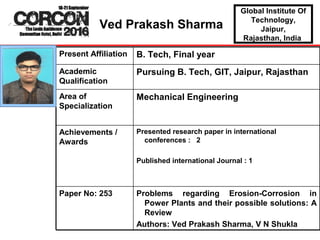
Ved Prakash Sharma
Present Affiliation B. Tech, Final year
Academic
Qualification
Pursuing B. Tech, GIT, Jaipur, Rajasthan
Area of
Specialization
Mechanical Engineering
Achievements /
Awards
Presented research paper in international
conferences : 2
Published international Journal : 1
Paper No: 253 Problems regarding Erosion-Corrosion in
Power Plants and their possible solutions: A
Review
Authors: Ved Prakash Sharma, V N Shukla
Presenting
Author Photo
Global Institute Of
Technology,
Jaipur,
Rajasthan, India
 Introduction (Erosion & Corrosion)
Prevention of corrosion & erosion
Thermal spray techniques
 Importance of Coating
 Requirement of protective system
Results and Discussions
Conclusion
Introduction
Corrosion is the degradation of material due to
chemical interaction with their environment.
According to Khanna (2005), oxidation - is the formation
of the oxide scale. If the scale spalls frequently - metal is
consumed continuously - material ultimately fails [1]
.
Erosion is the degradation of material due to
mechanical interaction with the environment.
He et al.,(2001), reported that both mechanical properties
and oxidation resistance must be considered for its use in
high temperature applications [2]
.
 Chatterjee et al., (2001), - Establishment and maintenance of an
impervious, stable, inert, adherent, protective layer on the substrate
during the service period [3]
.
 Heath et al., (1997), - Material damage can be controlled by including
proper alloy selection, optimum design of components, injecting chemical
additives, shielding of substrates and protective coatings [4]
.
 Eliaz et al., (2002), - Hot corrosion of gas turbine components could be
controlled by employing proper selection of structural alloys, application of
coatings [5]
.
 Priyantha et al., (2003), - An estimated 40% of total US steel
production goes to replacement of corroded parts and products [6]
.
 Cheruvu et al., (2006), – replacement cost of the hot section components
can exceed 35% of the cost of a new plant [7]
.
 Otsuka (2002), - Condensation/accumulation of low melting-point salts
from flue-gas - root cause for the severe wastage of tube materials [8]
.
Boiler elements highly vulnerable to erosion–corrosion
wear (Szymański et al., 2015)[9]
Typical examples of erosive wear in fluidized boiler: a) the area over the
ceramic lining, b) transition zone in thermally sprayed coatings, c) damage
caused by erosion of the wall, and d) damaged superheater tube.[9]
Importance of Coating
To achieve desired characteristics, surface modification
plays a vital role.
The use of suitable coatings provides
 Higher melting temperature
 Maintain high hardness and strength at
elevated temperatures.
 Better erosion and wear resistance
 Higher resistance to corrosion and oxidation
Thermal spray
technique:-
Melted particles
Voids, Porosity
Un-Melted Particles
Schematic diagram of thermal spray process, Sidhu et al., (2007) [10]
Coating parameters of thermal spray process (Kuroda et al.,
2008) [11]
.
PVD Machine, MNIT Jaipur
Prevention of Corrosion & Erosion
 Metal Treatment
o Alloying Elements – Add erosion-corrosion resistive
agents
o Surface Coatings - W-C, Cr-C based coatings, Zinc,
Tin etc.
 Treatment of Environment
o Removal of Erodent
o Control pH
o Removal of Oxygen
o Use of Inhibitor
 Change of Potential
o Cathodic Protection
o Anodic Protection
Type of Salt Deposit found on Boiler for
different fuels.
Type of fuel Typical salt deposits References
Waste ZnCl2, PbCl2, KCl, NaCl Smith et al., (2001) [12]
,
Spiegel et al., (2000) [13]
Straw KCl, K2SO4 Montgomery et al., (2000) [14]
Wood KCl, K2SO4, NaCl, Na2SO4 Henderson et al., (2000) [15]
Residual oil Na2SO4, V2O5 Luthra et al., (1982) [16]
Coal Na2SO4, K2SO4,
(Na,K)2Fe(SO4)3
Reichel et al., (1988) [17]
Viswanathan et al., (2002) [18]
Melting Points of Salt Deposits on Boiler
Tube (George et al.,2007) [19]
A CASE STUDY ON BOILER TUBE FAILURE by Prakash et al., (2001) [20]
S. NO. Type of Failure No. of Failures %age
out of 89
1 Erosion due to ash and hot 50 56.18
corrosion including overheating
due to corrosion
2 Erosion due to pulverized fuel 12 13.48
from coal nozzles
3 Welding joint cracks 10 11.24
4 Overheating due to choking 8 8.99
5 Leakage from water wall, header 5 5.62
drains due to expansion and
contraction
6 Miscellaneous 4 4.49
Results and Discussions
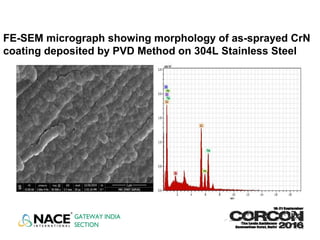
FE-SEM micrograph showing morphology of as-sprayed CrN
coating deposited by PVD Method on 304L Stainless Steel
Guru Gobind Singh Super Thermal power Plant (GGSSTPP), Roop Nagar (Punjab)
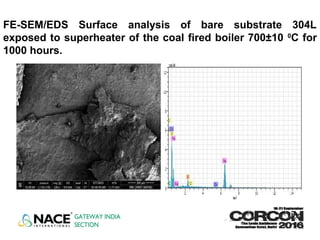
FE-SEM/EDS Surface analysis of bare substrate 304L
exposed to superheater of the coal fired boiler 700±10 0
C for
1000 hours.
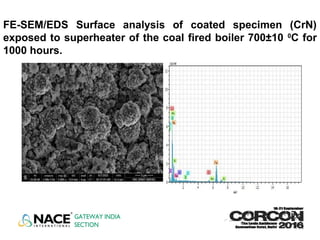
FE-SEM/EDS Surface analysis of coated specimen (CrN)
exposed to superheater of the coal fired boiler 700±10 0
C for
1000 hours.
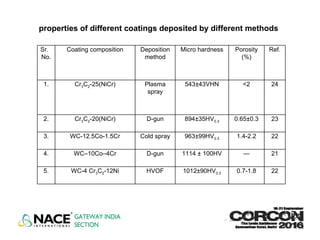
properties of different coatings deposited by different methods
Sr.
No.
Coating composition Deposition
method
Micro hardness Porosity
(%)
Ref.
1. Cr3C2-25(NiCr) Plasma
spray
543±43VHN <2 24
2. Cr3C2-20(NiCr) D-gun 894±35HV0.3 0.65±0.3 23
3. WC-12.5Co-1.5Cr Cold spray 963±99HV0.3 1.4-2.2 22
4. WC–10Co–4Cr D-gun 1114 ± 100HV — 21
5. WC-4 Cr3C2-12Ni HVOF 1012±90HV0.3 0.7-1.8 22
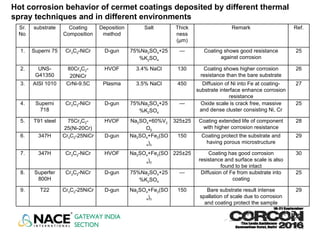
Hot corrosion behavior of cermet coatings deposited by different thermal
spray techniques and in different environments
Sr.
No.
substrate Coating
Composition
Deposition
method
Salt Thick
ness
(µm)
Remark Ref.
1. Superni 75 Cr3C2-NiCr D-gun 75%Na2SO4+25
%K2SO4
— Coating shows good resistance
against corrosion
25
2. UNS-
G41350
80Cr3C2-
20NiCr
HVOF 3.4% NaCl 130 Coating shows higher corrosion
resistance than the bare substrate
26
3. AISI 1010 CrNi-9.5C Plasma 3.5% NaCl 450 Diffusion of Ni into Fe at coating-
substrate interface enhance corrosion
resistance
27
4. Superni
718
Cr3C2-NiCr D-gun 75%Na2SO4+25
%K2SO4
— Oxide scale is crack free, massive
and dense cluster consisting Ni, Cr
25
5. T91 steel 75Cr3C2-
25(Ni-20Cr)
HVOF Na2SO4+60%V2
O5
325±25 Coating extended life of component
with higher corrosion resistance
28
6. 347H Cr3C2-25NiCr D-gun Na2SO4+Fe2(SO
4)3
150 Coating protect the substrate and
having porous microstructure
29
7. 347H Cr3C2-NiCr HVOF Na2SO4+Fe2(SO
4)3
225±25 Coating has good corrosion
resistance and surface scale is also
found to be intact
30
8. Superfer
800H
Cr3C2-NiCr D-gun 75%Na2SO4+25
%K2SO4
— Diffusion of Fe from substrate into
coating
25
9. T22 Cr3C2-25NiCr D-gun Na2SO4+Fe2(SO
4)3
150 Bare substrate result intense
spallation of scale due to corrosion
and coating protect the sample
29
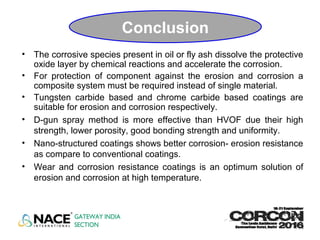
Conclusion
• The corrosive species present in oil or fly ash dissolve the protective
oxide layer by chemical reactions and accelerate the corrosion.
• For protection of component against the erosion and corrosion a
composite system must be required instead of single material.
• Tungsten carbide based and chrome carbide based coatings are
suitable for erosion and corrosion respectively.
• D-gun spray method is more effective than HVOF due their high
strength, lower porosity, good bonding strength and uniformity.
• Nano-structured coatings shows better corrosion- erosion resistance
as compare to conventional coatings.
• Wear and corrosion resistance coatings is an optimum solution of
erosion and corrosion at high temperature.
REFERENCES
[1] Khanna, A. S., (2005), Ch. 6: “Handbook of environmental degradation of Materials”, Pub., William Andrew, 13 Eaton Avenue,
New York.
[2] He, J. L., Chen K.C., Chen C.C., Leyland A., and Matthews A., (2001), “Cyclic oxidation resistance of Ni-Al alloy coatings
deposited on steel by a cathodic arc plasma process”, Surf. Coat. Technol., Vol. 135, pp. 158-165.
[3] Chatterjee, U. K, Bose S. K., and Roy S. K., (2001), “Environmental Degradation of Metals”, Pub., Marcel Dekkar, Inc. 270
Madison Avenue, New York.
[4] Heath, G. R., Heimgartner, P., Irons, G., Miller, R. and Gustafsson, S.,(1997), “An Assessment of Thermal Spray Coating
Technologies for High Temperature Corrosion Protection,” Mater. Sci. Forum, Vol. 251-54, pp. 809-816.
[5] Eliaz, N., Shemesh G., and Latanision R. M., (2002), “Hot corrosion in gas turbine components”, Engineering Failure Analysis,
Vol. 9, pp. 31-43.
[6] Priyantha, N., Jayaweera, P., Sanjurjo, A., Lau, K., Lu, F. and Krist, K., (2003), “Corrosion-Resistant Metallic
Coatings for Applications in Highly Aggressive Environments,” Surf. Coat. Technol., Vol. 163-164, pp. 31-36.
[7] Cheruvu N.S., Chan K.S., and Viswanathan R., (2006), “Evaluation, degradation and life assessment of coatings for
land based combustion turbines,” Energy Mater., Vol. 1, No. 1, pp. 33-47.
[8] Otsuka, N, (2002), “Effects of Fuel Impurities on the Fireside Corrosion of Boiler Tubes in Advanced Power
Generating Systems-A Thermodynamic Calculation of Deposit Chemistry,” Corros. Sci., Vol 44, pp. 265-283.
[9] Szymański Krzysztof, Hernas Adam, Moskal Grzegorz and Myalska Hanna, Thermally sprayed coatings resistant to
erosion and corrosion for power plant boilers - A review, Surf. Coat. Technol., Vol. 268, (2015), pp. 153-164
[10] Sidhu T S, Malik A, Prakash S, Agrawal R D, “ Oxidation and Hot Corrosion Resistance of HVOF WC-NiCrFeSiB
Coating on Ni- and Fe-based Superalloys at 800 °C,” Journal Thermal Spray Technology, vol. 16(5-6), pp. 844-849,
2007.
[11] Kuroda, S., Kawakita, J., Watanabe, M. and Katanoda, H. (2008), “Topical Review Warm spraying- A Novel
Coating Process Based on High-Velocity Impact of Solid Particles,” Sci. Technol. Adv. Mater., Vol. 9, pp. 1-17.
[12] Smith R.J.,Farr N.C.,Baker B.A.,the corrosion resistance of high nickel based alloys in relation to waste
incineratore applications, Proceedings of the Eurrcorr 2001, 30 sep-4 oct 2001, Rivadel garda, lake garda , Italy (2001)
[13] Spiegel M., Zahs A., Grabke H.J., Fundamental aspects of chlorine induced corrosion in power plants, Materials at
high temperature, 2 (2000) p 153-159.
[14]Montgomery M., Karlsson A., Larsen O.H.,In situ corrosion experiments at various strawfired power plants in
Denmark, Proceedings of the Eurocorr 2000, 10th 14th september 2000, Queen Mary westfield college university of
london UK (2000)
[15]Henderson P.J., Ljung P., Kallner P., Tollin J., Fireside corrosion of superheater materials in a wood fired
circulating fluidised bed boiler, Proceedings of the Eurocorr 2000, 10th-14th september 2000, Queen Marry &
Westfieldcollege university of London UK (2000).
[16] Luthra, K.L., Spacil, H.S.,IMPURITY DEPOSITS IN GAS TURBINES FROM FUELS CONTAINING SODIUM AND
VANADIUM. Journal of the Electrochemical Society Volume 129, Issue 3, March 1982, Pages
[17] Reichal H.H,Fireside corrosion in german fossil fuel fired power plants, Appearance, mechanism and causes,
Werkstoffe and Korrosion, 39 (1988) p 54-63
[18] Viswanathan R.,Purget R., Rao U, Materials for ultra supercritical coal fired power plant boilers, Proceedings of the
7th liege conference on Materials for advanced power engineering, Energy, 2002.
[19] George Y. Lai, “ High Temperature corrosion and materials application” , ASM International, 2007.
[20] Prakash, S., Singh, S., Sidhu, B. S. and Madeshia, A., (2001), “Tube Failures in Coal Fired Boilers,” Proc. National
Seminar on Advances in Material and Processing, Nov., 9-10, I1TR, Roorkee, India, pp. 245-253.
[21] Robert J.K. Wood, “Tribology of thermal sprayed WC–Co coatings,” Int. Journal of Refractory Metals & Hard
Materials Vol. 28, pp. 82–94, 2010.
[22] Berger L.-M., Saaro S., Naumann T., Wiener M., Weihnacht V., Thiele S. and Suchánek J., “Microstructure and
properties of HVOF sprayed chromium alloyed WC–Co and WC– Ni coatings,” Surface & Coatings Technology, vol.
202, pp.4417–4421, 2008.
[23] Murthy J.K.N. and Venkataraman B., “Abrasive wear behavior of WC–CoCr and Cr3C2–20(NiCr) deposited by
HVOF and detonation spray processes,” Surface & Coatings Technology, vol. 200, pp. 2642– 2652, 2006.
[24] Factor M. and Roman I., “Microhardness as a Simple Means of Estimating Relative Wear Resistance of Carbide
Thermal Spray Coatings,” Part 1 Characterization of Cemented Carbide Coatings ASM International JTTEE5, vol. 11,
pp. 468-481, 2001.
[25] Kamal S, Jayaganthan R and Prakash S, “Evaluation of cyclic hot corrosion behavior of detonation gun sprayed
Cr3C2–25%NiCr coatings on nickel- and iron-based super alloys,” Surf. Coat. Technol., vol. 203, pp. 1004–1013, 2009.
[26] Guilemany J.M., Espallargas N., Suegama P.H. and Benedetti A.V., “Comparative study of Cr3C2–NiCr coatings
obtained by HVOF and hard chromium coatings,” Corrosion Science, vol. 48, pp. 2998–3013, 2006.
[27] Suarez M., Bellayer S., Traisnel M., Gonzalez W., Chicot D., Lesage J., Puchi Cabrera E.S. and Staia M.H.,
“Corrosion behavior of Cr3C2-NiCr vacuum plasma sprayed coatings,” Surface & Coatings Technology, vol. 202, pp.
4566–4571, 2008.
[28] Chatha S. S., Sidhu H. S. and Sidhu B. S., “The effects of post-treatment on the hot corrosion behaviour of the
HVOF-sprayed Cr3C2-NiCr coating,” Surface & Coatings Technology, vol. 206, pp. 4212-4224, 2012.
[29] Kaur M., Singh H. and Prakash S., “Role of detonation gun spray Cr3C2-NiCr coating in improving high temperature
corrosion resistance of SAE-213-T22 and SAE-347H steel in presence of Na2SO4-Fe2(SO4)3 salt deposits,” Surface
Engineering, pp. 1-12, 2009.
[30] Kaur M., Singh H. and Prakash S, “High-temperature corrosion studies of HVOF- sprayed Cr3C2-NiCr coatings on
SAE-347H boiler steel,” Journal of Thermal Spray Technology, Volume 18(4), pp. 619-632, December 2009.

Corrosion and Erosion

  • 1.
    Ved Prakash Sharma PresentAffiliation B. Tech, Final year Academic Qualification Pursuing B. Tech, GIT, Jaipur, Rajasthan Area of Specialization Mechanical Engineering Achievements / Awards Presented research paper in international conferences : 2 Published international Journal : 1 Paper No: 253 Problems regarding Erosion-Corrosion in Power Plants and their possible solutions: A Review Authors: Ved Prakash Sharma, V N Shukla Presenting Author Photo Global Institute Of Technology, Jaipur, Rajasthan, India
  • 2.
     Introduction (Erosion& Corrosion) Prevention of corrosion & erosion Thermal spray techniques  Importance of Coating  Requirement of protective system Results and Discussions Conclusion
  • 3.
    Introduction Corrosion is thedegradation of material due to chemical interaction with their environment. According to Khanna (2005), oxidation - is the formation of the oxide scale. If the scale spalls frequently - metal is consumed continuously - material ultimately fails [1] . Erosion is the degradation of material due to mechanical interaction with the environment. He et al.,(2001), reported that both mechanical properties and oxidation resistance must be considered for its use in high temperature applications [2] .
  • 4.
     Chatterjee etal., (2001), - Establishment and maintenance of an impervious, stable, inert, adherent, protective layer on the substrate during the service period [3] .  Heath et al., (1997), - Material damage can be controlled by including proper alloy selection, optimum design of components, injecting chemical additives, shielding of substrates and protective coatings [4] .  Eliaz et al., (2002), - Hot corrosion of gas turbine components could be controlled by employing proper selection of structural alloys, application of coatings [5] .  Priyantha et al., (2003), - An estimated 40% of total US steel production goes to replacement of corroded parts and products [6] .  Cheruvu et al., (2006), – replacement cost of the hot section components can exceed 35% of the cost of a new plant [7] .  Otsuka (2002), - Condensation/accumulation of low melting-point salts from flue-gas - root cause for the severe wastage of tube materials [8] .
  • 5.
    Boiler elements highlyvulnerable to erosion–corrosion wear (Szymański et al., 2015)[9]
  • 6.
    Typical examples oferosive wear in fluidized boiler: a) the area over the ceramic lining, b) transition zone in thermally sprayed coatings, c) damage caused by erosion of the wall, and d) damaged superheater tube.[9]
  • 7.
    Importance of Coating Toachieve desired characteristics, surface modification plays a vital role. The use of suitable coatings provides  Higher melting temperature  Maintain high hardness and strength at elevated temperatures.  Better erosion and wear resistance  Higher resistance to corrosion and oxidation
  • 8.
    Thermal spray technique:- Melted particles Voids,Porosity Un-Melted Particles Schematic diagram of thermal spray process, Sidhu et al., (2007) [10]
  • 9.
    Coating parameters ofthermal spray process (Kuroda et al., 2008) [11] .
  • 10.
  • 11.
    Prevention of Corrosion& Erosion  Metal Treatment o Alloying Elements – Add erosion-corrosion resistive agents o Surface Coatings - W-C, Cr-C based coatings, Zinc, Tin etc.  Treatment of Environment o Removal of Erodent o Control pH o Removal of Oxygen o Use of Inhibitor  Change of Potential o Cathodic Protection o Anodic Protection
  • 12.
    Type of SaltDeposit found on Boiler for different fuels. Type of fuel Typical salt deposits References Waste ZnCl2, PbCl2, KCl, NaCl Smith et al., (2001) [12] , Spiegel et al., (2000) [13] Straw KCl, K2SO4 Montgomery et al., (2000) [14] Wood KCl, K2SO4, NaCl, Na2SO4 Henderson et al., (2000) [15] Residual oil Na2SO4, V2O5 Luthra et al., (1982) [16] Coal Na2SO4, K2SO4, (Na,K)2Fe(SO4)3 Reichel et al., (1988) [17] Viswanathan et al., (2002) [18]
  • 13.
    Melting Points ofSalt Deposits on Boiler Tube (George et al.,2007) [19]
  • 14.
    A CASE STUDYON BOILER TUBE FAILURE by Prakash et al., (2001) [20] S. NO. Type of Failure No. of Failures %age out of 89 1 Erosion due to ash and hot 50 56.18 corrosion including overheating due to corrosion 2 Erosion due to pulverized fuel 12 13.48 from coal nozzles 3 Welding joint cracks 10 11.24 4 Overheating due to choking 8 8.99 5 Leakage from water wall, header 5 5.62 drains due to expansion and contraction 6 Miscellaneous 4 4.49
  • 15.
  • 16.
    FE-SEM micrograph showingmorphology of as-sprayed CrN coating deposited by PVD Method on 304L Stainless Steel
  • 17.
    Guru Gobind SinghSuper Thermal power Plant (GGSSTPP), Roop Nagar (Punjab)
  • 18.
    FE-SEM/EDS Surface analysisof bare substrate 304L exposed to superheater of the coal fired boiler 700±10 0 C for 1000 hours.
  • 19.
    FE-SEM/EDS Surface analysisof coated specimen (CrN) exposed to superheater of the coal fired boiler 700±10 0 C for 1000 hours.
  • 20.
    properties of differentcoatings deposited by different methods Sr. No. Coating composition Deposition method Micro hardness Porosity (%) Ref. 1. Cr3C2-25(NiCr) Plasma spray 543±43VHN <2 24 2. Cr3C2-20(NiCr) D-gun 894±35HV0.3 0.65±0.3 23 3. WC-12.5Co-1.5Cr Cold spray 963±99HV0.3 1.4-2.2 22 4. WC–10Co–4Cr D-gun 1114 ± 100HV — 21 5. WC-4 Cr3C2-12Ni HVOF 1012±90HV0.3 0.7-1.8 22
  • 21.
    Hot corrosion behaviorof cermet coatings deposited by different thermal spray techniques and in different environments Sr. No. substrate Coating Composition Deposition method Salt Thick ness (µm) Remark Ref. 1. Superni 75 Cr3C2-NiCr D-gun 75%Na2SO4+25 %K2SO4 — Coating shows good resistance against corrosion 25 2. UNS- G41350 80Cr3C2- 20NiCr HVOF 3.4% NaCl 130 Coating shows higher corrosion resistance than the bare substrate 26 3. AISI 1010 CrNi-9.5C Plasma 3.5% NaCl 450 Diffusion of Ni into Fe at coating- substrate interface enhance corrosion resistance 27 4. Superni 718 Cr3C2-NiCr D-gun 75%Na2SO4+25 %K2SO4 — Oxide scale is crack free, massive and dense cluster consisting Ni, Cr 25 5. T91 steel 75Cr3C2- 25(Ni-20Cr) HVOF Na2SO4+60%V2 O5 325±25 Coating extended life of component with higher corrosion resistance 28 6. 347H Cr3C2-25NiCr D-gun Na2SO4+Fe2(SO 4)3 150 Coating protect the substrate and having porous microstructure 29 7. 347H Cr3C2-NiCr HVOF Na2SO4+Fe2(SO 4)3 225±25 Coating has good corrosion resistance and surface scale is also found to be intact 30 8. Superfer 800H Cr3C2-NiCr D-gun 75%Na2SO4+25 %K2SO4 — Diffusion of Fe from substrate into coating 25 9. T22 Cr3C2-25NiCr D-gun Na2SO4+Fe2(SO 4)3 150 Bare substrate result intense spallation of scale due to corrosion and coating protect the sample 29
  • 22.
    Conclusion • The corrosivespecies present in oil or fly ash dissolve the protective oxide layer by chemical reactions and accelerate the corrosion. • For protection of component against the erosion and corrosion a composite system must be required instead of single material. • Tungsten carbide based and chrome carbide based coatings are suitable for erosion and corrosion respectively. • D-gun spray method is more effective than HVOF due their high strength, lower porosity, good bonding strength and uniformity. • Nano-structured coatings shows better corrosion- erosion resistance as compare to conventional coatings. • Wear and corrosion resistance coatings is an optimum solution of erosion and corrosion at high temperature.
  • 23.
    REFERENCES [1] Khanna, A.S., (2005), Ch. 6: “Handbook of environmental degradation of Materials”, Pub., William Andrew, 13 Eaton Avenue, New York. [2] He, J. L., Chen K.C., Chen C.C., Leyland A., and Matthews A., (2001), “Cyclic oxidation resistance of Ni-Al alloy coatings deposited on steel by a cathodic arc plasma process”, Surf. Coat. Technol., Vol. 135, pp. 158-165. [3] Chatterjee, U. K, Bose S. K., and Roy S. K., (2001), “Environmental Degradation of Metals”, Pub., Marcel Dekkar, Inc. 270 Madison Avenue, New York. [4] Heath, G. R., Heimgartner, P., Irons, G., Miller, R. and Gustafsson, S.,(1997), “An Assessment of Thermal Spray Coating Technologies for High Temperature Corrosion Protection,” Mater. Sci. Forum, Vol. 251-54, pp. 809-816. [5] Eliaz, N., Shemesh G., and Latanision R. M., (2002), “Hot corrosion in gas turbine components”, Engineering Failure Analysis, Vol. 9, pp. 31-43. [6] Priyantha, N., Jayaweera, P., Sanjurjo, A., Lau, K., Lu, F. and Krist, K., (2003), “Corrosion-Resistant Metallic Coatings for Applications in Highly Aggressive Environments,” Surf. Coat. Technol., Vol. 163-164, pp. 31-36. [7] Cheruvu N.S., Chan K.S., and Viswanathan R., (2006), “Evaluation, degradation and life assessment of coatings for land based combustion turbines,” Energy Mater., Vol. 1, No. 1, pp. 33-47. [8] Otsuka, N, (2002), “Effects of Fuel Impurities on the Fireside Corrosion of Boiler Tubes in Advanced Power Generating Systems-A Thermodynamic Calculation of Deposit Chemistry,” Corros. Sci., Vol 44, pp. 265-283. [9] Szymański Krzysztof, Hernas Adam, Moskal Grzegorz and Myalska Hanna, Thermally sprayed coatings resistant to erosion and corrosion for power plant boilers - A review, Surf. Coat. Technol., Vol. 268, (2015), pp. 153-164 [10] Sidhu T S, Malik A, Prakash S, Agrawal R D, “ Oxidation and Hot Corrosion Resistance of HVOF WC-NiCrFeSiB Coating on Ni- and Fe-based Superalloys at 800 °C,” Journal Thermal Spray Technology, vol. 16(5-6), pp. 844-849, 2007. [11] Kuroda, S., Kawakita, J., Watanabe, M. and Katanoda, H. (2008), “Topical Review Warm spraying- A Novel Coating Process Based on High-Velocity Impact of Solid Particles,” Sci. Technol. Adv. Mater., Vol. 9, pp. 1-17. [12] Smith R.J.,Farr N.C.,Baker B.A.,the corrosion resistance of high nickel based alloys in relation to waste incineratore applications, Proceedings of the Eurrcorr 2001, 30 sep-4 oct 2001, Rivadel garda, lake garda , Italy (2001)
  • 24.
    [13] Spiegel M.,Zahs A., Grabke H.J., Fundamental aspects of chlorine induced corrosion in power plants, Materials at high temperature, 2 (2000) p 153-159. [14]Montgomery M., Karlsson A., Larsen O.H.,In situ corrosion experiments at various strawfired power plants in Denmark, Proceedings of the Eurocorr 2000, 10th 14th september 2000, Queen Mary westfield college university of london UK (2000) [15]Henderson P.J., Ljung P., Kallner P., Tollin J., Fireside corrosion of superheater materials in a wood fired circulating fluidised bed boiler, Proceedings of the Eurocorr 2000, 10th-14th september 2000, Queen Marry & Westfieldcollege university of London UK (2000). [16] Luthra, K.L., Spacil, H.S.,IMPURITY DEPOSITS IN GAS TURBINES FROM FUELS CONTAINING SODIUM AND VANADIUM. Journal of the Electrochemical Society Volume 129, Issue 3, March 1982, Pages [17] Reichal H.H,Fireside corrosion in german fossil fuel fired power plants, Appearance, mechanism and causes, Werkstoffe and Korrosion, 39 (1988) p 54-63 [18] Viswanathan R.,Purget R., Rao U, Materials for ultra supercritical coal fired power plant boilers, Proceedings of the 7th liege conference on Materials for advanced power engineering, Energy, 2002. [19] George Y. Lai, “ High Temperature corrosion and materials application” , ASM International, 2007. [20] Prakash, S., Singh, S., Sidhu, B. S. and Madeshia, A., (2001), “Tube Failures in Coal Fired Boilers,” Proc. National Seminar on Advances in Material and Processing, Nov., 9-10, I1TR, Roorkee, India, pp. 245-253. [21] Robert J.K. Wood, “Tribology of thermal sprayed WC–Co coatings,” Int. Journal of Refractory Metals & Hard Materials Vol. 28, pp. 82–94, 2010. [22] Berger L.-M., Saaro S., Naumann T., Wiener M., Weihnacht V., Thiele S. and Suchánek J., “Microstructure and properties of HVOF sprayed chromium alloyed WC–Co and WC– Ni coatings,” Surface & Coatings Technology, vol. 202, pp.4417–4421, 2008. [23] Murthy J.K.N. and Venkataraman B., “Abrasive wear behavior of WC–CoCr and Cr3C2–20(NiCr) deposited by HVOF and detonation spray processes,” Surface & Coatings Technology, vol. 200, pp. 2642– 2652, 2006. [24] Factor M. and Roman I., “Microhardness as a Simple Means of Estimating Relative Wear Resistance of Carbide Thermal Spray Coatings,” Part 1 Characterization of Cemented Carbide Coatings ASM International JTTEE5, vol. 11, pp. 468-481, 2001. [25] Kamal S, Jayaganthan R and Prakash S, “Evaluation of cyclic hot corrosion behavior of detonation gun sprayed Cr3C2–25%NiCr coatings on nickel- and iron-based super alloys,” Surf. Coat. Technol., vol. 203, pp. 1004–1013, 2009.
  • 25.
    [26] Guilemany J.M.,Espallargas N., Suegama P.H. and Benedetti A.V., “Comparative study of Cr3C2–NiCr coatings obtained by HVOF and hard chromium coatings,” Corrosion Science, vol. 48, pp. 2998–3013, 2006. [27] Suarez M., Bellayer S., Traisnel M., Gonzalez W., Chicot D., Lesage J., Puchi Cabrera E.S. and Staia M.H., “Corrosion behavior of Cr3C2-NiCr vacuum plasma sprayed coatings,” Surface & Coatings Technology, vol. 202, pp. 4566–4571, 2008. [28] Chatha S. S., Sidhu H. S. and Sidhu B. S., “The effects of post-treatment on the hot corrosion behaviour of the HVOF-sprayed Cr3C2-NiCr coating,” Surface & Coatings Technology, vol. 206, pp. 4212-4224, 2012. [29] Kaur M., Singh H. and Prakash S., “Role of detonation gun spray Cr3C2-NiCr coating in improving high temperature corrosion resistance of SAE-213-T22 and SAE-347H steel in presence of Na2SO4-Fe2(SO4)3 salt deposits,” Surface Engineering, pp. 1-12, 2009. [30] Kaur M., Singh H. and Prakash S, “High-temperature corrosion studies of HVOF- sprayed Cr3C2-NiCr coatings on SAE-347H boiler steel,” Journal of Thermal Spray Technology, Volume 18(4), pp. 619-632, December 2009.