GROUP MEMBER
NADEEM KHAN
NIKHIL BISHT 13
SUBMITTED TO: PROF. HEMANT
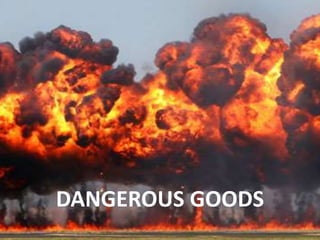
DANGEROUS GOODS
Dangerous goods:
• Dangerous goods are substances or articles that pose a risk to people,
property or the environment, due to their chemical or physical properties.
Dangerous goods are solid, liquids or gasses form.
• In USA/ Canada these goods are known as Hazmat (Hazardous Materials)
and are handled by specially trained hazmat personnel.
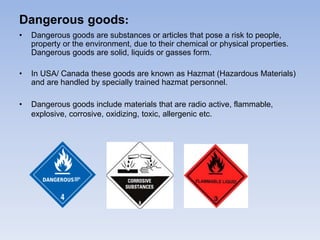
• Dangerous goods include materials that are radio active, flammable,
explosive, corrosive, oxidizing, toxic, allergenic etc.
International Maritime Dangerous Goods
(IMDG) Code
• IMDG Code or International Maritime Dangerous Goods Code
is accepted as an international guideline to the safe
transportation or shipment of dangerous goods or hazardous
materials by water on vessel.
The objective of the International Maritime
Dangerous Goods (IMDG) Code is to:
• Enhance the safe transport of dangerous goods
• Protect the marine environment
• Facilitate the free unrestricted movement of dangerous
goods
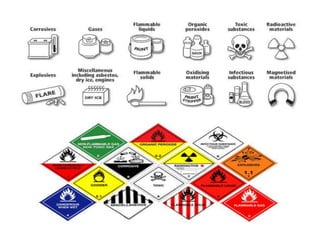
The 9 classes:
Class 1 Explosives
Class 2 Gases
Class 3 Flammable liquids
Class 4 Flammable solids
Class 5 Oxidizing substances and organic peroxides
Class 6 Toxic and infectious substances
Class 7 Radioactive material
Class 8 Corrosive substances
Class 9 Miscellaneous dangerous substances and
articles
These 9 hazard classes have been established internationally by a United Nations (UN)
committee to ensure that all modes of transport (road, rail, air and sea) classify
dangerous goods in the same way.
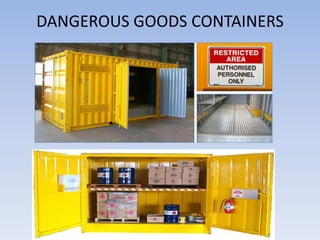
DANGEROUS GOODS CONTAINERS
Ship agent
• A shipping agency or shipping agent is the designated person or
agency held responsible for handling shipments and cargo, at ports
and harbours worldwide, on behalf of ship owners, managers, and
charterers. In some parts of the world, these agents are referred to
as port agents or cargo brokers.
• Shipping agent is chain between owner, operator, client,
customer
• He is responsible for pilotage and also for allotment of space on ship
Responsibilities of shipping agents include:
• Making declaration of ship arrival to Port Authority
• Marketing for cargo to be carried by the ship
• Taking care of all documentation
• Ensuring a berth for the incoming ship
• Arranging for the pilot and the tugs if necessary
• Drawing up the documents for the customs and harbour services
• Arranging for the necessary ship fresh water / provisions
• Arranging for the necessary doctor for the crew any medical
assistance
• Arranging for storage bunkers if these are needed
• Arranging for the necessary repairs
• Conveying instructions to and from the ship owner
• Organizing the supply, transport and the handling of the goods
• Organizing the necessary contacts with the stevedores
• Collecting freights, cargoes
• Contacting shippers and the receivers of the goods

Linear

  • 1.
    GROUP MEMBER NADEEM KHAN NIKHILBISHT 13 SUBMITTED TO: PROF. HEMANT
  • 2.
  • 3.
    Dangerous goods: • Dangerousgoods are substances or articles that pose a risk to people, property or the environment, due to their chemical or physical properties. Dangerous goods are solid, liquids or gasses form. • In USA/ Canada these goods are known as Hazmat (Hazardous Materials) and are handled by specially trained hazmat personnel. • Dangerous goods include materials that are radio active, flammable, explosive, corrosive, oxidizing, toxic, allergenic etc.
  • 4.
    International Maritime DangerousGoods (IMDG) Code • IMDG Code or International Maritime Dangerous Goods Code is accepted as an international guideline to the safe transportation or shipment of dangerous goods or hazardous materials by water on vessel. The objective of the International Maritime Dangerous Goods (IMDG) Code is to: • Enhance the safe transport of dangerous goods • Protect the marine environment • Facilitate the free unrestricted movement of dangerous goods
  • 5.
    The 9 classes: Class1 Explosives Class 2 Gases Class 3 Flammable liquids Class 4 Flammable solids Class 5 Oxidizing substances and organic peroxides Class 6 Toxic and infectious substances Class 7 Radioactive material Class 8 Corrosive substances Class 9 Miscellaneous dangerous substances and articles These 9 hazard classes have been established internationally by a United Nations (UN) committee to ensure that all modes of transport (road, rail, air and sea) classify dangerous goods in the same way.
  • 7.
  • 8.
    Ship agent • Ashipping agency or shipping agent is the designated person or agency held responsible for handling shipments and cargo, at ports and harbours worldwide, on behalf of ship owners, managers, and charterers. In some parts of the world, these agents are referred to as port agents or cargo brokers. • Shipping agent is chain between owner, operator, client, customer • He is responsible for pilotage and also for allotment of space on ship
  • 9.
    Responsibilities of shippingagents include: • Making declaration of ship arrival to Port Authority • Marketing for cargo to be carried by the ship • Taking care of all documentation • Ensuring a berth for the incoming ship • Arranging for the pilot and the tugs if necessary • Drawing up the documents for the customs and harbour services • Arranging for the necessary ship fresh water / provisions • Arranging for the necessary doctor for the crew any medical assistance • Arranging for storage bunkers if these are needed • Arranging for the necessary repairs • Conveying instructions to and from the ship owner • Organizing the supply, transport and the handling of the goods • Organizing the necessary contacts with the stevedores • Collecting freights, cargoes • Contacting shippers and the receivers of the goods