PRESENTATION ON “DEHYDRATION”
PRESENTED BY: RAJESH CHHETRI(18) & RAHAMAT
KHAN(17)
ROLL NO: EIGHTEEN(18) & SEVENTEEN(17)
SUBJECT: PUBLIC HEALTH PHARMACY
FACULTY: B.PHARM
LEVEL: BACHELOR
COLLEGE: SHREE MEDICAL AND TECHNICAL COLLEGE
PRESENTED TO: JIWAN POUDYAL
3/10/2020|DEHYDRATION|
2
CONTENTS
3/10/2020|DEHYDRATION|
3
 OBJECTIVES OF THE STUDY
 INTRODUCTION
 CLINICAL FEATURES
 CAUSES/DETERMINANTS/RISK FACTOR
 NEPALESE CONTEXT
-NEPALESE CONTEXT DATA PRESENTATION
 FIRST AIDMANAGEMENT ABCD
CONTENTS
3/10/2020|DEHYDRATION|
4
 EVALUATION THE DEGREE OF
DEHYDRATION
 THE ABCDE APPROACH – TRIAGE TREAT FIRST WHAT
KILLS FIRST
 CALCULATIONS
 TREATMENT
 COMPLICATION
 PROGNOSIS
 REFERENCES
OBJECTIVES OF THE STUDY
3/10/2020|DEHYDRATION|
5
 Define dehydration
 Identify causes and risk factors
 Become familiar with medications that may exacerbate
dehydration
 Identify signs and symptoms of dehydration
 Understand measures to prevent dehydration
 Treatment of the dehydration
INTRODUCTION
3/10/2020|DEHYDRATION|
6
 Dehydration is a condition that occurs when an individual has
lost so much fluid that the body can no longer function normally
and develops signs and symptoms due to the loss of fluid.
 Mostly water, exceeds the amount that is taken in. With
dehydration
 More water is moving out of individual cells and then out of the
body than the amount of water that is taken in through drinking.
3/10/2020|DEHYDRATION|
7
INTRODUCTION CONTINUE…..
3/10/2020|DEHYDRATION|
8
 Although infants and children are at highest risk
for dehydration, many adults and especially the
elderly have significant risk factors.
CLINICAL FEATURES
3/10/2020|DEHYDRATION|
9
 Signs & Symptoms of dehydration in children:
Signs of Dehydration:
1. Sunken eyes
2. Decreased frequency of urination or dry nappies
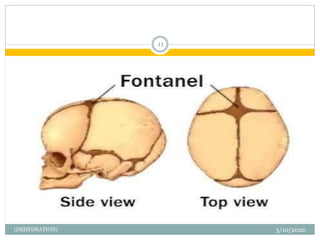
3. Sunken soft spot on the top of the head in babies (called the
fontanels)
4. No tears when the child cries
5. Dry or sticky mucous membranes (the lining of the mouth or
tongue)
6. Lethargy (less activity than normal)
7. Irritability (more crying, fussiness)
8. Abnormal capillary refill time
3/10/2020|DEHYDRATION|
10
Sunken eyes Sunken eyes
3/10/2020|DEHYDRATION|
11
CLINICAL FEATURES CONTINUE….
3/10/2020|DEHYDRATION|
12
1. Abnormal skin turgor
2. Abnormal respiratory pattern
CLINICAL FEATURES CONTINUE…..
3/10/2020|DEHYDRATION|
13
 The first symptoms of dehydration include thirst, darker urine, and
decreased urine production. In fact, urine color is one of the best
indicators of a person’s hydration level – clear urine means you are well
hydrated and darker urine means you are dehydrated.
 However, it is important to note that, particularly in older adults,
dehydration can occur without thirst. This is why it is important to drink
more water when ill, or during hotter weather.
 As the condition progresses to moderate dehydration, symptoms include:
CLINICAL FEATURES CONTINUE….
3/10/2020|DEHYDRATION|
14
 dry mouth
 lethargy
 weakness in muscles
 headache
 dizziness
CLINICAL FEATURES CONTINUE….
3/10/2020|DEHYDRATION|
15
 Severe dehydration (loss of 10-15 percent of the body’s water)
may be characterized by extreme versions of the symptoms
above as well as:
 lack of sweating
 sunken eyes
 shriveled and dry skin
 low blood pressure
 increased heart rate
 fever
 delirium
 unconsciousness
CAUSES/DETERMINANTS/RISK FACTOR
3/10/2020|DEHYDRATION|
16
 Some of the following causes are listed below:
Excessive fluid loss
Reduced fluid intake
Other causes of fluid loss include:
 Hemorrhage
 Excessive perspiration
 Acute renal failure with polyuria
 Abdominal surgery
CAUSES/DETERMINANTS/RISK FACTOR
CONTINUE…..
3/10/2020|DEHYDRATION|
17
 Vomiting or diarrhea
 Nasogastric drainage
 Excessive GI suctioning
 Diabetes mellitus with polyuria or diabetes insipidus
 Fistulas
 Excessive use of laxatives
Risk Factors for Dehydration
3/10/2020|DEHYDRATION|
18
 Elderly residents
 Residents with chronic illnesses:
– Diabetes
– Kidney disease
– Cystic fibrosis
– Alcoholism
– Adrenal gland disorders
NEPALESE CONTEXT
3/10/2020|DEHYDRATION|
19
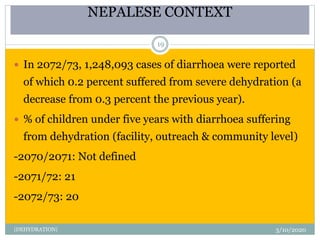
 In 2072/73, 1,248,093 cases of diarrhoea were reported
of which 0.2 percent suffered from severe dehydration (a
decrease from 0.3 percent the previous year).
 % of children under five years with diarrhoea suffering
from dehydration (facility, outreach & community level)
-2070/2071: Not defined
-2071/72: 21
-2072/73: 20
NEPALESE CONTEXT DATA
PRESENTATION
3/10/2020|DEHYDRATION|
20
FIRST AIDMANAGEMENT ABCD
3/10/2020|DEHYDRATION|
21
 First aid treatment for dehydration
 There are some simple first aid steps you can take if you
suspect someone is suffering from dehydration.
 Assist the casualty into a cool, shaded place
 Encourage them to sit down and stop any physical activity
 Provide plenty of water or Oral Rehydration Solution (ORS) to
drink
 If the patient is suffering from cramp, stretch and massage the
affected muscles
 Monitor and record vital signs (eg: pulse / respiratory rate) if
trained
EVALUATION THE DEGREE OF
DEHYDRATION
3/10/2020|DEHYDRATION|
22
 Mild dehydration (<5% in an infant; <3% in an older child or adult):
Normal or increased pulse
decreased urine output
Thirsty
Normal Physical findings
 Moderate dehydration (5-10% in an infant; 3-6 in an older child or adult):
Tachycardia, little or no urine output, irritable/lethargic, sunken eyes and fontanel,
decreased tears, dry mucous membranes, mild delay in elasticity (skin turgor)
EVALUATION THE DEGREE OF
DEHYDRATION CONTINUE…..
3/10/2020|DEHYDRATION|
23
 Severe dehydration (>10% in an infant, >6% in an older
child or adult):
Peripheral pulses either rapid and weak or absent
Decreased blood pressure
No urine output
Very sunken eyes and fontanel , no tears,
EVALUATION THE DEGREE OF
DEHYDRATION CONTINUE
3/10/2020|DEHYDRATION|
24
 The ABCDE Approach Treatment Chart (Chart 2)
This gives practical advice on emergency management of unwell patients.
Using the ABCDE approach
 Airway assessment is always the first as it is imperative that the airway is not
obstructed. For detailed advice on management of the airway see the WHO
ETAT course (1).
 Breathing should be adequate; if breathing assistance is required use a bag
valve mask device or give oxygen if available. Only when problems with
airway and breathing are addressed should the clinician move onto
circulation.
EVALUATION THE DEGREE OF
DEHYDRATION CONTINUE
3/10/2020|DEHYDRATION|
25
 Circulation. The chart gives guidance on the use of
fluids. It is important to recognise malnutrition at this
stage, as rapid infusion of intravenous fluids to a
malnourished child can be very dangerous. Depending
upon measurement of capillary refill, heart rate and
blood pressure, give fluids: rapidly IV, slowly IV, or
orally.
EVALUATION THE DEGREE OF
DEHYDRATION CONTINUE
3/10/2020|DEHYDRATION|
26
 Disability. If the patient shows signs of disability (either coma or
convulsion) airway and breathing management are top priority. It
is then appropriate to insert an IV cannual and measure the
blood sugar if possible. These patients are at risk of low blood
sugar and often it is safer to give glucose as soon as possible.
 Dehydration - is so common in tropical countries that checking
for signs of dehydration should be routine. The signs of shock
have already been looked for while assessing circulation but
specific examination for loose skin, lethargy and sunken eyes
should occur.
 Exposure. Finally it is important to look at the whole patient, to
look for signs of a rash, trauma or swollen abdomen.
THE ABCDE APPROACH – TRIAGE
TREAT FIRST WHAT KILLS FIRST
3/10/2020|DEHYDRATION|
27
Emergency Priority Queue
Airway Obstructed At risk Clear
Breathing
Rate
>40 or <10 30 -40 10-30
Breathing
Colour
Blue (Cyanosis) Pink or Pale Pink
Breathing
Effort
Distressed using accessory
muscles
Mild distress No distress
Circulation
Capillary Refill
>3 second (shock) >2 seconds <2 seconds
Circulation
Pulse rate
>150 (<40) >130 (<60) 60-100
Circulation
Temperature
Low (Shock) Normal or High Normal or High
THE ABCDE APPROACH – TRIAGE
TREAT FIRST WHAT KILLS FIRST
3/10/2020|DEHYDRATION|
28
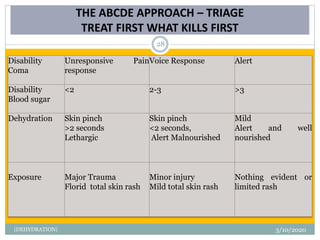
Disability
Coma
Unresponsive Pain
response
Voice Response Alert
Disability
Blood sugar
<2 2-3 >3
Dehydration Skin pinch
>2 seconds
Lethargic
Skin pinch
<2 seconds,
Alert Malnourished
Mild
Alert and well
nourished
Exposure Major Trauma
Florid total skin rash
Minor injury
Mild total skin rash
Nothing evident or
limited rash
3/10/2020|DEHYDRATION|
29
The ABCDE Approach - Treatment
Emergency Treatment of Children
and Adults
Airway – (Care with
Cervical Spine in Trauma)
Clear airway
Suction – If necessary
Breathing
Give assisted ventilation if
not breathing adequately
Use oxygen if available
3/10/2020|DEHYDRATION|
30
Malnourished Well Nourished
Capillary Refill
>3 seconds
Fluids IV Slowly Fluids IV rapidly
Capillary Refill
2-3 seconds
Oral Fluids Fluids IV
HR >150 Fluids IV Slowly Fluids IV Rapidly
HR 130-150 Oral Fluids Fluids IV
Low Blood Pressure Fluids IV Slowly Fluids IV Rapidly
Circulation – Child
3/10/2020|DEHYDRATION|
31
A B C D
Coma Clear/support Recovery
Position
IV Cannula Blood sugar
Convulsion Clear/support Recovery
Position
IV Cannula Blood
sugar/Drugs
Circulation – Adult – Unwell.
If Blood pressure <100 and Pulse > 100 give Normal Saline 500 mls.
Reasses and Repeat if still abnormal and patient unwell
Disability
3/10/2020|DEHYDRATION|
32
Malnourished Well nourished
Signs of Shock Fluids IV Slowly Fluids IV Rapidly
Skin Pinch >2 seconds Fluids IV Slowly Fluids IV Rapidly
Lethargic Try oral fluids first IV Fluids
Sunken Eyes Try oral fluids first IV Fluids
Dehydration
CALCULATIONS
3/10/2020|DEHYDRATION|
33
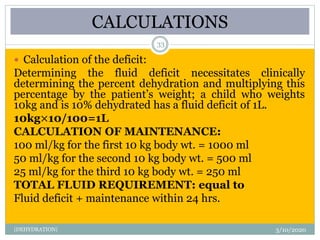
 Calculation of the deficit:
Determining the fluid deficit necessitates clinically
determining the percent dehydration and multiplying this
percentage by the patient’s weight; a child who weights
10kg and is 10% dehydrated has a fluid deficit of 1L.
10kg×10/100=1L
CALCULATION OF MAINTENANCE:
100 ml/kg for the first 10 kg body wt. = 1000 ml
50 ml/kg for the second 10 kg body wt. = 500 ml
25 ml/kg for the third 10 kg body wt. = 250 ml
TOTAL FLUID REQUIREMENT: equal to
Fluid deficit + maintenance within 24 hrs.
TREATMENT
3/10/2020|DEHYDRATION|
34
 WHO TREATMENT PLANS:
TREATMENT CONTINUE…
3/10/2020|DEHYDRATION|
35
TREATMENT CONTINUE…
3/10/2020|DEHYDRATION|
36
TREATMENT CONTINUE….
3/10/2020|DEHYDRATION|
37
TREATMENT CONTINUE
3/10/2020|DEHYDRATION|
38
TREATMENT CONTINUE…
3/10/2020|DEHYDRATION|
39
TREATMENT CONTINUE….
3/10/2020|DEHYDRATION|
40
TREATMENT CONTINUE….
3/10/2020|DEHYDRATION|
41
3/10/2020|DEHYDRATION|
42
PATIENT WITH DEHYDRATION & CHOLERA
COMPLICATION
3/10/2020|DEHYDRATION|
43
 Complications include:
1. Hypotension
2. Risk of falls related to hypotension
3. Decreased cardiac output and perfusion to tissues and
organs
4. Severe dehydration can progress to hypovolemic shock
Other complications include :
Renal failure & Death
PROGNOSIS
3/10/2020|DEHYDRATION|
44
 What Is the Prognosis of Dehydration in Adults?
 When dehydration is treated and the underlying cause
identified, most people will recover normally.
Dehydration caused by heat exposure, too much exercise,
or decreased water intake is generally easy to manage,
and the outcome is usually excellent. However, the
prognosis worsens as the severity of dehydration
increases and also depends on how well the underlying
cause responds to appropriate treatment.
REFERENCES
3/10/2020|DEHYDRATION|
45
 https://www.slideshare.net/ahm732/dehydration-41899819
 https://www.slideshare.net/jaaber/dehydration-5570782
 https://www.medicalnewstoday.com/articles/153363#symptoms
 https://dohs.gov.np/wp-content/uploads/2019/07/DoHS-
Annual-Report-FY-2074-75-date-22-Ashad-2076-for-web-1.pdf
 https://www.ncbi.nlm.nih.gov/pmc/articles/PMC6450136/
REFERENCES
3/10/2020|DEHYDRATION|
46
 https://healthinsight.org/tools-and-resources/send/128-educational-
resources/585-dehydration
 http://www.southsudanmedicaljournal.com/archive/may-2012/the-abcde-
approach-triage-and-treatment.html
 http://apps.who.int/medicinedocs/documents/s18015en/s18015en.pdf
 https://dohs.gov.np/wp-
content/uploads/2017/06/DoHS_Annual_Report_2072_73.pdf
3/10/2020|DEHYDRATION|
47
3/10/2020|DEHYDRATION|
48

Presentation on "DEHYDRATION"

  • 1.
    PRESENTATION ON “DEHYDRATION” PRESENTEDBY: RAJESH CHHETRI(18) & RAHAMAT KHAN(17) ROLL NO: EIGHTEEN(18) & SEVENTEEN(17) SUBJECT: PUBLIC HEALTH PHARMACY FACULTY: B.PHARM LEVEL: BACHELOR COLLEGE: SHREE MEDICAL AND TECHNICAL COLLEGE PRESENTED TO: JIWAN POUDYAL
  • 2.
  • 3.
    CONTENTS 3/10/2020|DEHYDRATION| 3  OBJECTIVES OFTHE STUDY  INTRODUCTION  CLINICAL FEATURES  CAUSES/DETERMINANTS/RISK FACTOR  NEPALESE CONTEXT -NEPALESE CONTEXT DATA PRESENTATION  FIRST AIDMANAGEMENT ABCD
  • 4.
    CONTENTS 3/10/2020|DEHYDRATION| 4  EVALUATION THEDEGREE OF DEHYDRATION  THE ABCDE APPROACH – TRIAGE TREAT FIRST WHAT KILLS FIRST  CALCULATIONS  TREATMENT  COMPLICATION  PROGNOSIS  REFERENCES
  • 5.
    OBJECTIVES OF THESTUDY 3/10/2020|DEHYDRATION| 5  Define dehydration  Identify causes and risk factors  Become familiar with medications that may exacerbate dehydration  Identify signs and symptoms of dehydration  Understand measures to prevent dehydration  Treatment of the dehydration
  • 6.
    INTRODUCTION 3/10/2020|DEHYDRATION| 6  Dehydration isa condition that occurs when an individual has lost so much fluid that the body can no longer function normally and develops signs and symptoms due to the loss of fluid.  Mostly water, exceeds the amount that is taken in. With dehydration  More water is moving out of individual cells and then out of the body than the amount of water that is taken in through drinking.
  • 7.
  • 8.
    INTRODUCTION CONTINUE….. 3/10/2020|DEHYDRATION| 8  Althoughinfants and children are at highest risk for dehydration, many adults and especially the elderly have significant risk factors.
  • 9.
    CLINICAL FEATURES 3/10/2020|DEHYDRATION| 9  Signs& Symptoms of dehydration in children: Signs of Dehydration: 1. Sunken eyes 2. Decreased frequency of urination or dry nappies 3. Sunken soft spot on the top of the head in babies (called the fontanels) 4. No tears when the child cries 5. Dry or sticky mucous membranes (the lining of the mouth or tongue) 6. Lethargy (less activity than normal) 7. Irritability (more crying, fussiness) 8. Abnormal capillary refill time
  • 10.
  • 11.
  • 12.
    CLINICAL FEATURES CONTINUE…. 3/10/2020|DEHYDRATION| 12 1.Abnormal skin turgor 2. Abnormal respiratory pattern
  • 13.
    CLINICAL FEATURES CONTINUE….. 3/10/2020|DEHYDRATION| 13 The first symptoms of dehydration include thirst, darker urine, and decreased urine production. In fact, urine color is one of the best indicators of a person’s hydration level – clear urine means you are well hydrated and darker urine means you are dehydrated.  However, it is important to note that, particularly in older adults, dehydration can occur without thirst. This is why it is important to drink more water when ill, or during hotter weather.  As the condition progresses to moderate dehydration, symptoms include:
  • 14.
    CLINICAL FEATURES CONTINUE…. 3/10/2020|DEHYDRATION| 14 dry mouth  lethargy  weakness in muscles  headache  dizziness
  • 15.
    CLINICAL FEATURES CONTINUE…. 3/10/2020|DEHYDRATION| 15 Severe dehydration (loss of 10-15 percent of the body’s water) may be characterized by extreme versions of the symptoms above as well as:  lack of sweating  sunken eyes  shriveled and dry skin  low blood pressure  increased heart rate  fever  delirium  unconsciousness
  • 16.
    CAUSES/DETERMINANTS/RISK FACTOR 3/10/2020|DEHYDRATION| 16  Someof the following causes are listed below: Excessive fluid loss Reduced fluid intake Other causes of fluid loss include:  Hemorrhage  Excessive perspiration  Acute renal failure with polyuria  Abdominal surgery
  • 17.
    CAUSES/DETERMINANTS/RISK FACTOR CONTINUE….. 3/10/2020|DEHYDRATION| 17  Vomitingor diarrhea  Nasogastric drainage  Excessive GI suctioning  Diabetes mellitus with polyuria or diabetes insipidus  Fistulas  Excessive use of laxatives
  • 18.
    Risk Factors forDehydration 3/10/2020|DEHYDRATION| 18  Elderly residents  Residents with chronic illnesses: – Diabetes – Kidney disease – Cystic fibrosis – Alcoholism – Adrenal gland disorders
  • 19.
    NEPALESE CONTEXT 3/10/2020|DEHYDRATION| 19  In2072/73, 1,248,093 cases of diarrhoea were reported of which 0.2 percent suffered from severe dehydration (a decrease from 0.3 percent the previous year).  % of children under five years with diarrhoea suffering from dehydration (facility, outreach & community level) -2070/2071: Not defined -2071/72: 21 -2072/73: 20
  • 20.
  • 21.
    FIRST AIDMANAGEMENT ABCD 3/10/2020|DEHYDRATION| 21 First aid treatment for dehydration  There are some simple first aid steps you can take if you suspect someone is suffering from dehydration.  Assist the casualty into a cool, shaded place  Encourage them to sit down and stop any physical activity  Provide plenty of water or Oral Rehydration Solution (ORS) to drink  If the patient is suffering from cramp, stretch and massage the affected muscles  Monitor and record vital signs (eg: pulse / respiratory rate) if trained
  • 22.
    EVALUATION THE DEGREEOF DEHYDRATION 3/10/2020|DEHYDRATION| 22  Mild dehydration (<5% in an infant; <3% in an older child or adult): Normal or increased pulse decreased urine output Thirsty Normal Physical findings  Moderate dehydration (5-10% in an infant; 3-6 in an older child or adult): Tachycardia, little or no urine output, irritable/lethargic, sunken eyes and fontanel, decreased tears, dry mucous membranes, mild delay in elasticity (skin turgor)
  • 23.
    EVALUATION THE DEGREEOF DEHYDRATION CONTINUE….. 3/10/2020|DEHYDRATION| 23  Severe dehydration (>10% in an infant, >6% in an older child or adult): Peripheral pulses either rapid and weak or absent Decreased blood pressure No urine output Very sunken eyes and fontanel , no tears,
  • 24.
    EVALUATION THE DEGREEOF DEHYDRATION CONTINUE 3/10/2020|DEHYDRATION| 24  The ABCDE Approach Treatment Chart (Chart 2) This gives practical advice on emergency management of unwell patients. Using the ABCDE approach  Airway assessment is always the first as it is imperative that the airway is not obstructed. For detailed advice on management of the airway see the WHO ETAT course (1).  Breathing should be adequate; if breathing assistance is required use a bag valve mask device or give oxygen if available. Only when problems with airway and breathing are addressed should the clinician move onto circulation.
  • 25.
    EVALUATION THE DEGREEOF DEHYDRATION CONTINUE 3/10/2020|DEHYDRATION| 25  Circulation. The chart gives guidance on the use of fluids. It is important to recognise malnutrition at this stage, as rapid infusion of intravenous fluids to a malnourished child can be very dangerous. Depending upon measurement of capillary refill, heart rate and blood pressure, give fluids: rapidly IV, slowly IV, or orally.
  • 26.
    EVALUATION THE DEGREEOF DEHYDRATION CONTINUE 3/10/2020|DEHYDRATION| 26  Disability. If the patient shows signs of disability (either coma or convulsion) airway and breathing management are top priority. It is then appropriate to insert an IV cannual and measure the blood sugar if possible. These patients are at risk of low blood sugar and often it is safer to give glucose as soon as possible.  Dehydration - is so common in tropical countries that checking for signs of dehydration should be routine. The signs of shock have already been looked for while assessing circulation but specific examination for loose skin, lethargy and sunken eyes should occur.  Exposure. Finally it is important to look at the whole patient, to look for signs of a rash, trauma or swollen abdomen.
  • 27.
    THE ABCDE APPROACH– TRIAGE TREAT FIRST WHAT KILLS FIRST 3/10/2020|DEHYDRATION| 27 Emergency Priority Queue Airway Obstructed At risk Clear Breathing Rate >40 or <10 30 -40 10-30 Breathing Colour Blue (Cyanosis) Pink or Pale Pink Breathing Effort Distressed using accessory muscles Mild distress No distress Circulation Capillary Refill >3 second (shock) >2 seconds <2 seconds Circulation Pulse rate >150 (<40) >130 (<60) 60-100 Circulation Temperature Low (Shock) Normal or High Normal or High
  • 28.
    THE ABCDE APPROACH– TRIAGE TREAT FIRST WHAT KILLS FIRST 3/10/2020|DEHYDRATION| 28 Disability Coma Unresponsive Pain response Voice Response Alert Disability Blood sugar <2 2-3 >3 Dehydration Skin pinch >2 seconds Lethargic Skin pinch <2 seconds, Alert Malnourished Mild Alert and well nourished Exposure Major Trauma Florid total skin rash Minor injury Mild total skin rash Nothing evident or limited rash
  • 29.
    3/10/2020|DEHYDRATION| 29 The ABCDE Approach- Treatment Emergency Treatment of Children and Adults Airway – (Care with Cervical Spine in Trauma) Clear airway Suction – If necessary Breathing Give assisted ventilation if not breathing adequately Use oxygen if available
  • 30.
    3/10/2020|DEHYDRATION| 30 Malnourished Well Nourished CapillaryRefill >3 seconds Fluids IV Slowly Fluids IV rapidly Capillary Refill 2-3 seconds Oral Fluids Fluids IV HR >150 Fluids IV Slowly Fluids IV Rapidly HR 130-150 Oral Fluids Fluids IV Low Blood Pressure Fluids IV Slowly Fluids IV Rapidly Circulation – Child
  • 31.
    3/10/2020|DEHYDRATION| 31 A B CD Coma Clear/support Recovery Position IV Cannula Blood sugar Convulsion Clear/support Recovery Position IV Cannula Blood sugar/Drugs Circulation – Adult – Unwell. If Blood pressure <100 and Pulse > 100 give Normal Saline 500 mls. Reasses and Repeat if still abnormal and patient unwell Disability
  • 32.
    3/10/2020|DEHYDRATION| 32 Malnourished Well nourished Signsof Shock Fluids IV Slowly Fluids IV Rapidly Skin Pinch >2 seconds Fluids IV Slowly Fluids IV Rapidly Lethargic Try oral fluids first IV Fluids Sunken Eyes Try oral fluids first IV Fluids Dehydration
  • 33.
    CALCULATIONS 3/10/2020|DEHYDRATION| 33  Calculation ofthe deficit: Determining the fluid deficit necessitates clinically determining the percent dehydration and multiplying this percentage by the patient’s weight; a child who weights 10kg and is 10% dehydrated has a fluid deficit of 1L. 10kg×10/100=1L CALCULATION OF MAINTENANCE: 100 ml/kg for the first 10 kg body wt. = 1000 ml 50 ml/kg for the second 10 kg body wt. = 500 ml 25 ml/kg for the third 10 kg body wt. = 250 ml TOTAL FLUID REQUIREMENT: equal to Fluid deficit + maintenance within 24 hrs.
  • 34.
  • 35.
  • 36.
  • 37.
  • 38.
  • 39.
  • 40.
  • 41.
  • 42.
  • 43.
    COMPLICATION 3/10/2020|DEHYDRATION| 43  Complications include: 1.Hypotension 2. Risk of falls related to hypotension 3. Decreased cardiac output and perfusion to tissues and organs 4. Severe dehydration can progress to hypovolemic shock Other complications include : Renal failure & Death
  • 44.
    PROGNOSIS 3/10/2020|DEHYDRATION| 44  What Isthe Prognosis of Dehydration in Adults?  When dehydration is treated and the underlying cause identified, most people will recover normally. Dehydration caused by heat exposure, too much exercise, or decreased water intake is generally easy to manage, and the outcome is usually excellent. However, the prognosis worsens as the severity of dehydration increases and also depends on how well the underlying cause responds to appropriate treatment.
  • 45.
    REFERENCES 3/10/2020|DEHYDRATION| 45  https://www.slideshare.net/ahm732/dehydration-41899819  https://www.slideshare.net/jaaber/dehydration-5570782 https://www.medicalnewstoday.com/articles/153363#symptoms  https://dohs.gov.np/wp-content/uploads/2019/07/DoHS- Annual-Report-FY-2074-75-date-22-Ashad-2076-for-web-1.pdf  https://www.ncbi.nlm.nih.gov/pmc/articles/PMC6450136/
  • 46.
  • 47.
  • 48.