
PresentationPresentation
OnOn
ConsumptionConsumption
HighlightsHighlights
Definition.Definition.
Types of Consumption.Types of Consumption.
MPC,APC,MPS,APSMPC,APC,MPS,APS
ConsumptionConsumption
 Consumption of goods and services is theConsumption of goods and services is the
amount of them used in a particular timeamount of them used in a particular time
period.period.
 The study of consumption behaviour plays aThe study of consumption behaviour plays a
central role in both macroeconomics andcentral role in both macroeconomics and
microeconomics.microeconomics.
Consumption Function= a + by.Consumption Function= a + by.
Types of ConsumptionTypes of Consumption
FunctionFunction
Linear Consumption FunctionLinear Consumption Function
Non-Linear ConsumptionNon-Linear Consumption
Function.Function.
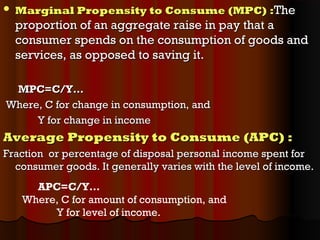
 Marginal Propensity to Consume (MPC)Marginal Propensity to Consume (MPC) ::TheThe
proportion of an aggregate raise in pay that aproportion of an aggregate raise in pay that a
consumer spends on the consumption of goods andconsumer spends on the consumption of goods and
services, as opposed to saving it.services, as opposed to saving it.
MPC=C/Y…MPC=C/Y…
Where, C for change in consumption, andWhere, C for change in consumption, and
Y for change in incomeY for change in income
Average Propensity to Consume (APC) :Average Propensity to Consume (APC) :
Fraction or percentage of disposal personal income spent forFraction or percentage of disposal personal income spent for
consumer goods. It generally varies with the level of income.consumer goods. It generally varies with the level of income.
APC=C/Y…
Where, C for amount of consumption, and
Y for level of income.
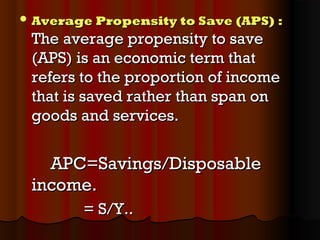
 Average Propensity to Save (APS)Average Propensity to Save (APS) ::
The average propensity to saveThe average propensity to save
(APS) is an economic term that(APS) is an economic term that
refers to the proportion of incomerefers to the proportion of income
that is saved rather than span onthat is saved rather than span on
goods and services.goods and services.
APC=Savings/DisposableAPC=Savings/Disposable
income.income.
= S/Y..= S/Y..
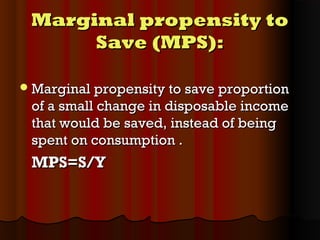
Marginal propensity toMarginal propensity to
Save (MPS):Save (MPS):
Marginal propensity to save proportionMarginal propensity to save proportion
of a small change in disposable incomeof a small change in disposable income
that would be saved, instead of beingthat would be saved, instead of being
spent on consumption .spent on consumption .
MPS=S/YMPS=S/Y
Presentation on Consumption

Presentation on Consumption

  • 1.
  • 2.
  • 3.
    ConsumptionConsumption  Consumption ofgoods and services is theConsumption of goods and services is the amount of them used in a particular timeamount of them used in a particular time period.period.  The study of consumption behaviour plays aThe study of consumption behaviour plays a central role in both macroeconomics andcentral role in both macroeconomics and microeconomics.microeconomics. Consumption Function= a + by.Consumption Function= a + by.
  • 4.
    Types of ConsumptionTypesof Consumption FunctionFunction Linear Consumption FunctionLinear Consumption Function Non-Linear ConsumptionNon-Linear Consumption Function.Function.
  • 5.
     Marginal Propensityto Consume (MPC)Marginal Propensity to Consume (MPC) ::TheThe proportion of an aggregate raise in pay that aproportion of an aggregate raise in pay that a consumer spends on the consumption of goods andconsumer spends on the consumption of goods and services, as opposed to saving it.services, as opposed to saving it. MPC=C/Y…MPC=C/Y… Where, C for change in consumption, andWhere, C for change in consumption, and Y for change in incomeY for change in income Average Propensity to Consume (APC) :Average Propensity to Consume (APC) : Fraction or percentage of disposal personal income spent forFraction or percentage of disposal personal income spent for consumer goods. It generally varies with the level of income.consumer goods. It generally varies with the level of income. APC=C/Y… Where, C for amount of consumption, and Y for level of income.
  • 6.
     Average Propensityto Save (APS)Average Propensity to Save (APS) :: The average propensity to saveThe average propensity to save (APS) is an economic term that(APS) is an economic term that refers to the proportion of incomerefers to the proportion of income that is saved rather than span onthat is saved rather than span on goods and services.goods and services. APC=Savings/DisposableAPC=Savings/Disposable income.income. = S/Y..= S/Y..
  • 7.
    Marginal propensity toMarginalpropensity to Save (MPS):Save (MPS): Marginal propensity to save proportionMarginal propensity to save proportion of a small change in disposable incomeof a small change in disposable income that would be saved, instead of beingthat would be saved, instead of being spent on consumption .spent on consumption . MPS=S/YMPS=S/Y