Consumption
Lower 6th Macro
Aggregate Demand
Intro to
Consumption
Consumption
Mr O’Grady
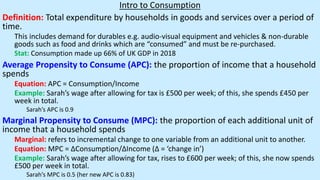
Intro to Consumption
Definition: Total expenditure by households in goods and services over a period of
time.
This includes demand for durables e.g. audio-visual equipment and vehicles & non-durable
goods such as food and drinks which are “consumed” and must be re-purchased.
Stat: Consumption made up 66% of UK GDP in 2018
Average Propensity to Consume (APC): the proportion of income that a household
spends
Equation: APC = Consumption/Income
Example: Sarah’s wage after allowing for tax is £500 per week; of this, she spends £450 per
week in total.
Sarah’s APC is 0.9
Marginal Propensity to Consume (MPC): the proportion of each additional unit of
income that a household spends
Marginal: refers to incremental change to one variable from an additional unit to another.
Equation: MPC = ∆Consumption/∆Income (∆ = ‘change in’)
Example: Sarah’s wage after allowing for tax, rises to £600 per week; of this, she now spends
ÂŁ500 per week in total.
Sarah’s MPC is 0.5 (her new APC is 0.83)
Determinants
of Consumption
Consumption
Mr O’Grady
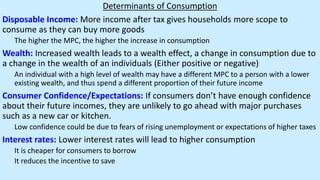
Determinants of Consumption
Disposable Income: More income after tax gives households more scope to
consume as they can buy more goods
The higher the MPC, the higher the increase in consumption
Wealth: Increased wealth leads to a wealth effect, a change in consumption due to
a change in the wealth of an individuals (Either positive or negative)
An individual with a high level of wealth may have a different MPC to a person with a lower
existing wealth, and thus spend a different proportion of their future income
Consumer Confidence/Expectations: If consumers don’t have enough confidence
about their future incomes, they are unlikely to go ahead with major purchases
such as a new car or kitchen.
Low confidence could be due to fears of rising unemployment or expectations of higher taxes
Interest rates: Lower interest rates will lead to higher consumption
It is cheaper for consumers to borrow
It reduces the incentive to save
Demographics: Young/elderly typically have a high APC
Old people have high APC as their incomes are low after retiring. They are living off the
savings they made when their income was higher in their working lives.
Young people have high APC as their incomes are low. They have limited scope to save as
they spend a large proportion of their income to live a satisfactory standard of life.
Distribution of income: Those on the lowest incomes spend a greater proportion
of them as they have lower ability to save
Redistributing income from the rich to the poor would encourage an increase in consumption
and stimulate economic output
Income tax level: lower levels of income tax mean more income after tax to be
spent on consumption
Greater MPC, means a greater increase in consumption
Unemployment rates: More unemployment means lower income and less
confidence
This harms consumption
The Relationship
between Savings
and Consumption
Consumption
Mr O’Grady
The Relationship between Savings and Consumption
Savings: The part of a person’s income that is not immediately spent on goods and
services, but is put aside for future consumption, often gaining interest
Whilst not a component of aggregate demand, the level of saving in an economy has a direct
impact upon the level of consumption, and hence, aggregate demand
In economics, any disposable household income that is not used for consumption is said to
have been saved
Marginal propensity to save: the proportion of each additional unit of income
that a household saves
Determinants of Savings:
Interest rates: Higher interest rates increase the incentives to save as the reward is greater
Confidence: If individuals and workers are nervous about the future, they may be inclined to
save more of their income in the event of wage cuts, wage freezes or redundancy
Inflation: If prices are rising quickly, then the real value of savings is eroded, so the incentive
to save reduces
Where next?
Don’t forget to SUBSCRIBE!
Visit our website: www.smootheconomics.co.uk
Find more resources, extension materials,
details of courses, competitions, and more!
Follow our socials:
Instagram: @smootheconomics
Twitter: @SmoothEconomics
Facebook: @SmoothEconomics

Consumption (C)

  • 1.
  • 2.
  • 3.
    Intro to Consumption Definition:Total expenditure by households in goods and services over a period of time. This includes demand for durables e.g. audio-visual equipment and vehicles & non-durable goods such as food and drinks which are “consumed” and must be re-purchased. Stat: Consumption made up 66% of UK GDP in 2018 Average Propensity to Consume (APC): the proportion of income that a household spends Equation: APC = Consumption/Income Example: Sarah’s wage after allowing for tax is £500 per week; of this, she spends £450 per week in total. Sarah’s APC is 0.9 Marginal Propensity to Consume (MPC): the proportion of each additional unit of income that a household spends Marginal: refers to incremental change to one variable from an additional unit to another. Equation: MPC = ∆Consumption/∆Income (∆ = ‘change in’) Example: Sarah’s wage after allowing for tax, rises to £600 per week; of this, she now spends £500 per week in total. Sarah’s MPC is 0.5 (her new APC is 0.83)
  • 4.
  • 5.
    Determinants of Consumption DisposableIncome: More income after tax gives households more scope to consume as they can buy more goods The higher the MPC, the higher the increase in consumption Wealth: Increased wealth leads to a wealth effect, a change in consumption due to a change in the wealth of an individuals (Either positive or negative) An individual with a high level of wealth may have a different MPC to a person with a lower existing wealth, and thus spend a different proportion of their future income Consumer Confidence/Expectations: If consumers don’t have enough confidence about their future incomes, they are unlikely to go ahead with major purchases such as a new car or kitchen. Low confidence could be due to fears of rising unemployment or expectations of higher taxes Interest rates: Lower interest rates will lead to higher consumption It is cheaper for consumers to borrow It reduces the incentive to save
  • 6.
    Demographics: Young/elderly typicallyhave a high APC Old people have high APC as their incomes are low after retiring. They are living off the savings they made when their income was higher in their working lives. Young people have high APC as their incomes are low. They have limited scope to save as they spend a large proportion of their income to live a satisfactory standard of life. Distribution of income: Those on the lowest incomes spend a greater proportion of them as they have lower ability to save Redistributing income from the rich to the poor would encourage an increase in consumption and stimulate economic output Income tax level: lower levels of income tax mean more income after tax to be spent on consumption Greater MPC, means a greater increase in consumption Unemployment rates: More unemployment means lower income and less confidence This harms consumption
  • 7.
    The Relationship between Savings andConsumption Consumption Mr O’Grady
  • 8.
    The Relationship betweenSavings and Consumption Savings: The part of a person’s income that is not immediately spent on goods and services, but is put aside for future consumption, often gaining interest Whilst not a component of aggregate demand, the level of saving in an economy has a direct impact upon the level of consumption, and hence, aggregate demand In economics, any disposable household income that is not used for consumption is said to have been saved Marginal propensity to save: the proportion of each additional unit of income that a household saves Determinants of Savings: Interest rates: Higher interest rates increase the incentives to save as the reward is greater Confidence: If individuals and workers are nervous about the future, they may be inclined to save more of their income in the event of wage cuts, wage freezes or redundancy Inflation: If prices are rising quickly, then the real value of savings is eroded, so the incentive to save reduces
  • 9.
    Where next? Don’t forgetto SUBSCRIBE! Visit our website: www.smootheconomics.co.uk Find more resources, extension materials, details of courses, competitions, and more! Follow our socials: Instagram: @smootheconomics Twitter: @SmoothEconomics Facebook: @SmoothEconomics