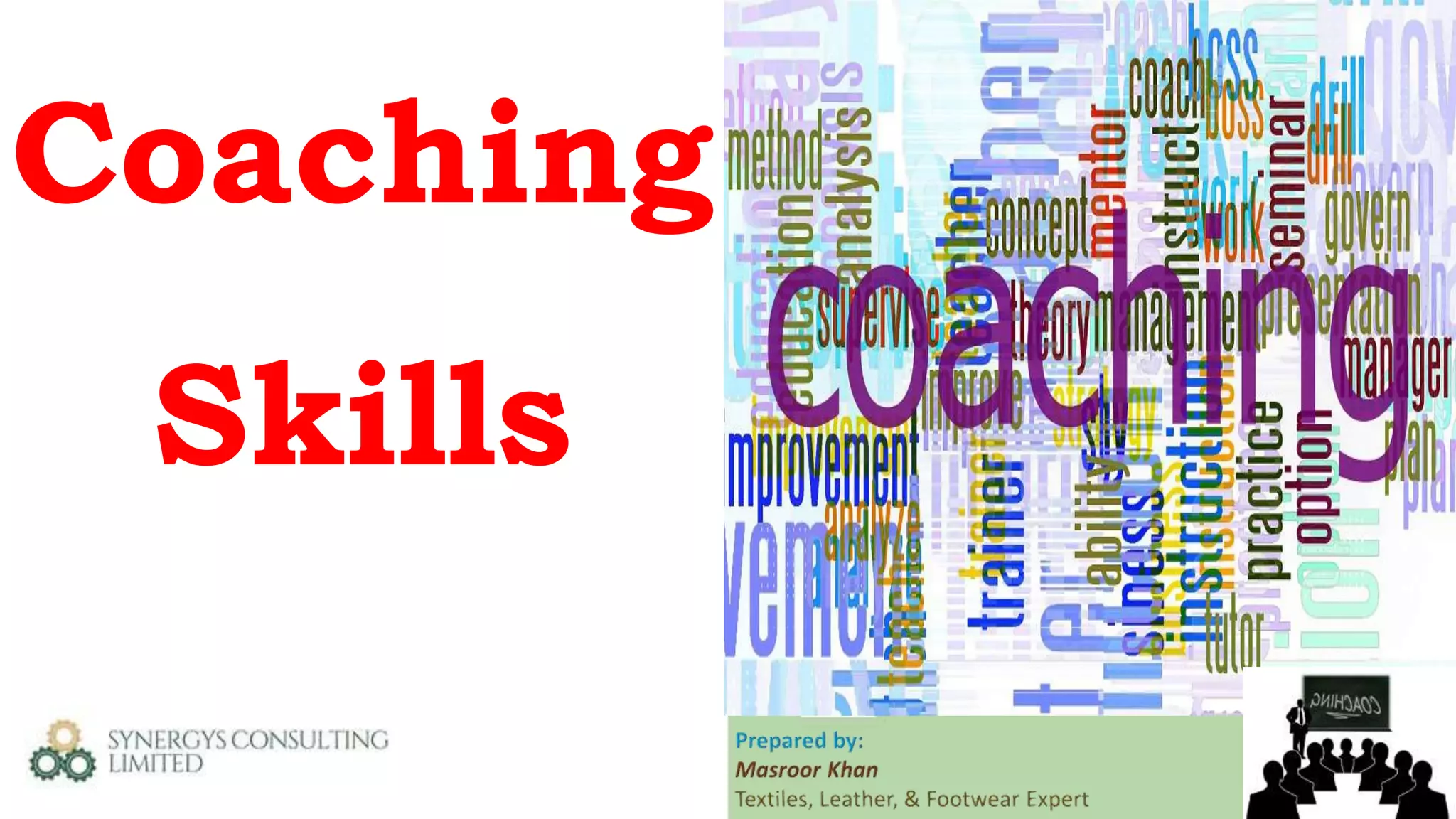
Coaching
Skills
What is Coaching
Coaching is a process that enables learning and
development to occur and thus performance to
improve.
To be successful a Coach requires a knowledge and
understanding of process as well as the variety of
styles, skills, and techniques that are appropriate to
the context in which the coaching takes place
(Eric Parsloe, The Manager, Coach, and Mentor)
Types of Coaching
•Business Coaching
•Executive Coaching
•Career Coaching
•Life Coaching
Business Coaching
A business coach will assist and guide
the business owner in running
a business by helping them clarify the
vision of their business and how it fits
in with their personal goals. Business
coaching is a process used to take
a business from where it is now to
where the business owner wants it to be.
Business Coaching
Business coaches are
typically expert
entrepreneurs who know
what it takes to make a
business successful.
What does Business Coaches do?
Business coaches work:
• To refine your talents
• Hone your goals
• Guide your decisions
• Do everything else that they can do to ensure that
you and your business are successful.
Business coaches start by learning everything that they
can about your brand, from its value propositions to its
target customers to the challenges it will face and
beyond.
Quote
“The true Measure of
the value of any
business leader and
manager is
performance.”
(Brian Tracy)
Executive Coaching
An executive coach is a qualified
professional that works with individuals
(usually executives, but often high
potential employees) to help them gain
self-awareness, clarify goals, achieve
their development objectives, unlock
their potential, and act as a sounding
board.
Executive Coaching
Executives have limited opportunity to devote
time and energy to their own development as
leaders.
“Most executives struggle to fulfill the
responsibilities of their positions and are too busy
and too stressed to step back and learn from their
experiences or to implement changes to satisfy
best management practices.”
What does Executive Coaches do?
• To develop the leadership skills of high-
potential individuals.
• To improve the odds that newly promoted
managers would be successful.
• To develop management and leadership skills
among their technical people.
• To correct behavioral problems at the
management level.
• To help leaders resolve interpersonal conflicts
among employees.
Career Coaching
Career coaching helps you
identify your career goals,
develop a strategy with action
steps to reach those goals, and
provide accountability as you
move along the path to achieving
your goals.
Career Coaching
Career coaches work with you to
guide you in clarifying your career
purpose and values and aligning
them with all aspects of your life
because a healthy career can have a
direct effect on the health and
happiness of all other parts of your
life.
What does Career Coaches do?
• Career coaches focus on helping you achieve your personal definition for
success
• prepare for a new career by developing resumes, cover letters, LinkedIn
Profiles, job applications, job search techniques, and networking strategies
• A career coach can also help you pursue advancement opportunities and reach
your growth potential by working to secure promotions, raises, advanced
degrees, training, and even negotiating a higher salary at a new job.
• Career coaches can work with you at any point of your career where you’re
feeling unfulfilled
• The right career coach (i.e., a career coach with a solid business background)
can even help you pursue your entrepreneurial vision by starting a new business
• Career coach can support you in skills improvement such as leadership, public
speaking, personal branding, communications, personnel management, team
building, conflict resolution, networking, problem solving, time management,
work-life balance, profit-building, ethics, systems management, delegating,
productivity, planning, decision-making, negotiating, and more
Life Coaching
Life Coaching is a profession that is profoundly
different from consulting, mentoring, advice,
therapy, or counseling. The coaching process
addresses specific personal projects, business
successes, general conditions and transitions in the
client's personal life, relationships or profession by
examining what is going on right now, discovering
what your obstacles or challenges might be, and
choosing a course of action to make your life be
what you want it to be.
Life Coaching
Life Coaching is a designed alliance
between coach and client where the
coaching relationship continually gives
all the power back to you, the client.
They believe that you know the answers
to every question or challenge you may
have in your life, even if those answers
appear to be obscured, concealed or
hidden inside.
What does Life Coaches do?
They support:
• Confidence, Self Worth & Self Esteem
• Loving Relationships That Work
• Career Change - Creating Workplaces That Work
• The Mastery of Balance - Juggling a Life
• Self Care - Getting Your Own Needs Met
• Living Your Purpose
• Hot Buttons - Managing Anger, Upsets, Frustration and Stress
• Managing Grief, Loss, Sadness and Change
• Connection Parenting
• Self & Identity - Surviving the Oppressive Over-Culture
• Homesteading, Environmental Activism & Permaculture
• Artists - Creativity & Art
• Food, Nutrition, & Optimal Health
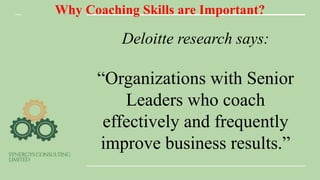
Why Coaching Skills are Important?
Deloitte research says:
“Organizations with Senior
Leaders who coach
effectively and frequently
improve business results.”
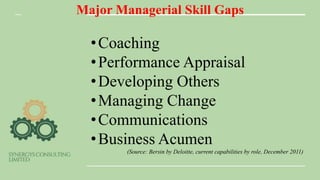
Major Managerial Skill Gaps
•Coaching
•Performance Appraisal
•Developing Others
•Managing Change
•Communications
•Business Acumen
(Source: Bersin by Deloitte, current capabilities by role, December 2011)
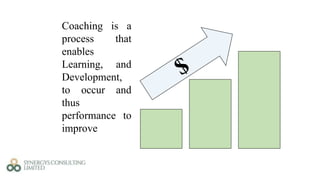
Coaching is a
process that
enables
Learning, and
Development,
to occur and
thus
performance to
improve
To be successful a coach requires a
knowledge and understanding of
process, as well as the variety of styles,
and techniques that are appropriate to
the context in which the coaching
takes place.
(Eric Parsloe, the manager coach, and mentor)
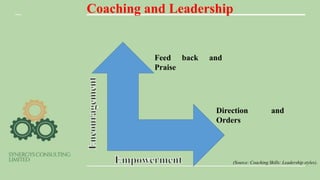
Coaching and Leadership
Feed back and
Praise
Direction and
Orders
(Source: Coaching Skills: Leadership styles).
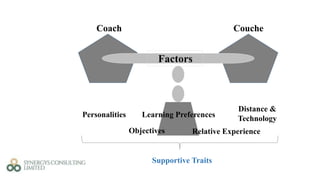
Factors
Coach Couche
Personalities Learning Preferences
Distance &
Technology
Objectives Relative Experience
Supportive Traits
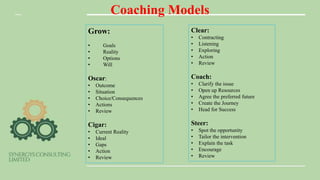
Coaching Models
Grow:
• Goals
• Reality
• Options
• Will
Oscar:
• Outcome
• Situation
• Choice/Consequences
• Actions
• Review
Cigar:
• Current Reality
• Ideal
• Gaps
• Action
• Review
Clear:
• Contracting
• Listening
• Exploring
• Action
• Review
Coach:
• Clarify the issue
• Open up Resources
• Agree the preferred future
• Create the Journey
• Head for Success
Steer:
• Spot the opportunity
• Tailor the intervention
• Explain the task
• Encourage
• Review
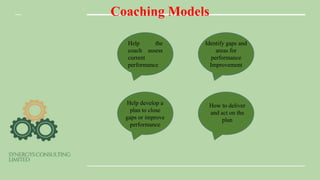
Coaching Models
Help the
coach assess
current
performance
Identify gaps and
areas for
performance
Improvement
Help develop a
plan to close
gaps or improve
performance
How to deliver
and act on the
plan
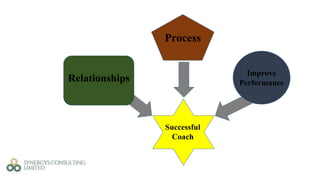
Coaching is building
ONE – ON – ONE
relationships and
managing a process that
results in specific
improved performance
in targeted areas.
Successful
Coach
Process
Improve
Performance
Relationships
Quote
“Today’s coaches must be
multifunctional, and be equally
competent as a Manager, Technicians,
Trainer, Psychologist, Physiologist, and
even a councilor. You simply cannot coach
the same way as you did ten, fifteen, or
twenty years ago for a number of
reasons.”
(Garry Curnee, Professional Coach and a Blogger)
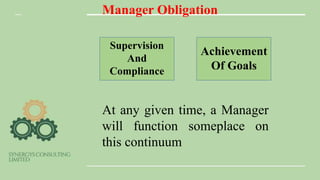
Manager Obligation
Supervision
And
Compliance
Achievement
Of Goals
At any given time, a Manager
will function someplace on
this continuum
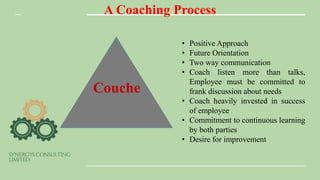
A Coaching Process
Couche
• Positive Approach
• Future Orientation
• Two way communication
• Coach listen more than talks,
Employee must be committed to
frank discussion about needs
• Coach heavily invested in success
of employee
• Commitment to continuous learning
by both parties
• Desire for improvement
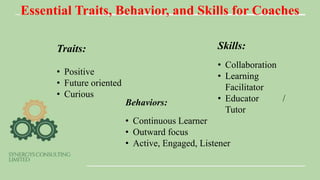
Essential Traits, Behavior, and Skills for Coaches
Traits:
• Positive
• Future oriented
• Curious
Skills:
• Collaboration
• Learning
Facilitator
• Educator /
Tutor
Behaviors:
• Continuous Learner
• Outward focus
• Active, Engaged, Listener
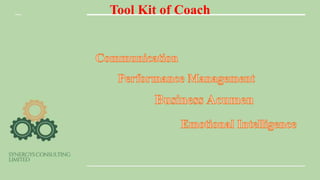
Tool Kit of Coach
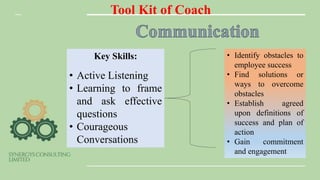
Tool Kit of Coach
Key Skills:
• Active Listening
• Learning to frame
and ask effective
questions
• Courageous
Conversations
• Identify obstacles to
employee success
• Find solutions or
ways to overcome
obstacles
• Establish agreed
upon definitions of
success and plan of
action
• Gain commitment
and engagement
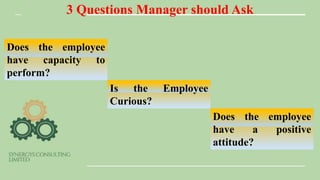
3 Questions Manager should Ask
Does the employee
have capacity to
perform?
Is the Employee
Curious?
Does the employee
have a positive
attitude?
Tool Kit of Coach
Key Skills:
• Understand
employee
Engagement and
Motivation
• Goal Setting
• Delegation
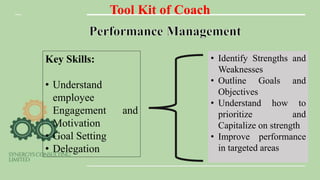
• Identify Strengths and
Weaknesses
• Outline Goals and
Objectives
• Understand how to
prioritize and
Capitalize on strength
• Improve performance
in targeted areas
Quote
With each generation entering the workplace, a
greater emphasis is placed on continual development
as these new employees know that they are unlikely to
stay more than a few years.
It’s about what they can develop and acquire to take
to the next stop in the career journey.
We know that effective leaders are one of the most
important influences on levels of engagement.
(Rebecca Ray. Employee engagement in a VUCA world)
Tool Kit of Coach
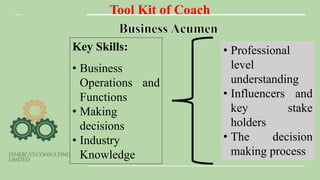
Key Skills:
• Business
Operations and
Functions
• Making
decisions
• Industry
Knowledge
• Professional
level
understanding
• Influencers and
key stake
holders
• The decision
making process
Tool Kit of Coach
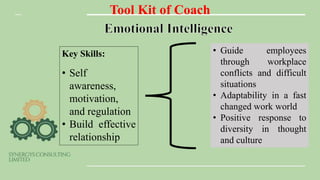
Key Skills:
• Self
awareness,
motivation,
and regulation
• Build effective
relationship
• Guide employees
through workplace
conflicts and difficult
situations
• Adaptability in a fast
changed work world
• Positive response to
diversity in thought
and culture
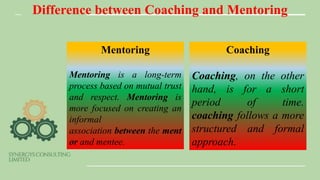
Difference between Coaching and Mentoring
Mentoring
Mentoring is a long-term
process based on mutual trust
and respect. Mentoring is
more focused on creating an
informal
association between the ment
or and mentee.
Coaching
Coaching, on the other
hand, is for a short
period of time.
coaching follows a more
structured and formal
approach.
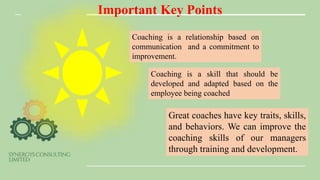
Important Key Points
Coaching is a relationship based on
communication and a commitment to
improvement.
Coaching is a skill that should be
developed and adapted based on the
employee being coached
Great coaches have key traits, skills,
and behaviors. We can improve the
coaching skills of our managers
through training and development.
QUOTE
“The interesting thing
about coaching is that
you have to trouble the
comfortable, and
comfort the troubled.”
(Ric Charlesworth, Hockey)

Coaching Skills rev 1.pptx

  • 1.
  • 2.
    What is Coaching Coachingis a process that enables learning and development to occur and thus performance to improve. To be successful a Coach requires a knowledge and understanding of process as well as the variety of styles, skills, and techniques that are appropriate to the context in which the coaching takes place (Eric Parsloe, The Manager, Coach, and Mentor)
  • 3.
    Types of Coaching •BusinessCoaching •Executive Coaching •Career Coaching •Life Coaching
  • 4.
    Business Coaching A businesscoach will assist and guide the business owner in running a business by helping them clarify the vision of their business and how it fits in with their personal goals. Business coaching is a process used to take a business from where it is now to where the business owner wants it to be.
  • 5.
    Business Coaching Business coachesare typically expert entrepreneurs who know what it takes to make a business successful.
  • 6.
    What does BusinessCoaches do? Business coaches work: • To refine your talents • Hone your goals • Guide your decisions • Do everything else that they can do to ensure that you and your business are successful. Business coaches start by learning everything that they can about your brand, from its value propositions to its target customers to the challenges it will face and beyond.
  • 7.
    Quote “The true Measureof the value of any business leader and manager is performance.” (Brian Tracy)
  • 8.
    Executive Coaching An executivecoach is a qualified professional that works with individuals (usually executives, but often high potential employees) to help them gain self-awareness, clarify goals, achieve their development objectives, unlock their potential, and act as a sounding board.
  • 9.
    Executive Coaching Executives havelimited opportunity to devote time and energy to their own development as leaders. “Most executives struggle to fulfill the responsibilities of their positions and are too busy and too stressed to step back and learn from their experiences or to implement changes to satisfy best management practices.”
  • 10.
    What does ExecutiveCoaches do? • To develop the leadership skills of high- potential individuals. • To improve the odds that newly promoted managers would be successful. • To develop management and leadership skills among their technical people. • To correct behavioral problems at the management level. • To help leaders resolve interpersonal conflicts among employees.
  • 11.
    Career Coaching Career coachinghelps you identify your career goals, develop a strategy with action steps to reach those goals, and provide accountability as you move along the path to achieving your goals.
  • 12.
    Career Coaching Career coacheswork with you to guide you in clarifying your career purpose and values and aligning them with all aspects of your life because a healthy career can have a direct effect on the health and happiness of all other parts of your life.
  • 13.
    What does CareerCoaches do? • Career coaches focus on helping you achieve your personal definition for success • prepare for a new career by developing resumes, cover letters, LinkedIn Profiles, job applications, job search techniques, and networking strategies • A career coach can also help you pursue advancement opportunities and reach your growth potential by working to secure promotions, raises, advanced degrees, training, and even negotiating a higher salary at a new job. • Career coaches can work with you at any point of your career where you’re feeling unfulfilled • The right career coach (i.e., a career coach with a solid business background) can even help you pursue your entrepreneurial vision by starting a new business • Career coach can support you in skills improvement such as leadership, public speaking, personal branding, communications, personnel management, team building, conflict resolution, networking, problem solving, time management, work-life balance, profit-building, ethics, systems management, delegating, productivity, planning, decision-making, negotiating, and more
  • 14.
    Life Coaching Life Coachingis a profession that is profoundly different from consulting, mentoring, advice, therapy, or counseling. The coaching process addresses specific personal projects, business successes, general conditions and transitions in the client's personal life, relationships or profession by examining what is going on right now, discovering what your obstacles or challenges might be, and choosing a course of action to make your life be what you want it to be.
  • 15.
    Life Coaching Life Coachingis a designed alliance between coach and client where the coaching relationship continually gives all the power back to you, the client. They believe that you know the answers to every question or challenge you may have in your life, even if those answers appear to be obscured, concealed or hidden inside.
  • 16.
    What does LifeCoaches do? They support: • Confidence, Self Worth & Self Esteem • Loving Relationships That Work • Career Change - Creating Workplaces That Work • The Mastery of Balance - Juggling a Life • Self Care - Getting Your Own Needs Met • Living Your Purpose • Hot Buttons - Managing Anger, Upsets, Frustration and Stress • Managing Grief, Loss, Sadness and Change • Connection Parenting • Self & Identity - Surviving the Oppressive Over-Culture • Homesteading, Environmental Activism & Permaculture • Artists - Creativity & Art • Food, Nutrition, & Optimal Health
  • 17.
    Why Coaching Skillsare Important? Deloitte research says: “Organizations with Senior Leaders who coach effectively and frequently improve business results.”
  • 18.
    Major Managerial SkillGaps •Coaching •Performance Appraisal •Developing Others •Managing Change •Communications •Business Acumen (Source: Bersin by Deloitte, current capabilities by role, December 2011)
  • 19.
    Coaching is a processthat enables Learning, and Development, to occur and thus performance to improve
  • 20.
    To be successfula coach requires a knowledge and understanding of process, as well as the variety of styles, and techniques that are appropriate to the context in which the coaching takes place. (Eric Parsloe, the manager coach, and mentor)
  • 21.
    Coaching and Leadership Feedback and Praise Direction and Orders (Source: Coaching Skills: Leadership styles).
  • 22.
    Factors Coach Couche Personalities LearningPreferences Distance & Technology Objectives Relative Experience Supportive Traits
  • 23.
    Coaching Models Grow: • Goals •Reality • Options • Will Oscar: • Outcome • Situation • Choice/Consequences • Actions • Review Cigar: • Current Reality • Ideal • Gaps • Action • Review Clear: • Contracting • Listening • Exploring • Action • Review Coach: • Clarify the issue • Open up Resources • Agree the preferred future • Create the Journey • Head for Success Steer: • Spot the opportunity • Tailor the intervention • Explain the task • Encourage • Review
  • 24.
    Coaching Models Help the coachassess current performance Identify gaps and areas for performance Improvement Help develop a plan to close gaps or improve performance How to deliver and act on the plan
  • 25.
    Coaching is building ONE– ON – ONE relationships and managing a process that results in specific improved performance in targeted areas.
  • 26.
  • 27.
    Quote “Today’s coaches mustbe multifunctional, and be equally competent as a Manager, Technicians, Trainer, Psychologist, Physiologist, and even a councilor. You simply cannot coach the same way as you did ten, fifteen, or twenty years ago for a number of reasons.” (Garry Curnee, Professional Coach and a Blogger)
  • 28.
    Manager Obligation Supervision And Compliance Achievement Of Goals Atany given time, a Manager will function someplace on this continuum
  • 29.
    A Coaching Process Couche •Positive Approach • Future Orientation • Two way communication • Coach listen more than talks, Employee must be committed to frank discussion about needs • Coach heavily invested in success of employee • Commitment to continuous learning by both parties • Desire for improvement
  • 30.
    Essential Traits, Behavior,and Skills for Coaches Traits: • Positive • Future oriented • Curious Skills: • Collaboration • Learning Facilitator • Educator / Tutor Behaviors: • Continuous Learner • Outward focus • Active, Engaged, Listener
  • 31.
  • 32.
    Tool Kit ofCoach Key Skills: • Active Listening • Learning to frame and ask effective questions • Courageous Conversations • Identify obstacles to employee success • Find solutions or ways to overcome obstacles • Establish agreed upon definitions of success and plan of action • Gain commitment and engagement
  • 33.
    3 Questions Managershould Ask Does the employee have capacity to perform? Is the Employee Curious? Does the employee have a positive attitude?
  • 34.
    Tool Kit ofCoach Key Skills: • Understand employee Engagement and Motivation • Goal Setting • Delegation • Identify Strengths and Weaknesses • Outline Goals and Objectives • Understand how to prioritize and Capitalize on strength • Improve performance in targeted areas
  • 35.
    Quote With each generationentering the workplace, a greater emphasis is placed on continual development as these new employees know that they are unlikely to stay more than a few years. It’s about what they can develop and acquire to take to the next stop in the career journey. We know that effective leaders are one of the most important influences on levels of engagement. (Rebecca Ray. Employee engagement in a VUCA world)
  • 36.
    Tool Kit ofCoach Key Skills: • Business Operations and Functions • Making decisions • Industry Knowledge • Professional level understanding • Influencers and key stake holders • The decision making process
  • 37.
    Tool Kit ofCoach Key Skills: • Self awareness, motivation, and regulation • Build effective relationship • Guide employees through workplace conflicts and difficult situations • Adaptability in a fast changed work world • Positive response to diversity in thought and culture
  • 38.
    Difference between Coachingand Mentoring Mentoring Mentoring is a long-term process based on mutual trust and respect. Mentoring is more focused on creating an informal association between the ment or and mentee. Coaching Coaching, on the other hand, is for a short period of time. coaching follows a more structured and formal approach.
  • 39.
    Important Key Points Coachingis a relationship based on communication and a commitment to improvement. Coaching is a skill that should be developed and adapted based on the employee being coached Great coaches have key traits, skills, and behaviors. We can improve the coaching skills of our managers through training and development.
  • 40.
    QUOTE “The interesting thing aboutcoaching is that you have to trouble the comfortable, and comfort the troubled.” (Ric Charlesworth, Hockey)