Coaching and Counseling
By: Atty. Christine P. Carpio
References:
 Atty. Josephus B. Jimenez, The Seven Secrets
for SUCCESS in EMPLOYEE DISCIPLINE
and DISMISSAL.
 Noe, Hollenbeck, Gerhart, Wright, Human
Resource Management, 2005 International
Edition.
 Arthur R. Pell, PhD., Complete Idiot’s Guide
to Team Building, 1999.
Introduction
Introduction
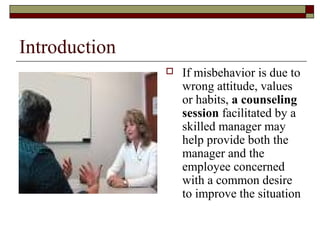
 If misbehavior is due to
wrong attitude, values
or habits, a counseling
session facilitated by a
skilled manager may
help provide both the
manager and the
employee concerned
with a common desire
to improve the situation
Introduction
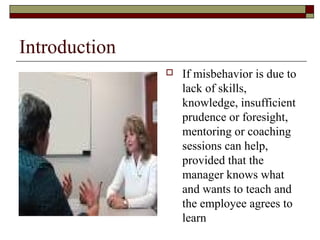
 If misbehavior is due to
lack of skills,
knowledge, insufficient
prudence or foresight,
mentoring or coaching
sessions can help,
provided that the
manager knows what
and wants to teach and
the employee agrees to
learn
Introduction:
 If the employees are insufficient in
KNOWLEDGE and SKILLS but high in
ATTITUDES and HABITS, the proper
management intervention is
MENTORING/COACHING. Managers must
be good coach or mentor. They can only be
such if they have gained a certain level of
expertise and proficiency that can inspire
respect among personnel.
Introduction:
 If the employees are insufficient in proper
ATTITUDES and HABITS, even HIGH in
KNOWLEDGE and SKILLS, the appropriate
management action is COUNSELING.
Managers must be good counselors. The best
form of counseling is by example.
Introduction:
 In other words, counseling and
coaching/mentoring are viewed as
developmental programs and are considered
positive approaches in aligning employee
behavior with employer’s expectations, goals
and organizational vision, an element of a
continuing process of employee discipline.
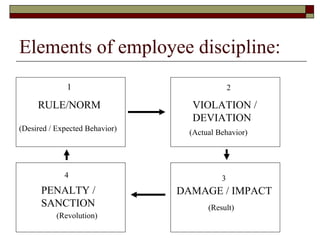
Elements of employee discipline:
1
RULE/NORM
(Desired / Expected Behavior)
2
VIOLATION /
DEVIATION
(Actual Behavior)
3
DAMAGE / IMPACT
(Result)
4
PENALTY /
SANCTION
(Revolution)
The Philosophy of
Coaching/Mentoring and Counseling
 To empower the organization
 To express management’s concern
 To uplift the spirit
 To empower individual
 To inspire the spirit
 To build a team
 To spread competence
Desired combined results of mentoring
and counseling
 A caring organization
 Employees with high morale
 An empowered workforce
 Inspired and passionate individuals
 An entire workforce working as a team
 A widespread competence
 An empowered organization
Counseling
Definition: Counseling
 Employee Counseling is defined as a discussion
between the employer and the employee about the
real or perceived performance deficiency or job-
related behavior; the employee's perception of the
identified behavior and the employer’s involvement
in helping the employee correct these behaviors; and
the employee's attempt to reduce or eliminate the
misconduct or incompetence.
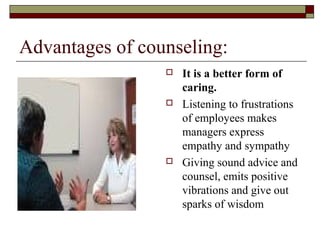
Advantages of counseling:
 It is a better form of
caring.
 Listening to frustrations
of employees makes
managers express
empathy and sympathy
 Giving sound advice and
counsel, emits positive
vibrations and give out
sparks of wisdom
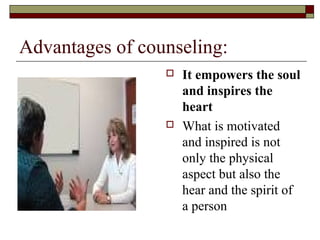
Advantages of counseling:
 It empowers the soul
and inspires the
heart
 What is motivated
and inspired is not
only the physical
aspect but also the
hear and the spirit of
a person
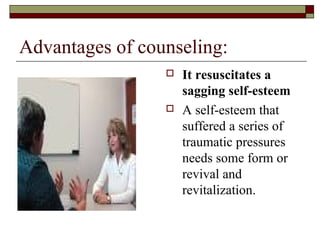
Advantages of counseling:
 It resuscitates a
sagging self-esteem
 A self-esteem that
suffered a series of
traumatic pressures
needs some form or
revival and
revitalization.
Advantages of counseling:
 It heals the wounds
of past
disillusionments
 Counseling provides
healing process to
remedy all these
pains
Advantages of counseling:
 It minimizes, if not
removes the
bitterness of
rejection
 Whenever
management rejects
an employee, he
suffers. Counseling
alleviates these
sufferings.
Advantages of counseling:
 It is a powerful means
of team-building
 Counselor and
counselee spend time
together and share
information.
 Powerful means to
build strong
relationship
Advantages of counseling:
 A powerful
mechanism to
empower the
organization
 Once pains of
employees are healed
and cured, people can
unleash positive
energies and constitute
a power that can create
strong values to the
entire organization.
Steps in counseling:
 Listen, observe and analyze.
 Empathize
 Identify the problems / issues
 Generate the alternatives
 Assess each alternative
 Let the person choose his alternative
 Assist the person in implementing it
Tips in counseling:
 Prepare in
advance for
counseling
sessions.
Tips in counseling:
 Conduct the
counseling session
in privacy.
 Do not allow
outside
interruptions.
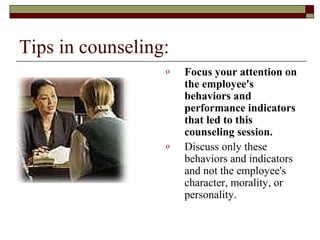
Tips in counseling:
o Focus your attention on
the employee's
behaviors and
performance indicators
that led to this
counseling session.
o Discuss only these
behaviors and indicators
and not the employee's
character, morality, or
personality.
Tips in counseling:
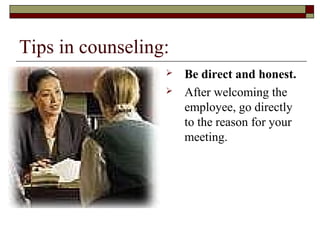
 Be direct and honest.
 After welcoming the
employee, go directly
to the reason for your
meeting.
Tips in counseling:
 Remain objective
without showing
emotion.
 Even though some
employees may be
hostile, remain calm,
speaking in a measured
voice
Tips in counseling:
 Keep an open
mind.
 Look for a
solution or set of
solutions.
Tips in counseling:
 Allow the
employee an
opportunity to
talk.
 You must be a
good listener.
Tips in counseling:
 Never
characterize the
counseling
session as
"discipline."
Tips in counseling:
 Do not speak in
a punitive or
derogatory
manner to the
employee.
Tips in counseling:
 Be sure to thank
the employee for
meeting with you
and make it clear
you are available
for further
discussion or
help.
Coaching and Mentoring
Coaching vs. Mentoring
 Coaching is a process where a peer or
manager works with an employee to motivate
her, help develop her skills and provide
reinforcement and feedback
 Mentoring is a process where and experienced
productive senior employee who helps
develop a less-experienced employee.
Advantages of Coaching / Mentoring:
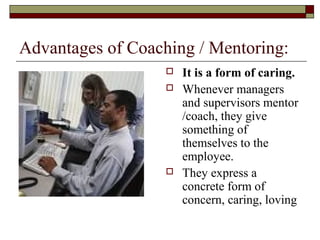
 It is a form of caring.
 Whenever managers
and supervisors mentor
/coach, they give
something of
themselves to the
employee.
 They express a
concrete form of
concern, caring, loving
Advantages of Coaching / Mentoring:
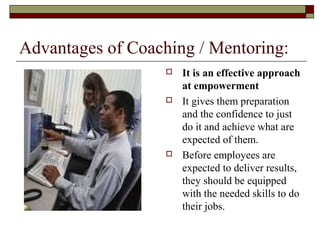
 It is an effective approach
at empowerment
 It gives them preparation
and the confidence to just
do it and achieve what are
expected of them.
 Before employees are
expected to deliver results,
they should be equipped
with the needed skills to do
their jobs.
Advantages of Coaching / Mentoring:
 It is a means of
strengthening the
mental faculties.
 This shall train the mind
to think as much as the
muscle to perform the
task.
 People who are coached
or mentored are expected
to think better and do
more.
Advantages of Coaching / Mentoring:
 It is a way of
enhancing physical
ability
 It is a way of building
up physical
capabilities, strengthen
their stamina, sharpen
their skills and improve
knowledge level.
Advantages of Coaching / Mentoring:
 It is a team-building
mechanism
 The relationship share
hours of working
together, and solve
problems jointly. They
consult, discuss and
collaborate.
Advantages of Coaching / Mentoring:
 It is a way of
democratizing power.
 To create a really
powerful organization,
every single member of
the organization should
have more knowledge
and more competence.
Advantages of Coaching / Mentoring:
 It is a way of strengthening the whole
organization
 When even the lowliest clerk has competence, the
whole organization stands to benefit.
 Whenever one resigns or retires, another equally
competent guy is ready to take over.
 The organization will not crumble when one leaves
because everyone is ready to fill the gap.
Steps in Mentoring/Coaching
 Let the employee observe how you work
 Break up the work into steps
 Explain the rationale for each step
 Allow the employee to do it step by step
 Allow the employee to identify successes and
improvement ideas
 Allow the employee to formulate improvement steps
 Assist the employee in perfecting his work.
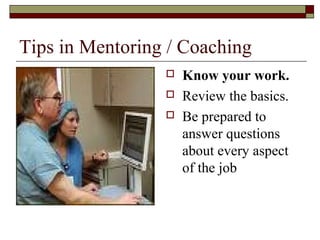
Tips in Mentoring / Coaching
 Know your work.
 Review the basics.
 Be prepared to
answer questions
about every aspect
of the job
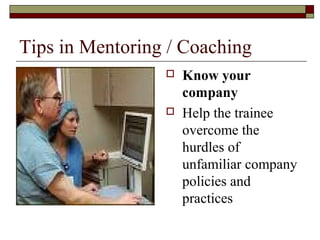
Tips in Mentoring / Coaching
 Know your
company
 Help the trainee
overcome the
hurdles of
unfamiliar company
policies and
practices
Tips in Mentoring / Coaching
 Get to know
your protégé.
 Learn as much as
you can about the
person you are
mentoring
Tips in Mentoring / Coaching
 Learn to teach.
 If you have minimal
experience in
teaching, pick up
pointers on teaching
methods from the
best trainers you
know.
Tips in Mentoring / Coaching
 Learn to learn.
 Never stop learning –
not only the latest
techniques in your own
field, but developments
in your industry, in the
businesses, and in the
overall field of
management.
Tips in Mentoring / Coaching
 Be patient.
 Patience is key
to success
Tips in Mentoring / Coaching
 Be tactful. Be kind.
Be courteous. Be
gentle.
 But be firm, and let
the trainee know
you expect the best
Tips in Mentoring / Coaching
 Do not be afraid to
take risks.
 Give your protégé
assignments that will
challenge his or her
capabilities.
 Failures may occur, but
we learn from our
failures
Tips in Mentoring / Coaching
 Celebrate
successes.
 Let the trainees
know you are
proud of their
accomplishments
and progress
made.
Tips in Mentoring / Coaching
 Encourage
your protégé
to become a
mentor or
counselor.


Coaching And Counseling

  • 1.
    Coaching and Counseling By:Atty. Christine P. Carpio
  • 2.
    References:  Atty. JosephusB. Jimenez, The Seven Secrets for SUCCESS in EMPLOYEE DISCIPLINE and DISMISSAL.  Noe, Hollenbeck, Gerhart, Wright, Human Resource Management, 2005 International Edition.  Arthur R. Pell, PhD., Complete Idiot’s Guide to Team Building, 1999.
  • 3.
  • 4.
    Introduction  If misbehavioris due to wrong attitude, values or habits, a counseling session facilitated by a skilled manager may help provide both the manager and the employee concerned with a common desire to improve the situation
  • 5.
    Introduction  If misbehavioris due to lack of skills, knowledge, insufficient prudence or foresight, mentoring or coaching sessions can help, provided that the manager knows what and wants to teach and the employee agrees to learn
  • 6.
    Introduction:  If theemployees are insufficient in KNOWLEDGE and SKILLS but high in ATTITUDES and HABITS, the proper management intervention is MENTORING/COACHING. Managers must be good coach or mentor. They can only be such if they have gained a certain level of expertise and proficiency that can inspire respect among personnel.
  • 7.
    Introduction:  If theemployees are insufficient in proper ATTITUDES and HABITS, even HIGH in KNOWLEDGE and SKILLS, the appropriate management action is COUNSELING. Managers must be good counselors. The best form of counseling is by example.
  • 8.
    Introduction:  In otherwords, counseling and coaching/mentoring are viewed as developmental programs and are considered positive approaches in aligning employee behavior with employer’s expectations, goals and organizational vision, an element of a continuing process of employee discipline.
  • 9.
    Elements of employeediscipline: 1 RULE/NORM (Desired / Expected Behavior) 2 VIOLATION / DEVIATION (Actual Behavior) 3 DAMAGE / IMPACT (Result) 4 PENALTY / SANCTION (Revolution)
  • 10.
    The Philosophy of Coaching/Mentoringand Counseling  To empower the organization  To express management’s concern  To uplift the spirit  To empower individual  To inspire the spirit  To build a team  To spread competence
  • 11.
    Desired combined resultsof mentoring and counseling  A caring organization  Employees with high morale  An empowered workforce  Inspired and passionate individuals  An entire workforce working as a team  A widespread competence  An empowered organization
  • 12.
  • 13.
    Definition: Counseling  EmployeeCounseling is defined as a discussion between the employer and the employee about the real or perceived performance deficiency or job- related behavior; the employee's perception of the identified behavior and the employer’s involvement in helping the employee correct these behaviors; and the employee's attempt to reduce or eliminate the misconduct or incompetence.
  • 14.
    Advantages of counseling: It is a better form of caring.  Listening to frustrations of employees makes managers express empathy and sympathy  Giving sound advice and counsel, emits positive vibrations and give out sparks of wisdom
  • 15.
    Advantages of counseling: It empowers the soul and inspires the heart  What is motivated and inspired is not only the physical aspect but also the hear and the spirit of a person
  • 16.
    Advantages of counseling: It resuscitates a sagging self-esteem  A self-esteem that suffered a series of traumatic pressures needs some form or revival and revitalization.
  • 17.
    Advantages of counseling: It heals the wounds of past disillusionments  Counseling provides healing process to remedy all these pains
  • 18.
    Advantages of counseling: It minimizes, if not removes the bitterness of rejection  Whenever management rejects an employee, he suffers. Counseling alleviates these sufferings.
  • 19.
    Advantages of counseling: It is a powerful means of team-building  Counselor and counselee spend time together and share information.  Powerful means to build strong relationship
  • 20.
    Advantages of counseling: A powerful mechanism to empower the organization  Once pains of employees are healed and cured, people can unleash positive energies and constitute a power that can create strong values to the entire organization.
  • 21.
    Steps in counseling: Listen, observe and analyze.  Empathize  Identify the problems / issues  Generate the alternatives  Assess each alternative  Let the person choose his alternative  Assist the person in implementing it
  • 22.
    Tips in counseling: Prepare in advance for counseling sessions.
  • 23.
    Tips in counseling: Conduct the counseling session in privacy.  Do not allow outside interruptions.
  • 24.
    Tips in counseling: oFocus your attention on the employee's behaviors and performance indicators that led to this counseling session. o Discuss only these behaviors and indicators and not the employee's character, morality, or personality.
  • 25.
    Tips in counseling: Be direct and honest.  After welcoming the employee, go directly to the reason for your meeting.
  • 26.
    Tips in counseling: Remain objective without showing emotion.  Even though some employees may be hostile, remain calm, speaking in a measured voice
  • 27.
    Tips in counseling: Keep an open mind.  Look for a solution or set of solutions.
  • 28.
    Tips in counseling: Allow the employee an opportunity to talk.  You must be a good listener.
  • 29.
    Tips in counseling: Never characterize the counseling session as "discipline."
  • 30.
    Tips in counseling: Do not speak in a punitive or derogatory manner to the employee.
  • 31.
    Tips in counseling: Be sure to thank the employee for meeting with you and make it clear you are available for further discussion or help.
  • 32.
  • 33.
    Coaching vs. Mentoring Coaching is a process where a peer or manager works with an employee to motivate her, help develop her skills and provide reinforcement and feedback  Mentoring is a process where and experienced productive senior employee who helps develop a less-experienced employee.
  • 34.
    Advantages of Coaching/ Mentoring:  It is a form of caring.  Whenever managers and supervisors mentor /coach, they give something of themselves to the employee.  They express a concrete form of concern, caring, loving
  • 35.
    Advantages of Coaching/ Mentoring:  It is an effective approach at empowerment  It gives them preparation and the confidence to just do it and achieve what are expected of them.  Before employees are expected to deliver results, they should be equipped with the needed skills to do their jobs.
  • 36.
    Advantages of Coaching/ Mentoring:  It is a means of strengthening the mental faculties.  This shall train the mind to think as much as the muscle to perform the task.  People who are coached or mentored are expected to think better and do more.
  • 37.
    Advantages of Coaching/ Mentoring:  It is a way of enhancing physical ability  It is a way of building up physical capabilities, strengthen their stamina, sharpen their skills and improve knowledge level.
  • 38.
    Advantages of Coaching/ Mentoring:  It is a team-building mechanism  The relationship share hours of working together, and solve problems jointly. They consult, discuss and collaborate.
  • 39.
    Advantages of Coaching/ Mentoring:  It is a way of democratizing power.  To create a really powerful organization, every single member of the organization should have more knowledge and more competence.
  • 40.
    Advantages of Coaching/ Mentoring:  It is a way of strengthening the whole organization  When even the lowliest clerk has competence, the whole organization stands to benefit.  Whenever one resigns or retires, another equally competent guy is ready to take over.  The organization will not crumble when one leaves because everyone is ready to fill the gap.
  • 41.
    Steps in Mentoring/Coaching Let the employee observe how you work  Break up the work into steps  Explain the rationale for each step  Allow the employee to do it step by step  Allow the employee to identify successes and improvement ideas  Allow the employee to formulate improvement steps  Assist the employee in perfecting his work.
  • 42.
    Tips in Mentoring/ Coaching  Know your work.  Review the basics.  Be prepared to answer questions about every aspect of the job
  • 43.
    Tips in Mentoring/ Coaching  Know your company  Help the trainee overcome the hurdles of unfamiliar company policies and practices
  • 44.
    Tips in Mentoring/ Coaching  Get to know your protégé.  Learn as much as you can about the person you are mentoring
  • 45.
    Tips in Mentoring/ Coaching  Learn to teach.  If you have minimal experience in teaching, pick up pointers on teaching methods from the best trainers you know.
  • 46.
    Tips in Mentoring/ Coaching  Learn to learn.  Never stop learning – not only the latest techniques in your own field, but developments in your industry, in the businesses, and in the overall field of management.
  • 47.
    Tips in Mentoring/ Coaching  Be patient.  Patience is key to success
  • 48.
    Tips in Mentoring/ Coaching  Be tactful. Be kind. Be courteous. Be gentle.  But be firm, and let the trainee know you expect the best
  • 49.
    Tips in Mentoring/ Coaching  Do not be afraid to take risks.  Give your protégé assignments that will challenge his or her capabilities.  Failures may occur, but we learn from our failures
  • 50.
    Tips in Mentoring/ Coaching  Celebrate successes.  Let the trainees know you are proud of their accomplishments and progress made.
  • 51.
    Tips in Mentoring/ Coaching  Encourage your protégé to become a mentor or counselor. 