
LIVER AND RENAL
FUNCTION TEST
Presented by:- Monnaf Ali
MSc OTAT
INTRODUCTION :- LIVER
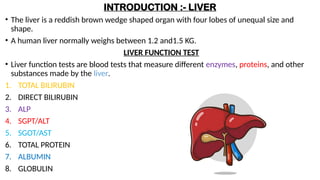
• The liver is a reddish brown wedge shaped organ with four lobes of unequal size and
shape.
• A human liver normally weighs between 1.2 and1.5 KG.
LIVER FUNCTION TEST
• Liver function tests are blood tests that measure different enzymes, proteins, and other
substances made by the liver.
1. TOTAL BILIRUBIN
2. DIRECT BILIRUBIN
3. ALP
4. SGPT/ALT
5. SGOT/AST
6. TOTAL PROTEIN
7. ALBUMIN
8. GLOBULIN
TOTAL BILIRUBIN
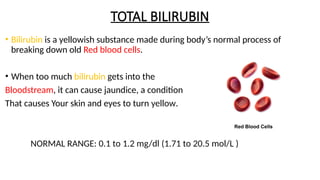
• Bilirubin is a yellowish substance made during body’s normal process of
breaking down old Red blood cells.
• When too much bilirubin gets into the
Bloodstream, it can cause jaundice, a condition
That causes Your skin and eyes to turn yellow.
NORMAL RANGE: 0.1 to 1.2 mg/dl (1.71 to 20.5 mol/L )
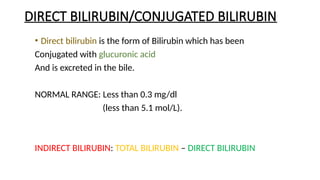
DIRECT BILIRUBIN/CONJUGATED BILIRUBIN
• Direct bilirubin is the form of Bilirubin which has been
Conjugated with glucuronic acid
And is excreted in the bile.
NORMAL RANGE: Less than 0.3 mg/dl
(less than 5.1 mol/L).
INDIRECT BILIRUBIN: TOTAL BILIRUBIN – DIRECT BILIRUBIN
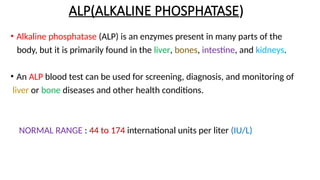
ALP(ALKALINE PHOSPHATASE)
• Alkaline phosphatase (ALP) is an enzymes present in many parts of the
body, but it is primarily found in the liver, bones, intestine, and kidneys.
• An ALP blood test can be used for screening, diagnosis, and monitoring of
liver or bone diseases and other health conditions.
NORMAL RANGE : 44 to 174 international units per liter (IU/L)
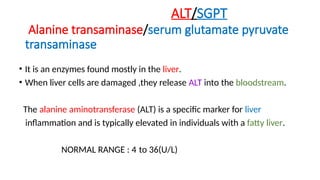
ALT/SGPT
Alanine transaminase/serum glutamate pyruvate
transaminase
• It is an enzymes found mostly in the liver.
• When liver cells are damaged ,they release ALT into the bloodstream.
The alanine aminotransferase (ALT) is a specific marker for liver
inflammation and is typically elevated in individuals with a fatty liver.
NORMAL RANGE : 4 to 36(U/L)
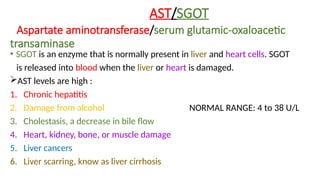
AST/SGOT
Aspartate aminotransferase/serum glutamic-oxaloacetic
transaminase
• SGOT is an enzyme that is normally present in liver and heart cells. SGOT
is released into blood when the liver or heart is damaged.
AST levels are high :
1. Chronic hepatitis
2. Damage from alcohol NORMAL RANGE: 4 to 38 U/L
3. Cholestasis, a decrease in bile flow
4. Heart, kidney, bone, or muscle damage
5. Liver cancers
6. Liver scarring, know as liver cirrhosis
TOTAL PROTEIN
• A total protein test measures the amount of protein in blood.
• Proteins are important for the health and growth of the body’s cells and
tissues.
• A total protein test can detect normal or abnormal, protein levels, which
can help diagnose medical conditions, such as kidney and liver diseases.
NORMAL RANGE : 6.0 to 8.3 grams per deciliter(g/dl)
ALBUMIN
• An albumin blood test checks liver and kidney function.
• Albumin is protein in blood plasma.
• Low albumin levels might be the result of kidney, liver disease,
inflammation or infections. High albumin levels usually the result of
dehydration or severe diarrhea.
NORMAL RANGE : 3.4 to 5.4 g/dl
GLOBULIN= TOTAL PROTEIN - ALBUMIN
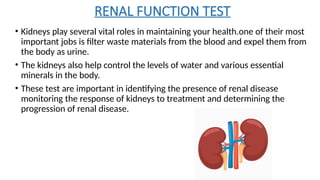
RENAL FUNCTION TEST
• Kidneys play several vital roles in maintaining your health.one of their most
important jobs is filter waste materials from the blood and expel them from
the body as urine.
• The kidneys also help control the levels of water and various essential
minerals in the body.
• These test are important in identifying the presence of renal disease
monitoring the response of kidneys to treatment and determining the
progression of renal disease.
TYPES OF KIDNEY FUNCTION TESTS
• BLOOD TESTS :- Measure the levels of substances in the blood that are
filtered by the kidneys. Such as blood urea nitrogen, serum creatinine.
• URINE TESTS:- Measure the amount of protein, glucose, and other
substances in the urine.
• IMAGING TESTS:- Can be used to get a picture of the kidneys and look for
any problem or damage.
• KIDNEY BIOPSY:- Procedure where a small piece of kidney tissue is removed
and examined under a microscope.
BLOOD URINE NITROGEN
• A blood urea nitrogen BUN test is a common blood test that
measure the amount of urea in the blood providing important
information about kidney function.
• Urea nitrogen is a waste product that is produced when the liver
breaks down the proteins and it is filtered out by the kidneys and
eliminated from the body through urine.
• Normal Range :- 7-20 mg/dL
SERUM CREATININE TEST
• Measure the level of creatinine in the blood.
• Creatinine is a waste product produced by the muscles.
• Normal Range:-0.7 – 1.3 mg/dL for men
0.6 – 1.1 mg/dL for women
• Elevated serum creatine levels may indicate impaired kidney function this
can be sign of kidney disease or other conditions that affect kidney function
such as dehydration urinary tract obstruction or certain medications on the
other hand lower than normal serum creatinine levels are less common and
may be seen in condition such as decreased muscle mass or liver disease
ESTIMATED GLOMERULAR FILTRATION RATE
• Calculates the estimated glomerular filtration rate (eGFR).
• Represented by milliliter per minute (ml/min).
• Normal Range :- 90 ml/min or higher
• Low eGFR result may also indicate chronic kidney disease CKD.
• Higher than normal eGFR levels are less common and may be seen
in people with certain health condition such as pregnancy or
hyperfiltration syndrome.
SERUM ALBUMIN TEST
• Measures the amount of albumin in blood.
• Albumin is a protein produced by the liver that helps maintain fluid
balance in the body and carries substances such as hormones,
medicines, and enzymes.
• Normal Range :- 3.5 – 5 g/dL
• Low albumin levels can be a sign of liver or kidney disease or another
medical condition.
• High levels may be sign of dehydration.
URINE ANALYSIS
• A key component of kidney function tests and is also known
as urinalysis.
• It involves examining a small sample of urine to check for
signs of kidney disease and other health problem.
• Urine tests can identify early signs of kidney disease such as
the presence of protein in the urine.
• Presence of protein in urine is called proteinuria.
THANK YOU

Presentation of LIVER AND RENAL FUNCTION TESTpptx

  • 1.
    LIVER AND RENAL FUNCTIONTEST Presented by:- Monnaf Ali MSc OTAT
  • 2.
    INTRODUCTION :- LIVER •The liver is a reddish brown wedge shaped organ with four lobes of unequal size and shape. • A human liver normally weighs between 1.2 and1.5 KG. LIVER FUNCTION TEST • Liver function tests are blood tests that measure different enzymes, proteins, and other substances made by the liver. 1. TOTAL BILIRUBIN 2. DIRECT BILIRUBIN 3. ALP 4. SGPT/ALT 5. SGOT/AST 6. TOTAL PROTEIN 7. ALBUMIN 8. GLOBULIN
  • 3.
    TOTAL BILIRUBIN • Bilirubinis a yellowish substance made during body’s normal process of breaking down old Red blood cells. • When too much bilirubin gets into the Bloodstream, it can cause jaundice, a condition That causes Your skin and eyes to turn yellow. NORMAL RANGE: 0.1 to 1.2 mg/dl (1.71 to 20.5 mol/L )
  • 4.
    DIRECT BILIRUBIN/CONJUGATED BILIRUBIN •Direct bilirubin is the form of Bilirubin which has been Conjugated with glucuronic acid And is excreted in the bile. NORMAL RANGE: Less than 0.3 mg/dl (less than 5.1 mol/L). INDIRECT BILIRUBIN: TOTAL BILIRUBIN – DIRECT BILIRUBIN
  • 5.
    ALP(ALKALINE PHOSPHATASE) • Alkalinephosphatase (ALP) is an enzymes present in many parts of the body, but it is primarily found in the liver, bones, intestine, and kidneys. • An ALP blood test can be used for screening, diagnosis, and monitoring of liver or bone diseases and other health conditions. NORMAL RANGE : 44 to 174 international units per liter (IU/L)
  • 6.
    ALT/SGPT Alanine transaminase/serum glutamatepyruvate transaminase • It is an enzymes found mostly in the liver. • When liver cells are damaged ,they release ALT into the bloodstream. The alanine aminotransferase (ALT) is a specific marker for liver inflammation and is typically elevated in individuals with a fatty liver. NORMAL RANGE : 4 to 36(U/L)
  • 7.
    AST/SGOT Aspartate aminotransferase/serum glutamic-oxaloacetic transaminase •SGOT is an enzyme that is normally present in liver and heart cells. SGOT is released into blood when the liver or heart is damaged. AST levels are high : 1. Chronic hepatitis 2. Damage from alcohol NORMAL RANGE: 4 to 38 U/L 3. Cholestasis, a decrease in bile flow 4. Heart, kidney, bone, or muscle damage 5. Liver cancers 6. Liver scarring, know as liver cirrhosis
  • 8.
    TOTAL PROTEIN • Atotal protein test measures the amount of protein in blood. • Proteins are important for the health and growth of the body’s cells and tissues. • A total protein test can detect normal or abnormal, protein levels, which can help diagnose medical conditions, such as kidney and liver diseases. NORMAL RANGE : 6.0 to 8.3 grams per deciliter(g/dl)
  • 9.
    ALBUMIN • An albuminblood test checks liver and kidney function. • Albumin is protein in blood plasma. • Low albumin levels might be the result of kidney, liver disease, inflammation or infections. High albumin levels usually the result of dehydration or severe diarrhea. NORMAL RANGE : 3.4 to 5.4 g/dl GLOBULIN= TOTAL PROTEIN - ALBUMIN
  • 10.
    RENAL FUNCTION TEST •Kidneys play several vital roles in maintaining your health.one of their most important jobs is filter waste materials from the blood and expel them from the body as urine. • The kidneys also help control the levels of water and various essential minerals in the body. • These test are important in identifying the presence of renal disease monitoring the response of kidneys to treatment and determining the progression of renal disease.
  • 11.
    TYPES OF KIDNEYFUNCTION TESTS • BLOOD TESTS :- Measure the levels of substances in the blood that are filtered by the kidneys. Such as blood urea nitrogen, serum creatinine. • URINE TESTS:- Measure the amount of protein, glucose, and other substances in the urine. • IMAGING TESTS:- Can be used to get a picture of the kidneys and look for any problem or damage. • KIDNEY BIOPSY:- Procedure where a small piece of kidney tissue is removed and examined under a microscope.
  • 12.
    BLOOD URINE NITROGEN •A blood urea nitrogen BUN test is a common blood test that measure the amount of urea in the blood providing important information about kidney function. • Urea nitrogen is a waste product that is produced when the liver breaks down the proteins and it is filtered out by the kidneys and eliminated from the body through urine. • Normal Range :- 7-20 mg/dL
  • 13.
    SERUM CREATININE TEST •Measure the level of creatinine in the blood. • Creatinine is a waste product produced by the muscles. • Normal Range:-0.7 – 1.3 mg/dL for men 0.6 – 1.1 mg/dL for women • Elevated serum creatine levels may indicate impaired kidney function this can be sign of kidney disease or other conditions that affect kidney function such as dehydration urinary tract obstruction or certain medications on the other hand lower than normal serum creatinine levels are less common and may be seen in condition such as decreased muscle mass or liver disease
  • 14.
    ESTIMATED GLOMERULAR FILTRATIONRATE • Calculates the estimated glomerular filtration rate (eGFR). • Represented by milliliter per minute (ml/min). • Normal Range :- 90 ml/min or higher • Low eGFR result may also indicate chronic kidney disease CKD. • Higher than normal eGFR levels are less common and may be seen in people with certain health condition such as pregnancy or hyperfiltration syndrome.
  • 15.
    SERUM ALBUMIN TEST •Measures the amount of albumin in blood. • Albumin is a protein produced by the liver that helps maintain fluid balance in the body and carries substances such as hormones, medicines, and enzymes. • Normal Range :- 3.5 – 5 g/dL • Low albumin levels can be a sign of liver or kidney disease or another medical condition. • High levels may be sign of dehydration.
  • 16.
    URINE ANALYSIS • Akey component of kidney function tests and is also known as urinalysis. • It involves examining a small sample of urine to check for signs of kidney disease and other health problem. • Urine tests can identify early signs of kidney disease such as the presence of protein in the urine. • Presence of protein in urine is called proteinuria.
  • 17.