Liver function test
FUNCTIONS OF LIVER
1. Excretory function: Liver cells metabolize and excrete endogenous as well as
exogenous substances. Liver regulates bilirubin metabolism by secretion and
excretion of bilirubin.
2. Synthetic function: Synthesis of proteins like albumin, α- and β-globulins,
transport proteins and many coagulation proteins occurs in the liver. Liver also
produces triglycerides, cholesterol, lipoproteins, and primary bile acids. Albumin
maintains osmotic pressure of plasma, transports various compounds, and acts as a
protein reserve. Liver does not synthesize immunoglobulins.
3. General metabolic functions: Liver regulates carbohydrate, lipid, and protein
metabolism.
4. Liver is the storage site for iron, glycogen, and vitamins.
5. During fetal life, hematopoiesis occurs in the liver. It is also a site for
destruction of damaged red cells (immune hemolysis).
6. Liver is the major organ for catabolism of steroid hormones
INDICATIONS OF LIVER FUNCTION TEST
• Screen for liver disease
• Identify the nature of liver disease (hepatocellular, cholestatic, or
infiltrative)
• Assess severity and prognosis of liver disease
• Follow up the course of liver disease
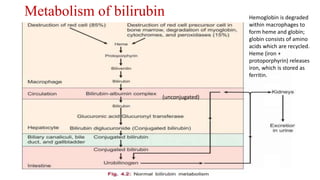
Metabolism of bilirubin Hemoglobin is degraded
within macrophages to
form heme and globin;
globin consists of amino
acids which are recycled.
Heme (iron +
protoporphyrin) releases
iron, which is stored as
ferritin.
(unconjugated)
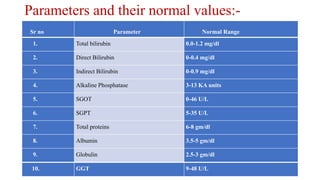
Parameters and their normal values:-
Sr no Parameter Normal Range
1. Total bilirubin 0.0-1.2 mg/dl
2. Direct Bilirubin 0-0.4 mg/dl
3. Indirect Bilirubin 0-0.9 mg/dl
4. Alkaline Phosphatase 3-13 KA units
5. SGOT 0-46 U/L
6. SGPT 5-35 U/L
7. Total proteins 6-8 gm/dl
8. Albumin 3.5-5 gm/dl
9. Globulin 2.5-3 gm/dl
10. GGT 9-48 U/L
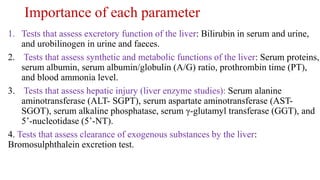
Importance of each parameter
1. Tests that assess excretory function of the liver: Bilirubin in serum and urine,
and urobilinogen in urine and faeces.
2. Tests that assess synthetic and metabolic functions of the liver: Serum proteins,
serum albumin, serum albumin/globulin (A/G) ratio, prothrombin time (PT),
and blood ammonia level.
3. Tests that assess hepatic injury (liver enzyme studies): Serum alanine
aminotransferase (ALT- SGPT), serum aspartate aminotransferase (AST-
SGOT), serum alkaline phosphatase, serum γ-glutamyl transferase (GGT), and
5’-nucleotidase (5’-NT).
4. Tests that assess clearance of exogenous substances by the liver:
Bromosulphthalein excretion test.
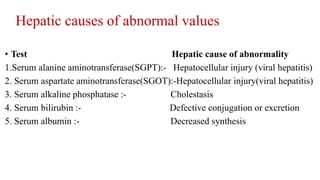
Hepatic causes of abnormal values
• Test Hepatic cause of abnormality
1.Serum alanine aminotransferase(SGPT):- Hepatocellular injury (viral hepatitis)
2. Serum aspartate aminotransferase(SGOT):-Hepatocellular injury(viral hepatitis)
3. Serum alkaline phosphatase :- Cholestasis
4. Serum bilirubin :- Defective conjugation or excretion
5. Serum albumin :- Decreased synthesis
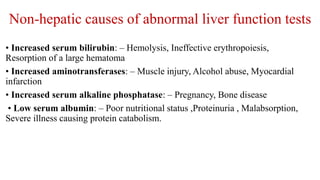
Non-hepatic causes of abnormal liver function tests
• Increased serum bilirubin: – Hemolysis, Ineffective erythropoiesis,
Resorption of a large hematoma
• Increased aminotransferases: – Muscle injury, Alcohol abuse, Myocardial
infarction
• Increased serum alkaline phosphatase: – Pregnancy, Bone disease
• Low serum albumin: – Poor nutritional status ,Proteinuria , Malabsorption,
Severe illness causing protein catabolism.
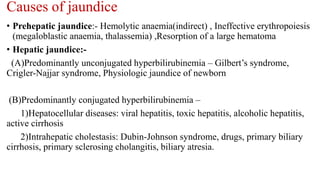
Causes of jaundice
• Prehepatic jaundice:- Hemolytic anaemia(indirect) , Ineffective erythropoiesis
(megaloblastic anaemia, thalassemia) ,Resorption of a large hematoma
• Hepatic jaundice:-
(A)Predominantly unconjugated hyperbilirubinemia – Gilbert’s syndrome,
Crigler-Najjar syndrome, Physiologic jaundice of newborn
(B)Predominantly conjugated hyperbilirubinemia –
1)Hepatocellular diseases: viral hepatitis, toxic hepatitis, alcoholic hepatitis,
active cirrhosis
2)Intrahepatic cholestasis: Dubin-Johnson syndrome, drugs, primary biliary
cirrhosis, primary sclerosing cholangitis, biliary atresia.
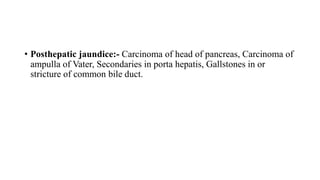
• Posthepatic jaundice:- Carcinoma of head of pancreas, Carcinoma of
ampulla of Vater, Secondaries in porta hepatis, Gallstones in or
stricture of common bile duct.
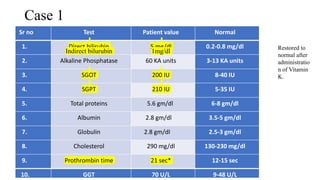
Case 1
Sr no Test Patient value Normal
1. Direct bilirubin
Indirect bilurubin
5 mg/dl
1mg/dl
0.2-0.8 mg/dl
2. Alkaline Phosphatase 60 KA units 3-13 KA units
3. SGOT 200 IU 8-40 IU
4. SGPT 210 IU 5-35 IU
5. Total proteins 5.6 gm/dl 6-8 gm/dl
6. Albumin 2.8 gm/dl 3.5-5 gm/dl
7. Globulin 2.8 gm/dl 2.5-3 gm/dl
8. Cholesterol 290 mg/dl 130-230 mg/dl
9. Prothrombin time 21 sec* 12-15 sec
10. GGT 70 U/L 9-48 U/L
Restored to
normal after
administratio
n of Vitamin
K.
• Diagnosis- Obstructive Jaundice.
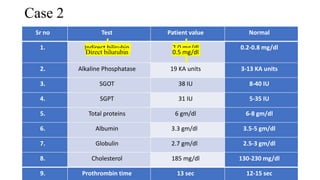
Case 2
Sr no Test Patient value Normal
1. Indirect bilirubin
Direct bilurubin
2.0 mg/dl
0.5 mg/dl
0.2-0.8 mg/dl
2. Alkaline Phosphatase 19 KA units 3-13 KA units
3. SGOT 38 IU 8-40 IU
4. SGPT 31 IU 5-35 IU
5. Total proteins 6 gm/dl 6-8 gm/dl
6. Albumin 3.3 gm/dl 3.5-5 gm/dl
7. Globulin 2.7 gm/dl 2.5-3 gm/dl
8. Cholesterol 185 mg/dl 130-230 mg/dl
9. Prothrombin time 13 sec 12-15 sec
• Diagnosis- Hemolytic Jaundice.
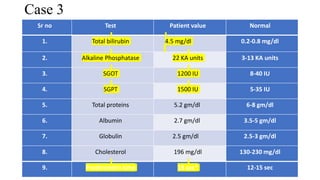
Case 3
Sr no Test Patient value Normal
1. Total bilirubin 4.5 mg/dl 0.2-0.8 mg/dl
2. Alkaline Phosphatase 22 KA units 3-13 KA units
3. SGOT 1200 IU 8-40 IU
4. SGPT 1500 IU 5-35 IU
5. Total proteins 5.2 gm/dl 6-8 gm/dl
6. Albumin 2.7 gm/dl 3.5-5 gm/dl
7. Globulin 2.5 gm/dl 2.5-3 gm/dl
8. Cholesterol 196 mg/dl 130-230 mg/dl
9. Prothrombin time 18 sec* 12-15 sec
Not restored to normal after parenteral administration of Vitamin K.
Diagnosis- Hepatocellular Jaundice (Viral Hepatitis).
Renal function test
Functions of kidney
• Maintenance of extracellular fluid volume and composition: Kidney regulates
water and electrolyte balance, acid-base balance, and fluid osmotic pressure.
• Excretion of metabolic waste products (blood urea, creatinine, uric acid) and
drugs, but retention of essential substances (like glucose and amino acids).
• Regulation of blood pressure by renin-angiotensin mechanism
• Synthesis of erythropoietin, a hormone which stimulates erythropoiesis
• Production of vit. D3 (active form of vit. D) from vit. D2, which stimulates
INDICATIONS FOR RENAL FUNCTION TEST
1.Early identification of impairment of renal function in patients with increased risk of
chronic renal disease.
2.Diagnosis of renal disease .
3.Follow the course of renal disease and assess response to treatment.
4.Plan renal replacement therapy (dialysis or renal transplantation) in advanced renal disease.
5.Adjust dosage of certain drugs according to renal function.
Glomerular filtration rate (GFR)
• Best test for assessment of excretory renal function
• Varies according to age, sex, and body weight of an individual; a normal GFR also depends on
normal renal blood flow and pressure.
• Normal GFR in young adults is 120-130 ml/min per 1.73 m2.
• Creatinine clearance is commonly used as a measure of GFR. Equations can be used to
estimate GFR from serum creatinine value.
• GFR declines with age (due to glomerular arteriolosclerosis)
• Fall in GFR leads to accumulation of waste products of metabolism in
blood.
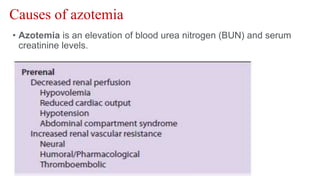
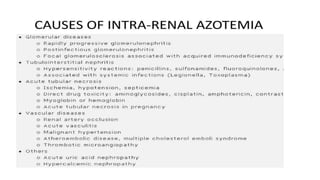
Causes of azotemia
• Azotemia is an elevation of blood urea nitrogen (BUN) and serum
creatinine levels.
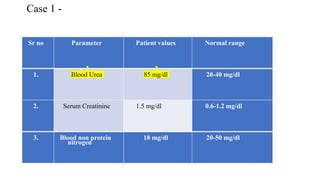
Case 1 -
Sr no Parameter Patient values Normal range
1. Blood Urea 85 mg/dl 20-40 mg/dl
2. Serum Creatinine 1.5 mg/dl 0.6-1.2 mg/dl
3. Blood non protein
nitrogen
18 mg/dl 20-50 mg/dl
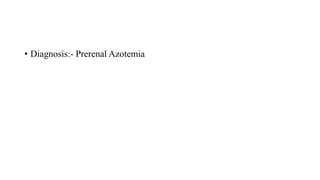
• Diagnosis:- Prerenal Azotemia
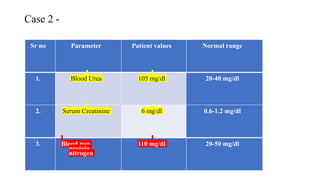
Case 2 -
Sr no Parameter Patient values Normal range
1. Blood Urea 105 mg/dl 20-40 mg/dl
2. Serum Creatinine 6 mg/dl 0.6-1.2 mg/dl
3. Blood non
protein
nitrogen
110 mg/dl 20-50 mg/dl
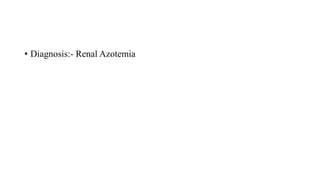
• Diagnosis:- Renal Azotemia
Thyroid function test
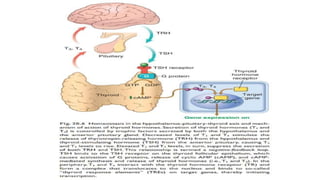
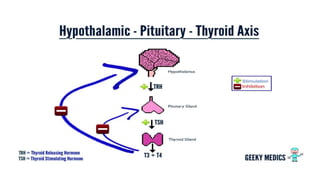
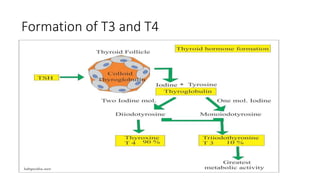
Formation of T3 and T4
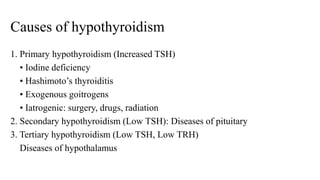
Causes of hypothyroidism
1. Primary hypothyroidism (Increased TSH)
• Iodine deficiency
• Hashimoto’s thyroiditis
• Exogenous goitrogens
• Iatrogenic: surgery, drugs, radiation
2. Secondary hypothyroidism (Low TSH): Diseases of pituitary
3. Tertiary hypothyroidism (Low TSH, Low TRH)
Diseases of hypothalamus
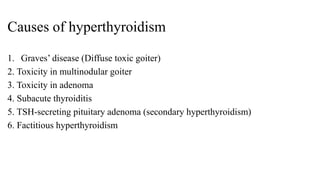
Causes of hyperthyroidism
1. Graves’ disease (Diffuse toxic goiter)
2. Toxicity in multinodular goiter
3. Toxicity in adenoma
4. Subacute thyroiditis
5. TSH-secreting pituitary adenoma (secondary hyperthyroidism)
6. Factitious hyperthyroidism
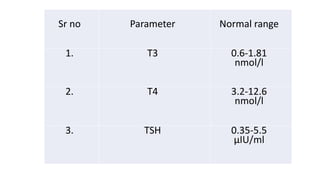
Sr no Parameter Normal range
1. T3 0.6-1.81
nmol/l
2. T4 3.2-12.6
nmol/l
3. TSH 0.35-5.5
μIU/ml
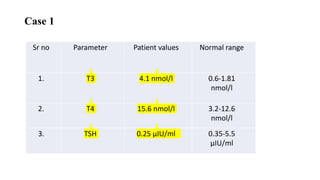
Case 1
Sr no Parameter Patient values Normal range
1. T3 4.1 nmol/l 0.6-1.81
nmol/l
2. T4 15.6 nmol/l 3.2-12.6
nmol/l
3. TSH 0.25 μIU/ml 0.35-5.5
μIU/ml
• Diagnosis:- Hyperthyroidism
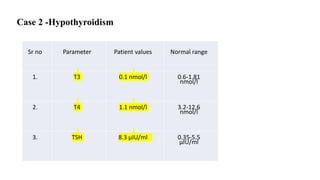
Case 2 -Hypothyroidism
Sr no Parameter Patient values Normal range
1. T3 0.1 nmol/l 0.6-1.81
nmol/l
2. T4 1.1 nmol/l 3.2-12.6
nmol/l
3. TSH 8.3 μIU/ml 0.35-5.5
μIU/ml
• Diagnosis :- Hypothyroidism
Thank you 

LFT,RFT,TFT.pptx

  • 1.
  • 2.
    FUNCTIONS OF LIVER 1.Excretory function: Liver cells metabolize and excrete endogenous as well as exogenous substances. Liver regulates bilirubin metabolism by secretion and excretion of bilirubin. 2. Synthetic function: Synthesis of proteins like albumin, α- and β-globulins, transport proteins and many coagulation proteins occurs in the liver. Liver also produces triglycerides, cholesterol, lipoproteins, and primary bile acids. Albumin maintains osmotic pressure of plasma, transports various compounds, and acts as a protein reserve. Liver does not synthesize immunoglobulins. 3. General metabolic functions: Liver regulates carbohydrate, lipid, and protein metabolism.
  • 3.
    4. Liver isthe storage site for iron, glycogen, and vitamins. 5. During fetal life, hematopoiesis occurs in the liver. It is also a site for destruction of damaged red cells (immune hemolysis). 6. Liver is the major organ for catabolism of steroid hormones
  • 4.
    INDICATIONS OF LIVERFUNCTION TEST • Screen for liver disease • Identify the nature of liver disease (hepatocellular, cholestatic, or infiltrative) • Assess severity and prognosis of liver disease • Follow up the course of liver disease
  • 5.
    Metabolism of bilirubinHemoglobin is degraded within macrophages to form heme and globin; globin consists of amino acids which are recycled. Heme (iron + protoporphyrin) releases iron, which is stored as ferritin. (unconjugated)
  • 6.
    Parameters and theirnormal values:- Sr no Parameter Normal Range 1. Total bilirubin 0.0-1.2 mg/dl 2. Direct Bilirubin 0-0.4 mg/dl 3. Indirect Bilirubin 0-0.9 mg/dl 4. Alkaline Phosphatase 3-13 KA units 5. SGOT 0-46 U/L 6. SGPT 5-35 U/L 7. Total proteins 6-8 gm/dl 8. Albumin 3.5-5 gm/dl 9. Globulin 2.5-3 gm/dl 10. GGT 9-48 U/L
  • 7.
    Importance of eachparameter 1. Tests that assess excretory function of the liver: Bilirubin in serum and urine, and urobilinogen in urine and faeces. 2. Tests that assess synthetic and metabolic functions of the liver: Serum proteins, serum albumin, serum albumin/globulin (A/G) ratio, prothrombin time (PT), and blood ammonia level. 3. Tests that assess hepatic injury (liver enzyme studies): Serum alanine aminotransferase (ALT- SGPT), serum aspartate aminotransferase (AST- SGOT), serum alkaline phosphatase, serum γ-glutamyl transferase (GGT), and 5’-nucleotidase (5’-NT). 4. Tests that assess clearance of exogenous substances by the liver: Bromosulphthalein excretion test.
  • 8.
    Hepatic causes ofabnormal values • Test Hepatic cause of abnormality 1.Serum alanine aminotransferase(SGPT):- Hepatocellular injury (viral hepatitis) 2. Serum aspartate aminotransferase(SGOT):-Hepatocellular injury(viral hepatitis) 3. Serum alkaline phosphatase :- Cholestasis 4. Serum bilirubin :- Defective conjugation or excretion 5. Serum albumin :- Decreased synthesis
  • 9.
    Non-hepatic causes ofabnormal liver function tests • Increased serum bilirubin: – Hemolysis, Ineffective erythropoiesis, Resorption of a large hematoma • Increased aminotransferases: – Muscle injury, Alcohol abuse, Myocardial infarction • Increased serum alkaline phosphatase: – Pregnancy, Bone disease • Low serum albumin: – Poor nutritional status ,Proteinuria , Malabsorption, Severe illness causing protein catabolism.
  • 10.
    Causes of jaundice •Prehepatic jaundice:- Hemolytic anaemia(indirect) , Ineffective erythropoiesis (megaloblastic anaemia, thalassemia) ,Resorption of a large hematoma • Hepatic jaundice:- (A)Predominantly unconjugated hyperbilirubinemia – Gilbert’s syndrome, Crigler-Najjar syndrome, Physiologic jaundice of newborn (B)Predominantly conjugated hyperbilirubinemia – 1)Hepatocellular diseases: viral hepatitis, toxic hepatitis, alcoholic hepatitis, active cirrhosis 2)Intrahepatic cholestasis: Dubin-Johnson syndrome, drugs, primary biliary cirrhosis, primary sclerosing cholangitis, biliary atresia.
  • 11.
    • Posthepatic jaundice:-Carcinoma of head of pancreas, Carcinoma of ampulla of Vater, Secondaries in porta hepatis, Gallstones in or stricture of common bile duct.
  • 12.
    Case 1 Sr noTest Patient value Normal 1. Direct bilirubin Indirect bilurubin 5 mg/dl 1mg/dl 0.2-0.8 mg/dl 2. Alkaline Phosphatase 60 KA units 3-13 KA units 3. SGOT 200 IU 8-40 IU 4. SGPT 210 IU 5-35 IU 5. Total proteins 5.6 gm/dl 6-8 gm/dl 6. Albumin 2.8 gm/dl 3.5-5 gm/dl 7. Globulin 2.8 gm/dl 2.5-3 gm/dl 8. Cholesterol 290 mg/dl 130-230 mg/dl 9. Prothrombin time 21 sec* 12-15 sec 10. GGT 70 U/L 9-48 U/L Restored to normal after administratio n of Vitamin K.
  • 13.
  • 14.
    Case 2 Sr noTest Patient value Normal 1. Indirect bilirubin Direct bilurubin 2.0 mg/dl 0.5 mg/dl 0.2-0.8 mg/dl 2. Alkaline Phosphatase 19 KA units 3-13 KA units 3. SGOT 38 IU 8-40 IU 4. SGPT 31 IU 5-35 IU 5. Total proteins 6 gm/dl 6-8 gm/dl 6. Albumin 3.3 gm/dl 3.5-5 gm/dl 7. Globulin 2.7 gm/dl 2.5-3 gm/dl 8. Cholesterol 185 mg/dl 130-230 mg/dl 9. Prothrombin time 13 sec 12-15 sec
  • 15.
  • 16.
    Case 3 Sr noTest Patient value Normal 1. Total bilirubin 4.5 mg/dl 0.2-0.8 mg/dl 2. Alkaline Phosphatase 22 KA units 3-13 KA units 3. SGOT 1200 IU 8-40 IU 4. SGPT 1500 IU 5-35 IU 5. Total proteins 5.2 gm/dl 6-8 gm/dl 6. Albumin 2.7 gm/dl 3.5-5 gm/dl 7. Globulin 2.5 gm/dl 2.5-3 gm/dl 8. Cholesterol 196 mg/dl 130-230 mg/dl 9. Prothrombin time 18 sec* 12-15 sec
  • 17.
    Not restored tonormal after parenteral administration of Vitamin K. Diagnosis- Hepatocellular Jaundice (Viral Hepatitis).
  • 18.
  • 19.
    Functions of kidney •Maintenance of extracellular fluid volume and composition: Kidney regulates water and electrolyte balance, acid-base balance, and fluid osmotic pressure. • Excretion of metabolic waste products (blood urea, creatinine, uric acid) and drugs, but retention of essential substances (like glucose and amino acids). • Regulation of blood pressure by renin-angiotensin mechanism • Synthesis of erythropoietin, a hormone which stimulates erythropoiesis • Production of vit. D3 (active form of vit. D) from vit. D2, which stimulates
  • 20.
    INDICATIONS FOR RENALFUNCTION TEST 1.Early identification of impairment of renal function in patients with increased risk of chronic renal disease. 2.Diagnosis of renal disease . 3.Follow the course of renal disease and assess response to treatment. 4.Plan renal replacement therapy (dialysis or renal transplantation) in advanced renal disease. 5.Adjust dosage of certain drugs according to renal function.
  • 21.
    Glomerular filtration rate(GFR) • Best test for assessment of excretory renal function • Varies according to age, sex, and body weight of an individual; a normal GFR also depends on normal renal blood flow and pressure. • Normal GFR in young adults is 120-130 ml/min per 1.73 m2. • Creatinine clearance is commonly used as a measure of GFR. Equations can be used to estimate GFR from serum creatinine value. • GFR declines with age (due to glomerular arteriolosclerosis)
  • 22.
    • Fall inGFR leads to accumulation of waste products of metabolism in blood.
  • 23.
    Causes of azotemia •Azotemia is an elevation of blood urea nitrogen (BUN) and serum creatinine levels.
  • 25.
    Case 1 - Srno Parameter Patient values Normal range 1. Blood Urea 85 mg/dl 20-40 mg/dl 2. Serum Creatinine 1.5 mg/dl 0.6-1.2 mg/dl 3. Blood non protein nitrogen 18 mg/dl 20-50 mg/dl
  • 26.
  • 27.
    Case 2 - Srno Parameter Patient values Normal range 1. Blood Urea 105 mg/dl 20-40 mg/dl 2. Serum Creatinine 6 mg/dl 0.6-1.2 mg/dl 3. Blood non protein nitrogen 110 mg/dl 20-50 mg/dl
  • 28.
  • 29.
  • 33.
  • 34.
    Causes of hypothyroidism 1.Primary hypothyroidism (Increased TSH) • Iodine deficiency • Hashimoto’s thyroiditis • Exogenous goitrogens • Iatrogenic: surgery, drugs, radiation 2. Secondary hypothyroidism (Low TSH): Diseases of pituitary 3. Tertiary hypothyroidism (Low TSH, Low TRH) Diseases of hypothalamus
  • 35.
    Causes of hyperthyroidism 1.Graves’ disease (Diffuse toxic goiter) 2. Toxicity in multinodular goiter 3. Toxicity in adenoma 4. Subacute thyroiditis 5. TSH-secreting pituitary adenoma (secondary hyperthyroidism) 6. Factitious hyperthyroidism
  • 36.
    Sr no ParameterNormal range 1. T3 0.6-1.81 nmol/l 2. T4 3.2-12.6 nmol/l 3. TSH 0.35-5.5 μIU/ml
  • 37.
    Case 1 Sr noParameter Patient values Normal range 1. T3 4.1 nmol/l 0.6-1.81 nmol/l 2. T4 15.6 nmol/l 3.2-12.6 nmol/l 3. TSH 0.25 μIU/ml 0.35-5.5 μIU/ml
  • 38.
  • 39.
    Case 2 -Hypothyroidism Srno Parameter Patient values Normal range 1. T3 0.1 nmol/l 0.6-1.81 nmol/l 2. T4 1.1 nmol/l 3.2-12.6 nmol/l 3. TSH 8.3 μIU/ml 0.35-5.5 μIU/ml
  • 40.
    • Diagnosis :-Hypothyroidism
  • 41.