01
An Introduction to Creative Europe
03
WHAT IS CREATIVE EUROPE?
The European Union’s support programme for the audiovisual, creative and
cultural sectors with a Europe-wide budget of €1.46 billion from 2014-2020.
04
AIMS OF CREATIVE EUROPE
• Strengthen the sectors’ capacity to operate transnationally
• Promote the transnational circulation of works and people
• Reach new audiences in Europe and beyond
• Encourage innovation (artistic, business models, spill-over effect)
• Strengthen policy making
05
CREATIVE EUROPE’S PRIORITIES
Cross-border mobility:
• Transnational circulation of professionals and content
Audience development
Capacity building:
• Digitisation
• New business models
• Training and education
06
CREATIVE EUROPE’S PRIORITIES
Cross-border mobility
Mobility not just for mobility's sake, it should result in:
• Improving professional skills, peer learning, education or training
• Artistic creation or production
• Career opportunities
• Reaching new audiences
• Extending lifespan of tour or performance or exhibition
• Increasing consumer choice or access
• Capacity building of cultural operators
07
CREATIVE EUROPE’S PRIORITIES
Audience development
• Involving audiences at any step of the creative process
• Working WITH audiences, not just FOR them
• Develop new audiences and maintain existing audiences
• Conduct research on current and potential audiences
• Apply segmentation models i.e. groups/demographics/behaviour
• Map out your audience development strategy
• Integrate research and monitor progress – ask audiences what they think
08
CREATIVE EUROPE’S PRIORITIES
Capacity building
• Create opportunities for training for staff, artists, professionals
• Have a collaborative approach to training (peer-to-peer, learn
• from other sectors)
• Encourage development new skills, i.e. helping the cultural sector
• to adapt to new digital developments
• Internationalise careers and access new markets
• Encourage cross-border networking
• Explore new ways of working: diversification of income streams,
• compare and contrast new business models and marketing techniques
09
MEDIA SUPPORTS
Audiovisual professionals including....
• producers
• distributors
• sales agents
• training providers
• festival organisers
• exhibitors
• film education specialists
• video game developers
10
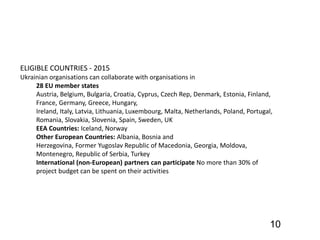
ELIGIBLE COUNTRIES - 2015
Ukrainian organisations can collaborate with organisations in
28 EU member states
Austria, Belgium, Bulgaria, Croatia, Cyprus, Czech Rep, Denmark, Estonia, Finland,
France, Germany, Greece, Hungary,
Ireland, Italy, Latvia, Lithuania, Luxembourg, Malta, Netherlands, Poland, Portugal,
Romania, Slovakia, Slovenia, Spain, Sweden, UK
EEA Countries: Iceland, Norway
Other European Countries: Albania, Bosnia and
Herzegovina, Former Yugoslav Republic of Macedonia, Georgia, Moldova,
Montenegro, Republic of Serbia, Turkey
International (non-European) partners can participate No more than 30% of
project budget can be spent on their activities
11
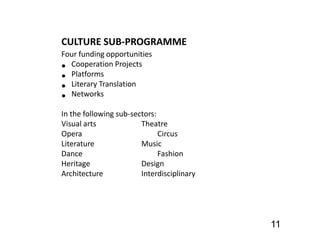
CULTURE SUB-PROGRAMME
Four funding opportunities
• Cooperation Projects
• Platforms
• Literary Translation
• Networks
In the following sub-sectors:
Visual arts Theatre
Opera Circus
Literature Music
Dance Fashion
Heritage Design
Architecture Interdisciplinary
.
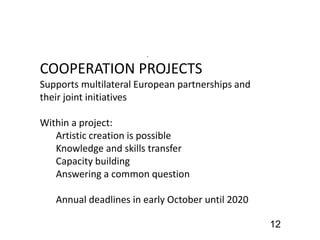
COOPERATION PROJECTS
Supports multilateral European partnerships and
their joint initiatives
Within a project:
Artistic creation is possible
Knowledge and skills transfer
Capacity building
Answering a common question
Annual deadlines in early October until 2020
12
13
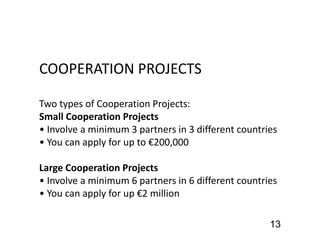
COOPERATION PROJECTS
Two types of Cooperation Projects:
Small Cooperation Projects
• Involve a minimum 3 partners in 3 different countries
• You can apply for up to €200,000
Large Cooperation Projects
• Involve a minimum 6 partners in 6 different countries
• You can apply for up €2 million
14
LITERARY TRANSLATION
Support for publishers for the translation and promotion of European literature
translated works
Translation of a series of 3-10 fiction works, their promotion and production
Can apply for maximum €100,000, 50% of total eligible costs
Annual deadlines in early February
OR
‘Framework partnership agreements’: Series of 5-10 fiction works per year, their
promotion and production
Can apply for maximum €100,000/year, 50% of total eligible costs
Next deadline in 2017
15
EUROPEAN PLATFORMS
European platform to promote new and emerging talent
‘Presenting European content to audiences’
• Members of a platform share programmes and artists
• Co-developing, co-creating
• Cooperate on distribution
• Provide visibility and mobility of new talent – min 30%
of emerging talent
• Minimum 10 members from 10 countries, 5 from EU
Member states
• 80% maximum support
• Multi-annual funding
16
EUROPEAN NETWORKS
European network to reinforce the members’ capacity to operate
trans-nationally
‘Professionals to professionals’
• Build capacity to work across Europe and adapt to change
• Foster linguistic and cultural diversity
• Cooperate, share experience, promote good practice
• through e.g. conferences, research
• Minimum 15 members from 10 countries, 5 from EU
• Member states
• 80% maximum support
• Multi-annual funding
HOW IS YOUR APPLICATION
EVALUATED?
• Database of experts with a high level of expertise in the sector
• Experts assess applications from their field of expertise
• Experts usually only review applications from outside their
country of residence to ensure that there is no conflict of interest
• All applications are assessed by two independent experts
• Score threshold for success varies every year depending on
quality of applications
• You receive detailed feedback whether you are successful or not
• Resubmission is possible and you can take on board feedback
17
18
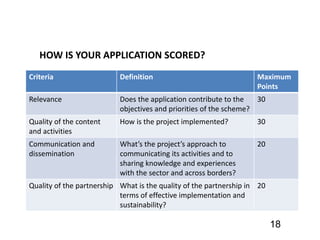
HOW IS YOUR APPLICATION SCORED?
Criteria Definition Maximum
Points
Relevance Does the application contribute to the
objectives and priorities of the scheme?
30
Quality of the content
and activities
How is the project implemented? 30
Communication and
dissemination
What’s the project’s approach to
communicating its activities and to
sharing knowledge and experiences
with the sector and across borders?
20
Quality of the partnership What is the quality of the partnership in
terms of effective implementation and
sustainability?
20
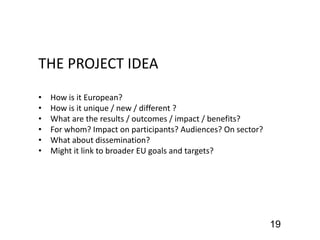
THE PROJECT IDEA
• How is it European?
• How is it unique / new / different ?
• What are the results / outcomes / impact / benefits?
• For whom? Impact on participants? Audiences? On sector?
• What about dissemination?
• Might it link to broader EU goals and targets?
19
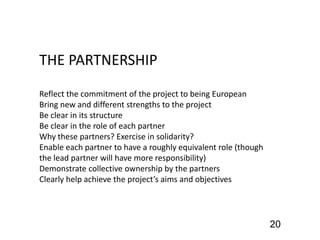
THE PARTNERSHIP
Reflect the commitment of the project to being European
Bring new and different strengths to the project
Be clear in its structure
Be clear in the role of each partner
Why these partners? Exercise in solidarity?
Enable each partner to have a roughly equivalent role (though
the lead partner will have more responsibility)
Demonstrate collective ownership by the partners
Clearly help achieve the project’s aims and objectives
20
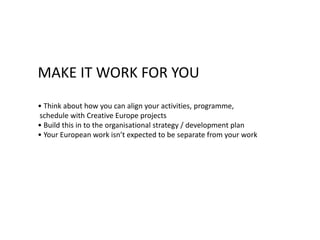
MAKE IT WORK FOR YOU
• Think about how you can align your activities, programme,
schedule with Creative Europe projects
• Build this in to the organisational strategy / development plan
• Your European work isn’t expected to be separate from your work
HOW TO FIND PARTNERS
Join a European or international cultural network
Look through funded projects on other Creative Europe
desk websites or the European Commission Project
Results Platform
FINANCE
Match funding principle
Every partner expected to put in some resources
For Cooperation Projects Creative Europe contributes:
Small projects:
Grants of up to €200,000
Up to 60% of total project budget
Large projects:
Grants of up to €2 million
Up to 50% of total project budget
MATCH FUNDING
Project income to come from funds generated by the project partners
can include:
– Own resources
– Grants
– Generated by the project from ticket sales/box office, sales of
publications, registration fees...
– Donations and sponsorship
– Some seconded staff (in moderation) – for ‘project coordination’
and ‘artistic’ costs for example
– Deliverables agreed with other partners/funders
– ‘in-kind’ contributions not eligible – BUT valued –
All costs, also income, MUST have supporting paperwork and be
Traceable in an accounting system
THE TIMELINE
Finding and confirming partners, the idea, developing
project concept, solidifying partnership
Submit application with detailed budget and schedule
Results published in March-April 2017
Justification of early start is now part of application form
Grant payment (50-70%)
Kick-off meeting organised by Agency
Project cycle: maximum 4 years
Report submission
Payment of final project grant (30%)
21
Звертайся до нас за адресою
ukraine@culturepartnership.eu
Підпишись на нашу сторінку у Фейсбук
www.facebook.com/culturepartnership
Відвідай наш сайт
http://www.culturepartnership.eu/

Presentation creative europe

  • 1.
    01 An Introduction toCreative Europe
  • 2.
    03 WHAT IS CREATIVEEUROPE? The European Union’s support programme for the audiovisual, creative and cultural sectors with a Europe-wide budget of €1.46 billion from 2014-2020.
  • 3.
    04 AIMS OF CREATIVEEUROPE • Strengthen the sectors’ capacity to operate transnationally • Promote the transnational circulation of works and people • Reach new audiences in Europe and beyond • Encourage innovation (artistic, business models, spill-over effect) • Strengthen policy making
  • 4.
    05 CREATIVE EUROPE’S PRIORITIES Cross-bordermobility: • Transnational circulation of professionals and content Audience development Capacity building: • Digitisation • New business models • Training and education
  • 5.
    06 CREATIVE EUROPE’S PRIORITIES Cross-bordermobility Mobility not just for mobility's sake, it should result in: • Improving professional skills, peer learning, education or training • Artistic creation or production • Career opportunities • Reaching new audiences • Extending lifespan of tour or performance or exhibition • Increasing consumer choice or access • Capacity building of cultural operators
  • 6.
    07 CREATIVE EUROPE’S PRIORITIES Audiencedevelopment • Involving audiences at any step of the creative process • Working WITH audiences, not just FOR them • Develop new audiences and maintain existing audiences • Conduct research on current and potential audiences • Apply segmentation models i.e. groups/demographics/behaviour • Map out your audience development strategy • Integrate research and monitor progress – ask audiences what they think
  • 7.
    08 CREATIVE EUROPE’S PRIORITIES Capacitybuilding • Create opportunities for training for staff, artists, professionals • Have a collaborative approach to training (peer-to-peer, learn • from other sectors) • Encourage development new skills, i.e. helping the cultural sector • to adapt to new digital developments • Internationalise careers and access new markets • Encourage cross-border networking • Explore new ways of working: diversification of income streams, • compare and contrast new business models and marketing techniques
  • 8.
    09 MEDIA SUPPORTS Audiovisual professionalsincluding.... • producers • distributors • sales agents • training providers • festival organisers • exhibitors • film education specialists • video game developers
  • 9.
    10 ELIGIBLE COUNTRIES -2015 Ukrainian organisations can collaborate with organisations in 28 EU member states Austria, Belgium, Bulgaria, Croatia, Cyprus, Czech Rep, Denmark, Estonia, Finland, France, Germany, Greece, Hungary, Ireland, Italy, Latvia, Lithuania, Luxembourg, Malta, Netherlands, Poland, Portugal, Romania, Slovakia, Slovenia, Spain, Sweden, UK EEA Countries: Iceland, Norway Other European Countries: Albania, Bosnia and Herzegovina, Former Yugoslav Republic of Macedonia, Georgia, Moldova, Montenegro, Republic of Serbia, Turkey International (non-European) partners can participate No more than 30% of project budget can be spent on their activities
  • 10.
    11 CULTURE SUB-PROGRAMME Four fundingopportunities • Cooperation Projects • Platforms • Literary Translation • Networks In the following sub-sectors: Visual arts Theatre Opera Circus Literature Music Dance Fashion Heritage Design Architecture Interdisciplinary
  • 11.
    . COOPERATION PROJECTS Supports multilateralEuropean partnerships and their joint initiatives Within a project: Artistic creation is possible Knowledge and skills transfer Capacity building Answering a common question Annual deadlines in early October until 2020 12
  • 12.
    13 COOPERATION PROJECTS Two typesof Cooperation Projects: Small Cooperation Projects • Involve a minimum 3 partners in 3 different countries • You can apply for up to €200,000 Large Cooperation Projects • Involve a minimum 6 partners in 6 different countries • You can apply for up €2 million
  • 13.
    14 LITERARY TRANSLATION Support forpublishers for the translation and promotion of European literature translated works Translation of a series of 3-10 fiction works, their promotion and production Can apply for maximum €100,000, 50% of total eligible costs Annual deadlines in early February OR ‘Framework partnership agreements’: Series of 5-10 fiction works per year, their promotion and production Can apply for maximum €100,000/year, 50% of total eligible costs Next deadline in 2017
  • 14.
    15 EUROPEAN PLATFORMS European platformto promote new and emerging talent ‘Presenting European content to audiences’ • Members of a platform share programmes and artists • Co-developing, co-creating • Cooperate on distribution • Provide visibility and mobility of new talent – min 30% of emerging talent • Minimum 10 members from 10 countries, 5 from EU Member states • 80% maximum support • Multi-annual funding
  • 15.
    16 EUROPEAN NETWORKS European networkto reinforce the members’ capacity to operate trans-nationally ‘Professionals to professionals’ • Build capacity to work across Europe and adapt to change • Foster linguistic and cultural diversity • Cooperate, share experience, promote good practice • through e.g. conferences, research • Minimum 15 members from 10 countries, 5 from EU • Member states • 80% maximum support • Multi-annual funding
  • 16.
    HOW IS YOURAPPLICATION EVALUATED? • Database of experts with a high level of expertise in the sector • Experts assess applications from their field of expertise • Experts usually only review applications from outside their country of residence to ensure that there is no conflict of interest • All applications are assessed by two independent experts • Score threshold for success varies every year depending on quality of applications • You receive detailed feedback whether you are successful or not • Resubmission is possible and you can take on board feedback 17
  • 17.
    18 HOW IS YOURAPPLICATION SCORED? Criteria Definition Maximum Points Relevance Does the application contribute to the objectives and priorities of the scheme? 30 Quality of the content and activities How is the project implemented? 30 Communication and dissemination What’s the project’s approach to communicating its activities and to sharing knowledge and experiences with the sector and across borders? 20 Quality of the partnership What is the quality of the partnership in terms of effective implementation and sustainability? 20
  • 18.
    THE PROJECT IDEA •How is it European? • How is it unique / new / different ? • What are the results / outcomes / impact / benefits? • For whom? Impact on participants? Audiences? On sector? • What about dissemination? • Might it link to broader EU goals and targets? 19
  • 19.
    THE PARTNERSHIP Reflect thecommitment of the project to being European Bring new and different strengths to the project Be clear in its structure Be clear in the role of each partner Why these partners? Exercise in solidarity? Enable each partner to have a roughly equivalent role (though the lead partner will have more responsibility) Demonstrate collective ownership by the partners Clearly help achieve the project’s aims and objectives 20
  • 20.
    MAKE IT WORKFOR YOU • Think about how you can align your activities, programme, schedule with Creative Europe projects • Build this in to the organisational strategy / development plan • Your European work isn’t expected to be separate from your work
  • 21.
    HOW TO FINDPARTNERS Join a European or international cultural network Look through funded projects on other Creative Europe desk websites or the European Commission Project Results Platform
  • 22.
    FINANCE Match funding principle Everypartner expected to put in some resources For Cooperation Projects Creative Europe contributes: Small projects: Grants of up to €200,000 Up to 60% of total project budget Large projects: Grants of up to €2 million Up to 50% of total project budget
  • 23.
    MATCH FUNDING Project incometo come from funds generated by the project partners can include: – Own resources – Grants – Generated by the project from ticket sales/box office, sales of publications, registration fees... – Donations and sponsorship – Some seconded staff (in moderation) – for ‘project coordination’ and ‘artistic’ costs for example – Deliverables agreed with other partners/funders – ‘in-kind’ contributions not eligible – BUT valued – All costs, also income, MUST have supporting paperwork and be Traceable in an accounting system
  • 24.
    THE TIMELINE Finding andconfirming partners, the idea, developing project concept, solidifying partnership Submit application with detailed budget and schedule Results published in March-April 2017 Justification of early start is now part of application form Grant payment (50-70%) Kick-off meeting organised by Agency Project cycle: maximum 4 years Report submission Payment of final project grant (30%)
  • 25.
    21 Звертайся до насза адресою ukraine@culturepartnership.eu Підпишись на нашу сторінку у Фейсбук www.facebook.com/culturepartnership Відвідай наш сайт http://www.culturepartnership.eu/