01
EU-Eastern Partnership
Culture & Creativity Programme
Creativity a Future Imperative
Tim Williams, Head of Programme
02
03
04
Purpose
to support the cultural and creative
sectors’ contribution to sustainable
humanitarian, social and economic
development.
05
The Programme’s
priorities
• Agenda Setting
• Win-Win Alliances
• Climate for Culture
• Evidence Building, Learning and Legacy
• Capacity Building
• Mainstreaming Eastern Partnership Culture
• Culture and Crisis
06
Our Programme will provide
• Practical research
• Cultural policy reform debate
• Capacity-building
• Synergies between:
public and private sector
government and civil society
• International cooperation
• Raising awareness
• Sharing knowledge and good practice
07
How cultural actors can engage with
this programme - I
• Workshops on:
Creative Europe
cultural leadership
project cycle management
cultural research
cultural journalism
PR and Communications
• A website to showcase EaP culture & share
best practice
• A study tour to Poland
08
How cultural actors can engage with
this programme - II
• Policy debate and development
• A National Partnership Fair and Culture Policy
Forum
• Research papers on subsectors
Operational Structure
• Core Leadership Team based in Kyiv
• 6 Country Coordinators
• A network of Associates
• ‘Backstopping’ provided by the Consortium
09
10
http://www.scidev.net/global/icts/data-
visualisation/digital-divide-data-
interactive.html?utm_medium=email&utm_so
urce=SciDevNewsletter&utm_campaign=intern
ational%20SciDev.Net%20update%3A%2012%
20October%202015
The Hidden Digital Divide
11
Moore’s Law
This observation measures advancements in R&D in digital
electronics
It estimates that every 18 months the number of
transistors in microprocessors doubles
So far these advancements have led to:
• Cheaper electronic goods
• Increased memory capacity
• Increase in pixels in digital cameras
12
Moore’s Law
Digital electronics have contributed to world economic
growth in the last 40 years
Therefore Moore’s Law describes the driving force of
technological and social change, productivity and
economic growth
13
The Singularity
The point where artificial intelligence matches human
intelligence is called the singularity.
At present our smart phones are nice toys, but what will
happen when they are smarter than you?
And when will that happen?
14
Catching up?
The size of our brains is amazing!
The brain can make 2.88 x 10¹⁷ calculations per second.
That figure is roughly the same as the volume of one of
the Great Lakes in North America.
Computers are not yet at that stage, but they are catching
up – and rapidly!
15
Exponential growth rates
http://waitbutwhy.com/2015/01/artificial-intelligence-
revolution-1.html
16
Will a robot take your job?
www.bbc.com/news/technology-34066941
17
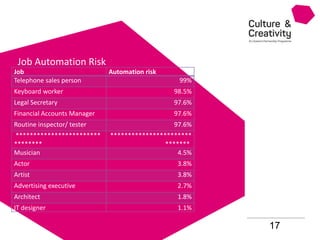
Job Automation Risk
Job Automation risk
Telephone sales person 99%
Keyboard worker 98.5%
Legal Secretary 97.6%
Financial Accounts Manager 97.6%
Routine inspector/ tester 97.6%
************************
********
***********************
*******
Musician 4.5%
Actor 3.8%
Artist 3.8%
Advertising executive 2.7%
Architect 1.8%
IT designer 1.1%
18
The End of Capitalism has Begun – Paul Mason
http://www.theguardian.com/books/2015/jul/17/postca
pitalism-end-of-capitalism-begun
19
The Ideal Machine - 1858
Marx imagined information coming to be stored and
shared in something called a “general intellect” – which
was the mind of everybody on Earth connected by social
knowledge.
In short, he had imagined something close to the
information economy in which we live.
He wrote, its existence would “blow capitalism sky high”.
20
Where does that leave your country?
• Digital economy in the EaP region is asymmetrical with
the EU
• and …. IT is about to exponentially develop
• We are moving into a post capitalist society
• Manufacturing, and middle-management jobs will go
• But jobs linked to innovation are least affected
• Because power will reside in knowledge and creativity
21
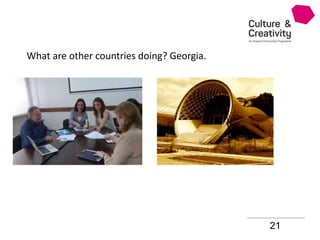
What are other countries doing? Georgia.
14
23
Thank you for attention!
Contact us
contact@culturepartnership.eu
Follow us at Facebook
www.facebook.com/culturepartnership
Visit our web site
www.culturepartnership.eu

Ea p eu c&c

  • 1.
    01 EU-Eastern Partnership Culture &Creativity Programme Creativity a Future Imperative Tim Williams, Head of Programme
  • 2.
  • 3.
  • 4.
    04 Purpose to support thecultural and creative sectors’ contribution to sustainable humanitarian, social and economic development.
  • 5.
    05 The Programme’s priorities • AgendaSetting • Win-Win Alliances • Climate for Culture • Evidence Building, Learning and Legacy • Capacity Building • Mainstreaming Eastern Partnership Culture • Culture and Crisis
  • 6.
    06 Our Programme willprovide • Practical research • Cultural policy reform debate • Capacity-building • Synergies between: public and private sector government and civil society • International cooperation • Raising awareness • Sharing knowledge and good practice
  • 7.
    07 How cultural actorscan engage with this programme - I • Workshops on: Creative Europe cultural leadership project cycle management cultural research cultural journalism PR and Communications • A website to showcase EaP culture & share best practice • A study tour to Poland
  • 8.
    08 How cultural actorscan engage with this programme - II • Policy debate and development • A National Partnership Fair and Culture Policy Forum • Research papers on subsectors
  • 9.
    Operational Structure • CoreLeadership Team based in Kyiv • 6 Country Coordinators • A network of Associates • ‘Backstopping’ provided by the Consortium 09
  • 10.
  • 11.
    11 Moore’s Law This observationmeasures advancements in R&D in digital electronics It estimates that every 18 months the number of transistors in microprocessors doubles So far these advancements have led to: • Cheaper electronic goods • Increased memory capacity • Increase in pixels in digital cameras
  • 12.
    12 Moore’s Law Digital electronicshave contributed to world economic growth in the last 40 years Therefore Moore’s Law describes the driving force of technological and social change, productivity and economic growth
  • 13.
    13 The Singularity The pointwhere artificial intelligence matches human intelligence is called the singularity. At present our smart phones are nice toys, but what will happen when they are smarter than you? And when will that happen?
  • 14.
    14 Catching up? The sizeof our brains is amazing! The brain can make 2.88 x 10¹⁷ calculations per second. That figure is roughly the same as the volume of one of the Great Lakes in North America. Computers are not yet at that stage, but they are catching up – and rapidly!
  • 15.
  • 16.
    16 Will a robottake your job? www.bbc.com/news/technology-34066941
  • 17.
    17 Job Automation Risk JobAutomation risk Telephone sales person 99% Keyboard worker 98.5% Legal Secretary 97.6% Financial Accounts Manager 97.6% Routine inspector/ tester 97.6% ************************ ******** *********************** ******* Musician 4.5% Actor 3.8% Artist 3.8% Advertising executive 2.7% Architect 1.8% IT designer 1.1%
  • 18.
    18 The End ofCapitalism has Begun – Paul Mason http://www.theguardian.com/books/2015/jul/17/postca pitalism-end-of-capitalism-begun
  • 19.
    19 The Ideal Machine- 1858 Marx imagined information coming to be stored and shared in something called a “general intellect” – which was the mind of everybody on Earth connected by social knowledge. In short, he had imagined something close to the information economy in which we live. He wrote, its existence would “blow capitalism sky high”.
  • 20.
    20 Where does thatleave your country? • Digital economy in the EaP region is asymmetrical with the EU • and …. IT is about to exponentially develop • We are moving into a post capitalist society • Manufacturing, and middle-management jobs will go • But jobs linked to innovation are least affected • Because power will reside in knowledge and creativity
  • 21.
    21 What are othercountries doing? Georgia.
  • 22.
  • 23.
    23 Thank you forattention! Contact us contact@culturepartnership.eu Follow us at Facebook www.facebook.com/culturepartnership Visit our web site www.culturepartnership.eu