The (missing) link in European Capitals of Culture (ECOC)
Pia Leydolt-Fuchs & Carina Kurta
(BTO, Florence, November 2017)
CaP.CULT – The idea
• Former ECOC-team member in Linz09 (Austria) und Istanbul 2010
(Turkey)
• Experience and deep interest in the project
„European Capital of Culture“ in general as well as in particular
• Working outside the structure of the official programme
organisation while participating directly in the project
• From an objective point of view
• Open for all parties interested in ECOC
CaP.CULT – The idea
Benchmarks of success: number of tourists
ECOC-Organisation: Tourism sector:
- to fill one year with content - hospitality & service in different fields
- to create something new - to show/sell the city to visitors
- to get the ball rolling in - history, sights, culture, hotels,
different fields gastronomy etc.
 mediation of art and culture for visitors / “temporary citizens”!!!
CaP.CULT– (Missing) Link
CaP.CULT
(ECOC-Tours)
Visitors
Tourism sector
ECOC-
Organisation
CaP.CULT - an additional offer
Already existing:
- Classic guided city tours
- Independent walking tours
(old town, history etc.)
- One-day-trips to the region
- Bus tours
- Audio guides
+ guided ECOC-Tours
Vision / Mission
During cultural city walks visitors
• encounter artistic and architectural projects
(in combination with traditional/historical sights and current
city development).
• get a comprehensive impression of the dynamics of the city
and insights into the cultural project as a catalyst for the local
urban development and transformation.
ECOC-Tours
Information concerning
• „European Capital of Culture“ in general and in particular
(former, current and future ECOCs; comparison)
• ECOC programme & projects
• Cultural diversity
• Urban development
• Cultural, social, political, economical background
• Changes and innovations
• Architecture
• Contemporary Art
• History
CaP.CULT – (Missing) Link
ECOCs are often visited by a few million people during the year,
simply because they are ECOC!
 Increase of
- cultural tourism sector
- individual tourism
- tailor made tours
 Different interests
 Specific questions
ECOC – what exactly does it mean?, How does a city or
region become ECOC?, What does it mean on a regional, national
or even international level – to the city, the region, the inhabitants?
How is the programme developed and who is involved?, How is such a large
project financed?, What is the content and why?, How to participate?
What happened in recent years?, What will happen once the year is over?
 Aim: to answer these questions comprehensively!
CaP.CULT – For whom?
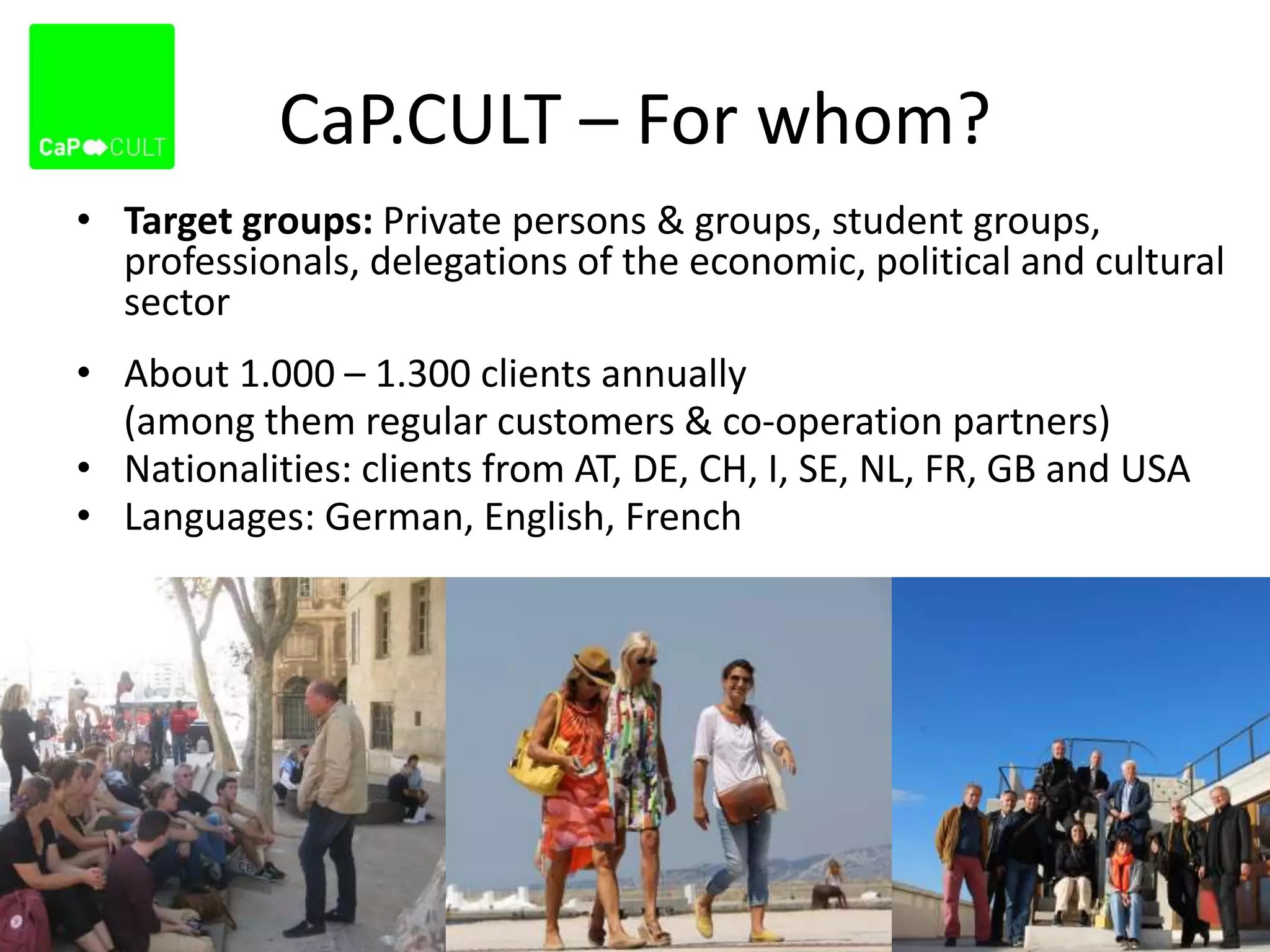
• Target groups: Private persons & groups, student groups,
professionals, delegations of the economic, political and cultural
sector
• About 1.000 – 1.300 clients annually
(among them regular customers & co-operation partners)
• Nationalities: clients from AT, DE, CH, I, SE, NL, FR, GB and USA
• Languages: German, English, French
CaP.CULT – How?
• Individual organisation / conceptual development
• Focus on the clients’ personal interests
• Personally accompanied city tours and trips
• Transfer of knowledge
• Meetings and round tables with ECOC-managers, local artists
and cultural stakeholder
• Pointing-out of non-obvious contexts / background stories
• Colleagues and co-operation partners in ECOCs
Les Terrasses, Kader Attia (MP2013)
Flammes et Flots (MP2013)
Ici même (MP2013)
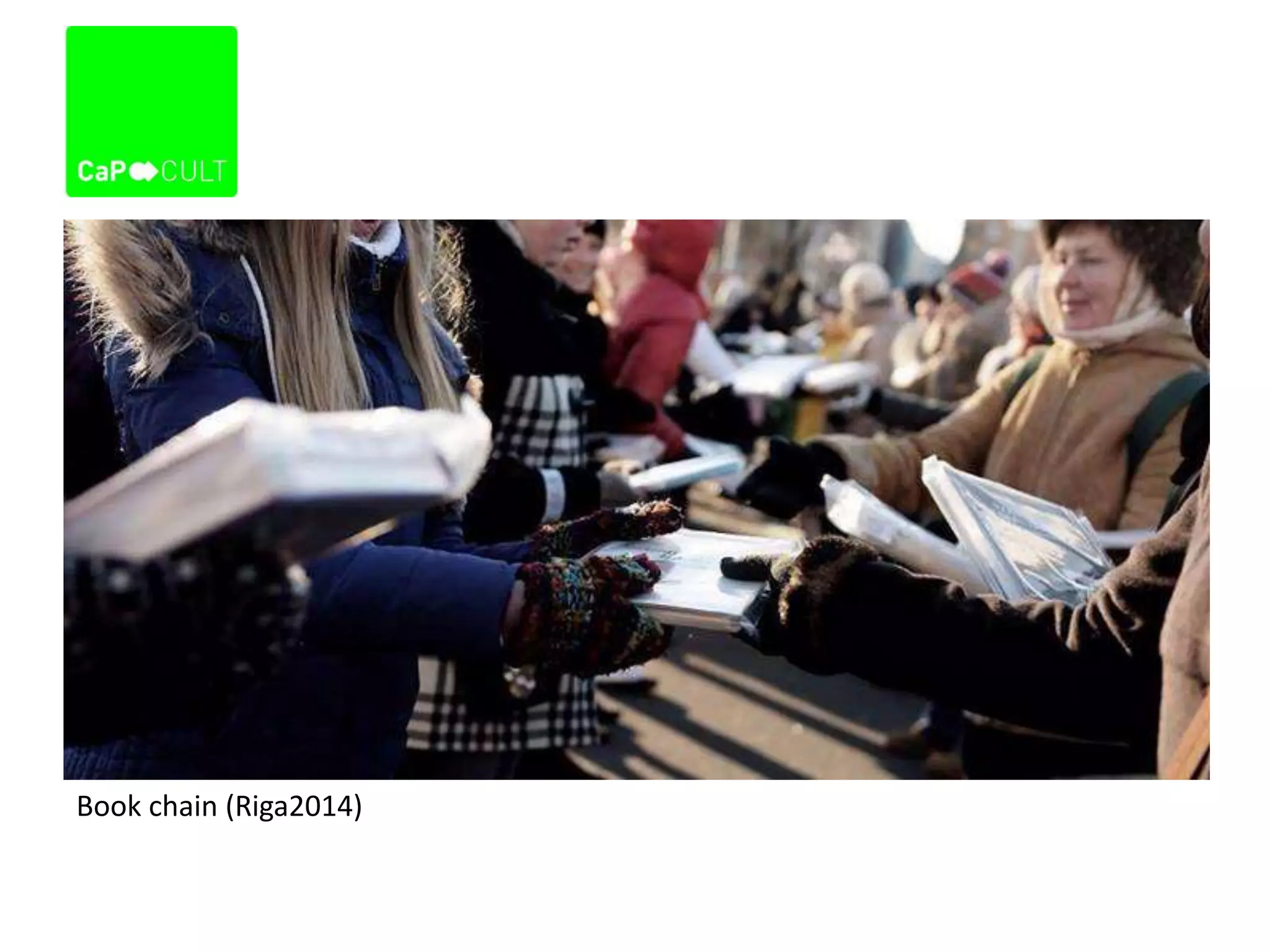
Book chain (Riga2014)
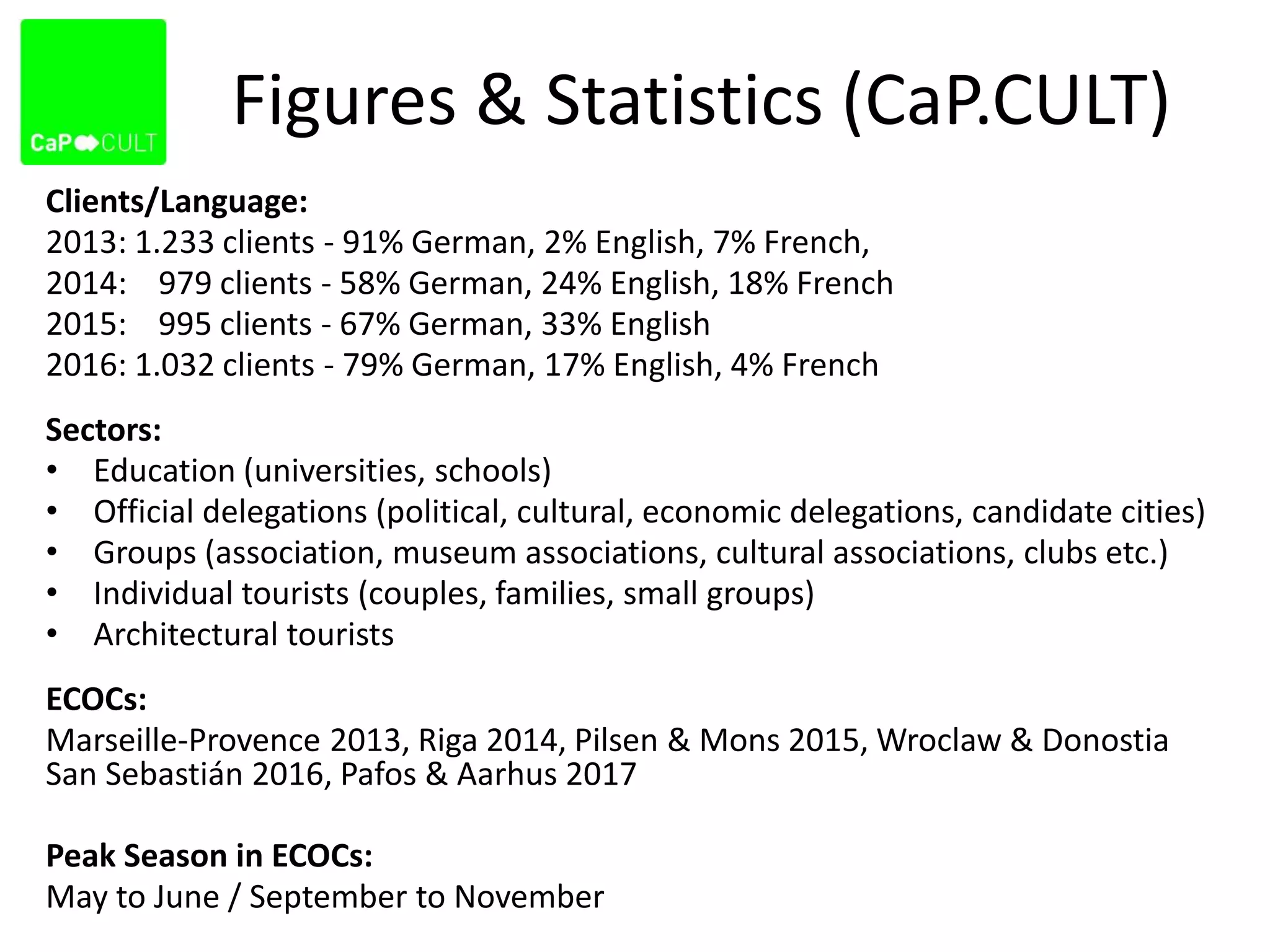
Figures & Statistics (CaP.CULT)
Clients/Language:
2013: 1.233 clients - 91% German, 2% English, 7% French,
2014: 979 clients - 58% German, 24% English, 18% French
2015: 995 clients - 67% German, 33% English
2016: 1.032 clients - 79% German, 17% English, 4% French
Sectors:
• Education (universities, schools)
• Official delegations (political, cultural, economic delegations, candidate cities)
• Groups (association, museum associations, cultural associations, clubs etc.)
• Individual tourists (couples, families, small groups)
• Architectural tourists
ECOCs:
Marseille-Provence 2013, Riga 2014, Pilsen & Mons 2015, Wroclaw & Donostia
San Sebastián 2016, Pafos & Aarhus 2017
Peak Season in ECOCs:
May to June / September to November
“ECOC – Tourism – Workshop”
Specialisation and training of cultural tourist guides in ECOCs
Set-up of a professional linked communication between the
touristic sector and the ECOC-organisation
Professionalism, efficiency, sustainability
• Share our long-time experience and know-how in ECOCs
• In a professional way
• Transmit it in form of a high quality educational programme
• To promote the offer of the capital year for a large number of
visitors
• To strengthen the local tourism sector and the ECOC-
organisation towards visitors in future ECOCs
“ECOC – Tourism – Workshop”
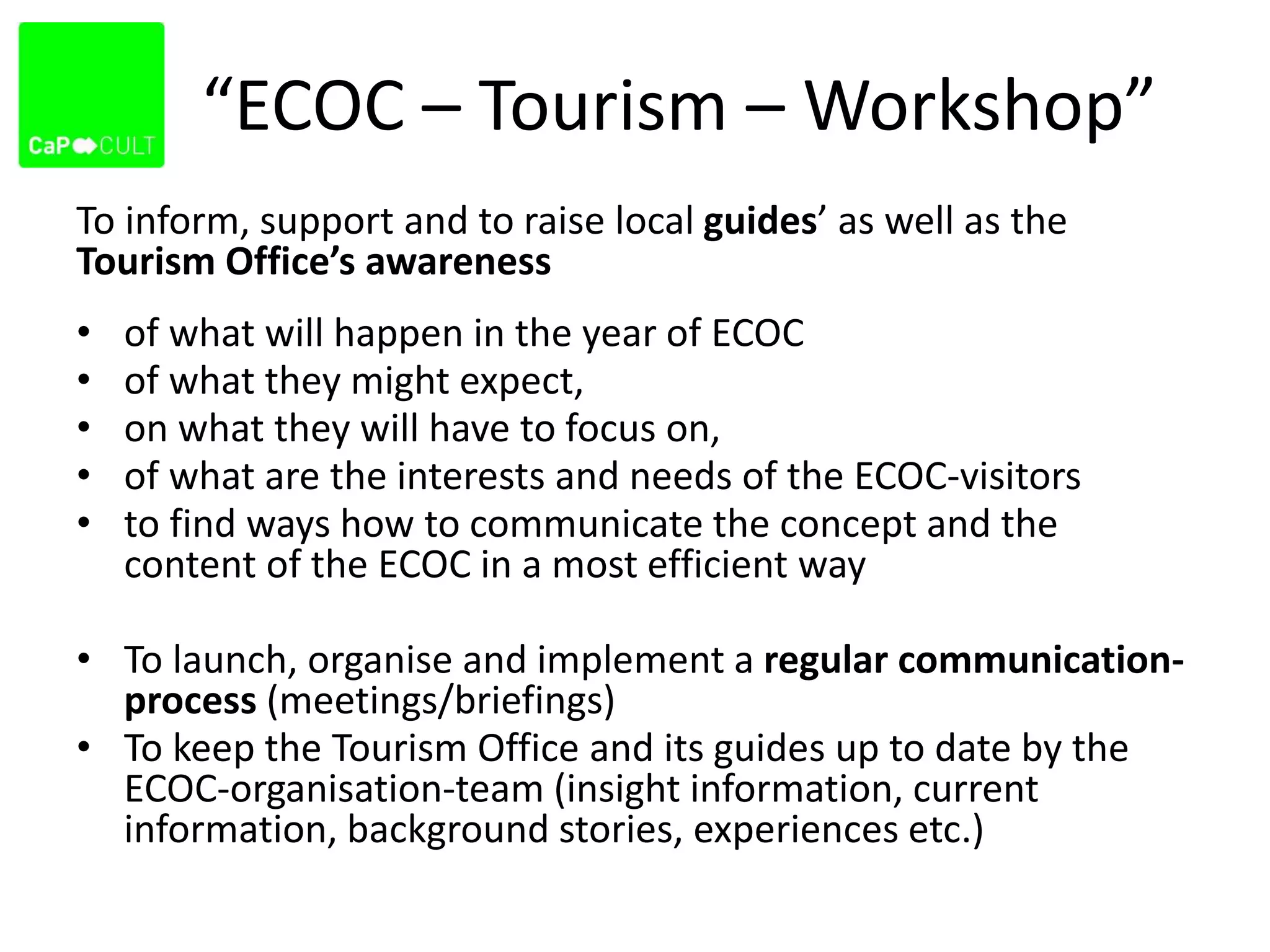
To inform, support and to raise local guides’ as well as the
Tourism Office’s awareness
• of what will happen in the year of ECOC
• of what they might expect,
• on what they will have to focus on,
• of what are the interests and needs of the ECOC-visitors
• to find ways how to communicate the concept and the
content of the ECOC in a most efficient way
• To launch, organise and implement a regular communication-
process (meetings/briefings)
• To keep the Tourism Office and its guides up to date by the
ECOC-organisation-team (insight information, current
information, background stories, experiences etc.)
Advantages and visions
For both Tourism Office in ECOCs and ECOC organisations:
Why adapting the current situation in cultural mediation for the ECOC
year?
• Development of a supplement to the regular touristic offer during
and after the ECOC
• Meet the current trend of developing a service for
individual/private interested visitor
• Going with the trend: implementing local people and local guides
(sustainability)
• Creation of jobs within the city in and after the ECOC (full or part
time jobs)
• Comprehensive explication of the ECOC concept and its objectives
• Understanding of the ECOC project for local or/and foreign visitors
• Long-term reputation of being a welcoming and interesting city
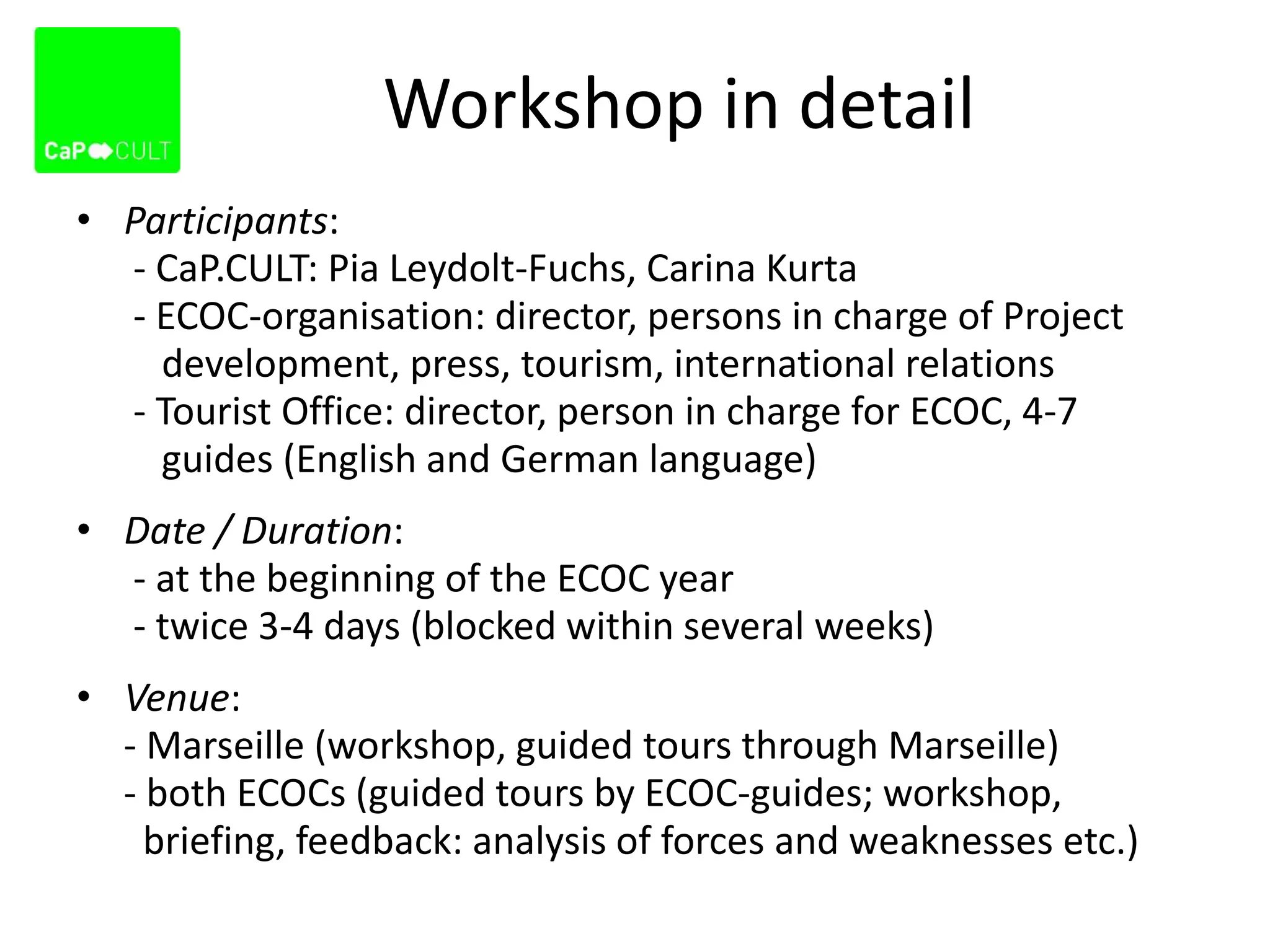
Workshop in detail
• Participants:
- CaP.CULT: Pia Leydolt-Fuchs, Carina Kurta
- ECOC-organisation: director, persons in charge of Project
development, press, tourism, international relations
- Tourist Office: director, person in charge for ECOC, 4-7
guides (English and German language)
• Date / Duration:
- at the beginning of the ECOC year
- twice 3-4 days (blocked within several weeks)
• Venue:
- Marseille (workshop, guided tours through Marseille)
- both ECOCs (guided tours by ECOC-guides; workshop,
briefing, feedback: analysis of forces and weaknesses etc.)
CaP.CULT
Pia Leydolt-Fuchs & Carina Kurta
Tel: +33 (0)6 95 77 43 89
+33 (0)6 95 77 45 31
Email: info@capcult.org
Web: www.capcult.org

BTO2017 | TEN - Cap.Cult - Pia Leydolt-Fuchs

  • 1.
    The (missing) linkin European Capitals of Culture (ECOC) Pia Leydolt-Fuchs & Carina Kurta (BTO, Florence, November 2017)
  • 2.
    CaP.CULT – Theidea • Former ECOC-team member in Linz09 (Austria) und Istanbul 2010 (Turkey) • Experience and deep interest in the project „European Capital of Culture“ in general as well as in particular • Working outside the structure of the official programme organisation while participating directly in the project • From an objective point of view • Open for all parties interested in ECOC
  • 3.
    CaP.CULT – Theidea Benchmarks of success: number of tourists ECOC-Organisation: Tourism sector: - to fill one year with content - hospitality & service in different fields - to create something new - to show/sell the city to visitors - to get the ball rolling in - history, sights, culture, hotels, different fields gastronomy etc.  mediation of art and culture for visitors / “temporary citizens”!!!
  • 4.
  • 5.
    CaP.CULT - anadditional offer Already existing: - Classic guided city tours - Independent walking tours (old town, history etc.) - One-day-trips to the region - Bus tours - Audio guides + guided ECOC-Tours
  • 6.
    Vision / Mission Duringcultural city walks visitors • encounter artistic and architectural projects (in combination with traditional/historical sights and current city development). • get a comprehensive impression of the dynamics of the city and insights into the cultural project as a catalyst for the local urban development and transformation.
  • 7.
    ECOC-Tours Information concerning • „EuropeanCapital of Culture“ in general and in particular (former, current and future ECOCs; comparison) • ECOC programme & projects • Cultural diversity • Urban development • Cultural, social, political, economical background • Changes and innovations • Architecture • Contemporary Art • History
  • 8.
    CaP.CULT – (Missing)Link ECOCs are often visited by a few million people during the year, simply because they are ECOC!  Increase of - cultural tourism sector - individual tourism - tailor made tours  Different interests  Specific questions ECOC – what exactly does it mean?, How does a city or region become ECOC?, What does it mean on a regional, national or even international level – to the city, the region, the inhabitants? How is the programme developed and who is involved?, How is such a large project financed?, What is the content and why?, How to participate? What happened in recent years?, What will happen once the year is over?  Aim: to answer these questions comprehensively!
  • 9.
    CaP.CULT – Forwhom? • Target groups: Private persons & groups, student groups, professionals, delegations of the economic, political and cultural sector • About 1.000 – 1.300 clients annually (among them regular customers & co-operation partners) • Nationalities: clients from AT, DE, CH, I, SE, NL, FR, GB and USA • Languages: German, English, French
  • 10.
    CaP.CULT – How? •Individual organisation / conceptual development • Focus on the clients’ personal interests • Personally accompanied city tours and trips • Transfer of knowledge • Meetings and round tables with ECOC-managers, local artists and cultural stakeholder • Pointing-out of non-obvious contexts / background stories • Colleagues and co-operation partners in ECOCs
  • 11.
    Les Terrasses, KaderAttia (MP2013)
  • 12.
  • 13.
  • 14.
  • 15.
    Figures & Statistics(CaP.CULT) Clients/Language: 2013: 1.233 clients - 91% German, 2% English, 7% French, 2014: 979 clients - 58% German, 24% English, 18% French 2015: 995 clients - 67% German, 33% English 2016: 1.032 clients - 79% German, 17% English, 4% French Sectors: • Education (universities, schools) • Official delegations (political, cultural, economic delegations, candidate cities) • Groups (association, museum associations, cultural associations, clubs etc.) • Individual tourists (couples, families, small groups) • Architectural tourists ECOCs: Marseille-Provence 2013, Riga 2014, Pilsen & Mons 2015, Wroclaw & Donostia San Sebastián 2016, Pafos & Aarhus 2017 Peak Season in ECOCs: May to June / September to November
  • 16.
    “ECOC – Tourism– Workshop” Specialisation and training of cultural tourist guides in ECOCs Set-up of a professional linked communication between the touristic sector and the ECOC-organisation Professionalism, efficiency, sustainability • Share our long-time experience and know-how in ECOCs • In a professional way • Transmit it in form of a high quality educational programme • To promote the offer of the capital year for a large number of visitors • To strengthen the local tourism sector and the ECOC- organisation towards visitors in future ECOCs
  • 17.
    “ECOC – Tourism– Workshop” To inform, support and to raise local guides’ as well as the Tourism Office’s awareness • of what will happen in the year of ECOC • of what they might expect, • on what they will have to focus on, • of what are the interests and needs of the ECOC-visitors • to find ways how to communicate the concept and the content of the ECOC in a most efficient way • To launch, organise and implement a regular communication- process (meetings/briefings) • To keep the Tourism Office and its guides up to date by the ECOC-organisation-team (insight information, current information, background stories, experiences etc.)
  • 18.
    Advantages and visions Forboth Tourism Office in ECOCs and ECOC organisations: Why adapting the current situation in cultural mediation for the ECOC year? • Development of a supplement to the regular touristic offer during and after the ECOC • Meet the current trend of developing a service for individual/private interested visitor • Going with the trend: implementing local people and local guides (sustainability) • Creation of jobs within the city in and after the ECOC (full or part time jobs) • Comprehensive explication of the ECOC concept and its objectives • Understanding of the ECOC project for local or/and foreign visitors • Long-term reputation of being a welcoming and interesting city
  • 19.
    Workshop in detail •Participants: - CaP.CULT: Pia Leydolt-Fuchs, Carina Kurta - ECOC-organisation: director, persons in charge of Project development, press, tourism, international relations - Tourist Office: director, person in charge for ECOC, 4-7 guides (English and German language) • Date / Duration: - at the beginning of the ECOC year - twice 3-4 days (blocked within several weeks) • Venue: - Marseille (workshop, guided tours through Marseille) - both ECOCs (guided tours by ECOC-guides; workshop, briefing, feedback: analysis of forces and weaknesses etc.)
  • 20.
    CaP.CULT Pia Leydolt-Fuchs &Carina Kurta Tel: +33 (0)6 95 77 43 89 +33 (0)6 95 77 45 31 Email: info@capcult.org Web: www.capcult.org

Editor's Notes

  • #12 The meaning of being ECOC of a city in respect of pushing that change …
  • #13 The meaning of being ECOC of a city in respect of pushing that change …
  • #14 The meaning of being ECOC of a city in respect of pushing that change …
  • #15 The meaning of being ECOC of a city in respect of pushing that change …