Design Policy in Action—
Monday 21st March
MUDAM (Luxembourg - Kirchberg)
The model of the Luxembourg
Design Action Group
Nice to meet you —
My name is Barbara Predan.
My link with design policy is:
I am a co-founder and leader of the department of
design theory at the Pekinpah Association, and,
since 2014, the director of the Institute of Design,
an academic research organization.
My work with design policy includes: workshops and
lectures for representatives from the public sector;
education, collaboration and co-working through
actual projects; development of new tools and
methods; writing and publishing research papers.
National design ecosystem—
Population: 2.062.874
Population Density: 102.39
people per sq. km
Total Area: 20,273 km²
GDP: $49,506 billion (Nominal, 2014)
GDP per capita: $30,824 (PPP, 2015)
N. of designers: 3065 (2009)
R&D Spending: 935 million EUR on R&D
activities in 2013. In 2014 53%
companies spent 3% of turnover or
less in R&D; 11% spent more than 10%
in R&D; the rest between 3 and 10%
Some data about my country
The national design ecosystem of Slovenia is complex.
We lack design-driven companies and policy makers, as well
as companies with a clear design (long-term) strategy.
Because of this, the designers’ efforts are less successful;
innovations lack the effect they would have otherwise.
Design Policy
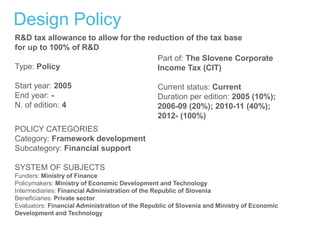
R&D tax allowance to allow for the reduction of the tax base
for up to 100% of R&D
Type: Policy
Start year: 2005
End year: -
N. of edition: 4
Part of: The Slovene Corporate
Income Tax (CIT)
Current status: Current
Duration per edition: 2005 (10%);
2006-09 (20%); 2010-11 (40%);
2012- (100%)
POLICY CATEGORIES
Category: Framework development
Subcategory: Financial support
SYSTEM OF SUBJECTS
Funders: Ministry of Finance
Policymakers: Ministry of Economic Development and Technology
Intermediaries: Financial Administration of the Republic of Slovenia
Beneficiaries: Private sector
Evaluators: Financial Administration of the Republic of Slovenia and Ministry of Economic
Development and Technology
Design Policy
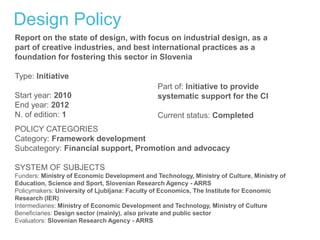
Report on the state of design, with focus on industrial design, as a
part of creative industries, and best international practices as a
foundation for fostering this sector in Slovenia
Type: Initiative
Start year: 2010
End year: 2012
N. of edition: 1
Part of: Initiative to provide
systematic support for the CI
Current status: Completed
POLICY CATEGORIES
Category: Framework development
Subcategory: Financial support, Promotion and advocacy
SYSTEM OF SUBJECTS
Funders: Ministry of Economic Development and Technology, Ministry of Culture, Ministry of
Education, Science and Sport, Slovenian Research Agency - ARRS
Policymakers: University of Ljubljana: Faculty of Economics, The Institute for Economic
Research (IER)
Intermediaries: Ministry of Economic Development and Technology, Ministry of Culture
Beneficiaries: Design sector (mainly), also private and public sector
Evaluators: Slovenian Research Agency - ARRS
Design Policy
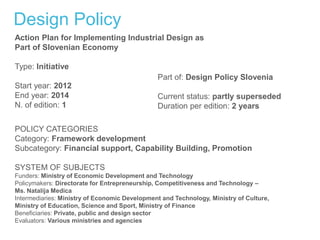
Action Plan for Implementing Industrial Design as
Part of Slovenian Economy
Type: Initiative
Start year: 2012
End year: 2014
N. of edition: 1
Part of: Design Policy Slovenia
Current status: partly superseded
Duration per edition: 2 years
POLICY CATEGORIES
Category: Framework development
Subcategory: Financial support, Capability Building, Promotion
SYSTEM OF SUBJECTS
Funders: Ministry of Economic Development and Technology
Policymakers: Directorate for Entrepreneurship, Competitiveness and Technology –
Ms. Natalija Medica
Intermediaries: Ministry of Economic Development and Technology, Ministry of Culture,
Ministry of Education, Science and Sport, Ministry of Finance
Beneficiaries: Private, public and design sector
Evaluators: Various ministries and agencies
Design Policy
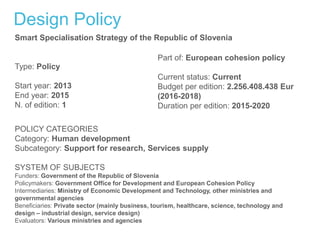
Smart Specialisation Strategy of the Republic of Slovenia
Type: Policy
Start year: 2013
End year: 2015
N. of edition: 1
Part of: European cohesion policy
Current status: Current
Budget per edition: 2.256.408.438 Eur
(2016-2018)
Duration per edition: 2015-2020
POLICY CATEGORIES
Category: Human development
Subcategory: Support for research, Services supply
SYSTEM OF SUBJECTS
Funders: Government of the Republic of Slovenia
Policymakers: Government Office for Development and European Cohesion Policy
Intermediaries: Ministry of Economic Development and Technology, other ministries and
governmental agencies
Beneficiaries: Private sector (mainly business, tourism, healthcare, science, technology and
design – industrial design, service design)
Evaluators: Various ministries and agencies
Design Policy
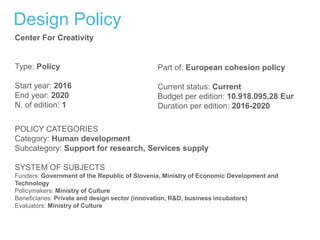
Center For Creativity
Type: Policy
Start year: 2016
End year: 2020
N. of edition: 1
Part of: European cohesion policy
Current status: Current
Budget per edition: 10.918.095,28 Eur
Duration per edition: 2016-2020
POLICY CATEGORIES
Category: Human development
Subcategory: Support for research, Services supply
SYSTEM OF SUBJECTS
Funders: Government of the Republic of Slovenia, Ministry of Economic Development and
Technology
Policymakers: Ministry of Culture
Beneficiaries: Private and design sector (innovation, R&D, business incubators)
Evaluators: Ministry of Culture
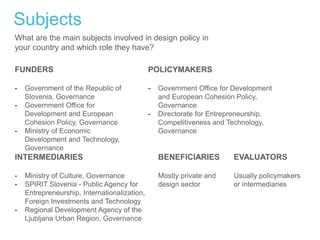
Subjects
What are the main subjects involved in design policy in
your country and which role they have?
FUNDERS
- Government of the Republic of
Slovenia, Governance
- Government Office for
Development and European
Cohesion Policy, Governance
- Ministry of Economic
Development and Technology,
Governance
POLICYMAKERS
- Government Office for Development
and European Cohesion Policy,
Governance
- Directorate for Entrepreneurship,
Competitiveness and Technology,
Governance
INTERMEDIARIES
- Ministry of Culture, Governance
- SPIRIT Slovenia - Public Agency for
Entrepreneurship, Internationalization,
Foreign Investments and Technology
- Regional Development Agency of the
Ljubljana Urban Region, Governance
BENEFICIARIES
Mostly private and
design sector
EVALUATORS
Usually policymakers
or intermediaries
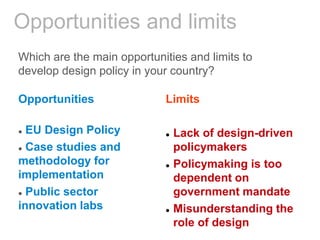
Opportunities and limits
Which are the main opportunities and limits to
develop design policy in your country?
Opportunities
 EU Design Policy
 Case studies and
methodology for
implementation
 Public sector
innovation labs
Limits
 Lack of design-driven
policymakers
 Policymaking is too
dependent on
government mandate
 Misunderstanding the
role of design
Thanks!

Design Policy in Action Workshop - Slovenia presentation

  • 1.
    Design Policy inAction— Monday 21st March MUDAM (Luxembourg - Kirchberg) The model of the Luxembourg Design Action Group
  • 2.
    Nice to meetyou — My name is Barbara Predan. My link with design policy is: I am a co-founder and leader of the department of design theory at the Pekinpah Association, and, since 2014, the director of the Institute of Design, an academic research organization. My work with design policy includes: workshops and lectures for representatives from the public sector; education, collaboration and co-working through actual projects; development of new tools and methods; writing and publishing research papers.
  • 3.
    National design ecosystem— Population:2.062.874 Population Density: 102.39 people per sq. km Total Area: 20,273 km² GDP: $49,506 billion (Nominal, 2014) GDP per capita: $30,824 (PPP, 2015) N. of designers: 3065 (2009) R&D Spending: 935 million EUR on R&D activities in 2013. In 2014 53% companies spent 3% of turnover or less in R&D; 11% spent more than 10% in R&D; the rest between 3 and 10% Some data about my country The national design ecosystem of Slovenia is complex. We lack design-driven companies and policy makers, as well as companies with a clear design (long-term) strategy. Because of this, the designers’ efforts are less successful; innovations lack the effect they would have otherwise.
  • 4.
    Design Policy R&D taxallowance to allow for the reduction of the tax base for up to 100% of R&D Type: Policy Start year: 2005 End year: - N. of edition: 4 Part of: The Slovene Corporate Income Tax (CIT) Current status: Current Duration per edition: 2005 (10%); 2006-09 (20%); 2010-11 (40%); 2012- (100%) POLICY CATEGORIES Category: Framework development Subcategory: Financial support SYSTEM OF SUBJECTS Funders: Ministry of Finance Policymakers: Ministry of Economic Development and Technology Intermediaries: Financial Administration of the Republic of Slovenia Beneficiaries: Private sector Evaluators: Financial Administration of the Republic of Slovenia and Ministry of Economic Development and Technology
  • 5.
    Design Policy Report onthe state of design, with focus on industrial design, as a part of creative industries, and best international practices as a foundation for fostering this sector in Slovenia Type: Initiative Start year: 2010 End year: 2012 N. of edition: 1 Part of: Initiative to provide systematic support for the CI Current status: Completed POLICY CATEGORIES Category: Framework development Subcategory: Financial support, Promotion and advocacy SYSTEM OF SUBJECTS Funders: Ministry of Economic Development and Technology, Ministry of Culture, Ministry of Education, Science and Sport, Slovenian Research Agency - ARRS Policymakers: University of Ljubljana: Faculty of Economics, The Institute for Economic Research (IER) Intermediaries: Ministry of Economic Development and Technology, Ministry of Culture Beneficiaries: Design sector (mainly), also private and public sector Evaluators: Slovenian Research Agency - ARRS
  • 6.
    Design Policy Action Planfor Implementing Industrial Design as Part of Slovenian Economy Type: Initiative Start year: 2012 End year: 2014 N. of edition: 1 Part of: Design Policy Slovenia Current status: partly superseded Duration per edition: 2 years POLICY CATEGORIES Category: Framework development Subcategory: Financial support, Capability Building, Promotion SYSTEM OF SUBJECTS Funders: Ministry of Economic Development and Technology Policymakers: Directorate for Entrepreneurship, Competitiveness and Technology – Ms. Natalija Medica Intermediaries: Ministry of Economic Development and Technology, Ministry of Culture, Ministry of Education, Science and Sport, Ministry of Finance Beneficiaries: Private, public and design sector Evaluators: Various ministries and agencies
  • 7.
    Design Policy Smart SpecialisationStrategy of the Republic of Slovenia Type: Policy Start year: 2013 End year: 2015 N. of edition: 1 Part of: European cohesion policy Current status: Current Budget per edition: 2.256.408.438 Eur (2016-2018) Duration per edition: 2015-2020 POLICY CATEGORIES Category: Human development Subcategory: Support for research, Services supply SYSTEM OF SUBJECTS Funders: Government of the Republic of Slovenia Policymakers: Government Office for Development and European Cohesion Policy Intermediaries: Ministry of Economic Development and Technology, other ministries and governmental agencies Beneficiaries: Private sector (mainly business, tourism, healthcare, science, technology and design – industrial design, service design) Evaluators: Various ministries and agencies
  • 8.
    Design Policy Center ForCreativity Type: Policy Start year: 2016 End year: 2020 N. of edition: 1 Part of: European cohesion policy Current status: Current Budget per edition: 10.918.095,28 Eur Duration per edition: 2016-2020 POLICY CATEGORIES Category: Human development Subcategory: Support for research, Services supply SYSTEM OF SUBJECTS Funders: Government of the Republic of Slovenia, Ministry of Economic Development and Technology Policymakers: Ministry of Culture Beneficiaries: Private and design sector (innovation, R&D, business incubators) Evaluators: Ministry of Culture
  • 9.
    Subjects What are themain subjects involved in design policy in your country and which role they have? FUNDERS - Government of the Republic of Slovenia, Governance - Government Office for Development and European Cohesion Policy, Governance - Ministry of Economic Development and Technology, Governance POLICYMAKERS - Government Office for Development and European Cohesion Policy, Governance - Directorate for Entrepreneurship, Competitiveness and Technology, Governance INTERMEDIARIES - Ministry of Culture, Governance - SPIRIT Slovenia - Public Agency for Entrepreneurship, Internationalization, Foreign Investments and Technology - Regional Development Agency of the Ljubljana Urban Region, Governance BENEFICIARIES Mostly private and design sector EVALUATORS Usually policymakers or intermediaries
  • 10.
    Opportunities and limits Whichare the main opportunities and limits to develop design policy in your country? Opportunities  EU Design Policy  Case studies and methodology for implementation  Public sector innovation labs Limits  Lack of design-driven policymakers  Policymaking is too dependent on government mandate  Misunderstanding the role of design
  • 11.