Finland and Nokia

    CASE ANALYSIS
Group Members


 Abaid Ullah
 Ammara Atta
 Anam Farooq
 Fahad Butt
 Hassan Zulqarnain


 Case: Finland & Nokia
Presentation Plan

 Case Summary                          Anam Farooq
 Issues & Problems                     Anam Farooq
 Case Analysis
  Finland                              Ammara Atta
  Nokia                                Fahad Butt
 Nokia at Corporate level              Fahad Butt
 Nokia at Global level                 Hassan Zulqarnain
 Finland & Nokia 2001-2010             Abaid Ullah


 Case: Finland & Nokia
Case Summary

 In the 1980s, a process started of moving out of an
  investment-driven economy into an innovation-
  driven one.
 With the collapse of the Soviet Union around 1990,
  Finland reached a crisis.
 Finland became the member of the European Union
  with fiscal stability.
 Finnish constitution had the semi-presidential form
  of government that plays a significant role in forming
  the good foreign relations.

 Case: Finland & Nokia                           Anam
Cont...

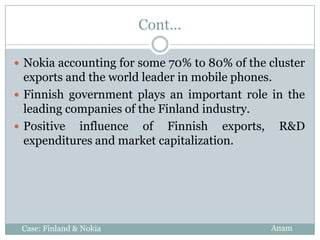
 Nokia accounting for some 70% to 80% of the cluster
  exports and the world leader in mobile phones.
 Finnish government plays an important role in the
  leading companies of the Finland industry.
 Positive influence of Finnish exports, R&D
  expenditures and market capitalization.


 Case: Finland & Nokia                        Anam
Issues & Problems

 Slowdown of global telecommunication.
 Overall growth rates were also on the way out with
  the major export markets weakening.
 The telecommunication cluster was at its peak and
  was also facing severe downturn.
 Demand for skilled labor was increasing whereas
  Nokia had shortage of skilled labor engineers and
  scientists.
 Unemployment was also increasing in Finnish
  society among young and unskilled.
 Case: Finland & Nokia                       Anam
Case Analysis

                           FINLAND


Case: Finland & Nokia                   Ammara
Levels of Fitness

 Simple consistency:
   Finland’s overall economy was consistent in innovation in
    telecommunication and IT industry.


 Reinforcement:
   New universities were opened

   Huge investments in R&D

   Acquisitions for latest technology and market developments

   Government was monitoring mergers and acquisitions in
    private sectors to harmonize and reinforce overall R&D efforts.


 Case: Finland & Nokia                                     Ammara
Cont...

 Optimization:

   A telecommunication cluster was emerged in Finland in which
   smaller companies merged in large conglomerates like Nokia.


   The best combination for innovation in telecommunication
   was formed in Finland.


 Case: Finland & Nokia                                Ammara
Major Business


 The 3 largest clusters in Finnish economy were;


    Pulp & paper (accounted for 40% of exports)

    Wood products (accounted for 16% of exports)

    Engineered metal (accounted for 23% of exports)


 Case: Finland & Nokia                                 Ammara
Economic Conditions


 The real GDP fell by 6.2%.
 Finnish exports came down.
 Overall interest rate increased in the economy.
 The prices of the property were increasing.
 With the betterment in the Finland economy and
 when it got stable, it started spending more on R&D
 and did more innovation.


 Case: Finland & Nokia                              Ammara
Telecom Sector


 In 2001, over 200 million mobile phones were sold
 worldwide.

 Telecom industry was divided into two parts:


    Mobile communication infrastructure
    Mobile handsets


 Case: Finland & Nokia                           Ammara
SWOT
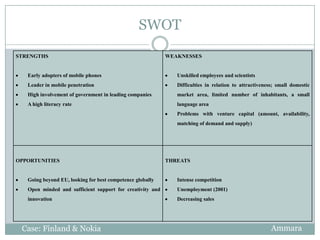
STRENGTHS                                                  WEAKNESSES


   Early adopters of mobile phones                            Unskilled employees and scientists
   Leader in mobile penetration                               Difficulties in relation to attractiveness; small domestic
   High involvement of government in leading companies        market area, limited number of inhabitants, a small
   A high literacy rate                                       language area
                                                              Problems with venture capital (amount, availability,
                                                              matching of demand and supply)


OPPORTUNITIES                                              THREATS


   Going beyond EU, looking for best competence globally      Intense competition
   Open minded and sufficient support for creativity and      Unemployment (2001)
   innovation                                                 Decreasing sales


 Case: Finland & Nokia                                                                                 Ammara
Business Conditions

 Telecommunication      was    the    major    sector
  contributing to the business economy with the
  increasing innovation with growth and stability of
  the economy.
 In 2001, the mobile service providers also faced the
  intense competition throughout the world. This had
  forced the handset manufacturers to develop
  handsets focused on segments.
 Mobile handsets were sold through service operators
  as well as through independent dealers.

 Case: Finland & Nokia                         Ammara
Cluster

 The Finnish telecommunication cluster started in
 1970s and by 2000 it showed the tremendous growth
 by employing some 83000 people under 4% of
 national employment.

 It gave 6.9% of GDP.


 The cluster had grown on average annual rate of
 20%.


 Case: Finland & Nokia                      Ammara
Case Analysis

                            NOKIA


Case: Finland & Nokia                   Fahad
Origin of Strategic Positioning


 “need based positioning” as sophisticated demand
 was there in Army which acted as a seed for the
 innovation in radio technology.


 Case: Finland & Nokia                             Fahad
Operating system focus

1.     Flexibility (Innovation)
2.     Quality (Nokia 2100 was Nokia’s first consumer
       targeted model and was sold mainly due to high
       quality)
3.     Delivery speed
4.     Service
5.     Cost


     Case: Finland & Nokia                        Fahad
SWOT


           Strengths                                   Weakness
                Innovation
               Market leader
              Increasing sales                Could not create monopoly as government
  Acquisitions and JVs for new technology                 forbade doing so.
           Backward integration
  Captured markets of different standards


      Opportunities                                       Threats
                                                Motorola’s first mover advantage in mobile
                                                   infrastructure and analog phones’
 Emerging telecommunication sector in third        Joint venture of Sony and Ericsson
              world countries                    Downturn in telecommunication sector


Case: Finland & Nokia                                                                   Fahad
Porter’s Five Forces Model

                      Bargaining   Low as customers
                                      have no/less
                      power of      other option to
                                     compare with
                      customers


                High because                                   High as overall
              related industry     Intensive because           technology was     Threats of
Threats of   competitors were      of many local and            changing and
              shifting towards           global               digital standards
                                                                                  substitutes
new          telecommunicatio
                    n
                                      competitors.             were emerging
                                                              (TDMA, CDMA)
entrants


                                     Low as large
                                      number of
                                                       Bargaining
                                       contract
                                    manufacturers
                                                       power of
                                   dependent upon
                                        Nokia
                                                       Suppliers
Case: Finland & Nokia                                                                Fahad
BCG Matrix


Case: Finland & Nokia                Fahad
Nokia at Corporate Level


Case: Finland & Nokia               Fahad
Culture and Core Values

 Nokia suffered a crisis situation in late 1980s.


 New CEO introduced four fundamentals values of Nokia
  named them “Nokia Way”.

      Customer satisfaction
      Respect for the individual
      Achievement
      Continuous learning


 Case: Finland & Nokia                               Fahad
Transferring Skills & Sharing Activities

 In 1979, Nokia and Salora created a 50-50 owned
 joint venture (named as Mobira) to market and
 develop radio technology.

 Mobira expanded through global alliances and
 established joint ventures in Korea and US.


 Case: Finland & Nokia                         Fahad
Cont...

 In 1990s, Nokia reorganized its supply chain to
 include contract manufacturers and began to
 contract for some software development and R&D.

 Acquired several electronics companies including
 PC and office electronics business of Ericsson
 Information Systems.


 Case: Finland & Nokia                       Fahad
Diversification

 Nokia did related diversification and invested in
 making mobile handsets.

 Nokia was among top three companies which were
 active in both, infrastructure and handsets in 2001.
 (Other two were Ericsson and Motorola)


 Case: Finland & Nokia                         Fahad
Big picture of overall growth

In 2001:
 Nokia networks: (Multiple setups)
 5 plants in Finland
 5 in China
 1 in Malaysia.


 Nokia Mobile Phones had production units in
  eight countries.


 Case: Finland & Nokia                          Fahad
Nokia at Global Level


Case: Finland & Nokia                Hassan
Cont...


 Size of Organization


 Manufacturing facilities


 World leader in Digital Phones


 Technology


 Case: Finland & Nokia             Hassan
 Brand recognition


 Market channels


 Adaptability


 Industry structure


 Competitive advantage
OLI


Case: Finland & Nokia         Hassan
Porter’s Diamond model


Case: Finland & Nokia                   Hassan
Recommendations for issues

 NOKIA should focus on high potential Asian and
 third world countries to give a boost to its overall
 global sales.

 Finland universities should market them as Global
 IT & Telecommunication specialized universities to
 attract more foreign students. NOKIA should get
 skilled labor from its global existing markets to cope
 up with skilled labor shortage.


 Case: Finland & Nokia                           Hassan
Finland

                        2001-2010


Case: Finland & Nokia               Abaid
Cont...

 2002-2004: Finnish Government adopted a
  resolution on the national broadband strategy.
 2005-2007: The Government of Finland granted an
  operating license to build a new digital mobile
  communications network. Flash-OFDM was chosen
  as the technology for the network.
 In 2007 Finland’s research and development
  expenditure represented 3.5% of the gross domestic
  product, which put Finland among the OECD top.


 Case: Finland & Nokia                         Abaid
Cont...

 2008-2010: New frequencies were allocated to
  telecommunications companies allowing them to
  build 4G mobile networks which made Finland the
  first country in Europe to allow the use of 4G LTE
  technology at such low frequencies.
 Over the past decade, the number of R&D personnel
  has grown from 40,000 to nearly 80,000. This
  makes over 2% of the overall labor force.


 Case: Finland & Nokia                           Abaid
Nokia

                        2001-2010


Case: Finland & Nokia               Abaid
Cont...

 2002: Nokia Networks, and Redback Networks Inc.
  announced strategic agreement to increase
  broadband solution.
 2003: Nokia built Eizel's foundation to make
  wireless Internet access interactive and highly
  satisfying for business users.
 2004: Nokia and Metrowerks completed transaction
  on transfer of application development technology to
  Nokia


 Case: Finland & Nokia                           Abaid
Cont...

 2005: Nokia Corporation sold all of the
  approximately 3.2 million Nextrom holding shares it
  owned.
 2006: Nokia acquired Intellisync, a leader in
  platform-independent wireless messaging and
  applications for mobile devices.
 2007: Nokia acquired Twango to offer a
  comprehensive media sharing experience:Share
  photos, video and other media through virtually any
  connected device.

 Case: Finland & Nokia                          Abaid
Cont...

 2008: Nokia completed its acquisition of Trolltech,
  a recognized software provider with world-class
  software development platforms and frameworks.
 Nokia acquired Symbian Limited .
 2009: Microsoft and Nokia formed global alliance to
  design, develop and market mobile productivity
  solutions.
 2010: Nokia completes acquisition of Novarra to
  enhance internet experience in Nokia series 40
  mobile phones.

 Case: Finland & Nokia                           Abaid
Market Share of Nokia in 2010


 Nokia products accounted for 34% of the global
 market for cell phones, compared with 38%
 previously announced. The company blamed a flood
 of Chinese and fake phones — devices often
 marketed under a brand close to Nokia’s but
 manufactured by others.


 Case: Finland & Nokia                             Abaid
Thank You

Finland & nokia

  • 1.
    Finland and Nokia CASE ANALYSIS
  • 2.
    Group Members  AbaidUllah  Ammara Atta  Anam Farooq  Fahad Butt  Hassan Zulqarnain Case: Finland & Nokia
  • 3.
    Presentation Plan  CaseSummary Anam Farooq  Issues & Problems Anam Farooq  Case Analysis  Finland Ammara Atta  Nokia Fahad Butt  Nokia at Corporate level Fahad Butt  Nokia at Global level Hassan Zulqarnain  Finland & Nokia 2001-2010 Abaid Ullah Case: Finland & Nokia
  • 4.
    Case Summary  Inthe 1980s, a process started of moving out of an investment-driven economy into an innovation- driven one.  With the collapse of the Soviet Union around 1990, Finland reached a crisis.  Finland became the member of the European Union with fiscal stability.  Finnish constitution had the semi-presidential form of government that plays a significant role in forming the good foreign relations. Case: Finland & Nokia Anam
  • 5.
    Cont...  Nokia accountingfor some 70% to 80% of the cluster exports and the world leader in mobile phones.  Finnish government plays an important role in the leading companies of the Finland industry.  Positive influence of Finnish exports, R&D expenditures and market capitalization. Case: Finland & Nokia Anam
  • 6.
    Issues & Problems Slowdown of global telecommunication.  Overall growth rates were also on the way out with the major export markets weakening.  The telecommunication cluster was at its peak and was also facing severe downturn.  Demand for skilled labor was increasing whereas Nokia had shortage of skilled labor engineers and scientists.  Unemployment was also increasing in Finnish society among young and unskilled. Case: Finland & Nokia Anam
  • 7.
    Case Analysis FINLAND Case: Finland & Nokia Ammara
  • 8.
    Levels of Fitness Simple consistency:  Finland’s overall economy was consistent in innovation in telecommunication and IT industry.  Reinforcement:  New universities were opened  Huge investments in R&D  Acquisitions for latest technology and market developments  Government was monitoring mergers and acquisitions in private sectors to harmonize and reinforce overall R&D efforts. Case: Finland & Nokia Ammara
  • 9.
    Cont...  Optimization: A telecommunication cluster was emerged in Finland in which smaller companies merged in large conglomerates like Nokia. The best combination for innovation in telecommunication was formed in Finland. Case: Finland & Nokia Ammara
  • 10.
    Major Business  The3 largest clusters in Finnish economy were;  Pulp & paper (accounted for 40% of exports)  Wood products (accounted for 16% of exports)  Engineered metal (accounted for 23% of exports) Case: Finland & Nokia Ammara
  • 11.
    Economic Conditions  Thereal GDP fell by 6.2%.  Finnish exports came down.  Overall interest rate increased in the economy.  The prices of the property were increasing.  With the betterment in the Finland economy and when it got stable, it started spending more on R&D and did more innovation. Case: Finland & Nokia Ammara
  • 12.
    Telecom Sector  In2001, over 200 million mobile phones were sold worldwide.  Telecom industry was divided into two parts:  Mobile communication infrastructure  Mobile handsets Case: Finland & Nokia Ammara
  • 13.
    SWOT STRENGTHS WEAKNESSES Early adopters of mobile phones Unskilled employees and scientists Leader in mobile penetration Difficulties in relation to attractiveness; small domestic High involvement of government in leading companies market area, limited number of inhabitants, a small A high literacy rate language area Problems with venture capital (amount, availability, matching of demand and supply) OPPORTUNITIES THREATS Going beyond EU, looking for best competence globally Intense competition Open minded and sufficient support for creativity and Unemployment (2001) innovation Decreasing sales Case: Finland & Nokia Ammara
  • 14.
    Business Conditions  Telecommunication was the major sector contributing to the business economy with the increasing innovation with growth and stability of the economy.  In 2001, the mobile service providers also faced the intense competition throughout the world. This had forced the handset manufacturers to develop handsets focused on segments.  Mobile handsets were sold through service operators as well as through independent dealers. Case: Finland & Nokia Ammara
  • 15.
    Cluster  The Finnishtelecommunication cluster started in 1970s and by 2000 it showed the tremendous growth by employing some 83000 people under 4% of national employment.  It gave 6.9% of GDP.  The cluster had grown on average annual rate of 20%. Case: Finland & Nokia Ammara
  • 16.
    Case Analysis NOKIA Case: Finland & Nokia Fahad
  • 17.
    Origin of StrategicPositioning  “need based positioning” as sophisticated demand was there in Army which acted as a seed for the innovation in radio technology. Case: Finland & Nokia Fahad
  • 18.
    Operating system focus 1. Flexibility (Innovation) 2. Quality (Nokia 2100 was Nokia’s first consumer targeted model and was sold mainly due to high quality) 3. Delivery speed 4. Service 5. Cost Case: Finland & Nokia Fahad
  • 19.
    SWOT Strengths Weakness Innovation Market leader Increasing sales Could not create monopoly as government Acquisitions and JVs for new technology forbade doing so. Backward integration Captured markets of different standards Opportunities Threats Motorola’s first mover advantage in mobile infrastructure and analog phones’ Emerging telecommunication sector in third Joint venture of Sony and Ericsson world countries Downturn in telecommunication sector Case: Finland & Nokia Fahad
  • 20.
    Porter’s Five ForcesModel Bargaining Low as customers have no/less power of other option to compare with customers High because High as overall related industry Intensive because technology was Threats of Threats of competitors were of many local and changing and shifting towards global digital standards substitutes new telecommunicatio n competitors. were emerging (TDMA, CDMA) entrants Low as large number of Bargaining contract manufacturers power of dependent upon Nokia Suppliers Case: Finland & Nokia Fahad
  • 21.
  • 22.
    Nokia at CorporateLevel Case: Finland & Nokia Fahad
  • 23.
    Culture and CoreValues  Nokia suffered a crisis situation in late 1980s.  New CEO introduced four fundamentals values of Nokia named them “Nokia Way”.  Customer satisfaction  Respect for the individual  Achievement  Continuous learning Case: Finland & Nokia Fahad
  • 24.
    Transferring Skills &Sharing Activities  In 1979, Nokia and Salora created a 50-50 owned joint venture (named as Mobira) to market and develop radio technology.  Mobira expanded through global alliances and established joint ventures in Korea and US. Case: Finland & Nokia Fahad
  • 25.
    Cont...  In 1990s,Nokia reorganized its supply chain to include contract manufacturers and began to contract for some software development and R&D.  Acquired several electronics companies including PC and office electronics business of Ericsson Information Systems. Case: Finland & Nokia Fahad
  • 26.
    Diversification  Nokia didrelated diversification and invested in making mobile handsets.  Nokia was among top three companies which were active in both, infrastructure and handsets in 2001. (Other two were Ericsson and Motorola) Case: Finland & Nokia Fahad
  • 27.
    Big picture ofoverall growth In 2001:  Nokia networks: (Multiple setups)  5 plants in Finland  5 in China  1 in Malaysia.  Nokia Mobile Phones had production units in eight countries. Case: Finland & Nokia Fahad
  • 28.
    Nokia at GlobalLevel Case: Finland & Nokia Hassan
  • 29.
    Cont...  Size ofOrganization  Manufacturing facilities  World leader in Digital Phones  Technology Case: Finland & Nokia Hassan
  • 30.
     Brand recognition Market channels  Adaptability  Industry structure  Competitive advantage
  • 31.
    OLI Case: Finland &Nokia Hassan
  • 32.
    Porter’s Diamond model Case:Finland & Nokia Hassan
  • 33.
    Recommendations for issues NOKIA should focus on high potential Asian and third world countries to give a boost to its overall global sales.  Finland universities should market them as Global IT & Telecommunication specialized universities to attract more foreign students. NOKIA should get skilled labor from its global existing markets to cope up with skilled labor shortage. Case: Finland & Nokia Hassan
  • 34.
    Finland 2001-2010 Case: Finland & Nokia Abaid
  • 35.
    Cont...  2002-2004: FinnishGovernment adopted a resolution on the national broadband strategy.  2005-2007: The Government of Finland granted an operating license to build a new digital mobile communications network. Flash-OFDM was chosen as the technology for the network.  In 2007 Finland’s research and development expenditure represented 3.5% of the gross domestic product, which put Finland among the OECD top. Case: Finland & Nokia Abaid
  • 36.
    Cont...  2008-2010: Newfrequencies were allocated to telecommunications companies allowing them to build 4G mobile networks which made Finland the first country in Europe to allow the use of 4G LTE technology at such low frequencies.  Over the past decade, the number of R&D personnel has grown from 40,000 to nearly 80,000. This makes over 2% of the overall labor force. Case: Finland & Nokia Abaid
  • 37.
    Nokia 2001-2010 Case: Finland & Nokia Abaid
  • 38.
    Cont...  2002: NokiaNetworks, and Redback Networks Inc. announced strategic agreement to increase broadband solution.  2003: Nokia built Eizel's foundation to make wireless Internet access interactive and highly satisfying for business users.  2004: Nokia and Metrowerks completed transaction on transfer of application development technology to Nokia Case: Finland & Nokia Abaid
  • 39.
    Cont...  2005: NokiaCorporation sold all of the approximately 3.2 million Nextrom holding shares it owned.  2006: Nokia acquired Intellisync, a leader in platform-independent wireless messaging and applications for mobile devices.  2007: Nokia acquired Twango to offer a comprehensive media sharing experience:Share photos, video and other media through virtually any connected device. Case: Finland & Nokia Abaid
  • 40.
    Cont...  2008: Nokiacompleted its acquisition of Trolltech, a recognized software provider with world-class software development platforms and frameworks.  Nokia acquired Symbian Limited .  2009: Microsoft and Nokia formed global alliance to design, develop and market mobile productivity solutions.  2010: Nokia completes acquisition of Novarra to enhance internet experience in Nokia series 40 mobile phones. Case: Finland & Nokia Abaid
  • 41.
    Market Share ofNokia in 2010  Nokia products accounted for 34% of the global market for cell phones, compared with 38% previously announced. The company blamed a flood of Chinese and fake phones — devices often marketed under a brand close to Nokia’s but manufactured by others. Case: Finland & Nokia Abaid
  • 42.