GHULAM MUSTAFA 
2013-ag-997 
•Energy crises effected 
the economy of Pakistan
Introduction 
An Energy Crisis is any great shortfall in the 
supply of energy to an economy 
It usually refers to the shortage of oil, 
electricity or other natural resources
Effects on the economy 
Unemployment increased 
Effect on production 
Higher electricity prices 
Effect in agriculture 
Effect on industries 
Effect on education
Impact on society 
• Imported oil and coal and shortage of natural 
gas increase prices 
• Dependent on other countries 
• Less agriculture yields
Causes of energy crises 
1 .AGING OF THE EQUIPMENT 
One very important reason attributed to this 
energy shortage is the aging of the generating 
equipment which could not develop the electricity 
as per the design requirement 
2 .WASTAGE OF ENERGY 
So far energy conservation is limited to newspaper 
ads lip service in seminars. No serious thought is 
being given to utilize the energy at the optimum 
level.
3 .HIGH COST OF FUEL 
The cost of crude has increased from 40 $ to 
140 $/barrel. it means the generation from 
thermal units are costing exorbitant price. 
WAPDA and KESC when purchasing electricity 
on higher cost are not eager to keep on selling 
the electricity on loss. Therefore they do not 
move on general complain of load shedding.
4 .MONOPOLY IN THE BUSINESS 
Wapda and KESC are two generation and 
dispatch units in Pakistan. although NEPRA is a 
government authority to settle the 
tariff issues but the fact remains that once 
the question of WAPDA comes the authority 
has a very little influence.
• 5 .EXPLORING COAL 
Pakistan is blessed with large amount of the 
coal. again no serious work is done to explore 
the coal for power generation. This is 
complained that the coal quality is inferior. 
however tailored made solutions are available 
to burn any type of coal. Government is 
looking for private sector to play its role
• 6 .RENEWABLE ENERGY 
The government exerting great efforts to develop 
the renewable energy. PPIB has issued letter of 
intent to many private sector sponsors. If a serious 
work is done then the total shortage can be met 
from Hydro and wind power sector. 
7 .ROLE OF GOVERNMENT 
So far the government is looking for private 
sector investment in energy sector and for itself 
it choose a role of facilitator and arbitrator
• 8 .ENERGY PLANNING 
in spite higher costs immediate relief is only 
possible with thermal power plants which can be 
commissioned in 24 months time. A comprehensive 
and realistic planning will help to develop 
generating units in Pakistan which will be a catalytic 
element for the economic growth , poverty 
elevation and prosperity in Pakistan 
9 .DISTRIBUTION SYSTEM 
Wapda briefing highlight the poor distribution 
system as the main cause of tripping and break down 
of the system. However we consider as the last of our 
concern
SWOT Analysis 
Strength 
 Government import and 
increase taxes to generate 
revenue. 
 Explorations of more oils, 
gas and coal reserves 
 Conservation of energy 
resources 
Weakness 
 Industries destroyed 
 Lack of investor 
 Economy slowdown 
 Recession 
 Unemployment increases
SWOT Analysis 
Opportunities 
 Increase the number of IPPs 
(Independent Power 
Producers). 
 Monopolistic environment 
 Profitable for some business 
like generator, ups 
THREATS 
 Protest of general public 
 Vulnerabilities leading 
toward political instability 
 Lack of new projects but 
just seminars only 
 People buying power 
decreases
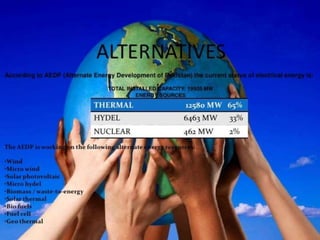
Installed capacity 
Electricity – total installed capacity 21,103MW 
• Electricity – Sources 
– fossil fuel – 13,637 MW – 65% of total 
– hydro – 6,654 MW – 31% of total 
– nuclear – 812 MW – 4% of total 
• There are four major power producers in country: 
WAPDA (Water & Power Development Authority), 
KESC (Karachi Electric Supply Company), IPPs 
(Independent Power Producers) and PAEC (Pakistan 
Atomic Energy Commission).
• WAPDA Hydel 
• Tarbela 3478 MW 
Mangla 1000 MW 
• Ghazi – Barotha 1450 MW 
• Warsak 243 MW 
• Chashma 184 MW 
• Dargai 20 MW 
• Rasul 22 MW 
• Shadi-Waal 18 MW 
• Nandi pur 14 MW 
• Kurram Garhi 4 MW 
• Renala 1 MW 
• Chitral 1 MW 
• Jagran (AK) 30 MW 
• Khankhwar 72 MW 
• AllaiKhwar 121 MW 
• Total Hydel 6,654 MW
• WAPDA Thermal 
• Gas Turbine Power Station, Shahdra 59 MW 
• Steam Power Station, Faisalabad 132 MW 
• Gas Turbine Power Station, Faisalabad 244 MW 
• Gas Power Station, Multan 195 MW 
• Thermal Power Station, Muzaffargarh 1350 MW 
• Thermal Power Station, Guddu 1655 MW 
• Gas Turbine Power Station, Kotri 174 MW 
• Thermal Power Station, Jamshoro 850 MW 
• Thermal Power Station, Larkana 150 MW 
• Thermal Power Station, Quetta 35 MW 
• Gas Turbine Power Station, Panjgur 39 MW 
• Thermal Power Station, Pasni 17 MW 
• Total Thermal 4811 MW
• WAPDA’s total hydel and thermal capacity is 
11,272 MW. Hydel electricity generated by 
WAPDA varies between two extremities, i.e., 
between minimum of 2,414 MW and 
maximum of 6,761 MW depending upon the 
river flow.
• Karachi Electric Supply Company 
• Thermal Power Station, Korangi 316 MW 
• Gas Turbine Power Station, Korangi 80 MW 
• Gas Turbine Power Station, SITE 100 MW 
• Thermal Power Station, Bin Qasim 1260 MW 
• KESC total generation capacity is 1756 MW.
Steps to overcome energy crises 
• 1) Govt. should pay the dues of power 
generation Companies so that they can 
produce electricity at their level best. 
• 2) Immediately replace Street Lights of our Big 
Cities with an LED Panel Lights. Through this 
we can save approximately 1900 MW of 
Electricity.
• 3) Replace florescent Bulbs with Energy Saver bulbs 
and encourage the Citizens to use Energy Saver 
bulbs as through this policy we can save 1150 MW 
of Electricity. 
• 4) We must collect reliable and credible data for 
solar and wind mills development. In meanwhile in 
few selected areas, projects of wind and solar 
energy should be taken up. 
• 5) Whatever we do, it must be affordable. Symbolic 
Houses like PM House, and Presidency should be 
the part of load shedding schedule.
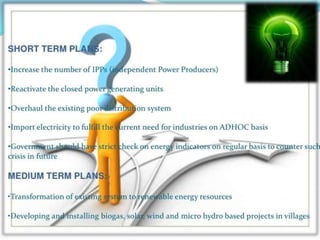
Solutions 
• Short term planning 
• Mid term planning 
• Long term planning
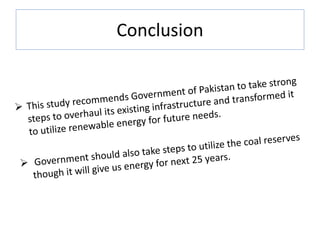
Conclusion

Energy

  • 1.
    GHULAM MUSTAFA 2013-ag-997 •Energy crises effected the economy of Pakistan
  • 2.
    Introduction An EnergyCrisis is any great shortfall in the supply of energy to an economy It usually refers to the shortage of oil, electricity or other natural resources
  • 4.
    Effects on theeconomy Unemployment increased Effect on production Higher electricity prices Effect in agriculture Effect on industries Effect on education
  • 6.
    Impact on society • Imported oil and coal and shortage of natural gas increase prices • Dependent on other countries • Less agriculture yields
  • 8.
    Causes of energycrises 1 .AGING OF THE EQUIPMENT One very important reason attributed to this energy shortage is the aging of the generating equipment which could not develop the electricity as per the design requirement 2 .WASTAGE OF ENERGY So far energy conservation is limited to newspaper ads lip service in seminars. No serious thought is being given to utilize the energy at the optimum level.
  • 9.
    3 .HIGH COSTOF FUEL The cost of crude has increased from 40 $ to 140 $/barrel. it means the generation from thermal units are costing exorbitant price. WAPDA and KESC when purchasing electricity on higher cost are not eager to keep on selling the electricity on loss. Therefore they do not move on general complain of load shedding.
  • 10.
    4 .MONOPOLY INTHE BUSINESS Wapda and KESC are two generation and dispatch units in Pakistan. although NEPRA is a government authority to settle the tariff issues but the fact remains that once the question of WAPDA comes the authority has a very little influence.
  • 11.
    • 5 .EXPLORINGCOAL Pakistan is blessed with large amount of the coal. again no serious work is done to explore the coal for power generation. This is complained that the coal quality is inferior. however tailored made solutions are available to burn any type of coal. Government is looking for private sector to play its role
  • 12.
    • 6 .RENEWABLEENERGY The government exerting great efforts to develop the renewable energy. PPIB has issued letter of intent to many private sector sponsors. If a serious work is done then the total shortage can be met from Hydro and wind power sector. 7 .ROLE OF GOVERNMENT So far the government is looking for private sector investment in energy sector and for itself it choose a role of facilitator and arbitrator
  • 13.
    • 8 .ENERGYPLANNING in spite higher costs immediate relief is only possible with thermal power plants which can be commissioned in 24 months time. A comprehensive and realistic planning will help to develop generating units in Pakistan which will be a catalytic element for the economic growth , poverty elevation and prosperity in Pakistan 9 .DISTRIBUTION SYSTEM Wapda briefing highlight the poor distribution system as the main cause of tripping and break down of the system. However we consider as the last of our concern
  • 14.
    SWOT Analysis Strength  Government import and increase taxes to generate revenue.  Explorations of more oils, gas and coal reserves  Conservation of energy resources Weakness  Industries destroyed  Lack of investor  Economy slowdown  Recession  Unemployment increases
  • 15.
    SWOT Analysis Opportunities  Increase the number of IPPs (Independent Power Producers).  Monopolistic environment  Profitable for some business like generator, ups THREATS  Protest of general public  Vulnerabilities leading toward political instability  Lack of new projects but just seminars only  People buying power decreases
  • 17.
    Installed capacity Electricity– total installed capacity 21,103MW • Electricity – Sources – fossil fuel – 13,637 MW – 65% of total – hydro – 6,654 MW – 31% of total – nuclear – 812 MW – 4% of total • There are four major power producers in country: WAPDA (Water & Power Development Authority), KESC (Karachi Electric Supply Company), IPPs (Independent Power Producers) and PAEC (Pakistan Atomic Energy Commission).
  • 18.
    • WAPDA Hydel • Tarbela 3478 MW Mangla 1000 MW • Ghazi – Barotha 1450 MW • Warsak 243 MW • Chashma 184 MW • Dargai 20 MW • Rasul 22 MW • Shadi-Waal 18 MW • Nandi pur 14 MW • Kurram Garhi 4 MW • Renala 1 MW • Chitral 1 MW • Jagran (AK) 30 MW • Khankhwar 72 MW • AllaiKhwar 121 MW • Total Hydel 6,654 MW
  • 19.
    • WAPDA Thermal • Gas Turbine Power Station, Shahdra 59 MW • Steam Power Station, Faisalabad 132 MW • Gas Turbine Power Station, Faisalabad 244 MW • Gas Power Station, Multan 195 MW • Thermal Power Station, Muzaffargarh 1350 MW • Thermal Power Station, Guddu 1655 MW • Gas Turbine Power Station, Kotri 174 MW • Thermal Power Station, Jamshoro 850 MW • Thermal Power Station, Larkana 150 MW • Thermal Power Station, Quetta 35 MW • Gas Turbine Power Station, Panjgur 39 MW • Thermal Power Station, Pasni 17 MW • Total Thermal 4811 MW
  • 20.
    • WAPDA’s totalhydel and thermal capacity is 11,272 MW. Hydel electricity generated by WAPDA varies between two extremities, i.e., between minimum of 2,414 MW and maximum of 6,761 MW depending upon the river flow.
  • 21.
    • Karachi ElectricSupply Company • Thermal Power Station, Korangi 316 MW • Gas Turbine Power Station, Korangi 80 MW • Gas Turbine Power Station, SITE 100 MW • Thermal Power Station, Bin Qasim 1260 MW • KESC total generation capacity is 1756 MW.
  • 25.
    Steps to overcomeenergy crises • 1) Govt. should pay the dues of power generation Companies so that they can produce electricity at their level best. • 2) Immediately replace Street Lights of our Big Cities with an LED Panel Lights. Through this we can save approximately 1900 MW of Electricity.
  • 26.
    • 3) Replaceflorescent Bulbs with Energy Saver bulbs and encourage the Citizens to use Energy Saver bulbs as through this policy we can save 1150 MW of Electricity. • 4) We must collect reliable and credible data for solar and wind mills development. In meanwhile in few selected areas, projects of wind and solar energy should be taken up. • 5) Whatever we do, it must be affordable. Symbolic Houses like PM House, and Presidency should be the part of load shedding schedule.
  • 28.
    Solutions • Shortterm planning • Mid term planning • Long term planning
  • 31.