


Energy Sector of Pakistan: An
         Overview
Energy
• Key Determinant of Economic Development

• Uninterrupted and affordable supply of energy for accelerated
  growth

• An important economic indicator

• Developing world and energy demand

• Pakistan’s energy demand
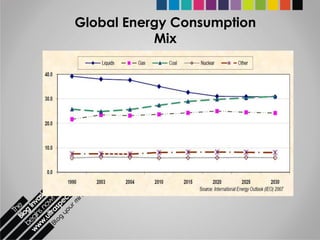
Global Energy Consumption
           Mix
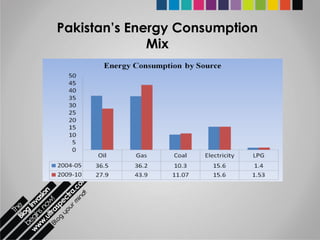
Pakistan’s Energy Consumption
              Mix
Pakistan’s Energy Consumption
                      Mix
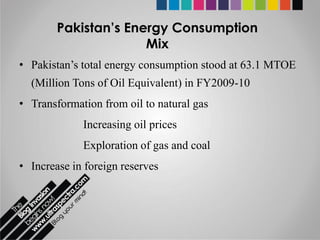
• Pakistan’s total energy consumption stood at 63.1 MTOE
  (Million Tons of Oil Equivalent) in FY2009-10
• Transformation from oil to natural gas
             Increasing oil prices
             Exploration of gas and coal
• Increase in foreign reserves
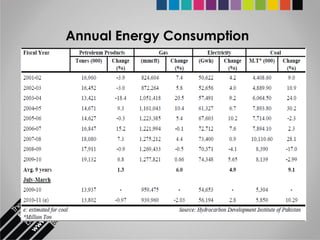
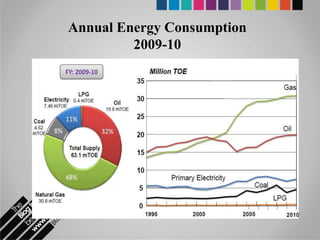
Annual Energy Consumption
         2009-10
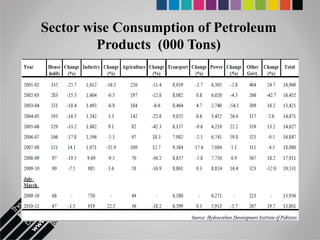
Sector wise Consumption of Petroleum
         Products (000 Tons)
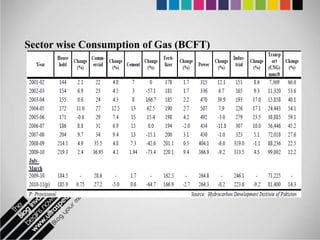
Sector wise Consumption of Gas (BCFT)
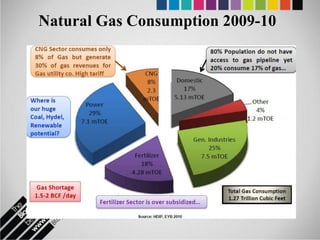
Natural Gas Consumption 2009-10
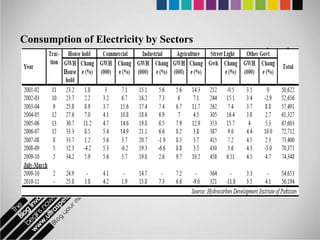
Consumption of Electricity by Sectors
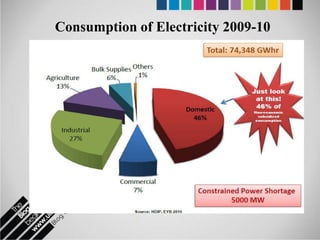
Consumption of Electricity 2009-10
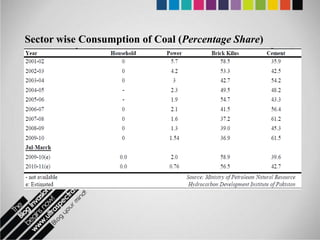
Sector wise Consumption of Coal (Percentage Share)
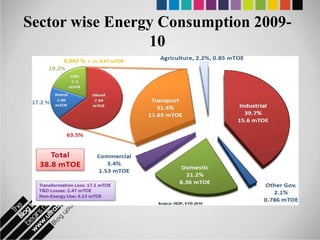
Sector wise Energy Consumption 2009-
                 10
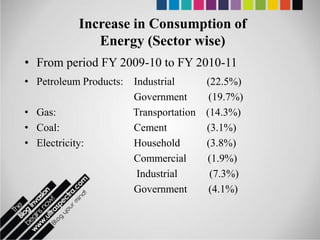
Increase in Consumption of
              Energy (Sector wise)
• From period FY 2009-10 to FY 2010-11
• Petroleum Products: Industrial     (22.5%)
                      Government      (19.7%)
• Gas:                Transportation (14.3%)
• Coal:               Cement         (3.1%)
• Electricity:        Household      (3.8%)
                      Commercial     (1.9%)
                       Industrial     (7.3%)
                      Government      (4.1%)
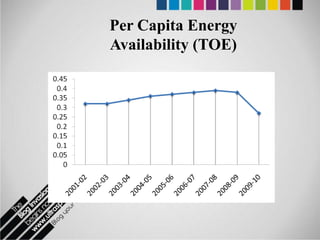
Per Capita Energy
Availability (TOE)
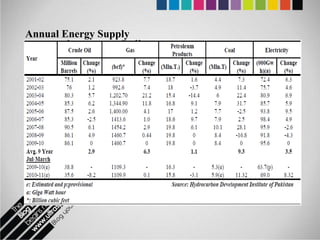
Annual Energy Supply
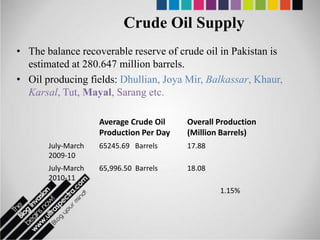
Crude Oil Supply
• The balance recoverable reserve of crude oil in Pakistan is
  estimated at 280.647 million barrels.
• Oil producing fields: Dhullian, Joya Mir, Balkassar, Khaur,
  Karsal, Tut, Mayal, Sarang etc.

                    Average Crude Oil    Overall Production
                    Production Per Day   (Million Barrels)
       July-March   65245.69 Barrels     17.88
       2009-10
       July-March   65,996.50 Barrels    18.08
       2010-11
                                                 1.15%
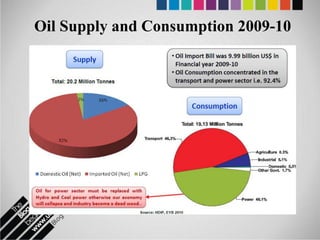
Oil Supply and Consumption 2009-10
Natural Gas Supply
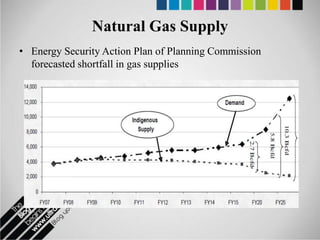
• Energy Security Action Plan of Planning Commission
  forecasted shortfall in gas supplies
Natural Gas Supply
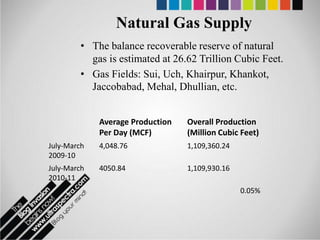
        • The balance recoverable reserve of natural
          gas is estimated at 26.62 Trillion Cubic Feet.
        • Gas Fields: Sui, Uch, Khairpur, Khankot,
          Jaccobabad, Mehal, Dhullian, etc.


             Average Production   Overall Production
             Per Day (MCF)        (Million Cubic Feet)
July-March   4,048.76             1,109,360.24
2009-10
July-March   4050.84              1,109,930.16
2010-11
                                                 0.05%
Liquefied Petroleum Gas
         (LPG)
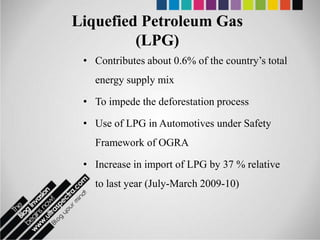
 • Contributes about 0.6% of the country’s total
   energy supply mix

 • To impede the deforestation process

 • Use of LPG in Automotives under Safety
   Framework of OGRA

 • Increase in import of LPG by 37 % relative
   to last year (July-March 2009-10)
Compressed Natural Gas
         (CNG)
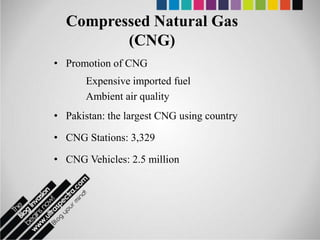
• Promotion of CNG
       Expensive imported fuel
       Ambient air quality
• Pakistan: the largest CNG using country

• CNG Stations: 3,329

• CNG Vehicles: 2.5 million
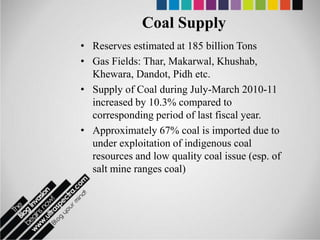
Coal Supply
• Reserves estimated at 185 billion Tons
• Gas Fields: Thar, Makarwal, Khushab,
  Khewara, Dandot, Pidh etc.
• Supply of Coal during July-March 2010-11
  increased by 10.3% compared to
  corresponding period of last fiscal year.
• Approximately 67% coal is imported due to
  under exploitation of indigenous coal
  resources and low quality coal issue (esp. of
  salt mine ranges coal)
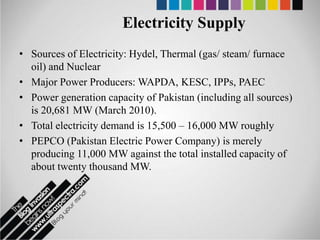
Electricity Supply
• Sources of Electricity: Hydel, Thermal (gas/ steam/ furnace
  oil) and Nuclear
• Major Power Producers: WAPDA, KESC, IPPs, PAEC
• Power generation capacity of Pakistan (including all sources)
  is 20,681 MW (March 2010).
• Total electricity demand is 15,500 – 16,000 MW roughly
• PEPCO (Pakistan Electric Power Company) is merely
  producing 11,000 MW against the total installed capacity of
  about twenty thousand MW.
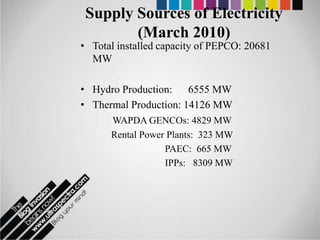
Supply Sources of Electricity
        (March 2010)
• Total installed capacity of PEPCO: 20681
  MW

• Hydro Production: 6555 MW
• Thermal Production: 14126 MW
      WAPDA GENCOs: 4829 MW
      Rental Power Plants: 323 MW
                  PAEC: 665 MW
                  IPPs: 8309 MW
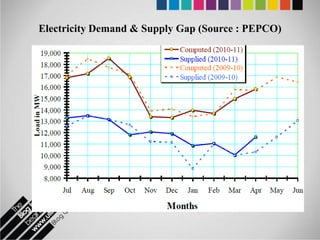
Electricity Demand & Supply Gap (Source : PEPCO)
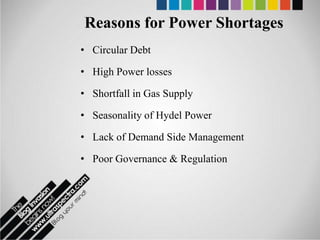
Reasons for Power Shortages
• Circular Debt

• High Power losses

• Shortfall in Gas Supply

• Seasonality of Hydel Power

• Lack of Demand Side Management

• Poor Governance & Regulation
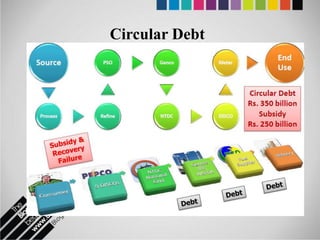
Circular Debt
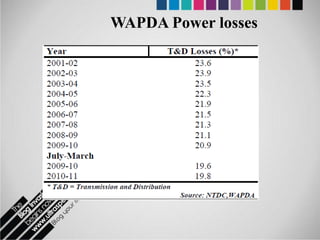
WAPDA Power losses
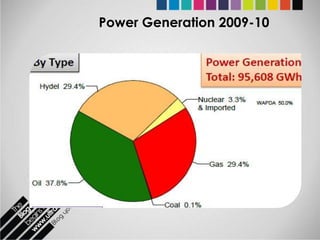
Power Generation 2009-10
Lack of Demand Side Management

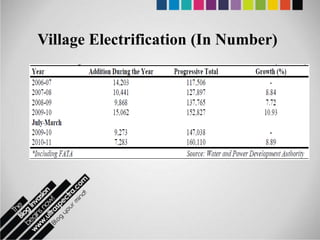
• Village Electrification
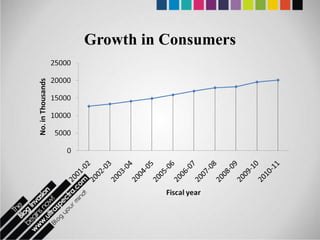
• Growth in Consumers
Village Electrification (In Number)
Growth in Consumers
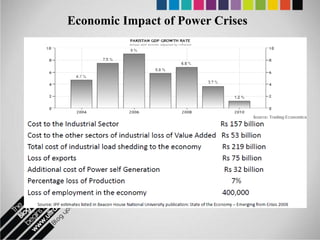
Economic Impact of Power Crises
Energy Crises: Issues &
  Recommendations
• Growing Energy Demand

• Imbalanced Energy Consumption Mix

• Under exploitation of indigenous resources

• Poor Governance & Lack of Integrated
  Planning
Growing Energy Demand
 • Increase in Population
   “Every year Pakistan adds the equivalent of a New
   Zealand to its population; every two years, a
   Switzerland; every three years, a Greece; every four
   years, a Chile or a Netherlands; and every five, an
   Australia.”


 • Industrial and Agricultural Growth

 • Urbanization
Imbalanced Energy Consumption Mix
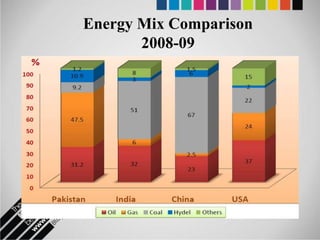
      • Greater share (more than 70%) of non-
        renewable energy resources (oil & gas) in
        energy consumption mix.

      • Any shock in these resources affects
        significantly the overall economy.

      • Need of a greater share of renewable,
        indigenous and affordable energy mix.
Energy Mix Comparison
       2008-09
Under exploitation of indigenous
          resources
   • Thar Coal

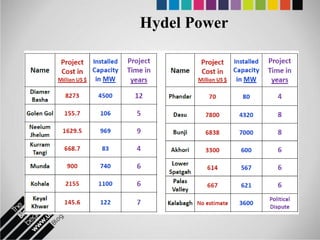
   • Hydel

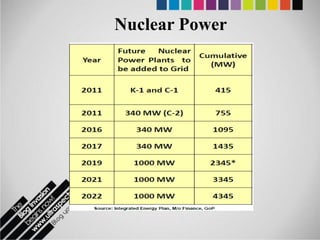
   • Nuclear

   • Solar, Wind & Biodiesel
Hydel Power
Nuclear Power
Alternative Energy Resources
• Alternative Energy Development Board
  (AEDB) is serving as the executing agency at
  the federal level to consolidate the project
  proposals from federal, provincial and other
  public entities for submission to ADB for
  subsequent loan tranches.

• AEDB under its mandate serves as a One-
  window facility to process all Alternative and
  Renewable Energy (ARE) projects both in
  Public and the Private Sectors.
Solar, Wind, Biodiesel
• AEDB issued seven (7) letters of Intent (LOI) for wind power
  projects.
• AEDB has engaged Pakistan State Oil (PSO) for furthering the
  National Biodiesel Programme and provided a production
  plant of biodiesel to PSO for the optimization of processing
  techniques for Biodiesel.
• Pakistan’s first ever commercial Biodiesel production facility
  with the capacity of producing 18,000 tons of Biodiesel per
  annum has been setup in Karachi by the private sector.
Solar, Wind, Biodiesel
• Pakistan is blessed with a huge solar potential of
  more than 5-6 KWH/m²/day of irradiation the
  province of Baluchistan followed by Eastern
  Sindh and Southern Punjab promising technical
  and financially viable solar energy projects.
• Street lights and billboards consume around 400
  MW of power which can be taken off from the
  grid by converting these loads to solar.
• AEDB plans to electrify 400 villages, 100 in
  Sindh and 400 in Baluchistan. 49 villages in
  Sindh have already been electrified where 3000
  Solar Home Systems are installed.
Conclusion
• Energy Sector is the lifeline of an economy.
• Energy demand is growing over the time specially in Developing
  World.
• “Energy crisis in Pakistan is a management and not a capacity
  issue” (Framework for Economic Growth Pakistan May 2011: Planning
    Commission)
•   Integrated Energy Planning is the need of the hour.
•   Develop indigenous energy resources (Thar Coal)
•   Research for New Uninterrupted and Affordable energy sources.
•   Improve Governance and Demand Side Management
Thank You
Connect With Us


        ULTRASPECTRA                    OPEN Academy
Facebook.com/Ultraspectra       Facebook.com/openacademy.isb
Twitter.com/Ultraspectra        Twitter.com/openacademyisb
YouTube.com/user/ultraspectra   YouTube.com/user/openacademy
LinkedIn.com/in/Ultraspectra    LinkedIn.com/in/openacademy
Forum.ultraspectra.com

Energy Sector Pakistan

  • 1.
    Energy Sector ofPakistan: An Overview
  • 2.
    Energy • Key Determinantof Economic Development • Uninterrupted and affordable supply of energy for accelerated growth • An important economic indicator • Developing world and energy demand • Pakistan’s energy demand
  • 4.
  • 5.
  • 6.
    Pakistan’s Energy Consumption Mix • Pakistan’s total energy consumption stood at 63.1 MTOE (Million Tons of Oil Equivalent) in FY2009-10 • Transformation from oil to natural gas Increasing oil prices Exploration of gas and coal • Increase in foreign reserves
  • 7.
  • 8.
  • 9.
    Sector wise Consumptionof Petroleum Products (000 Tons)
  • 10.
  • 11.
  • 12.
  • 13.
  • 14.
    Sector wise Consumptionof Coal (Percentage Share)
  • 15.
    Sector wise EnergyConsumption 2009- 10
  • 16.
    Increase in Consumptionof Energy (Sector wise) • From period FY 2009-10 to FY 2010-11 • Petroleum Products: Industrial (22.5%) Government (19.7%) • Gas: Transportation (14.3%) • Coal: Cement (3.1%) • Electricity: Household (3.8%) Commercial (1.9%) Industrial (7.3%) Government (4.1%)
  • 17.
  • 18.
  • 19.
    Crude Oil Supply •The balance recoverable reserve of crude oil in Pakistan is estimated at 280.647 million barrels. • Oil producing fields: Dhullian, Joya Mir, Balkassar, Khaur, Karsal, Tut, Mayal, Sarang etc. Average Crude Oil Overall Production Production Per Day (Million Barrels) July-March 65245.69 Barrels 17.88 2009-10 July-March 65,996.50 Barrels 18.08 2010-11 1.15%
  • 20.
    Oil Supply andConsumption 2009-10
  • 21.
    Natural Gas Supply •Energy Security Action Plan of Planning Commission forecasted shortfall in gas supplies
  • 22.
    Natural Gas Supply • The balance recoverable reserve of natural gas is estimated at 26.62 Trillion Cubic Feet. • Gas Fields: Sui, Uch, Khairpur, Khankot, Jaccobabad, Mehal, Dhullian, etc. Average Production Overall Production Per Day (MCF) (Million Cubic Feet) July-March 4,048.76 1,109,360.24 2009-10 July-March 4050.84 1,109,930.16 2010-11 0.05%
  • 23.
    Liquefied Petroleum Gas (LPG) • Contributes about 0.6% of the country’s total energy supply mix • To impede the deforestation process • Use of LPG in Automotives under Safety Framework of OGRA • Increase in import of LPG by 37 % relative to last year (July-March 2009-10)
  • 24.
    Compressed Natural Gas (CNG) • Promotion of CNG Expensive imported fuel Ambient air quality • Pakistan: the largest CNG using country • CNG Stations: 3,329 • CNG Vehicles: 2.5 million
  • 25.
    Coal Supply • Reservesestimated at 185 billion Tons • Gas Fields: Thar, Makarwal, Khushab, Khewara, Dandot, Pidh etc. • Supply of Coal during July-March 2010-11 increased by 10.3% compared to corresponding period of last fiscal year. • Approximately 67% coal is imported due to under exploitation of indigenous coal resources and low quality coal issue (esp. of salt mine ranges coal)
  • 26.
    Electricity Supply • Sourcesof Electricity: Hydel, Thermal (gas/ steam/ furnace oil) and Nuclear • Major Power Producers: WAPDA, KESC, IPPs, PAEC • Power generation capacity of Pakistan (including all sources) is 20,681 MW (March 2010). • Total electricity demand is 15,500 – 16,000 MW roughly • PEPCO (Pakistan Electric Power Company) is merely producing 11,000 MW against the total installed capacity of about twenty thousand MW.
  • 27.
    Supply Sources ofElectricity (March 2010) • Total installed capacity of PEPCO: 20681 MW • Hydro Production: 6555 MW • Thermal Production: 14126 MW WAPDA GENCOs: 4829 MW Rental Power Plants: 323 MW PAEC: 665 MW IPPs: 8309 MW
  • 28.
    Electricity Demand &Supply Gap (Source : PEPCO)
  • 29.
    Reasons for PowerShortages • Circular Debt • High Power losses • Shortfall in Gas Supply • Seasonality of Hydel Power • Lack of Demand Side Management • Poor Governance & Regulation
  • 30.
  • 31.
  • 32.
  • 33.
    Lack of DemandSide Management • Village Electrification • Growth in Consumers
  • 34.
  • 35.
  • 36.
    Economic Impact ofPower Crises
  • 37.
    Energy Crises: Issues& Recommendations • Growing Energy Demand • Imbalanced Energy Consumption Mix • Under exploitation of indigenous resources • Poor Governance & Lack of Integrated Planning
  • 38.
    Growing Energy Demand • Increase in Population “Every year Pakistan adds the equivalent of a New Zealand to its population; every two years, a Switzerland; every three years, a Greece; every four years, a Chile or a Netherlands; and every five, an Australia.” • Industrial and Agricultural Growth • Urbanization
  • 39.
    Imbalanced Energy ConsumptionMix • Greater share (more than 70%) of non- renewable energy resources (oil & gas) in energy consumption mix. • Any shock in these resources affects significantly the overall economy. • Need of a greater share of renewable, indigenous and affordable energy mix.
  • 40.
  • 41.
    Under exploitation ofindigenous resources • Thar Coal • Hydel • Nuclear • Solar, Wind & Biodiesel
  • 42.
  • 43.
  • 44.
    Alternative Energy Resources •Alternative Energy Development Board (AEDB) is serving as the executing agency at the federal level to consolidate the project proposals from federal, provincial and other public entities for submission to ADB for subsequent loan tranches. • AEDB under its mandate serves as a One- window facility to process all Alternative and Renewable Energy (ARE) projects both in Public and the Private Sectors.
  • 45.
    Solar, Wind, Biodiesel •AEDB issued seven (7) letters of Intent (LOI) for wind power projects. • AEDB has engaged Pakistan State Oil (PSO) for furthering the National Biodiesel Programme and provided a production plant of biodiesel to PSO for the optimization of processing techniques for Biodiesel. • Pakistan’s first ever commercial Biodiesel production facility with the capacity of producing 18,000 tons of Biodiesel per annum has been setup in Karachi by the private sector.
  • 46.
    Solar, Wind, Biodiesel •Pakistan is blessed with a huge solar potential of more than 5-6 KWH/m²/day of irradiation the province of Baluchistan followed by Eastern Sindh and Southern Punjab promising technical and financially viable solar energy projects. • Street lights and billboards consume around 400 MW of power which can be taken off from the grid by converting these loads to solar. • AEDB plans to electrify 400 villages, 100 in Sindh and 400 in Baluchistan. 49 villages in Sindh have already been electrified where 3000 Solar Home Systems are installed.
  • 47.
    Conclusion • Energy Sectoris the lifeline of an economy. • Energy demand is growing over the time specially in Developing World. • “Energy crisis in Pakistan is a management and not a capacity issue” (Framework for Economic Growth Pakistan May 2011: Planning Commission) • Integrated Energy Planning is the need of the hour. • Develop indigenous energy resources (Thar Coal) • Research for New Uninterrupted and Affordable energy sources. • Improve Governance and Demand Side Management
  • 48.
  • 49.
    Connect With Us ULTRASPECTRA OPEN Academy Facebook.com/Ultraspectra Facebook.com/openacademy.isb Twitter.com/Ultraspectra Twitter.com/openacademyisb YouTube.com/user/ultraspectra YouTube.com/user/openacademy LinkedIn.com/in/Ultraspectra LinkedIn.com/in/openacademy Forum.ultraspectra.com