Block Cipher
Name :- Ashish Duggal
Qualification :- M.C.A.
Introduction of Block Ciphers
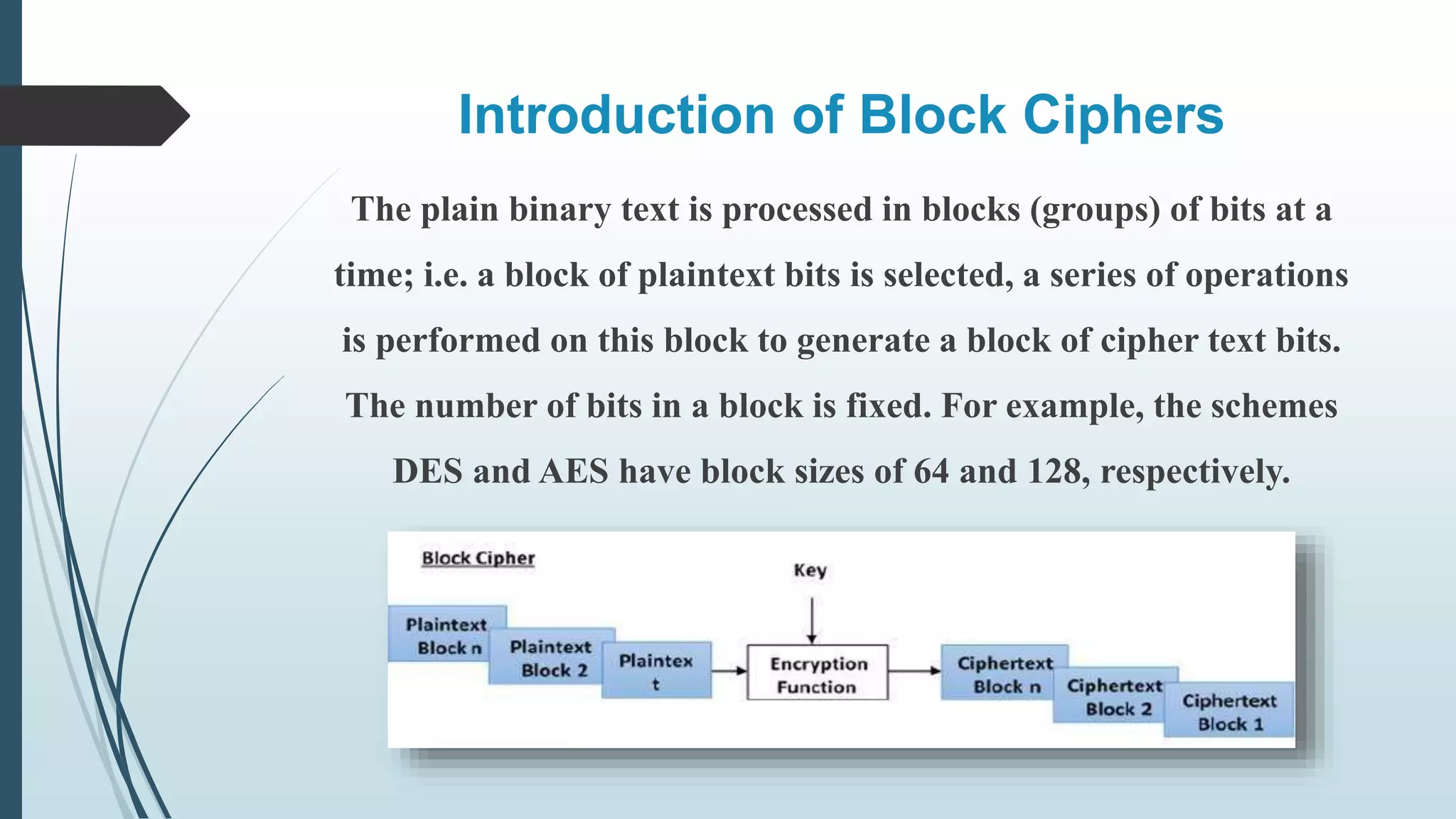
The plain binary text is processed in blocks (groups) of bits at a
time; i.e. a block of plaintext bits is selected, a series of operations
is performed on this block to generate a block of cipher text bits.
The number of bits in a block is fixed. For example, the schemes
DES and AES have block sizes of 64 and 128, respectively.
Example
we have a message in plain text “STREET_BY_STREET”
required to be encrypted. Using bock cipher, “STREET” must be
encrypted at first, followed by “_BY_” and finally at last
“STREET”.
Block Size
 Avoid very small block size − A larger block size makes attack harder
as the dictionary needs to be larger.
 Do not have very large block size − With very large block size, the
cipher becomes inefficient to operate. Such plaintexts will need to be
padded before being encrypted.
 Multiples of 8 bit − A preferred block size is a multiple of 8 as it is
easy for implementation as most computer processor handle data in
multiple of 8 bits.
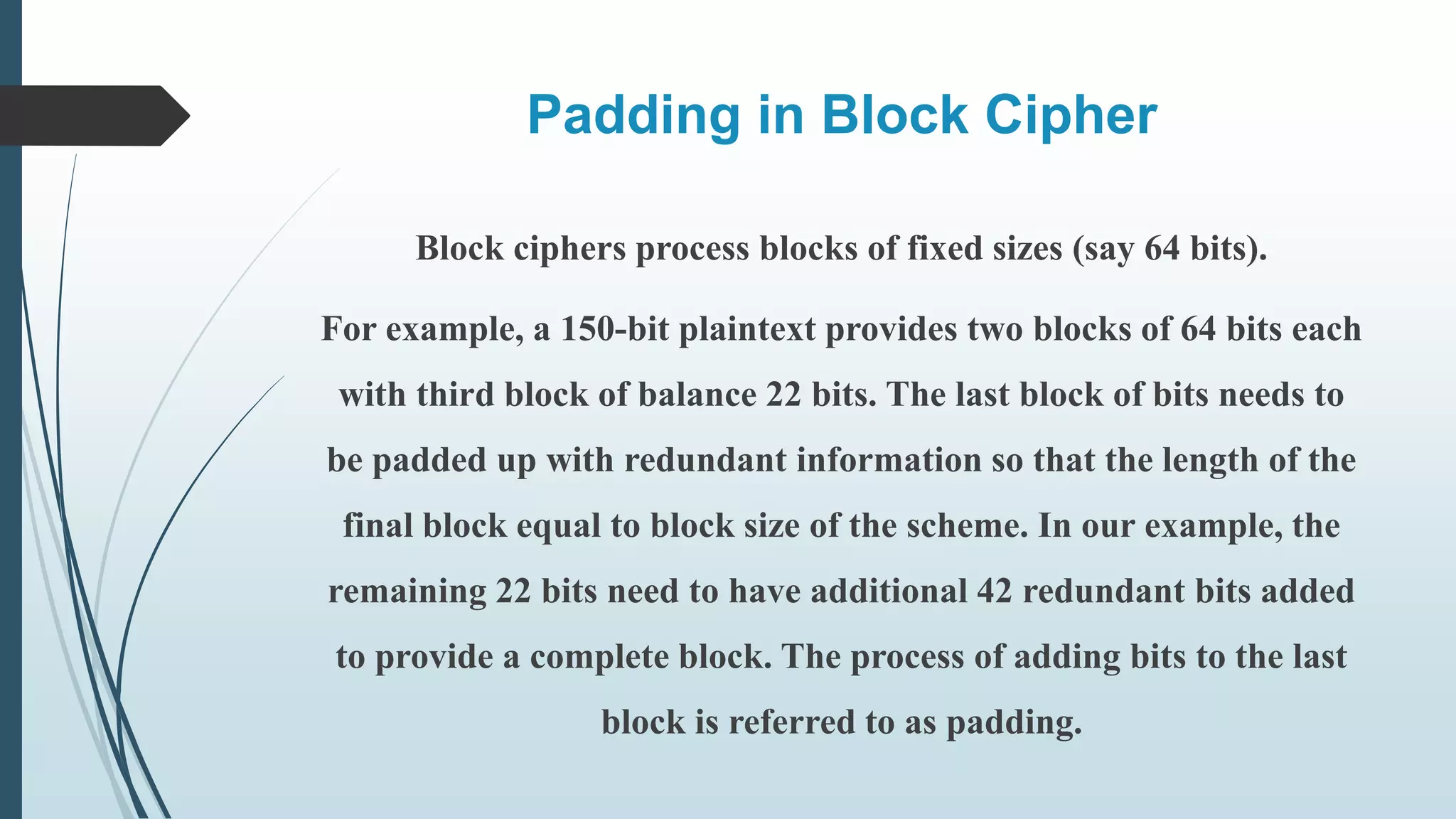
Padding in Block Cipher
Block ciphers process blocks of fixed sizes (say 64 bits).
For example, a 150-bit plaintext provides two blocks of 64 bits each
with third block of balance 22 bits. The last block of bits needs to
be padded up with redundant information so that the length of the
final block equal to block size of the scheme. In our example, the
remaining 22 bits need to have additional 42 redundant bits added
to provide a complete block. The process of adding bits to the last
block is referred to as padding.
Block Cipher Schemes
 Data Encryption Standard (DES)
 Triple DES
 Advanced Encryption Standard (AES)
 IDEA
 Twofish
Thank You

Network Security - Block cipher

  • 1.
    Block Cipher Name :-Ashish Duggal Qualification :- M.C.A.
  • 2.
    Introduction of BlockCiphers The plain binary text is processed in blocks (groups) of bits at a time; i.e. a block of plaintext bits is selected, a series of operations is performed on this block to generate a block of cipher text bits. The number of bits in a block is fixed. For example, the schemes DES and AES have block sizes of 64 and 128, respectively.
  • 3.
    Example we have amessage in plain text “STREET_BY_STREET” required to be encrypted. Using bock cipher, “STREET” must be encrypted at first, followed by “_BY_” and finally at last “STREET”.
  • 4.
    Block Size  Avoidvery small block size − A larger block size makes attack harder as the dictionary needs to be larger.  Do not have very large block size − With very large block size, the cipher becomes inefficient to operate. Such plaintexts will need to be padded before being encrypted.  Multiples of 8 bit − A preferred block size is a multiple of 8 as it is easy for implementation as most computer processor handle data in multiple of 8 bits.
  • 5.
    Padding in BlockCipher Block ciphers process blocks of fixed sizes (say 64 bits). For example, a 150-bit plaintext provides two blocks of 64 bits each with third block of balance 22 bits. The last block of bits needs to be padded up with redundant information so that the length of the final block equal to block size of the scheme. In our example, the remaining 22 bits need to have additional 42 redundant bits added to provide a complete block. The process of adding bits to the last block is referred to as padding.
  • 6.
    Block Cipher Schemes Data Encryption Standard (DES)  Triple DES  Advanced Encryption Standard (AES)  IDEA  Twofish
  • 7.