MATERIALS DEVELOPMENT
IN ELT
Licda. Guiselle Weelkly Williamson
http://wwwprincesslover.blogspot.com/
Questions selected from Prof. Gilberto’s Slides. Goes from 6 to 10
for Discussion and Presentation in Class.
“ The most beautiful universal language
spoken worldwide is English. Speaking
English is a skill that can be developed by
anyone willing to practice their speech
daily. As an English teacher, I take great
satisfaction in making what I believe is a
rich contribution to my student's lives .”
ELT must at all times stimulate
interaction as well as to be able to meet
the practical needs of teachers and
learners matching the realities of
publishing materials.
Brain Tomlinson presented six basic
principles of language acquisition
and four principles of language
teaching. He stated that they should
not be random recreation of other
people's idea or repertoire, or
clones; but rather, whatever,
invention is portrait should be
coherent following these principled
The learners are exposed to a rich,
meaningful, and comprehensive input of
language in use. Learners need a lot of
experience of the language being used in
a variety of different ways for a variety of
purposes.
a
The learners will :
Gained new vocabulary items.
Optimal space between the repetitions.
Previous knowledge is still retained.
There is novelty to the repeated one.
Word occurring each time in a new
context.
Elaboration with the new word that
stretches its meaning for the learner.
Language: body of words and the systems for their
use common to a people of the same community,
nation, cultural tradition, and more.
Corpora (corpus): Large or complete collection of
writings, collection of utterances, as spoken or
written sentences, taken as a representative sample of
a given language or dialect and used for linguistic
analysis.
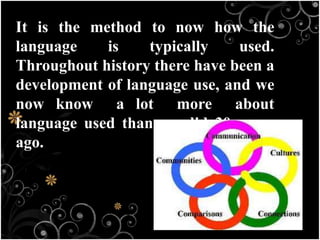
It is the method to now how the
language is typically used.
Throughout history there have been a
development of language use, and we
now know a lot more about
language used than we did 30 years
ago.
Contextualization is providing the
learner with the information they need
to develop awareness of how the target
language is actually used.
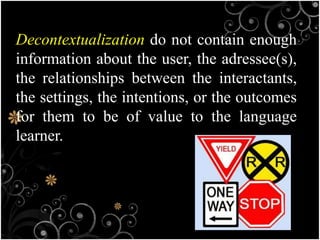
Decontextualization do not contain enough
information about the user, the adressee(s),
the relationships between the interactants,
the settings, the intentions, or the outcomes
for them to be of value to the language
learner.
In order for us to interpret this thought we
need:
 Know what it really means.
Why the speaker has used that imperative.
Who is saying it?
Who they are saying it to?
What has happened before?
What the objectives of the conversations are?
Teachers have the great responsibility of
motivating the learners' needs by helping
them to develop a positive mentally as they
engage in the target language, in their learning
environment, as they interact with their
teachers and classmates.
Presentation About Materials Development in ELT

Presentation About Materials Development in ELT

  • 1.
    MATERIALS DEVELOPMENT IN ELT Licda.Guiselle Weelkly Williamson http://wwwprincesslover.blogspot.com/ Questions selected from Prof. Gilberto’s Slides. Goes from 6 to 10 for Discussion and Presentation in Class.
  • 2.
    “ The mostbeautiful universal language spoken worldwide is English. Speaking English is a skill that can be developed by anyone willing to practice their speech daily. As an English teacher, I take great satisfaction in making what I believe is a rich contribution to my student's lives .”
  • 3.
    ELT must atall times stimulate interaction as well as to be able to meet the practical needs of teachers and learners matching the realities of publishing materials. Brain Tomlinson presented six basic principles of language acquisition and four principles of language teaching. He stated that they should not be random recreation of other people's idea or repertoire, or clones; but rather, whatever, invention is portrait should be coherent following these principled
  • 4.
    The learners areexposed to a rich, meaningful, and comprehensive input of language in use. Learners need a lot of experience of the language being used in a variety of different ways for a variety of purposes.
  • 5.
  • 6.
    The learners will: Gained new vocabulary items. Optimal space between the repetitions. Previous knowledge is still retained. There is novelty to the repeated one. Word occurring each time in a new context. Elaboration with the new word that stretches its meaning for the learner.
  • 7.
    Language: body ofwords and the systems for their use common to a people of the same community, nation, cultural tradition, and more. Corpora (corpus): Large or complete collection of writings, collection of utterances, as spoken or written sentences, taken as a representative sample of a given language or dialect and used for linguistic analysis.
  • 8.
    It is themethod to now how the language is typically used. Throughout history there have been a development of language use, and we now know a lot more about language used than we did 30 years ago.
  • 9.
    Contextualization is providingthe learner with the information they need to develop awareness of how the target language is actually used.
  • 10.
    Decontextualization do notcontain enough information about the user, the adressee(s), the relationships between the interactants, the settings, the intentions, or the outcomes for them to be of value to the language learner.
  • 11.
    In order forus to interpret this thought we need:  Know what it really means. Why the speaker has used that imperative. Who is saying it? Who they are saying it to? What has happened before? What the objectives of the conversations are?
  • 12.
    Teachers have thegreat responsibility of motivating the learners' needs by helping them to develop a positive mentally as they engage in the target language, in their learning environment, as they interact with their teachers and classmates.