Interactive Communication for Resource
Allocation
Jie Ren
jr843@drexel.edu
John MacLaren Walsh
jmw96@drexel.edu
Adaptive Signal Processing and Information Theory Group
Department of Electrical and Computer Engineering
Drexel University, Philadelphia, PA 19104
This research has been supported by the Air Force Research Laboratory
under agreement number FA9550-12-1-0086.
March 19th, 2014
Jie Ren (Drexel ASPITRG) ICFRA March 19th
, 2014 1 / 20
Introduction
Outline
1 Introduction
2 Problem Model
3 Analysis
4 Results
5 Conclusions
Jie Ren (Drexel ASPITRG) ICFRA March 19th
, 2014 2 / 20
Introduction
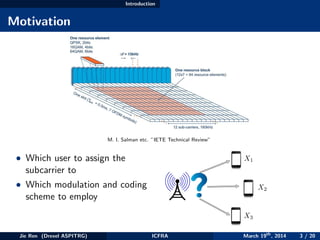
Motivation
M. I. Salman etc. ”IETE Technical Review”
• Which user to assign the
subcarrier to
• Which modulation and coding
scheme to employ
X1
X2
X3
Jie Ren (Drexel ASPITRG) ICFRA March 19th
, 2014 3 / 20
Introduction
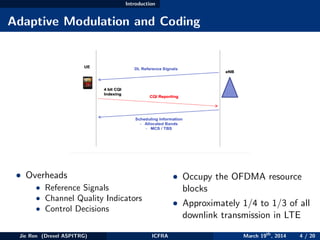
Adaptive Modulation and Coding
• Overheads
• Reference Signals
• Channel Quality Indicators
• Control Decisions
• Occupy the OFDMA resource
blocks
• Approximately 1/4 to 1/3 of all
downlink transmission in LTE
Jie Ren (Drexel ASPITRG) ICFRA March 19th
, 2014 4 / 20
Introduction
Background
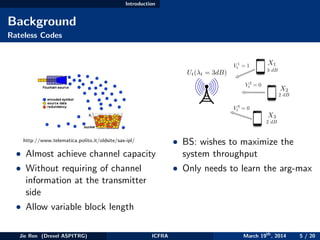
Rateless Codes
http://www.telematica.polito.it/oldsite/sas-ipl/
• Almost achieve channel capacity
• Without requiring of channel
information at the transmitter
side
• Allow variable block length
3 dB
2 dB
2 dB
Ut( t = 3dB)
X1
X2
X3
V 1
t = 1
V 2
t = 0
V 3
t = 0
• BS: wishes to maximize the
system throughput
• Only needs to learn the arg-max
Jie Ren (Drexel ASPITRG) ICFRA March 19th
, 2014 5 / 20
Introduction
Background
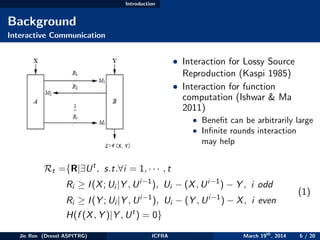
Interactive Communication
• Interaction for Lossy Source
Reproduction (Kaspi 1985)
• Interaction for function
computation (Ishwar & Ma
2011)
• Benefit can be arbitrarily large
• Infinite rounds interaction
may help
Rt ={R|∃Ut
, s.t.∀i = 1, · · · , t
Ri ≥ I(X; Ui |Y , Ui−1
), Ui − (X, Ui−1
) − Y , i odd
Ri ≥ I(Y ; Ui |Y , Ui−1
), Ui − (Y , Ui−1
) − X, i even
H(f (X, Y )|Y , Ut
) = 0}
(1)
Jie Ren (Drexel ASPITRG) ICFRA March 19th
, 2014 6 / 20
Introduction
Main Contribution
Achievable Interactive Communication Scheme for Resource
Allocation
• Determine the arg-max (use rateless codes for data transmission)
• Solve by dynamic programming
• Show huge savings
Jie Ren (Drexel ASPITRG) ICFRA March 19th
, 2014 7 / 20
Problem Model
Outline
1 Introduction
2 Problem Model
3 Analysis
4 Results
5 Conclusions
Jie Ren (Drexel ASPITRG) ICFRA March 19th
, 2014 8 / 20
Problem Model
Problem Model
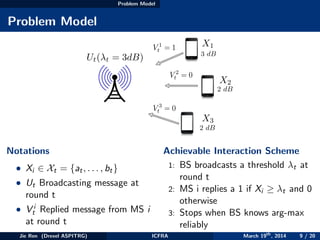
3 dB
2 dB
2 dB
Ut( t = 3dB)
X1
X2
X3
V 1
t = 1
V 2
t = 0
V 3
t = 0
Notations
• Xi ∈ Xt = {at, . . . , bt}
• Ut Broadcasting message at
round t
• V i
t Replied message from MS i
at round t
Achievable Interaction Scheme
1: BS broadcasts a threshold λt at
round t
2: MS i replies a 1 if Xi ≥ λt and 0
otherwise
3: Stops when BS knows arg-max
reliably
Jie Ren (Drexel ASPITRG) ICFRA March 19th
, 2014 9 / 20
Problem Model
Problem Model
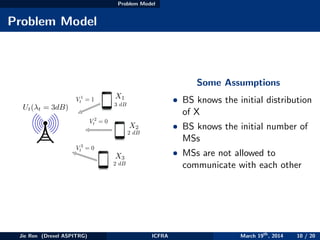
3 dB
2 dB
2 dB
Ut( t = 3dB)
X1
X2
X3
V 1
t = 1
V 2
t = 0
V 3
t = 0
Some Assumptions
• BS knows the initial distribution
of X
• BS knows the initial number of
MSs
• MSs are not allowed to
communicate with each other
Jie Ren (Drexel ASPITRG) ICFRA March 19th
, 2014 10 / 20
Analysis
Outline
1 Introduction
2 Problem Model
3 Analysis
4 Results
5 Conclusions
Jie Ren (Drexel ASPITRG) ICFRA March 19th
, 2014 11 / 20
Analysis
Analysis
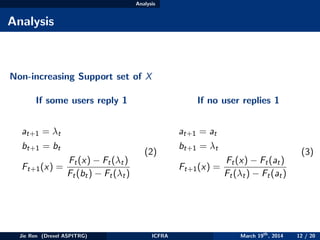
Non-increasing Support set of X
If some users reply 1
at+1 = λt
bt+1 = bt
Ft+1(x) =
Ft(x) − Ft(λt)
Ft(bt) − Ft(λt)
(2)
If no user replies 1
at+1 = at
bt+1 = λt
Ft+1(x) =
Ft(x) − Ft(at)
Ft(λt) − Ft(at)
(3)
Jie Ren (Drexel ASPITRG) ICFRA March 19th
, 2014 12 / 20
Analysis
Analysis
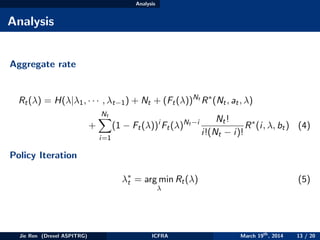
Aggregate rate
Rt(λ) = H(λ|λ1, · · · , λt−1) + Nt + (Ft(λ))Nt
R∗
(Nt, at, λ)
+
Nt
i=1
(1 − Ft(λ))i
Ft(λ)Nt −i Nt!
i!(Nt − i)!
R∗
(i, λ, bt) (4)
Policy Iteration
λ∗
t = arg min
λ
Rt(λ) (5)
Jie Ren (Drexel ASPITRG) ICFRA March 19th
, 2014 13 / 20
Analysis
Analysis
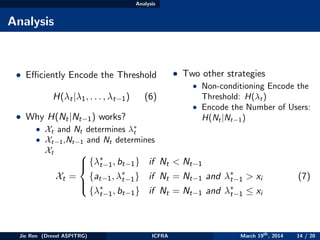
• Efficiently Encode the Threshold
H(λt|λ1, . . . , λt−1) (6)
• Why H(Nt|Nt−1) works?
• Xt and Nt determines λ∗
t
• Xt−1,Nt−1 and Nt determines
Xt
• Two other strategies
• Non-conditioning Encode the
Threshold: H(λt)
• Encode the Number of Users:
H(Nt|Nt−1)
Xt =



{λ∗
t−1, bt−1} if Nt < Nt−1
{at−1, λ∗
t−1} if Nt = Nt−1 and λ∗
t−1 > xi
{λ∗
t−1, bt−1} if Nt = Nt−1 and λ∗
t−1 ≤ xi
(7)
Jie Ren (Drexel ASPITRG) ICFRA March 19th
, 2014 14 / 20
Results
Outline
1 Introduction
2 Problem Model
3 Analysis
4 Results
5 Conclusions
Jie Ren (Drexel ASPITRG) ICFRA March 19th
, 2014 15 / 20
Results
Results
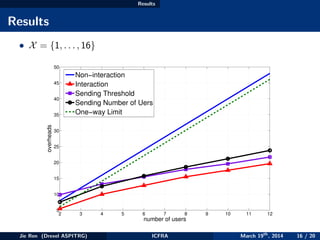
• X = {1, . . . , 16}
2 3 4 5 6 7 8 9 10 11 12
5
10
15
20
25
30
35
40
45
50
number of users
overheads
Non−interaction
Interaction
Sending Threshold
Sending Number of Uers
One−way Limit
Jie Ren (Drexel ASPITRG) ICFRA March 19th
, 2014 16 / 20
Results
Some Extensions
Interaction with Distortion
E[max{X1, . . . , XNt } − Xi ] ≤ D (8)
Bits Cost Vs. Time Cost
C = µR + (1 − µ)T (9)
Jie Ren (Drexel ASPITRG) ICFRA March 19th
, 2014 17 / 20
Conclusions
Outline
1 Introduction
2 Problem Model
3 Analysis
4 Results
5 Conclusions
Jie Ren (Drexel ASPITRG) ICFRA March 19th
, 2014 18 / 20
Conclusions
Contribution & Future Work
Review of Contribution
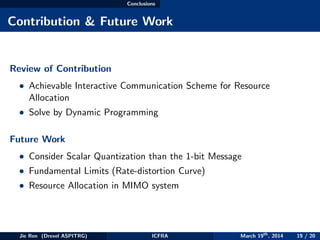
• Achievable Interactive Communication Scheme for Resource
Allocation
• Solve by Dynamic Programming
Future Work
• Consider Scalar Quantization than the 1-bit Message
• Fundamental Limits (Rate-distortion Curve)
• Resource Allocation in MIMO system
Jie Ren (Drexel ASPITRG) ICFRA March 19th
, 2014 19 / 20
Conclusions
Acknowledgments
Supported by the AFOSR under agreement number FA9550-12-1-0086
Jie Ren (Drexel ASPITRG) ICFRA March 19th
, 2014 20 / 20

presentation

  • 1.
    Interactive Communication forResource Allocation Jie Ren jr843@drexel.edu John MacLaren Walsh jmw96@drexel.edu Adaptive Signal Processing and Information Theory Group Department of Electrical and Computer Engineering Drexel University, Philadelphia, PA 19104 This research has been supported by the Air Force Research Laboratory under agreement number FA9550-12-1-0086. March 19th, 2014 Jie Ren (Drexel ASPITRG) ICFRA March 19th , 2014 1 / 20
  • 2.
    Introduction Outline 1 Introduction 2 ProblemModel 3 Analysis 4 Results 5 Conclusions Jie Ren (Drexel ASPITRG) ICFRA March 19th , 2014 2 / 20
  • 3.
    Introduction Motivation M. I. Salmanetc. ”IETE Technical Review” • Which user to assign the subcarrier to • Which modulation and coding scheme to employ X1 X2 X3 Jie Ren (Drexel ASPITRG) ICFRA March 19th , 2014 3 / 20
  • 4.
    Introduction Adaptive Modulation andCoding • Overheads • Reference Signals • Channel Quality Indicators • Control Decisions • Occupy the OFDMA resource blocks • Approximately 1/4 to 1/3 of all downlink transmission in LTE Jie Ren (Drexel ASPITRG) ICFRA March 19th , 2014 4 / 20
  • 5.
    Introduction Background Rateless Codes http://www.telematica.polito.it/oldsite/sas-ipl/ • Almostachieve channel capacity • Without requiring of channel information at the transmitter side • Allow variable block length 3 dB 2 dB 2 dB Ut( t = 3dB) X1 X2 X3 V 1 t = 1 V 2 t = 0 V 3 t = 0 • BS: wishes to maximize the system throughput • Only needs to learn the arg-max Jie Ren (Drexel ASPITRG) ICFRA March 19th , 2014 5 / 20
  • 6.
    Introduction Background Interactive Communication • Interactionfor Lossy Source Reproduction (Kaspi 1985) • Interaction for function computation (Ishwar & Ma 2011) • Benefit can be arbitrarily large • Infinite rounds interaction may help Rt ={R|∃Ut , s.t.∀i = 1, · · · , t Ri ≥ I(X; Ui |Y , Ui−1 ), Ui − (X, Ui−1 ) − Y , i odd Ri ≥ I(Y ; Ui |Y , Ui−1 ), Ui − (Y , Ui−1 ) − X, i even H(f (X, Y )|Y , Ut ) = 0} (1) Jie Ren (Drexel ASPITRG) ICFRA March 19th , 2014 6 / 20
  • 7.
    Introduction Main Contribution Achievable InteractiveCommunication Scheme for Resource Allocation • Determine the arg-max (use rateless codes for data transmission) • Solve by dynamic programming • Show huge savings Jie Ren (Drexel ASPITRG) ICFRA March 19th , 2014 7 / 20
  • 8.
    Problem Model Outline 1 Introduction 2Problem Model 3 Analysis 4 Results 5 Conclusions Jie Ren (Drexel ASPITRG) ICFRA March 19th , 2014 8 / 20
  • 9.
    Problem Model Problem Model 3dB 2 dB 2 dB Ut( t = 3dB) X1 X2 X3 V 1 t = 1 V 2 t = 0 V 3 t = 0 Notations • Xi ∈ Xt = {at, . . . , bt} • Ut Broadcasting message at round t • V i t Replied message from MS i at round t Achievable Interaction Scheme 1: BS broadcasts a threshold λt at round t 2: MS i replies a 1 if Xi ≥ λt and 0 otherwise 3: Stops when BS knows arg-max reliably Jie Ren (Drexel ASPITRG) ICFRA March 19th , 2014 9 / 20
  • 10.
    Problem Model Problem Model 3dB 2 dB 2 dB Ut( t = 3dB) X1 X2 X3 V 1 t = 1 V 2 t = 0 V 3 t = 0 Some Assumptions • BS knows the initial distribution of X • BS knows the initial number of MSs • MSs are not allowed to communicate with each other Jie Ren (Drexel ASPITRG) ICFRA March 19th , 2014 10 / 20
  • 11.
    Analysis Outline 1 Introduction 2 ProblemModel 3 Analysis 4 Results 5 Conclusions Jie Ren (Drexel ASPITRG) ICFRA March 19th , 2014 11 / 20
  • 12.
    Analysis Analysis Non-increasing Support setof X If some users reply 1 at+1 = λt bt+1 = bt Ft+1(x) = Ft(x) − Ft(λt) Ft(bt) − Ft(λt) (2) If no user replies 1 at+1 = at bt+1 = λt Ft+1(x) = Ft(x) − Ft(at) Ft(λt) − Ft(at) (3) Jie Ren (Drexel ASPITRG) ICFRA March 19th , 2014 12 / 20
  • 13.
    Analysis Analysis Aggregate rate Rt(λ) =H(λ|λ1, · · · , λt−1) + Nt + (Ft(λ))Nt R∗ (Nt, at, λ) + Nt i=1 (1 − Ft(λ))i Ft(λ)Nt −i Nt! i!(Nt − i)! R∗ (i, λ, bt) (4) Policy Iteration λ∗ t = arg min λ Rt(λ) (5) Jie Ren (Drexel ASPITRG) ICFRA March 19th , 2014 13 / 20
  • 14.
    Analysis Analysis • Efficiently Encodethe Threshold H(λt|λ1, . . . , λt−1) (6) • Why H(Nt|Nt−1) works? • Xt and Nt determines λ∗ t • Xt−1,Nt−1 and Nt determines Xt • Two other strategies • Non-conditioning Encode the Threshold: H(λt) • Encode the Number of Users: H(Nt|Nt−1) Xt =    {λ∗ t−1, bt−1} if Nt < Nt−1 {at−1, λ∗ t−1} if Nt = Nt−1 and λ∗ t−1 > xi {λ∗ t−1, bt−1} if Nt = Nt−1 and λ∗ t−1 ≤ xi (7) Jie Ren (Drexel ASPITRG) ICFRA March 19th , 2014 14 / 20
  • 15.
    Results Outline 1 Introduction 2 ProblemModel 3 Analysis 4 Results 5 Conclusions Jie Ren (Drexel ASPITRG) ICFRA March 19th , 2014 15 / 20
  • 16.
    Results Results • X ={1, . . . , 16} 2 3 4 5 6 7 8 9 10 11 12 5 10 15 20 25 30 35 40 45 50 number of users overheads Non−interaction Interaction Sending Threshold Sending Number of Uers One−way Limit Jie Ren (Drexel ASPITRG) ICFRA March 19th , 2014 16 / 20
  • 17.
    Results Some Extensions Interaction withDistortion E[max{X1, . . . , XNt } − Xi ] ≤ D (8) Bits Cost Vs. Time Cost C = µR + (1 − µ)T (9) Jie Ren (Drexel ASPITRG) ICFRA March 19th , 2014 17 / 20
  • 18.
    Conclusions Outline 1 Introduction 2 ProblemModel 3 Analysis 4 Results 5 Conclusions Jie Ren (Drexel ASPITRG) ICFRA March 19th , 2014 18 / 20
  • 19.
    Conclusions Contribution & FutureWork Review of Contribution • Achievable Interactive Communication Scheme for Resource Allocation • Solve by Dynamic Programming Future Work • Consider Scalar Quantization than the 1-bit Message • Fundamental Limits (Rate-distortion Curve) • Resource Allocation in MIMO system Jie Ren (Drexel ASPITRG) ICFRA March 19th , 2014 19 / 20
  • 20.
    Conclusions Acknowledgments Supported by theAFOSR under agreement number FA9550-12-1-0086 Jie Ren (Drexel ASPITRG) ICFRA March 19th , 2014 20 / 20