Communication Complexity
Jie Ren
Adaptive Signal Processing and Information Theory Group
Nov 3rd, 2014
Jie Ren (Drexel ASPITRG) CC Nov 3rd
, 2014 1 / 77
1 E. Kushilevitz and N. Nisan, “Communication Complexity,”
Cambridge University Press, 1997.
2 L. Lovasz, “Communication Complexity: A Survey,” in Paths, Flows,
and VLSI Layout, B. H. Korte, Ed., Springer Verlag: Berlin 1990.
3 T. Lee and A. Shraibman, “Lower Bounds in Communication
Complexity: A Survey,” Now Publishers Inc., 2009.
4 A. C. Yao, “Some Complexity Questions Related to Distributed
Computing,” Proc. of 11th ACM Symposium on Theory of
Computing, 1981, 308-311.
5 P. Beame and J. Lawry, “Randomized versus Nondeterministic
Communication Complexity,” Proc. of 24th ACM Symposium on
Theory of Computing, 1992, 188-199.
6 A. K. Chandra, M. L. Furst and R. J. Lipton, “Multi-party
Protocols,” Proc. of 15th ACM Symposium on Theory of Computing,
1983, 94-99.
7 P. B. Miltersen, N. Nisan, S. Safra and A. Wigderson, “On Data
Structures and Asymmetric Communication Complexity,” Proc. of
27th ACM Symposium on Theory of Computing, 1995, 103-111.
Jie Ren (Drexel ASPITRG) CC Nov 3rd
, 2014 2 / 77
Deterministic Communication Complexity
Outline
1 Deterministic Communication Complexity
Problem Setup
Protocol Tree
Combinatorial Rectangles
Fooling Sets
Rectangle Rank
2 Nondeterministic CC & Randomized CC
Nondeterministic Communication Complexity: Motivation
Nondeterministic Communication Complexity: definitions
Randomized Communication Complexity
Distributional Complexity and Discrepancy
3 Some Analysis
Jie Ren (Drexel ASPITRG) CC Nov 3rd
, 2014 3 / 77
Deterministic Communication Complexity Problem Setup
Outline
1 Deterministic Communication Complexity
Problem Setup
Protocol Tree
Combinatorial Rectangles
Fooling Sets
Rectangle Rank
2 Nondeterministic CC & Randomized CC
Nondeterministic Communication Complexity: Motivation
Nondeterministic Communication Complexity: definitions
Randomized Communication Complexity
Distributional Complexity and Discrepancy
3 Some Analysis
Jie Ren (Drexel ASPITRG) CC Nov 3rd
, 2014 4 / 77
Deterministic Communication Complexity Problem Setup
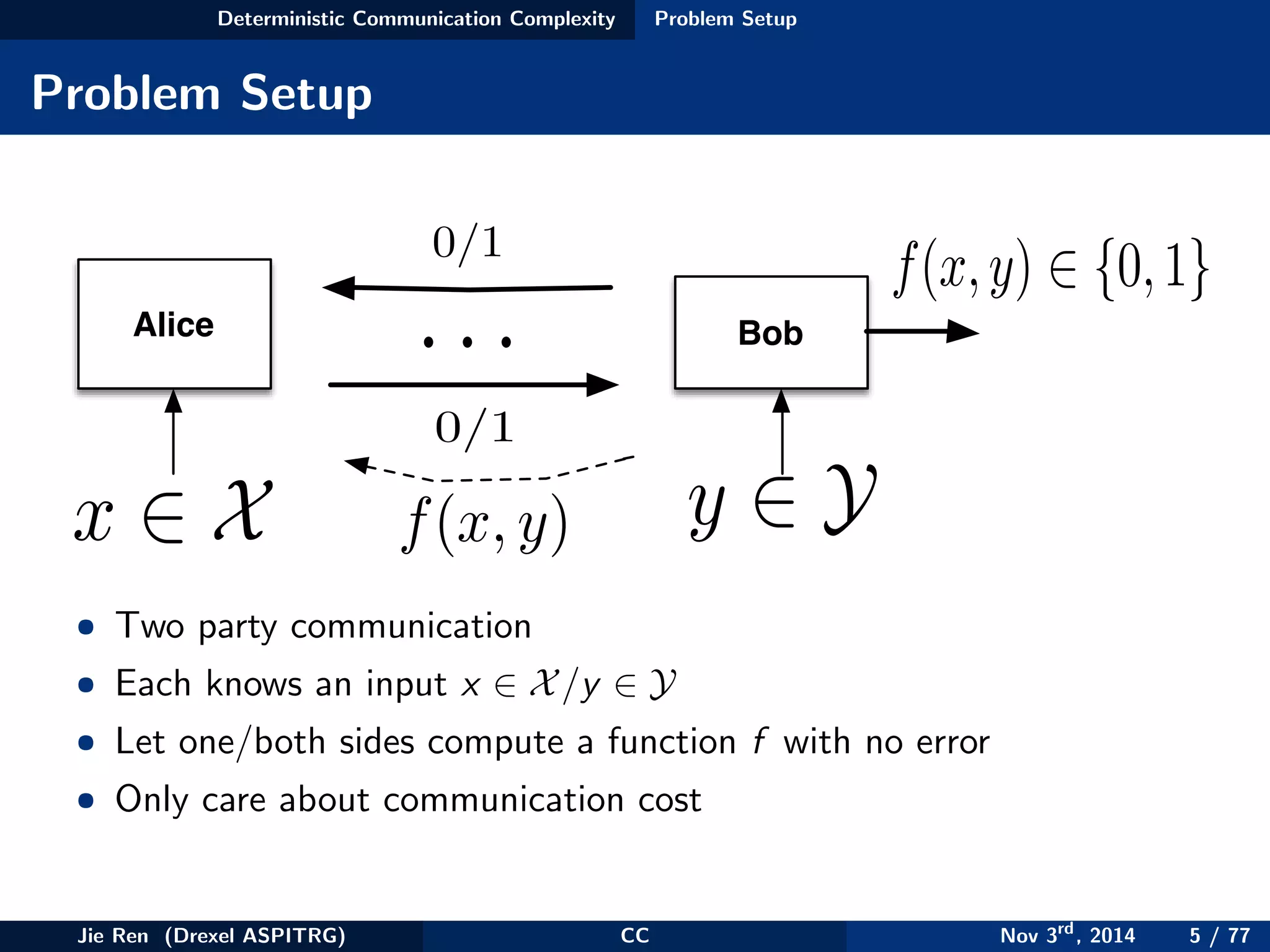
Problem Setup
Alice Bob
x ∈ X y ∈ Y
f(x,y) ∈ {0,1}
···
f(x, y)
0/1
0/1
• Two party communication
• Each knows an input x ∈ X/y ∈ Y
• Let one/both sides compute a function f with no error
• Only care about communication cost
Jie Ren (Drexel ASPITRG) CC Nov 3rd
, 2014 5 / 77
Deterministic Communication Complexity Problem Setup
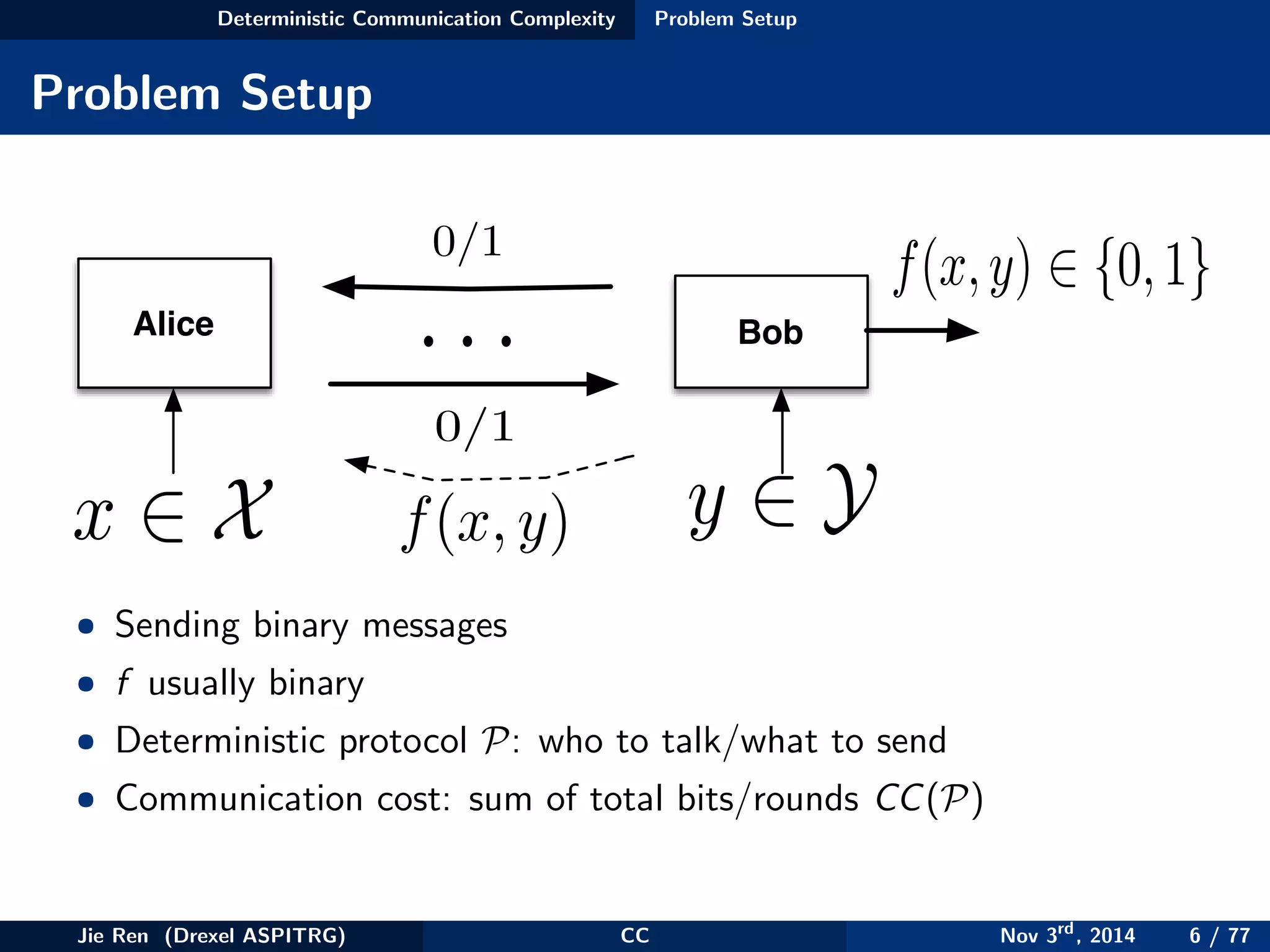
Problem Setup
Alice Bob
x ∈ X y ∈ Y
f(x,y) ∈ {0,1}
···
f(x, y)
0/1
0/1
• Sending binary messages
• f usually binary
• Deterministic protocol P: who to talk/what to send
• Communication cost: sum of total bits/rounds CC(P)
Jie Ren (Drexel ASPITRG) CC Nov 3rd
, 2014 6 / 77
Deterministic Communication Complexity Problem Setup
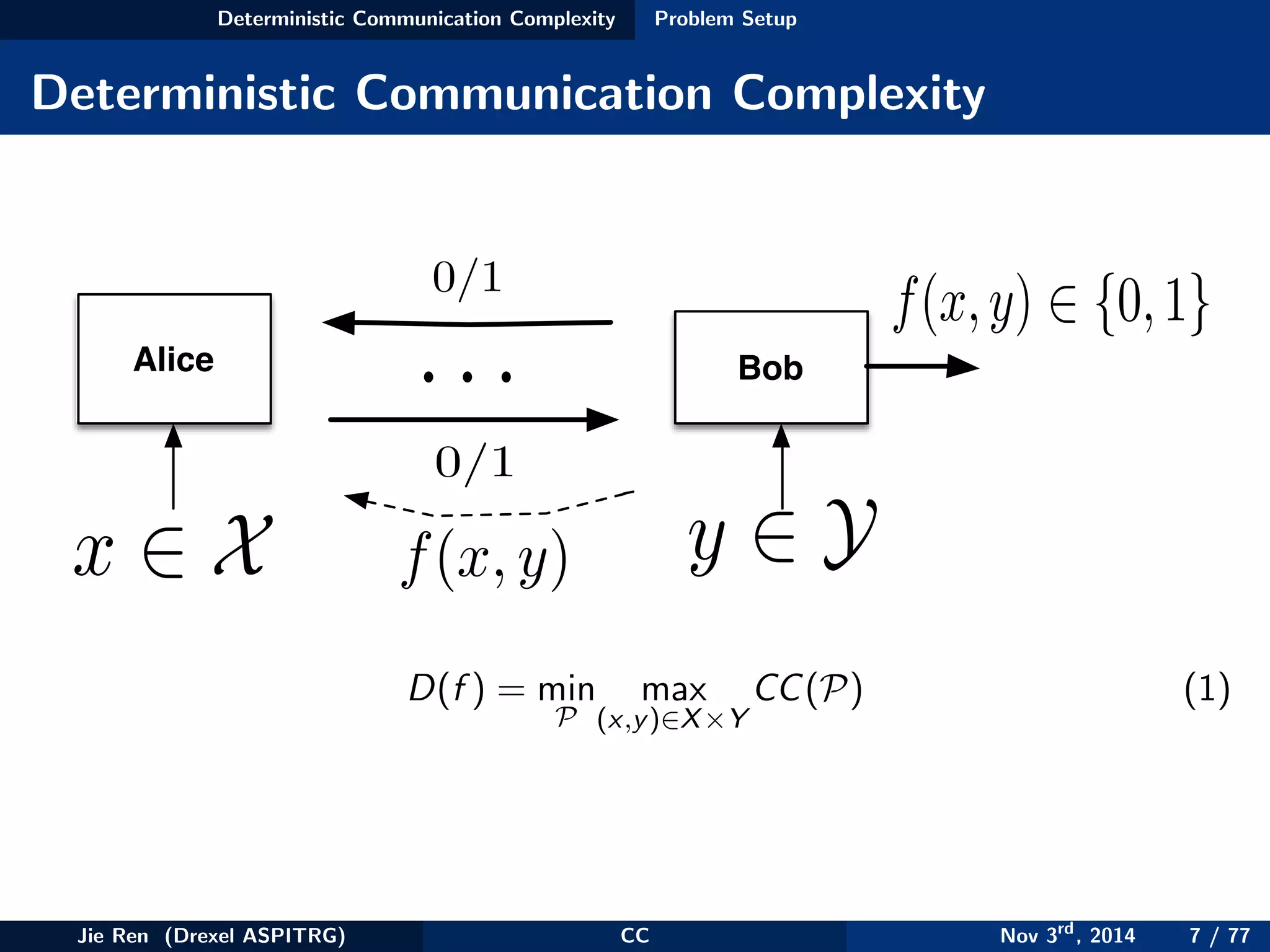
Deterministic Communication Complexity
Alice Bob
x ∈ X y ∈ Y
f(x,y) ∈ {0,1}
···
f(x, y)
0/1
0/1
D(f ) = min
P
max
(x,y)∈X×Y
CC(P) (1)
Jie Ren (Drexel ASPITRG) CC Nov 3rd
, 2014 7 / 77
Deterministic Communication Complexity Problem Setup
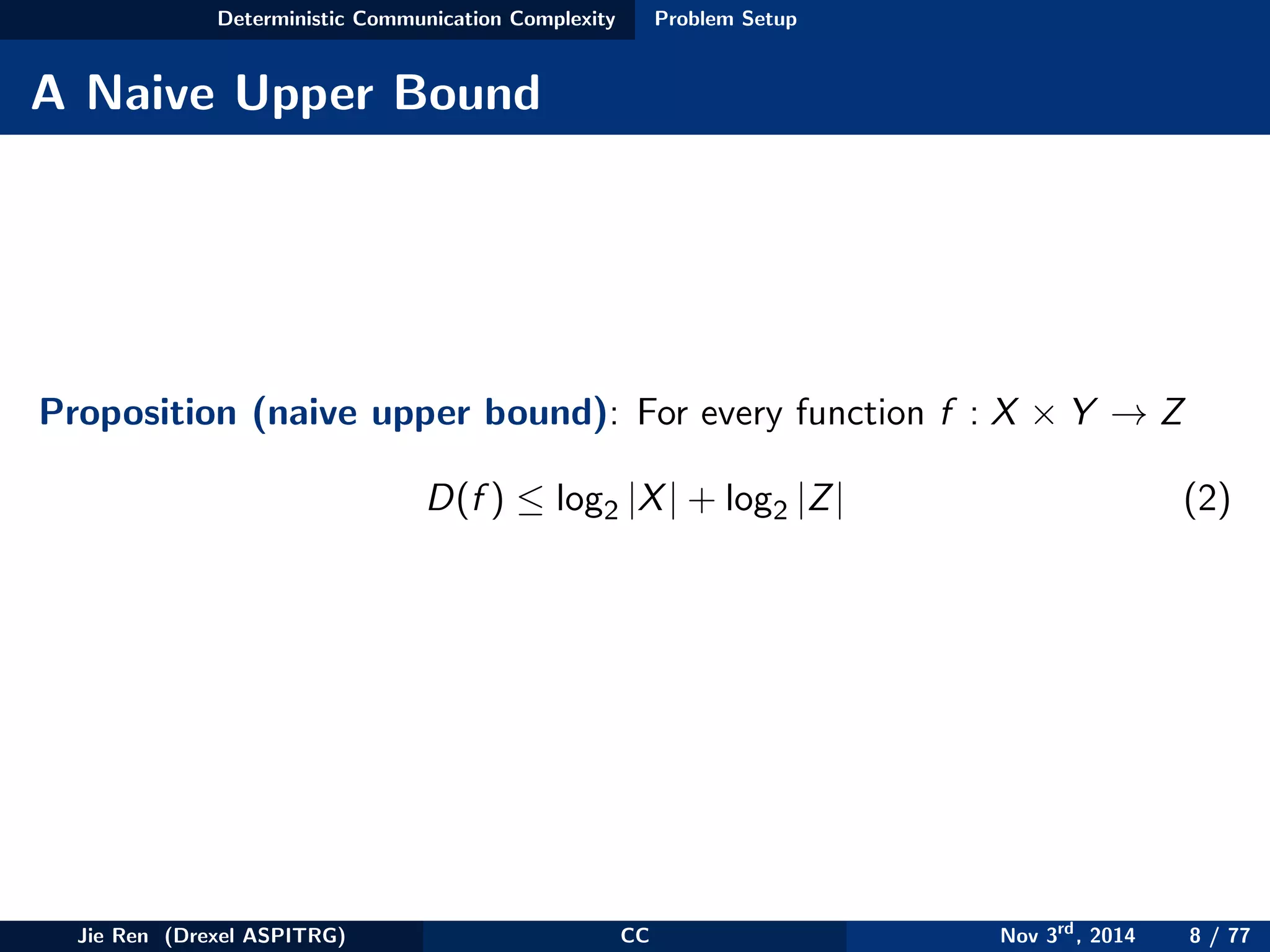
A Naive Upper Bound
Proposition (naive upper bound): For every function f : X × Y → Z
D(f ) ≤ log2 |X| + log2 |Z| (2)
Jie Ren (Drexel ASPITRG) CC Nov 3rd
, 2014 8 / 77
Deterministic Communication Complexity Problem Setup
A Naive Upper Bound
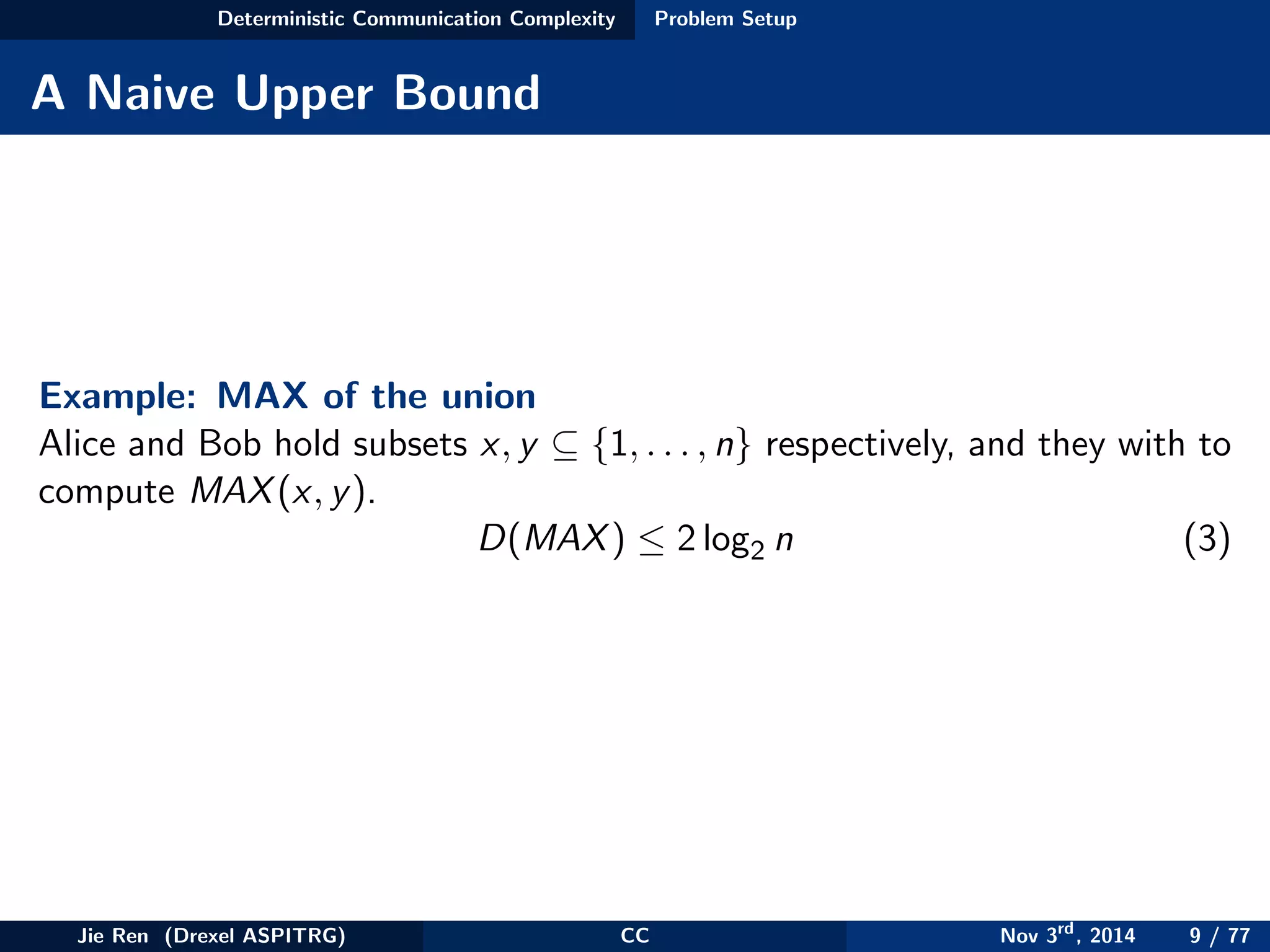
Example: MAX of the union
Alice and Bob hold subsets x, y ⊆ {1, . . . , n} respectively, and they with to
compute MAX(x, y).
D(MAX) ≤ 2 log2 n (3)
Jie Ren (Drexel ASPITRG) CC Nov 3rd
, 2014 9 / 77
Deterministic Communication Complexity Protocol Tree
Outline
1 Deterministic Communication Complexity
Problem Setup
Protocol Tree
Combinatorial Rectangles
Fooling Sets
Rectangle Rank
2 Nondeterministic CC & Randomized CC
Nondeterministic Communication Complexity: Motivation
Nondeterministic Communication Complexity: definitions
Randomized Communication Complexity
Distributional Complexity and Discrepancy
3 Some Analysis
Jie Ren (Drexel ASPITRG) CC Nov 3rd
, 2014 10 / 77
Deterministic Communication Complexity Protocol Tree
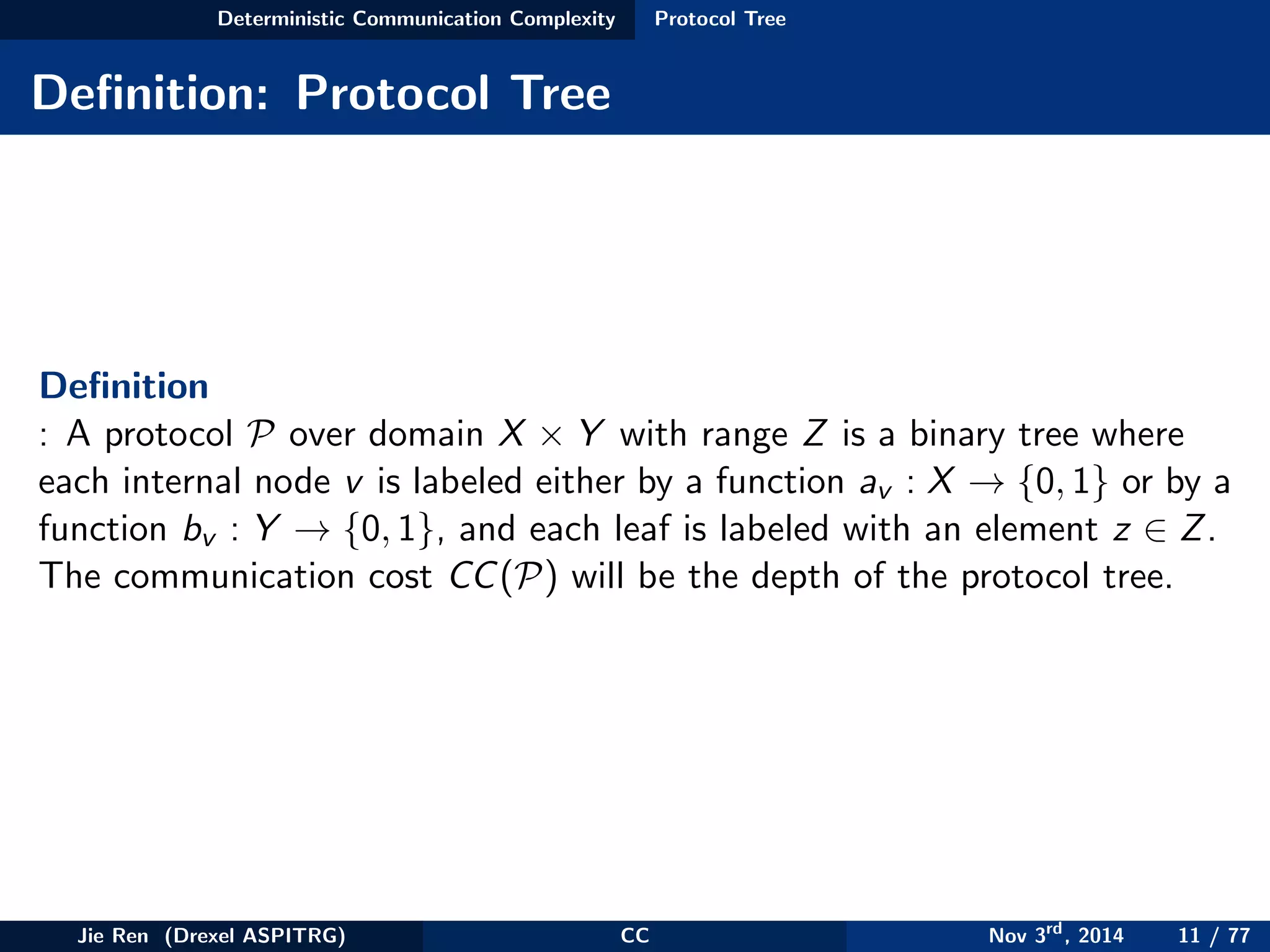
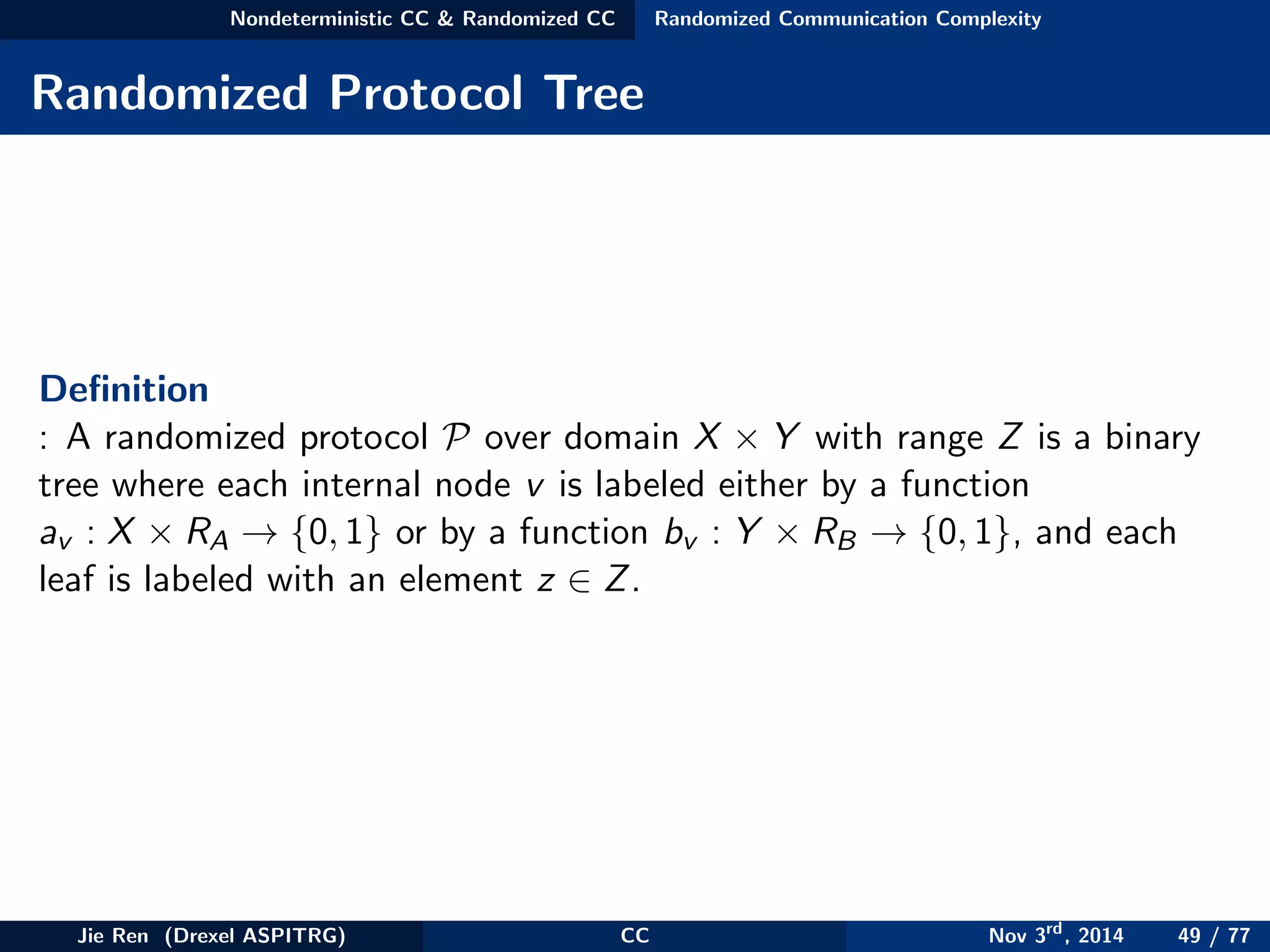
Definition: Protocol Tree
Definition
: A protocol P over domain X × Y with range Z is a binary tree where
each internal node v is labeled either by a function av : X → {0, 1} or by a
function bv : Y → {0, 1}, and each leaf is labeled with an element z ∈ Z.
The communication cost CC(P) will be the depth of the protocol tree.
Jie Ren (Drexel ASPITRG) CC Nov 3rd
, 2014 11 / 77
Deterministic Communication Complexity Protocol Tree
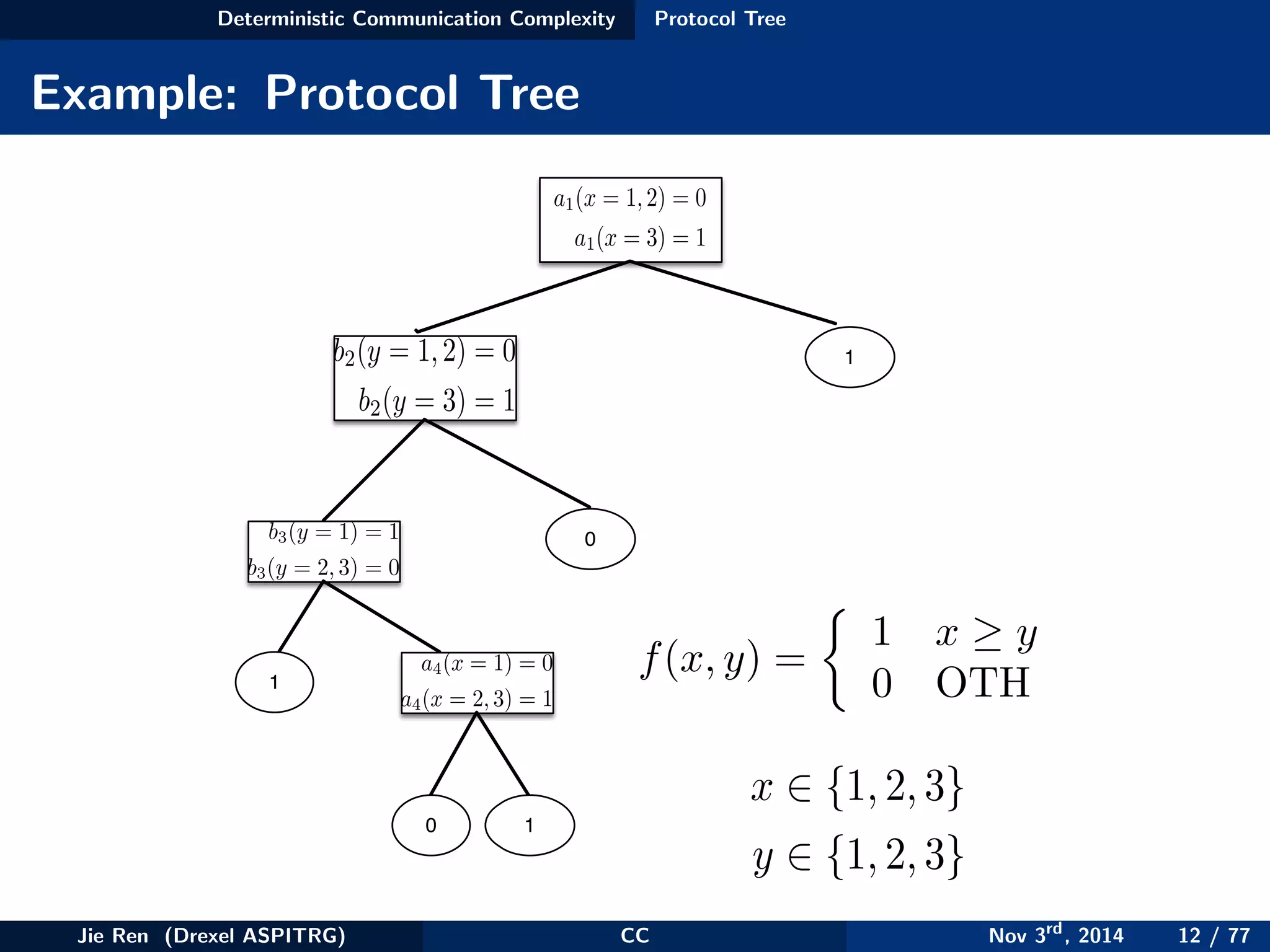
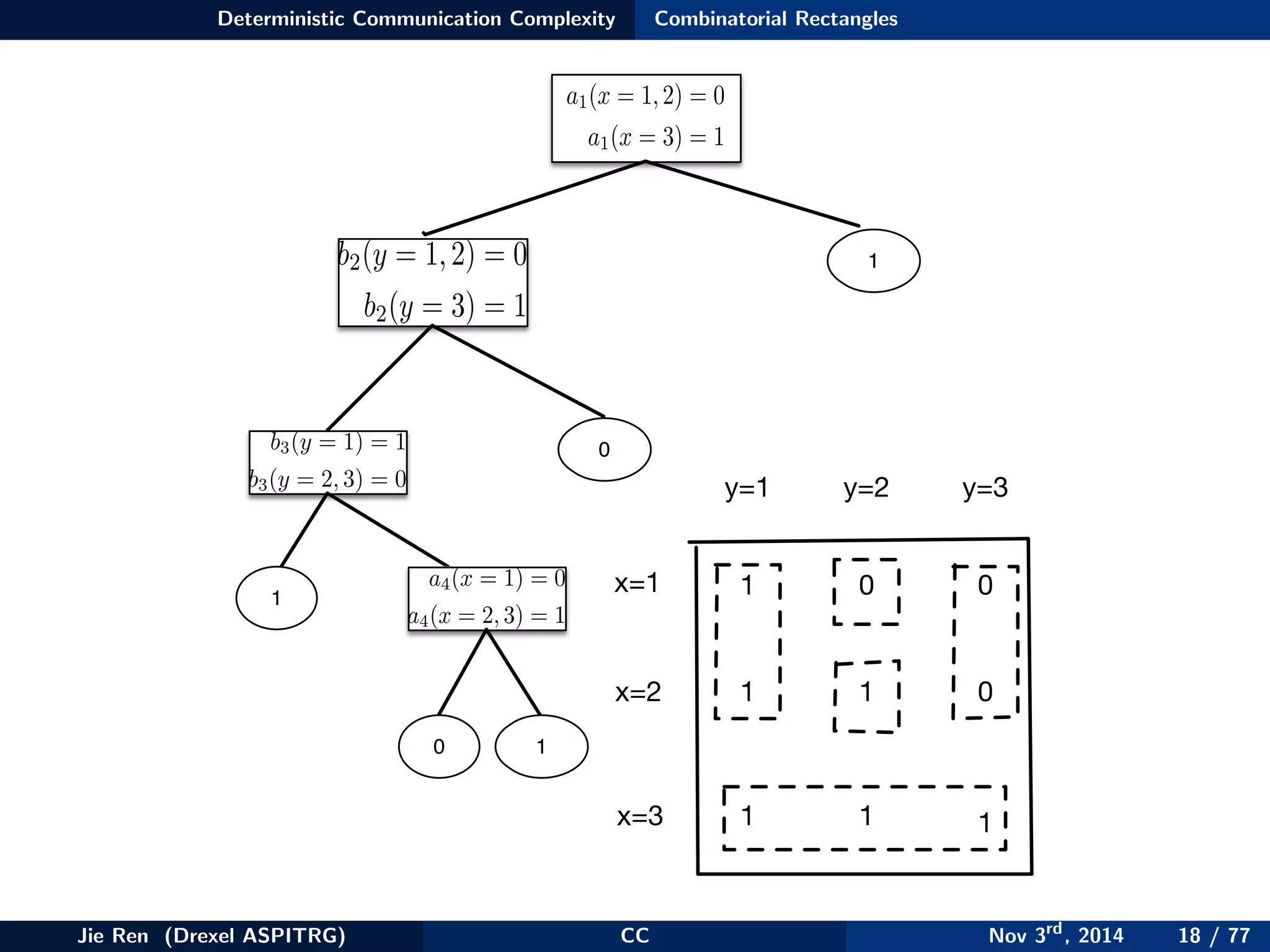
Example: Protocol Tree
a1(x = 1,2) = 0
a1(x = 3) = 1
b2(y = 1,2) = 0
b2(y = 3) = 1
0b3(y = 1) = 1
b3(y = 2, 3) = 0
1
1
a4(x = 1) = 0
a4(x = 2, 3) = 1
0 1
f(x, y) =
1 x ≥ y
0 OTH
x ∈ {1, 2, 3}
y ∈ {1, 2, 3}
Jie Ren (Drexel ASPITRG) CC Nov 3rd
, 2014 12 / 77
Deterministic Communication Complexity Protocol Tree
Why Binary Message?
• Entropy not involved - simple?
• No block coding (compute a single function)
• Worst case - always exists p = 1/2 s.t. h2(p) = 1
Jie Ren (Drexel ASPITRG) CC Nov 3rd
, 2014 13 / 77
Deterministic Communication Complexity Protocol Tree
One Side Compute f Vs. Both Sides Compute f
• Equivalent setup
• ⇒ Need one more bit if f is binary
• ⇐ Second last round: one side must know f (x, y)
Some Lower Bounds of Communication Complexity
• D(f ) : unknown for general f
• Interested in lower bounds
Jie Ren (Drexel ASPITRG) CC Nov 3rd
, 2014 14 / 77
Deterministic Communication Complexity Combinatorial Rectangles
Outline
1 Deterministic Communication Complexity
Problem Setup
Protocol Tree
Combinatorial Rectangles
Fooling Sets
Rectangle Rank
2 Nondeterministic CC & Randomized CC
Nondeterministic Communication Complexity: Motivation
Nondeterministic Communication Complexity: definitions
Randomized Communication Complexity
Distributional Complexity and Discrepancy
3 Some Analysis
Jie Ren (Drexel ASPITRG) CC Nov 3rd
, 2014 15 / 77
Deterministic Communication Complexity Combinatorial Rectangles
Combinatorial Rectangles
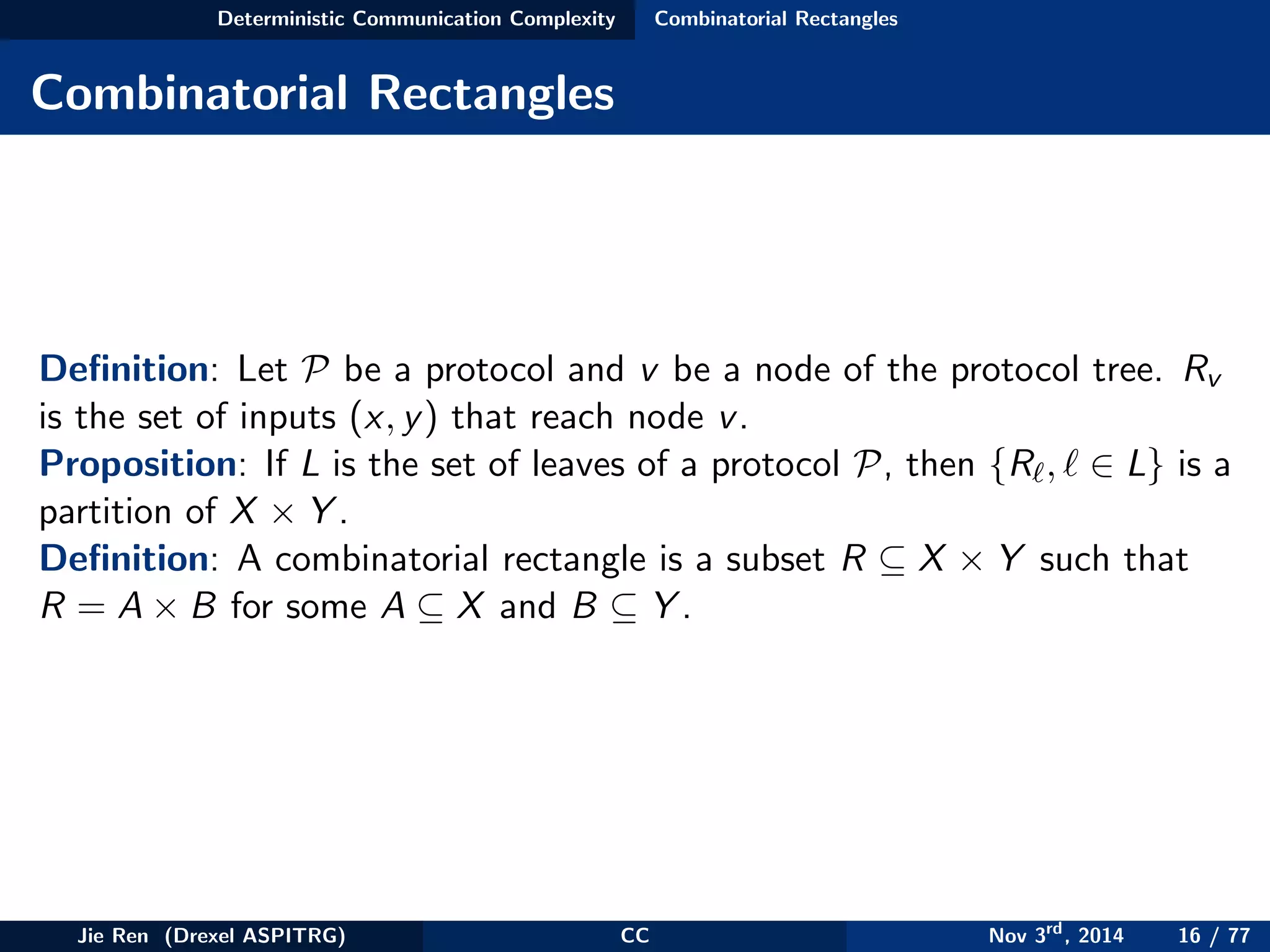
Definition: Let P be a protocol and v be a node of the protocol tree. Rv
is the set of inputs (x, y) that reach node v.
Proposition: If L is the set of leaves of a protocol P, then {R , ∈ L} is a
partition of X × Y .
Definition: A combinatorial rectangle is a subset R ⊆ X × Y such that
R = A × B for some A ⊆ X and B ⊆ Y .
Jie Ren (Drexel ASPITRG) CC Nov 3rd
, 2014 16 / 77
Deterministic Communication Complexity Combinatorial Rectangles
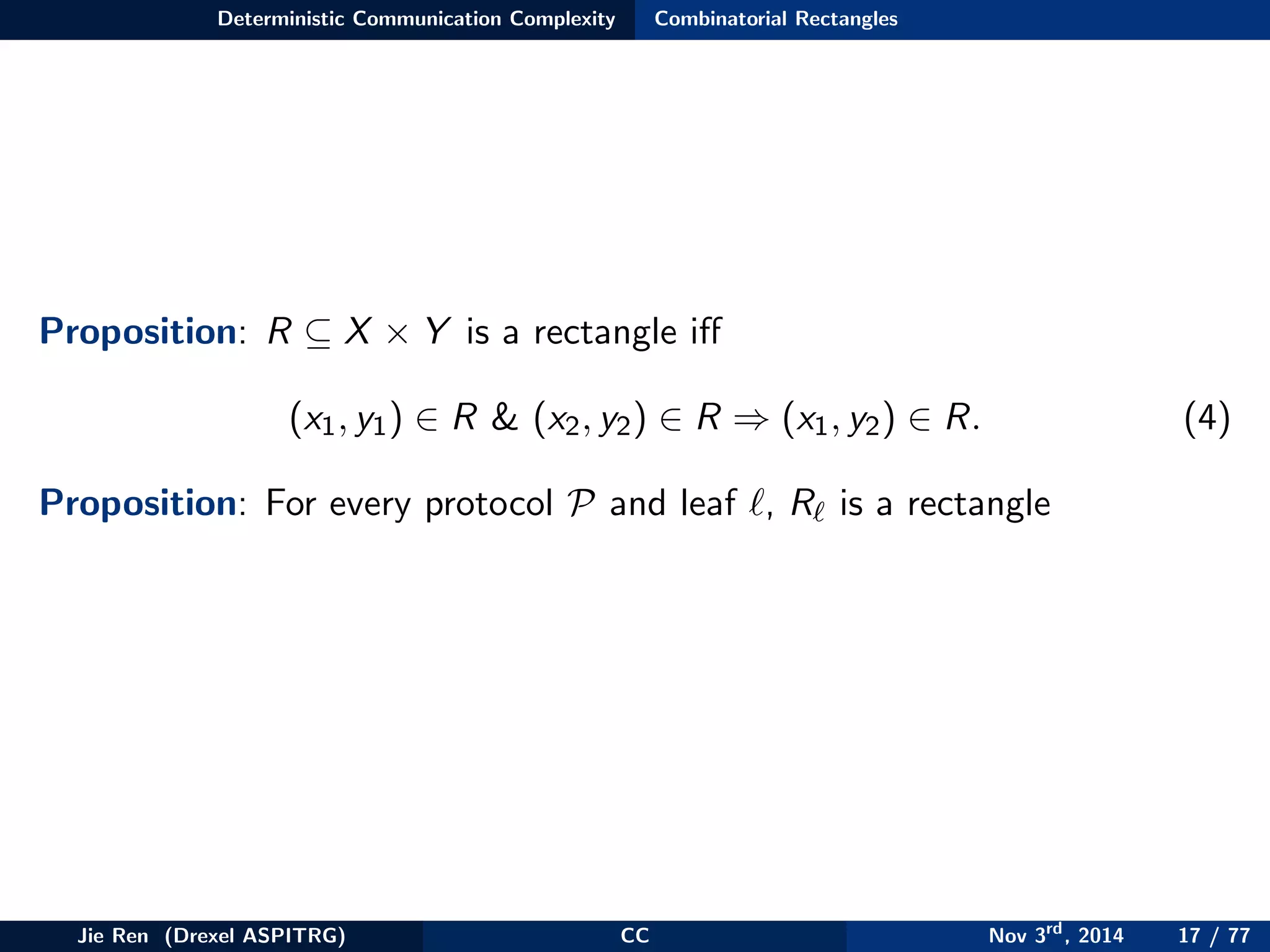
Proposition: R ⊆ X × Y is a rectangle iff
(x1, y1) ∈ R & (x2, y2) ∈ R ⇒ (x1, y2) ∈ R. (4)
Proposition: For every protocol P and leaf , R is a rectangle
Jie Ren (Drexel ASPITRG) CC Nov 3rd
, 2014 17 / 77
Deterministic Communication Complexity Combinatorial Rectangles
a1(x = 1,2) = 0
a1(x = 3) = 1
b2(y = 1,2) = 0
b2(y = 3) = 1
0b3(y = 1) = 1
b3(y = 2, 3) = 0
1
1
a4(x = 1) = 0
a4(x = 2, 3) = 1
0 1
x=1
x=3
x=2
y=1 y=2 y=3
1 0 0
1
1
1 0
1 1
Jie Ren (Drexel ASPITRG) CC Nov 3rd
, 2014 18 / 77
Deterministic Communication Complexity Combinatorial Rectangles
Rectangle lower bound
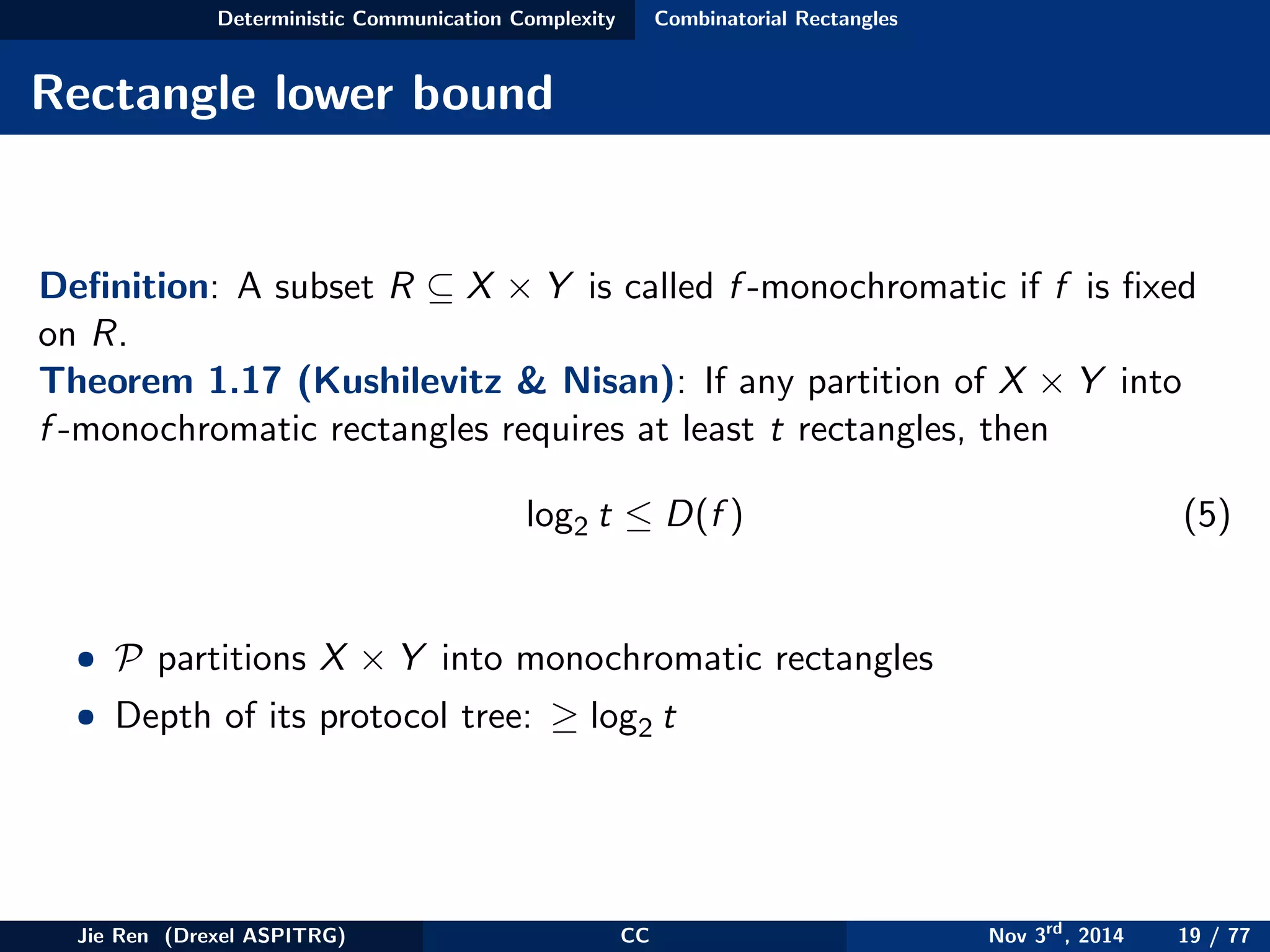
Definition: A subset R ⊆ X × Y is called f -monochromatic if f is fixed
on R.
Theorem 1.17 (Kushilevitz & Nisan): If any partition of X × Y into
f -monochromatic rectangles requires at least t rectangles, then
log2 t ≤ D(f ) (5)
• P partitions X × Y into monochromatic rectangles
• Depth of its protocol tree: ≥ log2 t
Jie Ren (Drexel ASPITRG) CC Nov 3rd
, 2014 19 / 77
Deterministic Communication Complexity Combinatorial Rectangles
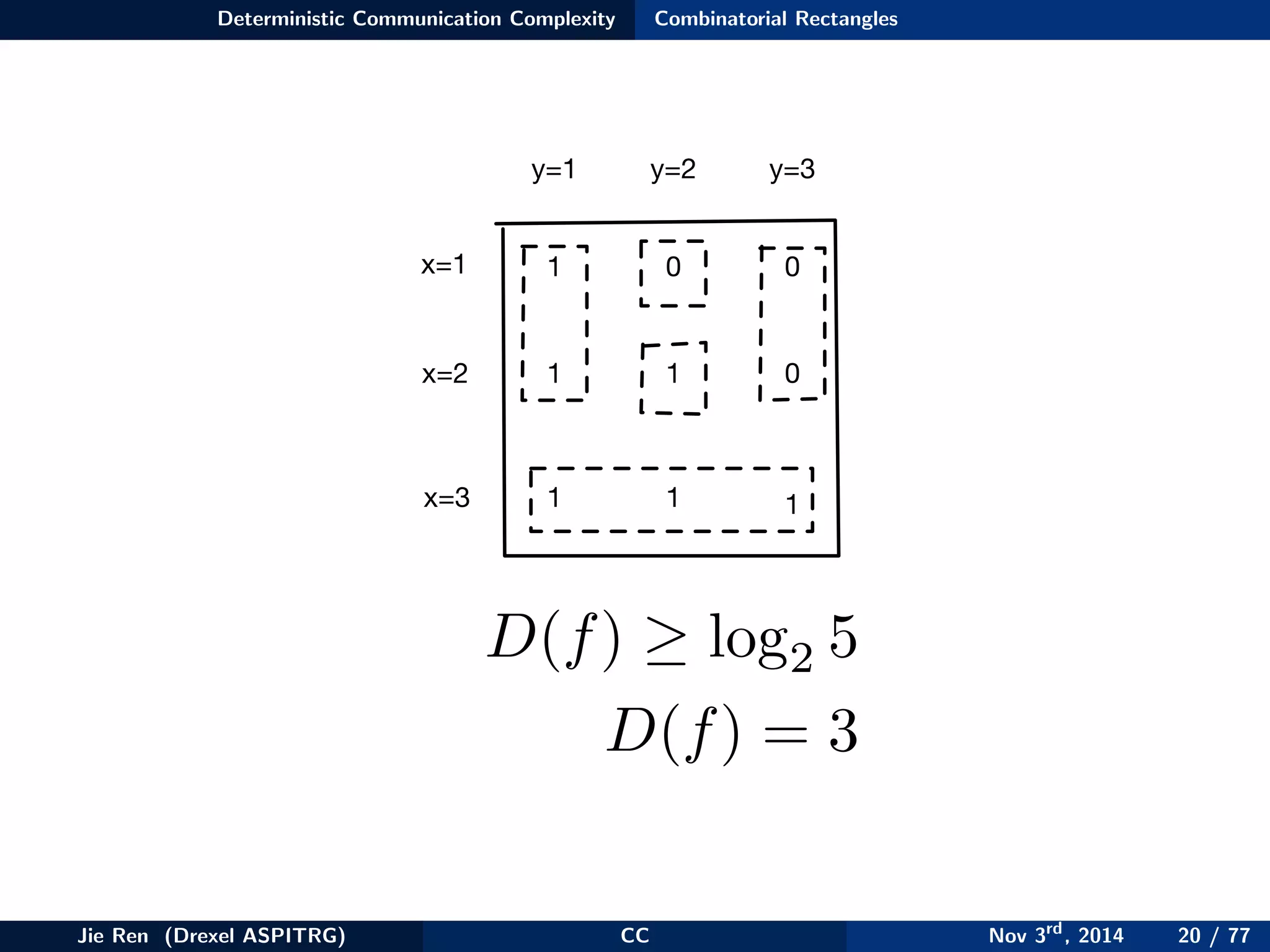
x=1
x=3
x=2
y=1 y=2 y=3
1 0 0
1
1
1 0
1 1
D(f) ≥ log2 5
D(f) = 3
Jie Ren (Drexel ASPITRG) CC Nov 3rd
, 2014 20 / 77
Deterministic Communication Complexity Fooling Sets
Outline
1 Deterministic Communication Complexity
Problem Setup
Protocol Tree
Combinatorial Rectangles
Fooling Sets
Rectangle Rank
2 Nondeterministic CC & Randomized CC
Nondeterministic Communication Complexity: Motivation
Nondeterministic Communication Complexity: definitions
Randomized Communication Complexity
Distributional Complexity and Discrepancy
3 Some Analysis
Jie Ren (Drexel ASPITRG) CC Nov 3rd
, 2014 21 / 77
Deterministic Communication Complexity Fooling Sets
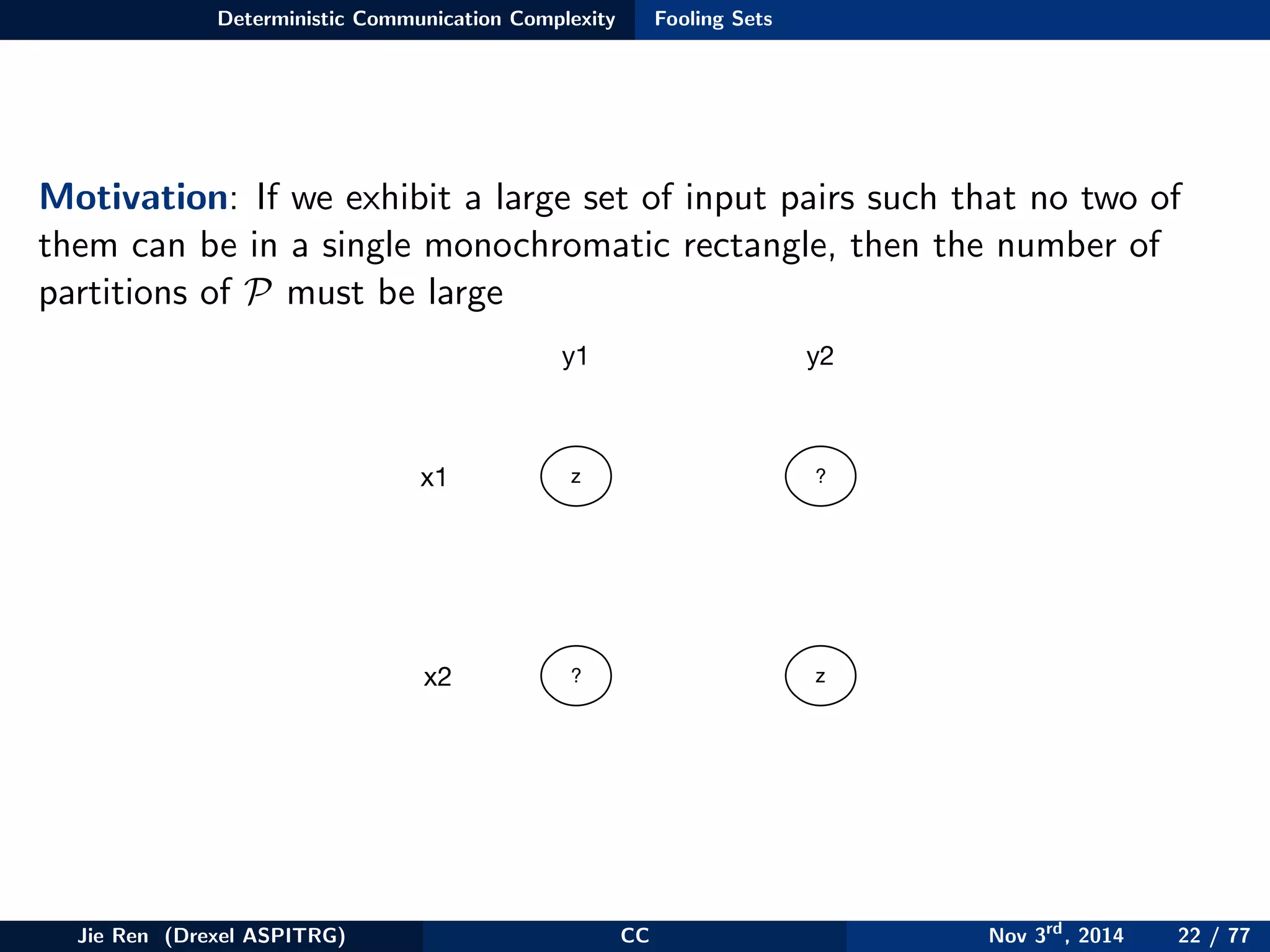
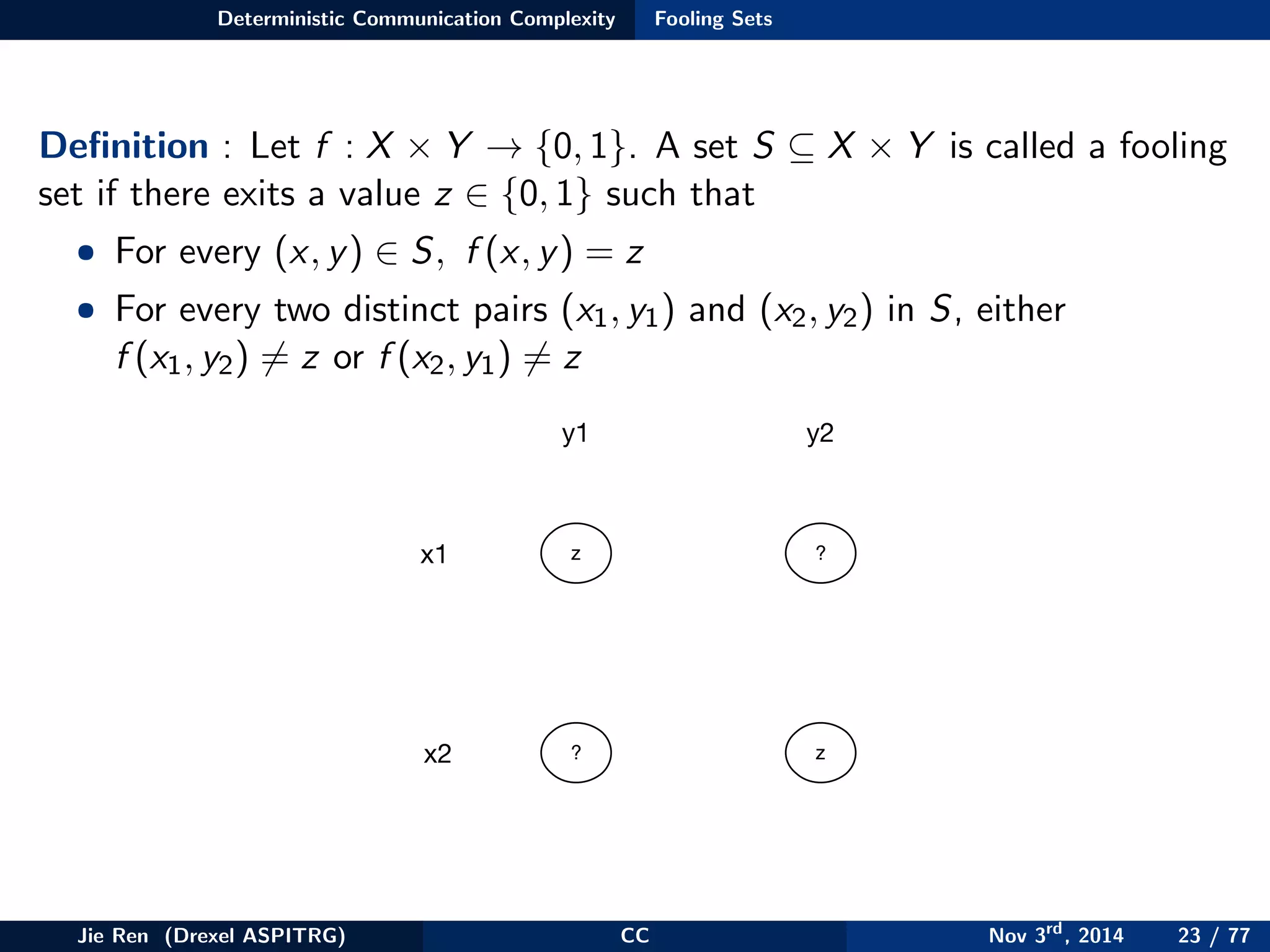
Motivation: If we exhibit a large set of input pairs such that no two of
them can be in a single monochromatic rectangle, then the number of
partitions of P must be large
z ?
? z
x1
y2y1
x2
Jie Ren (Drexel ASPITRG) CC Nov 3rd
, 2014 22 / 77
Deterministic Communication Complexity Fooling Sets
Definition : Let f : X × Y → {0, 1}. A set S ⊆ X × Y is called a fooling
set if there exits a value z ∈ {0, 1} such that
• For every (x, y) ∈ S, f (x, y) = z
• For every two distinct pairs (x1, y1) and (x2, y2) in S, either
f (x1, y2) = z or f (x2, y1) = z
z ?
? z
x1
y2y1
x2
Jie Ren (Drexel ASPITRG) CC Nov 3rd
, 2014 23 / 77
Deterministic Communication Complexity Fooling Sets
Fooling set lower bound
Theorem 1.20 (Kushilevitz & Nisan) : If f has a fooling set S of size t,
then
log2 t ≤ D(f ) (6)
Proof : No monochromatic rectangle contains more than one element of S
Jie Ren (Drexel ASPITRG) CC Nov 3rd
, 2014 24 / 77
Deterministic Communication Complexity Fooling Sets
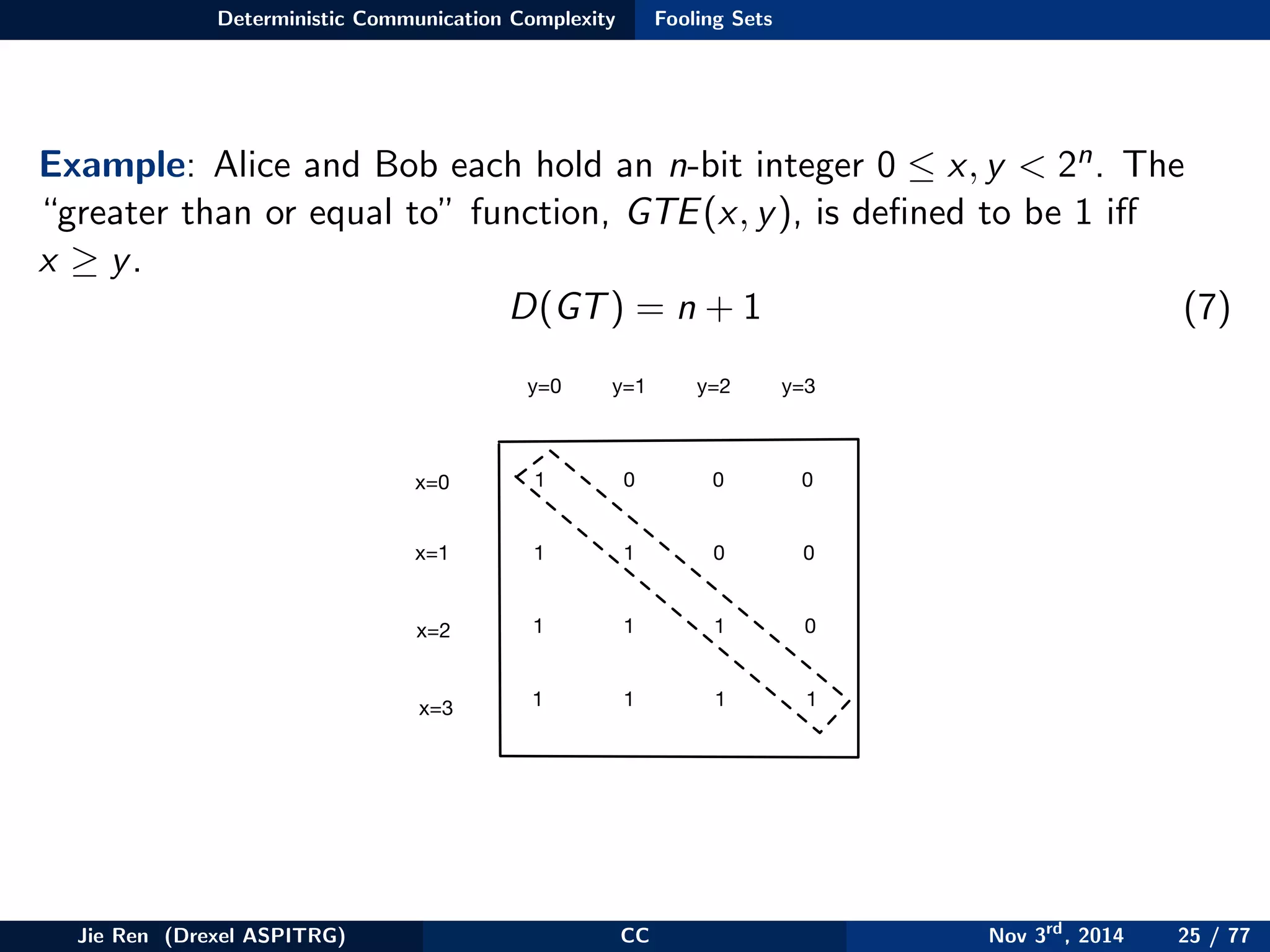
Example: Alice and Bob each hold an n-bit integer 0 ≤ x, y < 2n. The
“greater than or equal to” function, GTE(x, y), is defined to be 1 iff
x ≥ y.
D(GT) = n + 1 (7)
x=0
x=1
x=2
x=3
y=0 y=1 y=2 y=3
1
1
1
1
0 0 0
1 0 0
1 1 0
1 1 1
Jie Ren (Drexel ASPITRG) CC Nov 3rd
, 2014 25 / 77
Deterministic Communication Complexity Fooling Sets
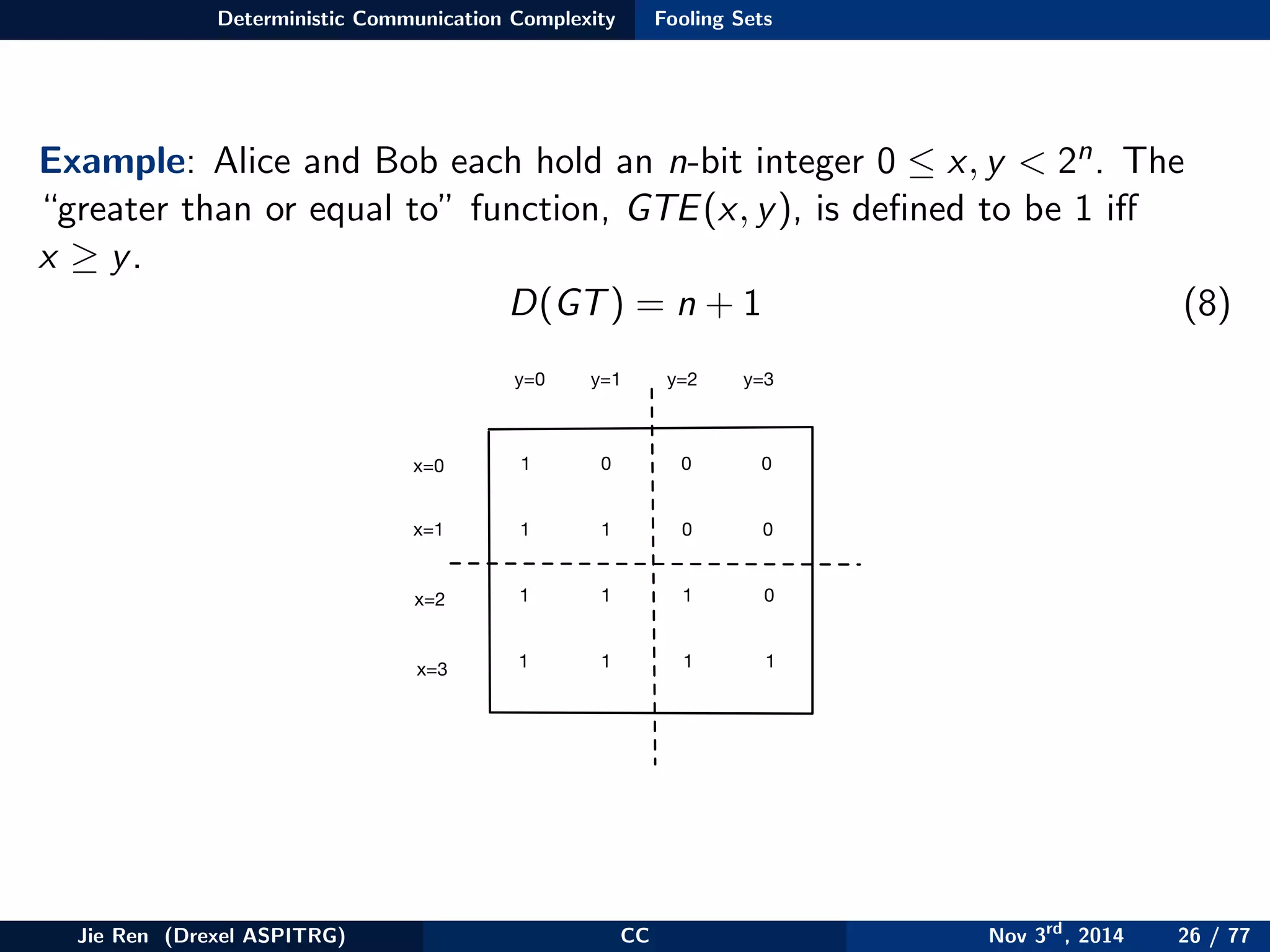
Example: Alice and Bob each hold an n-bit integer 0 ≤ x, y < 2n. The
“greater than or equal to” function, GTE(x, y), is defined to be 1 iff
x ≥ y.
D(GT) = n + 1 (8)
x=0
x=1
x=2
x=3
y=0 y=1 y=2 y=3
1
1
1
1
0 0 0
1 0 0
1 1 0
1 1 1
Jie Ren (Drexel ASPITRG) CC Nov 3rd
, 2014 26 / 77
Deterministic Communication Complexity Rectangle Rank
Outline
1 Deterministic Communication Complexity
Problem Setup
Protocol Tree
Combinatorial Rectangles
Fooling Sets
Rectangle Rank
2 Nondeterministic CC & Randomized CC
Nondeterministic Communication Complexity: Motivation
Nondeterministic Communication Complexity: definitions
Randomized Communication Complexity
Distributional Complexity and Discrepancy
3 Some Analysis
Jie Ren (Drexel ASPITRG) CC Nov 3rd
, 2014 27 / 77
Deterministic Communication Complexity Rectangle Rank
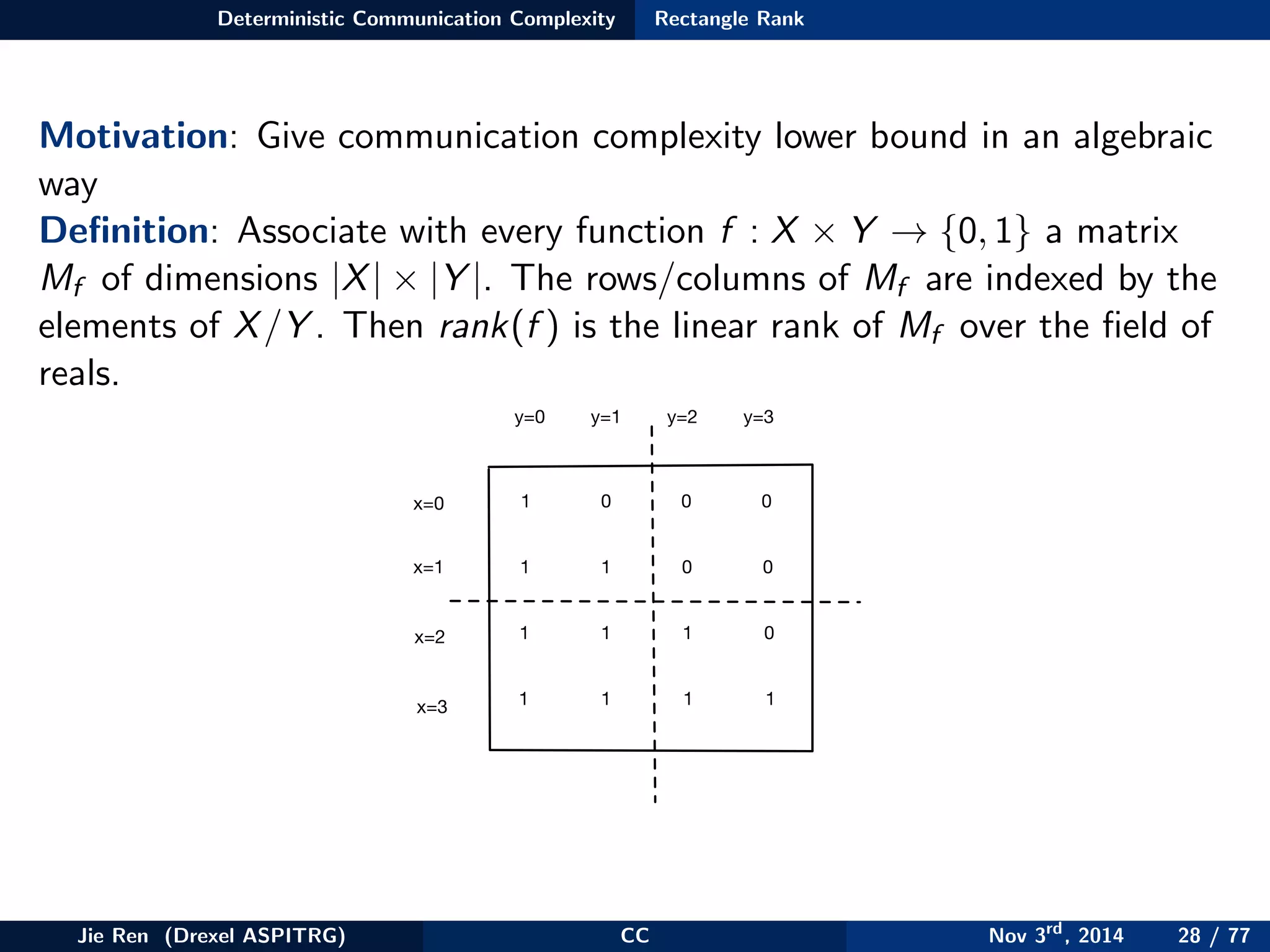
Motivation: Give communication complexity lower bound in an algebraic
way
Definition: Associate with every function f : X × Y → {0, 1} a matrix
Mf of dimensions |X| × |Y |. The rows/columns of Mf are indexed by the
elements of X/Y . Then rank(f ) is the linear rank of Mf over the field of
reals.
x=0
x=1
x=2
x=3
y=0 y=1 y=2 y=3
1
1
1
1
0 0 0
1 0 0
1 1 0
1 1 1
Jie Ren (Drexel ASPITRG) CC Nov 3rd
, 2014 28 / 77
Deterministic Communication Complexity Rectangle Rank
Rank lower bound
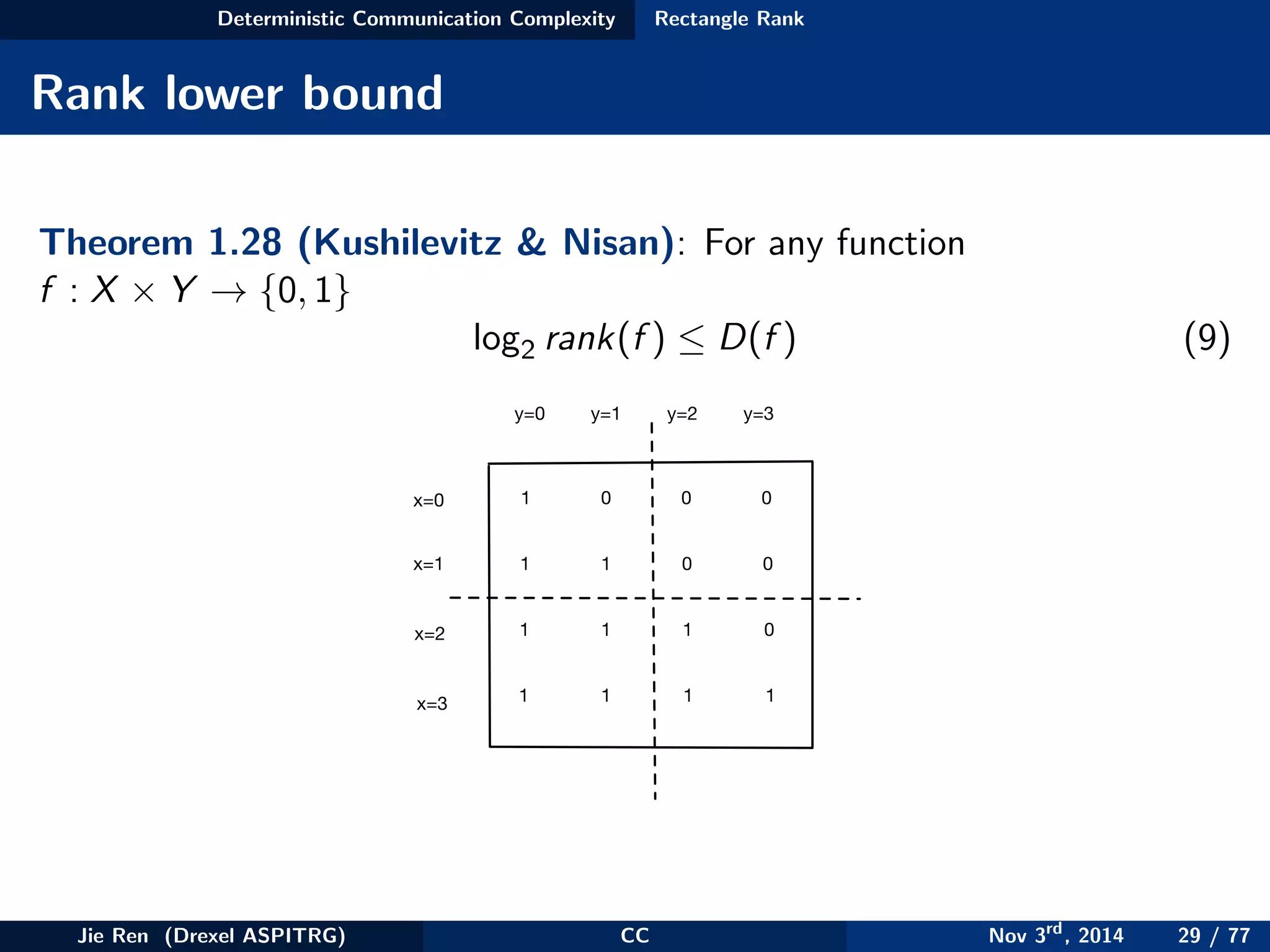
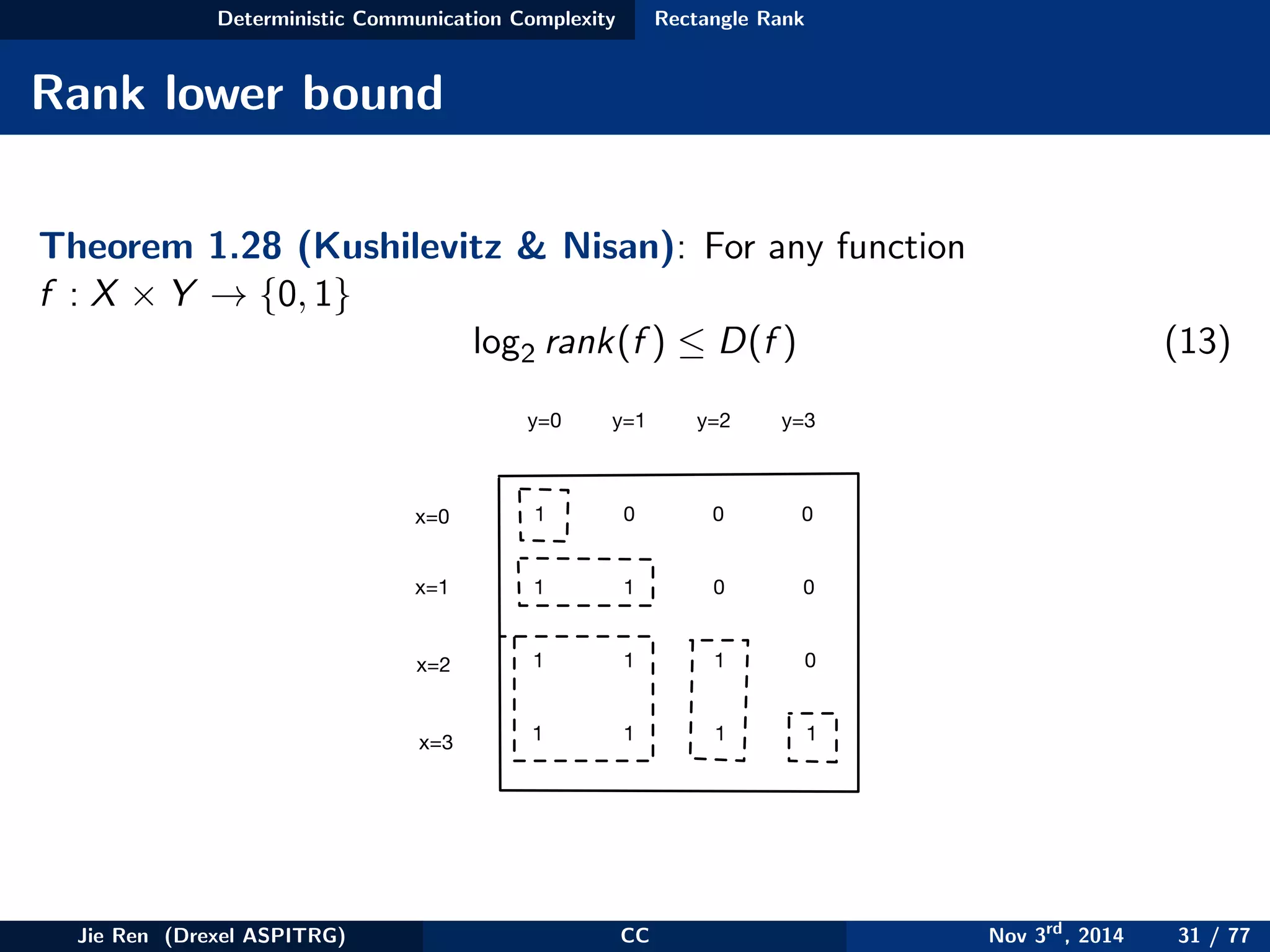
Theorem 1.28 (Kushilevitz & Nisan): For any function
f : X × Y → {0, 1}
log2 rank(f ) ≤ D(f ) (9)
x=0
x=1
x=2
x=3
y=0 y=1 y=2 y=3
1
1
1
1
0 0 0
1 0 0
1 1 0
1 1 1
Jie Ren (Drexel ASPITRG) CC Nov 3rd
, 2014 29 / 77
Deterministic Communication Complexity Rectangle Rank
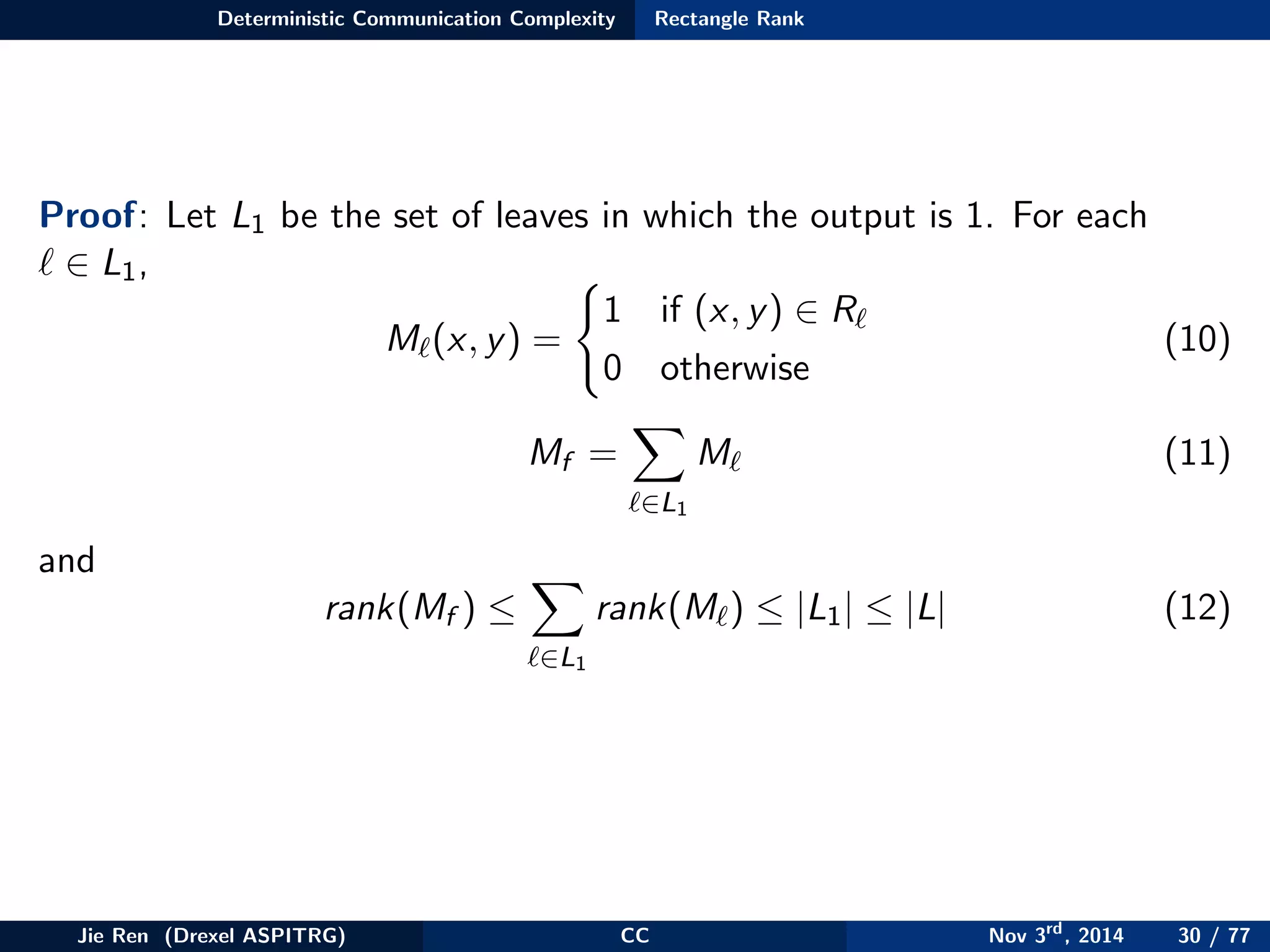
Proof: Let L1 be the set of leaves in which the output is 1. For each
∈ L1,
M (x, y) =
1 if (x, y) ∈ R
0 otherwise
(10)
Mf =
∈L1
M (11)
and
rank(Mf ) ≤
∈L1
rank(M ) ≤ |L1| ≤ |L| (12)
Jie Ren (Drexel ASPITRG) CC Nov 3rd
, 2014 30 / 77
Deterministic Communication Complexity Rectangle Rank
Rank lower bound
Theorem 1.28 (Kushilevitz & Nisan): For any function
f : X × Y → {0, 1}
log2 rank(f ) ≤ D(f ) (13)
x=0
x=1
x=2
x=3
y=0 y=1 y=2 y=3
1
1
1
1
0 0 0
1 0 0
1 1 0
1 1 1
Jie Ren (Drexel ASPITRG) CC Nov 3rd
, 2014 31 / 77
Deterministic Communication Complexity Rectangle Rank
Rank upper bound
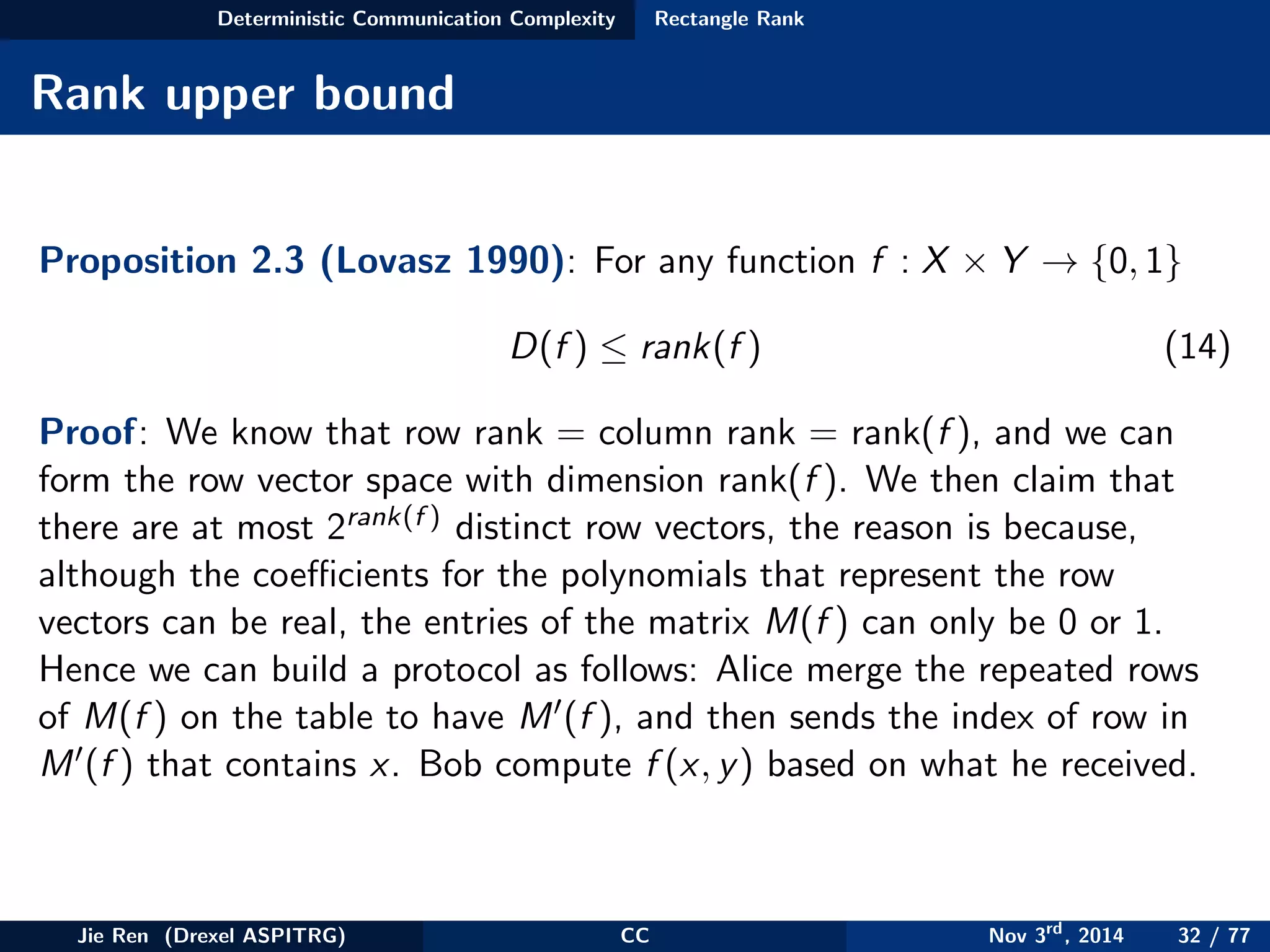
Proposition 2.3 (Lovasz 1990): For any function f : X × Y → {0, 1}
D(f ) ≤ rank(f ) (14)
Proof: We know that row rank = column rank = rank(f ), and we can
form the row vector space with dimension rank(f ). We then claim that
there are at most 2rank(f ) distinct row vectors, the reason is because,
although the coefficients for the polynomials that represent the row
vectors can be real, the entries of the matrix M(f ) can only be 0 or 1.
Hence we can build a protocol as follows: Alice merge the repeated rows
of M(f ) on the table to have M (f ), and then sends the index of row in
M (f ) that contains x. Bob compute f (x, y) based on what he received.
Jie Ren (Drexel ASPITRG) CC Nov 3rd
, 2014 32 / 77
Deterministic Communication Complexity Rectangle Rank
Summary
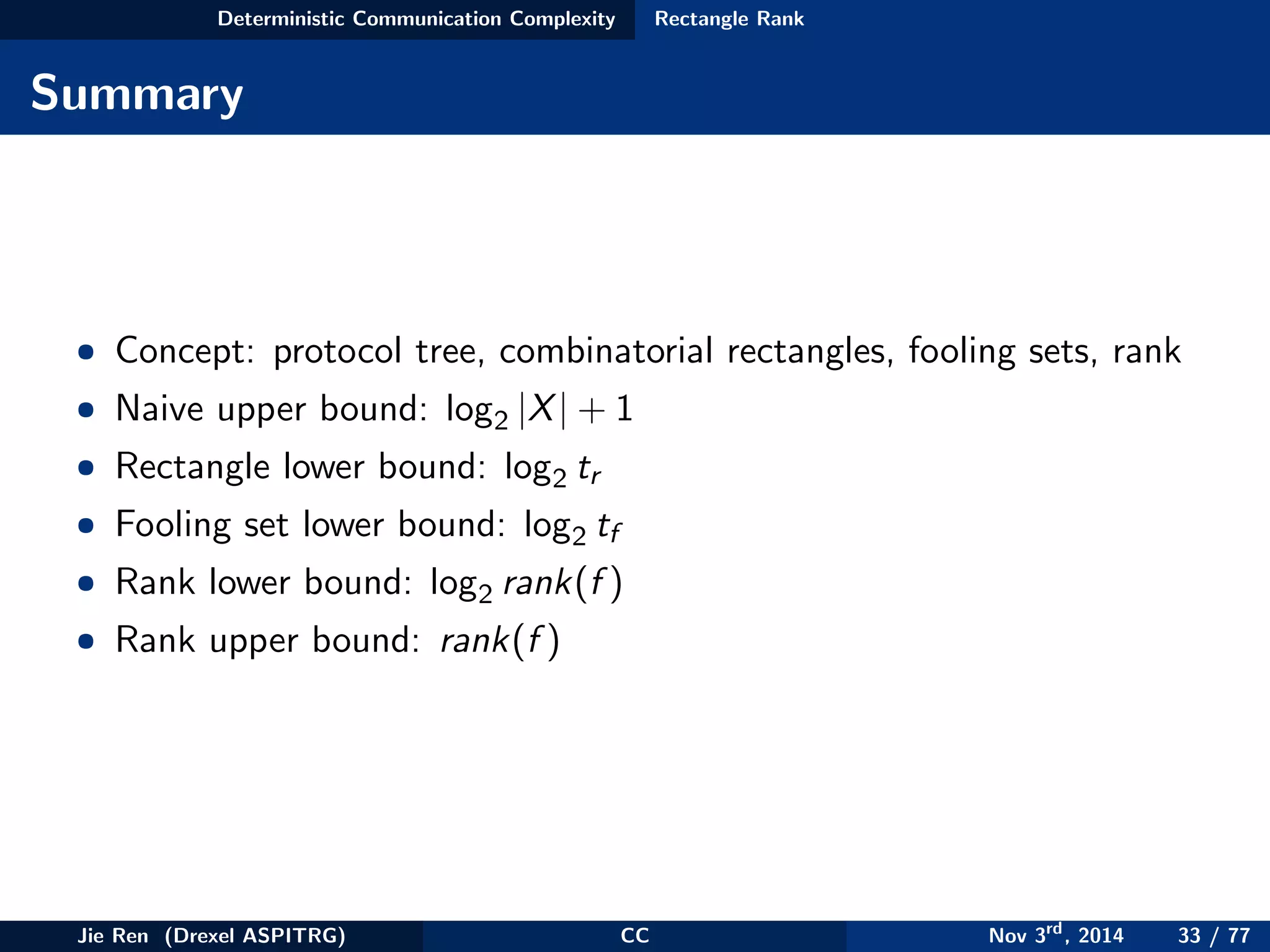
• Concept: protocol tree, combinatorial rectangles, fooling sets, rank
• Naive upper bound: log2 |X| + 1
• Rectangle lower bound: log2 tr
• Fooling set lower bound: log2 tf
• Rank lower bound: log2 rank(f )
• Rank upper bound: rank(f )
Jie Ren (Drexel ASPITRG) CC Nov 3rd
, 2014 33 / 77
Nondeterministic CC & Randomized CC
Outline
1 Deterministic Communication Complexity
Problem Setup
Protocol Tree
Combinatorial Rectangles
Fooling Sets
Rectangle Rank
2 Nondeterministic CC & Randomized CC
Nondeterministic Communication Complexity: Motivation
Nondeterministic Communication Complexity: definitions
Randomized Communication Complexity
Distributional Complexity and Discrepancy
3 Some Analysis
Jie Ren (Drexel ASPITRG) CC Nov 3rd
, 2014 34 / 77
Nondeterministic CC & Randomized CC Nondeterministic Communication Complexity: Motivation
Outline
1 Deterministic Communication Complexity
Problem Setup
Protocol Tree
Combinatorial Rectangles
Fooling Sets
Rectangle Rank
2 Nondeterministic CC & Randomized CC
Nondeterministic Communication Complexity: Motivation
Nondeterministic Communication Complexity: definitions
Randomized Communication Complexity
Distributional Complexity and Discrepancy
3 Some Analysis
Jie Ren (Drexel ASPITRG) CC Nov 3rd
, 2014 35 / 77
Nondeterministic CC & Randomized CC Nondeterministic Communication Complexity: Motivation
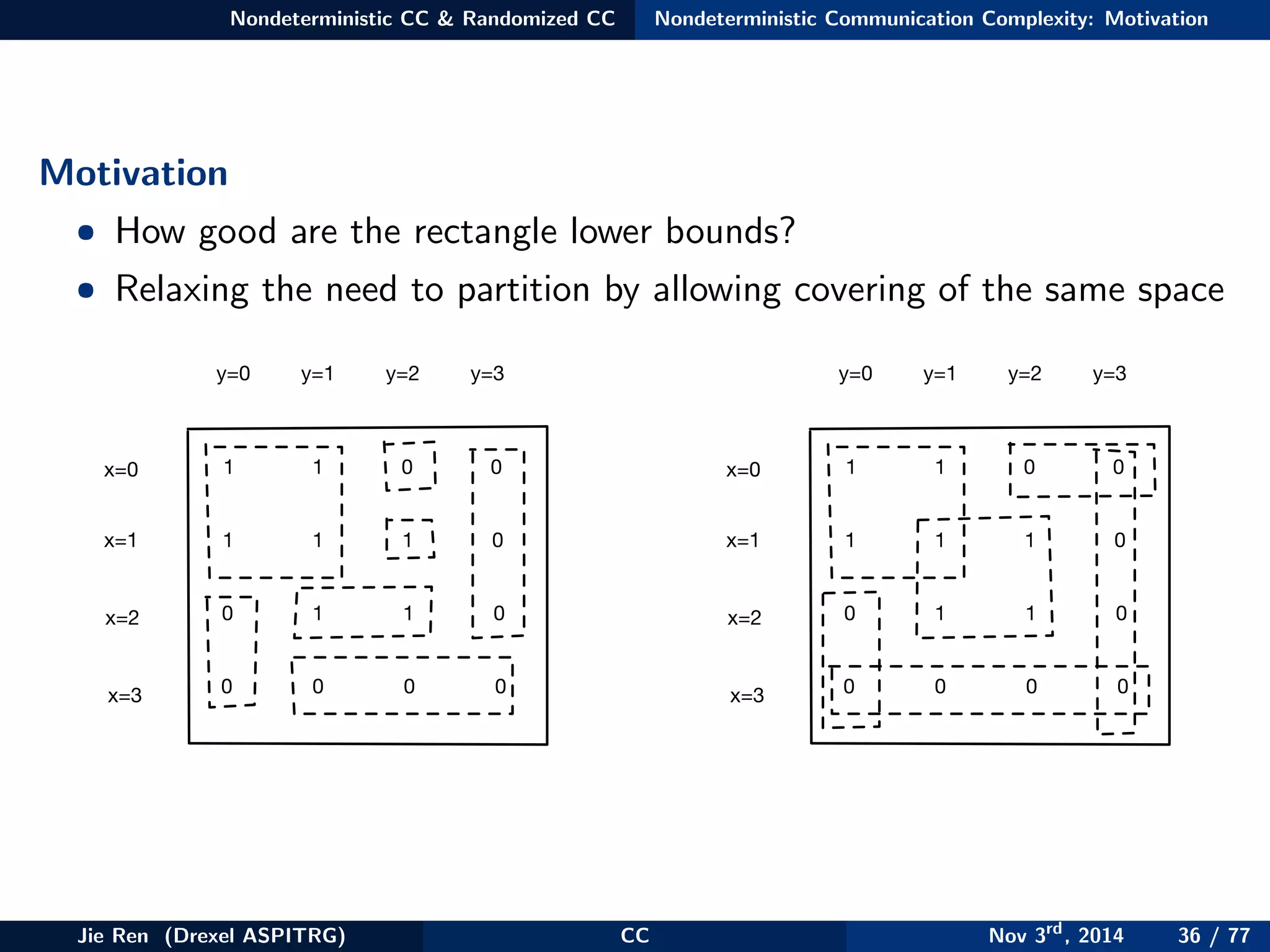
Motivation
• How good are the rectangle lower bounds?
• Relaxing the need to partition by allowing covering of the same space
x=0
x=1
x=2
x=3
y=0 y=1 y=2 y=3
1
1
0
0
1 0 0
1 1 0
1 1 0
0 0 0
x=0
x=1
x=2
x=3
y=0 y=1 y=2 y=3
1
1
0
0
1 0 0
1 1 0
1 1 0
0 0 0
Jie Ren (Drexel ASPITRG) CC Nov 3rd
, 2014 36 / 77
Nondeterministic CC & Randomized CC Nondeterministic Communication Complexity: Motivation
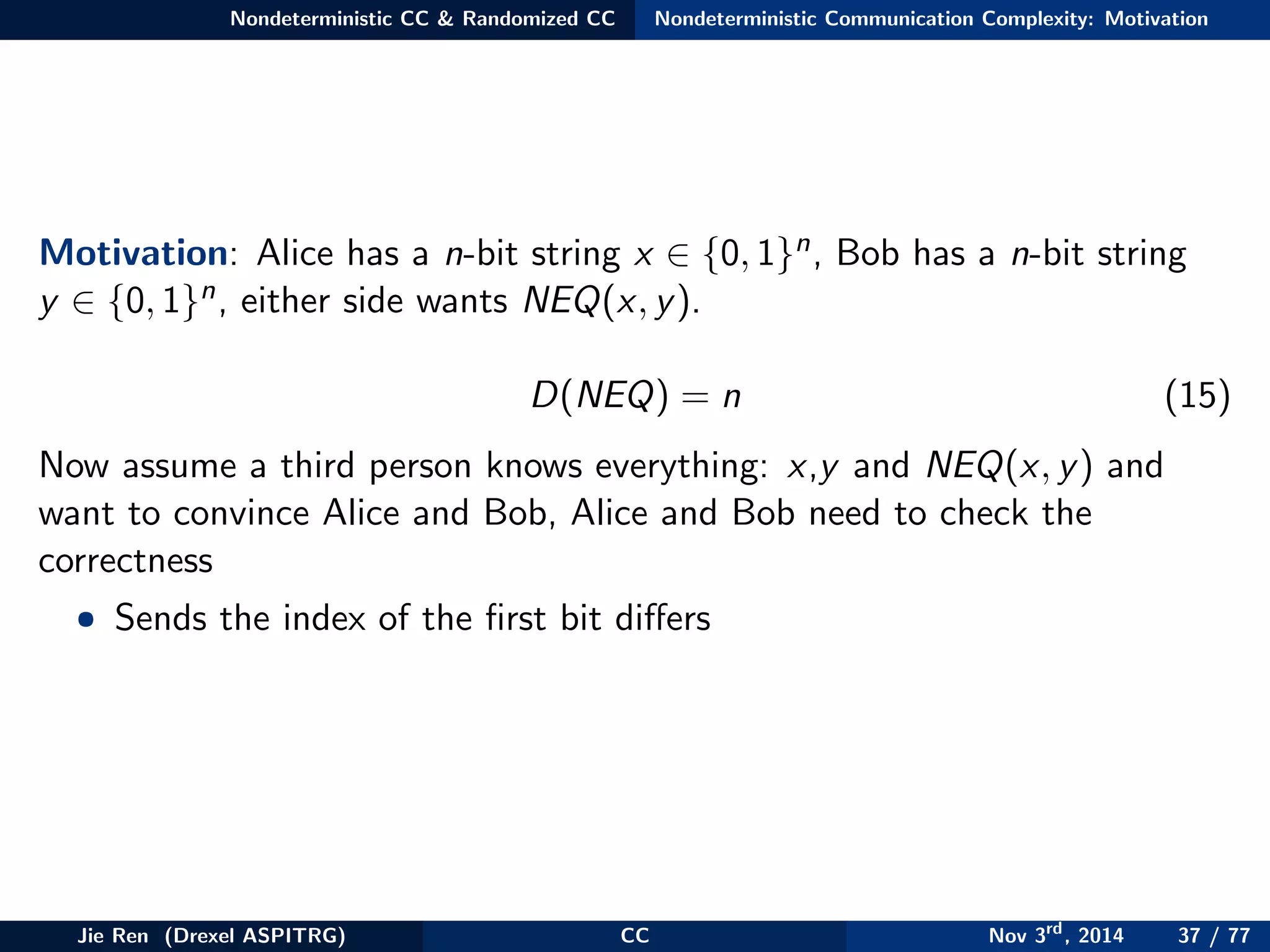
Motivation: Alice has a n-bit string x ∈ {0, 1}n, Bob has a n-bit string
y ∈ {0, 1}n, either side wants NEQ(x, y).
D(NEQ) = n (15)
Now assume a third person knows everything: x,y and NEQ(x, y) and
want to convince Alice and Bob, Alice and Bob need to check the
correctness
• Sends the index of the first bit differs
Jie Ren (Drexel ASPITRG) CC Nov 3rd
, 2014 37 / 77
Nondeterministic CC & Randomized CC Nondeterministic Communication Complexity: Motivation
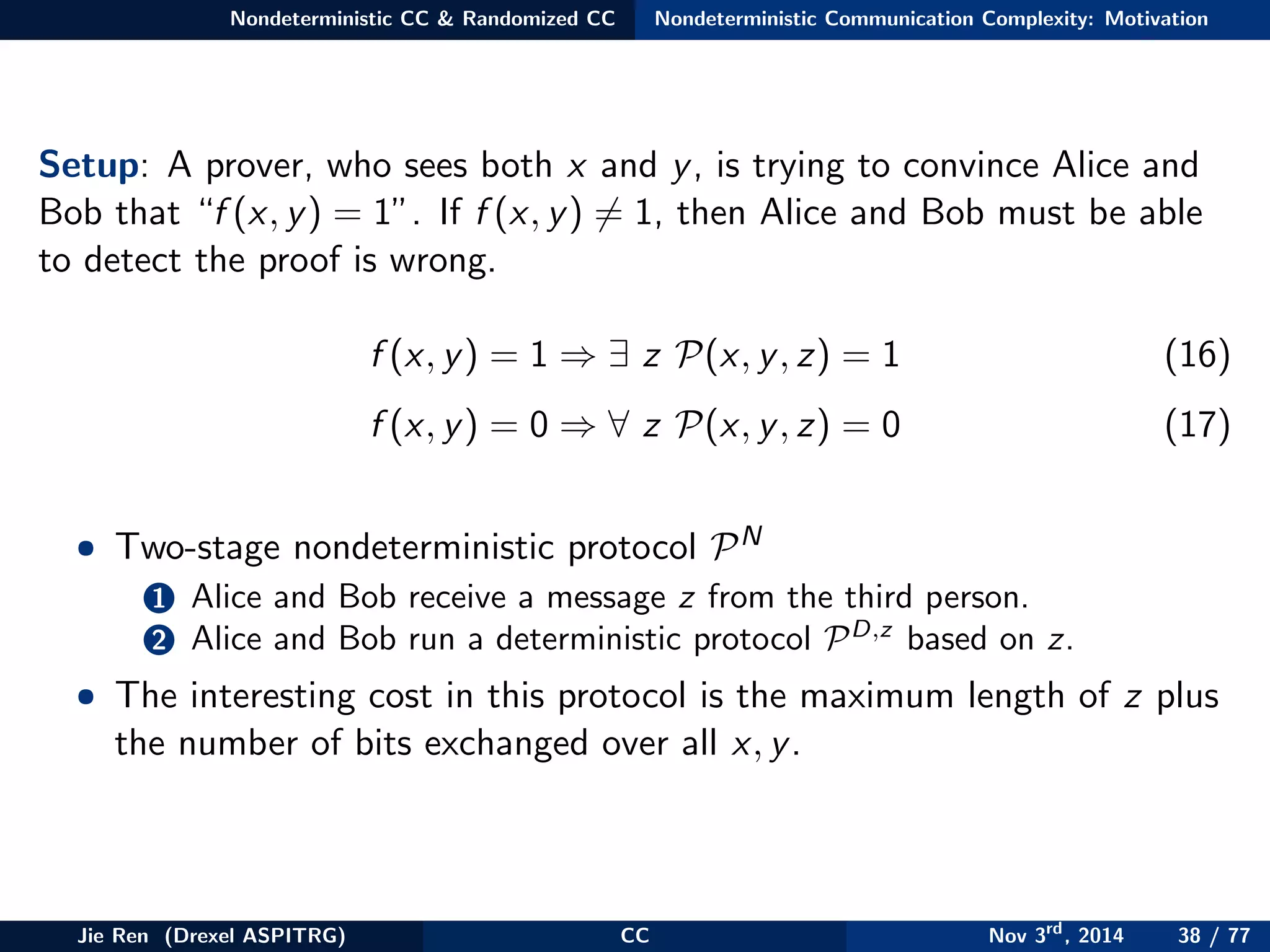
Setup: A prover, who sees both x and y, is trying to convince Alice and
Bob that “f (x, y) = 1”. If f (x, y) = 1, then Alice and Bob must be able
to detect the proof is wrong.
f (x, y) = 1 ⇒ ∃ z P(x, y, z) = 1 (16)
f (x, y) = 0 ⇒ ∀ z P(x, y, z) = 0 (17)
• Two-stage nondeterministic protocol PN
1 Alice and Bob receive a message z from the third person.
2 Alice and Bob run a deterministic protocol PD,z
based on z.
• The interesting cost in this protocol is the maximum length of z plus
the number of bits exchanged over all x, y.
Jie Ren (Drexel ASPITRG) CC Nov 3rd
, 2014 38 / 77
Nondeterministic CC & Randomized CC Nondeterministic Communication Complexity: Motivation
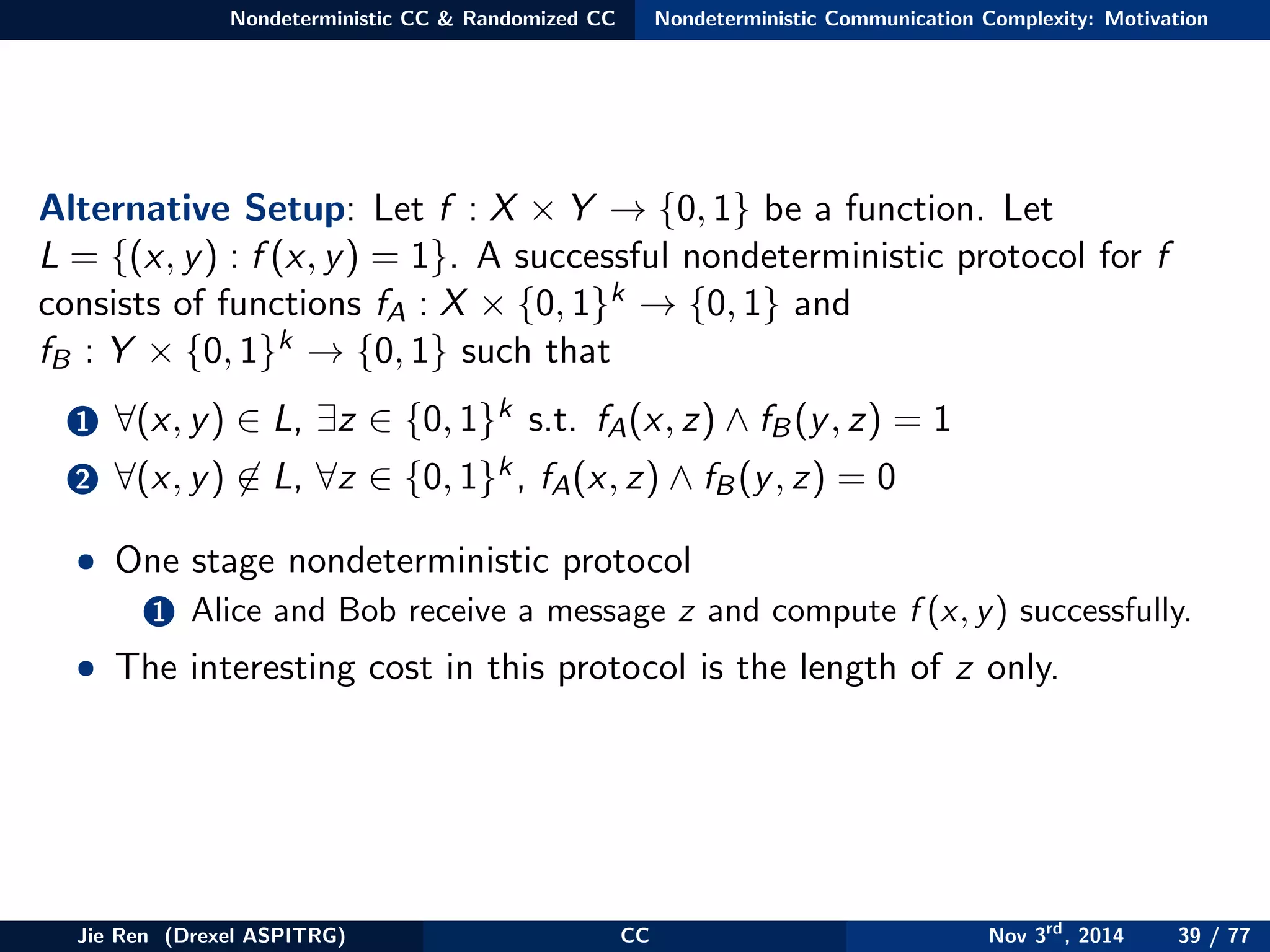
Alternative Setup: Let f : X × Y → {0, 1} be a function. Let
L = {(x, y) : f (x, y) = 1}. A successful nondeterministic protocol for f
consists of functions fA : X × {0, 1}k → {0, 1} and
fB : Y × {0, 1}k → {0, 1} such that
1 ∀(x, y) ∈ L, ∃z ∈ {0, 1}k s.t. fA(x, z) ∧ fB(y, z) = 1
2 ∀(x, y) ∈ L, ∀z ∈ {0, 1}k, fA(x, z) ∧ fB(y, z) = 0
• One stage nondeterministic protocol
1 Alice and Bob receive a message z and compute f (x, y) successfully.
• The interesting cost in this protocol is the length of z only.
Jie Ren (Drexel ASPITRG) CC Nov 3rd
, 2014 39 / 77
Nondeterministic CC & Randomized CC Nondeterministic Communication Complexity: Motivation
Two-stage ⇒ One-stage: Given a two-stage nondeterministic protocol
with k bits first stage cost and d bits second stage cost, we can always
build a one-stage nondeterministic protocol by adding the d bits
deterministic communication to the witness z with each party accepting if
the message agrees with what Alice and Bob would have said in the
protocol.
Jie Ren (Drexel ASPITRG) CC Nov 3rd
, 2014 40 / 77
Nondeterministic CC & Randomized CC Nondeterministic Communication Complexity: Motivation
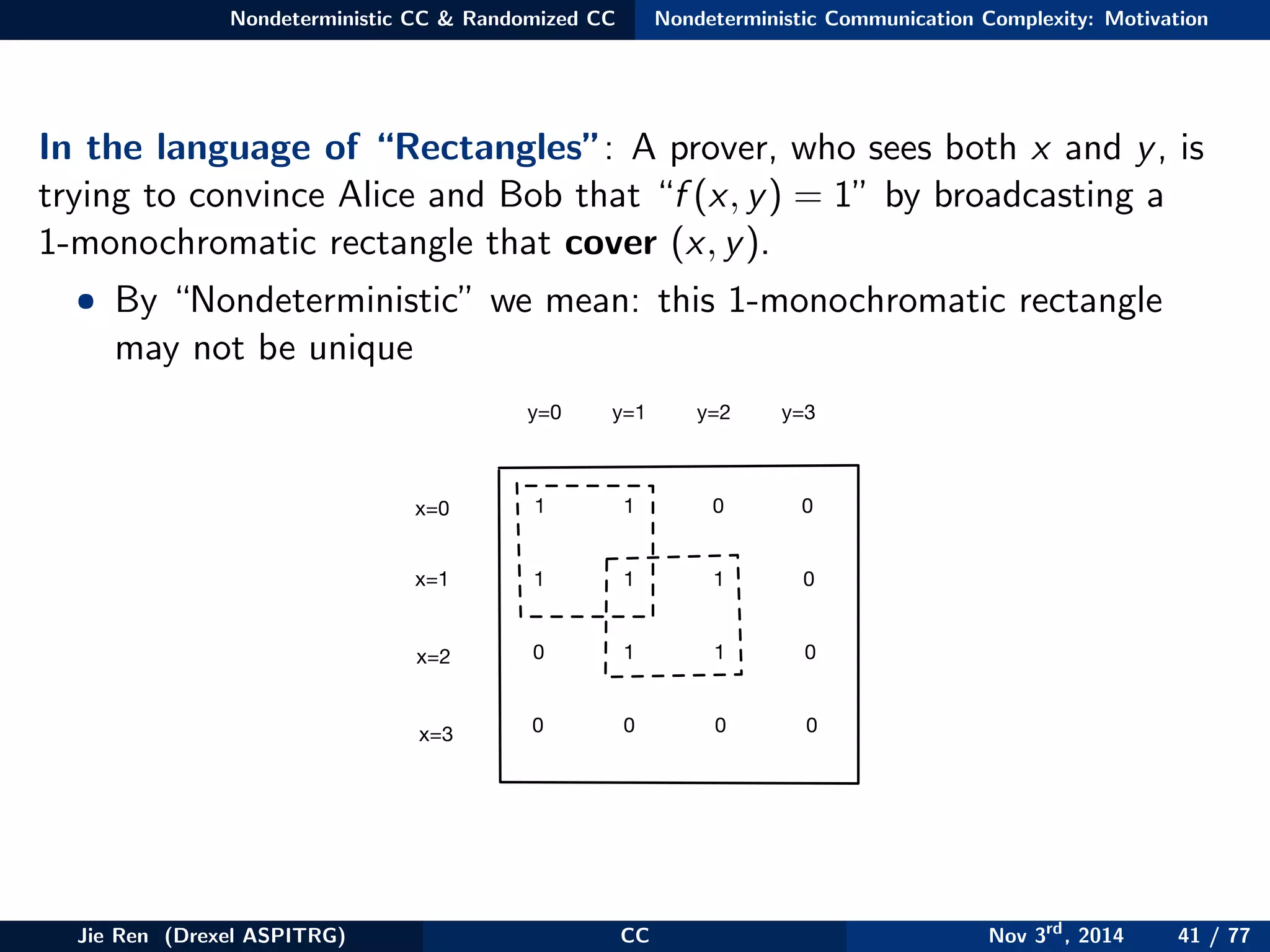
In the language of “Rectangles”: A prover, who sees both x and y, is
trying to convince Alice and Bob that “f (x, y) = 1” by broadcasting a
1-monochromatic rectangle that cover (x, y).
• By “Nondeterministic” we mean: this 1-monochromatic rectangle
may not be unique
x=0
x=1
x=2
x=3
y=0 y=1 y=2 y=3
1
1
0
0
1 0 0
1 1 0
1 1 0
0 0 0
Jie Ren (Drexel ASPITRG) CC Nov 3rd
, 2014 41 / 77
Nondeterministic CC & Randomized CC Nondeterministic Communication Complexity: definitions
Outline
1 Deterministic Communication Complexity
Problem Setup
Protocol Tree
Combinatorial Rectangles
Fooling Sets
Rectangle Rank
2 Nondeterministic CC & Randomized CC
Nondeterministic Communication Complexity: Motivation
Nondeterministic Communication Complexity: definitions
Randomized Communication Complexity
Distributional Complexity and Discrepancy
3 Some Analysis
Jie Ren (Drexel ASPITRG) CC Nov 3rd
, 2014 42 / 77
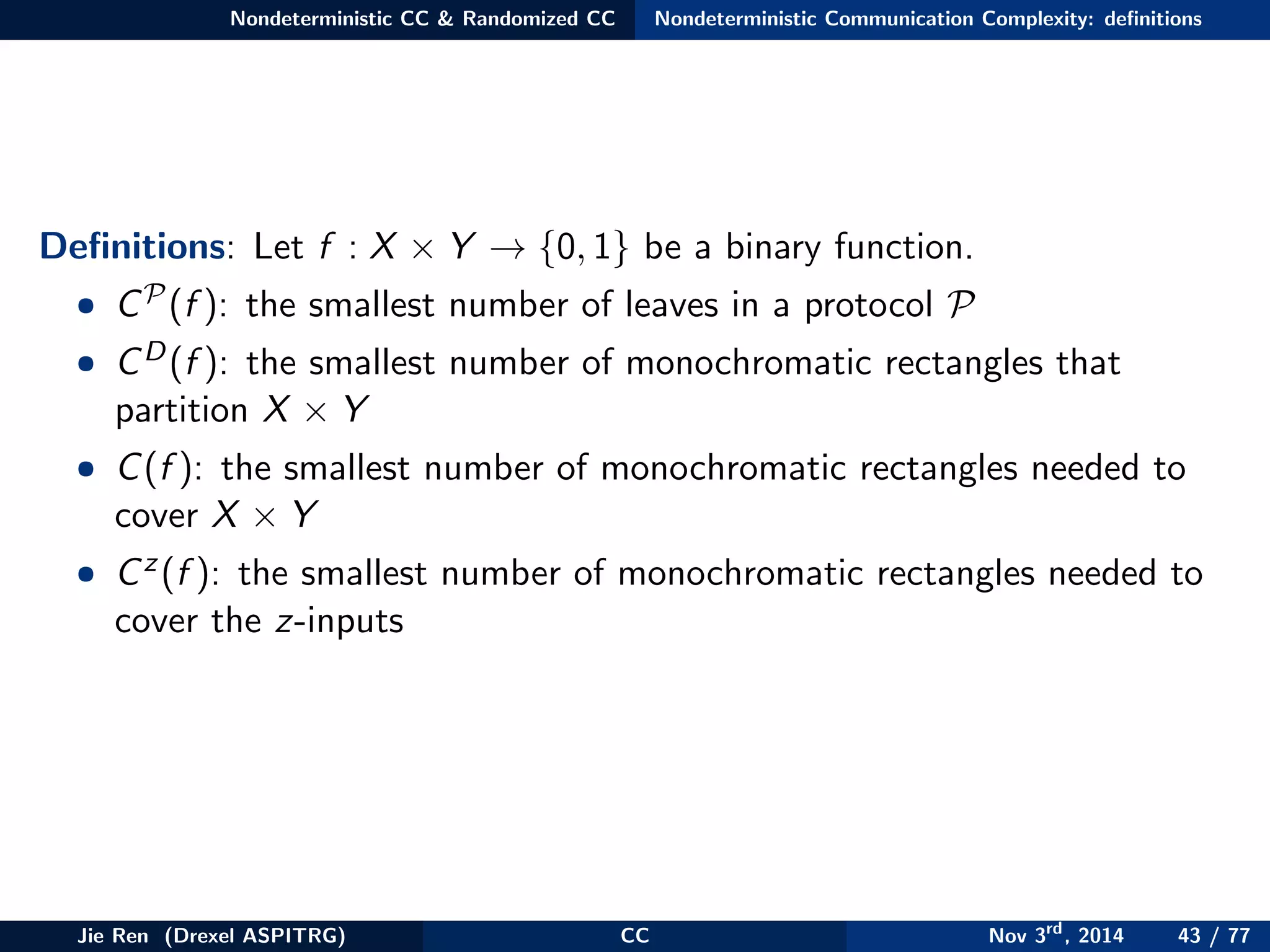
Nondeterministic CC & Randomized CC Nondeterministic Communication Complexity: definitions
Definitions: Let f : X × Y → {0, 1} be a binary function.
• CP(f ): the smallest number of leaves in a protocol P
• CD(f ): the smallest number of monochromatic rectangles that
partition X × Y
• C(f ): the smallest number of monochromatic rectangles needed to
cover X × Y
• Cz(f ): the smallest number of monochromatic rectangles needed to
cover the z-inputs
Jie Ren (Drexel ASPITRG) CC Nov 3rd
, 2014 43 / 77
Nondeterministic CC & Randomized CC Nondeterministic Communication Complexity: definitions
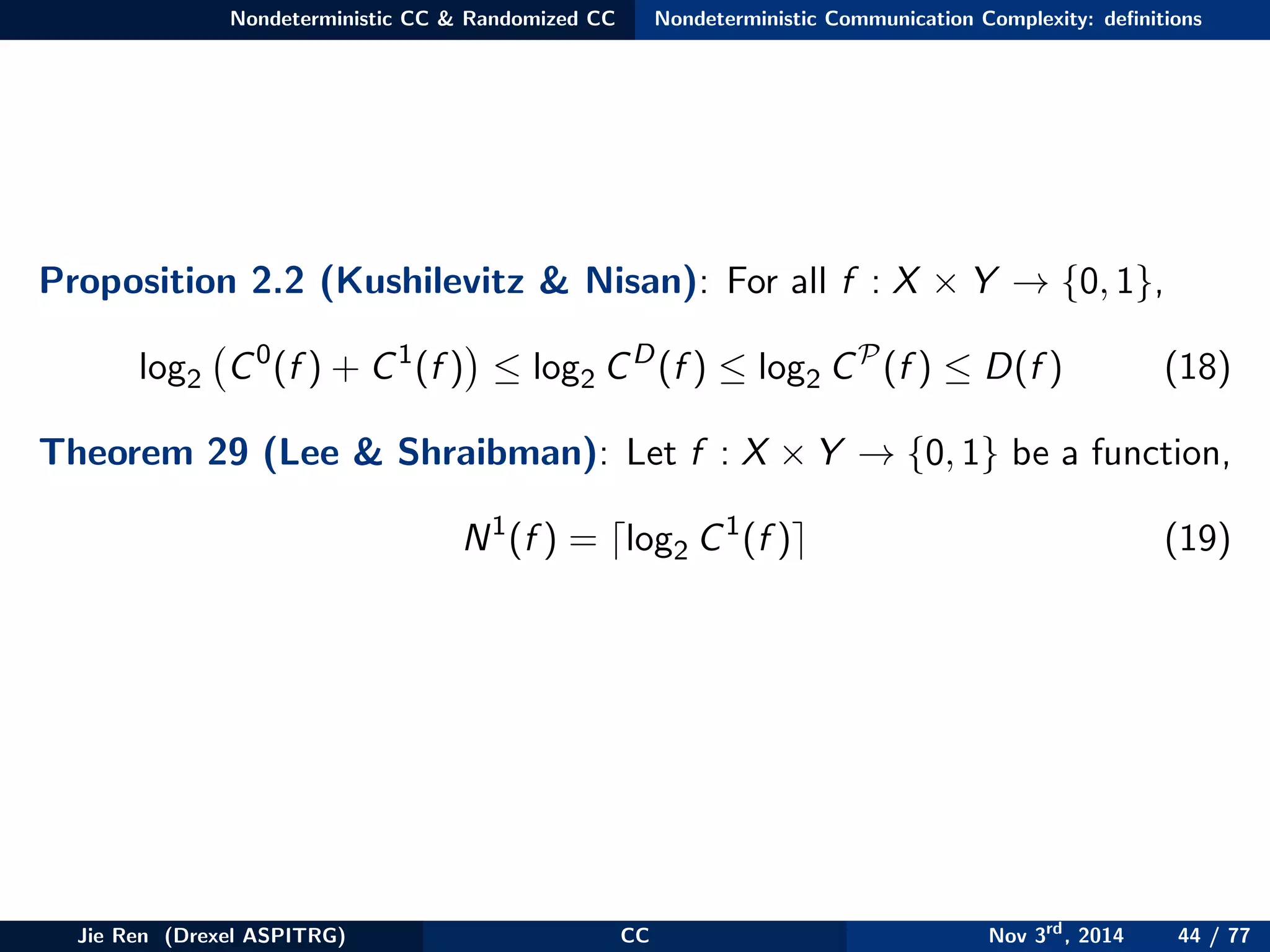
Proposition 2.2 (Kushilevitz & Nisan): For all f : X × Y → {0, 1},
log2 C0
(f ) + C1
(f ) ≤ log2 CD
(f ) ≤ log2 CP
(f ) ≤ D(f ) (18)
Theorem 29 (Lee & Shraibman): Let f : X × Y → {0, 1} be a function,
N1
(f ) = log2 C1
(f ) (19)
Jie Ren (Drexel ASPITRG) CC Nov 3rd
, 2014 44 / 77
Nondeterministic CC & Randomized CC Nondeterministic Communication Complexity: definitions
Proof:
• N1(f ) ≤ log2 C1(f ) : Let {R } be a cover. If f (x, y) = 1, the
players receive the index that (x, y) ∈ R
• N1(f ) ≥ log2 C1(f ) : Let k = N1(f ), and let
fA : X × {0, 1}k → {0, 1}, fB : Y × {0, 1}k → {0, 1} be functions in
the one-stage nondeterministic protocol. Define
Rz = {(x, y) : fA(x, z) ∧ fB(y, z) = 1}, Rz is a rectangle. We claim
{Rz, z ∈ {0, 1}k} is a cover of the 1s. This is because by the
definition of nondeterministic protocol:
• ∀(x, y) pairs that f (x, y) = 1, there must exists some z s.t.
(x, y) ∈ Rz .
• ∀(x, y) pairs that f (x, y) = 0, (x, y) ∈ Rz for all z.
Jie Ren (Drexel ASPITRG) CC Nov 3rd
, 2014 45 / 77
Nondeterministic CC & Randomized CC Nondeterministic Communication Complexity: definitions
Definition (Lee & Shraibman):
N1
(f ) = log2 C1
(f ) (20)
N0
(f ) = log2 C0
(f ) (21)
N(f ) = max(N1
(f ), N0
(f )) (22)
Definition (Kushilevitz & Nisan):
N1
(f ) = log2 C1
(f ) (23)
N0
(f ) = log2 C0
(f ) (24)
N(f ) = log2 C0
(f ) + C1
(f ) (25)
Jie Ren (Drexel ASPITRG) CC Nov 3rd
, 2014 46 / 77
Nondeterministic CC & Randomized CC Randomized Communication Complexity
Outline
1 Deterministic Communication Complexity
Problem Setup
Protocol Tree
Combinatorial Rectangles
Fooling Sets
Rectangle Rank
2 Nondeterministic CC & Randomized CC
Nondeterministic Communication Complexity: Motivation
Nondeterministic Communication Complexity: definitions
Randomized Communication Complexity
Distributional Complexity and Discrepancy
3 Some Analysis
Jie Ren (Drexel ASPITRG) CC Nov 3rd
, 2014 47 / 77
Nondeterministic CC & Randomized CC Randomized Communication Complexity
Motivation:
• Introduce randomness in the protocol rA and rB: flip coins
• Allow protocols that may have error
Jie Ren (Drexel ASPITRG) CC Nov 3rd
, 2014 48 / 77
Nondeterministic CC & Randomized CC Randomized Communication Complexity
Randomized Protocol Tree
Definition
: A randomized protocol P over domain X × Y with range Z is a binary
tree where each internal node v is labeled either by a function
av : X × RA → {0, 1} or by a function bv : Y × RB → {0, 1}, and each
leaf is labeled with an element z ∈ Z.
Jie Ren (Drexel ASPITRG) CC Nov 3rd
, 2014 49 / 77
Nondeterministic CC & Randomized CC Randomized Communication Complexity
Definition: Let P be a randomized protocol. All the probabilities below
are over random choices of rA and rB.
• P computes a function f with zero error
• P computes a function f with −error if for all (x, y)
P[P(x, y) = f (x, y)] ≥ 1 − (26)
• P computes a function f with one-sided −error if for all (x, y) such
that f (x, y) = 0
P[P(x, y) = 0] = 1, (27)
and for all (x, y) such that f (x, y) = 1,
P[P(x, y) = 1] ≥ 1 − (28)
Jie Ren (Drexel ASPITRG) CC Nov 3rd
, 2014 50 / 77
Nondeterministic CC & Randomized CC Randomized Communication Complexity
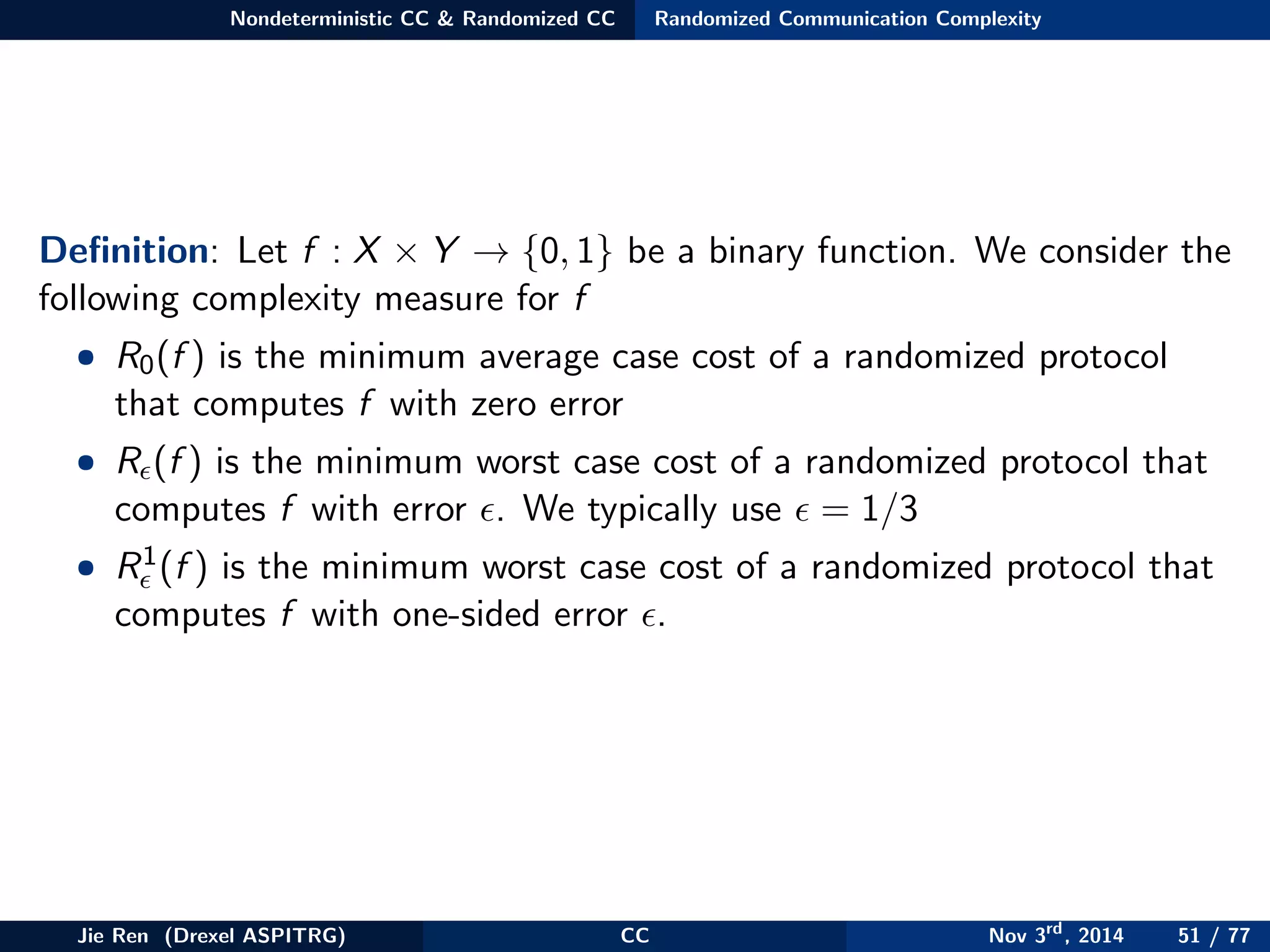
Definition: Let f : X × Y → {0, 1} be a binary function. We consider the
following complexity measure for f
• R0(f ) is the minimum average case cost of a randomized protocol
that computes f with zero error
• R (f ) is the minimum worst case cost of a randomized protocol that
computes f with error . We typically use = 1/3
• R1(f ) is the minimum worst case cost of a randomized protocol that
computes f with one-sided error .
Jie Ren (Drexel ASPITRG) CC Nov 3rd
, 2014 51 / 77
Nondeterministic CC & Randomized CC Randomized Communication Complexity
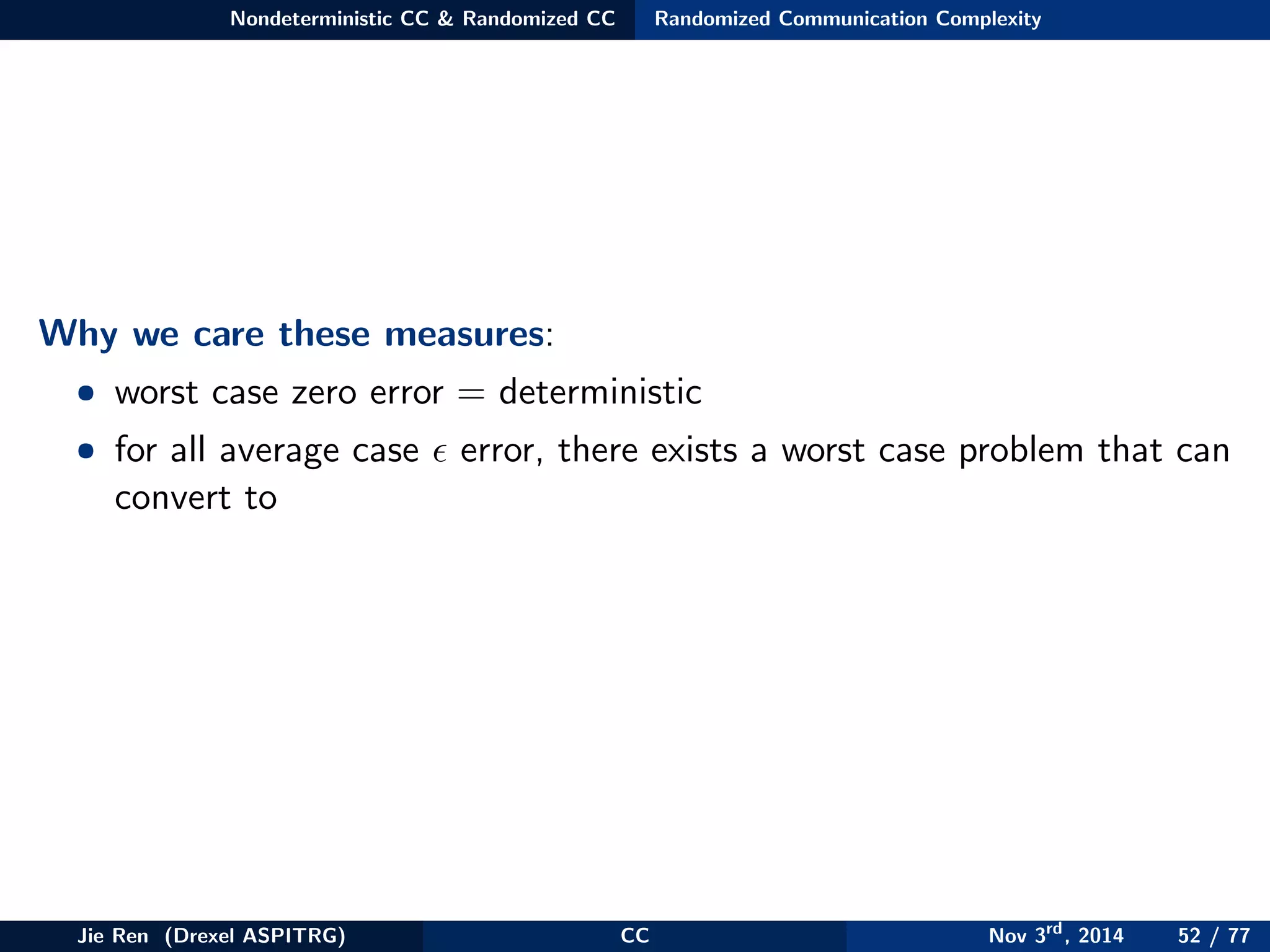
Why we care these measures:
• worst case zero error = deterministic
• for all average case error, there exists a worst case problem that can
convert to
Jie Ren (Drexel ASPITRG) CC Nov 3rd
, 2014 52 / 77
Nondeterministic CC & Randomized CC Randomized Communication Complexity
Proposition: Given a protocol P that makes an error /2 and the average
number of bits exchanged is t, it can always be modified as follows:
execute P as long as at most 2t/ bits are exchanged, if the protocol
finishes, use its output, otherwise output 0. This gives a worst case cost
2t/ with error upper bounded by .
Proof:
t =
ra,rb,x,y
cc · p(ra, rb, x, y)
=
cc≤2t/
cc · p(ra, rb, x, y) +
cc>2t/
cc · p(ra, rb, x, y)
≥
cc>2t/
cc · p(ra, rb, x, y) ≥
2t
Pr[cc > 2t/ ]
(29)
Hence,
Pr[err] ≤
2
Pr[P ends] + 1 · Pr[P not ends]
≤
2
+
t
2t/
=
(30)
Jie Ren (Drexel ASPITRG) CC Nov 3rd
, 2014 53 / 77
Nondeterministic CC & Randomized CC Randomized Communication Complexity
1 For all 0 < ≤ < 1/2,
R (f ) ≤ O(log · R (f )) (31)
2 For all 0 < ≤ 1/2,
R (f ) ≤ R1
(f ) ≤ O(log −1
R0(f )) (32)
3 For all 0 < ≤ 1/2,
R0(f ) = Θ(max[R1
(f ), R1
(not(f ))]) (33)
Jie Ren (Drexel ASPITRG) CC Nov 3rd
, 2014 54 / 77
Nondeterministic CC & Randomized CC Randomized Communication Complexity
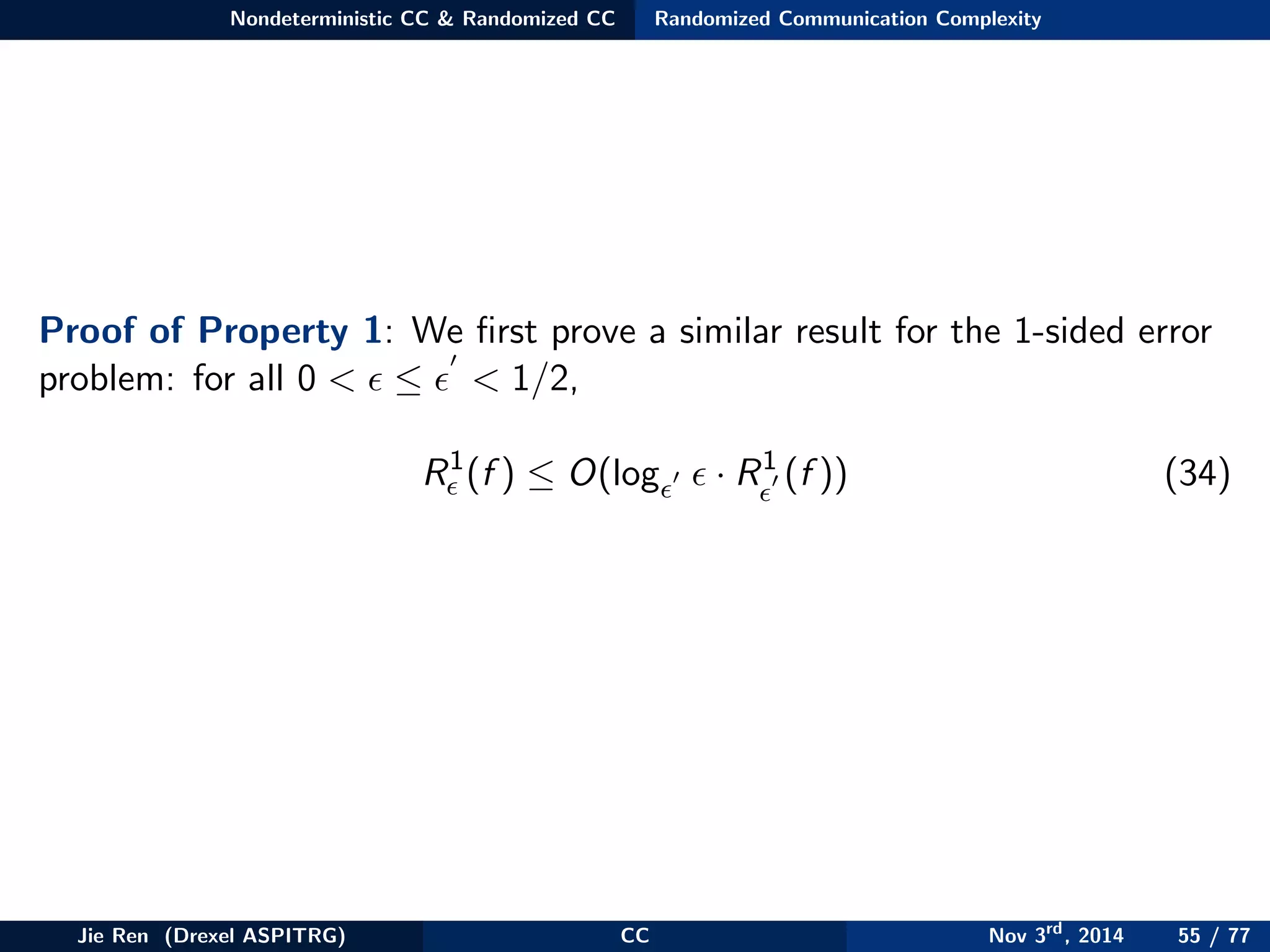
Proof of Property 1: We first prove a similar result for the 1-sided error
problem: for all 0 < ≤ < 1/2,
R1
(f ) ≤ O(log · R1
(f )) (34)
Jie Ren (Drexel ASPITRG) CC Nov 3rd
, 2014 55 / 77
Nondeterministic CC & Randomized CC Randomized Communication Complexity
Proof of Property 1: Given a randomized protocol P with worst case
cost T bits and one-sided error no greater than < 1/2, we can build a
new protocol P with worst case cost nT bits by simply running P n
times. In the new protocol, Alice and Bob will claim f (x, y) = 1 if and
only if there exists at least one time among the n repeating protocols that
they will output 1. Now we bound the error for the new protocol P :
P[err|f (x, y) = 0] = 0 (35)
P[err|f (x, y) = 1] = P[all n trails output 0|f (x, y) = 1]
= ( )n
(36)
Therefore, if we repeat P log times, we can guarantee to reduce the
one-sided error to .
Jie Ren (Drexel ASPITRG) CC Nov 3rd
, 2014 56 / 77
Nondeterministic CC & Randomized CC Randomized Communication Complexity
Proof of Property 1: Now we prove property 1. We still run P n times,
each gives an output Xi , i ∈ {1, . . . , n}. In the new protocol, Alice and
Bob will claim f (x, y) = 1 if and only if
1
n
i
Xi >
1
2
(37)
Now we bound the error for the new protocol P :
P[err|f (x, y) = 0] ≤
n
i= n/2
n
i
( )i
(1 − )n−i
≤ ( )n
(38)
P[err|f (x, y) = 1] ≤
n
i= n/2
n
i
( )i
(1 − )n−i
≤ ( )n
(39)
Therefore, if we repeat P log times, we can also guarantee to reduce
the two-sided error to .
Jie Ren (Drexel ASPITRG) CC Nov 3rd
, 2014 57 / 77
Nondeterministic CC & Randomized CC Distributional Complexity and Discrepancy
Outline
1 Deterministic Communication Complexity
Problem Setup
Protocol Tree
Combinatorial Rectangles
Fooling Sets
Rectangle Rank
2 Nondeterministic CC & Randomized CC
Nondeterministic Communication Complexity: Motivation
Nondeterministic Communication Complexity: definitions
Randomized Communication Complexity
Distributional Complexity and Discrepancy
3 Some Analysis
Jie Ren (Drexel ASPITRG) CC Nov 3rd
, 2014 58 / 77
Nondeterministic CC & Randomized CC Distributional Complexity and Discrepancy
Distributional Complexity
Motivation: Consider probability distributions over the inputs
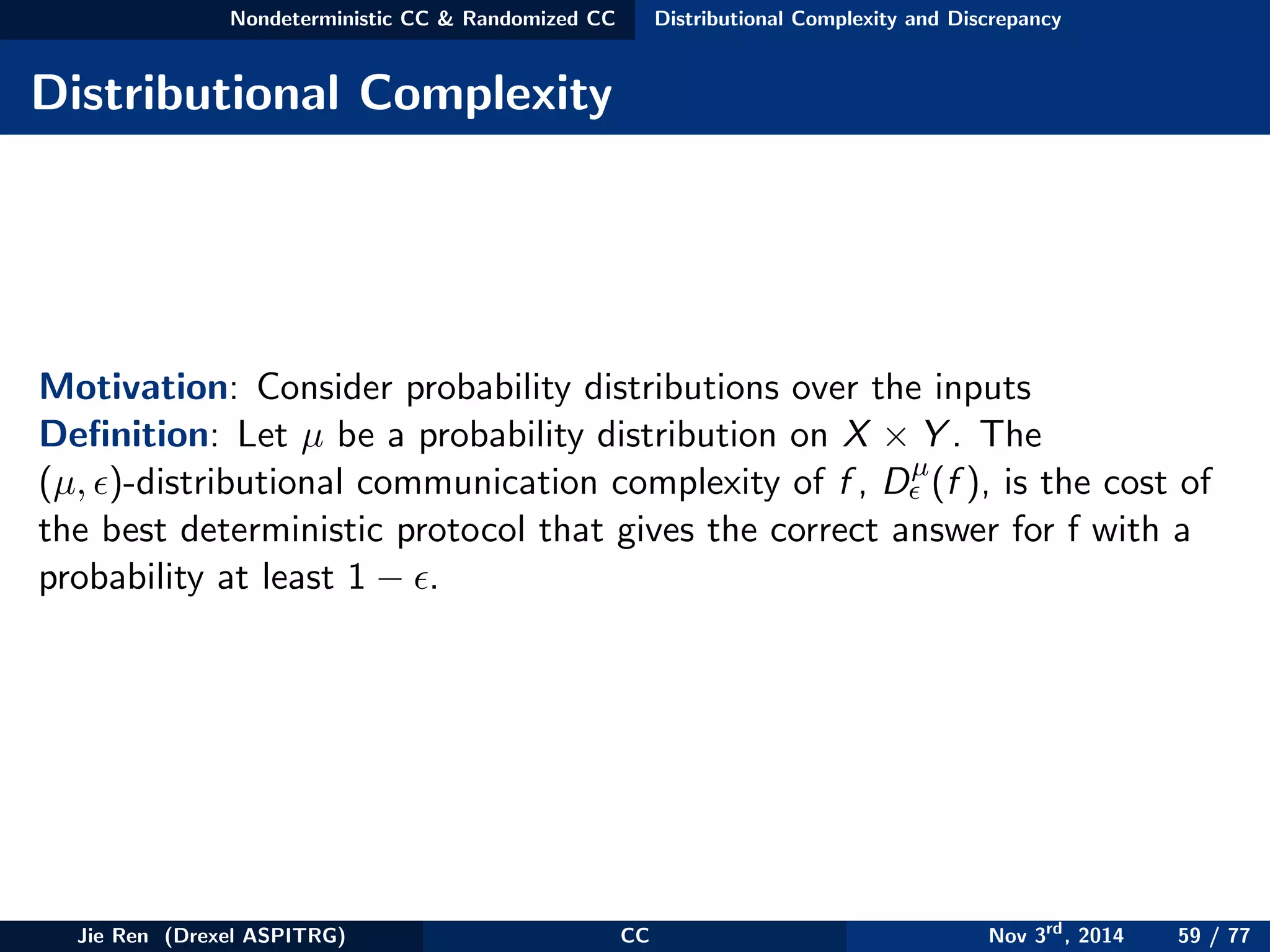
Definition: Let µ be a probability distribution on X × Y . The
(µ, )-distributional communication complexity of f , Dµ
(f ), is the cost of
the best deterministic protocol that gives the correct answer for f with a
probability at least 1 − .
Jie Ren (Drexel ASPITRG) CC Nov 3rd
, 2014 59 / 77
Nondeterministic CC & Randomized CC Distributional Complexity and Discrepancy
Discrepancy
Motivation: Allow those rectangles that partition the support to be
“almost” f -monochromatic.
Definition: Let f : X × Y → {0, 1} be a function, R be any rectangle,
and µ be a probability distribution on X × Y , Denote
Discµ(R, f ) = |P
µ
[f (x, y) = 0 & (x, y) ∈ R] − P
µ
[f (x, y) = 1 & (x, y) ∈ R]|
(40)
The discrepancy of f according to µ is,
Discµ(f ) = max
R
Discµ(R, f ) (41)
Jie Ren (Drexel ASPITRG) CC Nov 3rd
, 2014 60 / 77
Nondeterministic CC & Randomized CC Distributional Complexity and Discrepancy
Discrepancy
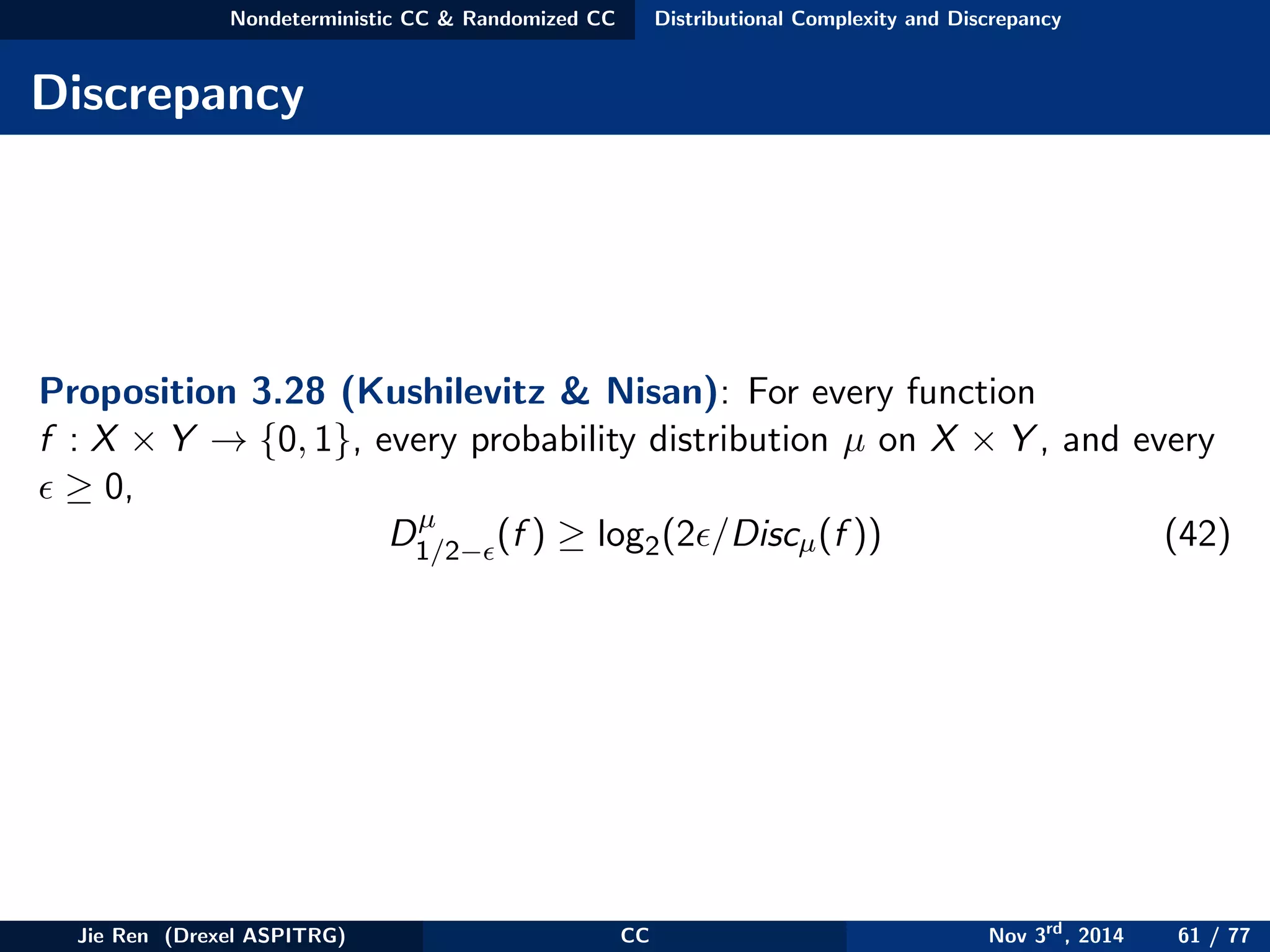
Proposition 3.28 (Kushilevitz & Nisan): For every function
f : X × Y → {0, 1}, every probability distribution µ on X × Y , and every
≥ 0,
Dµ
1/2− (f ) ≥ log2(2 /Discµ(f )) (42)
Jie Ren (Drexel ASPITRG) CC Nov 3rd
, 2014 61 / 77
Nondeterministic CC & Randomized CC Distributional Complexity and Discrepancy
Discrepancy
Proof: Given any P with c bits to compute f , we have
2 ≤ P[P(x, y) = f (x, y)] − P[P(x, y) = f (x, y)]
= (P[P(x, y) = f (x, y)&(x, y) ∈ R ]
−P[P(x, y) = f (x, y)&(x, y) ∈ R ])
≤ |P
µ
[f (x, y) = 0 & (x, y) ∈ R ] − P
µ
[f (x, y) = 1 & (x, y) ∈ R ]|
≤ 2c
· Discµ(f )
(43)
Jie Ren (Drexel ASPITRG) CC Nov 3rd
, 2014 62 / 77
Some Analysis
Outline
1 Deterministic Communication Complexity
Problem Setup
Protocol Tree
Combinatorial Rectangles
Fooling Sets
Rectangle Rank
2 Nondeterministic CC & Randomized CC
Nondeterministic Communication Complexity: Motivation
Nondeterministic Communication Complexity: definitions
Randomized Communication Complexity
Distributional Complexity and Discrepancy
3 Some Analysis
Jie Ren (Drexel ASPITRG) CC Nov 3rd
, 2014 63 / 77
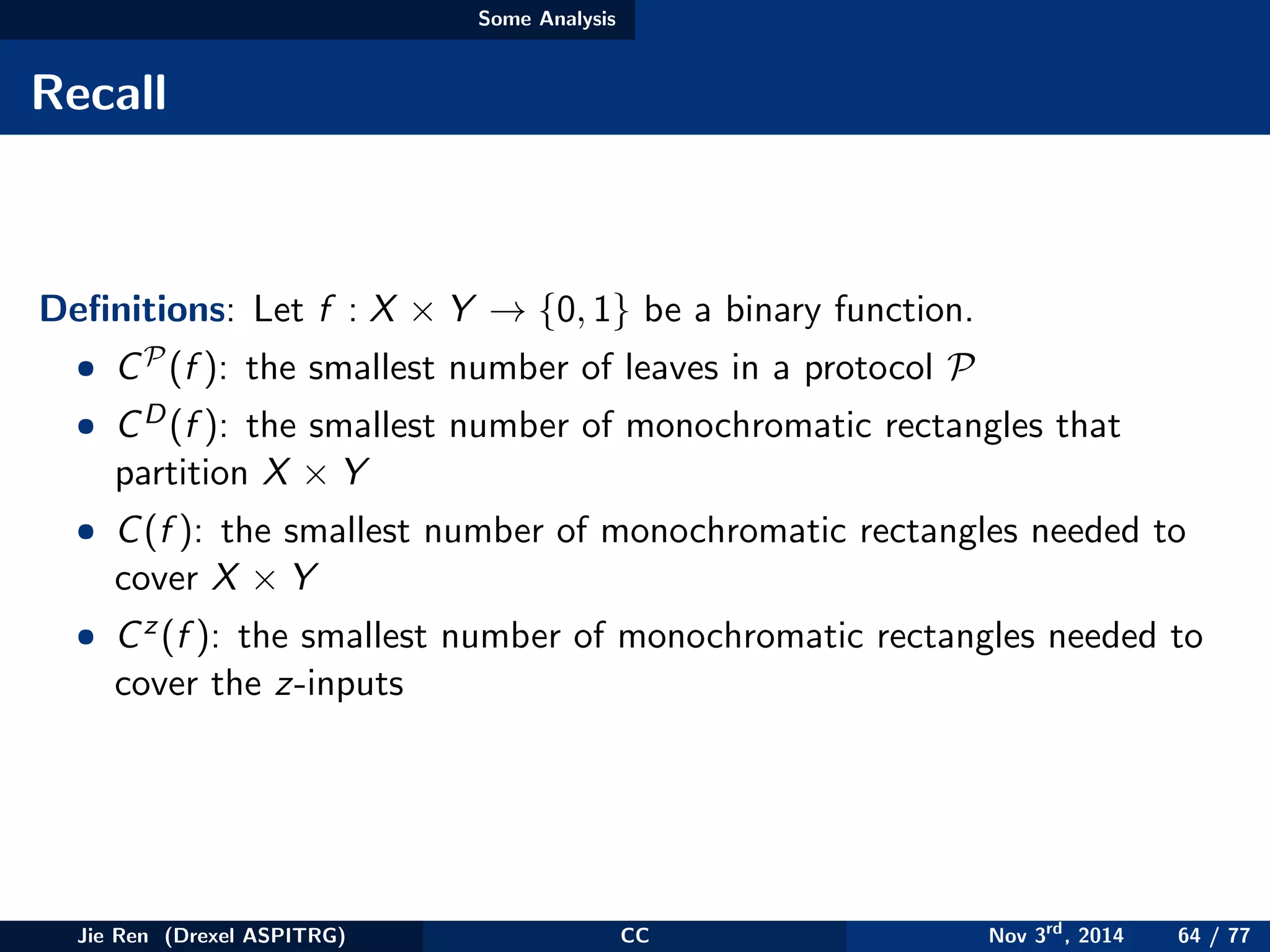
Some Analysis
Recall
Definitions: Let f : X × Y → {0, 1} be a binary function.
• CP(f ): the smallest number of leaves in a protocol P
• CD(f ): the smallest number of monochromatic rectangles that
partition X × Y
• C(f ): the smallest number of monochromatic rectangles needed to
cover X × Y
• Cz(f ): the smallest number of monochromatic rectangles needed to
cover the z-inputs
Jie Ren (Drexel ASPITRG) CC Nov 3rd
, 2014 64 / 77
Some Analysis
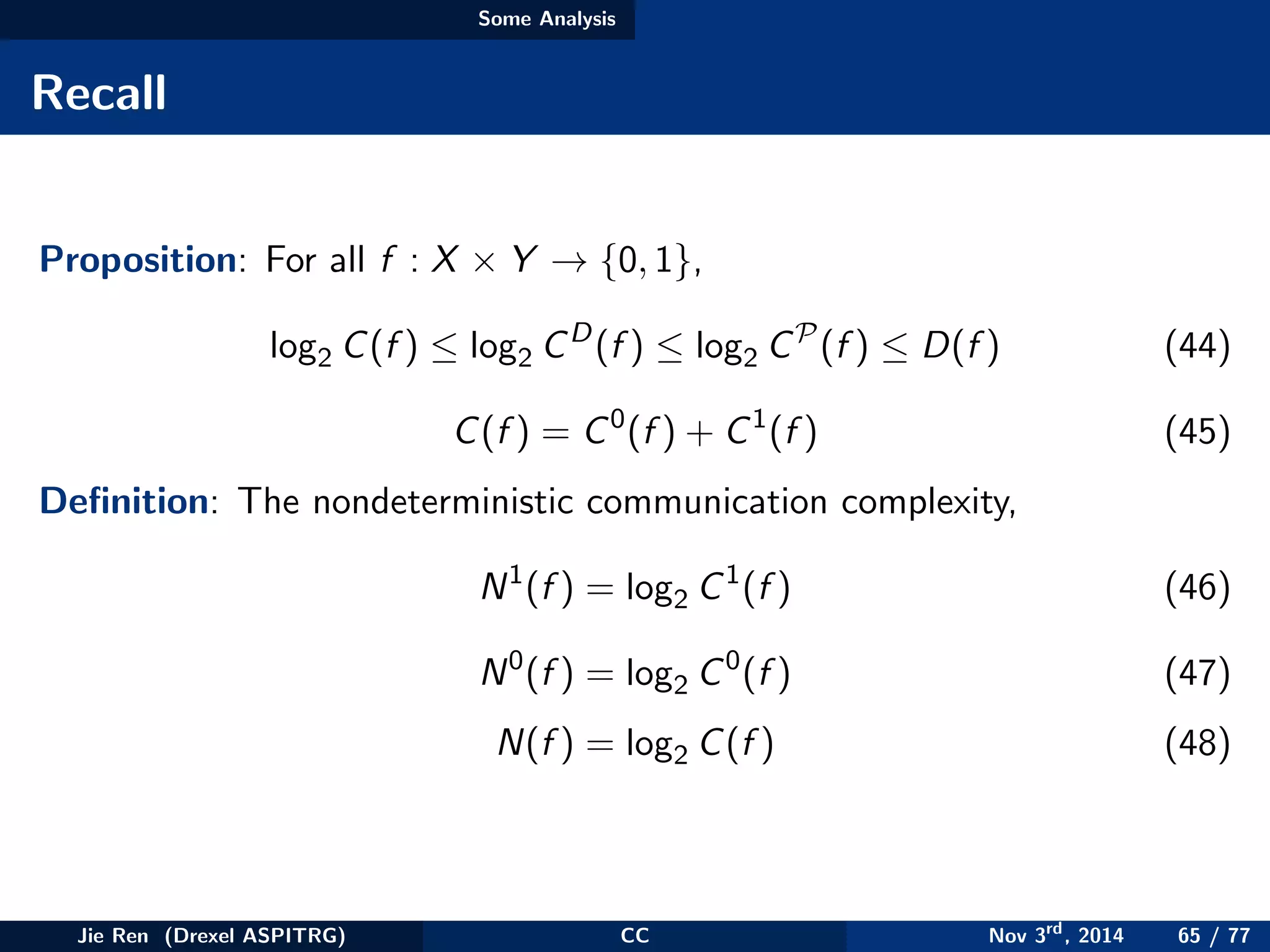
Recall
Proposition: For all f : X × Y → {0, 1},
log2 C(f ) ≤ log2 CD
(f ) ≤ log2 CP
(f ) ≤ D(f ) (44)
C(f ) = C0
(f ) + C1
(f ) (45)
Definition: The nondeterministic communication complexity,
N1
(f ) = log2 C1
(f ) (46)
N0
(f ) = log2 C0
(f ) (47)
N(f ) = log2 C(f ) (48)
Jie Ren (Drexel ASPITRG) CC Nov 3rd
, 2014 65 / 77
Some Analysis
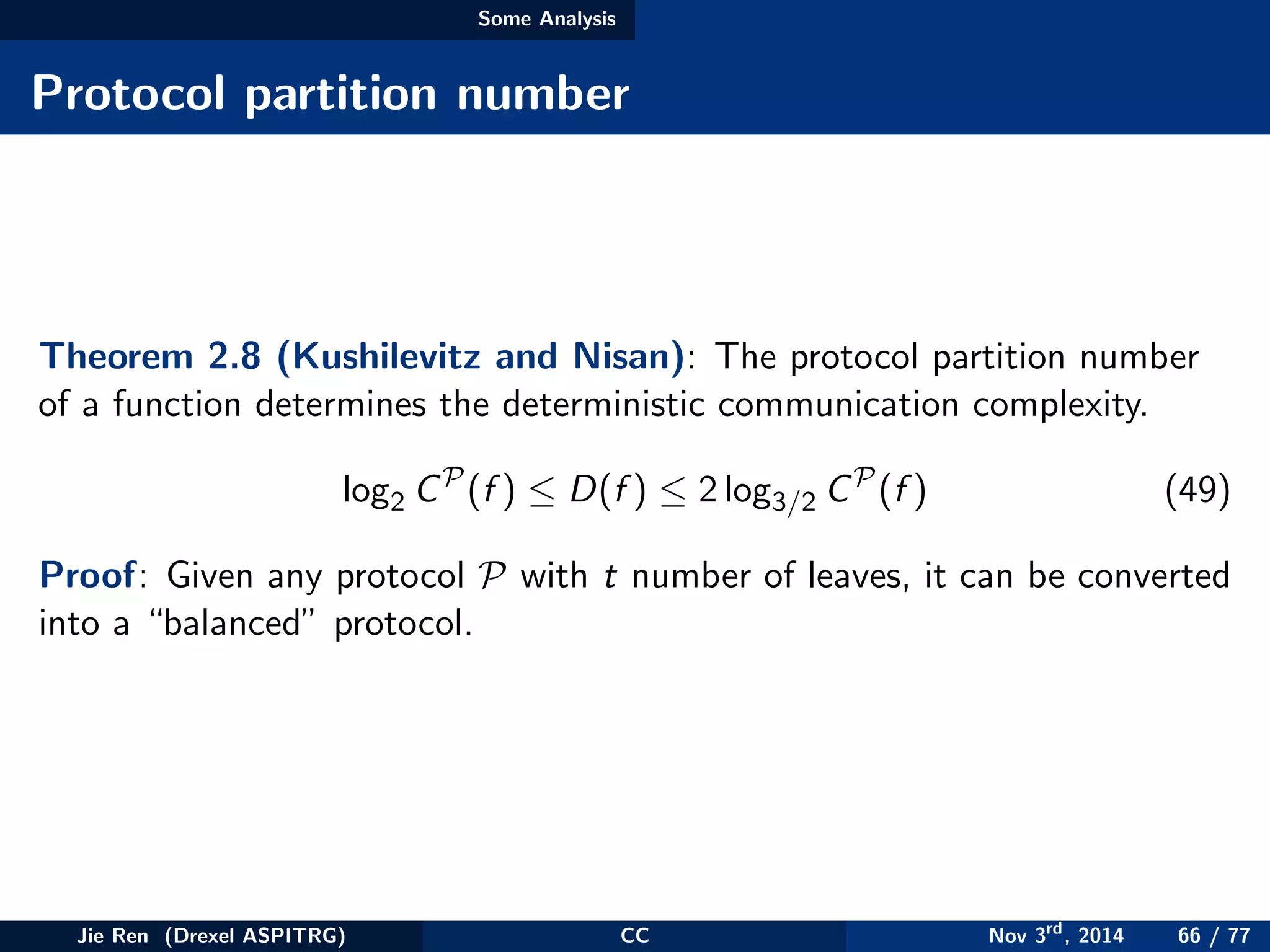
Protocol partition number
Theorem 2.8 (Kushilevitz and Nisan): The protocol partition number
of a function determines the deterministic communication complexity.
log2 CP
(f ) ≤ D(f ) ≤ 2 log3/2 CP
(f ) (49)
Proof: Given any protocol P with t number of leaves, it can be converted
into a “balanced” protocol.
Jie Ren (Drexel ASPITRG) CC Nov 3rd
, 2014 66 / 77
Some Analysis
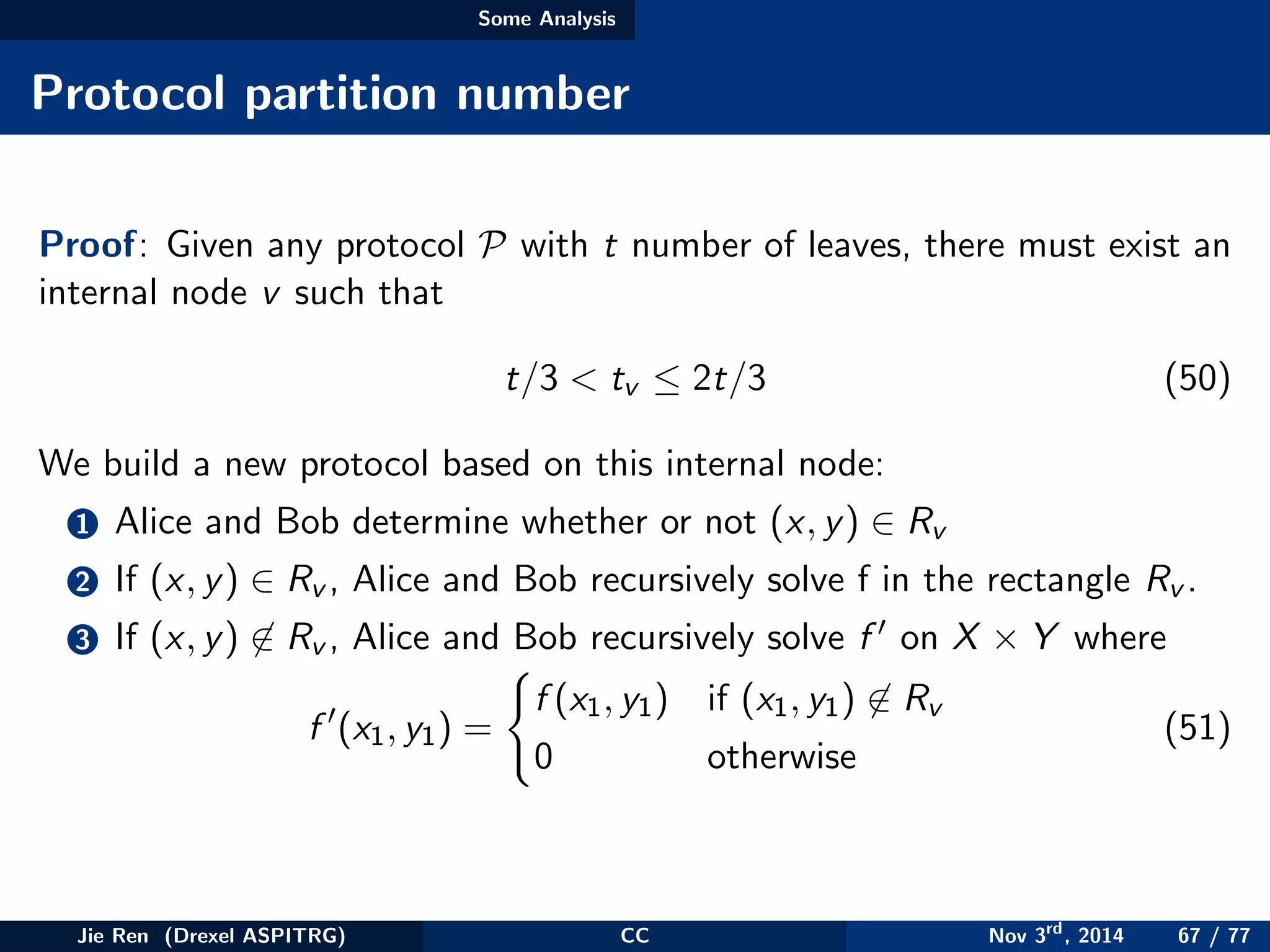
Protocol partition number
Proof: Given any protocol P with t number of leaves, there must exist an
internal node v such that
t/3 < tv ≤ 2t/3 (50)
We build a new protocol based on this internal node:
1 Alice and Bob determine whether or not (x, y) ∈ Rv
2 If (x, y) ∈ Rv , Alice and Bob recursively solve f in the rectangle Rv .
3 If (x, y) ∈ Rv , Alice and Bob recursively solve f on X × Y where
f (x1, y1) =
f (x1, y1) if (x1, y1) ∈ Rv
0 otherwise
(51)
Jie Ren (Drexel ASPITRG) CC Nov 3rd
, 2014 67 / 77
Some Analysis
Protocol partition number
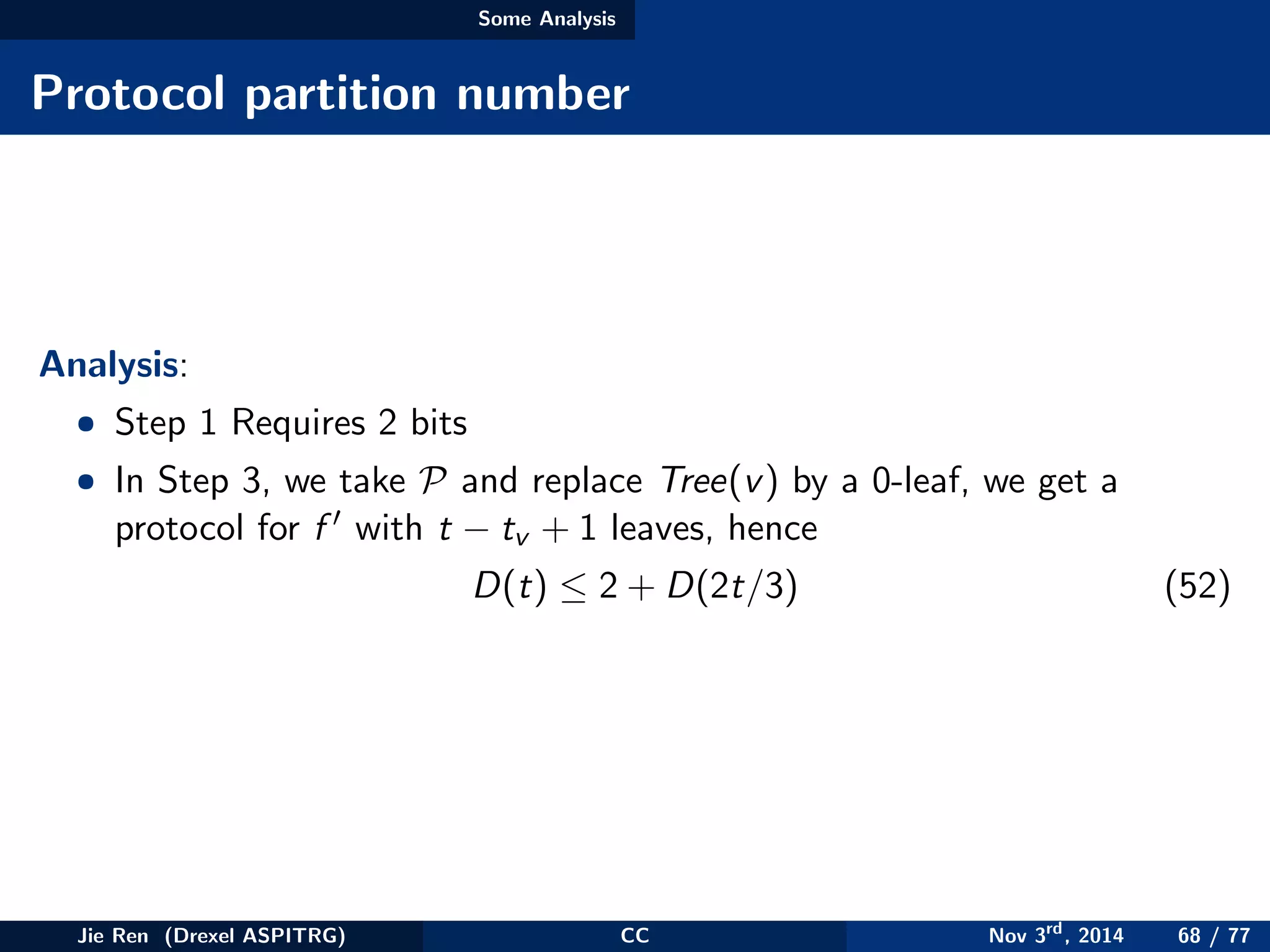
Analysis:
• Step 1 Requires 2 bits
• In Step 3, we take P and replace Tree(v) by a 0-leaf, we get a
protocol for f with t − tv + 1 leaves, hence
D(t) ≤ 2 + D(2t/3) (52)
Jie Ren (Drexel ASPITRG) CC Nov 3rd
, 2014 68 / 77
Some Analysis
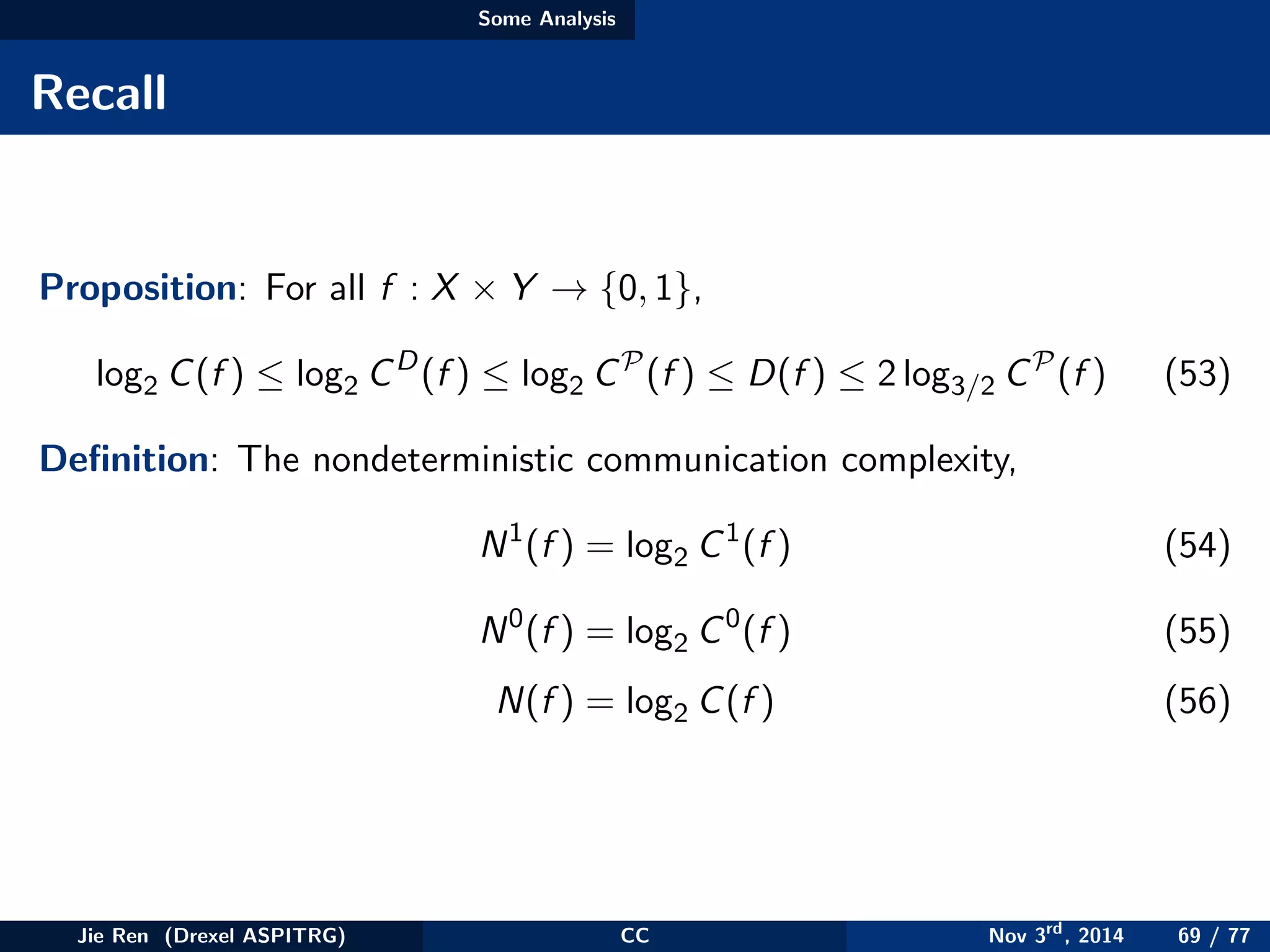
Recall
Proposition: For all f : X × Y → {0, 1},
log2 C(f ) ≤ log2 CD
(f ) ≤ log2 CP
(f ) ≤ D(f ) ≤ 2 log3/2 CP
(f ) (53)
Definition: The nondeterministic communication complexity,
N1
(f ) = log2 C1
(f ) (54)
N0
(f ) = log2 C0
(f ) (55)
N(f ) = log2 C(f ) (56)
Jie Ren (Drexel ASPITRG) CC Nov 3rd
, 2014 69 / 77
Some Analysis
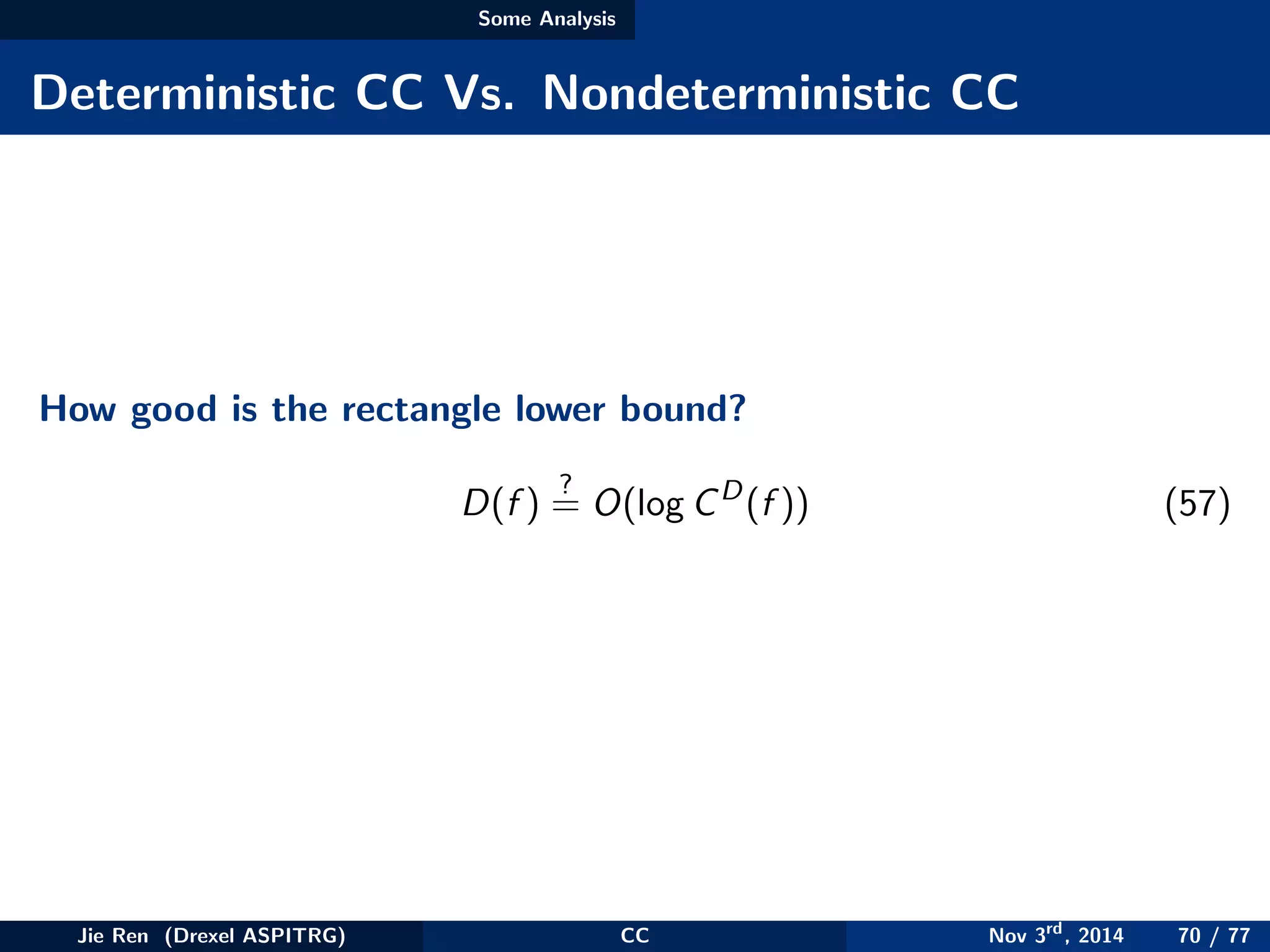
Deterministic CC Vs. Nondeterministic CC
How good is the rectangle lower bound?
D(f )
?
= O(log CD
(f )) (57)
Jie Ren (Drexel ASPITRG) CC Nov 3rd
, 2014 70 / 77
Some Analysis
Deterministic CC Vs. Nondeterministic CC
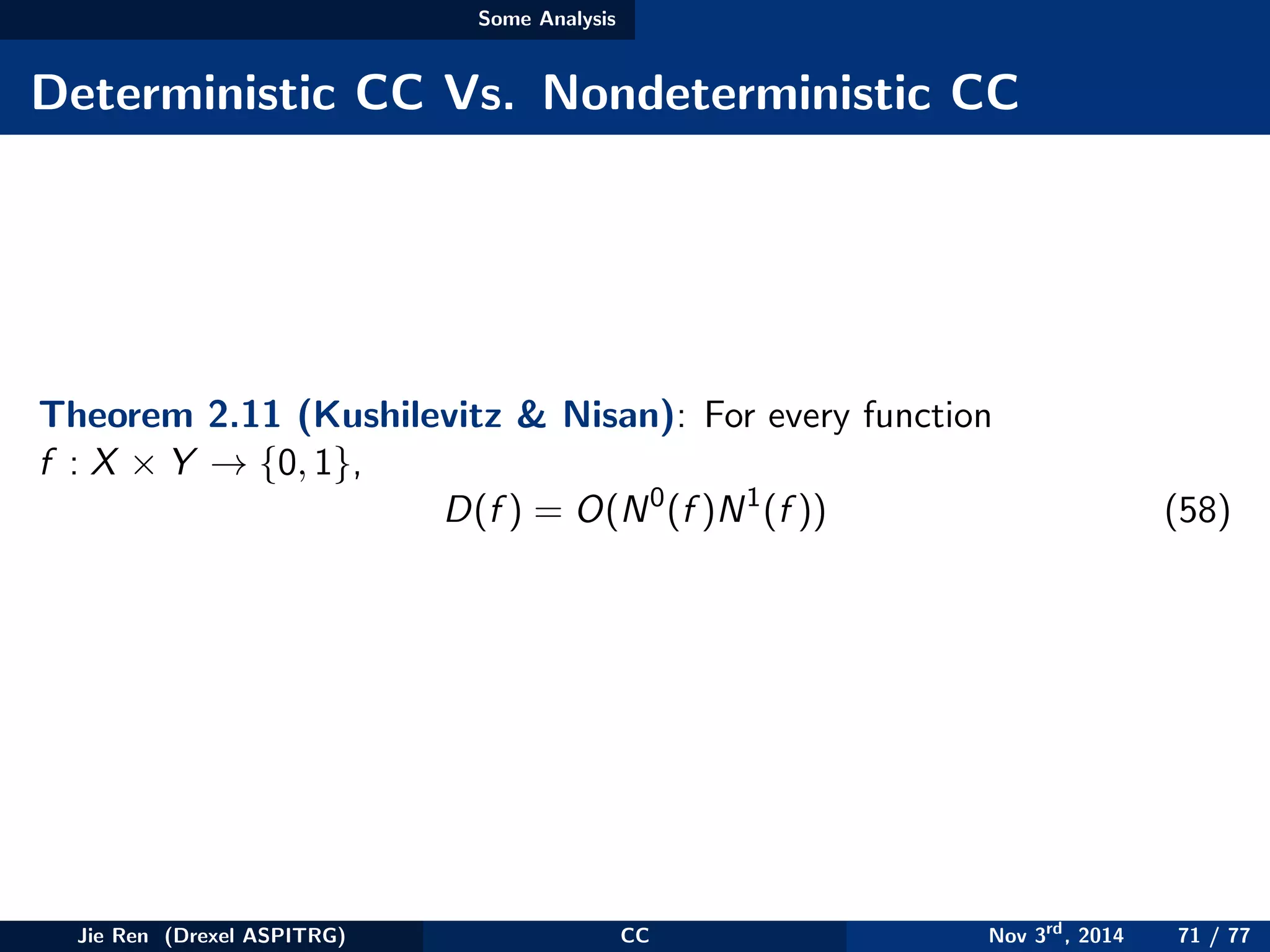
Theorem 2.11 (Kushilevitz & Nisan): For every function
f : X × Y → {0, 1},
D(f ) = O(N0
(f )N1
(f )) (58)
Jie Ren (Drexel ASPITRG) CC Nov 3rd
, 2014 71 / 77
Some Analysis
Deterministic CC Vs. Nondeterministic CC
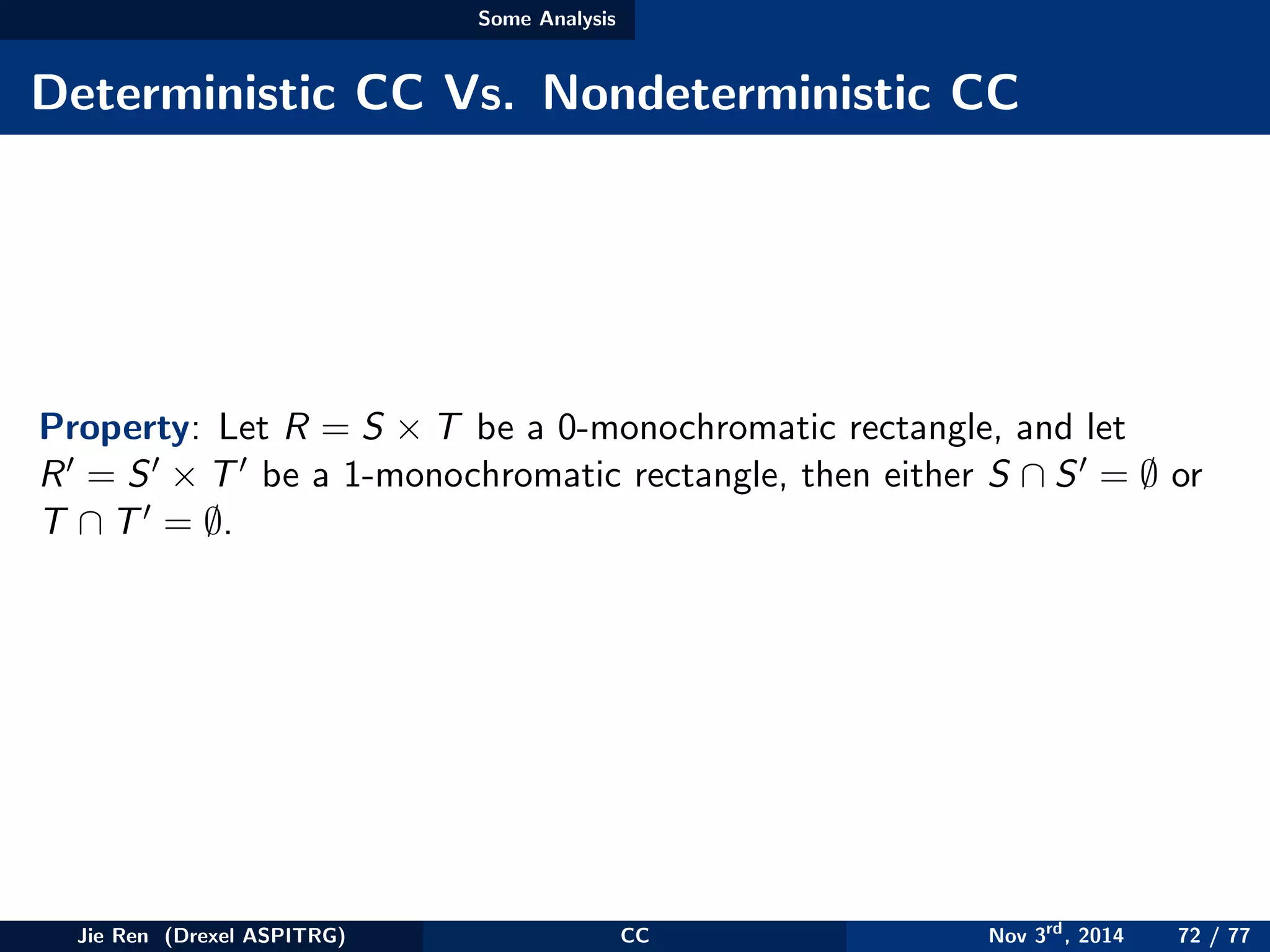
Property: Let R = S × T be a 0-monochromatic rectangle, and let
R = S × T be a 1-monochromatic rectangle, then either S ∩ S = ∅ or
T ∩ T = ∅.
Jie Ren (Drexel ASPITRG) CC Nov 3rd
, 2014 72 / 77
Some Analysis
Deterministic CC Vs. Nondeterministic CC
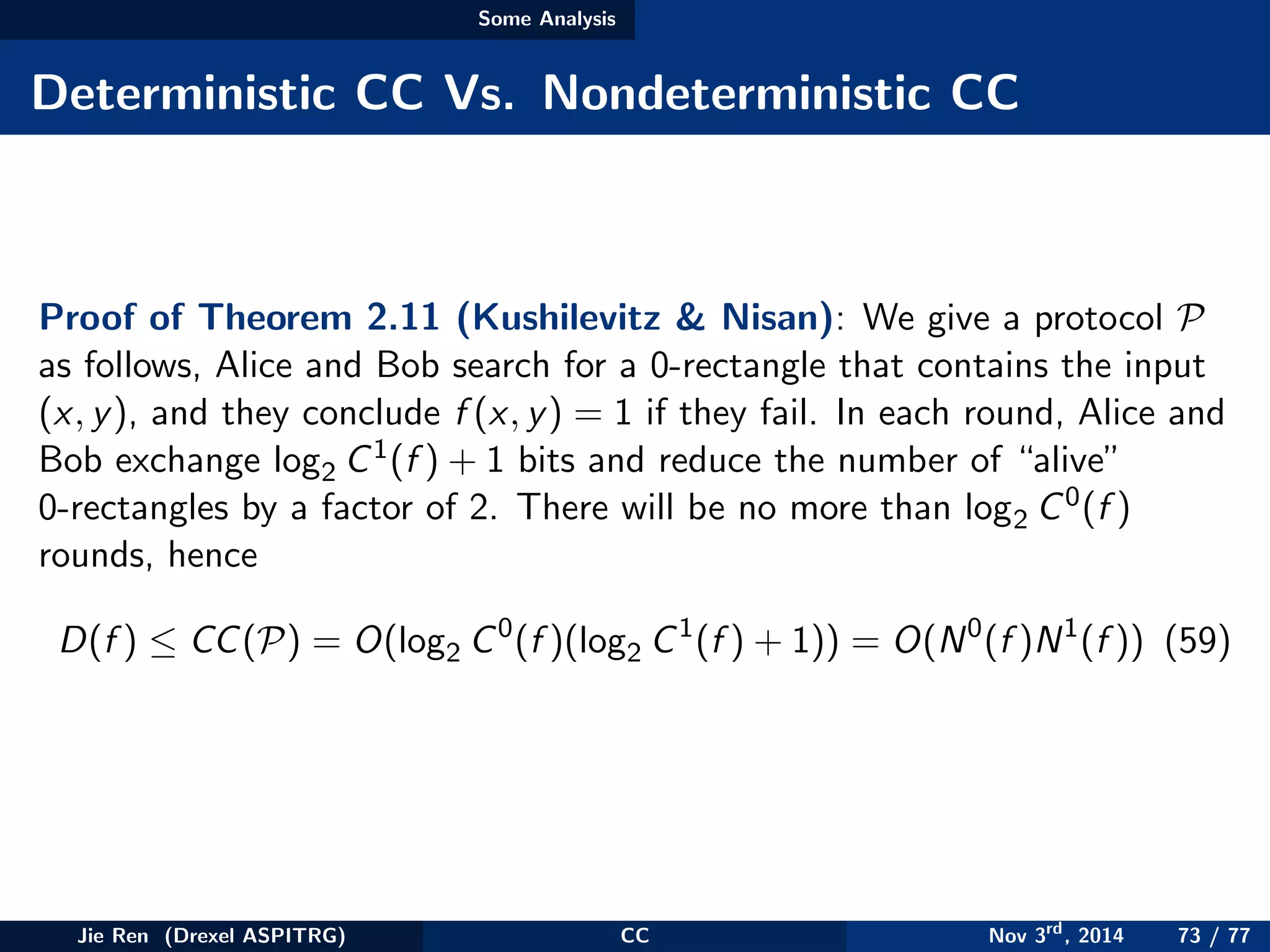
Proof of Theorem 2.11 (Kushilevitz & Nisan): We give a protocol P
as follows, Alice and Bob search for a 0-rectangle that contains the input
(x, y), and they conclude f (x, y) = 1 if they fail. In each round, Alice and
Bob exchange log2 C1(f ) + 1 bits and reduce the number of “alive”
0-rectangles by a factor of 2. There will be no more than log2 C0(f )
rounds, hence
D(f ) ≤ CC(P) = O(log2 C0
(f )(log2 C1
(f ) + 1)) = O(N0
(f )N1
(f )) (59)
Jie Ren (Drexel ASPITRG) CC Nov 3rd
, 2014 73 / 77
Some Analysis
Deterministic CC Vs. Nondeterministic CC
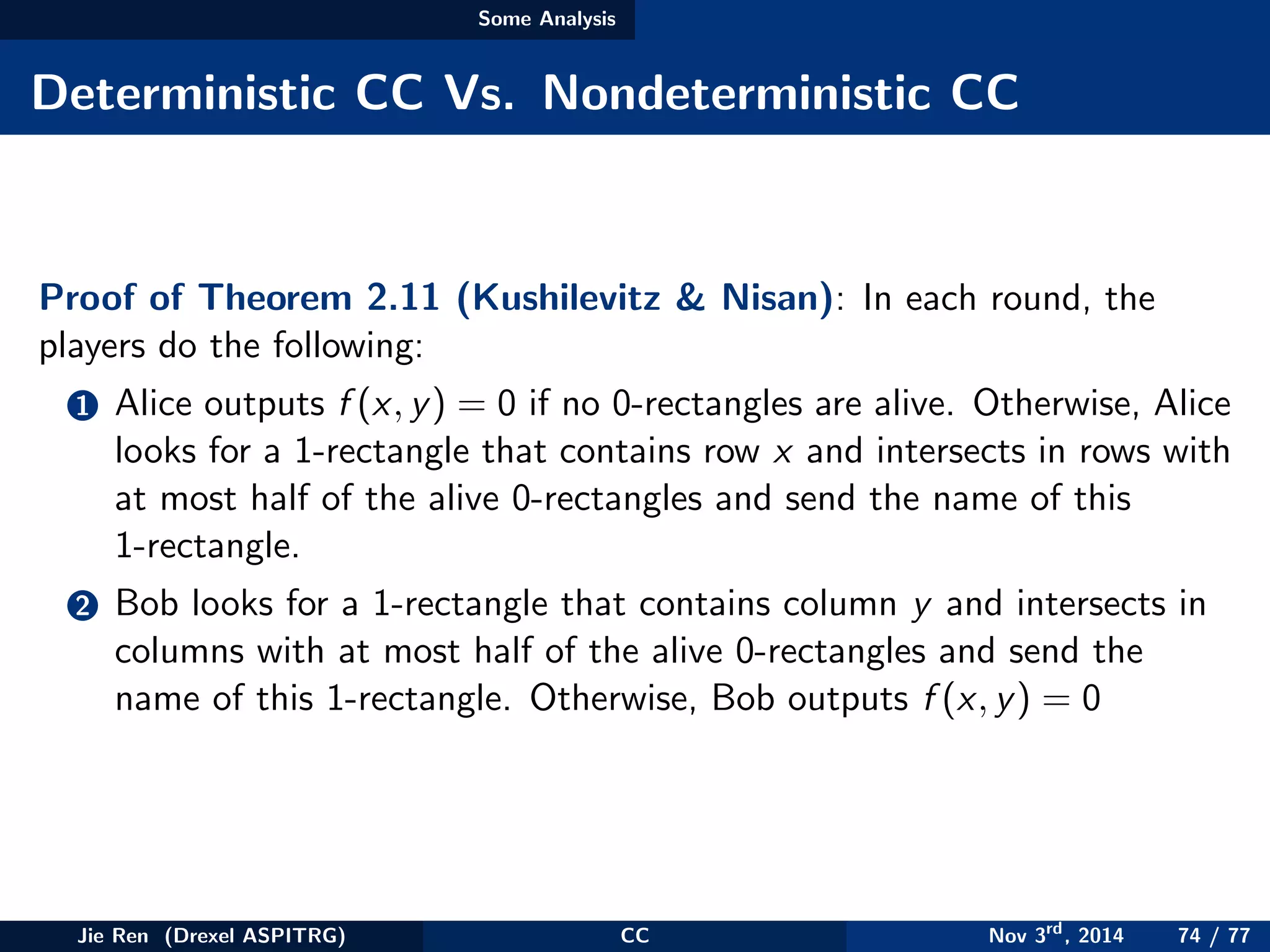
Proof of Theorem 2.11 (Kushilevitz & Nisan): In each round, the
players do the following:
1 Alice outputs f (x, y) = 0 if no 0-rectangles are alive. Otherwise, Alice
looks for a 1-rectangle that contains row x and intersects in rows with
at most half of the alive 0-rectangles and send the name of this
1-rectangle.
2 Bob looks for a 1-rectangle that contains column y and intersects in
columns with at most half of the alive 0-rectangles and send the
name of this 1-rectangle. Otherwise, Bob outputs f (x, y) = 0
Jie Ren (Drexel ASPITRG) CC Nov 3rd
, 2014 74 / 77
Some Analysis
Deterministic CC Vs. Nondeterministic CC
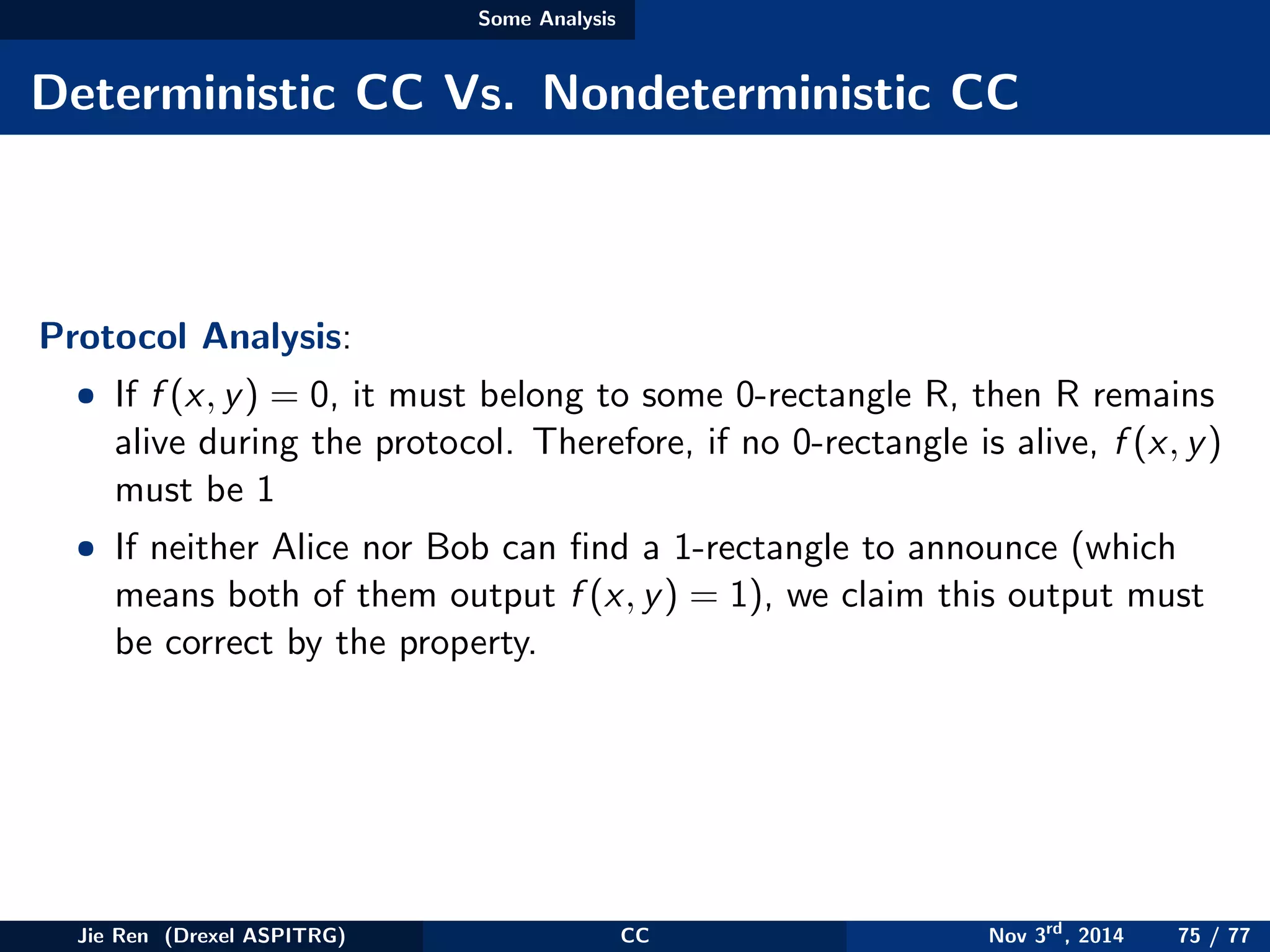
Protocol Analysis:
• If f (x, y) = 0, it must belong to some 0-rectangle R, then R remains
alive during the protocol. Therefore, if no 0-rectangle is alive, f (x, y)
must be 1
• If neither Alice nor Bob can find a 1-rectangle to announce (which
means both of them output f (x, y) = 1), we claim this output must
be correct by the property.
Jie Ren (Drexel ASPITRG) CC Nov 3rd
, 2014 75 / 77
Some Analysis
Public coin
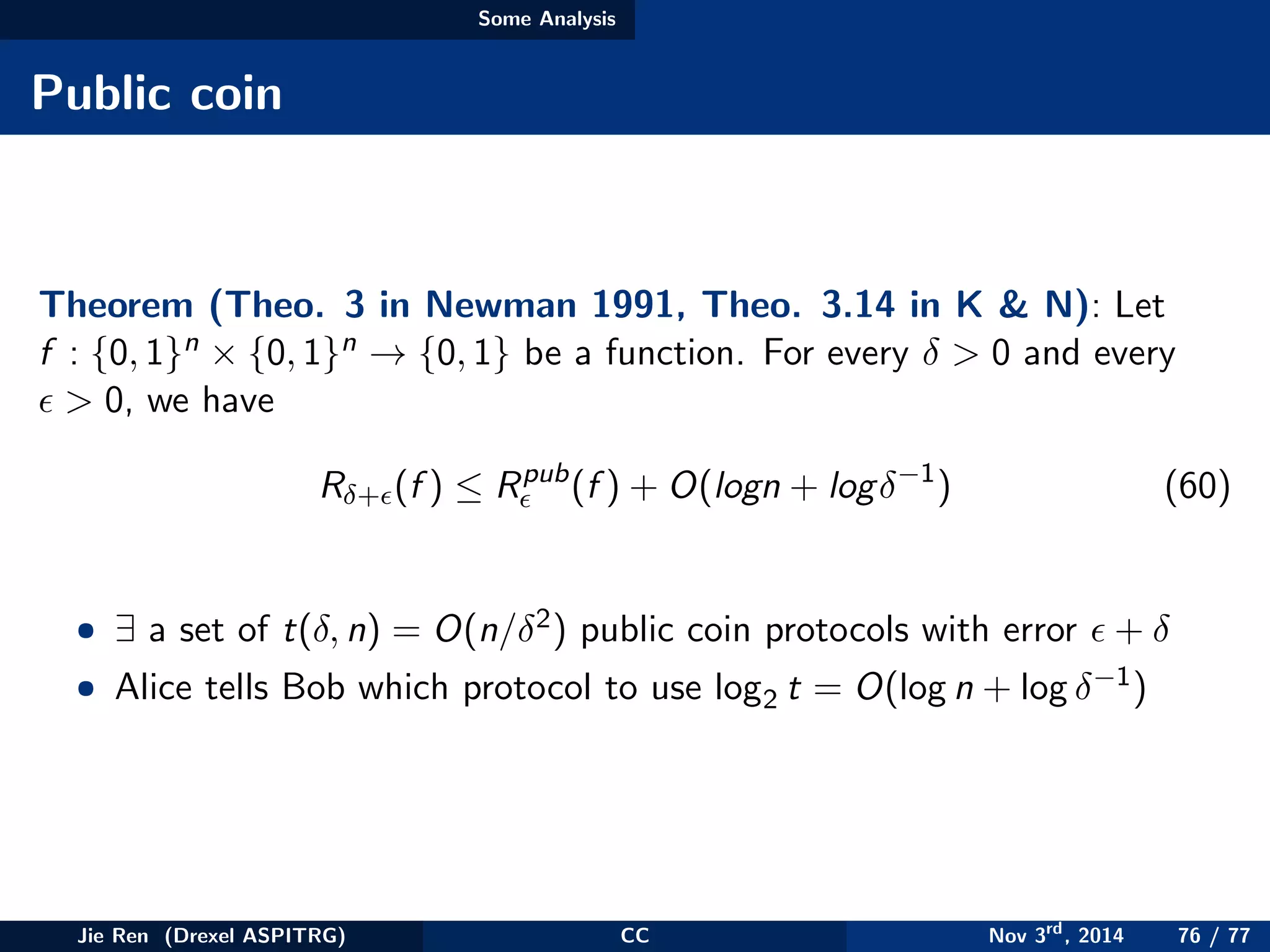
Theorem (Theo. 3 in Newman 1991, Theo. 3.14 in K & N): Let
f : {0, 1}n × {0, 1}n → {0, 1} be a function. For every δ > 0 and every
> 0, we have
Rδ+ (f ) ≤ Rpub
(f ) + O(logn + logδ−1
) (60)
• ∃ a set of t(δ, n) = O(n/δ2) public coin protocols with error + δ
• Alice tells Bob which protocol to use log2 t = O(log n + log δ−1)
Jie Ren (Drexel ASPITRG) CC Nov 3rd
, 2014 76 / 77
Some Analysis
Randomized CC Vs. Distributional CC
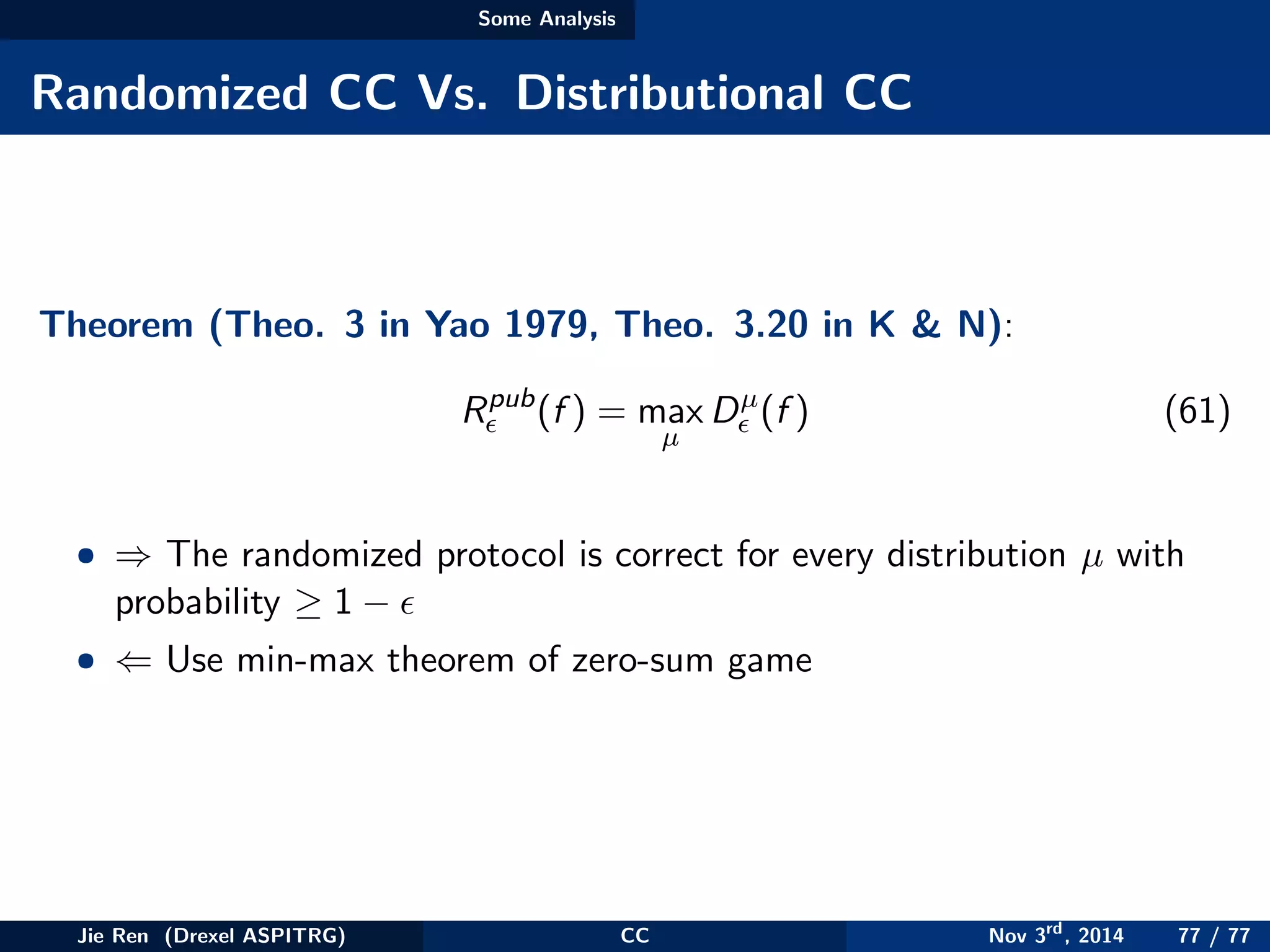
Theorem (Theo. 3 in Yao 1979, Theo. 3.20 in K & N):
Rpub
(f ) = max
µ
Dµ
(f ) (61)
• ⇒ The randomized protocol is correct for every distribution µ with
probability ≥ 1 −
• ⇐ Use min-max theorem of zero-sum game
Jie Ren (Drexel ASPITRG) CC Nov 3rd
, 2014 77 / 77

CommunicationComplexity1_jieren

  • 1.
    Communication Complexity Jie Ren AdaptiveSignal Processing and Information Theory Group Nov 3rd, 2014 Jie Ren (Drexel ASPITRG) CC Nov 3rd , 2014 1 / 77
  • 2.
    1 E. Kushilevitzand N. Nisan, “Communication Complexity,” Cambridge University Press, 1997. 2 L. Lovasz, “Communication Complexity: A Survey,” in Paths, Flows, and VLSI Layout, B. H. Korte, Ed., Springer Verlag: Berlin 1990. 3 T. Lee and A. Shraibman, “Lower Bounds in Communication Complexity: A Survey,” Now Publishers Inc., 2009. 4 A. C. Yao, “Some Complexity Questions Related to Distributed Computing,” Proc. of 11th ACM Symposium on Theory of Computing, 1981, 308-311. 5 P. Beame and J. Lawry, “Randomized versus Nondeterministic Communication Complexity,” Proc. of 24th ACM Symposium on Theory of Computing, 1992, 188-199. 6 A. K. Chandra, M. L. Furst and R. J. Lipton, “Multi-party Protocols,” Proc. of 15th ACM Symposium on Theory of Computing, 1983, 94-99. 7 P. B. Miltersen, N. Nisan, S. Safra and A. Wigderson, “On Data Structures and Asymmetric Communication Complexity,” Proc. of 27th ACM Symposium on Theory of Computing, 1995, 103-111. Jie Ren (Drexel ASPITRG) CC Nov 3rd , 2014 2 / 77
  • 3.
    Deterministic Communication Complexity Outline 1Deterministic Communication Complexity Problem Setup Protocol Tree Combinatorial Rectangles Fooling Sets Rectangle Rank 2 Nondeterministic CC & Randomized CC Nondeterministic Communication Complexity: Motivation Nondeterministic Communication Complexity: definitions Randomized Communication Complexity Distributional Complexity and Discrepancy 3 Some Analysis Jie Ren (Drexel ASPITRG) CC Nov 3rd , 2014 3 / 77
  • 4.
    Deterministic Communication ComplexityProblem Setup Outline 1 Deterministic Communication Complexity Problem Setup Protocol Tree Combinatorial Rectangles Fooling Sets Rectangle Rank 2 Nondeterministic CC & Randomized CC Nondeterministic Communication Complexity: Motivation Nondeterministic Communication Complexity: definitions Randomized Communication Complexity Distributional Complexity and Discrepancy 3 Some Analysis Jie Ren (Drexel ASPITRG) CC Nov 3rd , 2014 4 / 77
  • 5.
    Deterministic Communication ComplexityProblem Setup Problem Setup Alice Bob x ∈ X y ∈ Y f(x,y) ∈ {0,1} ··· f(x, y) 0/1 0/1 • Two party communication • Each knows an input x ∈ X/y ∈ Y • Let one/both sides compute a function f with no error • Only care about communication cost Jie Ren (Drexel ASPITRG) CC Nov 3rd , 2014 5 / 77
  • 6.
    Deterministic Communication ComplexityProblem Setup Problem Setup Alice Bob x ∈ X y ∈ Y f(x,y) ∈ {0,1} ··· f(x, y) 0/1 0/1 • Sending binary messages • f usually binary • Deterministic protocol P: who to talk/what to send • Communication cost: sum of total bits/rounds CC(P) Jie Ren (Drexel ASPITRG) CC Nov 3rd , 2014 6 / 77
  • 7.
    Deterministic Communication ComplexityProblem Setup Deterministic Communication Complexity Alice Bob x ∈ X y ∈ Y f(x,y) ∈ {0,1} ··· f(x, y) 0/1 0/1 D(f ) = min P max (x,y)∈X×Y CC(P) (1) Jie Ren (Drexel ASPITRG) CC Nov 3rd , 2014 7 / 77
  • 8.
    Deterministic Communication ComplexityProblem Setup A Naive Upper Bound Proposition (naive upper bound): For every function f : X × Y → Z D(f ) ≤ log2 |X| + log2 |Z| (2) Jie Ren (Drexel ASPITRG) CC Nov 3rd , 2014 8 / 77
  • 9.
    Deterministic Communication ComplexityProblem Setup A Naive Upper Bound Example: MAX of the union Alice and Bob hold subsets x, y ⊆ {1, . . . , n} respectively, and they with to compute MAX(x, y). D(MAX) ≤ 2 log2 n (3) Jie Ren (Drexel ASPITRG) CC Nov 3rd , 2014 9 / 77
  • 10.
    Deterministic Communication ComplexityProtocol Tree Outline 1 Deterministic Communication Complexity Problem Setup Protocol Tree Combinatorial Rectangles Fooling Sets Rectangle Rank 2 Nondeterministic CC & Randomized CC Nondeterministic Communication Complexity: Motivation Nondeterministic Communication Complexity: definitions Randomized Communication Complexity Distributional Complexity and Discrepancy 3 Some Analysis Jie Ren (Drexel ASPITRG) CC Nov 3rd , 2014 10 / 77
  • 11.
    Deterministic Communication ComplexityProtocol Tree Definition: Protocol Tree Definition : A protocol P over domain X × Y with range Z is a binary tree where each internal node v is labeled either by a function av : X → {0, 1} or by a function bv : Y → {0, 1}, and each leaf is labeled with an element z ∈ Z. The communication cost CC(P) will be the depth of the protocol tree. Jie Ren (Drexel ASPITRG) CC Nov 3rd , 2014 11 / 77
  • 12.
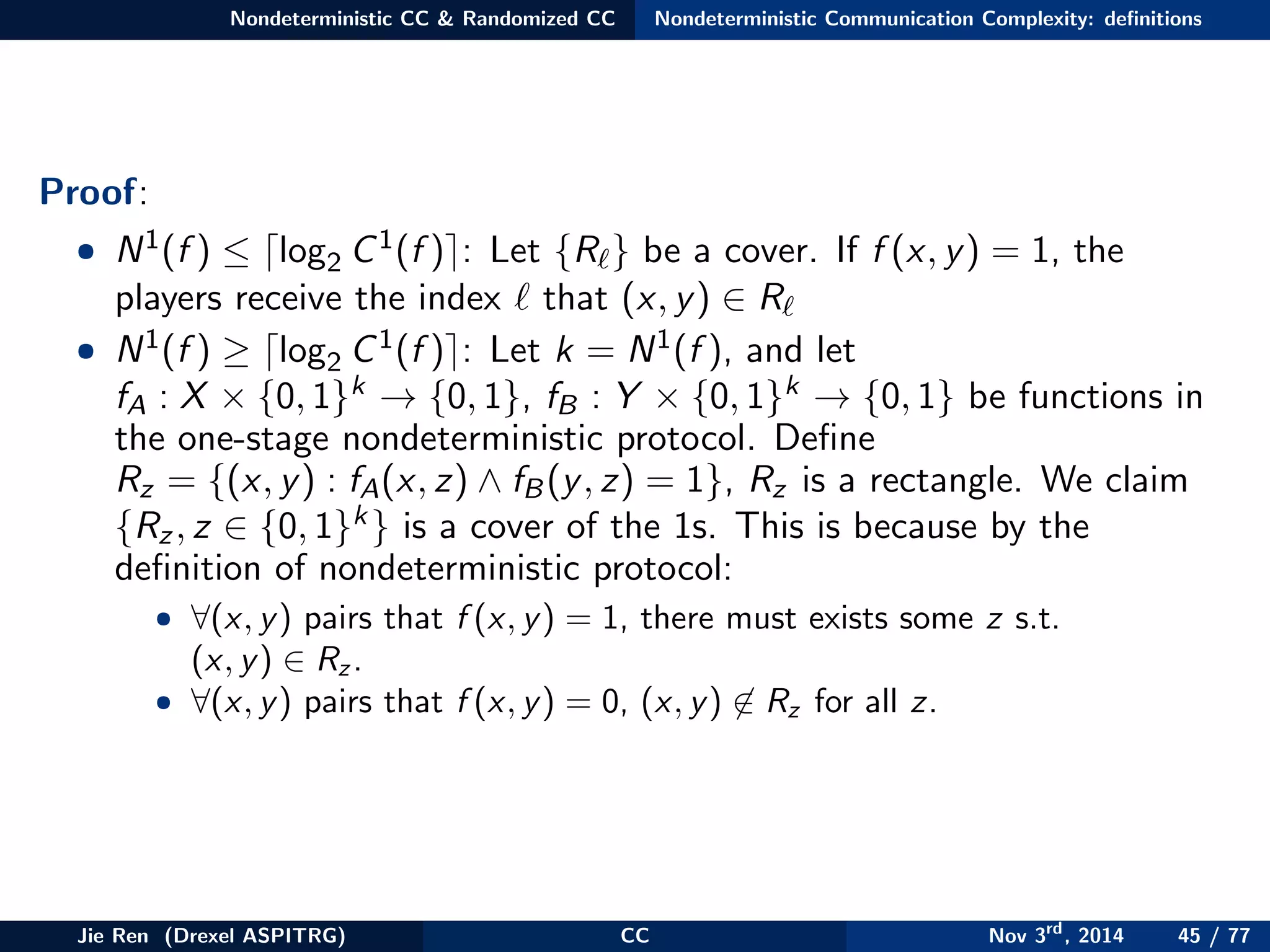
    Deterministic Communication ComplexityProtocol Tree Example: Protocol Tree a1(x = 1,2) = 0 a1(x = 3) = 1 b2(y = 1,2) = 0 b2(y = 3) = 1 0b3(y = 1) = 1 b3(y = 2, 3) = 0 1 1 a4(x = 1) = 0 a4(x = 2, 3) = 1 0 1 f(x, y) = 1 x ≥ y 0 OTH x ∈ {1, 2, 3} y ∈ {1, 2, 3} Jie Ren (Drexel ASPITRG) CC Nov 3rd , 2014 12 / 77
  • 13.
    Deterministic Communication ComplexityProtocol Tree Why Binary Message? • Entropy not involved - simple? • No block coding (compute a single function) • Worst case - always exists p = 1/2 s.t. h2(p) = 1 Jie Ren (Drexel ASPITRG) CC Nov 3rd , 2014 13 / 77
  • 14.
    Deterministic Communication ComplexityProtocol Tree One Side Compute f Vs. Both Sides Compute f • Equivalent setup • ⇒ Need one more bit if f is binary • ⇐ Second last round: one side must know f (x, y) Some Lower Bounds of Communication Complexity • D(f ) : unknown for general f • Interested in lower bounds Jie Ren (Drexel ASPITRG) CC Nov 3rd , 2014 14 / 77
  • 15.
    Deterministic Communication ComplexityCombinatorial Rectangles Outline 1 Deterministic Communication Complexity Problem Setup Protocol Tree Combinatorial Rectangles Fooling Sets Rectangle Rank 2 Nondeterministic CC & Randomized CC Nondeterministic Communication Complexity: Motivation Nondeterministic Communication Complexity: definitions Randomized Communication Complexity Distributional Complexity and Discrepancy 3 Some Analysis Jie Ren (Drexel ASPITRG) CC Nov 3rd , 2014 15 / 77
  • 16.
    Deterministic Communication ComplexityCombinatorial Rectangles Combinatorial Rectangles Definition: Let P be a protocol and v be a node of the protocol tree. Rv is the set of inputs (x, y) that reach node v. Proposition: If L is the set of leaves of a protocol P, then {R , ∈ L} is a partition of X × Y . Definition: A combinatorial rectangle is a subset R ⊆ X × Y such that R = A × B for some A ⊆ X and B ⊆ Y . Jie Ren (Drexel ASPITRG) CC Nov 3rd , 2014 16 / 77
  • 17.
    Deterministic Communication ComplexityCombinatorial Rectangles Proposition: R ⊆ X × Y is a rectangle iff (x1, y1) ∈ R & (x2, y2) ∈ R ⇒ (x1, y2) ∈ R. (4) Proposition: For every protocol P and leaf , R is a rectangle Jie Ren (Drexel ASPITRG) CC Nov 3rd , 2014 17 / 77
  • 18.
    Deterministic Communication ComplexityCombinatorial Rectangles a1(x = 1,2) = 0 a1(x = 3) = 1 b2(y = 1,2) = 0 b2(y = 3) = 1 0b3(y = 1) = 1 b3(y = 2, 3) = 0 1 1 a4(x = 1) = 0 a4(x = 2, 3) = 1 0 1 x=1 x=3 x=2 y=1 y=2 y=3 1 0 0 1 1 1 0 1 1 Jie Ren (Drexel ASPITRG) CC Nov 3rd , 2014 18 / 77
  • 19.
    Deterministic Communication ComplexityCombinatorial Rectangles Rectangle lower bound Definition: A subset R ⊆ X × Y is called f -monochromatic if f is fixed on R. Theorem 1.17 (Kushilevitz & Nisan): If any partition of X × Y into f -monochromatic rectangles requires at least t rectangles, then log2 t ≤ D(f ) (5) • P partitions X × Y into monochromatic rectangles • Depth of its protocol tree: ≥ log2 t Jie Ren (Drexel ASPITRG) CC Nov 3rd , 2014 19 / 77
  • 20.
    Deterministic Communication ComplexityCombinatorial Rectangles x=1 x=3 x=2 y=1 y=2 y=3 1 0 0 1 1 1 0 1 1 D(f) ≥ log2 5 D(f) = 3 Jie Ren (Drexel ASPITRG) CC Nov 3rd , 2014 20 / 77
  • 21.
    Deterministic Communication ComplexityFooling Sets Outline 1 Deterministic Communication Complexity Problem Setup Protocol Tree Combinatorial Rectangles Fooling Sets Rectangle Rank 2 Nondeterministic CC & Randomized CC Nondeterministic Communication Complexity: Motivation Nondeterministic Communication Complexity: definitions Randomized Communication Complexity Distributional Complexity and Discrepancy 3 Some Analysis Jie Ren (Drexel ASPITRG) CC Nov 3rd , 2014 21 / 77
  • 22.
    Deterministic Communication ComplexityFooling Sets Motivation: If we exhibit a large set of input pairs such that no two of them can be in a single monochromatic rectangle, then the number of partitions of P must be large z ? ? z x1 y2y1 x2 Jie Ren (Drexel ASPITRG) CC Nov 3rd , 2014 22 / 77
  • 23.
    Deterministic Communication ComplexityFooling Sets Definition : Let f : X × Y → {0, 1}. A set S ⊆ X × Y is called a fooling set if there exits a value z ∈ {0, 1} such that • For every (x, y) ∈ S, f (x, y) = z • For every two distinct pairs (x1, y1) and (x2, y2) in S, either f (x1, y2) = z or f (x2, y1) = z z ? ? z x1 y2y1 x2 Jie Ren (Drexel ASPITRG) CC Nov 3rd , 2014 23 / 77
  • 24.
    Deterministic Communication ComplexityFooling Sets Fooling set lower bound Theorem 1.20 (Kushilevitz & Nisan) : If f has a fooling set S of size t, then log2 t ≤ D(f ) (6) Proof : No monochromatic rectangle contains more than one element of S Jie Ren (Drexel ASPITRG) CC Nov 3rd , 2014 24 / 77
  • 25.
    Deterministic Communication ComplexityFooling Sets Example: Alice and Bob each hold an n-bit integer 0 ≤ x, y < 2n. The “greater than or equal to” function, GTE(x, y), is defined to be 1 iff x ≥ y. D(GT) = n + 1 (7) x=0 x=1 x=2 x=3 y=0 y=1 y=2 y=3 1 1 1 1 0 0 0 1 0 0 1 1 0 1 1 1 Jie Ren (Drexel ASPITRG) CC Nov 3rd , 2014 25 / 77
  • 26.
    Deterministic Communication ComplexityFooling Sets Example: Alice and Bob each hold an n-bit integer 0 ≤ x, y < 2n. The “greater than or equal to” function, GTE(x, y), is defined to be 1 iff x ≥ y. D(GT) = n + 1 (8) x=0 x=1 x=2 x=3 y=0 y=1 y=2 y=3 1 1 1 1 0 0 0 1 0 0 1 1 0 1 1 1 Jie Ren (Drexel ASPITRG) CC Nov 3rd , 2014 26 / 77
  • 27.
    Deterministic Communication ComplexityRectangle Rank Outline 1 Deterministic Communication Complexity Problem Setup Protocol Tree Combinatorial Rectangles Fooling Sets Rectangle Rank 2 Nondeterministic CC & Randomized CC Nondeterministic Communication Complexity: Motivation Nondeterministic Communication Complexity: definitions Randomized Communication Complexity Distributional Complexity and Discrepancy 3 Some Analysis Jie Ren (Drexel ASPITRG) CC Nov 3rd , 2014 27 / 77
  • 28.
    Deterministic Communication ComplexityRectangle Rank Motivation: Give communication complexity lower bound in an algebraic way Definition: Associate with every function f : X × Y → {0, 1} a matrix Mf of dimensions |X| × |Y |. The rows/columns of Mf are indexed by the elements of X/Y . Then rank(f ) is the linear rank of Mf over the field of reals. x=0 x=1 x=2 x=3 y=0 y=1 y=2 y=3 1 1 1 1 0 0 0 1 0 0 1 1 0 1 1 1 Jie Ren (Drexel ASPITRG) CC Nov 3rd , 2014 28 / 77
  • 29.
    Deterministic Communication ComplexityRectangle Rank Rank lower bound Theorem 1.28 (Kushilevitz & Nisan): For any function f : X × Y → {0, 1} log2 rank(f ) ≤ D(f ) (9) x=0 x=1 x=2 x=3 y=0 y=1 y=2 y=3 1 1 1 1 0 0 0 1 0 0 1 1 0 1 1 1 Jie Ren (Drexel ASPITRG) CC Nov 3rd , 2014 29 / 77
  • 30.
    Deterministic Communication ComplexityRectangle Rank Proof: Let L1 be the set of leaves in which the output is 1. For each ∈ L1, M (x, y) = 1 if (x, y) ∈ R 0 otherwise (10) Mf = ∈L1 M (11) and rank(Mf ) ≤ ∈L1 rank(M ) ≤ |L1| ≤ |L| (12) Jie Ren (Drexel ASPITRG) CC Nov 3rd , 2014 30 / 77
  • 31.
    Deterministic Communication ComplexityRectangle Rank Rank lower bound Theorem 1.28 (Kushilevitz & Nisan): For any function f : X × Y → {0, 1} log2 rank(f ) ≤ D(f ) (13) x=0 x=1 x=2 x=3 y=0 y=1 y=2 y=3 1 1 1 1 0 0 0 1 0 0 1 1 0 1 1 1 Jie Ren (Drexel ASPITRG) CC Nov 3rd , 2014 31 / 77
  • 32.
    Deterministic Communication ComplexityRectangle Rank Rank upper bound Proposition 2.3 (Lovasz 1990): For any function f : X × Y → {0, 1} D(f ) ≤ rank(f ) (14) Proof: We know that row rank = column rank = rank(f ), and we can form the row vector space with dimension rank(f ). We then claim that there are at most 2rank(f ) distinct row vectors, the reason is because, although the coefficients for the polynomials that represent the row vectors can be real, the entries of the matrix M(f ) can only be 0 or 1. Hence we can build a protocol as follows: Alice merge the repeated rows of M(f ) on the table to have M (f ), and then sends the index of row in M (f ) that contains x. Bob compute f (x, y) based on what he received. Jie Ren (Drexel ASPITRG) CC Nov 3rd , 2014 32 / 77
  • 33.
    Deterministic Communication ComplexityRectangle Rank Summary • Concept: protocol tree, combinatorial rectangles, fooling sets, rank • Naive upper bound: log2 |X| + 1 • Rectangle lower bound: log2 tr • Fooling set lower bound: log2 tf • Rank lower bound: log2 rank(f ) • Rank upper bound: rank(f ) Jie Ren (Drexel ASPITRG) CC Nov 3rd , 2014 33 / 77
  • 34.
    Nondeterministic CC &Randomized CC Outline 1 Deterministic Communication Complexity Problem Setup Protocol Tree Combinatorial Rectangles Fooling Sets Rectangle Rank 2 Nondeterministic CC & Randomized CC Nondeterministic Communication Complexity: Motivation Nondeterministic Communication Complexity: definitions Randomized Communication Complexity Distributional Complexity and Discrepancy 3 Some Analysis Jie Ren (Drexel ASPITRG) CC Nov 3rd , 2014 34 / 77
  • 35.
    Nondeterministic CC &Randomized CC Nondeterministic Communication Complexity: Motivation Outline 1 Deterministic Communication Complexity Problem Setup Protocol Tree Combinatorial Rectangles Fooling Sets Rectangle Rank 2 Nondeterministic CC & Randomized CC Nondeterministic Communication Complexity: Motivation Nondeterministic Communication Complexity: definitions Randomized Communication Complexity Distributional Complexity and Discrepancy 3 Some Analysis Jie Ren (Drexel ASPITRG) CC Nov 3rd , 2014 35 / 77
  • 36.
    Nondeterministic CC &Randomized CC Nondeterministic Communication Complexity: Motivation Motivation • How good are the rectangle lower bounds? • Relaxing the need to partition by allowing covering of the same space x=0 x=1 x=2 x=3 y=0 y=1 y=2 y=3 1 1 0 0 1 0 0 1 1 0 1 1 0 0 0 0 x=0 x=1 x=2 x=3 y=0 y=1 y=2 y=3 1 1 0 0 1 0 0 1 1 0 1 1 0 0 0 0 Jie Ren (Drexel ASPITRG) CC Nov 3rd , 2014 36 / 77
  • 37.
    Nondeterministic CC &Randomized CC Nondeterministic Communication Complexity: Motivation Motivation: Alice has a n-bit string x ∈ {0, 1}n, Bob has a n-bit string y ∈ {0, 1}n, either side wants NEQ(x, y). D(NEQ) = n (15) Now assume a third person knows everything: x,y and NEQ(x, y) and want to convince Alice and Bob, Alice and Bob need to check the correctness • Sends the index of the first bit differs Jie Ren (Drexel ASPITRG) CC Nov 3rd , 2014 37 / 77
  • 38.
    Nondeterministic CC &Randomized CC Nondeterministic Communication Complexity: Motivation Setup: A prover, who sees both x and y, is trying to convince Alice and Bob that “f (x, y) = 1”. If f (x, y) = 1, then Alice and Bob must be able to detect the proof is wrong. f (x, y) = 1 ⇒ ∃ z P(x, y, z) = 1 (16) f (x, y) = 0 ⇒ ∀ z P(x, y, z) = 0 (17) • Two-stage nondeterministic protocol PN 1 Alice and Bob receive a message z from the third person. 2 Alice and Bob run a deterministic protocol PD,z based on z. • The interesting cost in this protocol is the maximum length of z plus the number of bits exchanged over all x, y. Jie Ren (Drexel ASPITRG) CC Nov 3rd , 2014 38 / 77
  • 39.
    Nondeterministic CC &Randomized CC Nondeterministic Communication Complexity: Motivation Alternative Setup: Let f : X × Y → {0, 1} be a function. Let L = {(x, y) : f (x, y) = 1}. A successful nondeterministic protocol for f consists of functions fA : X × {0, 1}k → {0, 1} and fB : Y × {0, 1}k → {0, 1} such that 1 ∀(x, y) ∈ L, ∃z ∈ {0, 1}k s.t. fA(x, z) ∧ fB(y, z) = 1 2 ∀(x, y) ∈ L, ∀z ∈ {0, 1}k, fA(x, z) ∧ fB(y, z) = 0 • One stage nondeterministic protocol 1 Alice and Bob receive a message z and compute f (x, y) successfully. • The interesting cost in this protocol is the length of z only. Jie Ren (Drexel ASPITRG) CC Nov 3rd , 2014 39 / 77
  • 40.
    Nondeterministic CC &Randomized CC Nondeterministic Communication Complexity: Motivation Two-stage ⇒ One-stage: Given a two-stage nondeterministic protocol with k bits first stage cost and d bits second stage cost, we can always build a one-stage nondeterministic protocol by adding the d bits deterministic communication to the witness z with each party accepting if the message agrees with what Alice and Bob would have said in the protocol. Jie Ren (Drexel ASPITRG) CC Nov 3rd , 2014 40 / 77
  • 41.
    Nondeterministic CC &Randomized CC Nondeterministic Communication Complexity: Motivation In the language of “Rectangles”: A prover, who sees both x and y, is trying to convince Alice and Bob that “f (x, y) = 1” by broadcasting a 1-monochromatic rectangle that cover (x, y). • By “Nondeterministic” we mean: this 1-monochromatic rectangle may not be unique x=0 x=1 x=2 x=3 y=0 y=1 y=2 y=3 1 1 0 0 1 0 0 1 1 0 1 1 0 0 0 0 Jie Ren (Drexel ASPITRG) CC Nov 3rd , 2014 41 / 77
  • 42.
    Nondeterministic CC &Randomized CC Nondeterministic Communication Complexity: definitions Outline 1 Deterministic Communication Complexity Problem Setup Protocol Tree Combinatorial Rectangles Fooling Sets Rectangle Rank 2 Nondeterministic CC & Randomized CC Nondeterministic Communication Complexity: Motivation Nondeterministic Communication Complexity: definitions Randomized Communication Complexity Distributional Complexity and Discrepancy 3 Some Analysis Jie Ren (Drexel ASPITRG) CC Nov 3rd , 2014 42 / 77
  • 43.
    Nondeterministic CC &Randomized CC Nondeterministic Communication Complexity: definitions Definitions: Let f : X × Y → {0, 1} be a binary function. • CP(f ): the smallest number of leaves in a protocol P • CD(f ): the smallest number of monochromatic rectangles that partition X × Y • C(f ): the smallest number of monochromatic rectangles needed to cover X × Y • Cz(f ): the smallest number of monochromatic rectangles needed to cover the z-inputs Jie Ren (Drexel ASPITRG) CC Nov 3rd , 2014 43 / 77
  • 44.
    Nondeterministic CC &Randomized CC Nondeterministic Communication Complexity: definitions Proposition 2.2 (Kushilevitz & Nisan): For all f : X × Y → {0, 1}, log2 C0 (f ) + C1 (f ) ≤ log2 CD (f ) ≤ log2 CP (f ) ≤ D(f ) (18) Theorem 29 (Lee & Shraibman): Let f : X × Y → {0, 1} be a function, N1 (f ) = log2 C1 (f ) (19) Jie Ren (Drexel ASPITRG) CC Nov 3rd , 2014 44 / 77
  • 45.
    Nondeterministic CC &Randomized CC Nondeterministic Communication Complexity: definitions Proof: • N1(f ) ≤ log2 C1(f ) : Let {R } be a cover. If f (x, y) = 1, the players receive the index that (x, y) ∈ R • N1(f ) ≥ log2 C1(f ) : Let k = N1(f ), and let fA : X × {0, 1}k → {0, 1}, fB : Y × {0, 1}k → {0, 1} be functions in the one-stage nondeterministic protocol. Define Rz = {(x, y) : fA(x, z) ∧ fB(y, z) = 1}, Rz is a rectangle. We claim {Rz, z ∈ {0, 1}k} is a cover of the 1s. This is because by the definition of nondeterministic protocol: • ∀(x, y) pairs that f (x, y) = 1, there must exists some z s.t. (x, y) ∈ Rz . • ∀(x, y) pairs that f (x, y) = 0, (x, y) ∈ Rz for all z. Jie Ren (Drexel ASPITRG) CC Nov 3rd , 2014 45 / 77
  • 46.
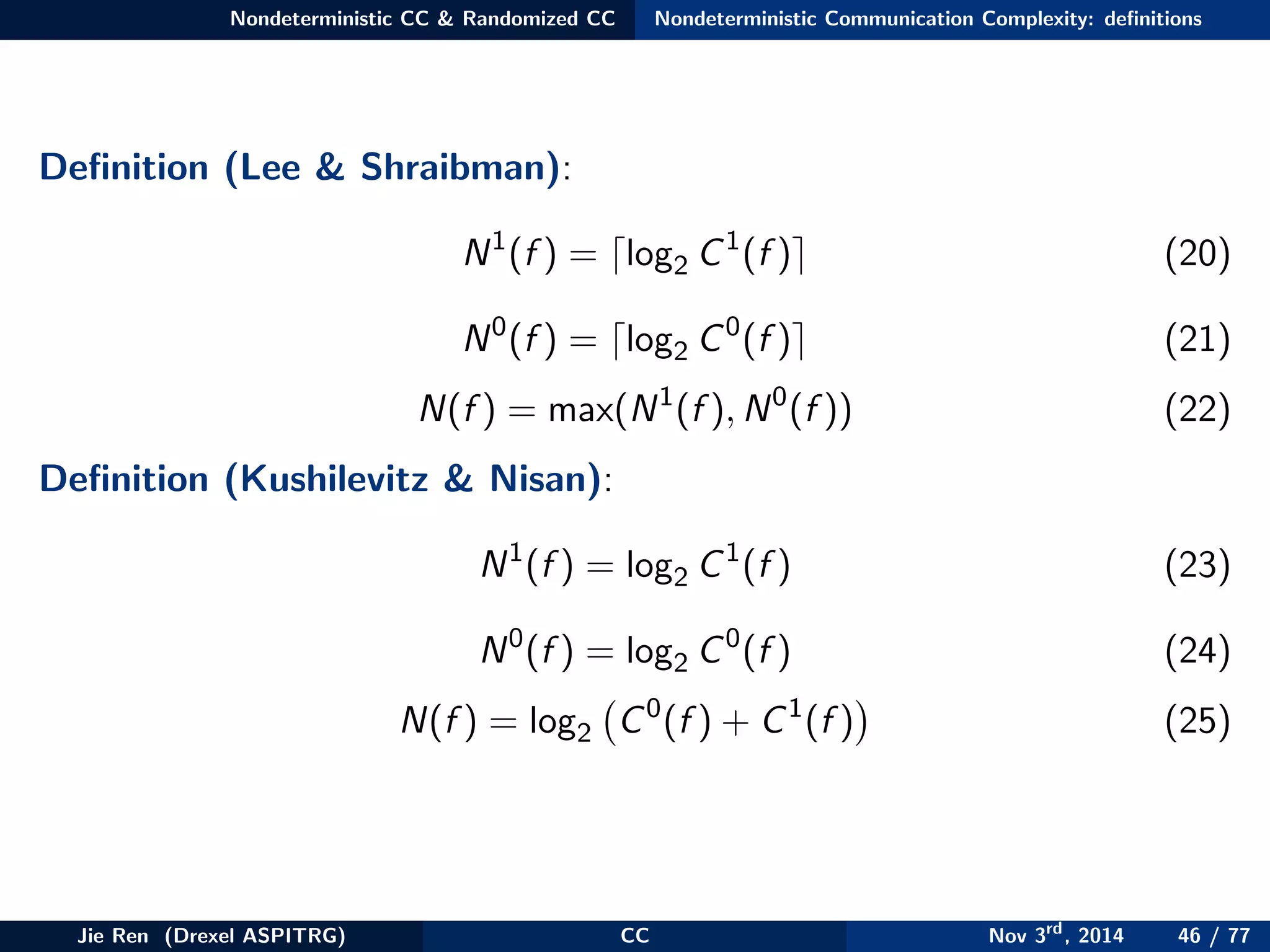
    Nondeterministic CC &Randomized CC Nondeterministic Communication Complexity: definitions Definition (Lee & Shraibman): N1 (f ) = log2 C1 (f ) (20) N0 (f ) = log2 C0 (f ) (21) N(f ) = max(N1 (f ), N0 (f )) (22) Definition (Kushilevitz & Nisan): N1 (f ) = log2 C1 (f ) (23) N0 (f ) = log2 C0 (f ) (24) N(f ) = log2 C0 (f ) + C1 (f ) (25) Jie Ren (Drexel ASPITRG) CC Nov 3rd , 2014 46 / 77
  • 47.
    Nondeterministic CC &Randomized CC Randomized Communication Complexity Outline 1 Deterministic Communication Complexity Problem Setup Protocol Tree Combinatorial Rectangles Fooling Sets Rectangle Rank 2 Nondeterministic CC & Randomized CC Nondeterministic Communication Complexity: Motivation Nondeterministic Communication Complexity: definitions Randomized Communication Complexity Distributional Complexity and Discrepancy 3 Some Analysis Jie Ren (Drexel ASPITRG) CC Nov 3rd , 2014 47 / 77
  • 48.
    Nondeterministic CC &Randomized CC Randomized Communication Complexity Motivation: • Introduce randomness in the protocol rA and rB: flip coins • Allow protocols that may have error Jie Ren (Drexel ASPITRG) CC Nov 3rd , 2014 48 / 77
  • 49.
    Nondeterministic CC &Randomized CC Randomized Communication Complexity Randomized Protocol Tree Definition : A randomized protocol P over domain X × Y with range Z is a binary tree where each internal node v is labeled either by a function av : X × RA → {0, 1} or by a function bv : Y × RB → {0, 1}, and each leaf is labeled with an element z ∈ Z. Jie Ren (Drexel ASPITRG) CC Nov 3rd , 2014 49 / 77
  • 50.
    Nondeterministic CC &Randomized CC Randomized Communication Complexity Definition: Let P be a randomized protocol. All the probabilities below are over random choices of rA and rB. • P computes a function f with zero error • P computes a function f with −error if for all (x, y) P[P(x, y) = f (x, y)] ≥ 1 − (26) • P computes a function f with one-sided −error if for all (x, y) such that f (x, y) = 0 P[P(x, y) = 0] = 1, (27) and for all (x, y) such that f (x, y) = 1, P[P(x, y) = 1] ≥ 1 − (28) Jie Ren (Drexel ASPITRG) CC Nov 3rd , 2014 50 / 77
  • 51.
    Nondeterministic CC &Randomized CC Randomized Communication Complexity Definition: Let f : X × Y → {0, 1} be a binary function. We consider the following complexity measure for f • R0(f ) is the minimum average case cost of a randomized protocol that computes f with zero error • R (f ) is the minimum worst case cost of a randomized protocol that computes f with error . We typically use = 1/3 • R1(f ) is the minimum worst case cost of a randomized protocol that computes f with one-sided error . Jie Ren (Drexel ASPITRG) CC Nov 3rd , 2014 51 / 77
  • 52.
    Nondeterministic CC &Randomized CC Randomized Communication Complexity Why we care these measures: • worst case zero error = deterministic • for all average case error, there exists a worst case problem that can convert to Jie Ren (Drexel ASPITRG) CC Nov 3rd , 2014 52 / 77
  • 53.
    Nondeterministic CC &Randomized CC Randomized Communication Complexity Proposition: Given a protocol P that makes an error /2 and the average number of bits exchanged is t, it can always be modified as follows: execute P as long as at most 2t/ bits are exchanged, if the protocol finishes, use its output, otherwise output 0. This gives a worst case cost 2t/ with error upper bounded by . Proof: t = ra,rb,x,y cc · p(ra, rb, x, y) = cc≤2t/ cc · p(ra, rb, x, y) + cc>2t/ cc · p(ra, rb, x, y) ≥ cc>2t/ cc · p(ra, rb, x, y) ≥ 2t Pr[cc > 2t/ ] (29) Hence, Pr[err] ≤ 2 Pr[P ends] + 1 · Pr[P not ends] ≤ 2 + t 2t/ = (30) Jie Ren (Drexel ASPITRG) CC Nov 3rd , 2014 53 / 77
  • 54.
    Nondeterministic CC &Randomized CC Randomized Communication Complexity 1 For all 0 < ≤ < 1/2, R (f ) ≤ O(log · R (f )) (31) 2 For all 0 < ≤ 1/2, R (f ) ≤ R1 (f ) ≤ O(log −1 R0(f )) (32) 3 For all 0 < ≤ 1/2, R0(f ) = Θ(max[R1 (f ), R1 (not(f ))]) (33) Jie Ren (Drexel ASPITRG) CC Nov 3rd , 2014 54 / 77
  • 55.
    Nondeterministic CC &Randomized CC Randomized Communication Complexity Proof of Property 1: We first prove a similar result for the 1-sided error problem: for all 0 < ≤ < 1/2, R1 (f ) ≤ O(log · R1 (f )) (34) Jie Ren (Drexel ASPITRG) CC Nov 3rd , 2014 55 / 77
  • 56.
    Nondeterministic CC &Randomized CC Randomized Communication Complexity Proof of Property 1: Given a randomized protocol P with worst case cost T bits and one-sided error no greater than < 1/2, we can build a new protocol P with worst case cost nT bits by simply running P n times. In the new protocol, Alice and Bob will claim f (x, y) = 1 if and only if there exists at least one time among the n repeating protocols that they will output 1. Now we bound the error for the new protocol P : P[err|f (x, y) = 0] = 0 (35) P[err|f (x, y) = 1] = P[all n trails output 0|f (x, y) = 1] = ( )n (36) Therefore, if we repeat P log times, we can guarantee to reduce the one-sided error to . Jie Ren (Drexel ASPITRG) CC Nov 3rd , 2014 56 / 77
  • 57.
    Nondeterministic CC &Randomized CC Randomized Communication Complexity Proof of Property 1: Now we prove property 1. We still run P n times, each gives an output Xi , i ∈ {1, . . . , n}. In the new protocol, Alice and Bob will claim f (x, y) = 1 if and only if 1 n i Xi > 1 2 (37) Now we bound the error for the new protocol P : P[err|f (x, y) = 0] ≤ n i= n/2 n i ( )i (1 − )n−i ≤ ( )n (38) P[err|f (x, y) = 1] ≤ n i= n/2 n i ( )i (1 − )n−i ≤ ( )n (39) Therefore, if we repeat P log times, we can also guarantee to reduce the two-sided error to . Jie Ren (Drexel ASPITRG) CC Nov 3rd , 2014 57 / 77
  • 58.
    Nondeterministic CC &Randomized CC Distributional Complexity and Discrepancy Outline 1 Deterministic Communication Complexity Problem Setup Protocol Tree Combinatorial Rectangles Fooling Sets Rectangle Rank 2 Nondeterministic CC & Randomized CC Nondeterministic Communication Complexity: Motivation Nondeterministic Communication Complexity: definitions Randomized Communication Complexity Distributional Complexity and Discrepancy 3 Some Analysis Jie Ren (Drexel ASPITRG) CC Nov 3rd , 2014 58 / 77
  • 59.
    Nondeterministic CC &Randomized CC Distributional Complexity and Discrepancy Distributional Complexity Motivation: Consider probability distributions over the inputs Definition: Let µ be a probability distribution on X × Y . The (µ, )-distributional communication complexity of f , Dµ (f ), is the cost of the best deterministic protocol that gives the correct answer for f with a probability at least 1 − . Jie Ren (Drexel ASPITRG) CC Nov 3rd , 2014 59 / 77
  • 60.
    Nondeterministic CC &Randomized CC Distributional Complexity and Discrepancy Discrepancy Motivation: Allow those rectangles that partition the support to be “almost” f -monochromatic. Definition: Let f : X × Y → {0, 1} be a function, R be any rectangle, and µ be a probability distribution on X × Y , Denote Discµ(R, f ) = |P µ [f (x, y) = 0 & (x, y) ∈ R] − P µ [f (x, y) = 1 & (x, y) ∈ R]| (40) The discrepancy of f according to µ is, Discµ(f ) = max R Discµ(R, f ) (41) Jie Ren (Drexel ASPITRG) CC Nov 3rd , 2014 60 / 77
  • 61.
    Nondeterministic CC &Randomized CC Distributional Complexity and Discrepancy Discrepancy Proposition 3.28 (Kushilevitz & Nisan): For every function f : X × Y → {0, 1}, every probability distribution µ on X × Y , and every ≥ 0, Dµ 1/2− (f ) ≥ log2(2 /Discµ(f )) (42) Jie Ren (Drexel ASPITRG) CC Nov 3rd , 2014 61 / 77
  • 62.
    Nondeterministic CC &Randomized CC Distributional Complexity and Discrepancy Discrepancy Proof: Given any P with c bits to compute f , we have 2 ≤ P[P(x, y) = f (x, y)] − P[P(x, y) = f (x, y)] = (P[P(x, y) = f (x, y)&(x, y) ∈ R ] −P[P(x, y) = f (x, y)&(x, y) ∈ R ]) ≤ |P µ [f (x, y) = 0 & (x, y) ∈ R ] − P µ [f (x, y) = 1 & (x, y) ∈ R ]| ≤ 2c · Discµ(f ) (43) Jie Ren (Drexel ASPITRG) CC Nov 3rd , 2014 62 / 77
  • 63.
    Some Analysis Outline 1 DeterministicCommunication Complexity Problem Setup Protocol Tree Combinatorial Rectangles Fooling Sets Rectangle Rank 2 Nondeterministic CC & Randomized CC Nondeterministic Communication Complexity: Motivation Nondeterministic Communication Complexity: definitions Randomized Communication Complexity Distributional Complexity and Discrepancy 3 Some Analysis Jie Ren (Drexel ASPITRG) CC Nov 3rd , 2014 63 / 77
  • 64.
    Some Analysis Recall Definitions: Letf : X × Y → {0, 1} be a binary function. • CP(f ): the smallest number of leaves in a protocol P • CD(f ): the smallest number of monochromatic rectangles that partition X × Y • C(f ): the smallest number of monochromatic rectangles needed to cover X × Y • Cz(f ): the smallest number of monochromatic rectangles needed to cover the z-inputs Jie Ren (Drexel ASPITRG) CC Nov 3rd , 2014 64 / 77
  • 65.
    Some Analysis Recall Proposition: Forall f : X × Y → {0, 1}, log2 C(f ) ≤ log2 CD (f ) ≤ log2 CP (f ) ≤ D(f ) (44) C(f ) = C0 (f ) + C1 (f ) (45) Definition: The nondeterministic communication complexity, N1 (f ) = log2 C1 (f ) (46) N0 (f ) = log2 C0 (f ) (47) N(f ) = log2 C(f ) (48) Jie Ren (Drexel ASPITRG) CC Nov 3rd , 2014 65 / 77
  • 66.
    Some Analysis Protocol partitionnumber Theorem 2.8 (Kushilevitz and Nisan): The protocol partition number of a function determines the deterministic communication complexity. log2 CP (f ) ≤ D(f ) ≤ 2 log3/2 CP (f ) (49) Proof: Given any protocol P with t number of leaves, it can be converted into a “balanced” protocol. Jie Ren (Drexel ASPITRG) CC Nov 3rd , 2014 66 / 77
  • 67.
    Some Analysis Protocol partitionnumber Proof: Given any protocol P with t number of leaves, there must exist an internal node v such that t/3 < tv ≤ 2t/3 (50) We build a new protocol based on this internal node: 1 Alice and Bob determine whether or not (x, y) ∈ Rv 2 If (x, y) ∈ Rv , Alice and Bob recursively solve f in the rectangle Rv . 3 If (x, y) ∈ Rv , Alice and Bob recursively solve f on X × Y where f (x1, y1) = f (x1, y1) if (x1, y1) ∈ Rv 0 otherwise (51) Jie Ren (Drexel ASPITRG) CC Nov 3rd , 2014 67 / 77
  • 68.
    Some Analysis Protocol partitionnumber Analysis: • Step 1 Requires 2 bits • In Step 3, we take P and replace Tree(v) by a 0-leaf, we get a protocol for f with t − tv + 1 leaves, hence D(t) ≤ 2 + D(2t/3) (52) Jie Ren (Drexel ASPITRG) CC Nov 3rd , 2014 68 / 77
  • 69.
    Some Analysis Recall Proposition: Forall f : X × Y → {0, 1}, log2 C(f ) ≤ log2 CD (f ) ≤ log2 CP (f ) ≤ D(f ) ≤ 2 log3/2 CP (f ) (53) Definition: The nondeterministic communication complexity, N1 (f ) = log2 C1 (f ) (54) N0 (f ) = log2 C0 (f ) (55) N(f ) = log2 C(f ) (56) Jie Ren (Drexel ASPITRG) CC Nov 3rd , 2014 69 / 77
  • 70.
    Some Analysis Deterministic CCVs. Nondeterministic CC How good is the rectangle lower bound? D(f ) ? = O(log CD (f )) (57) Jie Ren (Drexel ASPITRG) CC Nov 3rd , 2014 70 / 77
  • 71.
    Some Analysis Deterministic CCVs. Nondeterministic CC Theorem 2.11 (Kushilevitz & Nisan): For every function f : X × Y → {0, 1}, D(f ) = O(N0 (f )N1 (f )) (58) Jie Ren (Drexel ASPITRG) CC Nov 3rd , 2014 71 / 77
  • 72.
    Some Analysis Deterministic CCVs. Nondeterministic CC Property: Let R = S × T be a 0-monochromatic rectangle, and let R = S × T be a 1-monochromatic rectangle, then either S ∩ S = ∅ or T ∩ T = ∅. Jie Ren (Drexel ASPITRG) CC Nov 3rd , 2014 72 / 77
  • 73.
    Some Analysis Deterministic CCVs. Nondeterministic CC Proof of Theorem 2.11 (Kushilevitz & Nisan): We give a protocol P as follows, Alice and Bob search for a 0-rectangle that contains the input (x, y), and they conclude f (x, y) = 1 if they fail. In each round, Alice and Bob exchange log2 C1(f ) + 1 bits and reduce the number of “alive” 0-rectangles by a factor of 2. There will be no more than log2 C0(f ) rounds, hence D(f ) ≤ CC(P) = O(log2 C0 (f )(log2 C1 (f ) + 1)) = O(N0 (f )N1 (f )) (59) Jie Ren (Drexel ASPITRG) CC Nov 3rd , 2014 73 / 77
  • 74.
    Some Analysis Deterministic CCVs. Nondeterministic CC Proof of Theorem 2.11 (Kushilevitz & Nisan): In each round, the players do the following: 1 Alice outputs f (x, y) = 0 if no 0-rectangles are alive. Otherwise, Alice looks for a 1-rectangle that contains row x and intersects in rows with at most half of the alive 0-rectangles and send the name of this 1-rectangle. 2 Bob looks for a 1-rectangle that contains column y and intersects in columns with at most half of the alive 0-rectangles and send the name of this 1-rectangle. Otherwise, Bob outputs f (x, y) = 0 Jie Ren (Drexel ASPITRG) CC Nov 3rd , 2014 74 / 77
  • 75.
    Some Analysis Deterministic CCVs. Nondeterministic CC Protocol Analysis: • If f (x, y) = 0, it must belong to some 0-rectangle R, then R remains alive during the protocol. Therefore, if no 0-rectangle is alive, f (x, y) must be 1 • If neither Alice nor Bob can find a 1-rectangle to announce (which means both of them output f (x, y) = 1), we claim this output must be correct by the property. Jie Ren (Drexel ASPITRG) CC Nov 3rd , 2014 75 / 77
  • 76.
    Some Analysis Public coin Theorem(Theo. 3 in Newman 1991, Theo. 3.14 in K & N): Let f : {0, 1}n × {0, 1}n → {0, 1} be a function. For every δ > 0 and every > 0, we have Rδ+ (f ) ≤ Rpub (f ) + O(logn + logδ−1 ) (60) • ∃ a set of t(δ, n) = O(n/δ2) public coin protocols with error + δ • Alice tells Bob which protocol to use log2 t = O(log n + log δ−1) Jie Ren (Drexel ASPITRG) CC Nov 3rd , 2014 76 / 77
  • 77.
    Some Analysis Randomized CCVs. Distributional CC Theorem (Theo. 3 in Yao 1979, Theo. 3.20 in K & N): Rpub (f ) = max µ Dµ (f ) (61) • ⇒ The randomized protocol is correct for every distribution µ with probability ≥ 1 − • ⇐ Use min-max theorem of zero-sum game Jie Ren (Drexel ASPITRG) CC Nov 3rd , 2014 77 / 77