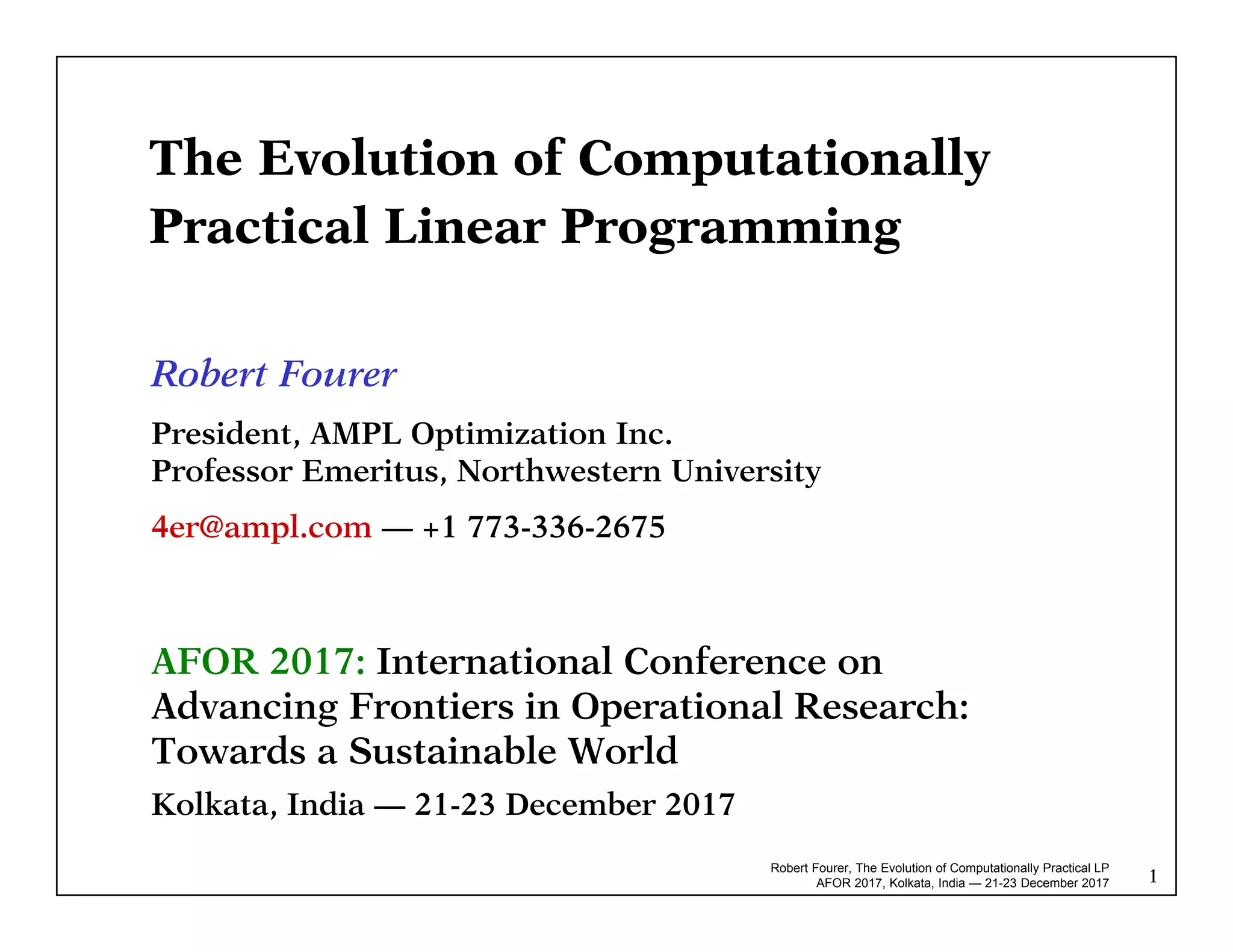
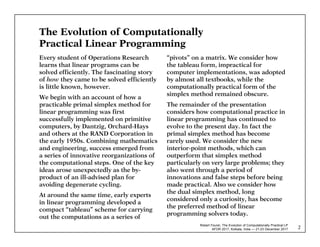
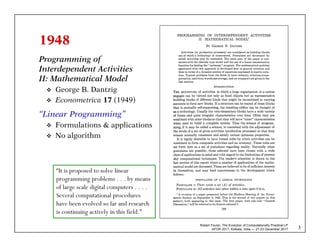
The document discusses the historical evolution of computationally practical linear programming, highlighting significant developments from the 1950s to contemporary methods. It reviews the transition from the traditional simplex method to innovative approaches, such as interior-point methods and the dual simplex method, and emphasizes the importance of combining mathematics and engineering for optimizing performance. The author, Robert Fourer, provides insights into how computational techniques have adapted to meet the needs of increasingly complex linear programming problems.
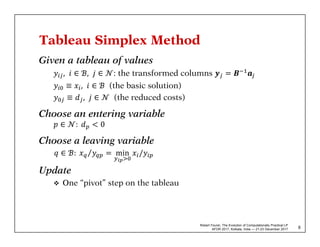
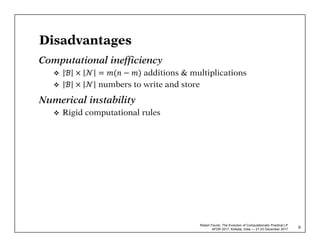
![Robert Fourer, The Evolution of Computationally Practical LP
AFOR 2017, Kolkata, India — 21-23 December 2017 10
1953
The Generalized Simplex
Method for Minimizing a
Linear Form under Linear
Inequality Restraints
George B. Dantzig,
Alex Orden, Philip Wolfe
Project RAND Research
Memorandum RM-1264
“Lexicographic Simplex Method”
Prevent degenerate cycling
Reorganize computations
“The k+1st iterate is closely related
to the kth by simple transformations
that constitute the computational
algorithm [6], . . .”](https://image.slidesharecdn.com/afor2017evolutionofpracticallp-180103230309/85/The-Evolution-of-Computationally-Practical-Linear-Programming-10-320.jpg)
![Robert Fourer, The Evolution of Computationally Practical LP
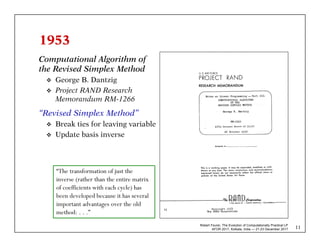
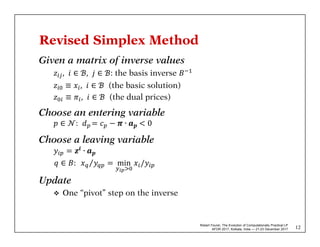
AFOR 2017, Kolkata, India — 21-23 December 2017
Inefficiency
additions & multiplications
| | numbers to write and store
Instability
Rigid computational rules
However . . .
14
Disadvantages
“. . . the revised method (by making
extensive use of cumulative sums of
products) requires the recording of about
elements (and an alternative method [5]
can reduce this to . . .).”](https://image.slidesharecdn.com/afor2017evolutionofpracticallp-180103230309/85/The-Evolution-of-Computationally-Practical-Linear-Programming-14-320.jpg)
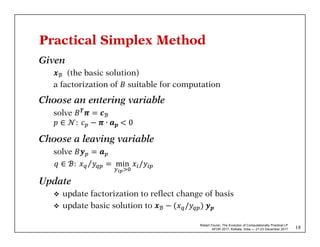
![Robert Fourer, The Evolution of Computationally Practical LP
AFOR 2017, Kolkata, India — 21-23 December 2017 19
1963
Linear Programming
and Extensions
George B. Dantzig
“Because some readers might find that
the matrix notation of §8.5 [The
SimplexAlgorithm in Matrix Form]
obscures the computational aspects,
we have tended to avoid its use here.”
“. . . the simplex algorithm . . . starts
with a canonical form, consists of a
sequence of pivot operations, and
forms the main subroutine of the
simplex method.”](https://image.slidesharecdn.com/afor2017evolutionofpracticallp-180103230309/85/The-Evolution-of-Computationally-Practical-Linear-Programming-19-320.jpg)
![Robert Fourer, The Evolution of Computationally Practical LP
AFOR 2017, Kolkata, India — 21-23 December 2017 20
1968
Advanced
Linear-Programming
Computing Techniques
William Orchard-Hays
“I hope that the many users of
mathematical programming systems
implemented on today’s large
computers find the book valuable as
background for the largely
undocumented algorithms embedded
in these systems. If it should also be
found useful as a course text, all
objectives will have been achieved.”
“Except for [a few sections], the
contents of the book reflect actual and
extensive experience.”](https://image.slidesharecdn.com/afor2017evolutionofpracticallp-180103230309/85/The-Evolution-of-Computationally-Practical-Linear-Programming-20-320.jpg)
![Robert Fourer, The Evolution of Computationally Practical LP
AFOR 2017, Kolkata, India — 21-23 December 2017 53
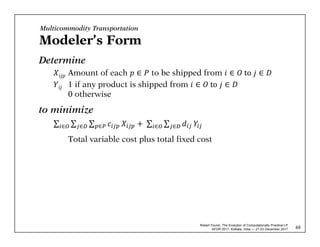
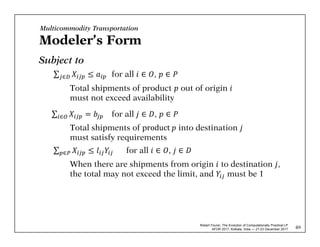
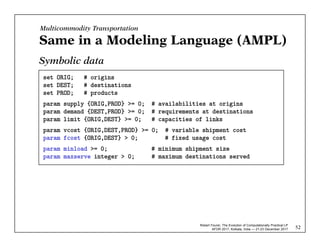
AMPL Formulation
Symbolic model: variables and objective
var Trans {ORIG,DEST,PROD} >= 0; # actual units to be shipped
var Use {ORIG, DEST} binary; # 1 if link used, 0 otherwise
minimize Total_Cost:
sum {i in ORIG, j in DEST, p in PROD} vcost[i,j,p] * Trans[i,j,p]
+ sum {i in ORIG, j in DEST} fcost[i,j] * Use[i,j];
Multicommodity Transportation
∑ ∑ ∑ ∈∈∈ ∑ ∑ ∈∈](https://image.slidesharecdn.com/afor2017evolutionofpracticallp-180103230309/85/The-Evolution-of-Computationally-Practical-Linear-Programming-53-320.jpg)
![Robert Fourer, The Evolution of Computationally Practical LP
AFOR 2017, Kolkata, India — 21-23 December 2017 54
AMPL Formulation
Symbolic model: constraints
subject to Supply {i in ORIG, p in PROD}:
sum {j in DEST} Trans[i,j,p] <= supply[i,p];
subject to Demand {j in DEST, p in PROD}:
sum {i in ORIG} Trans[i,j,p] = demand[j,p];
subject to Multi {i in ORIG, j in DEST}:
sum {p in PROD} Trans[i,j,p] <= limit[i,j] * Use[i,j];
subject to Min_Ship {i in ORIG, j in DEST}:
sum {p in PROD} Trans[i,j,p] >= minload * Use[i,j];
subject to Max_Serve {i in ORIG}:
sum {j in DEST} Use[i,j] <= maxserve;
Multicommodity Transportation](https://image.slidesharecdn.com/afor2017evolutionofpracticallp-180103230309/85/The-Evolution-of-Computationally-Practical-Linear-Programming-54-320.jpg)
![Robert Fourer, The Evolution of Computationally Practical LP
AFOR 2017, Kolkata, India — 21-23 December 2017 56
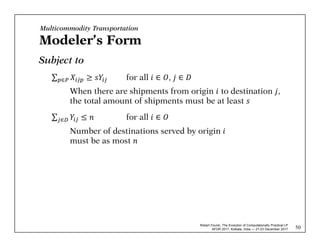
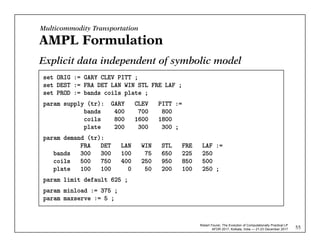
AMPL Formulation
Explicit data (continued)
param vcost :=
[*,*,bands]: FRA DET LAN WIN STL FRE LAF :=
GARY 30 10 8 10 11 71 6
CLEV 22 7 10 7 21 82 13
PITT 19 11 12 10 25 83 15
[*,*,coils]: FRA DET LAN WIN STL FRE LAF :=
GARY 39 14 11 14 16 82 8
CLEV 27 9 12 9 26 95 17
PITT 24 14 17 13 28 99 20
[*,*,plate]: FRA DET LAN WIN STL FRE LAF :=
GARY 41 15 12 16 17 86 8
CLEV 29 9 13 9 28 99 18
PITT 26 14 17 13 31 104 20 ;
param fcost: FRA DET LAN WIN STL FRE LAF :=
GARY 3000 1200 1200 1200 2500 3500 2500
CLEV 2000 1000 1500 1200 2500 3000 2200
PITT 2000 1200 1500 1500 2500 3500 2200 ;
Multicommodity Transportation](https://image.slidesharecdn.com/afor2017evolutionofpracticallp-180103230309/85/The-Evolution-of-Computationally-Practical-Linear-Programming-56-320.jpg)
![Robert Fourer, The Evolution of Computationally Practical LP
AFOR 2017, Kolkata, India — 21-23 December 2017 57
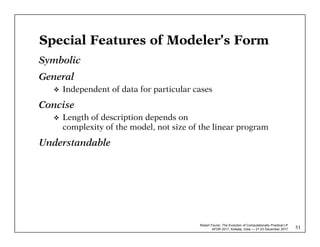
AMPL Solution
Model + data = problem instance to be solved
ampl: model multmip3.mod;
ampl: data multmip3.dat;
ampl: option solver gurobi;
ampl: solve;
Gurobi 7.0.0: optimal solution; objective 235625
332 simplex iterations
23 branch-and-cut nodes
ampl: display Use;
Use [*,*]
: DET FRA FRE LAF LAN STL WIN :=
CLEV 1 1 1 0 1 1 0
GARY 0 0 0 1 0 1 1
PITT 1 1 1 1 0 1 0
;
Multicommodity Transportation](https://image.slidesharecdn.com/afor2017evolutionofpracticallp-180103230309/85/The-Evolution-of-Computationally-Practical-Linear-Programming-57-320.jpg)
![Robert Fourer, The Evolution of Computationally Practical LP
AFOR 2017, Kolkata, India — 21-23 December 2017 58
AMPL Solution
Solver choice independent of model and data
ampl: model multmip3.mod;
ampl: data multmip3.dat;
ampl: option solver cplex;
ampl: solve;
CPLEX 12.7.0.0: optimal integer solution; objective 235625
135 MIP simplex iterations
0 branch-and-bound nodes
ampl: display Use;
Use [*,*]
: DET FRA FRE LAF LAN STL WIN :=
CLEV 1 1 1 0 1 1 0
GARY 0 0 0 1 0 1 1
PITT 1 1 1 1 0 1 0
;
Multicommodity Transportation](https://image.slidesharecdn.com/afor2017evolutionofpracticallp-180103230309/85/The-Evolution-of-Computationally-Practical-Linear-Programming-58-320.jpg)
![Robert Fourer, The Evolution of Computationally Practical LP
AFOR 2017, Kolkata, India — 21-23 December 2017 59
AMPL Solution
Solver choice independent of model and data
ampl: model multmip3.mod;
ampl: data multmip3.dat;
ampl: option solver xpress;
ampl: solve;
XPRESS 29.01: Global search complete
Best integer solution found 235625
4 integer solutions have been found, 7 branch and bound nodes
ampl: display Use;
Use [*,*]
: DET FRA FRE LAF LAN STL WIN :=
CLEV 1 1 1 0 1 1 0
GARY 0 0 0 1 0 1 1
PITT 1 1 1 1 0 1 0
;
Multicommodity Transportation](https://image.slidesharecdn.com/afor2017evolutionofpracticallp-180103230309/85/The-Evolution-of-Computationally-Practical-Linear-Programming-59-320.jpg)


