London, 9th June 2015
R2D2

EPSRC First Grant
Scheme (EP/L006251/1)
Optimized Network-coded
Scalable Video Multicasting
over eMBMS Networks
IEEE ICC 2015 - Mobile and Wireless Networking Symposium
A. Tassi, I. Chatzigeorgiou, D. Vukobratović, A. L. Jones
a.tassi@{lancaster.ac.uk, bristol.ac.uk}
andCommunications
School of Computing
Starting Point and Goals
๏ Delivery of multimedia broadcast/multicast services over 

4G/5G networks is a challenging task. This has propelled
research into delivery schemes.
๏ Scalable video service (such as H.264/SVC) consists of a basic
layer and multiple enhancement layers.
๏ Multi-rate Transmission (MrT) strategies have been proposed
as a means of delivering layered services to users experiencing
different downlink channel conditions.
Goals
๏ Error control - Ensure that a predetermined fraction of users
achieves a certain service level with at least a given probability
๏ Resource optimisation - Reduce the total amount of radio
resources needed to deliver a layered service in a fair way.
2
andCommunications
School of Computing
Index
1. System Parameters and Performance Analysis
2. Proposed Resource Allocation Modeling and
Heuristic Solution
3. Analytical Results
4. Concluding Remarks
3
andCommunications
School of Computing
1. System Parameters and Performance Analysis
andCommunications
School of Computing
System Model
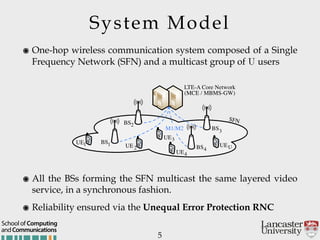
๏ One-hop wireless communication system composed of a Single
Frequency Network (SFN) and a multicast group of U users
5
๏ All the BSs forming the SFN multicast the same layered video
service, in a synchronous fashion.
๏ Reliability ensured via the Unequal Error Protection RNC
andCommunications
School of Computing
BS
BS
BS
BS
M1/M2
(MCE / MBMS-GW)
SFN
4
1
2
3
UE3
UEUUE2
UE1
UE4
LTE-A Core Network
6
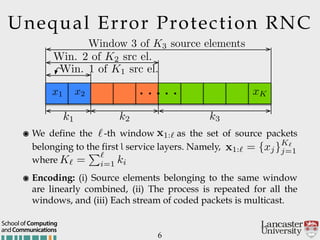
๏ Encoding: (i) Source elements belonging to the same window
are linearly combined, (ii) The process is repeated for all the
windows, and (iii) Each stream of coded packets is multicast.
Unequal Error Protection RNC
๏ We define the -th window as the set of source packets
belonging to the first l service layers. Namely, 

where
andCommunications
School of Computing
k1 k2 k3
x1 x2 xK. . .. . .
Window 3 of K3 source elements
Win. 2 of K2 src el.
Win. 1 of K1 src el.
` x1:`
x1:` = {xj}K`
j=1
K` =
P`
i=1 ki
7
UEP-RNC and LTE-A
andCommunications
School of Computing
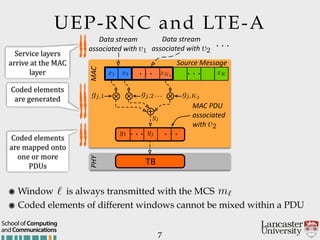
Data$stream
associated$with$$ $
⊗⊗ ⊗
⊕
TB
MACPHY
Data$stream
associated$with$$ $
MAC$PDU
associated
with
x1 x2 xK. . .
gj,1 gj,2 gj,K2
. . . xK2
y1 yj. . . . . .
Source$Message
. . .
yj
v1 v2
v2
Service'layers'
arrive'at'the'MAC'
layer
Coded'elements'
are'generated
Coded'elements'
are'mapped'onto'
one'or'more'
PDUs'
๏ Window is always transmitted with the MCS
๏ Coded elements of different windows cannot be mixed within a PDU
m``
Performance Model
8
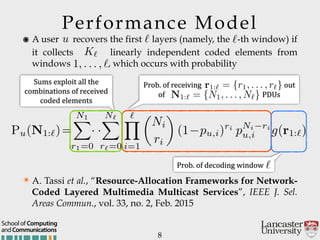
๏ A user recovers the first layers (namely, the -th window) if
it collects linearly independent coded elements from
windows , which occurs with probability
Prob.'of'receiving ''''''out'
of' PDUs
Prob.'of'decoding'window'''''
andCommunications
School of Computing
u `
K`
1, . . . , `
`
Pu(N1:`)=
N1X
r1=0
· ·
N`X
r`=0
`Y
i=1
✓
Ni
ri
◆
(1 pu,i)ri
pNi ri
u,i g(r1:`)
N1:` = {N1, . . . , N`}
`
✴ A. Tassi et al., “Resource-Allocation Frameworks for Network-
Coded Layered Multimedia Multicast Services”, IEEE J. Sel.
Areas Commun., vol. 33, no. 2, Feb. 2015
Sums'exploit'all'the'
combinations'of'received'
coded'elements
r1:` = {r1, . . . , r`}
2. Proposed Resource Allocation Modelling and
Heuristic Solution
andCommunications
School of Computing
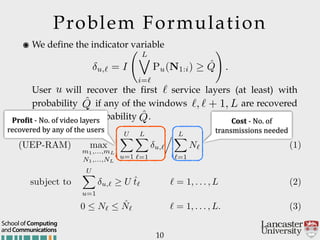
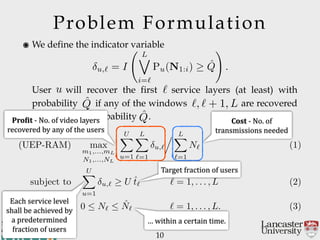
Problem Formulation
10
andCommunications
School of Computing
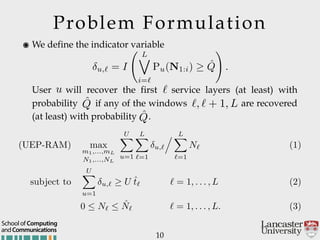
๏ We define the indicator variable


User will recover the first service layers (at least) with
probability if any of the windows are recovered
(at least) with probability .
u,` = I
L_
i=`
Pu(N1:i) ˆQ
!
.
u `
ˆQ `, ` + 1, L
ˆQ
(UEP-RAM) max
m1,...,mL
N1,...,NL
UX
u=1
LX
`=1
u,`
. LX
`=1
N` (1)
subject to
UX
u=1
u,` U ˆt` ` = 1, . . . , L (2)
0  N`  ˆN` ` = 1, . . . , L. (3)
Problem Formulation
10
andCommunications
School of Computing
๏ We define the indicator variable


User will recover the first service layers (at least) with
probability if any of the windows are recovered
(at least) with probability .
u,` = I
L_
i=`
Pu(N1:i) ˆQ
!
.
u `
ˆQ `, ` + 1, L
ˆQ
(UEP-RAM) max
m1,...,mL
N1,...,NL
UX
u=1
LX
`=1
u,`
. LX
`=1
N` (1)
subject to
UX
u=1
u,` U ˆt` ` = 1, . . . , L (2)
0  N`  ˆN` ` = 1, . . . , L. (3)
Pro$it'@'No.'of'video'layers'
recovered'by'any'of'the'users
Cost'@'No.'of'
transmissions'needed
Problem Formulation
10
andCommunications
School of Computing
๏ We define the indicator variable


User will recover the first service layers (at least) with
probability if any of the windows are recovered
(at least) with probability .
u,` = I
L_
i=`
Pu(N1:i) ˆQ
!
.
u `
ˆQ `, ` + 1, L
ˆQ
(UEP-RAM) max
m1,...,mL
N1,...,NL
UX
u=1
LX
`=1
u,`
. LX
`=1
N` (1)
subject to
UX
u=1
u,` U ˆt` ` = 1, . . . , L (2)
0  N`  ˆN` ` = 1, . . . , L. (3)
Pro$it'@'No.'of'video'layers'
recovered'by'any'of'the'users
Cost'@'No.'of'
transmissions'needed
Each'service'level'
shall'be'achieved'by'
a'predetermined'
fraction'of'users
Target'fraction'of'users
…'within'a'certain'time.
Problem Heuristic
๏ Users provide as CQI feedback the max. MCS index ensuring
an acceptable PDU error probability (at the MAC Layer). The
larger the MCS index is, the higher the modulation order or the
lower the error-correcting capability is.
๏ The UEP-RAM is an hard integer optimisation problem
because of the coupling constraints among variables. We
proposed the following heuristic strategy.
๏ Remark Assume that the first windows are not
delivered. The service coverage can only be offered if
(i) service layers are recovered with a
probability of at least by the user fraction .
(ii) and the remaining layers are recovered as stated in SLA.
11
andCommunications
School of Computing
s 2 [0, L 1]
1, . . . , (s + 1)
ˆQ ˆt1
Heuristic Procedure
1. The value of is initially set to . We try to transmit only
window
2. MCS of window is accommodated via
12
andCommunications
School of Computing
and the PDU transmission are optimized via
3. If any of these problems cannot be solved, is decreased and
the procedure repeated. Otherwise, the solution is refined.
s
L 1
L
` 2 [s + 1, L]
s
(S1-`) arg max
m`2[1,15]
n UX
u=1
I
⇣
m`  m(u)
⌘
U t0
`
o
(S2-`) arg min
N`2[0, ˆN`]
n
P(N1:`) ˆQ ^ 0  N`  ˆN`
o
Requires'a'
Ginite'no.'
of'steps
MCSs'and'PDU'
trans.'indep.'
optimized'across'
the'windows'
Heuristic Procedure
1. The value of is initially set to . We try to transmit only
window
2. MCS of window is accommodated via
12
andCommunications
School of Computing
and the PDU transmission are optimized via
3. If any of these problems cannot be solved, is decreased and
the procedure repeated. Otherwise, the solution is refined.
s
L 1
L
` 2 [s + 1, L]
s
(S1-`) arg max
m`2[1,15]
n UX
u=1
I
⇣
m`  m(u)
⌘
U t0
`
o
(S2-`) arg min
N`2[0, ˆN`]
n
P(N1:`) ˆQ ^ 0  N`  ˆN`
o
Requires'a'
Ginite'no.'
of'steps
MCSs'and'PDU'
trans.'indep.'
optimized'across'
the'windows'
Total'no.'of'
windows
Heuristic Procedure
1. The value of is initially set to . We try to transmit only
window
2. MCS of window is accommodated via
12
andCommunications
School of Computing
and the PDU transmission are optimized via
3. If any of these problems cannot be solved, is decreased and
the procedure repeated. Otherwise, the solution is refined.
s
L 1
L
` 2 [s + 1, L]
s
(S1-`) arg max
m`2[1,15]
n UX
u=1
I
⇣
m`  m(u)
⌘
U t0
`
o
(S2-`) arg min
N`2[0, ˆN`]
n
P(N1:`) ˆQ ^ 0  N`  ˆN`
o
Requires'a'
Ginite'no.'
of'steps
MCSs'and'PDU'
trans.'indep.'
optimized'across'
the'windows'
No.'of'windows'
to'be'skipped'
Total'no.'of'
windows
3. Analytical Results
andCommunications
School of Computing
Numerical Results
14
๏ SFN scenario composed by 4 BSs
๏ We compared the proposed strategies with a classic Multi-
rate Transmission (MrT) strategy
System'proGit
No'error'control'
strategies'are'allowed'
(ARQ,'RLNC,'etc.)
andCommunications
School of Computing
max
m1,...,mL
UX
u=1
LX
`=1
˜u,`
Numerical Results
15
andCommunications
School of Computing
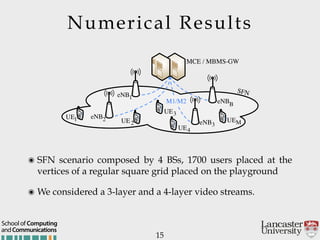
๏ SFN scenario composed by 4 BSs, 1700 users placed at the
vertices of a regular square grid placed on the playground
๏ We considered a 3-layer and a 4-layer video streams.
eNB
eNB
eNB
eNB
M1/M2
MCE / MBMS-GW
SFN
3
2
1
B
UE3
UEMUE2
UE1
UE4
x position (m)
yposition(m)
−500 −300 −100 100 300 500 700
−200
−100
0
100
200
300
400
500
600
700
x position (m)
yposition(m)
−500 −300 −100 100 300 500 700
−200
−100
0
100
200
300
400
500
600
700
3
33
3
3
33 3
3
3
2
2
2
2
2
2
2
2
2
2
2
1
1
1
1
1
1
1
1
1
1
1
1
UEP$RAM
MrT
3
3
Heuris/c
Numerical Results
16
andCommunications
School of Computing
3@layer'stream
QoS'level'3'
achieved'by'
34.1%'vs.'60%'
of'the'users'
QoS'level'3'
achieved'by'
74%'vs.'60%'
of'the'users'
SFN'BS
QoS'level'3
QoS'level'2
QoS'level'1
x position (m)
yposition(m)
−500 −300 −100 100 300 500 700
−200
−100
0
100
200
300
400
500
600
700
x position (m)
yposition(m)
−500 −300 −100 100 300 500 700
−200
−100
0
100
200
300
400
500
600
700
MrT
4
44
4
4
4 4
4
44
4
4
3
3
3
3
3
3
3
3
33
3
22
2
2
2
2
2
2
1
1
1
1
1
1
1
1 1
4
4
UEP'RAM
Heuris/c
Numerical Results
17
andCommunications
School of Computing
4@layer'stream
QoS'level'4'
achieved'by'
33.1%'vs.'60%'
of'the'users'
QoS'level'4'
achieved'by'
65%'vs.'60%'
of'the'users'
SFN'BS
QoS'level'4
QoS'level'3
QoS'level'2
QoS'level'1
4. Concluding Remarks
andCommunications
School of Computing
Concluding Remarks
19
๏ We presented a viable method for the incorporation of the
UEP-NC scheme into LTE-A stack as a means of improving
the reliability of scalable video multicast services
๏ Inspired by a fundamental economics principle, we defined
of a novel resource allocation framework that aims to
improve the service coverage with a reduced resource
footprint.
๏ We defined a novel heuristic strategy that can efficiently
derive a good quality resource allocation solution of the
considered problem.
๏ Results showed that our modeling ensures a service coverage
which is up to 2.5-times greater than that of the considered
conventional MrT strategy.
andCommunications
School of Computing
Thank you for
your attention
andCommunications
School of Computing
For more information

http://goo.gl/Z4Y9YF
A. Tassi, I. Chatzigeorgiou, and D. Vukobratović, “Resource Allocation
Frameworks for Network-coded Layered Multimedia Multicast
Services”, IEEE J. Sel. Areas Commun., vol. 33, no. 2, Feb. 2015
London, 9th June 2015
R2D2

EPSRC First Grant
Scheme (EP/L006251/1)
Optimized Network-coded
Scalable Video Multicasting
over eMBMS Networks
IEEE ICC 2015 - Mobile and Wireless Networking Symposium
A. Tassi, I. Chatzigeorgiou, D. Vukobratović, A. L. Jones
a.tassi@{lancaster.ac.uk, bristol.ac.uk}
andCommunications
School of Computing

Optimized Network-coded Scalable Video Multicasting over eMBMS Networks

  • 1.
    London, 9th June2015 R2D2
 EPSRC First Grant Scheme (EP/L006251/1) Optimized Network-coded Scalable Video Multicasting over eMBMS Networks IEEE ICC 2015 - Mobile and Wireless Networking Symposium A. Tassi, I. Chatzigeorgiou, D. Vukobratović, A. L. Jones a.tassi@{lancaster.ac.uk, bristol.ac.uk} andCommunications School of Computing
  • 2.
    Starting Point andGoals ๏ Delivery of multimedia broadcast/multicast services over 
 4G/5G networks is a challenging task. This has propelled research into delivery schemes. ๏ Scalable video service (such as H.264/SVC) consists of a basic layer and multiple enhancement layers. ๏ Multi-rate Transmission (MrT) strategies have been proposed as a means of delivering layered services to users experiencing different downlink channel conditions. Goals ๏ Error control - Ensure that a predetermined fraction of users achieves a certain service level with at least a given probability ๏ Resource optimisation - Reduce the total amount of radio resources needed to deliver a layered service in a fair way. 2 andCommunications School of Computing
  • 3.
    Index 1. System Parametersand Performance Analysis 2. Proposed Resource Allocation Modeling and Heuristic Solution 3. Analytical Results 4. Concluding Remarks 3 andCommunications School of Computing
  • 4.
    1. System Parametersand Performance Analysis andCommunications School of Computing
  • 5.
    System Model ๏ One-hopwireless communication system composed of a Single Frequency Network (SFN) and a multicast group of U users 5 ๏ All the BSs forming the SFN multicast the same layered video service, in a synchronous fashion. ๏ Reliability ensured via the Unequal Error Protection RNC andCommunications School of Computing BS BS BS BS M1/M2 (MCE / MBMS-GW) SFN 4 1 2 3 UE3 UEUUE2 UE1 UE4 LTE-A Core Network
  • 6.
    6 ๏ Encoding: (i)Source elements belonging to the same window are linearly combined, (ii) The process is repeated for all the windows, and (iii) Each stream of coded packets is multicast. Unequal Error Protection RNC ๏ We define the -th window as the set of source packets belonging to the first l service layers. Namely, 
 where andCommunications School of Computing k1 k2 k3 x1 x2 xK. . .. . . Window 3 of K3 source elements Win. 2 of K2 src el. Win. 1 of K1 src el. ` x1:` x1:` = {xj}K` j=1 K` = P` i=1 ki
  • 7.
    7 UEP-RNC and LTE-A andCommunications Schoolof Computing Data$stream associated$with$$ $ ⊗⊗ ⊗ ⊕ TB MACPHY Data$stream associated$with$$ $ MAC$PDU associated with x1 x2 xK. . . gj,1 gj,2 gj,K2 . . . xK2 y1 yj. . . . . . Source$Message . . . yj v1 v2 v2 Service'layers' arrive'at'the'MAC' layer Coded'elements' are'generated Coded'elements' are'mapped'onto' one'or'more' PDUs' ๏ Window is always transmitted with the MCS ๏ Coded elements of different windows cannot be mixed within a PDU m``
  • 8.
    Performance Model 8 ๏ Auser recovers the first layers (namely, the -th window) if it collects linearly independent coded elements from windows , which occurs with probability Prob.'of'receiving ''''''out' of' PDUs Prob.'of'decoding'window''''' andCommunications School of Computing u ` K` 1, . . . , ` ` Pu(N1:`)= N1X r1=0 · · N`X r`=0 `Y i=1 ✓ Ni ri ◆ (1 pu,i)ri pNi ri u,i g(r1:`) N1:` = {N1, . . . , N`} ` ✴ A. Tassi et al., “Resource-Allocation Frameworks for Network- Coded Layered Multimedia Multicast Services”, IEEE J. Sel. Areas Commun., vol. 33, no. 2, Feb. 2015 Sums'exploit'all'the' combinations'of'received' coded'elements r1:` = {r1, . . . , r`}
  • 9.
    2. Proposed ResourceAllocation Modelling and Heuristic Solution andCommunications School of Computing
  • 10.
    Problem Formulation 10 andCommunications School ofComputing ๏ We define the indicator variable


 User will recover the first service layers (at least) with probability if any of the windows are recovered (at least) with probability . u,` = I L_ i=` Pu(N1:i) ˆQ ! . u ` ˆQ `, ` + 1, L ˆQ (UEP-RAM) max m1,...,mL N1,...,NL UX u=1 LX `=1 u,` . LX `=1 N` (1) subject to UX u=1 u,` U ˆt` ` = 1, . . . , L (2) 0  N`  ˆN` ` = 1, . . . , L. (3)
  • 11.
    Problem Formulation 10 andCommunications School ofComputing ๏ We define the indicator variable


 User will recover the first service layers (at least) with probability if any of the windows are recovered (at least) with probability . u,` = I L_ i=` Pu(N1:i) ˆQ ! . u ` ˆQ `, ` + 1, L ˆQ (UEP-RAM) max m1,...,mL N1,...,NL UX u=1 LX `=1 u,` . LX `=1 N` (1) subject to UX u=1 u,` U ˆt` ` = 1, . . . , L (2) 0  N`  ˆN` ` = 1, . . . , L. (3) Pro$it'@'No.'of'video'layers' recovered'by'any'of'the'users Cost'@'No.'of' transmissions'needed
  • 12.
    Problem Formulation 10 andCommunications School ofComputing ๏ We define the indicator variable


 User will recover the first service layers (at least) with probability if any of the windows are recovered (at least) with probability . u,` = I L_ i=` Pu(N1:i) ˆQ ! . u ` ˆQ `, ` + 1, L ˆQ (UEP-RAM) max m1,...,mL N1,...,NL UX u=1 LX `=1 u,` . LX `=1 N` (1) subject to UX u=1 u,` U ˆt` ` = 1, . . . , L (2) 0  N`  ˆN` ` = 1, . . . , L. (3) Pro$it'@'No.'of'video'layers' recovered'by'any'of'the'users Cost'@'No.'of' transmissions'needed Each'service'level' shall'be'achieved'by' a'predetermined' fraction'of'users Target'fraction'of'users …'within'a'certain'time.
  • 13.
    Problem Heuristic ๏ Usersprovide as CQI feedback the max. MCS index ensuring an acceptable PDU error probability (at the MAC Layer). The larger the MCS index is, the higher the modulation order or the lower the error-correcting capability is. ๏ The UEP-RAM is an hard integer optimisation problem because of the coupling constraints among variables. We proposed the following heuristic strategy. ๏ Remark Assume that the first windows are not delivered. The service coverage can only be offered if (i) service layers are recovered with a probability of at least by the user fraction . (ii) and the remaining layers are recovered as stated in SLA. 11 andCommunications School of Computing s 2 [0, L 1] 1, . . . , (s + 1) ˆQ ˆt1
  • 14.
    Heuristic Procedure 1. Thevalue of is initially set to . We try to transmit only window 2. MCS of window is accommodated via 12 andCommunications School of Computing and the PDU transmission are optimized via 3. If any of these problems cannot be solved, is decreased and the procedure repeated. Otherwise, the solution is refined. s L 1 L ` 2 [s + 1, L] s (S1-`) arg max m`2[1,15] n UX u=1 I ⇣ m`  m(u) ⌘ U t0 ` o (S2-`) arg min N`2[0, ˆN`] n P(N1:`) ˆQ ^ 0  N`  ˆN` o Requires'a' Ginite'no.' of'steps MCSs'and'PDU' trans.'indep.' optimized'across' the'windows'
  • 15.
    Heuristic Procedure 1. Thevalue of is initially set to . We try to transmit only window 2. MCS of window is accommodated via 12 andCommunications School of Computing and the PDU transmission are optimized via 3. If any of these problems cannot be solved, is decreased and the procedure repeated. Otherwise, the solution is refined. s L 1 L ` 2 [s + 1, L] s (S1-`) arg max m`2[1,15] n UX u=1 I ⇣ m`  m(u) ⌘ U t0 ` o (S2-`) arg min N`2[0, ˆN`] n P(N1:`) ˆQ ^ 0  N`  ˆN` o Requires'a' Ginite'no.' of'steps MCSs'and'PDU' trans.'indep.' optimized'across' the'windows' Total'no.'of' windows
  • 16.
    Heuristic Procedure 1. Thevalue of is initially set to . We try to transmit only window 2. MCS of window is accommodated via 12 andCommunications School of Computing and the PDU transmission are optimized via 3. If any of these problems cannot be solved, is decreased and the procedure repeated. Otherwise, the solution is refined. s L 1 L ` 2 [s + 1, L] s (S1-`) arg max m`2[1,15] n UX u=1 I ⇣ m`  m(u) ⌘ U t0 ` o (S2-`) arg min N`2[0, ˆN`] n P(N1:`) ˆQ ^ 0  N`  ˆN` o Requires'a' Ginite'no.' of'steps MCSs'and'PDU' trans.'indep.' optimized'across' the'windows' No.'of'windows' to'be'skipped' Total'no.'of' windows
  • 17.
  • 18.
    Numerical Results 14 ๏ SFNscenario composed by 4 BSs ๏ We compared the proposed strategies with a classic Multi- rate Transmission (MrT) strategy System'proGit No'error'control' strategies'are'allowed' (ARQ,'RLNC,'etc.) andCommunications School of Computing max m1,...,mL UX u=1 LX `=1 ˜u,`
  • 19.
    Numerical Results 15 andCommunications School ofComputing ๏ SFN scenario composed by 4 BSs, 1700 users placed at the vertices of a regular square grid placed on the playground ๏ We considered a 3-layer and a 4-layer video streams. eNB eNB eNB eNB M1/M2 MCE / MBMS-GW SFN 3 2 1 B UE3 UEMUE2 UE1 UE4
  • 20.
    x position (m) yposition(m) −500−300 −100 100 300 500 700 −200 −100 0 100 200 300 400 500 600 700 x position (m) yposition(m) −500 −300 −100 100 300 500 700 −200 −100 0 100 200 300 400 500 600 700 3 33 3 3 33 3 3 3 2 2 2 2 2 2 2 2 2 2 2 1 1 1 1 1 1 1 1 1 1 1 1 UEP$RAM MrT 3 3 Heuris/c Numerical Results 16 andCommunications School of Computing 3@layer'stream QoS'level'3' achieved'by' 34.1%'vs.'60%' of'the'users' QoS'level'3' achieved'by' 74%'vs.'60%' of'the'users' SFN'BS QoS'level'3 QoS'level'2 QoS'level'1
  • 21.
    x position (m) yposition(m) −500−300 −100 100 300 500 700 −200 −100 0 100 200 300 400 500 600 700 x position (m) yposition(m) −500 −300 −100 100 300 500 700 −200 −100 0 100 200 300 400 500 600 700 MrT 4 44 4 4 4 4 4 44 4 4 3 3 3 3 3 3 3 3 33 3 22 2 2 2 2 2 2 1 1 1 1 1 1 1 1 1 4 4 UEP'RAM Heuris/c Numerical Results 17 andCommunications School of Computing 4@layer'stream QoS'level'4' achieved'by' 33.1%'vs.'60%' of'the'users' QoS'level'4' achieved'by' 65%'vs.'60%' of'the'users' SFN'BS QoS'level'4 QoS'level'3 QoS'level'2 QoS'level'1
  • 22.
  • 23.
    Concluding Remarks 19 ๏ Wepresented a viable method for the incorporation of the UEP-NC scheme into LTE-A stack as a means of improving the reliability of scalable video multicast services ๏ Inspired by a fundamental economics principle, we defined of a novel resource allocation framework that aims to improve the service coverage with a reduced resource footprint. ๏ We defined a novel heuristic strategy that can efficiently derive a good quality resource allocation solution of the considered problem. ๏ Results showed that our modeling ensures a service coverage which is up to 2.5-times greater than that of the considered conventional MrT strategy. andCommunications School of Computing
  • 24.
    Thank you for yourattention andCommunications School of Computing For more information
 http://goo.gl/Z4Y9YF A. Tassi, I. Chatzigeorgiou, and D. Vukobratović, “Resource Allocation Frameworks for Network-coded Layered Multimedia Multicast Services”, IEEE J. Sel. Areas Commun., vol. 33, no. 2, Feb. 2015
  • 25.
    London, 9th June2015 R2D2
 EPSRC First Grant Scheme (EP/L006251/1) Optimized Network-coded Scalable Video Multicasting over eMBMS Networks IEEE ICC 2015 - Mobile and Wireless Networking Symposium A. Tassi, I. Chatzigeorgiou, D. Vukobratović, A. L. Jones a.tassi@{lancaster.ac.uk, bristol.ac.uk} andCommunications School of Computing