AHSANULLAH UNIVERSITY OF SCIENCE & TECHNOLOGY
Department of Civil Engineering

Prestress Concrete Design Sessional
CE 416
PRESENTED BY
MD. SHARIFUL ISLAM
STUDENT NO: 10.01.03.008

COURSE TEACHERS
Mr. Munshi Galib Muktadir
Ms. Sabreena Nasrin
PRESENTATION TOPIC :
AXIAL FORCE
PRESENTATION OUTLINE
-Definition
-Unit
-Scope
-Description
-Conclusion
 A force

applied parallel to the centerline of an

object.
Axial force evaluates the internal forces that
exist in a structure, often presented by the
characteristics of its dimensions.
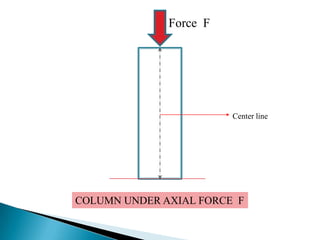
Force F

Center line

COLUMN UNDER AXIAL FORCE F
Axial force is determined by width, effective
length, and load and is measured in kilo
pounds or kips (1,000 pounds of force).
SCOPE:
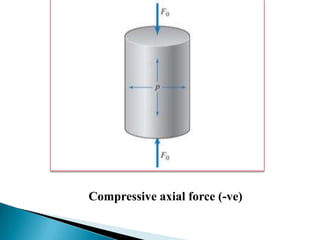
Compressive axial force (-ve)
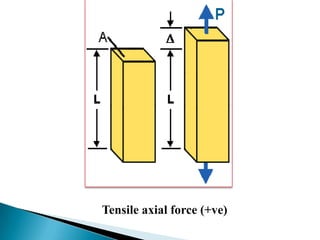
Tensile axial force (+ve)
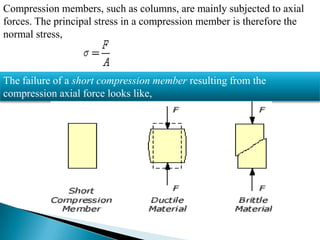
Compression members, such as columns, are mainly subjected to axial
forces. The principal stress in a compression member is therefore the
normal stress,

The failure of a short compression member resulting from the
compression axial force looks like,
DESCRIPTION


An axial force is any force that directly acts on the center
axis of an object. These forces are typically stretching
force or compression force, depending on direction.



A prime example of these forces can be seen on
columns within buildings. The column has an axis that
runs through the entire form from top to bottom. The
column is constantly compressed as it supports the
roof of the structure.
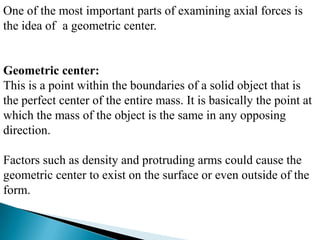
One of the most important parts of examining axial forces is
the idea of a geometric center.

Geometric center:
This is a point within the boundaries of a solid object that is
the perfect center of the entire mass. It is basically the point at
which the mass of the object is the same in any opposing
direction.
Factors such as density and protruding arms could cause the
geometric center to exist on the surface or even outside of the
form.
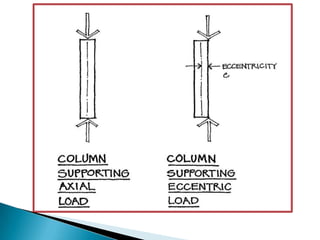
Concentric:
when the force load is even across the form’s geometric center,
it is concentric.
Eccentric:
when the force load is uneven across the form’s geometric
center, it is eccentric.
 In the column example, the axial force runs through the
geometric center of the form; this makes the force
concentric. A concentric force is stable at rest. When the
axis doesn’t pass through the geometric center, the shape
isn’t stable and the force is eccentric. This typically means
that the form is unable to withstand axial forces while at
rest.
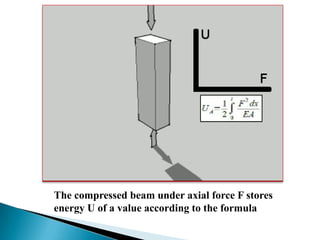
The compressed beam under axial force F stores
energy U of a value according to the formula
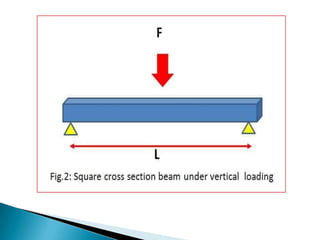
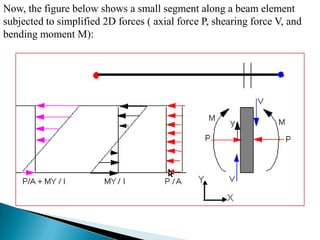
Now, the figure below shows a small segment along a beam element
subjected to simplified 2D forces ( axial force P, shearing force V, and
bending moment M):
In a general case 3 forces and 3 moments act on the segment.
Uniform axial stress = P/A (similar to truss elements)
Uniform shearing stress = V/A
The bending moment M causes a bending stress that varies linearly with
the vertical distance y from the neutral axis.
Bending stress (bending in y direction) = My/I
where I is the moment of inertia about the neutral axis.
The bending stress is the largest at the extreme fibers.

In this example, the largest compression occurs at the top fiber and the
largest tension occurs at the extreme bottom fibers.
THANK YOU

Presentation 10.01.03.008

  • 1.
    AHSANULLAH UNIVERSITY OFSCIENCE & TECHNOLOGY Department of Civil Engineering Prestress Concrete Design Sessional CE 416 PRESENTED BY MD. SHARIFUL ISLAM STUDENT NO: 10.01.03.008 COURSE TEACHERS Mr. Munshi Galib Muktadir Ms. Sabreena Nasrin
  • 2.
  • 3.
  • 4.
     A force appliedparallel to the centerline of an object. Axial force evaluates the internal forces that exist in a structure, often presented by the characteristics of its dimensions.
  • 5.
    Force F Center line COLUMNUNDER AXIAL FORCE F
  • 7.
    Axial force isdetermined by width, effective length, and load and is measured in kilo pounds or kips (1,000 pounds of force).
  • 8.
  • 9.
  • 10.
  • 11.
    Compression members, suchas columns, are mainly subjected to axial forces. The principal stress in a compression member is therefore the normal stress, The failure of a short compression member resulting from the compression axial force looks like,
  • 12.
  • 13.
     An axial forceis any force that directly acts on the center axis of an object. These forces are typically stretching force or compression force, depending on direction.  A prime example of these forces can be seen on columns within buildings. The column has an axis that runs through the entire form from top to bottom. The column is constantly compressed as it supports the roof of the structure.
  • 14.
    One of themost important parts of examining axial forces is the idea of a geometric center. Geometric center: This is a point within the boundaries of a solid object that is the perfect center of the entire mass. It is basically the point at which the mass of the object is the same in any opposing direction. Factors such as density and protruding arms could cause the geometric center to exist on the surface or even outside of the form.
  • 15.
    Concentric: when the forceload is even across the form’s geometric center, it is concentric. Eccentric: when the force load is uneven across the form’s geometric center, it is eccentric.  In the column example, the axial force runs through the geometric center of the form; this makes the force concentric. A concentric force is stable at rest. When the axis doesn’t pass through the geometric center, the shape isn’t stable and the force is eccentric. This typically means that the form is unable to withstand axial forces while at rest.
  • 17.
    The compressed beamunder axial force F stores energy U of a value according to the formula
  • 19.
    Now, the figurebelow shows a small segment along a beam element subjected to simplified 2D forces ( axial force P, shearing force V, and bending moment M):
  • 20.
    In a generalcase 3 forces and 3 moments act on the segment. Uniform axial stress = P/A (similar to truss elements) Uniform shearing stress = V/A The bending moment M causes a bending stress that varies linearly with the vertical distance y from the neutral axis. Bending stress (bending in y direction) = My/I where I is the moment of inertia about the neutral axis. The bending stress is the largest at the extreme fibers. In this example, the largest compression occurs at the top fiber and the largest tension occurs at the extreme bottom fibers.
  • 21.