Welcome to presentation
Based on moment of inertia
Rafiqul islam
10.01.03.005
Course No: CE 416
Course Title :pre-stressed concrete
Introduction
• Forces which are proportional to the area or volume
over which they act but also vary linearly with
distance from a given axis.
- the magnitude of the resultant depends on the first
moment of the force distribution with respect to the
axis.
- The point of application of the resultant depends on
the second moment of the distribution with respect
to the axis.
Herein methods for computing the moments and
products of inertia for areas and masses will be
presented
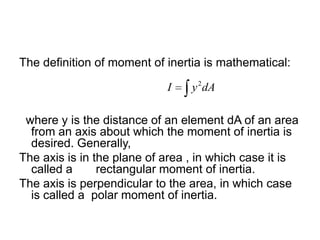
The definition of moment of inertia is mathematical:
I

y 2 dA

where y is the distance of an element dA of an area
from an axis about which the moment of inertia is
desired. Generally,
The axis is in the plane of area , in which case it is
called a
rectangular moment of inertia.
The axis is perpendicular to the area, in which case
is called a polar moment of inertia.
Moment of Inertia of an Area

F

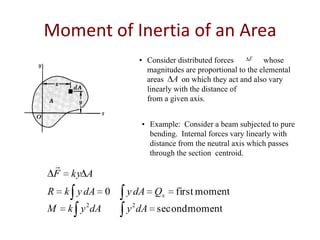
• Consider distributed forces
whose
magnitudes are proportional to the elemental
areas A on which they act and also vary
linearly with the distance of
from a given axis.
• Example: Consider a beam subjected to pure
bending. Internal forces vary linearly with
distance from the neutral axis which passes
through the section centroid.


F

ky A

R

k y dA 0

M

k y 2 dA

y dA Qx

first moment

y 2 dA second moment
Moment of Inertia of an Area by
Integration
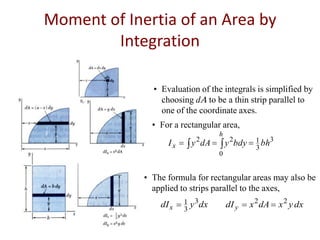
• Evaluation of the integrals is simplified by
choosing d to be a thin strip parallel to
one of the coordinate axes.
• For a rectangular area,
Ix

2

h

y dA

y 2bdy

0

1 bh3
3

• The formula for rectangular areas may also be
applied to strips parallel to the axes,

dI x

1 y 3dx
3

dI y

x 2 dA

x 2 y dx
Polar Moment of Inertia
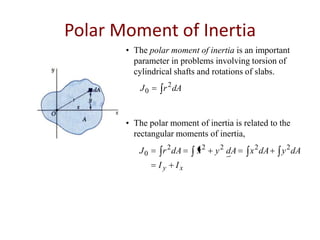
• The polar moment of inertia is an important
parameter in problems involving torsion of
cylindrical shafts and rotations of slabs.
J0

r 2 dA

• The polar moment of inertia is related to the
rectangular moments of inertia,

J0

r 2 dA
Iy

Ix

x2

y 2 dA

x 2 dA

y 2 dA
Radius of Gyration of an Area
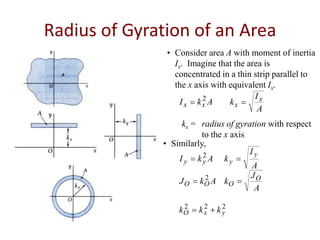
• Consider area A with moment of inertia
Ix. Imagine that the area is
concentrated in a thin strip parallel to
the x axis with equivalent Ix.
Ix
2
I x kx A
kx
A
kx = radius of gyration with respect
to the x axis
• Similarly,
Iy
2
Iy ky A ky
A
JO
2
J O kO A kO
A
2
kO

2
kx

2
ky
Examples
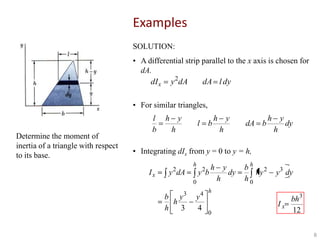
SOLUTION:

•

• A differential strip parallel to the x axis is chosen for
dA.
dI x y 2dA
dA l dy
• For similar triangles,

Determine the moment of
inertia of a triangle with respect
to its base.

l
b

h

y

l

h

b

h

y
h

dA b

h

y
h

dy

• Integrating dIx from y = 0 to y = h,
Ix

h

2

y dA

2

y b

h

0
3

b y
h
h
3

y
h

dy

bh 2
hy
h0

y 3 dy

4 h

y
4

Ix
0

bh3
12
8
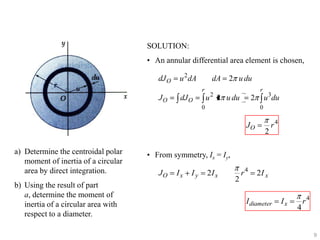
SOLUTION:

• An annular differential area element is chosen,
dJ O

u 2 dA

dA
r

JO

dJ O

2 u du
r

2

u 2 u du

2

0

0

JO
a) Determine the centroidal polar
moment of inertia of a circular
area by direct integration.
b) Using the result of part
a, determine the moment of
inertia of a circular area with
respect to a diameter.

u 3du

2

r4

• From symmetry, Ix = Iy,

JO

Ix

Iy

2I x

2

r4

2I x

I diameter

Ix

4

r4

9
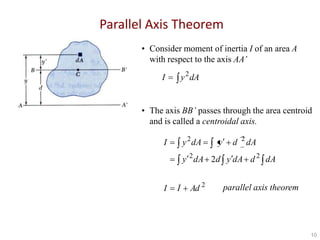
Parallel Axis Theorem
• Consider moment of inertia I of an area A
with respect to the axis AA’
y 2 dA

I

• The axis BB’ passes through the area centroid
and is called a centroidal axis.
y 2 dA

I

y

d 2 dA

y 2 dA 2d y dA d 2 dA
I

I

Ad 2

parallel axis theorem

10
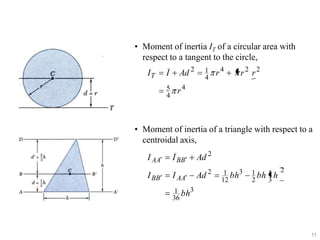
• Moment of inertia IT of a circular area with
respect to a tangent to the circle,

I

Ad 2

5
4

IT

r4

1
4

r4

r2 r2

• Moment of inertia of a triangle with respect to a
centroidal axis,
I AA
I BB

I BB

Ad 2

I AA

2

Ad

1 bh3
12

1 bh 1 h 2
2
3

1 bh3
36

11
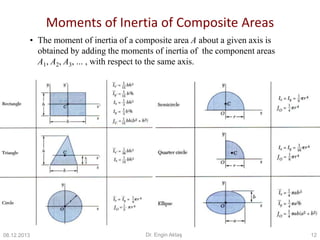
Moments of Inertia of Composite Areas
• The moment of inertia of a composite area A about a given axis is
obtained by adding the moments of inertia of the component areas
A1, A2, A3, ... , with respect to the same axis.

08.12.2013

Dr. Engin Aktaş

12
Thanks to everybody
10.01.03.005

10.01.03.005

  • 1.
    Welcome to presentation Basedon moment of inertia Rafiqul islam 10.01.03.005 Course No: CE 416 Course Title :pre-stressed concrete
  • 2.
    Introduction • Forces whichare proportional to the area or volume over which they act but also vary linearly with distance from a given axis. - the magnitude of the resultant depends on the first moment of the force distribution with respect to the axis. - The point of application of the resultant depends on the second moment of the distribution with respect to the axis. Herein methods for computing the moments and products of inertia for areas and masses will be presented
  • 3.
    The definition ofmoment of inertia is mathematical: I y 2 dA where y is the distance of an element dA of an area from an axis about which the moment of inertia is desired. Generally, The axis is in the plane of area , in which case it is called a rectangular moment of inertia. The axis is perpendicular to the area, in which case is called a polar moment of inertia.
  • 4.
    Moment of Inertiaof an Area  F • Consider distributed forces whose magnitudes are proportional to the elemental areas A on which they act and also vary linearly with the distance of from a given axis. • Example: Consider a beam subjected to pure bending. Internal forces vary linearly with distance from the neutral axis which passes through the section centroid.  F ky A R k y dA 0 M k y 2 dA y dA Qx first moment y 2 dA second moment
  • 5.
    Moment of Inertiaof an Area by Integration • Evaluation of the integrals is simplified by choosing d to be a thin strip parallel to one of the coordinate axes. • For a rectangular area, Ix 2 h y dA y 2bdy 0 1 bh3 3 • The formula for rectangular areas may also be applied to strips parallel to the axes, dI x 1 y 3dx 3 dI y x 2 dA x 2 y dx
  • 6.
    Polar Moment ofInertia • The polar moment of inertia is an important parameter in problems involving torsion of cylindrical shafts and rotations of slabs. J0 r 2 dA • The polar moment of inertia is related to the rectangular moments of inertia, J0 r 2 dA Iy Ix x2 y 2 dA x 2 dA y 2 dA
  • 7.
    Radius of Gyrationof an Area • Consider area A with moment of inertia Ix. Imagine that the area is concentrated in a thin strip parallel to the x axis with equivalent Ix. Ix 2 I x kx A kx A kx = radius of gyration with respect to the x axis • Similarly, Iy 2 Iy ky A ky A JO 2 J O kO A kO A 2 kO 2 kx 2 ky
  • 8.
    Examples SOLUTION: • • A differentialstrip parallel to the x axis is chosen for dA. dI x y 2dA dA l dy • For similar triangles, Determine the moment of inertia of a triangle with respect to its base. l b h y l h b h y h dA b h y h dy • Integrating dIx from y = 0 to y = h, Ix h 2 y dA 2 y b h 0 3 b y h h 3 y h dy bh 2 hy h0 y 3 dy 4 h y 4 Ix 0 bh3 12 8
  • 9.
    SOLUTION: • An annulardifferential area element is chosen, dJ O u 2 dA dA r JO dJ O 2 u du r 2 u 2 u du 2 0 0 JO a) Determine the centroidal polar moment of inertia of a circular area by direct integration. b) Using the result of part a, determine the moment of inertia of a circular area with respect to a diameter. u 3du 2 r4 • From symmetry, Ix = Iy, JO Ix Iy 2I x 2 r4 2I x I diameter Ix 4 r4 9
  • 10.
    Parallel Axis Theorem •Consider moment of inertia I of an area A with respect to the axis AA’ y 2 dA I • The axis BB’ passes through the area centroid and is called a centroidal axis. y 2 dA I y d 2 dA y 2 dA 2d y dA d 2 dA I I Ad 2 parallel axis theorem 10
  • 11.
    • Moment ofinertia IT of a circular area with respect to a tangent to the circle, I Ad 2 5 4 IT r4 1 4 r4 r2 r2 • Moment of inertia of a triangle with respect to a centroidal axis, I AA I BB I BB Ad 2 I AA 2 Ad 1 bh3 12 1 bh 1 h 2 2 3 1 bh3 36 11
  • 12.
    Moments of Inertiaof Composite Areas • The moment of inertia of a composite area A about a given axis is obtained by adding the moments of inertia of the component areas A1, A2, A3, ... , with respect to the same axis. 08.12.2013 Dr. Engin Aktaş 12
  • 13.