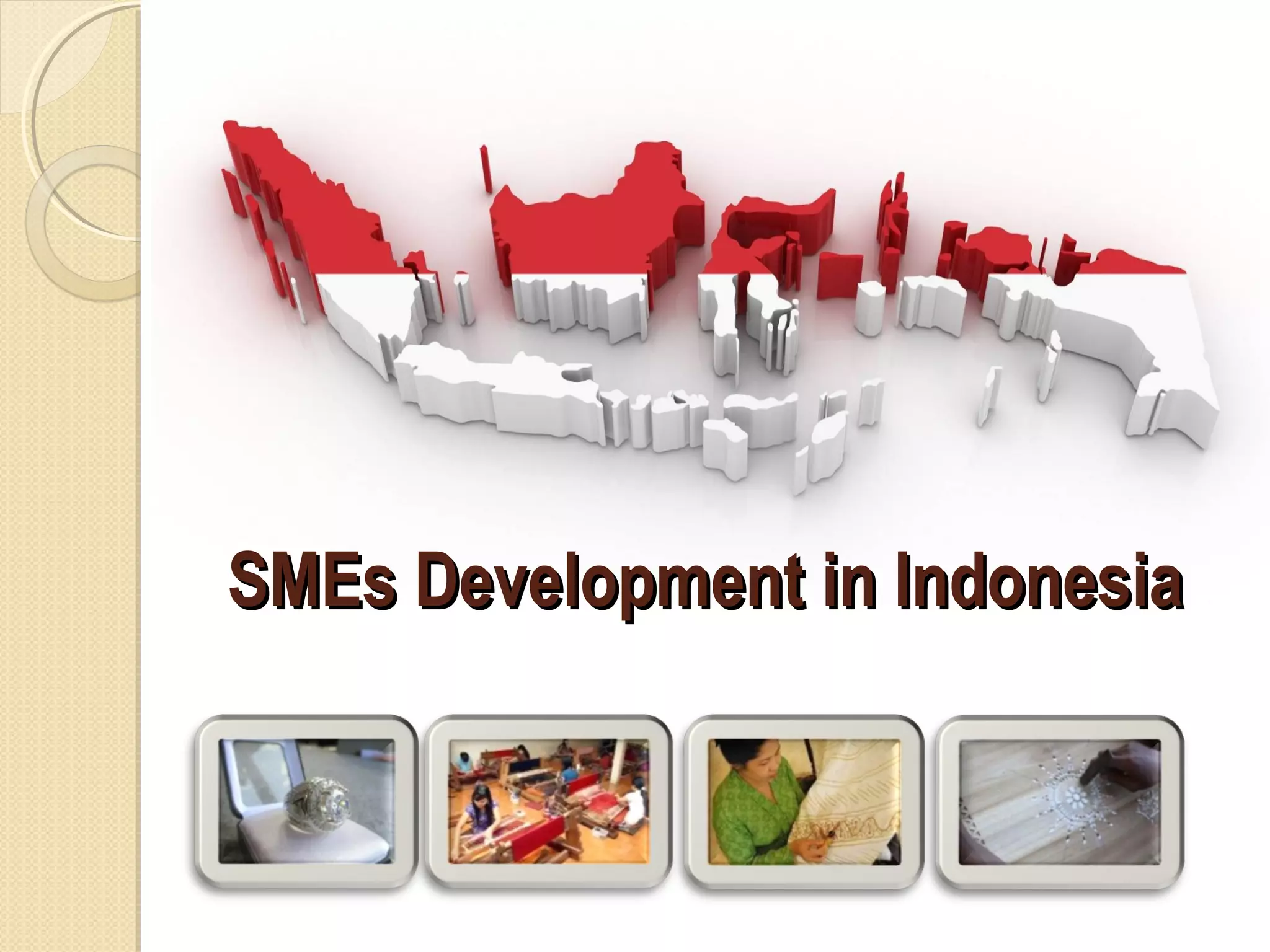

SSMMEEss DDeevveellooppmmeenntt iinn IInnddoonneessiiaa
INTRODUCTION 
- Small Medium Enterprises (SMEs) in Indonesia is growing 
fast. In the period of 2011-2012, SMEs in Indonesia 
grew as much as 2.41% 
- SMEs in Indonesia gives big contribution to create job 
employment, SMEs created jobs to about 97.24% (equal 
to 101.722.548 persons); and in 2012, SMEs had 
successfully created jobs to about 9.16% (equal to 
107.657.509 persons). 
- SMEs’ contribution to the National GDP is also 
significant. In 2011, SMEs’ contribution to National GDP 
was about 57.94% (or equal to IDR 4.303.571,5 
Trillion) and it increased to 59.08% (or equal to 
IDR 4.869.568,1 Trillion) in 2012. These 
contributions have made SMEs become one of the 
key sectors to enhance Indonesian economy
- The main policy challenge will be to speed up the 
development of technology based SMEs, preferably 
in the kind of technology that conforms to the current 
global discourse on sustainable development that 
embeds with three key domains: i) Environmental 
Sustainability, ii) Social Sustainability, and iii) 
Economic Sustainability. In that spirit, the main feature 
of the development policies for SMEs consists of: 
a) Improvement of access to technology, 
b) Improvement of access to finance, 
c) Improvement of access to market, 
d) Technology diffusion and commercialization scenarios 
through business incubation, and 
e) Provision and creation of conducive environment to 
supportnew business ventures, etc.
SSTTRRAATTEEGGIIEESS AANNDD 
CCHHAALLLLEENNGGEESS 
In order to pursue National Welfare, GOI supports its 
SMEs in many ways. Indonesia’s policy and strategy are 
geared up to drive SMEs empowerment. The SMEs’ 
empowerment programmes are done by empowering the 
policy directions as follows: 
1.Develop SMEs to support their significant 
contributions towards economy growth, jobs creation, and 
increasing competitiveness as well as to support their 
contribution on increasing people’s income, especially 
to low-income people; 
2.Strengthen the institutions by applying good governance 
principals; 
3.Expand the bases and opportunities as well as grow 
the senses of entrepreneurship to drive national 
growth, to increase export, and to create job employment;
4. Increase the collaboration of educated labour and skilled 
labour by adopting technology application; 
5. Develop SMEs to increasingly play its role in the process 
of industrialization, transfer technology, and capacity 
building; 
6. Integrate business development in the context of regional 
improvement, in line with the character of entrepreneur, 
and business potential in each province; 
7. Develop SMEs to increasingly play a role as products 
(goods and services) provider to become more competitive 
than importer’s products.
Those strategies are made up to speed up SMEs 
capacity in line with Indonesian policy direction which 
focuses on 5 priorities: 
1.increase business climate for Cooperative and SMEs 
2.increase access toward productive resources 
3.develop product and market for Cooperatives and 
SMEs, 
4.increase labour competitiveness 
5.increase Cooperatives as institution
Problems 
Indonesia still face many problems in promoting SMEs 
export products which include internal and external 
problems. 
1.Internally, obstacles that face by Indonesian SMEs 
involve: 
-low commitment to fulfill consumer orders (both domestic 
and foreign customers); 
-lack of management applied by SMEs, especially in 
production, administration, and financial aspects; 
-limitation of facilitation for SMEs in order to fulfill 
orders; low quality of human resources; 
-limitation of capital owned by SMEs; 
-lack of information and communication to stakeholders; and 
lack of capability in SMEs research and development
2. Externally, Indonesia face several problems, such as: 
-instability of supply and price of raw and support 
materials; 
-high requirements from buyers toward product quality, 
social environment quality, work environment quality, price 
competition, and eco-friendly aspects; 
-lack of market access; 
-lack of financial access which includes information, credit 
skim, and high interest rate; 
-also variation of halal standardization between Indonesia and 
importing countries
Towards those challenges, attention has been 
paid to support SMEs in many aspects. Encouraging 
entrepreneurship on SMEs players is put high on the 
agenda of GOI, for entrepreneurs are seen as the 
catalyst of growth, combining capital, innovation and 
skills. This agenda recognizes the importance of 
entrepreneurship that stands out in the time of 
innovative change, and fostering a conducive climate for 
SMEs which is considered as fundamental aspect
The presumed initiative gives special consideration 
to the increasingly important role of SMEs in economy. 
Two prong objectives, i.e. to increase the number of 
innovative start-ups and to improve the technological 
capability of existing SMEs are targeted simultaneously. 
Those initiatives attempt to address issues related to 
technology diffusion, innovation, business environment and 
regulatory framework, financing, taxation, human 
resources, access to markets, electronic commerce, etc.
CCOONNCCLLUUSSIIOONN 
in the context of rapid flows of information and 
capital and increased global competition, it is argued that 
strategic national and regional efforts to maintain 
industrial competitiveness depend not only on 
innovativeness but more than ever on the diffusion, 
effective application, and further incremental 
improvement of known technologies. More importantly, 
the establishment of takers for each innovative product 
had been becoming more pressing than ever.
Presentasi project report (SME Development In Indonesia)

Presentasi project report (SME Development In Indonesia)

  • 1.
  • 2.
    INTRODUCTION - SmallMedium Enterprises (SMEs) in Indonesia is growing fast. In the period of 2011-2012, SMEs in Indonesia grew as much as 2.41% - SMEs in Indonesia gives big contribution to create job employment, SMEs created jobs to about 97.24% (equal to 101.722.548 persons); and in 2012, SMEs had successfully created jobs to about 9.16% (equal to 107.657.509 persons). - SMEs’ contribution to the National GDP is also significant. In 2011, SMEs’ contribution to National GDP was about 57.94% (or equal to IDR 4.303.571,5 Trillion) and it increased to 59.08% (or equal to IDR 4.869.568,1 Trillion) in 2012. These contributions have made SMEs become one of the key sectors to enhance Indonesian economy
  • 3.
    - The mainpolicy challenge will be to speed up the development of technology based SMEs, preferably in the kind of technology that conforms to the current global discourse on sustainable development that embeds with three key domains: i) Environmental Sustainability, ii) Social Sustainability, and iii) Economic Sustainability. In that spirit, the main feature of the development policies for SMEs consists of: a) Improvement of access to technology, b) Improvement of access to finance, c) Improvement of access to market, d) Technology diffusion and commercialization scenarios through business incubation, and e) Provision and creation of conducive environment to supportnew business ventures, etc.
  • 4.
    SSTTRRAATTEEGGIIEESS AANNDD CCHHAALLLLEENNGGEESS In order to pursue National Welfare, GOI supports its SMEs in many ways. Indonesia’s policy and strategy are geared up to drive SMEs empowerment. The SMEs’ empowerment programmes are done by empowering the policy directions as follows: 1.Develop SMEs to support their significant contributions towards economy growth, jobs creation, and increasing competitiveness as well as to support their contribution on increasing people’s income, especially to low-income people; 2.Strengthen the institutions by applying good governance principals; 3.Expand the bases and opportunities as well as grow the senses of entrepreneurship to drive national growth, to increase export, and to create job employment;
  • 5.
    4. Increase thecollaboration of educated labour and skilled labour by adopting technology application; 5. Develop SMEs to increasingly play its role in the process of industrialization, transfer technology, and capacity building; 6. Integrate business development in the context of regional improvement, in line with the character of entrepreneur, and business potential in each province; 7. Develop SMEs to increasingly play a role as products (goods and services) provider to become more competitive than importer’s products.
  • 6.
    Those strategies aremade up to speed up SMEs capacity in line with Indonesian policy direction which focuses on 5 priorities: 1.increase business climate for Cooperative and SMEs 2.increase access toward productive resources 3.develop product and market for Cooperatives and SMEs, 4.increase labour competitiveness 5.increase Cooperatives as institution
  • 7.
    Problems Indonesia stillface many problems in promoting SMEs export products which include internal and external problems. 1.Internally, obstacles that face by Indonesian SMEs involve: -low commitment to fulfill consumer orders (both domestic and foreign customers); -lack of management applied by SMEs, especially in production, administration, and financial aspects; -limitation of facilitation for SMEs in order to fulfill orders; low quality of human resources; -limitation of capital owned by SMEs; -lack of information and communication to stakeholders; and lack of capability in SMEs research and development
  • 8.
    2. Externally, Indonesiaface several problems, such as: -instability of supply and price of raw and support materials; -high requirements from buyers toward product quality, social environment quality, work environment quality, price competition, and eco-friendly aspects; -lack of market access; -lack of financial access which includes information, credit skim, and high interest rate; -also variation of halal standardization between Indonesia and importing countries
  • 9.
    Towards those challenges,attention has been paid to support SMEs in many aspects. Encouraging entrepreneurship on SMEs players is put high on the agenda of GOI, for entrepreneurs are seen as the catalyst of growth, combining capital, innovation and skills. This agenda recognizes the importance of entrepreneurship that stands out in the time of innovative change, and fostering a conducive climate for SMEs which is considered as fundamental aspect
  • 10.
    The presumed initiativegives special consideration to the increasingly important role of SMEs in economy. Two prong objectives, i.e. to increase the number of innovative start-ups and to improve the technological capability of existing SMEs are targeted simultaneously. Those initiatives attempt to address issues related to technology diffusion, innovation, business environment and regulatory framework, financing, taxation, human resources, access to markets, electronic commerce, etc.
  • 11.
    CCOONNCCLLUUSSIIOONN in thecontext of rapid flows of information and capital and increased global competition, it is argued that strategic national and regional efforts to maintain industrial competitiveness depend not only on innovativeness but more than ever on the diffusion, effective application, and further incremental improvement of known technologies. More importantly, the establishment of takers for each innovative product had been becoming more pressing than ever.