©COPYRIGHT 2011. ANDREW J. SHERMAN. ALL RIGHTS RESERVED 1
Firmex Webinar Series
M&A Master Class
November 17, 2011
1:00 p.m. to 2:00 p.m.
Andrew J. Sherman, Esq.
Jones Day
51 Louisiana Avenue, N.W.
Washington, D.C. 20001-2113
202-879-3686
ajsherman@jonesday.com
Art or Science?
Due Diligence Best Practices and Pitfalls
#firmexmc
©COPYRIGHT 2011. ANDREW J. SHERMAN. ALL RIGHTS RESERVED 2
About Firmex
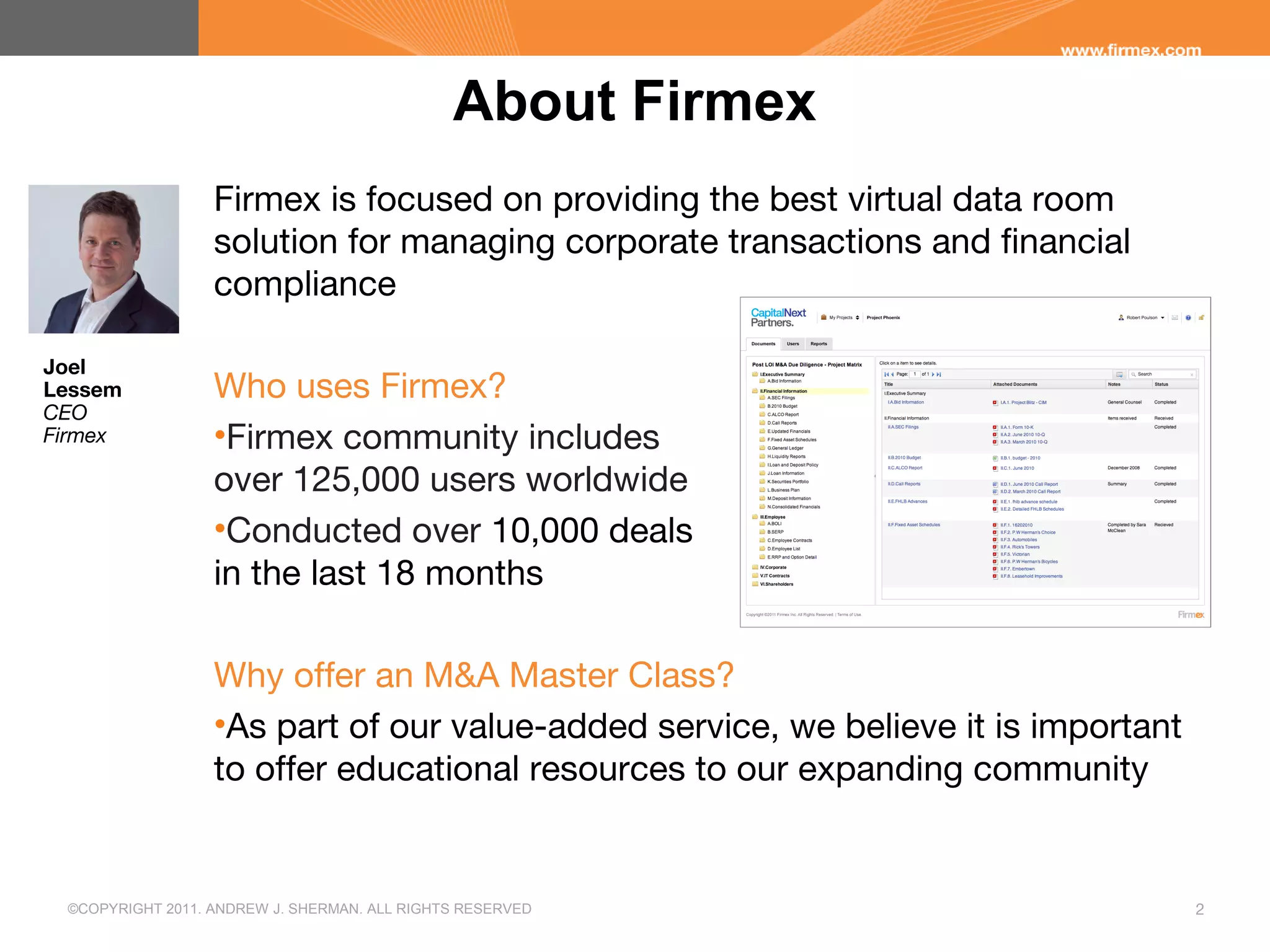
Firmex is focused on providing the best virtual data room
solution for managing corporate transactions and financial
compliance
Who uses Firmex?
•Firmex community includes
over 125,000 users worldwide
•Conducted over 10,000 deals
in the last 18 months
Why offer an M&A Master Class?
•As part of our value-added service, we believe it is important
to offer educational resources to our expanding community
Joel
Lessem
CEO
Firmex
©COPYRIGHT 2011. ANDREW J. SHERMAN. ALL RIGHTS RESERVED 3
Andrew J. Sherman
Mr. Sherman is a partner in the Washington, D.C. office of Jones Day with over 2,500
lawyers worldwide.
He is the author of 23 books on business growth, capital formation and the leveraging of
intellectual property. His eighteenth (18th) book, Road Rules Be the Truck. Not the
Squirrel. (http://www.bethetruck.com) is an inspirational book which was published in
the Fall of 2008. He has appeared as a guest and a commentator on all of the major
television networks as well as CNBC’s “Power Lunch,” CNN’s “Day Watch,” CNNfn’s
“For Entrepreneurs Only,” USA Network’s “First Business,” and Bloomberg’s “Small
Business Weekly.” He has appeared on numerous regional and local television
broadcasts as well as national and local radio interviews for National Public Radio
(NPR), Business News Network (BNN), Bloomberg Radio, AP Radio Network, Voice of
America, Talk America Radio Network and the USA Radio Network, as a resource on
capital formation, entrepreneurship and technology development.
He has served as a top-rated Adjunct Professor in the Masters of Business
Administration (MBA) programs at the University of Maryland for 23 years and at
Georgetown University for 15 years where he teaches courses on business growth
strategy.
He has served as General Counsel to the Young Entrepreneurs’ Organization (YEO)
since 1987. In 2003, Fortune magazine named him one of the Top Ten Minds in
Entrepreneurship and in February of 2006, Inc. magazine named him one of the all-time
champions and supporters of entrepreneurship.
©COPYRIGHT 2011. ANDREW J. SHERMAN. ALL RIGHTS RESERVED 4
What Is “Due Diligence”?
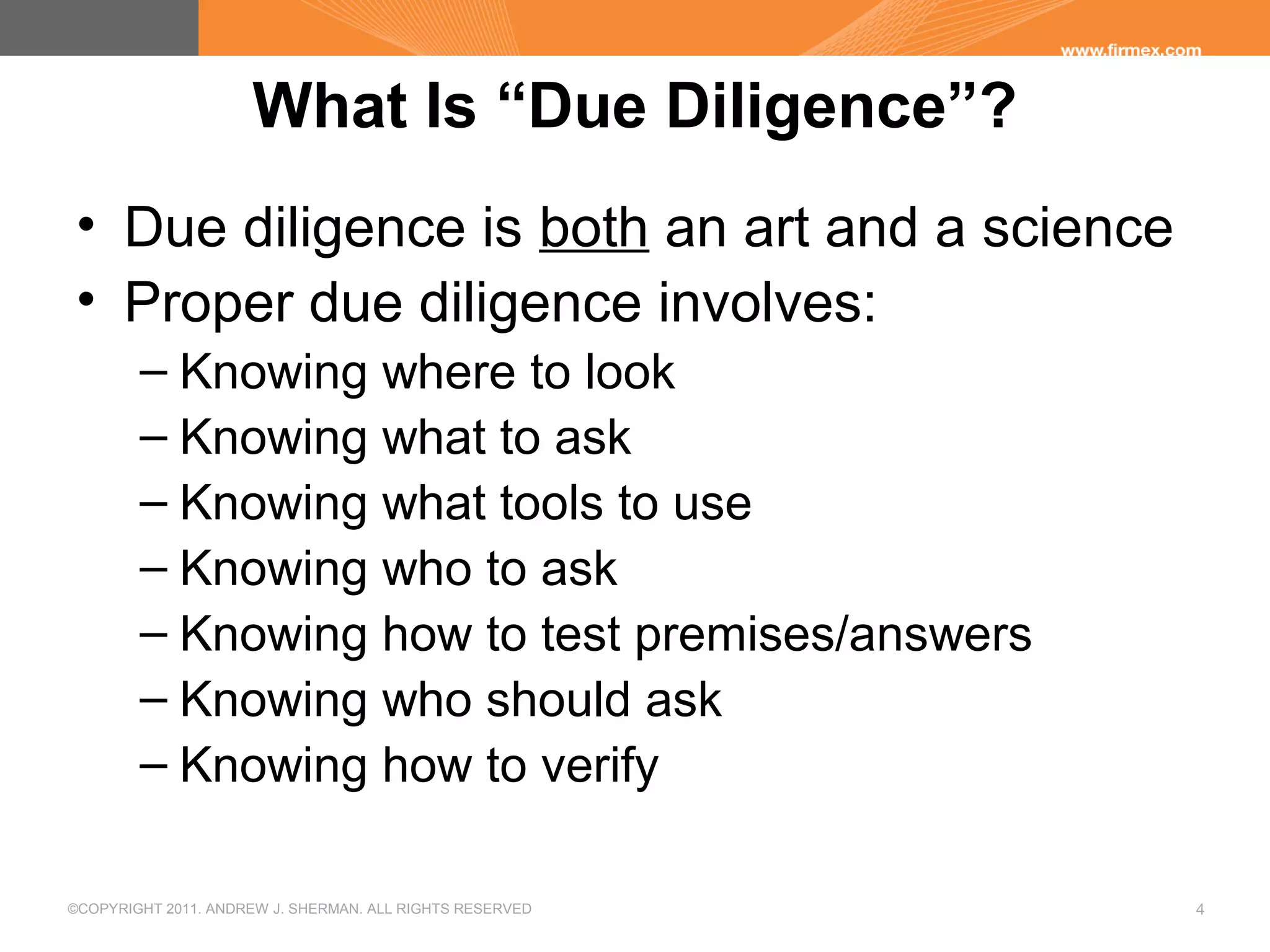
• Due diligence is both an art and a science
• Proper due diligence involves:
– Knowing where to look
– Knowing what to ask
– Knowing what tools to use
– Knowing who to ask
– Knowing how to test premises/answers
– Knowing who should ask
– Knowing how to verify
©COPYRIGHT 2011. ANDREW J. SHERMAN. ALL RIGHTS RESERVED 5
What Is “Due Diligence”? (Cont’d)
• The “Art” of Due Diligence:
– Understanding how to extract key information
from a person or situation
– Understanding the objectives of the parties
and the underlying transaction
– Identifying key hurdles and risks
– Identifying why information might be falsified
or omitted
– Targeting the proper sources for disclosure of
information
©COPYRIGHT 2011. ANDREW J. SHERMAN. ALL RIGHTS RESERVED 6
What Is “Due Diligence”? (Cont’d)
• The “Science” of Due Diligence:
– Do your homework
– Be prepared and well-organized
– Be precise in your requests
– Be persistent in your quest for the truth
– Don’t accept the first answer as the final
answer
– Trust your gut – “if it’s too good to be true …”
©COPYRIGHT 2011. ANDREW J. SHERMAN. ALL RIGHTS RESERVED 7
Our Due Diligence “Heros”
Peter Falk
AJS
TO
PICK
PICTURE
AJS
TO
PICK
PICTURE
Curious George Sherlock Holmes
©COPYRIGHT 2011. ANDREW J. SHERMAN. ALL RIGHTS RESERVED 8
Due Diligence and Current Events
• Impact of 9/11/01 Attacks
• Impact of Dot.com failures and Enron
• The era of Sarbanes-Oxley
• Subprime Crisis
• The Madoff and Stanford scandals
• Overall global recession and financial system woes
Bottom Line:
We are in an era where everything and everyone must
be questioned and answers verified
©COPYRIGHT 2011. ANDREW J. SHERMAN. ALL RIGHTS RESERVED 9
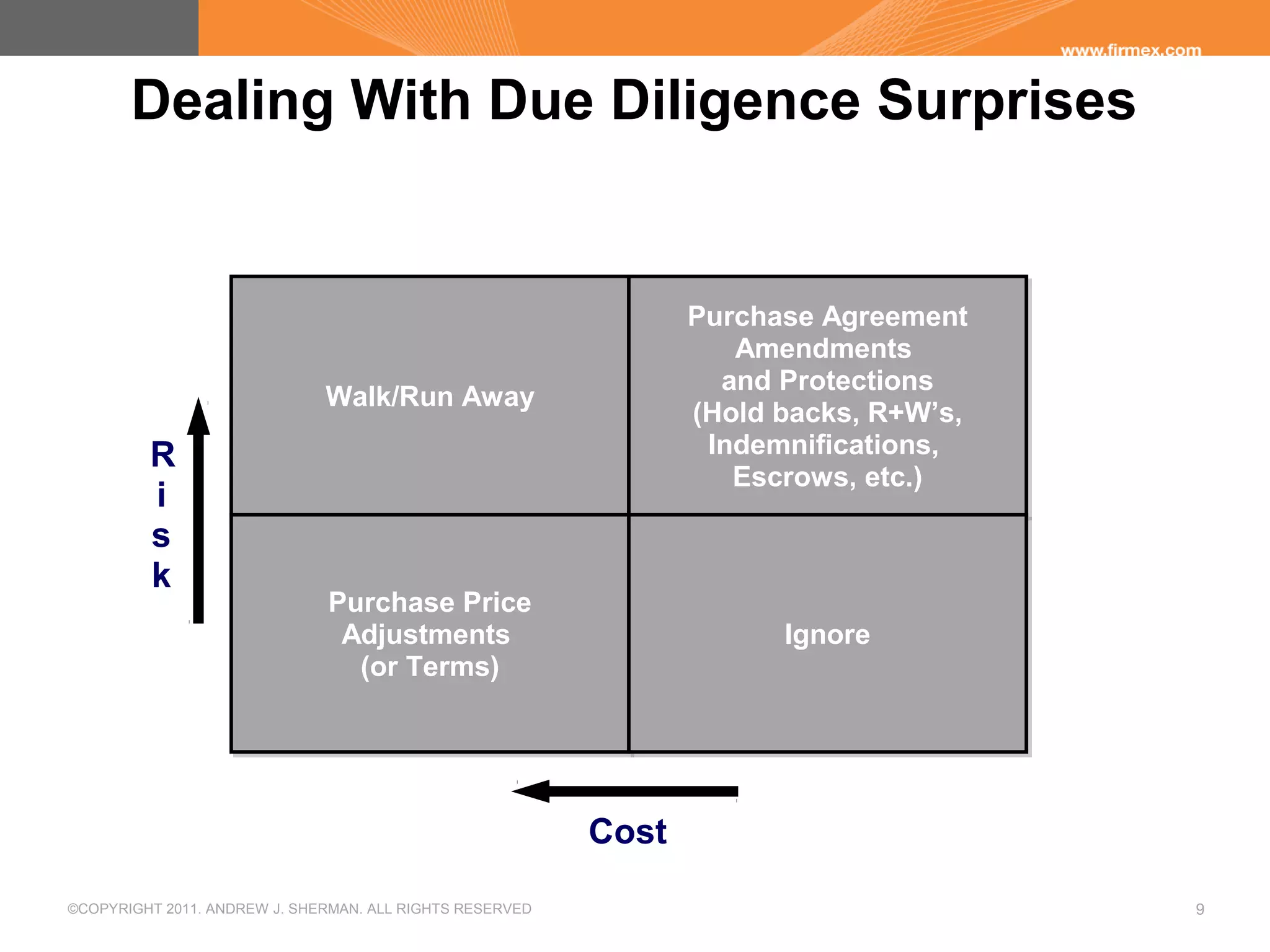
Dealing With Due Diligence Surprises
Walk/Run AwayWalk/Run Away
Purchase Agreement
Amendments
and Protections
(Hold backs, R+W’s,
Indemnifications,
Escrows, etc.)
Purchase Agreement
Amendments
and Protections
(Hold backs, R+W’s,
Indemnifications,
Escrows, etc.)
Purchase Price
Adjustments
(or Terms)
Purchase Price
Adjustments
(or Terms)
IgnoreIgnore
Cost
R
i
s
k
©COPYRIGHT 2011. ANDREW J. SHERMAN. ALL RIGHTS RESERVED 10
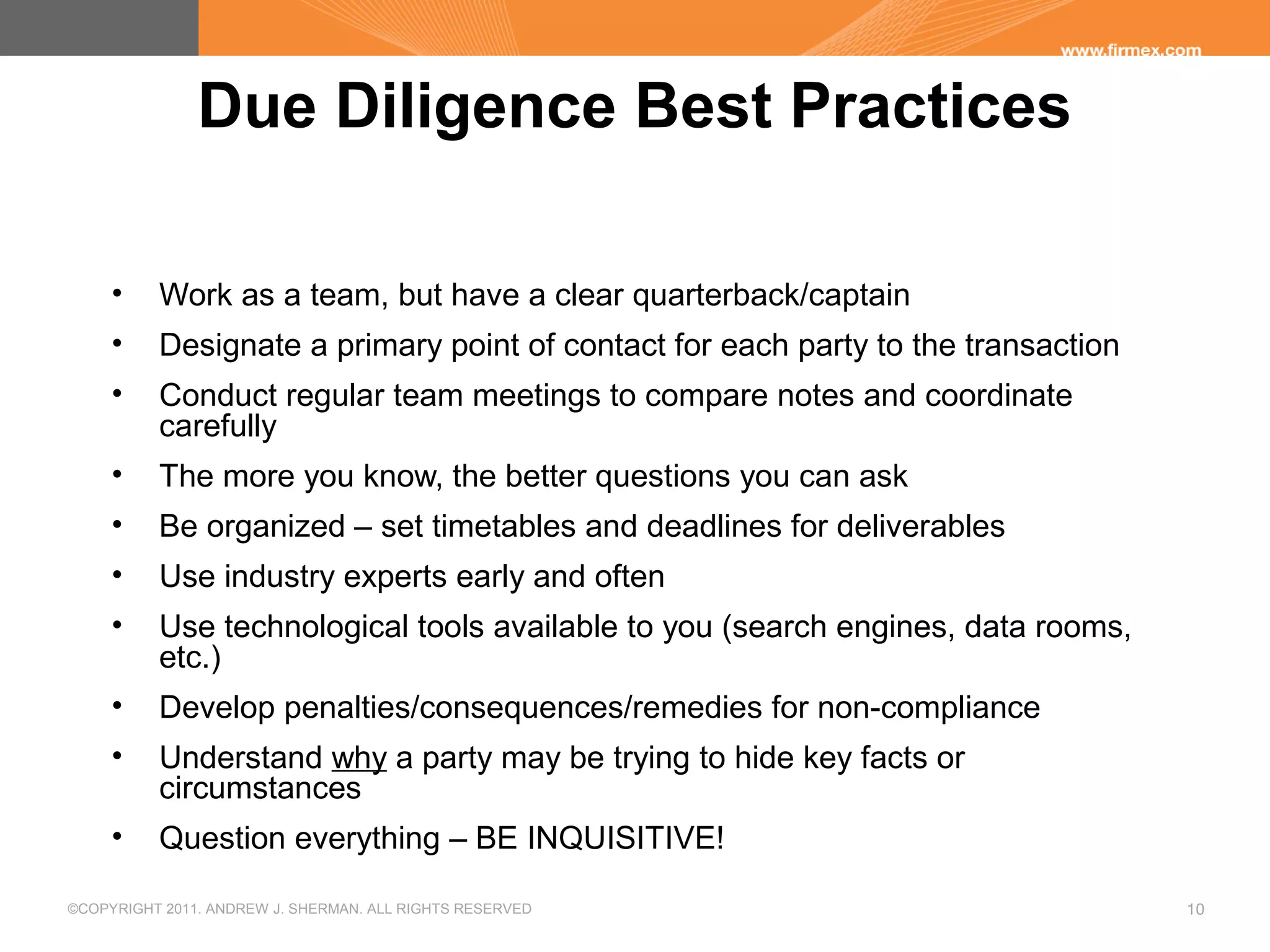
Due Diligence Best Practices
• Work as a team, but have a clear quarterback/captain
• Designate a primary point of contact for each party to the transaction
• Conduct regular team meetings to compare notes and coordinate
carefully
• The more you know, the better questions you can ask
• Be organized – set timetables and deadlines for deliverables
• Use industry experts early and often
• Use technological tools available to you (search engines, data rooms,
etc.)
• Develop penalties/consequences/remedies for non-compliance
• Understand why a party may be trying to hide key facts or
circumstances
• Question everything – BE INQUISITIVE!
©COPYRIGHT 2011. ANDREW J. SHERMAN. ALL RIGHTS RESERVED 11
Overview of Analysis of
M&A Targets
©COPYRIGHT 2011. ANDREW J. SHERMAN. ALL RIGHTS RESERVED 12
Overview of the
Due Diligence Process
©COPYRIGHT 2011. ANDREW J. SHERMAN. ALL RIGHTS RESERVED 13
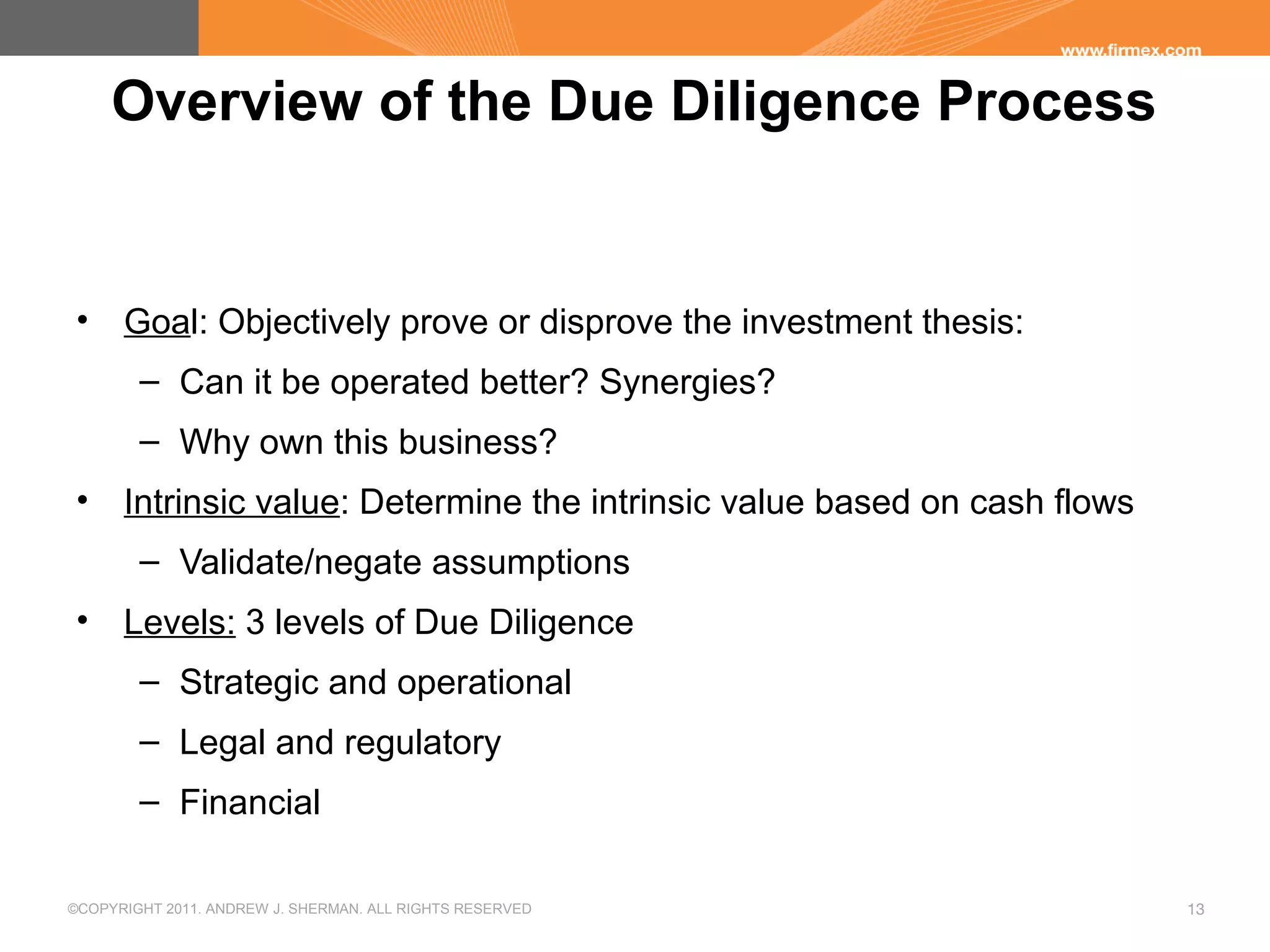
Overview of the Due Diligence Process
• Goal: Objectively prove or disprove the investment thesis:
– Can it be operated better? Synergies?
– Why own this business?
• Intrinsic value: Determine the intrinsic value based on cash flows
– Validate/negate assumptions
• Levels: 3 levels of Due Diligence
– Strategic and operational
– Legal and regulatory
– Financial
©COPYRIGHT 2011. ANDREW J. SHERMAN. ALL RIGHTS RESERVED 14
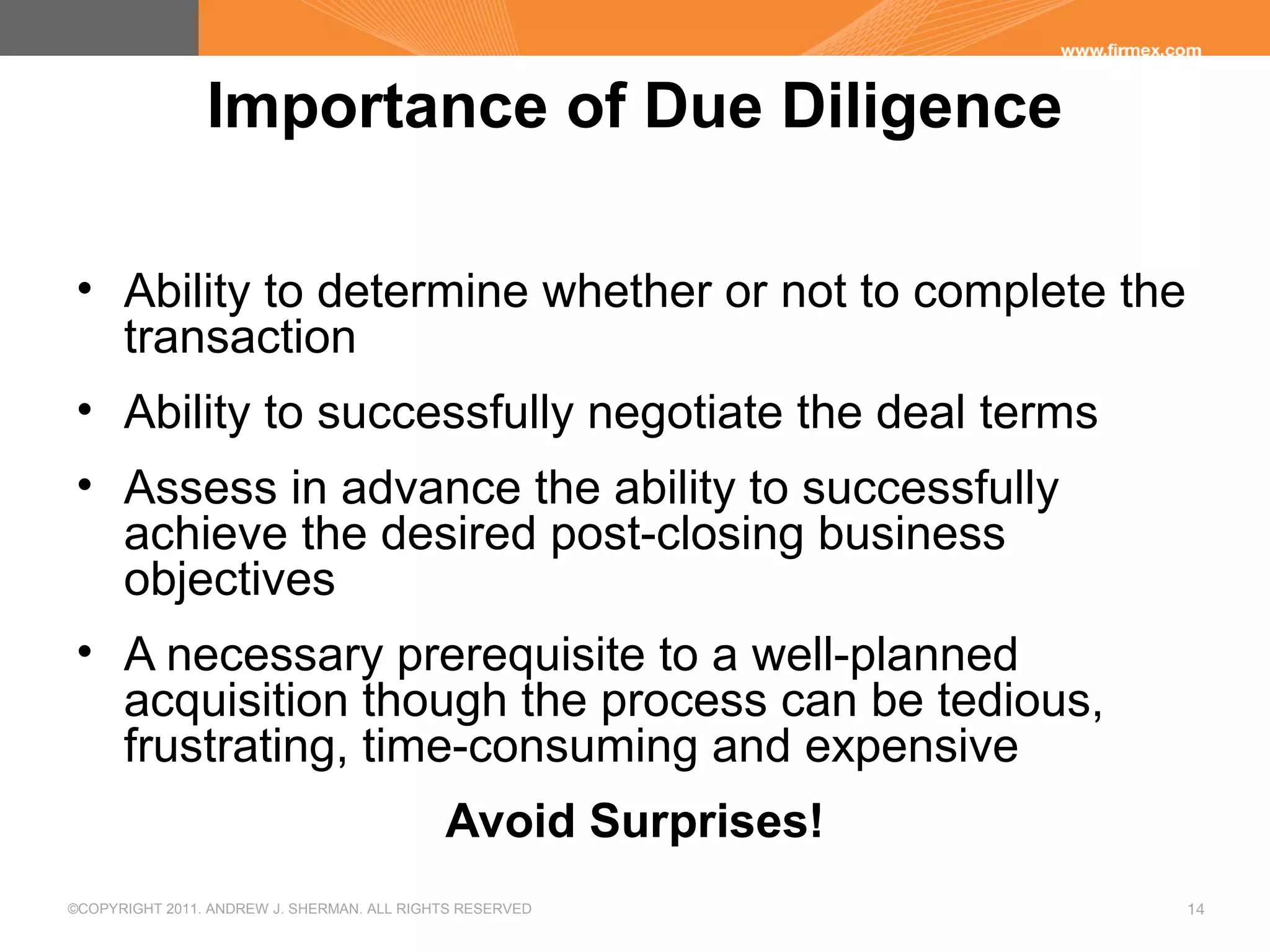
Importance of Due Diligence
• Ability to determine whether or not to complete the
transaction
• Ability to successfully negotiate the deal terms
• Assess in advance the ability to successfully
achieve the desired post-closing business
objectives
• A necessary prerequisite to a well-planned
acquisition though the process can be tedious,
frustrating, time-consuming and expensive
Avoid Surprises!
©COPYRIGHT 2011. ANDREW J. SHERMAN. ALL RIGHTS RESERVED 15
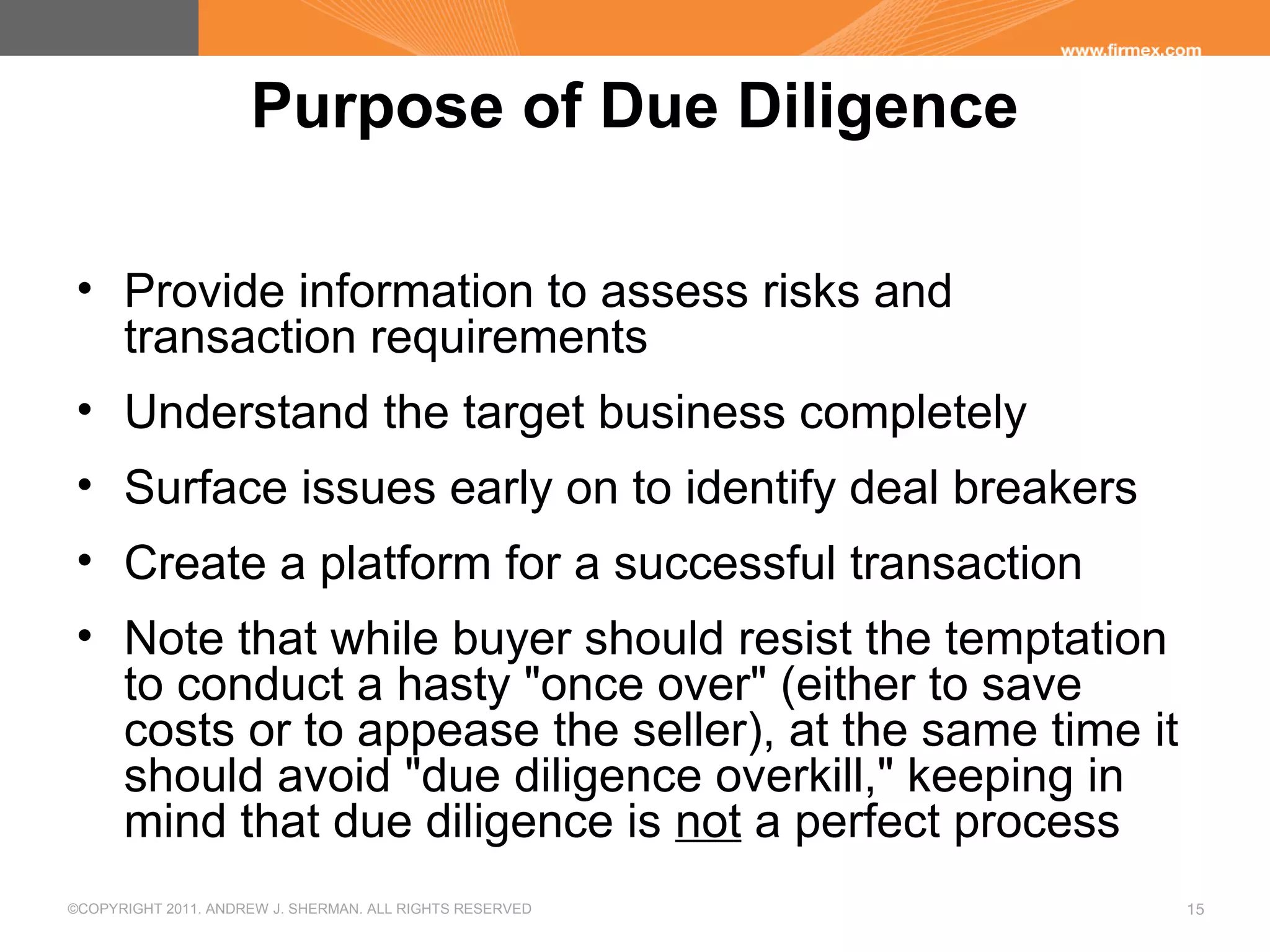
Purpose of Due Diligence
• Provide information to assess risks and
transaction requirements
• Understand the target business completely
• Surface issues early on to identify deal breakers
• Create a platform for a successful transaction
• Note that while buyer should resist the temptation
to conduct a hasty "once over" (either to save
costs or to appease the seller), at the same time it
should avoid "due diligence overkill," keeping in
mind that due diligence is not a perfect process
©COPYRIGHT 2011. ANDREW J. SHERMAN. ALL RIGHTS RESERVED 16
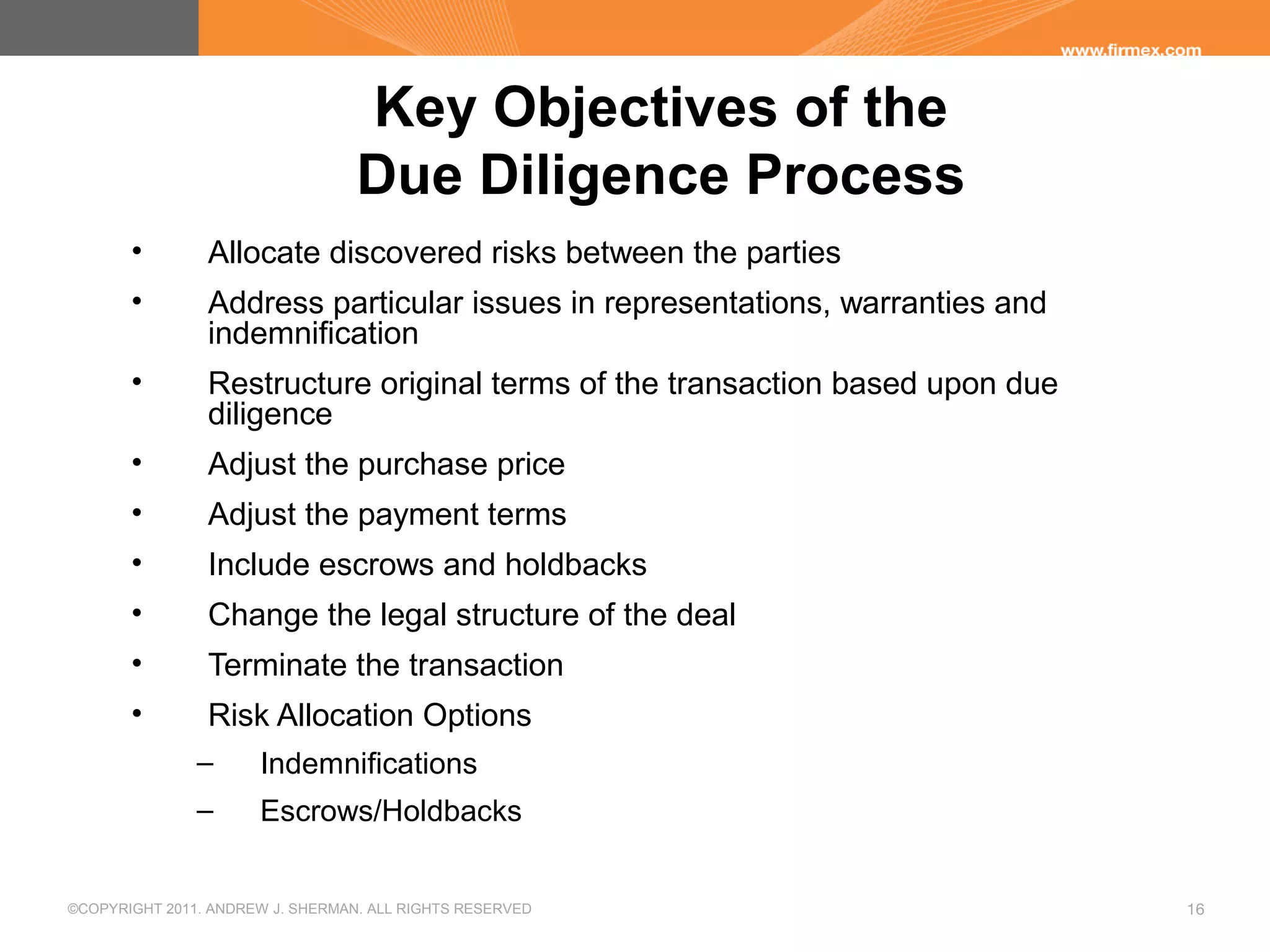
Key Objectives of the
Due Diligence Process
• Allocate discovered risks between the parties
• Address particular issues in representations, warranties and
indemnification
• Restructure original terms of the transaction based upon due
diligence
• Adjust the purchase price
• Adjust the payment terms
• Include escrows and holdbacks
• Change the legal structure of the deal
• Terminate the transaction
• Risk Allocation Options
– Indemnifications
– Escrows/Holdbacks
©COPYRIGHT 2011. ANDREW J. SHERMAN. ALL RIGHTS RESERVED 17
Due Diligence Teams
• Due Diligence Team: The purpose is to assemble a multi-
disciplinary team
– Attorneys
– Accountants
• Accountants can help give the team ammo to re-negotiate
the deal
– Investment bankers and advisors
– Operational personnel, including technology personnel
– Lenders
– Don’t forget specialty consultants (tax, intellectual
property etc.)
©COPYRIGHT 2011. ANDREW J. SHERMAN. ALL RIGHTS RESERVED 18
Common Due Diligence Mistakes
Made By The Buyer
• Mismatch between the documents provided by the seller and the skills of the
buyer's review team. It may be the case that the seller has particularly
complex financial statements or highly technical reports which must be truly
understood by the buyer's due diligence team. Make sure there is a capability
fit.
• Poor communication and misunderstandings. The communications should be
open and clear between the teams of the buyer and the seller. The process
must be well orchestrated.
• Lack of planning and focus in the preparation of the due diligence
questionnaires and in the interviews with the seller's team. The focus must be
on asking the right questions, not just a lot of questions.
• Inadequate time devoted to tax and financial matters. The buyer's (and
seller's) CFO and CPA must play an integral part in the due diligence process
in order to gather data on past financial performance and tax reporting,
unusual financial events or disturbing trends or inefficiencies.
• The buyer must insist that its team will be treated like welcome guests,
not enemies from the IRS!
©COPYRIGHT 2011. ANDREW J. SHERMAN. ALL RIGHTS RESERVED 19
Business Issues In Due Diligence
• Industry - Macro Factors
– Growth rates
– Cyclicality
– Adoption rates
– Elasticity
• Business Model - specific to company
– Understanding its products, services, niche, "reason for
being"
• Growth factors
– Barriers to entry
– Competitors
©COPYRIGHT 2011. ANDREW J. SHERMAN. ALL RIGHTS RESERVED 20
Business Issues In Due Diligence (Cont’d)
• Customers
• Suppliers
– Distribution/how, and who controls?
– Pricing
– Regulations
– Strategic relationships
– Brand recognition
• Are there areas where investors/buyers
can add value beyond?
©COPYRIGHT 2011. ANDREW J. SHERMAN. ALL RIGHTS RESERVED 21
Business Issues In Due Diligence (Cont’d)
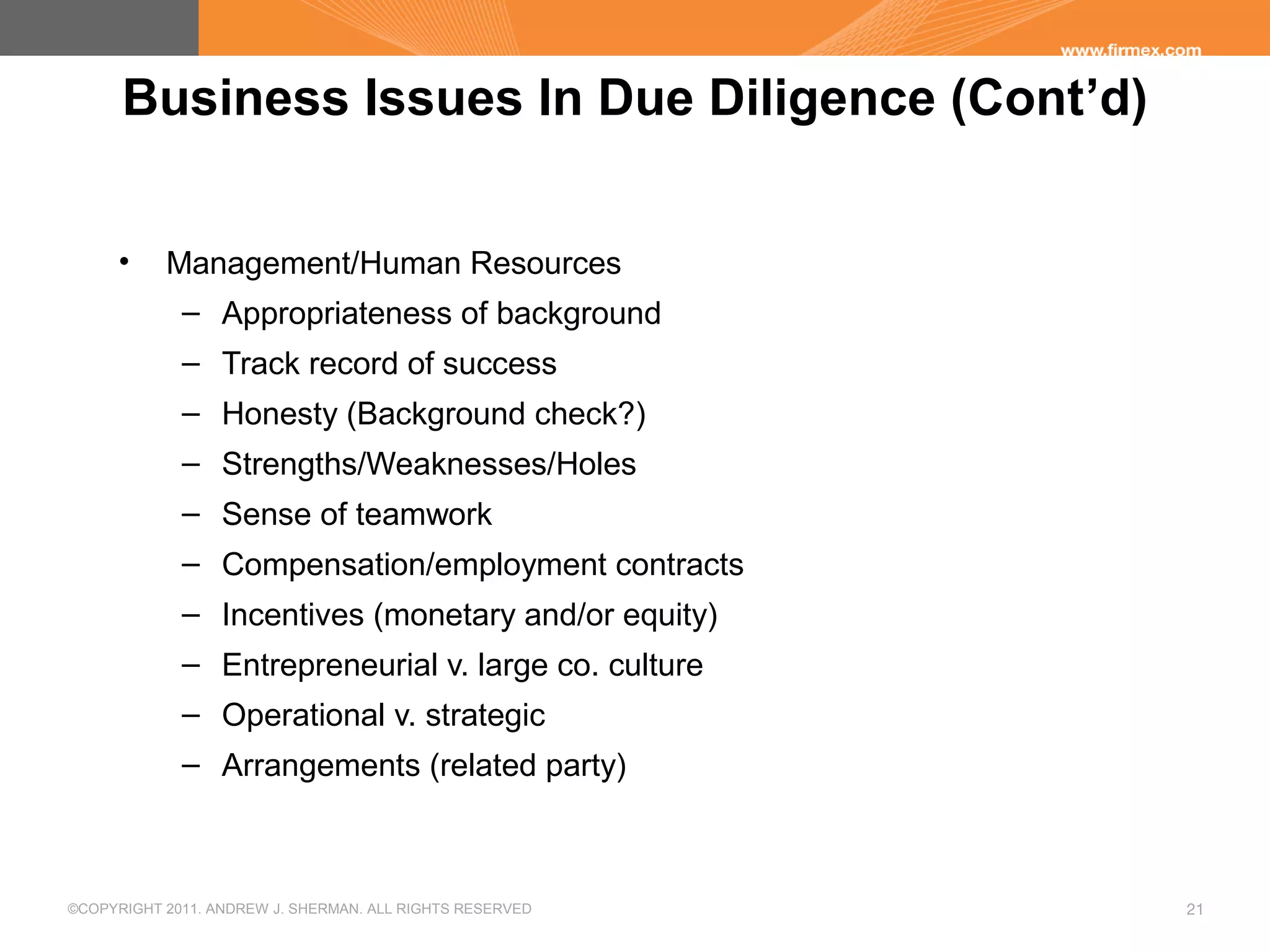
• Management/Human Resources
– Appropriateness of background
– Track record of success
– Honesty (Background check?)
– Strengths/Weaknesses/Holes
– Sense of teamwork
– Compensation/employment contracts
– Incentives (monetary and/or equity)
– Entrepreneurial v. large co. culture
– Operational v. strategic
– Arrangements (related party)
©COPYRIGHT 2011. ANDREW J. SHERMAN. ALL RIGHTS RESERVED 22
Business Issues In Due Diligence (Cont’d)
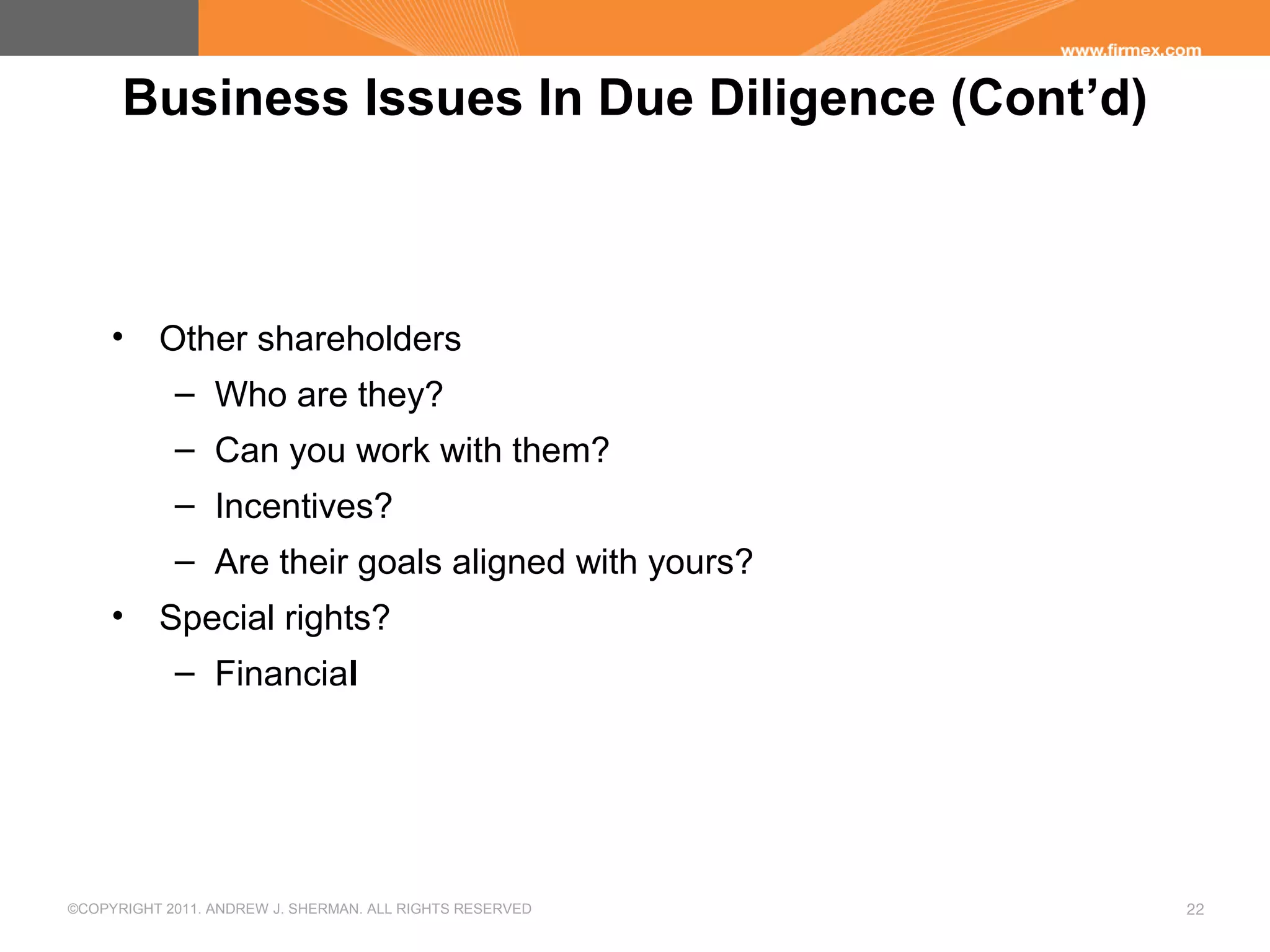
• Other shareholders
– Who are they?
– Can you work with them?
– Incentives?
– Are their goals aligned with yours?
• Special rights?
– Financial
©COPYRIGHT 2011. ANDREW J. SHERMAN. ALL RIGHTS RESERVED 23
Business Issues In Due Diligence (Cont’d)
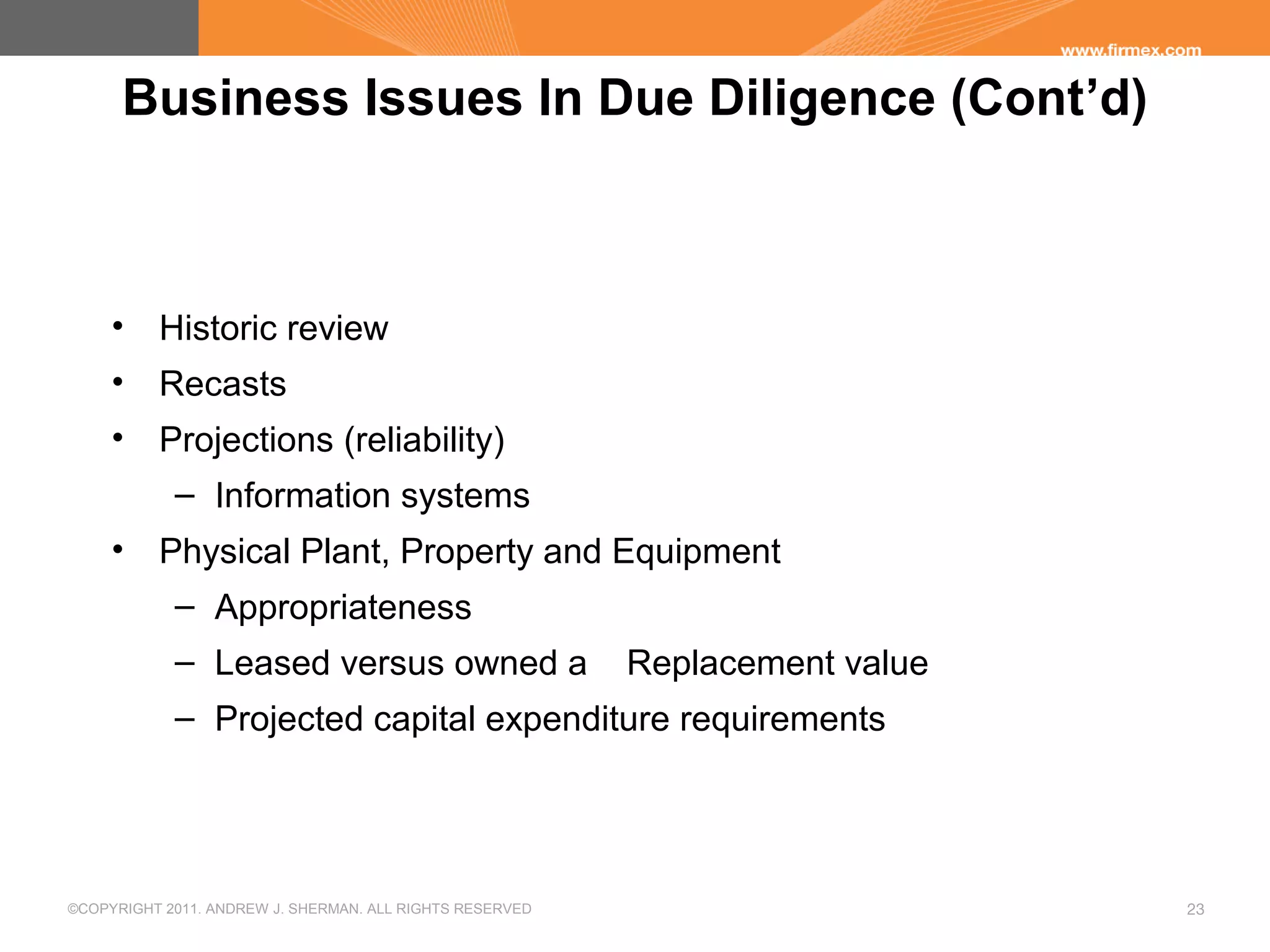
• Historic review
• Recasts
• Projections (reliability)
– Information systems
• Physical Plant, Property and Equipment
– Appropriateness
– Leased versus owned a Replacement value
– Projected capital expenditure requirements
©COPYRIGHT 2011. ANDREW J. SHERMAN. ALL RIGHTS RESERVED 24
Analyzing the Business Issues
In Due Diligence
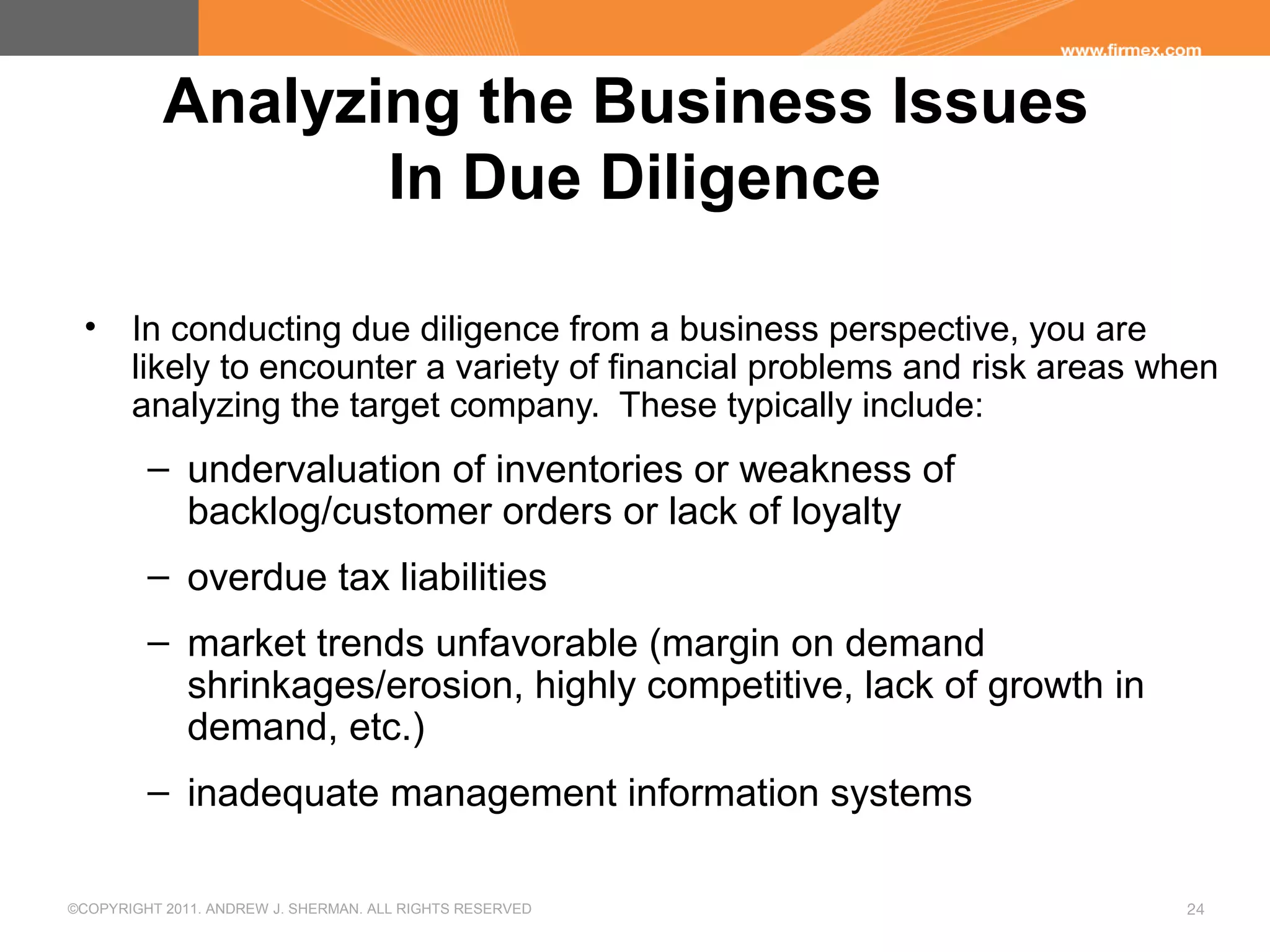
• In conducting due diligence from a business perspective, you are
likely to encounter a variety of financial problems and risk areas when
analyzing the target company. These typically include:
– undervaluation of inventories or weakness of
backlog/customer orders or lack of loyalty
– overdue tax liabilities
– market trends unfavorable (margin on demand
shrinkages/erosion, highly competitive, lack of growth in
demand, etc.)
– inadequate management information systems
©COPYRIGHT 2011. ANDREW J. SHERMAN. ALL RIGHTS RESERVED 25
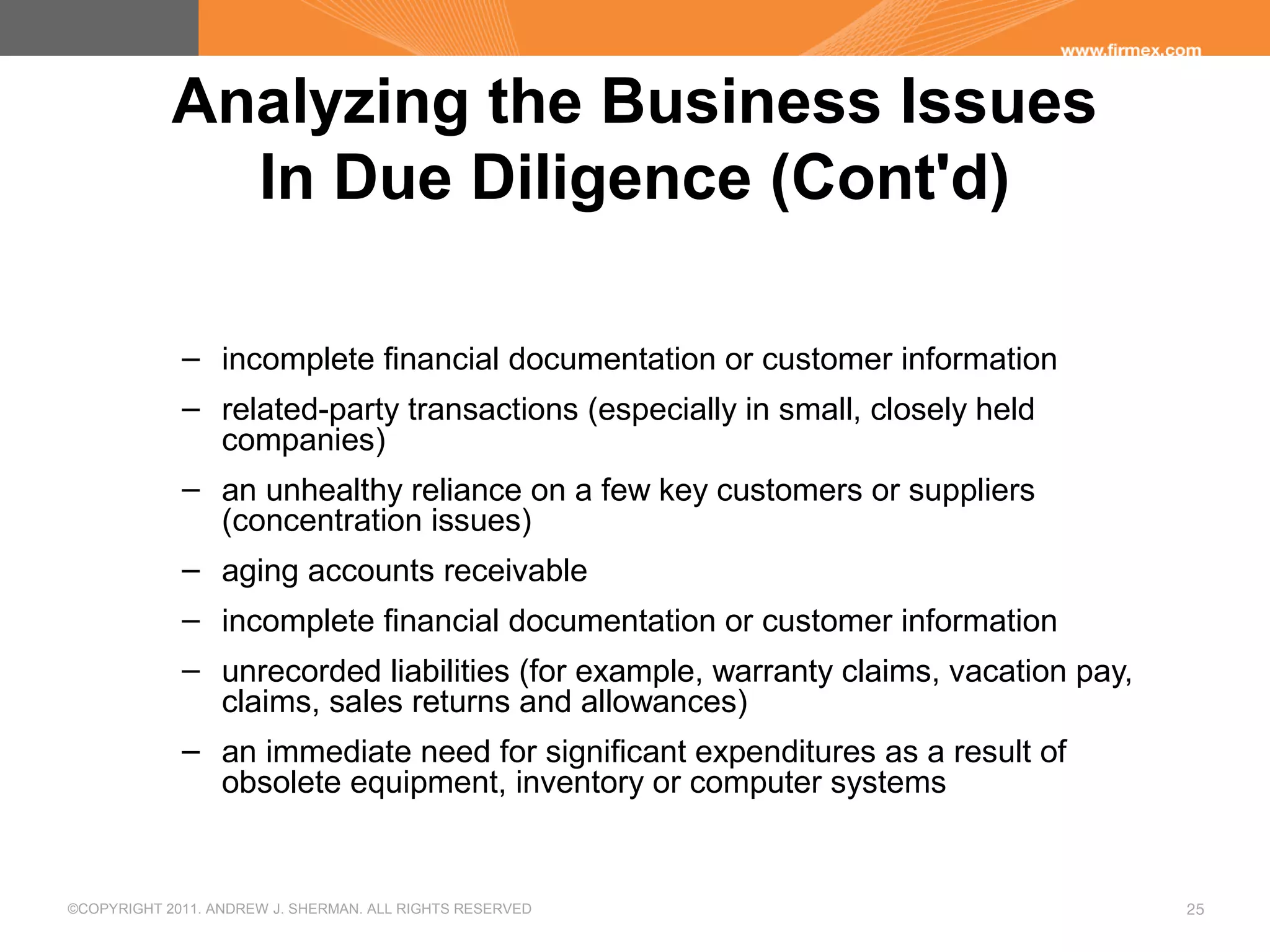
Analyzing the Business Issues
In Due Diligence (Cont'd)
– incomplete financial documentation or customer information
– related-party transactions (especially in small, closely held
companies)
– an unhealthy reliance on a few key customers or suppliers
(concentration issues)
– aging accounts receivable
– incomplete financial documentation or customer information
– unrecorded liabilities (for example, warranty claims, vacation pay,
claims, sales returns and allowances)
– an immediate need for significant expenditures as a result of
obsolete equipment, inventory or computer systems
©COPYRIGHT 2011. ANDREW J. SHERMAN. ALL RIGHTS RESERVED 26
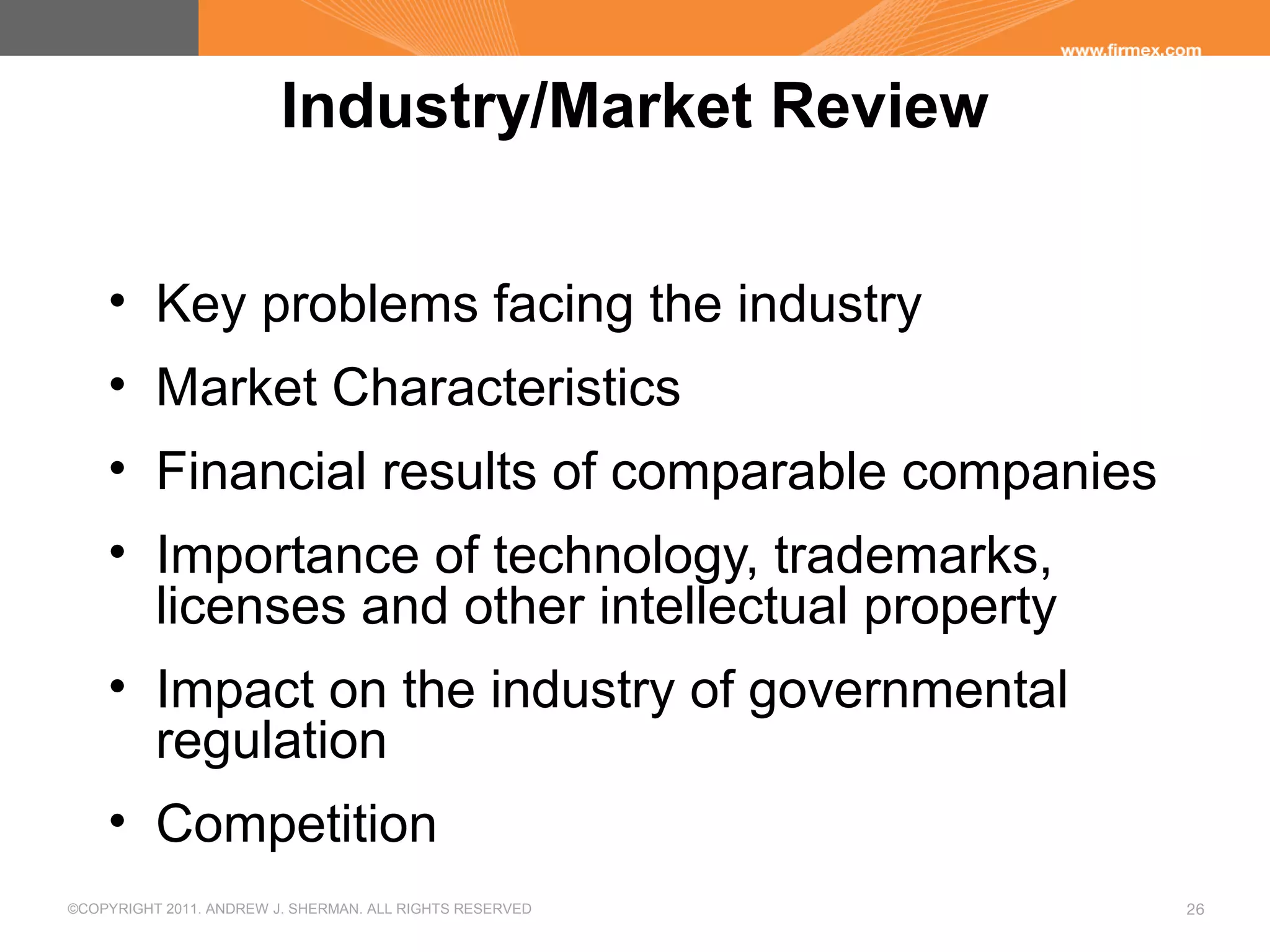
Industry/Market Review
• Key problems facing the industry
• Market Characteristics
• Financial results of comparable companies
• Importance of technology, trademarks,
licenses and other intellectual property
• Impact on the industry of governmental
regulation
• Competition
©COPYRIGHT 2011. ANDREW J. SHERMAN. ALL RIGHTS RESERVED 27
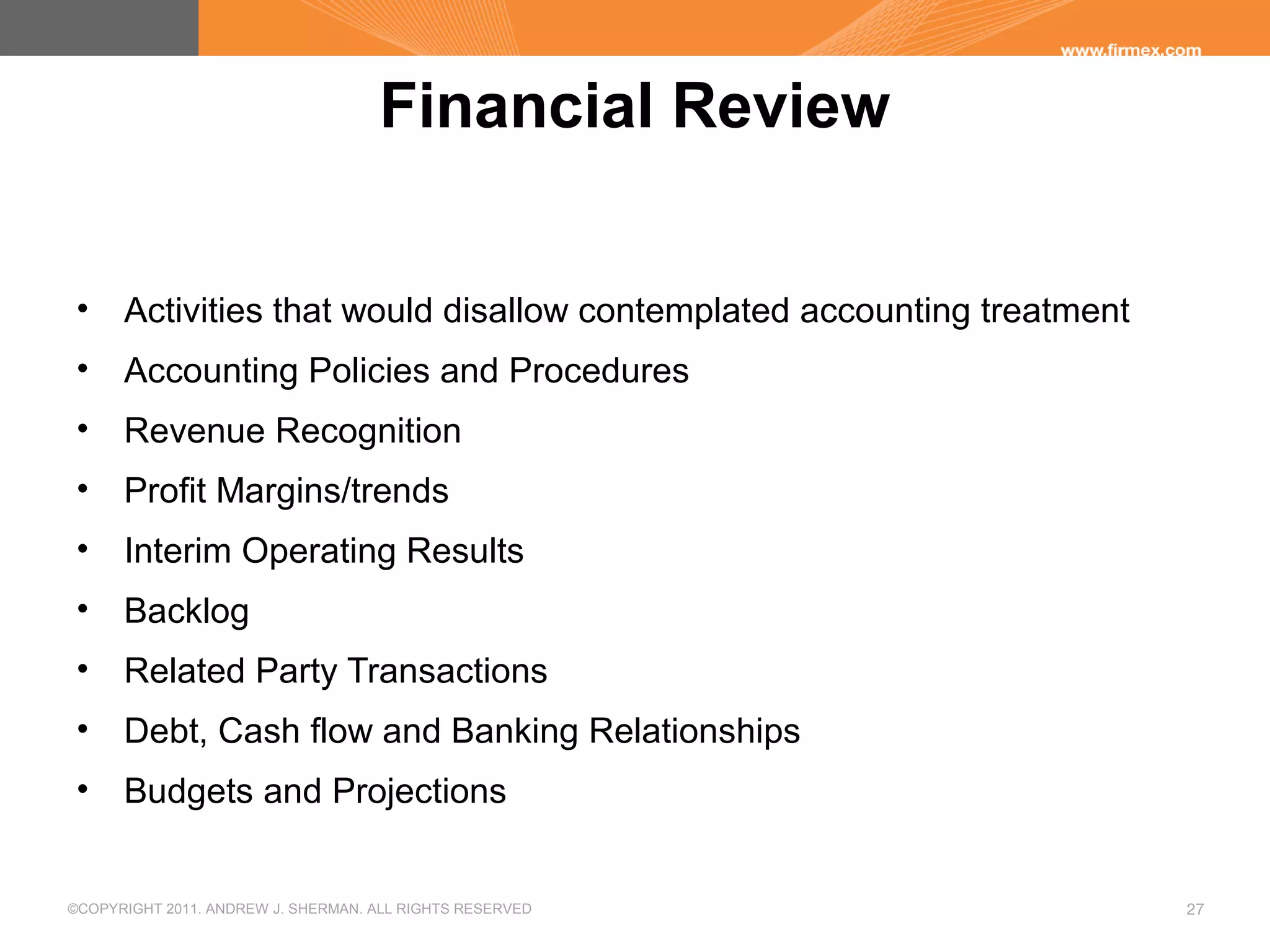
Financial Review
• Activities that would disallow contemplated accounting treatment
• Accounting Policies and Procedures
• Revenue Recognition
• Profit Margins/trends
• Interim Operating Results
• Backlog
• Related Party Transactions
• Debt, Cash flow and Banking Relationships
• Budgets and Projections
©COPYRIGHT 2011. ANDREW J. SHERMAN. ALL RIGHTS RESERVED 28
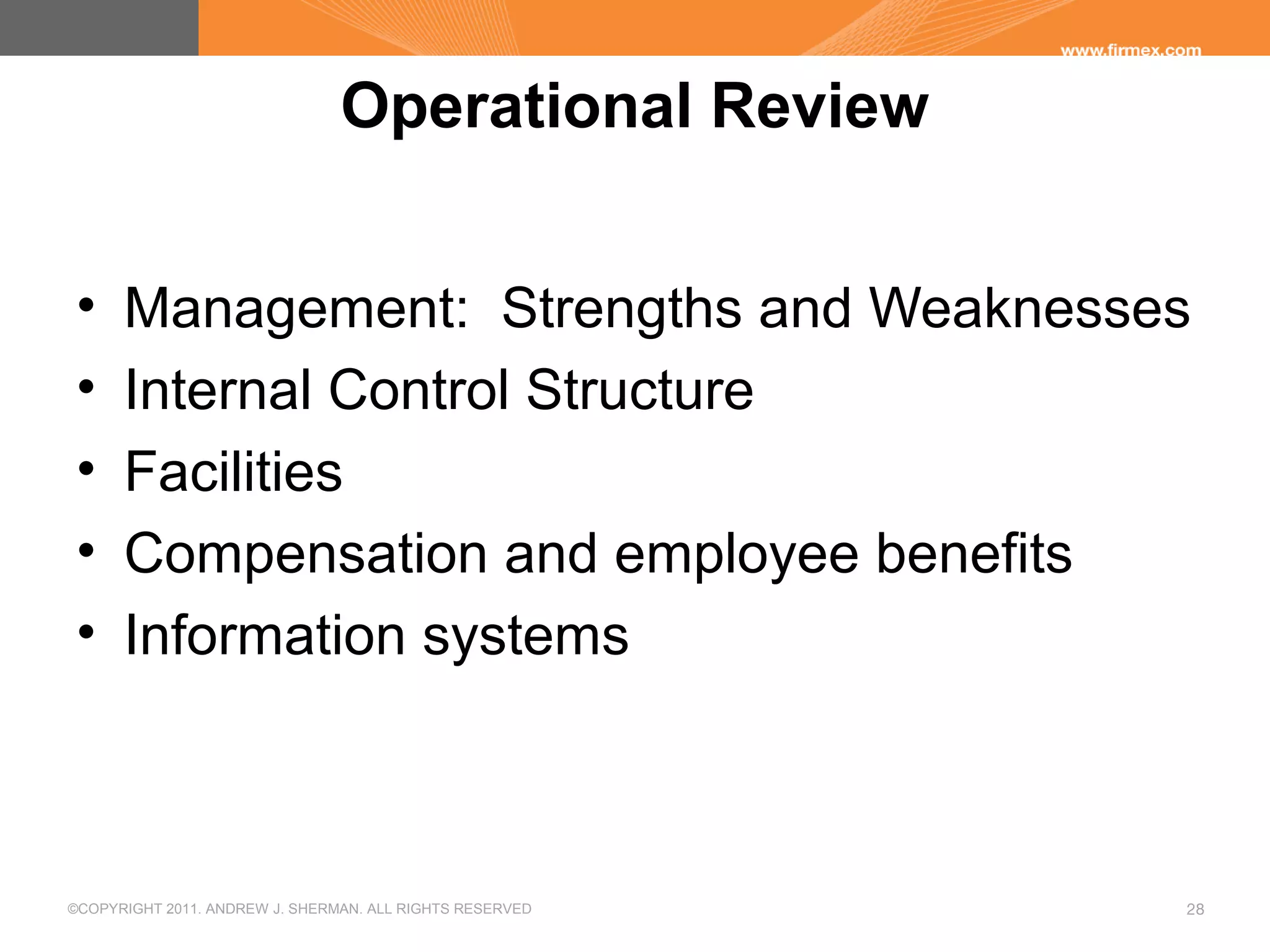
Operational Review
• Management: Strengths and Weaknesses
• Internal Control Structure
• Facilities
• Compensation and employee benefits
• Information systems
©COPYRIGHT 2011. ANDREW J. SHERMAN. ALL RIGHTS RESERVED 29
Mechanics of Due Diligence
©COPYRIGHT 2011. ANDREW J. SHERMAN. ALL RIGHTS RESERVED 30
Gathering Data
©COPYRIGHT 2011. ANDREW J. SHERMAN. ALL RIGHTS RESERVED 31
Logistics of Due Diligence
• Before we understand the sources of data for the
process of due diligence, it is important to understand
certain logistics
• The buyer's lawyer should coordinate the due diligence
process so that target receives only one set of diligence
requests, rather than repetitive requests from the various
advisors (e.g., accountants and bankers).
• Even if accountants or other specialists are also
performing due diligence, the buyer's lawyers should be
responsible for at least reviewing and cataloguing all
items in a data room unless explicitly told to not review
certain items.
©COPYRIGHT 2011. ANDREW J. SHERMAN. ALL RIGHTS RESERVED 32
Logistics of Due Diligence (Cont’d)
• The target's lawyers should control the due
diligence process at least to the extent that they
receive copies of all materials that are forwarded to
the buyer. Also, the target's lawyers should
conduct their own due diligence review of the
target, particularly if they have not historically
represented the company, to ensure the accuracy
of the representations and warranties and
schedules.
©COPYRIGHT 2011. ANDREW J. SHERMAN. ALL RIGHTS RESERVED 33
Logistics of Due Diligence (Cont’d)
• When distributing a due diligence request list, the buyer's
lawyer may wish to also distribute the draft
representations and warranties so that the target can
compile information which is responsive to the diligence
request and is necessary to prepare schedules to the
acquisition agreement.
©COPYRIGHT 2011. ANDREW J. SHERMAN. ALL RIGHTS RESERVED 34
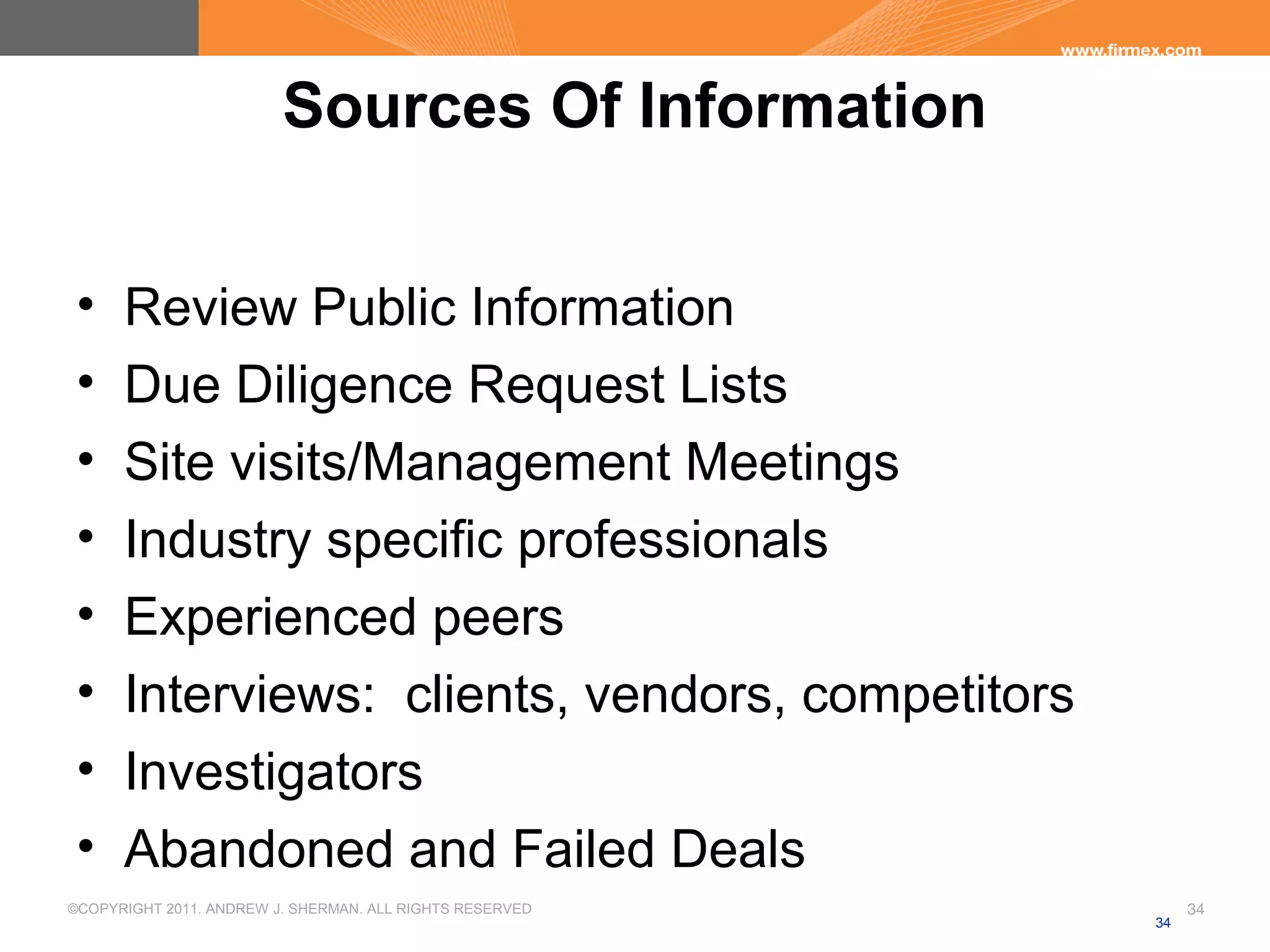
Sources Of Information
• Review Public Information
• Due Diligence Request Lists
• Site visits/Management Meetings
• Industry specific professionals
• Experienced peers
• Interviews: clients, vendors, competitors
• Investigators
• Abandoned and Failed Deals
34
©COPYRIGHT 2011. ANDREW J. SHERMAN. ALL RIGHTS RESERVED 35
Virtual Data Rooms
©COPYRIGHT 2011. ANDREW J. SHERMAN. ALL RIGHTS RESERVED 36
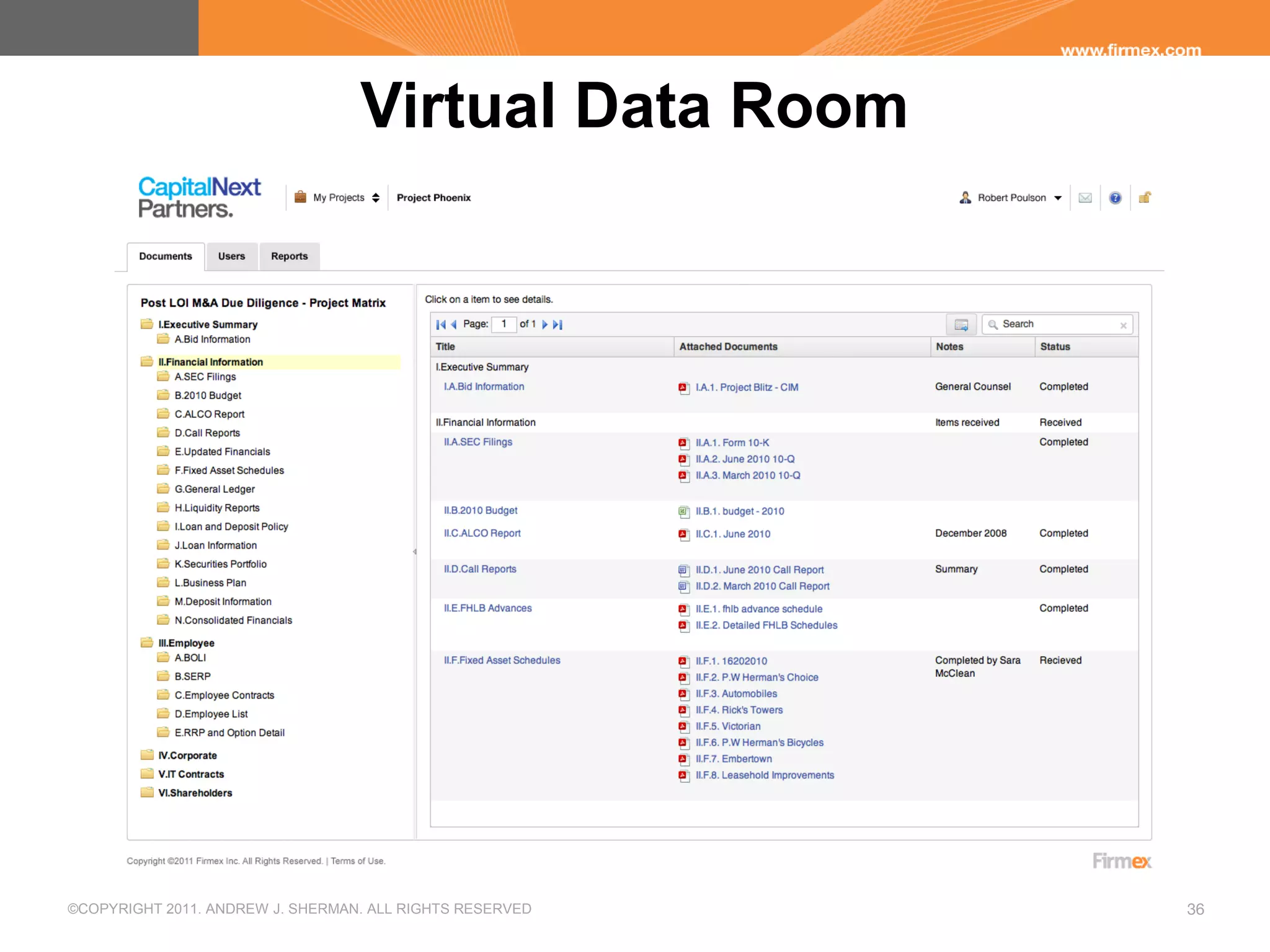
Virtual Data Room
©COPYRIGHT 2011. ANDREW J. SHERMAN. ALL RIGHTS RESERVED 37
Virtual Data Room
• Print and Access Features
– Enable to disable printing of documents
– Enable or disable the ability to view a document
– “Confidential” Options
• Audit
– Customized reports show date, document, time and print activity
• Maximum Reach
– All users are more productive and efficient – office, road or home
– 24/7 availability
• User Friendly
– No orientation necessary
©COPYRIGHT 2011. ANDREW J. SHERMAN. ALL RIGHTS RESERVED 38
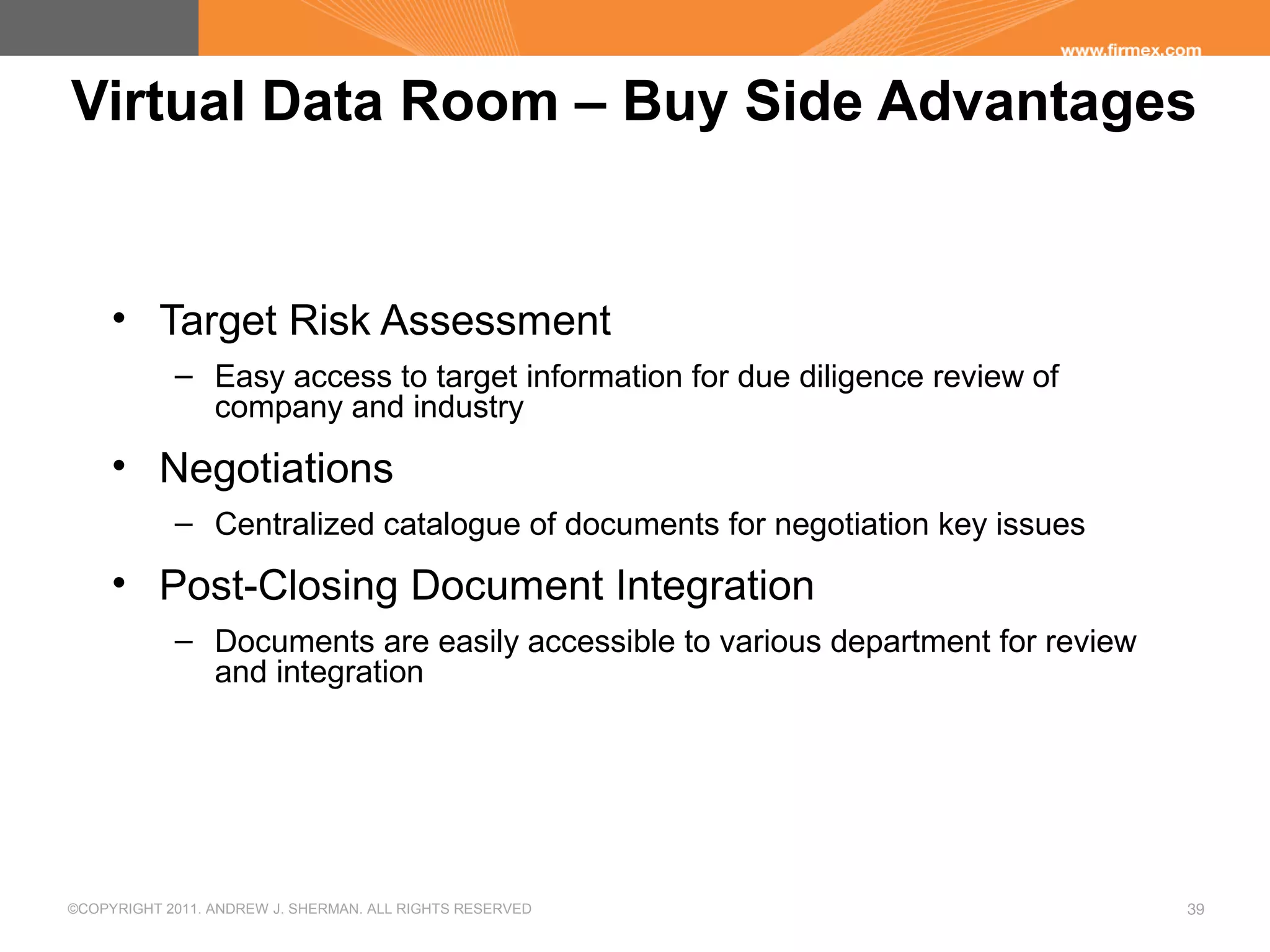
Virtual Data Room – Sell Side Advantages
• Reduced Transaction Time
– Serious bidders identified early in process
– Deal closes sooner
– No scheduling conflicts
– No travel delays
• Detail Audit Reports
– Follow footsteps of each user
– Easily identify documents that have not been viewed
• Confidentiality
– Users never bump into one another
– Security protocols insure confidentiality
©COPYRIGHT 2011. ANDREW J. SHERMAN. ALL RIGHTS RESERVED 39
Virtual Data Room – Buy Side Advantages
• Target Risk Assessment
– Easy access to target information for due diligence review of
company and industry
• Negotiations
– Centralized catalogue of documents for negotiation key issues
• Post-Closing Document Integration
– Documents are easily accessible to various department for review
and integration
©COPYRIGHT 2011. ANDREW J. SHERMAN. ALL RIGHTS RESERVED 40
Legal Due Diligence
©COPYRIGHT 2011. ANDREW J. SHERMAN. ALL RIGHTS RESERVED 41
Due Diligence Checklists – Key Issues
The buyer's acquisition team and its legal counsel gather data to answer
the following a variety of key legal questions during the legal phase of
due diligence:
1. What legal steps will need to be taken to effectuate the transaction
(e.g., director and stockholder approval, share transfer
restrictions, restrictive covenants in loan documentation)? Has the
appropriate corporate authority been obtained to proceed with the
agreement? What key (e.g., FCC, DOJ) third-party consents (e.g.,
lenders, venture capitalists, landlords, key customers) are
required?
2. What antitrust problems, if any, are raised by the transaction? Will
filing with the FTC be necessary under the pre-merger notification
provisions of the Hart-Scott-Rodino Act?
©COPYRIGHT 2011. ANDREW J. SHERMAN. ALL RIGHTS RESERVED 42
Due Diligence Checklists – Key Issues
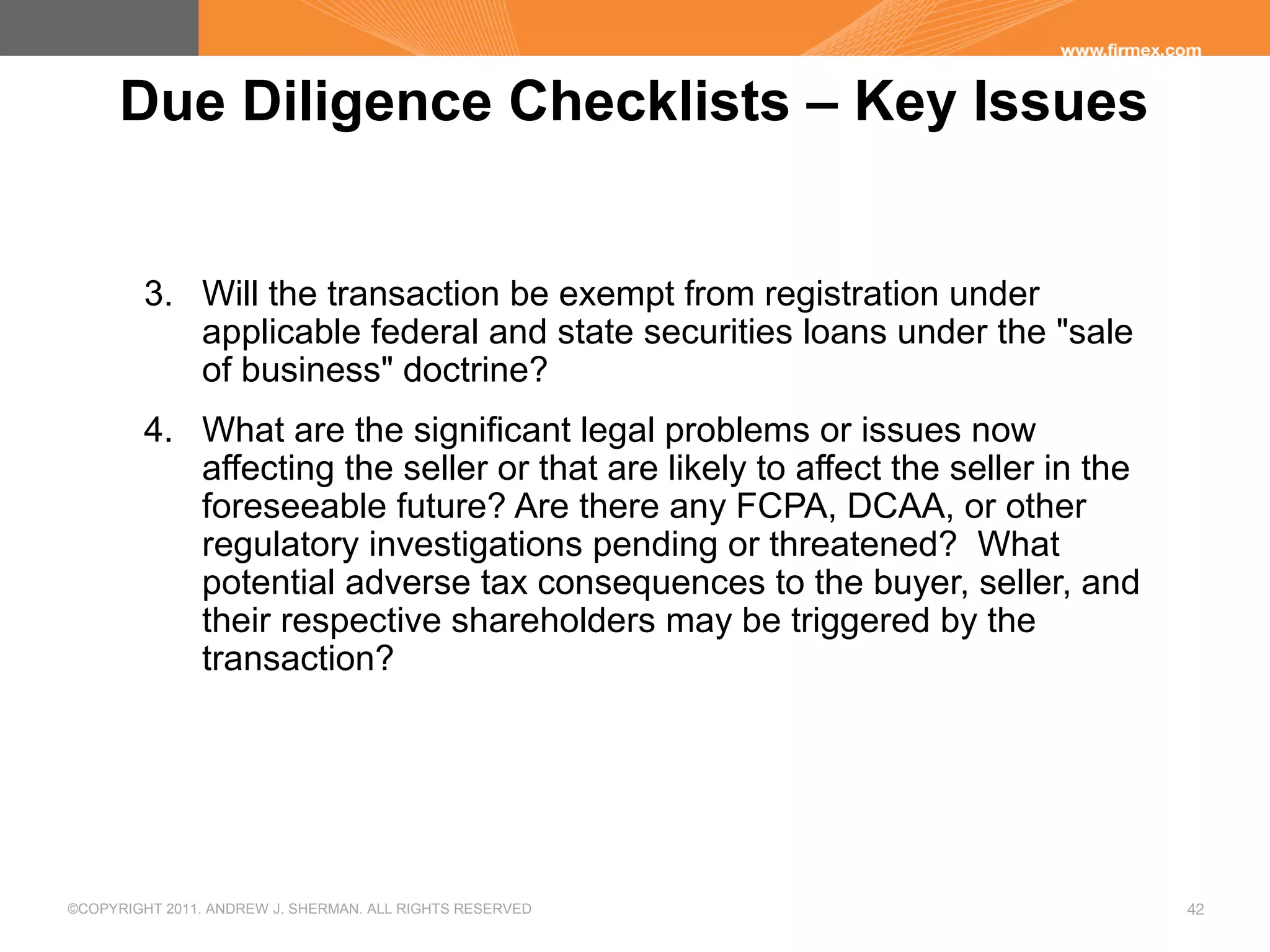
3. Will the transaction be exempt from registration under
applicable federal and state securities loans under the "sale
of business" doctrine?
4. What are the significant legal problems or issues now
affecting the seller or that are likely to affect the seller in the
foreseeable future? Are there any FCPA, DCAA, or other
regulatory investigations pending or threatened? What
potential adverse tax consequences to the buyer, seller, and
their respective shareholders may be triggered by the
transaction?
©COPYRIGHT 2011. ANDREW J. SHERMAN. ALL RIGHTS RESERVED 43
Due Diligence Checklists –
Key Issues (Cont’d)
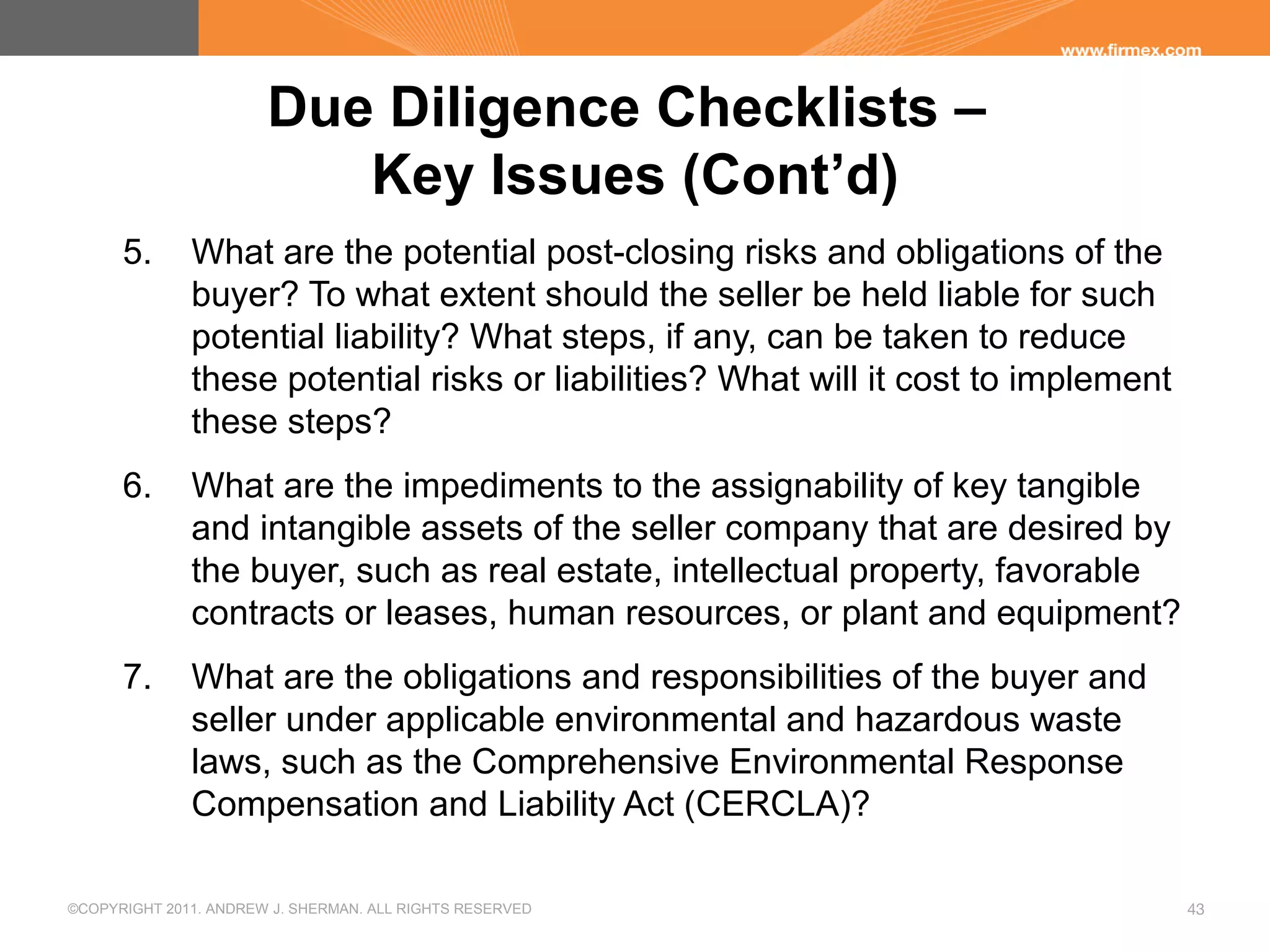
5. What are the potential post-closing risks and obligations of the
buyer? To what extent should the seller be held liable for such
potential liability? What steps, if any, can be taken to reduce
these potential risks or liabilities? What will it cost to implement
these steps?
6. What are the impediments to the assignability of key tangible
and intangible assets of the seller company that are desired by
the buyer, such as real estate, intellectual property, favorable
contracts or leases, human resources, or plant and equipment?
7. What are the obligations and responsibilities of the buyer and
seller under applicable environmental and hazardous waste
laws, such as the Comprehensive Environmental Response
Compensation and Liability Act (CERCLA)?
©COPYRIGHT 2011. ANDREW J. SHERMAN. ALL RIGHTS RESERVED 44
Due Diligence Checklists –
Key Issues (Cont’d)
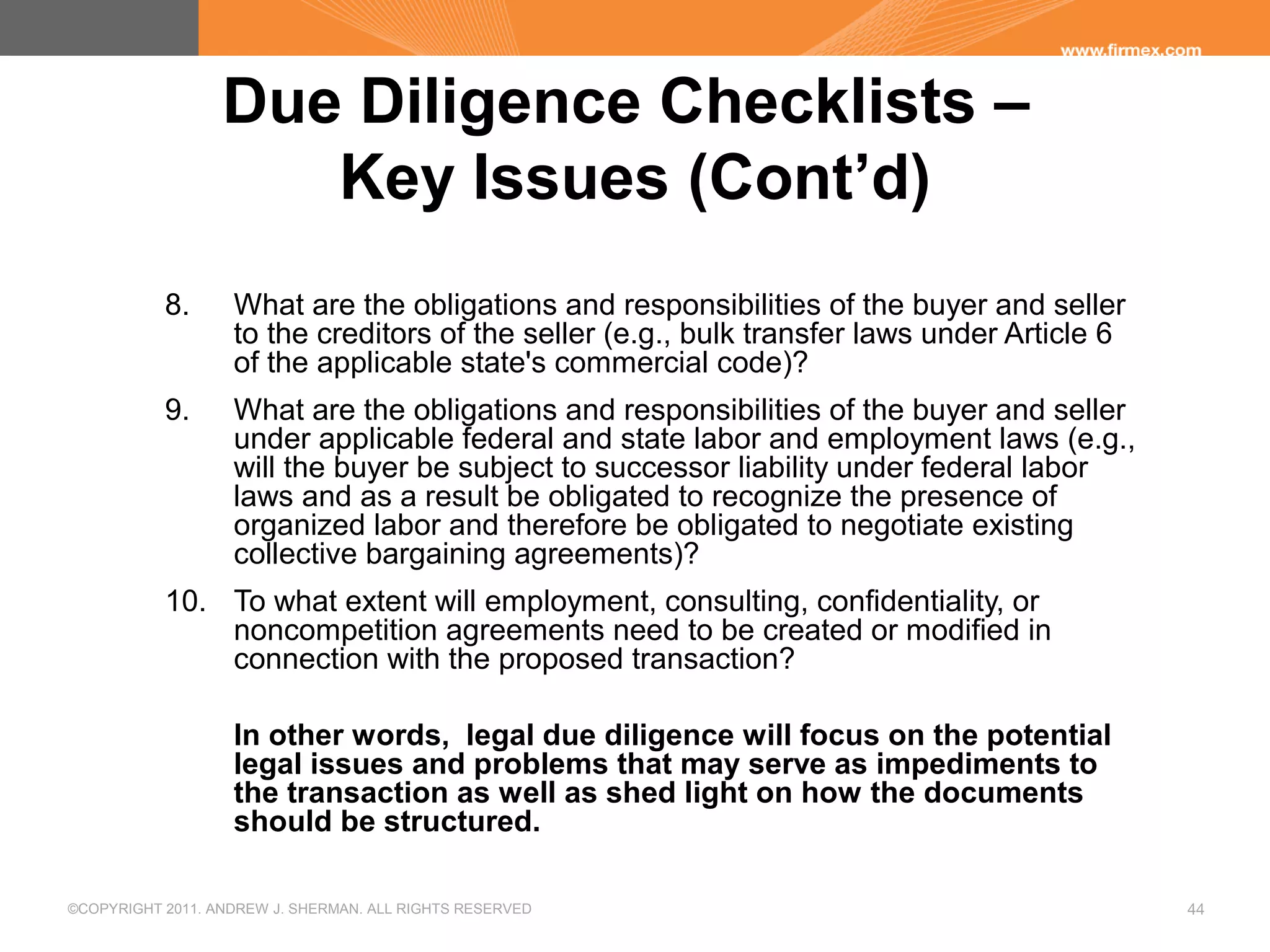
8. What are the obligations and responsibilities of the buyer and seller
to the creditors of the seller (e.g., bulk transfer laws under Article 6
of the applicable state's commercial code)?
9. What are the obligations and responsibilities of the buyer and seller
under applicable federal and state labor and employment laws (e.g.,
will the buyer be subject to successor liability under federal labor
laws and as a result be obligated to recognize the presence of
organized labor and therefore be obligated to negotiate existing
collective bargaining agreements)?
10. To what extent will employment, consulting, confidentiality, or
noncompetition agreements need to be created or modified in
connection with the proposed transaction?
In other words, legal due diligence will focus on the potential
legal issues and problems that may serve as impediments to
the transaction as well as shed light on how the documents
should be structured.
©COPYRIGHT 2011. ANDREW J. SHERMAN. ALL RIGHTS RESERVED 45
Critical Success Factors
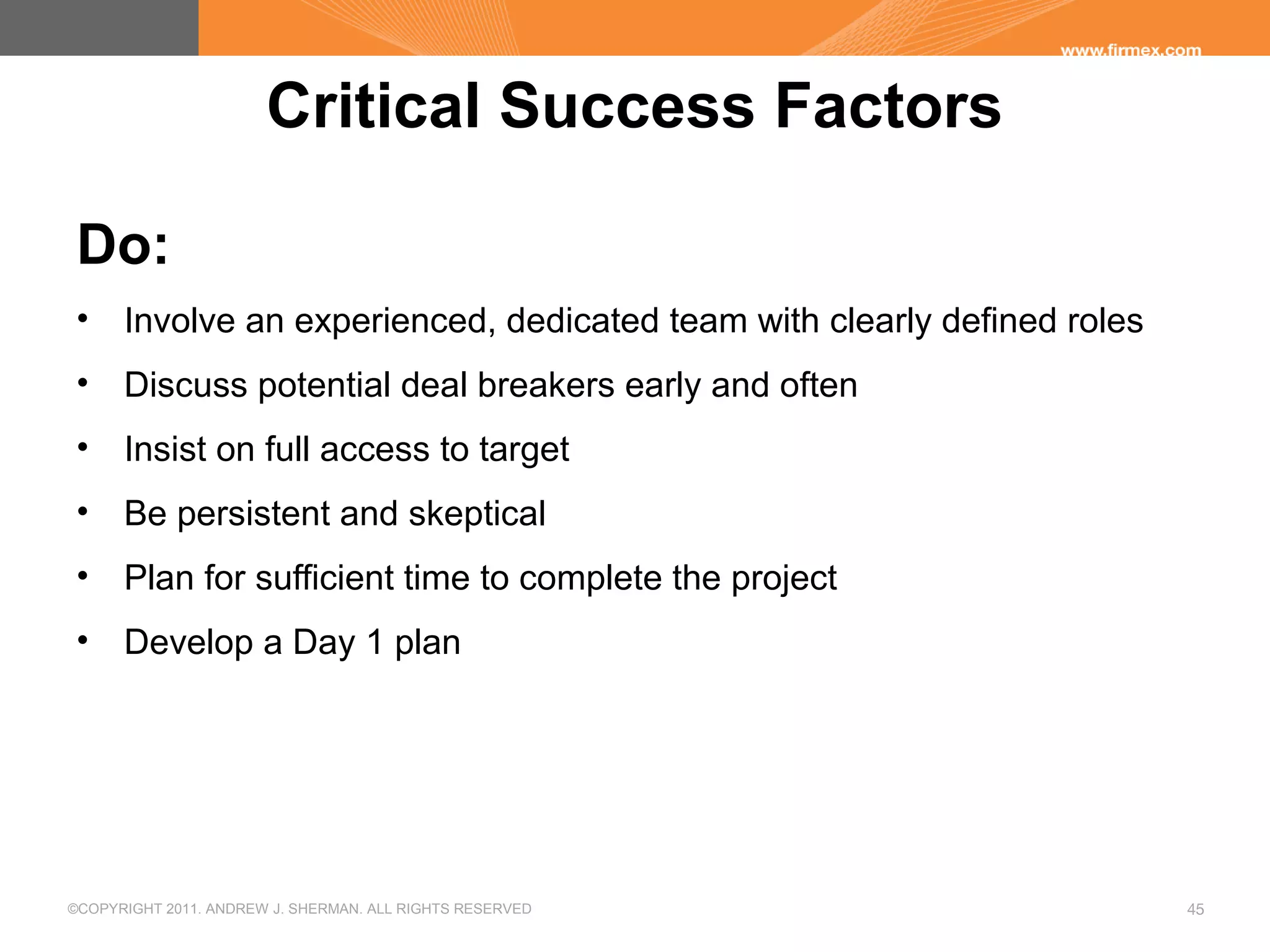
Do:
• Involve an experienced, dedicated team with clearly defined roles
• Discuss potential deal breakers early and often
• Insist on full access to target
• Be persistent and skeptical
• Plan for sufficient time to complete the project
• Develop a Day 1 plan
©COPYRIGHT 2011. ANDREW J. SHERMAN. ALL RIGHTS RESERVED 46
Potential Problems to Avoid
Don’ t:
• Exclude experienced legal counsel
• Agree on contract details too quickly
• Rush due diligence
• Assume the deal is done until it is actually closed
• Be afraid to walk away from the deal before it is closed. Remember
that the key objective of due diligence is not just to "confirm that the
deal makes sense" but rather to determine whether the transaction
should proceed at all, recognizing at all times that there may be a
need to "jump ship" if the risks or potential liabilities in the
transaction greatly exceed what the buyer anticipated.
©COPYRIGHT 2011. ANDREW J. SHERMAN. ALL RIGHTS RESERVED 47
Questions & Answers
©COPYRIGHT 2011. ANDREW J. SHERMAN. ALL RIGHTS RESERVED 48
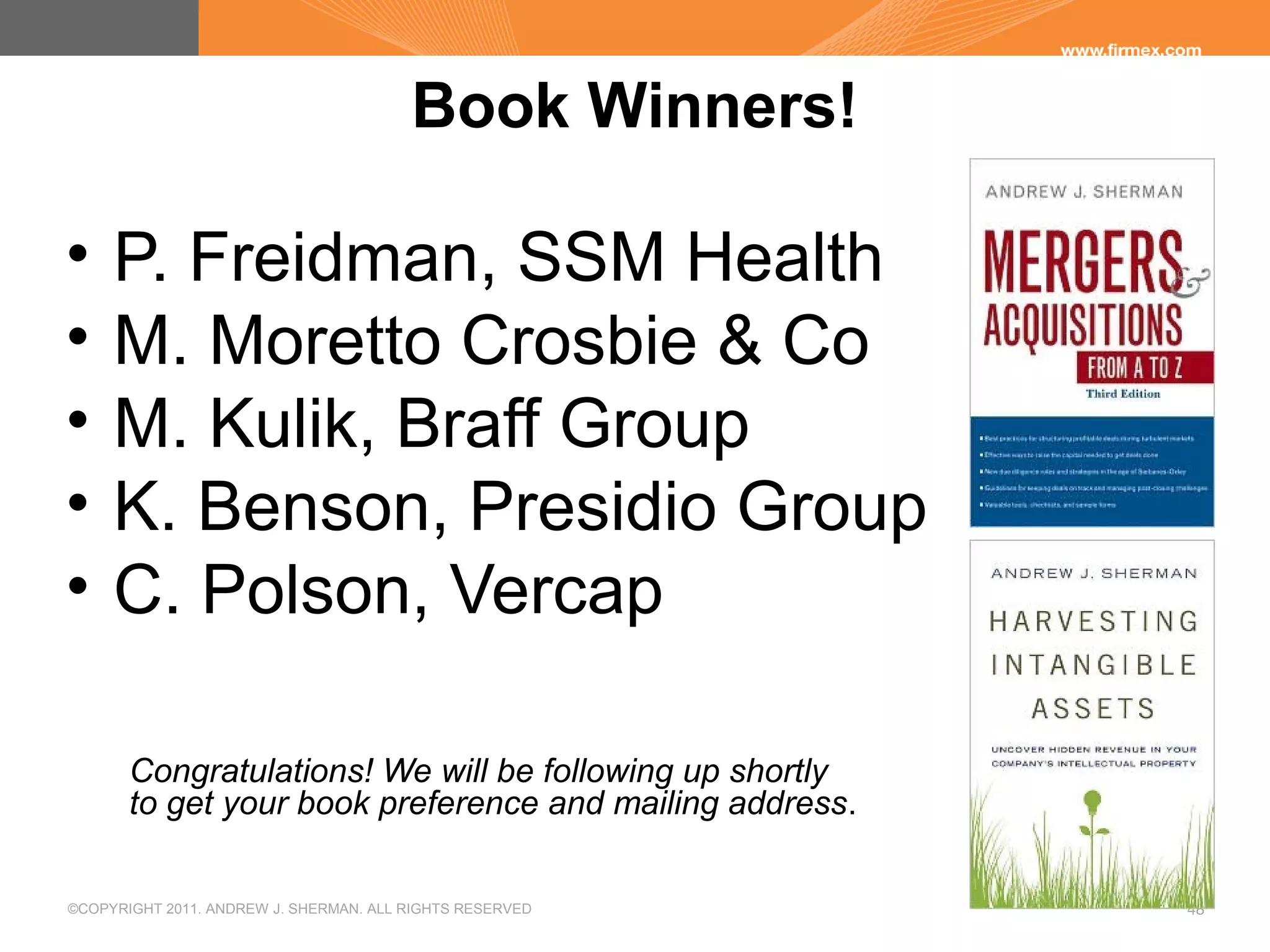
Book Winners!
• P. Freidman, SSM Health
• M. Moretto Crosbie & Co
• M. Kulik, Braff Group
• K. Benson, Presidio Group
• C. Polson, Vercap
Congratulations! We will be following up shortly
to get your book preference and mailing address.
©COPYRIGHT 2011. ANDREW J. SHERMAN. ALL RIGHTS RESERVED 49
Thank You
Next M&A Master Class is Dec 8th, 1pm Eastern
Rubber Hits the Road
Ensuring Success in Post-close Integration
The easy part’s done – now make your investment work.
Alarmed about post-close integration failure rates? How do you
increase your chances of retaining key clients, partners and staff?
Where can redundant processes and excess costs be cut? Learn
practical tips for building successful post-merger integration
program and avoid a deal disaster.
www.Firmex.com/company/events
Today’s Recorded Webinar, Slides, and Complementary Checklists will be
made available in a follow-up email shortly.

Due Diligence Best Practices and Pitfalls

  • 1.
    ©COPYRIGHT 2011. ANDREWJ. SHERMAN. ALL RIGHTS RESERVED 1 Firmex Webinar Series M&A Master Class November 17, 2011 1:00 p.m. to 2:00 p.m. Andrew J. Sherman, Esq. Jones Day 51 Louisiana Avenue, N.W. Washington, D.C. 20001-2113 202-879-3686 ajsherman@jonesday.com Art or Science? Due Diligence Best Practices and Pitfalls #firmexmc
  • 2.
    ©COPYRIGHT 2011. ANDREWJ. SHERMAN. ALL RIGHTS RESERVED 2 About Firmex Firmex is focused on providing the best virtual data room solution for managing corporate transactions and financial compliance Who uses Firmex? •Firmex community includes over 125,000 users worldwide •Conducted over 10,000 deals in the last 18 months Why offer an M&A Master Class? •As part of our value-added service, we believe it is important to offer educational resources to our expanding community Joel Lessem CEO Firmex
  • 3.
    ©COPYRIGHT 2011. ANDREWJ. SHERMAN. ALL RIGHTS RESERVED 3 Andrew J. Sherman Mr. Sherman is a partner in the Washington, D.C. office of Jones Day with over 2,500 lawyers worldwide. He is the author of 23 books on business growth, capital formation and the leveraging of intellectual property. His eighteenth (18th) book, Road Rules Be the Truck. Not the Squirrel. (http://www.bethetruck.com) is an inspirational book which was published in the Fall of 2008. He has appeared as a guest and a commentator on all of the major television networks as well as CNBC’s “Power Lunch,” CNN’s “Day Watch,” CNNfn’s “For Entrepreneurs Only,” USA Network’s “First Business,” and Bloomberg’s “Small Business Weekly.” He has appeared on numerous regional and local television broadcasts as well as national and local radio interviews for National Public Radio (NPR), Business News Network (BNN), Bloomberg Radio, AP Radio Network, Voice of America, Talk America Radio Network and the USA Radio Network, as a resource on capital formation, entrepreneurship and technology development. He has served as a top-rated Adjunct Professor in the Masters of Business Administration (MBA) programs at the University of Maryland for 23 years and at Georgetown University for 15 years where he teaches courses on business growth strategy. He has served as General Counsel to the Young Entrepreneurs’ Organization (YEO) since 1987. In 2003, Fortune magazine named him one of the Top Ten Minds in Entrepreneurship and in February of 2006, Inc. magazine named him one of the all-time champions and supporters of entrepreneurship.
  • 4.
    ©COPYRIGHT 2011. ANDREWJ. SHERMAN. ALL RIGHTS RESERVED 4 What Is “Due Diligence”? • Due diligence is both an art and a science • Proper due diligence involves: – Knowing where to look – Knowing what to ask – Knowing what tools to use – Knowing who to ask – Knowing how to test premises/answers – Knowing who should ask – Knowing how to verify
  • 5.
    ©COPYRIGHT 2011. ANDREWJ. SHERMAN. ALL RIGHTS RESERVED 5 What Is “Due Diligence”? (Cont’d) • The “Art” of Due Diligence: – Understanding how to extract key information from a person or situation – Understanding the objectives of the parties and the underlying transaction – Identifying key hurdles and risks – Identifying why information might be falsified or omitted – Targeting the proper sources for disclosure of information
  • 6.
    ©COPYRIGHT 2011. ANDREWJ. SHERMAN. ALL RIGHTS RESERVED 6 What Is “Due Diligence”? (Cont’d) • The “Science” of Due Diligence: – Do your homework – Be prepared and well-organized – Be precise in your requests – Be persistent in your quest for the truth – Don’t accept the first answer as the final answer – Trust your gut – “if it’s too good to be true …”
  • 7.
    ©COPYRIGHT 2011. ANDREWJ. SHERMAN. ALL RIGHTS RESERVED 7 Our Due Diligence “Heros” Peter Falk AJS TO PICK PICTURE AJS TO PICK PICTURE Curious George Sherlock Holmes
  • 8.
    ©COPYRIGHT 2011. ANDREWJ. SHERMAN. ALL RIGHTS RESERVED 8 Due Diligence and Current Events • Impact of 9/11/01 Attacks • Impact of Dot.com failures and Enron • The era of Sarbanes-Oxley • Subprime Crisis • The Madoff and Stanford scandals • Overall global recession and financial system woes Bottom Line: We are in an era where everything and everyone must be questioned and answers verified
  • 9.
    ©COPYRIGHT 2011. ANDREWJ. SHERMAN. ALL RIGHTS RESERVED 9 Dealing With Due Diligence Surprises Walk/Run AwayWalk/Run Away Purchase Agreement Amendments and Protections (Hold backs, R+W’s, Indemnifications, Escrows, etc.) Purchase Agreement Amendments and Protections (Hold backs, R+W’s, Indemnifications, Escrows, etc.) Purchase Price Adjustments (or Terms) Purchase Price Adjustments (or Terms) IgnoreIgnore Cost R i s k
  • 10.
    ©COPYRIGHT 2011. ANDREWJ. SHERMAN. ALL RIGHTS RESERVED 10 Due Diligence Best Practices • Work as a team, but have a clear quarterback/captain • Designate a primary point of contact for each party to the transaction • Conduct regular team meetings to compare notes and coordinate carefully • The more you know, the better questions you can ask • Be organized – set timetables and deadlines for deliverables • Use industry experts early and often • Use technological tools available to you (search engines, data rooms, etc.) • Develop penalties/consequences/remedies for non-compliance • Understand why a party may be trying to hide key facts or circumstances • Question everything – BE INQUISITIVE!
  • 11.
    ©COPYRIGHT 2011. ANDREWJ. SHERMAN. ALL RIGHTS RESERVED 11 Overview of Analysis of M&A Targets
  • 12.
    ©COPYRIGHT 2011. ANDREWJ. SHERMAN. ALL RIGHTS RESERVED 12 Overview of the Due Diligence Process
  • 13.
    ©COPYRIGHT 2011. ANDREWJ. SHERMAN. ALL RIGHTS RESERVED 13 Overview of the Due Diligence Process • Goal: Objectively prove or disprove the investment thesis: – Can it be operated better? Synergies? – Why own this business? • Intrinsic value: Determine the intrinsic value based on cash flows – Validate/negate assumptions • Levels: 3 levels of Due Diligence – Strategic and operational – Legal and regulatory – Financial
  • 14.
    ©COPYRIGHT 2011. ANDREWJ. SHERMAN. ALL RIGHTS RESERVED 14 Importance of Due Diligence • Ability to determine whether or not to complete the transaction • Ability to successfully negotiate the deal terms • Assess in advance the ability to successfully achieve the desired post-closing business objectives • A necessary prerequisite to a well-planned acquisition though the process can be tedious, frustrating, time-consuming and expensive Avoid Surprises!
  • 15.
    ©COPYRIGHT 2011. ANDREWJ. SHERMAN. ALL RIGHTS RESERVED 15 Purpose of Due Diligence • Provide information to assess risks and transaction requirements • Understand the target business completely • Surface issues early on to identify deal breakers • Create a platform for a successful transaction • Note that while buyer should resist the temptation to conduct a hasty "once over" (either to save costs or to appease the seller), at the same time it should avoid "due diligence overkill," keeping in mind that due diligence is not a perfect process
  • 16.
    ©COPYRIGHT 2011. ANDREWJ. SHERMAN. ALL RIGHTS RESERVED 16 Key Objectives of the Due Diligence Process • Allocate discovered risks between the parties • Address particular issues in representations, warranties and indemnification • Restructure original terms of the transaction based upon due diligence • Adjust the purchase price • Adjust the payment terms • Include escrows and holdbacks • Change the legal structure of the deal • Terminate the transaction • Risk Allocation Options – Indemnifications – Escrows/Holdbacks
  • 17.
    ©COPYRIGHT 2011. ANDREWJ. SHERMAN. ALL RIGHTS RESERVED 17 Due Diligence Teams • Due Diligence Team: The purpose is to assemble a multi- disciplinary team – Attorneys – Accountants • Accountants can help give the team ammo to re-negotiate the deal – Investment bankers and advisors – Operational personnel, including technology personnel – Lenders – Don’t forget specialty consultants (tax, intellectual property etc.)
  • 18.
    ©COPYRIGHT 2011. ANDREWJ. SHERMAN. ALL RIGHTS RESERVED 18 Common Due Diligence Mistakes Made By The Buyer • Mismatch between the documents provided by the seller and the skills of the buyer's review team. It may be the case that the seller has particularly complex financial statements or highly technical reports which must be truly understood by the buyer's due diligence team. Make sure there is a capability fit. • Poor communication and misunderstandings. The communications should be open and clear between the teams of the buyer and the seller. The process must be well orchestrated. • Lack of planning and focus in the preparation of the due diligence questionnaires and in the interviews with the seller's team. The focus must be on asking the right questions, not just a lot of questions. • Inadequate time devoted to tax and financial matters. The buyer's (and seller's) CFO and CPA must play an integral part in the due diligence process in order to gather data on past financial performance and tax reporting, unusual financial events or disturbing trends or inefficiencies. • The buyer must insist that its team will be treated like welcome guests, not enemies from the IRS!
  • 19.
    ©COPYRIGHT 2011. ANDREWJ. SHERMAN. ALL RIGHTS RESERVED 19 Business Issues In Due Diligence • Industry - Macro Factors – Growth rates – Cyclicality – Adoption rates – Elasticity • Business Model - specific to company – Understanding its products, services, niche, "reason for being" • Growth factors – Barriers to entry – Competitors
  • 20.
    ©COPYRIGHT 2011. ANDREWJ. SHERMAN. ALL RIGHTS RESERVED 20 Business Issues In Due Diligence (Cont’d) • Customers • Suppliers – Distribution/how, and who controls? – Pricing – Regulations – Strategic relationships – Brand recognition • Are there areas where investors/buyers can add value beyond?
  • 21.
    ©COPYRIGHT 2011. ANDREWJ. SHERMAN. ALL RIGHTS RESERVED 21 Business Issues In Due Diligence (Cont’d) • Management/Human Resources – Appropriateness of background – Track record of success – Honesty (Background check?) – Strengths/Weaknesses/Holes – Sense of teamwork – Compensation/employment contracts – Incentives (monetary and/or equity) – Entrepreneurial v. large co. culture – Operational v. strategic – Arrangements (related party)
  • 22.
    ©COPYRIGHT 2011. ANDREWJ. SHERMAN. ALL RIGHTS RESERVED 22 Business Issues In Due Diligence (Cont’d) • Other shareholders – Who are they? – Can you work with them? – Incentives? – Are their goals aligned with yours? • Special rights? – Financial
  • 23.
    ©COPYRIGHT 2011. ANDREWJ. SHERMAN. ALL RIGHTS RESERVED 23 Business Issues In Due Diligence (Cont’d) • Historic review • Recasts • Projections (reliability) – Information systems • Physical Plant, Property and Equipment – Appropriateness – Leased versus owned a Replacement value – Projected capital expenditure requirements
  • 24.
    ©COPYRIGHT 2011. ANDREWJ. SHERMAN. ALL RIGHTS RESERVED 24 Analyzing the Business Issues In Due Diligence • In conducting due diligence from a business perspective, you are likely to encounter a variety of financial problems and risk areas when analyzing the target company. These typically include: – undervaluation of inventories or weakness of backlog/customer orders or lack of loyalty – overdue tax liabilities – market trends unfavorable (margin on demand shrinkages/erosion, highly competitive, lack of growth in demand, etc.) – inadequate management information systems
  • 25.
    ©COPYRIGHT 2011. ANDREWJ. SHERMAN. ALL RIGHTS RESERVED 25 Analyzing the Business Issues In Due Diligence (Cont'd) – incomplete financial documentation or customer information – related-party transactions (especially in small, closely held companies) – an unhealthy reliance on a few key customers or suppliers (concentration issues) – aging accounts receivable – incomplete financial documentation or customer information – unrecorded liabilities (for example, warranty claims, vacation pay, claims, sales returns and allowances) – an immediate need for significant expenditures as a result of obsolete equipment, inventory or computer systems
  • 26.
    ©COPYRIGHT 2011. ANDREWJ. SHERMAN. ALL RIGHTS RESERVED 26 Industry/Market Review • Key problems facing the industry • Market Characteristics • Financial results of comparable companies • Importance of technology, trademarks, licenses and other intellectual property • Impact on the industry of governmental regulation • Competition
  • 27.
    ©COPYRIGHT 2011. ANDREWJ. SHERMAN. ALL RIGHTS RESERVED 27 Financial Review • Activities that would disallow contemplated accounting treatment • Accounting Policies and Procedures • Revenue Recognition • Profit Margins/trends • Interim Operating Results • Backlog • Related Party Transactions • Debt, Cash flow and Banking Relationships • Budgets and Projections
  • 28.
    ©COPYRIGHT 2011. ANDREWJ. SHERMAN. ALL RIGHTS RESERVED 28 Operational Review • Management: Strengths and Weaknesses • Internal Control Structure • Facilities • Compensation and employee benefits • Information systems
  • 29.
    ©COPYRIGHT 2011. ANDREWJ. SHERMAN. ALL RIGHTS RESERVED 29 Mechanics of Due Diligence
  • 30.
    ©COPYRIGHT 2011. ANDREWJ. SHERMAN. ALL RIGHTS RESERVED 30 Gathering Data
  • 31.
    ©COPYRIGHT 2011. ANDREWJ. SHERMAN. ALL RIGHTS RESERVED 31 Logistics of Due Diligence • Before we understand the sources of data for the process of due diligence, it is important to understand certain logistics • The buyer's lawyer should coordinate the due diligence process so that target receives only one set of diligence requests, rather than repetitive requests from the various advisors (e.g., accountants and bankers). • Even if accountants or other specialists are also performing due diligence, the buyer's lawyers should be responsible for at least reviewing and cataloguing all items in a data room unless explicitly told to not review certain items.
  • 32.
    ©COPYRIGHT 2011. ANDREWJ. SHERMAN. ALL RIGHTS RESERVED 32 Logistics of Due Diligence (Cont’d) • The target's lawyers should control the due diligence process at least to the extent that they receive copies of all materials that are forwarded to the buyer. Also, the target's lawyers should conduct their own due diligence review of the target, particularly if they have not historically represented the company, to ensure the accuracy of the representations and warranties and schedules.
  • 33.
    ©COPYRIGHT 2011. ANDREWJ. SHERMAN. ALL RIGHTS RESERVED 33 Logistics of Due Diligence (Cont’d) • When distributing a due diligence request list, the buyer's lawyer may wish to also distribute the draft representations and warranties so that the target can compile information which is responsive to the diligence request and is necessary to prepare schedules to the acquisition agreement.
  • 34.
    ©COPYRIGHT 2011. ANDREWJ. SHERMAN. ALL RIGHTS RESERVED 34 Sources Of Information • Review Public Information • Due Diligence Request Lists • Site visits/Management Meetings • Industry specific professionals • Experienced peers • Interviews: clients, vendors, competitors • Investigators • Abandoned and Failed Deals 34
  • 35.
    ©COPYRIGHT 2011. ANDREWJ. SHERMAN. ALL RIGHTS RESERVED 35 Virtual Data Rooms
  • 36.
    ©COPYRIGHT 2011. ANDREWJ. SHERMAN. ALL RIGHTS RESERVED 36 Virtual Data Room
  • 37.
    ©COPYRIGHT 2011. ANDREWJ. SHERMAN. ALL RIGHTS RESERVED 37 Virtual Data Room • Print and Access Features – Enable to disable printing of documents – Enable or disable the ability to view a document – “Confidential” Options • Audit – Customized reports show date, document, time and print activity • Maximum Reach – All users are more productive and efficient – office, road or home – 24/7 availability • User Friendly – No orientation necessary
  • 38.
    ©COPYRIGHT 2011. ANDREWJ. SHERMAN. ALL RIGHTS RESERVED 38 Virtual Data Room – Sell Side Advantages • Reduced Transaction Time – Serious bidders identified early in process – Deal closes sooner – No scheduling conflicts – No travel delays • Detail Audit Reports – Follow footsteps of each user – Easily identify documents that have not been viewed • Confidentiality – Users never bump into one another – Security protocols insure confidentiality
  • 39.
    ©COPYRIGHT 2011. ANDREWJ. SHERMAN. ALL RIGHTS RESERVED 39 Virtual Data Room – Buy Side Advantages • Target Risk Assessment – Easy access to target information for due diligence review of company and industry • Negotiations – Centralized catalogue of documents for negotiation key issues • Post-Closing Document Integration – Documents are easily accessible to various department for review and integration
  • 40.
    ©COPYRIGHT 2011. ANDREWJ. SHERMAN. ALL RIGHTS RESERVED 40 Legal Due Diligence
  • 41.
    ©COPYRIGHT 2011. ANDREWJ. SHERMAN. ALL RIGHTS RESERVED 41 Due Diligence Checklists – Key Issues The buyer's acquisition team and its legal counsel gather data to answer the following a variety of key legal questions during the legal phase of due diligence: 1. What legal steps will need to be taken to effectuate the transaction (e.g., director and stockholder approval, share transfer restrictions, restrictive covenants in loan documentation)? Has the appropriate corporate authority been obtained to proceed with the agreement? What key (e.g., FCC, DOJ) third-party consents (e.g., lenders, venture capitalists, landlords, key customers) are required? 2. What antitrust problems, if any, are raised by the transaction? Will filing with the FTC be necessary under the pre-merger notification provisions of the Hart-Scott-Rodino Act?
  • 42.
    ©COPYRIGHT 2011. ANDREWJ. SHERMAN. ALL RIGHTS RESERVED 42 Due Diligence Checklists – Key Issues 3. Will the transaction be exempt from registration under applicable federal and state securities loans under the "sale of business" doctrine? 4. What are the significant legal problems or issues now affecting the seller or that are likely to affect the seller in the foreseeable future? Are there any FCPA, DCAA, or other regulatory investigations pending or threatened? What potential adverse tax consequences to the buyer, seller, and their respective shareholders may be triggered by the transaction?
  • 43.
    ©COPYRIGHT 2011. ANDREWJ. SHERMAN. ALL RIGHTS RESERVED 43 Due Diligence Checklists – Key Issues (Cont’d) 5. What are the potential post-closing risks and obligations of the buyer? To what extent should the seller be held liable for such potential liability? What steps, if any, can be taken to reduce these potential risks or liabilities? What will it cost to implement these steps? 6. What are the impediments to the assignability of key tangible and intangible assets of the seller company that are desired by the buyer, such as real estate, intellectual property, favorable contracts or leases, human resources, or plant and equipment? 7. What are the obligations and responsibilities of the buyer and seller under applicable environmental and hazardous waste laws, such as the Comprehensive Environmental Response Compensation and Liability Act (CERCLA)?
  • 44.
    ©COPYRIGHT 2011. ANDREWJ. SHERMAN. ALL RIGHTS RESERVED 44 Due Diligence Checklists – Key Issues (Cont’d) 8. What are the obligations and responsibilities of the buyer and seller to the creditors of the seller (e.g., bulk transfer laws under Article 6 of the applicable state's commercial code)? 9. What are the obligations and responsibilities of the buyer and seller under applicable federal and state labor and employment laws (e.g., will the buyer be subject to successor liability under federal labor laws and as a result be obligated to recognize the presence of organized labor and therefore be obligated to negotiate existing collective bargaining agreements)? 10. To what extent will employment, consulting, confidentiality, or noncompetition agreements need to be created or modified in connection with the proposed transaction? In other words, legal due diligence will focus on the potential legal issues and problems that may serve as impediments to the transaction as well as shed light on how the documents should be structured.
  • 45.
    ©COPYRIGHT 2011. ANDREWJ. SHERMAN. ALL RIGHTS RESERVED 45 Critical Success Factors Do: • Involve an experienced, dedicated team with clearly defined roles • Discuss potential deal breakers early and often • Insist on full access to target • Be persistent and skeptical • Plan for sufficient time to complete the project • Develop a Day 1 plan
  • 46.
    ©COPYRIGHT 2011. ANDREWJ. SHERMAN. ALL RIGHTS RESERVED 46 Potential Problems to Avoid Don’ t: • Exclude experienced legal counsel • Agree on contract details too quickly • Rush due diligence • Assume the deal is done until it is actually closed • Be afraid to walk away from the deal before it is closed. Remember that the key objective of due diligence is not just to "confirm that the deal makes sense" but rather to determine whether the transaction should proceed at all, recognizing at all times that there may be a need to "jump ship" if the risks or potential liabilities in the transaction greatly exceed what the buyer anticipated.
  • 47.
    ©COPYRIGHT 2011. ANDREWJ. SHERMAN. ALL RIGHTS RESERVED 47 Questions & Answers
  • 48.
    ©COPYRIGHT 2011. ANDREWJ. SHERMAN. ALL RIGHTS RESERVED 48 Book Winners! • P. Freidman, SSM Health • M. Moretto Crosbie & Co • M. Kulik, Braff Group • K. Benson, Presidio Group • C. Polson, Vercap Congratulations! We will be following up shortly to get your book preference and mailing address.
  • 49.
    ©COPYRIGHT 2011. ANDREWJ. SHERMAN. ALL RIGHTS RESERVED 49 Thank You Next M&A Master Class is Dec 8th, 1pm Eastern Rubber Hits the Road Ensuring Success in Post-close Integration The easy part’s done – now make your investment work. Alarmed about post-close integration failure rates? How do you increase your chances of retaining key clients, partners and staff? Where can redundant processes and excess costs be cut? Learn practical tips for building successful post-merger integration program and avoid a deal disaster. www.Firmex.com/company/events Today’s Recorded Webinar, Slides, and Complementary Checklists will be made available in a follow-up email shortly.