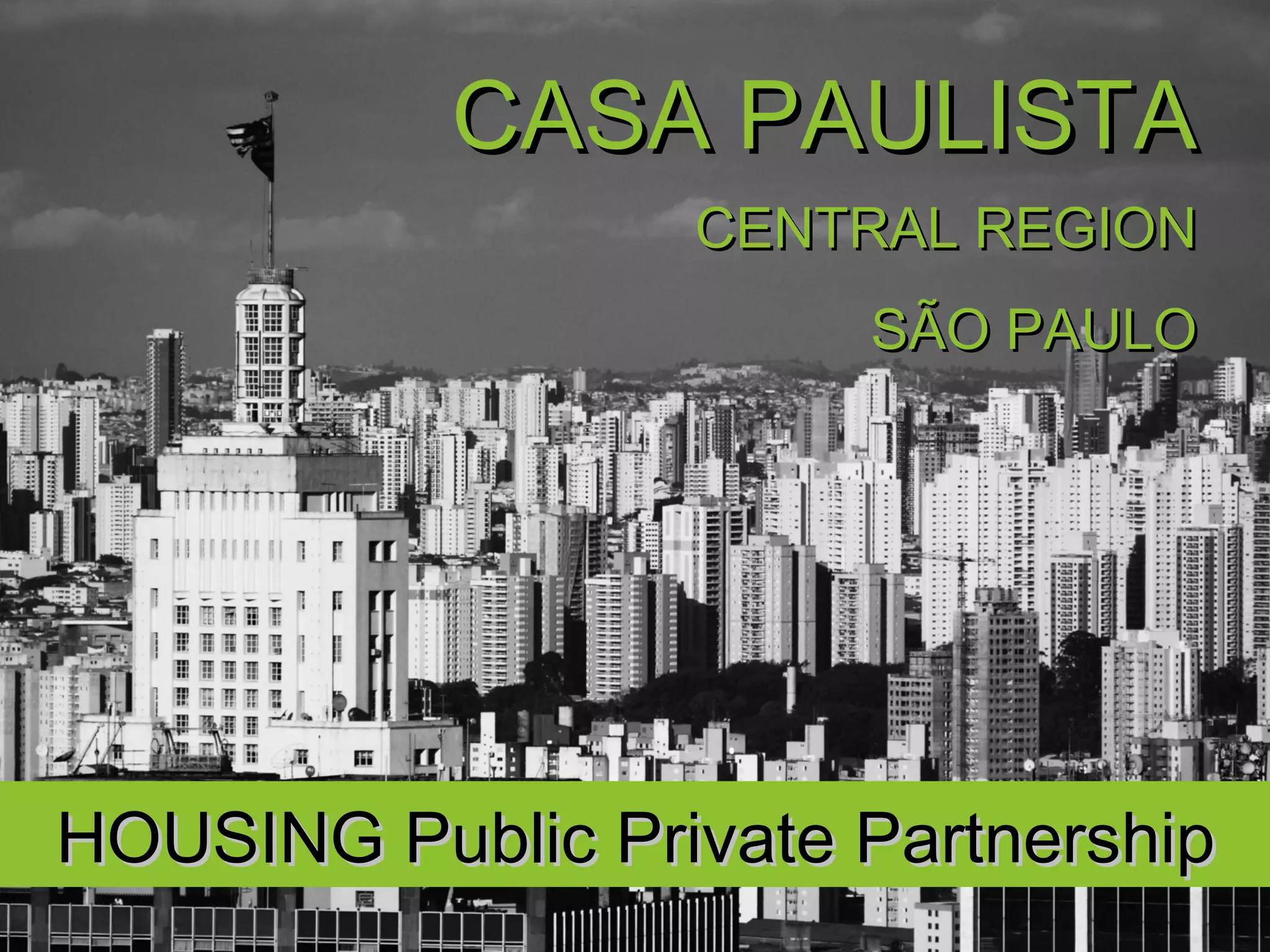
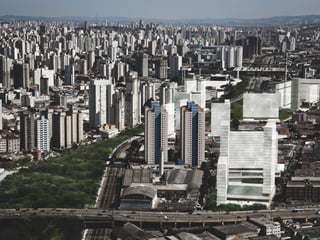
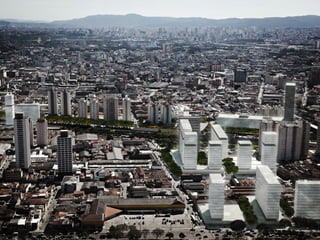
HOUSING Public Private PartnershipHOUSING Public Private Partnership
CENTRAL REGIONCENTRAL REGION
SÃO PAULOSÃO PAULO
CASA PAULISTACASA PAULISTA
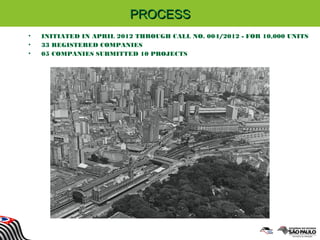
PROCESSPROCESS
• INITIATED IN APRIL 2012 THROUGH CALL NO. 004/2012 - FOR 10,000 UNITS
• 33 REGISTERED COMPANIES
• 05 COMPANIES SUBMITTED 10 PROJECTS
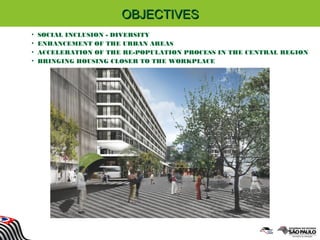
OBJECTIVESOBJECTIVES
• SOCIAL INCLUSION - DIVERSITY
• ENHANCEMENT OF THE URBAN AREAS
• ACCELERATION OF THE RE-POPULATION PROCESS IN THE CENTRAL REGION
• BRINGING HOUSING CLOSER TO THE WORKPLACE
STRATEGIESSTRATEGIES
• SOCIAL INCLUSION - DIVERSITY
• ADOPTION OF ZEIS - ZONES OF SPECIAL SOCIAL INTEREST
• ENTRUSTING THE PRIVATE SECTOR WITH THE AUTHORITY TO EXPROPRIATE
REAL ESTATE
• UNDERPINNINGS: GRANTING AUTHORITY (REGISTRATION, INCOME LEVELS;
SECTORS OF INTEREST, PRODUCT TECHNICAL DATA, INFRASTRUCTURE AND
EQUIPMENT) ENHANCEMENT OF URBAN AREAS
• UNDERPINNINGS: GRANTING AUTHORITY
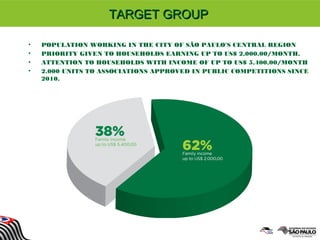
TARGET GROUPTARGET GROUP
• POPULATION WORKING IN THE CITY OF SÃO PAULO'S CENTRAL REGION
• PRIORITY GIVEN TO HOUSEHOLDS EARNING UP TO US$ 2,000.00/MONTH.
• ATTENTION TO HOUSEHOLDS WITH INCOME OF UP TO US$ 5,400,00/MONTH
• 2.000 UNITS TO ASSOCIATIONS APPROVED IN PUBLIC COMPETITIONS SINCE
2010.
HOUSING PPP
CENTRAL REGIONAL - SÃO PAULO
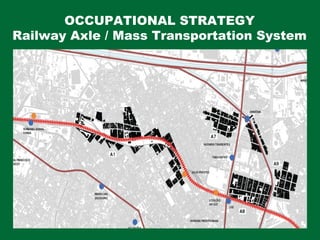
Districts covered by the intervention:
Sé, República, Santa Cecília, Barra Funda, Bom Retiro, Pari, Brás, Mooca, Belém, Cambuci, Liberdade, Bela Vista
OCCUPATIONAL STRATEGY
Railway Axle / Mass Transportation System
CENTRAL REGION PPPCENTRAL REGION PPP
ModelModel
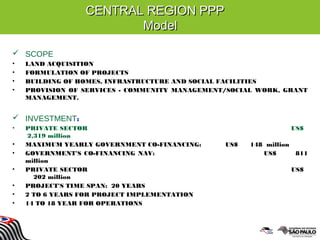
 SCOPE
• LAND ACQUISITION
• FORMULATION OF PROJECTS
• BUILDING OF HOMES, INFRASTRUCTURE AND SOCIAL FACILITIES
• PROVISION OF SERVICES - COMMUNITY MANAGEMENT/SOCIAL WORK, GRANT
MANAGEMENT.
 INVESTMENT:
• PRIVATE SECTOR US$
2,319 million
• MAXIMUM YEARLY GOVERNMENT CO-FINANCING: US$ 148 million
• GOVERNMENT'S CO-FINANCING NAV: US$ 811
million
• PRIVATE SECTOR US$
202 million
• PROJECT'S TIME SPAN: 20 YEARS
• 2 TO 6 YEARS FOR PROJECT IMPLEMENTATION
• 14 TO 18 YEAR FOR OPERATIONS
CENTRALCENTRAL REGION PPPREGION PPP
ModelModel
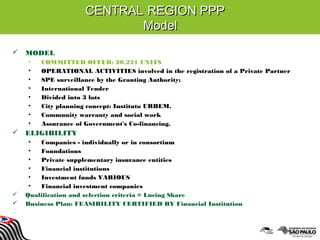
 MODEL
• COMMITTED OFFER: 20,221 UNITS
• OPERATIONAL ACTIVITIES involved in the registration of a Private Partner
• SPE surveillance by the Granting Authority;
• International Tender
• Divided into 3 lots
• City planning concept: Instituto URBEM.
• Community warranty and social work
• Assurance of Government's Co-financing.
 ELIGIBILITY
• Companies - individually or in consortium
• Foundations
• Private supplementary insurance entities
• Financial institutions
• Investment funds VARIOUS
• Financial investment companies
 Qualification and selection criteria = Lncing Share
 Business Plan: FEASIBILITY CERTIFIED BY Financial Institution
PRIVATE SECTOR´S GUARANTEESPRIVATE SECTOR´S GUARANTEES
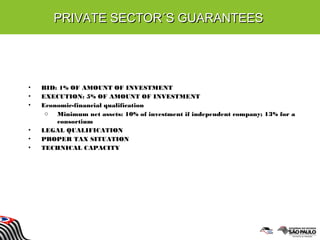
• BID: 1% OF AMOUNT OF INVESTMENT
• EXECUTION: 5% OF AMOUNT OF INVESTMENT
• Economic-financial qualification
o Minimum net assets: 10% of investment if independent company; 13% for a
consortium
• LEGAL QUALIFICATION
• PROPER TAX SITUATION
• TECHNICAL CAPACITY
CENTRAL REGION PPPCENTRAL REGION PPP
ModelModel
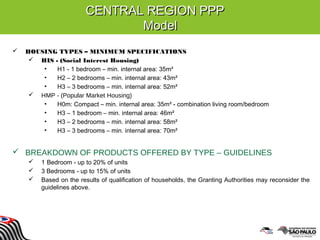
 HOUSING TYPES – MINIMUM SPECIFICATIONS
 HIS - (Social Interest Housing)
• H1 - 1 bedroom – min. internal area: 35m²
• H2 – 2 bedrooms – min. internal area: 43m²
• H3 – 3 bedrooms – min. internal area: 52m²
 HMP - (Popular Market Housing)
• H0m: Compact – min. internal area: 35m² - combination living room/bedroom
• H3 – 1 bedroom – min. internal area: 46m²
• H3 – 2 bedrooms – min. internal area: 58m²
• H3 – 3 bedrooms – min. internal area: 70m²
 BREAKDOWN OF PRODUCTS OFFERED BY TYPE – GUIDELINES
 1 Bedroom - up to 20% of units
 3 Bedrooms - up to 15% of units
 Based on the results of qualification of households, the Granting Authorities may reconsider the
guidelines above.
CENTRAL REGION PPPCENTRAL REGION PPP
ModelModel
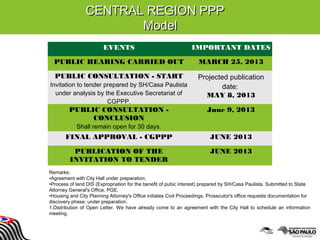
EVENTS IMPORTANT DATES
PUBLIC HEARING CARRIED OUT MARCH 25, 2013
PUBLIC CONSULTATION - START
Invitation to tender prepared by SH/Casa Paulista
under analysis by the Executive Secretariat of
CGPPP.
Projected publication
date:
MAY 8, 2013
PUBLIC CONSULTATION -
CONCLUSION
Shall remain open for 30 days.
June 9, 2013
FINAL APPROVAL - CGPPP JUNE 2013
PUBLICATION OF THE
INVITATION TO TENDER
JUNE 2013
Remarks:
•Agreement with City Hall under preparation;
•Process of land DIS (Expropriation for the benefit of pubic interest) prepared by SH/Casa Paulista. Submitted to State
Attorney General's Office, PGE.
•Housing and City Planning Attorney's Office initiates Civil Proceedings. Prosecutor's office requests documentation for
discovery phase; under preparation.
1.Distribution of Open Letter. We have already come to an agreement with the City Hall to schedule an information
meeting.
CITY
PLANNING
MODEL
HOUSING SECRETARIAT
CENTRAL REGION PPPCENTRAL REGION PPP
Guidelines for Urban InterventionGuidelines for Urban Intervention
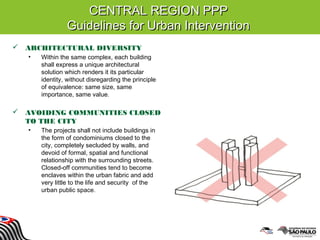
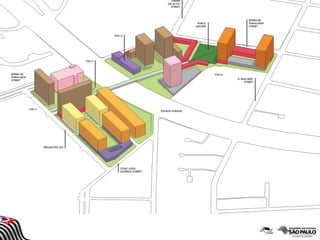
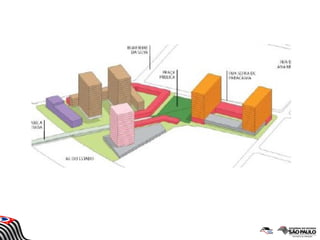
 ARCHITECTURAL DIVERSITY
• Within the same complex, each building
shall express a unique architectural
solution which renders it its particular
identity, without disregarding the principle
of equivalence: same size, same
importance, same value.
 AVOIDING COMMUNITIES CLOSED
TO THE CITY
• The projects shall not include buildings in
the form of condominiums closed to the
city, completely secluded by walls, and
devoid of formal, spatial and functional
relationship with the surrounding streets.
Closed-off communities tend to become
enclaves within the urban fabric and add
very little to the life and security of the
urban public space.
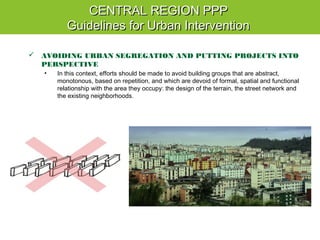
 AVOIDING URBAN SEGREGATION AND PUTTING PROJECTS INTO
PERSPECTIVE
• In this context, efforts should be made to avoid building groups that are abstract,
monotonous, based on repetition, and which are devoid of formal, spatial and functional
relationship with the area they occupy: the design of the terrain, the street network and
the existing neighborhoods.
CENTRAL REGION PPPCENTRAL REGION PPP
Guidelines for Urban InterventionGuidelines for Urban Intervention
CENTRALCENTRAL REGION PPPREGION PPP
Guidelines for Urban InterventionGuidelines for Urban Intervention
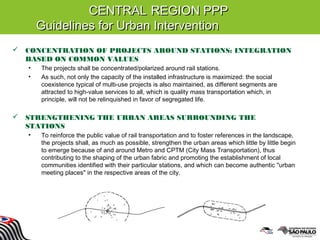
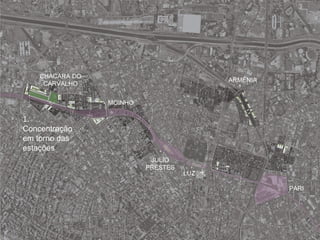
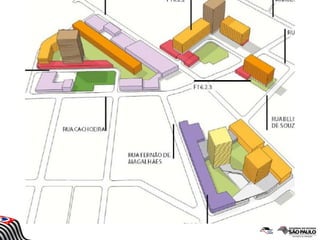
 CONCENTRATION OF PROJECTS AROUND STATIONS: INTEGRATION
BASED ON COMMON VALUES
• The projects shall be concentrated/polarized around rail stations.
• As such, not only the capacity of the installed infrastructure is maximized: the social
coexistence typical of multi-use projects is also maintained, as different segments are
attracted to high-value services to all, which is quality mass transportation which, in
principle, will not be relinquished in favor of segregated life.
 STRENGTHENING THE URBAN AREAS SURROUNDING THE
STATIONS
• To reinforce the public value of rail transportation and to foster references in the landscape,
the projects shall, as much as possible, strengthen the urban areas which little by little begin
to emerge because of and around Metro and CPTM (City Mass Transportation), thus
contributing to the shaping of the urban fabric and promoting the establishment of local
communities identified with their particular stations, and which can become authentic "urban
meeting places" in the respective areas of the city.
MOINHO
CHÁCARA DO
CARVALHO
PARI
1.
Concentração
em torno das
estações
LUZ
JULIO
PRESTES
ARMÊNIA
CENTRALCENTRAL REGION PPPREGION PPP
Guidelines for Urban InterventionGuidelines for Urban Intervention
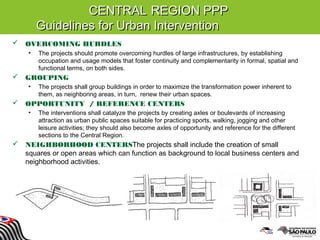
 OVERCOMING HURDLES
• The projects should promote overcoming hurdles of large infrastructures, by establishing
occupation and usage models that foster continuity and complementarity in formal, spatial and
functional terms, on both sides.
 GROUPING
• The projects shall group buildings in order to maximize the transformation power inherent to
them, as neighboring areas, in turn, renew their urban spaces.
 OPPORTUNITY / REFERENCE CENTERS
• The interventions shall catalyze the projects by creating axles or boulevards of increasing
attraction as urban public spaces suitable for practicing sports, walking, jogging and other
leisure activities; they should also become axles of opportunity and reference for the different
sections to the Central Region.
 NEIGHBORHOOD CENTERSThe projects shall include the creation of small
squares or open areas which can function as background to local business centers and
neighborhood activities.
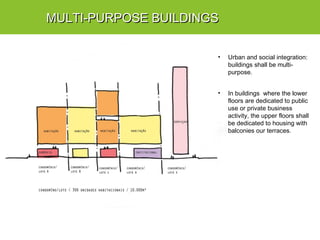
MULTI-PURPOSE BUILDINGSMULTI-PURPOSE BUILDINGS
• Urban and social integration:
buildings shall be multi-
purpose.
• In buildings where the lower
floors are dedicated to public
use or private business
activity, the upper floors shall
be dedicated to housing with
balconies our terraces.
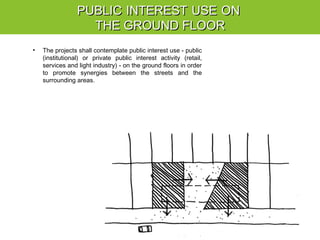
PUBLICPUBLIC INTERESTINTEREST USEUSE ONON
THE GROUND FLOORTHE GROUND FLOOR
• The projects shall contemplate public interest use - public
(institutional) or private public interest activity (retail,
services and light industry) - on the ground floors in order
to promote synergies between the streets and the
surrounding areas.
GOVERNMENT OF THE STATE OF SÃO PAULO
Geraldo Alckmin
SECRETARIA DA HABITAÇÃO - STATE HOUSING
AUTHORITY
Sílvio Torres
AGENCY FOR SOCIAL HOUSING

Presentación ppp casa paulista ingles

  • 1.
    HOUSING Public PrivatePartnershipHOUSING Public Private Partnership CENTRAL REGIONCENTRAL REGION SÃO PAULOSÃO PAULO CASA PAULISTACASA PAULISTA
  • 2.
    PROCESSPROCESS • INITIATED INAPRIL 2012 THROUGH CALL NO. 004/2012 - FOR 10,000 UNITS • 33 REGISTERED COMPANIES • 05 COMPANIES SUBMITTED 10 PROJECTS
  • 3.
    OBJECTIVESOBJECTIVES • SOCIAL INCLUSION- DIVERSITY • ENHANCEMENT OF THE URBAN AREAS • ACCELERATION OF THE RE-POPULATION PROCESS IN THE CENTRAL REGION • BRINGING HOUSING CLOSER TO THE WORKPLACE
  • 4.
    STRATEGIESSTRATEGIES • SOCIAL INCLUSION- DIVERSITY • ADOPTION OF ZEIS - ZONES OF SPECIAL SOCIAL INTEREST • ENTRUSTING THE PRIVATE SECTOR WITH THE AUTHORITY TO EXPROPRIATE REAL ESTATE • UNDERPINNINGS: GRANTING AUTHORITY (REGISTRATION, INCOME LEVELS; SECTORS OF INTEREST, PRODUCT TECHNICAL DATA, INFRASTRUCTURE AND EQUIPMENT) ENHANCEMENT OF URBAN AREAS • UNDERPINNINGS: GRANTING AUTHORITY
  • 5.
    TARGET GROUPTARGET GROUP •POPULATION WORKING IN THE CITY OF SÃO PAULO'S CENTRAL REGION • PRIORITY GIVEN TO HOUSEHOLDS EARNING UP TO US$ 2,000.00/MONTH. • ATTENTION TO HOUSEHOLDS WITH INCOME OF UP TO US$ 5,400,00/MONTH • 2.000 UNITS TO ASSOCIATIONS APPROVED IN PUBLIC COMPETITIONS SINCE 2010.
  • 6.
    HOUSING PPP CENTRAL REGIONAL- SÃO PAULO Districts covered by the intervention: Sé, República, Santa Cecília, Barra Funda, Bom Retiro, Pari, Brás, Mooca, Belém, Cambuci, Liberdade, Bela Vista
  • 7.
    OCCUPATIONAL STRATEGY Railway Axle/ Mass Transportation System
  • 11.
    CENTRAL REGION PPPCENTRALREGION PPP ModelModel  SCOPE • LAND ACQUISITION • FORMULATION OF PROJECTS • BUILDING OF HOMES, INFRASTRUCTURE AND SOCIAL FACILITIES • PROVISION OF SERVICES - COMMUNITY MANAGEMENT/SOCIAL WORK, GRANT MANAGEMENT.  INVESTMENT: • PRIVATE SECTOR US$ 2,319 million • MAXIMUM YEARLY GOVERNMENT CO-FINANCING: US$ 148 million • GOVERNMENT'S CO-FINANCING NAV: US$ 811 million • PRIVATE SECTOR US$ 202 million • PROJECT'S TIME SPAN: 20 YEARS • 2 TO 6 YEARS FOR PROJECT IMPLEMENTATION • 14 TO 18 YEAR FOR OPERATIONS
  • 12.
    CENTRALCENTRAL REGION PPPREGIONPPP ModelModel  MODEL • COMMITTED OFFER: 20,221 UNITS • OPERATIONAL ACTIVITIES involved in the registration of a Private Partner • SPE surveillance by the Granting Authority; • International Tender • Divided into 3 lots • City planning concept: Instituto URBEM. • Community warranty and social work • Assurance of Government's Co-financing.  ELIGIBILITY • Companies - individually or in consortium • Foundations • Private supplementary insurance entities • Financial institutions • Investment funds VARIOUS • Financial investment companies  Qualification and selection criteria = Lncing Share  Business Plan: FEASIBILITY CERTIFIED BY Financial Institution
  • 13.
    PRIVATE SECTOR´S GUARANTEESPRIVATESECTOR´S GUARANTEES • BID: 1% OF AMOUNT OF INVESTMENT • EXECUTION: 5% OF AMOUNT OF INVESTMENT • Economic-financial qualification o Minimum net assets: 10% of investment if independent company; 13% for a consortium • LEGAL QUALIFICATION • PROPER TAX SITUATION • TECHNICAL CAPACITY
  • 16.
    CENTRAL REGION PPPCENTRALREGION PPP ModelModel  HOUSING TYPES – MINIMUM SPECIFICATIONS  HIS - (Social Interest Housing) • H1 - 1 bedroom – min. internal area: 35m² • H2 – 2 bedrooms – min. internal area: 43m² • H3 – 3 bedrooms – min. internal area: 52m²  HMP - (Popular Market Housing) • H0m: Compact – min. internal area: 35m² - combination living room/bedroom • H3 – 1 bedroom – min. internal area: 46m² • H3 – 2 bedrooms – min. internal area: 58m² • H3 – 3 bedrooms – min. internal area: 70m²  BREAKDOWN OF PRODUCTS OFFERED BY TYPE – GUIDELINES  1 Bedroom - up to 20% of units  3 Bedrooms - up to 15% of units  Based on the results of qualification of households, the Granting Authorities may reconsider the guidelines above.
  • 17.
    CENTRAL REGION PPPCENTRALREGION PPP ModelModel EVENTS IMPORTANT DATES PUBLIC HEARING CARRIED OUT MARCH 25, 2013 PUBLIC CONSULTATION - START Invitation to tender prepared by SH/Casa Paulista under analysis by the Executive Secretariat of CGPPP. Projected publication date: MAY 8, 2013 PUBLIC CONSULTATION - CONCLUSION Shall remain open for 30 days. June 9, 2013 FINAL APPROVAL - CGPPP JUNE 2013 PUBLICATION OF THE INVITATION TO TENDER JUNE 2013 Remarks: •Agreement with City Hall under preparation; •Process of land DIS (Expropriation for the benefit of pubic interest) prepared by SH/Casa Paulista. Submitted to State Attorney General's Office, PGE. •Housing and City Planning Attorney's Office initiates Civil Proceedings. Prosecutor's office requests documentation for discovery phase; under preparation. 1.Distribution of Open Letter. We have already come to an agreement with the City Hall to schedule an information meeting.
  • 18.
  • 19.
    CENTRAL REGION PPPCENTRALREGION PPP Guidelines for Urban InterventionGuidelines for Urban Intervention  ARCHITECTURAL DIVERSITY • Within the same complex, each building shall express a unique architectural solution which renders it its particular identity, without disregarding the principle of equivalence: same size, same importance, same value.  AVOIDING COMMUNITIES CLOSED TO THE CITY • The projects shall not include buildings in the form of condominiums closed to the city, completely secluded by walls, and devoid of formal, spatial and functional relationship with the surrounding streets. Closed-off communities tend to become enclaves within the urban fabric and add very little to the life and security of the urban public space.
  • 20.
     AVOIDING URBANSEGREGATION AND PUTTING PROJECTS INTO PERSPECTIVE • In this context, efforts should be made to avoid building groups that are abstract, monotonous, based on repetition, and which are devoid of formal, spatial and functional relationship with the area they occupy: the design of the terrain, the street network and the existing neighborhoods. CENTRAL REGION PPPCENTRAL REGION PPP Guidelines for Urban InterventionGuidelines for Urban Intervention
  • 21.
    CENTRALCENTRAL REGION PPPREGIONPPP Guidelines for Urban InterventionGuidelines for Urban Intervention  CONCENTRATION OF PROJECTS AROUND STATIONS: INTEGRATION BASED ON COMMON VALUES • The projects shall be concentrated/polarized around rail stations. • As such, not only the capacity of the installed infrastructure is maximized: the social coexistence typical of multi-use projects is also maintained, as different segments are attracted to high-value services to all, which is quality mass transportation which, in principle, will not be relinquished in favor of segregated life.  STRENGTHENING THE URBAN AREAS SURROUNDING THE STATIONS • To reinforce the public value of rail transportation and to foster references in the landscape, the projects shall, as much as possible, strengthen the urban areas which little by little begin to emerge because of and around Metro and CPTM (City Mass Transportation), thus contributing to the shaping of the urban fabric and promoting the establishment of local communities identified with their particular stations, and which can become authentic "urban meeting places" in the respective areas of the city.
  • 22.
    MOINHO CHÁCARA DO CARVALHO PARI 1. Concentração em tornodas estações LUZ JULIO PRESTES ARMÊNIA
  • 23.
    CENTRALCENTRAL REGION PPPREGIONPPP Guidelines for Urban InterventionGuidelines for Urban Intervention  OVERCOMING HURDLES • The projects should promote overcoming hurdles of large infrastructures, by establishing occupation and usage models that foster continuity and complementarity in formal, spatial and functional terms, on both sides.  GROUPING • The projects shall group buildings in order to maximize the transformation power inherent to them, as neighboring areas, in turn, renew their urban spaces.  OPPORTUNITY / REFERENCE CENTERS • The interventions shall catalyze the projects by creating axles or boulevards of increasing attraction as urban public spaces suitable for practicing sports, walking, jogging and other leisure activities; they should also become axles of opportunity and reference for the different sections to the Central Region.  NEIGHBORHOOD CENTERSThe projects shall include the creation of small squares or open areas which can function as background to local business centers and neighborhood activities.
  • 24.
    MULTI-PURPOSE BUILDINGSMULTI-PURPOSE BUILDINGS •Urban and social integration: buildings shall be multi- purpose. • In buildings where the lower floors are dedicated to public use or private business activity, the upper floors shall be dedicated to housing with balconies our terraces.
  • 25.
    PUBLICPUBLIC INTERESTINTEREST USEUSEONON THE GROUND FLOORTHE GROUND FLOOR • The projects shall contemplate public interest use - public (institutional) or private public interest activity (retail, services and light industry) - on the ground floors in order to promote synergies between the streets and the surrounding areas.
  • 32.
    GOVERNMENT OF THESTATE OF SÃO PAULO Geraldo Alckmin SECRETARIA DA HABITAÇÃO - STATE HOUSING AUTHORITY Sílvio Torres AGENCY FOR SOCIAL HOUSING