United Nations Human Settlements Programme
Nairobi 2011


                                             Sec1:i
The Global Urban Economic Dialogue Series
Public-Private Partnerships in Housing and Urban Development


First published in Nairobi in 2011 by UN-HABITAT.
Copyright © United Nations Human Settlements Programme 2011


HS Number: HS/062/11E
ISBN Number (Series): 978-92-1-132027-5
ISBN Number (Volume): 978-92-1-132356-6


Disclaimer

The designations employed and the presentation of the material in this publication do
not imply the expression of any opinion whatsoever on the part of the Secretariat of
the United Nations concerning the legal status of any country, territory, city or area
or of its authorities, or concerning the delimitation of its frontiers of boundaries.

Views expressed in this publication do not necessarily reflect those of the United
Nations Human Settlements Programme, the United Nations, or its Member States.

Excerpts may be reproduced without authorization, on condition that the source is indicated.


Acknowledgements:

Director: Oyebanji Oyeyinka

Chief Editor and Manager: Xing Quan Zhang

Principal Author: Alexandra Moskalyk

English Editor: Eric Orina

Layout: Irene Juma

Cover design: Victor Mgendi

Cover Photo ©: 1971yes /Shutterstock


ii
FOREWORD

                              Ur b a n i z a t i o n   are essential for poverty reduction and the
                           is one of the               provision of adequate housing, infrastructure,
                           most       powerful,        education, health, safety, and basic services.
                           irreversible forces
                           in the world. It              The Global Urban Economic Dialogue series
                           is estimated that           presented here is a platform for all sectors
                           93 percent of               of the society to address urban economic
                           the future urban            development and particularly its contribution
                           population growth           to addressing housing issues. This work carries
                           will occur in the           many new ideas, solutions and innovative
                           cities of Asia and          best practices from some of the world’s
Africa, and to a lesser extent, Latin America          leading urban thinkers and practitioners
and the Caribbean.                                     from international organisations, national
                                                       governments, local authorities, the private
  We live in a new urban era with most of              sector, and civil society.
humanity now living in towns and cities.
                                                         This series also gives us an interesting
  Global poverty is moving into cities, mostly         insight and deeper understanding of the wide
in developing countries, in a process we call          range of urban economic development and
the urbanisation of poverty.                           human settlements development issues. It will
                                                       serve UN member States well in their quest
  The world’s slums are growing and growing            for better policies and strategies to address
as are the global urban populations. Indeed,           increasing global challenges in these areas.
this is one of the greatest challenges we face in
the new millennium.

  The persistent problems of poverty and
slums are in large part due to weak urban
economies. Urban economic development is
fundamental to UN-HABITAT’s mandate.                                   Joan Clos
Cities act as engines of national economic              Under-Secretary-General, United Nations,
development. Strong urban economies                       Executive Director, UN-HABITAT


                                                                                                    iii
Public-Private Partnerships in Housing and Urban Development


Contents


FOREWORD 		                                                              iii

Contents		                                                               iv

PART I:	INTRODUCTION	                                                    1

Chapter 1: 	Introduction	                                                1

Chapter 2: 	THE IMPORTANCE OF PUBLIC-PRIVATE
             PARTNERSHIPS	                                               2
                Cost Savings	                                            3
                Whole of Life-Cycle	                                     3
                Output-Based Contracts	                                  3
                Risk sharing	                                            3

Chapter 3:	THE ADVANTAGES AND DISADVANTAGES OF PPPs	 3
                     PPPs Deliver On-Time	                               4
                     Enhancing Public Management	                        4
                     Improved Levels of Service	                         4
                     Increased Availability of Infrastructure Funds	     4
                Some disadvantages of PPPs can be defined as follows:	   4
                     Additional Costs	                                   4
                     Reduced Control of Public Assets	                   5
                     Loss of Accountability	                             5
                     Mitigating Risk	                                    5
                     Rigidities in Long-Term Contract	                   5
                     Differing Goals	                                    6
                     Public Acceptability	                               6

Chapter 4: 	CHALLENGES FOR PPPs IN HOUSING AND
             URBAN DEVELOPMENT	                                          6
                Capacity Challenges at the Local Level	                  7
                Challenges in Governance for Sustainable Development	 7
                Financing Challenges for PPPs	                           7

Chapter 5: 	RELATIONSHIPS WITH LENDERS AND
             OTHER PARTIES	                                              8


iv
Key Principles	                                 10
            Methods and Instruments 	                       10
            PPP Suitability	                                10
            Project Screening Instruments	                  10

Chapter 6: 	 KEY PRINCIPLES, INSTRUMENTS AND METHODS	       10
            Applying Lessons Learned	                       11
            Disciplined Planning	                           11
            PPP Units	                                      11
            Adopting a Holistic Approach	                   11
            Models and their Structure	                     12
            Approaches	                                     12

Chapter 7: 	 DIFFERENT APPROACHES AND MODELS OF PPPS 	 12
            The Scale of Public-Private Partnerships:
            Risk Transfer and Private Sector Involvement	   12
            Legal Structure 	                               14

Chapter 8: 	 GOOD PRACTICES IN LEGAL, REGULATORY
             AND FINANCE STRUCTURE	                         14
            Regulatory Structure 	                          15
            Finance Structure 	                             15
            Partner Selection	                              17
            Building Strong Relationships through Clear
            Communication	                                  17
            Clear Roles and Responsibilities	               17
            Procedures	                                     17
            Strong Public Administration	                   17

Chapter 9: 	 PUBLIC-PRIVATE PARTNERSHIP ORGANIZATIONAL
             AND ADMINISTRATIVE EFFECTIVENESS	              17
            Strong Leadership	                              18
            Building Capacity	                              19
            Refining the Scope of the Project 	             19
            Selecting the Preferred Procurement Process 	   19

Chapter 10: 	IMPLEMENTING HOUSING AND URBAN
             SECTOR PPPs	                                   19
            Competitive Negotiations	                       20
            Pre-Qualification	                              20
            Finalizing Contract Terms 	                     20
            Stakeholder Engagement 	                        21
            Urban Housing	                                  22


                                                                 v
Public-Private Partnerships in Housing and Urban Development


Chapter 11: 	 PATTERNS IN APPLYING THE PPP MODEL
              TO HOUSING AND URBAN DEVELOPMENT	                            22
                Urban Transport	                                           23
                Urban Water and Sanitation Management 	                    23
                Urban Schools and Hospitals 	                              24
                Regent Park (Toronto, Canada)	                             25
                Background 	                                               25
                Key Observations and Issues 	                              25

Chapter 12: 	CASE STUDIES 	                                                25
                Yitzhak Rabin Trans-Israel Highway 6 (Tel Aviv, Israel)	   27
                     Background	                                           27
                     Key Observations and Issues	                          28
                Ilembe District Municipality - Siza Water
                Company (South Africa)	                                    29
                     Background	                                           29
                     Key Observations and Issues 	                         30
                Meleka-Manipal Medical College (Malaysia-India).	          31
                     Background 	                                          31
                     Key Observations and Issues 	                         32

Chapter 13: 	CONCLUSION 	                                                  33

REFERENCES 		                                                              34


vi
ABBREVIATIONS
Public-Private Partnerships (PPPs)
United Kingdom (UK)
United States (US)
Value for Money (VfM)
Public Sector Comparator (PSC)
Request for Proposal (RFP)
Request for Qualifications (RFQ)
Toronto Community Housing Corporation (TCHC)
Siza Water Company (SWC)
Melaka-Manipal Medical College (MMMC)


LIST OF TABLES
Table 1. Regional Summary of Private Sector Investment in Transport from 2000-2008
Table 2. Regional Summary of Private Sector Investment in Water and Waste
Management from 2000-2008


LIST OF FIGURES
Figure 1. Common Risk Sharing Areas for PPPs
Figure 2. Generic Relationship Structure for PPPs
Figure 3. The Public-Private Spectrum and Model Definitions
Figure 4. Required Government In-House Skills for Public-Private Partnerships
Figure 5. Perspective View of Regent Park North Prior to Project Development
Figure 6. A Model of the Refurbished Regent Park Development Project
Figure 7. A View of Highway 6 in Israel
Figure 8. Ilembe District Community Water and Wastewater Plant
Figure 9. Manipal University Medical College in Manipal, India


                                                                                     vii
Public-Private Partnerships in Housing and Urban Development


viii
chapter one Introduction


Chapter 1: Introduction


   It is estimated that more than half of the         facing enormous urban challenges. Economic
world’s six billion people now live in cities,        growth has not kept pace with the rise in the
towns and other urban spaces. Current trends          urban population. As a result, there is a severe
predict that this number will continue to             shortage of adequate housing and much of the
rise with urban population growth being               basic infrastructure so desperately needed to
significantly more pervasive and rapid in the         sustain urban growth is either deteriorating, or
developing world than that of the developed.          non-existent.
According to the World Bank, over 90
percent of recent urbanization has occurred             This study, prepared for the United Nations
in developing countries, with urban areas             Human Settlement Programme, aims to provide
gaining an estimated 70 million new residents         insight into how the public-private partnership
each year. This trend is especially prevalent in      (PPP) model can help promote sustainable
South Asia and Sub-Saharan Africa, the two            housing and urban development for countries
poorest regions in the world, where the urban         at all levels of economic development. The
population is expected to double by 2030.1            selected case studies illustrated towards the end
                                                      of this study cross-reference against PPP best
   Adequate, well-managed cities are an               practices and governing principles outlined in
important element of a sound, prosperous              sections throughout this report. While the key
national economy and a significant contributor        ideas and guidelines presented here can be used
to quality of life. Consequently, as cities grow      to help shape future government policy, it is
and the urbanization process continues, there         important to recognize that the application of
is rising pressure on governments to house the        the PPP model is not described in full detail.
world’s poor and provide them with access             Much more resources and skills are needed for
to basic human needs such as healthcare,              governments looking to apply this approach
clean water, and sanitation. As it stands, a          to housing and wider urban development
majority of the developing cities expected            projects in their communities.
to absorb the greatest number of people are


1
 World Bank (2009:1), Systems of Cities: Harnessing
Urbanization for Growth and Poverty Alleviation.


                                                                                                      1
Public-Private Partnerships in Housing and Urban Development


Chapter 2: THE IMPORTANCE OF PUBLIC-
           PRIVATE PARTNERSHIPS


   While urban areas across the globe are                   being solely provided by the public authority.
characterized by their own set of complex                   It is also important not to confuse PPPs with
issues, the financial challenges are notably the            privatization - a situation where responsibility
same; at all levels of economic development,                over the delivery of the public service is fully
there is a far greater financing need for urban             transferred to the private partner with little or
development projects than can be provided by                no government oversight.
the traditional public purse alone. Recognizing
this, governments around the world are turning                Almost all countries around the world have
to PPPs as one possible financing option for large          witnessed some form of PPP investment
scale investments in the provision of affordable            in the provision of housing and urban
housing and other basic infrastructure assets.2             infrastructure since the early 1990s. Although
A finance model entirely driven by                          the level and success of PPPs varies sharply,
collaboration between the public, private, and              particularly in the developing world,3
at times nonprofit sectors, PPPs take many                  their     well-documented        potential   in
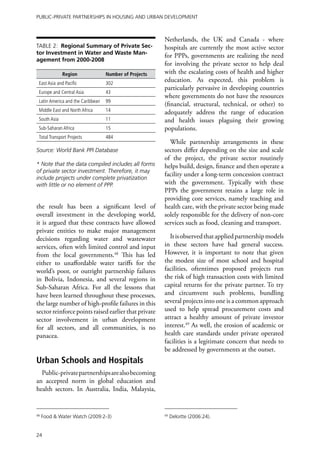
forms (shown below), but generally represent a              consistently generating efficiency gains
more dynamic, long-term agreement between                   in developed countries like Canada, the
various parties in which each sector contributes            Netherlands and the United Kingdom (UK)
and shares some level of risk.                              cannot be overlooked. In these countries,
                                                            partnerships have been a significant
   Broadly speaking, a typical PPP allows a                 contributor to lowering costs and increasing
private consortium to assume the financing                  operating efficiencies for urban development
risk and two or more phases of the project’s                projects ranging from affordable housing to
life-cycle. This may include the design and                 water treatment facilities, roads and hospitals.
construction phases of the project and the                   As such, there is a growing body of evidence
subsequent maintenance and operation of the                 that indicates that PPPs are an important
government facility under a carefully contrived             instrument that can be used to help extend
long-term lease. This is in contrast to the private         infrastructure assets, along with basic urban
sector’s traditional role in urban infrastructure           services, to the poorest neighborhoods of some
development where its involvement is limited                of the world’s liveliest urban centers.
to providing skilled labour under short-term
contracts, with the delivery of the services


                                                            3
                                                             See OECD (2005:2), ‘Investment for African
                                                            Development: Making It Happen.’
2
  For the purposes of this report, basic infrastructure     4
                                                              Conference Board of Canada (2010:i), Dispelling the
refers to social assets such as affordable housing,         Myths: A Pan Canadian Assessment of Public-Private
schools and hospital facilities as well as infrastructure   Partnerships for Infrastructure Investment and Deloitte
development for basic utilities including water, waste      (2006: 21-26), ‘Closing the Infrastructure Gap: The
management, sanitation and transport systems.               Role of Public-Private Partnerships.’


2
Chapter Three THE ADVANTAGES AND DISADVANTAGES OF PPPs


Chapter 3:	THE ADVANTAGES AND
          DISADVANTAGES OF PPPs


   The principal reason for adopting a PPP          Output-Based Contracts
model for the provision of housing and urban
                                                      Public-private partnership projects typically
development is that, where project suitability
                                                    adopt an output-focused contract which links
is correctly measured and implemented, this
                                                    payments to performance. This specifies project
approach can offer greater value for money
                                                    results in terms of the quality delivered, rather
when compared with traditional procurement.
                                                    than how assets or services are provided.6
While this section highlights this and other
                                                      Emphasis on outputs also encourages
important key advantages associated with this
                                                    innovation to take place by motivating the
model, it also considers some of the arguments
                                                    private partner to develop new methods and
made against PPP procurement for wider
                                                    approaches for project delivery that meets
urban development.
                                                    requirements at lower costs.


Some of the advantages of                           Risk sharing

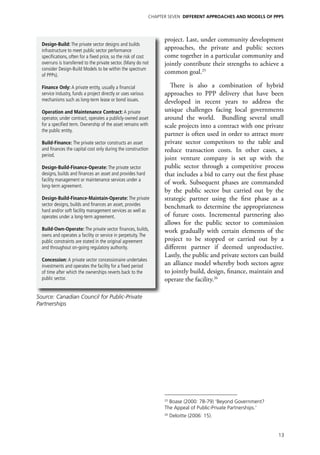
PPPs can be defined as follows:                        Public-private partnerships are designed so
                                                    that risk is transferred between the public and
Cost Savings                                        private sectors, allocating particular project
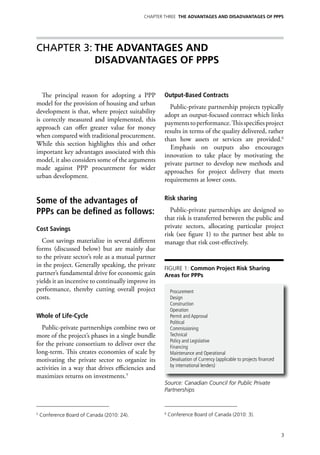
                                                    risk (see figure 1) to the partner best able to
  Cost savings materialize in several different     manage that risk cost-effectively.
forms (discussed below) but are mainly due
to the private sector’s role as a mutual partner
in the project. Generally speaking, the private     Figure 1: Common Project Risk Sharing
partner’s fundamental drive for economic gain       Areas for PPPs
yields it an incentive to continually improve its
performance, thereby cutting overall project             Procurement
costs.                                                   Design
                                                         Construction
                                                         Operation
Whole of Life-Cycle                                      Permit and Approval
                                                         Political
  Public-private partnerships combine two or             Commissioning
more of the project’s phases in a single bundle          Technical
                                                         Policy and Legislative
for the private consortium to deliver over the           Financing
long-term. This creates economies of scale by            Maintenance and Operational
motivating the private sector to organize its            Devaluation of Currency (applicable to projects financed
                                                         by international lenders)
activities in a way that drives efficiencies and
maximizes returns on investments.5
                                                    Source: Canadian Council for Public Private
                                                    Partnerships


5
    Conference Board of Canada (2010: 24).          6
                                                        Conference Board of Canada (2010: 3).


                                                                                                                    3
Public-Private Partnerships in Housing and Urban Development


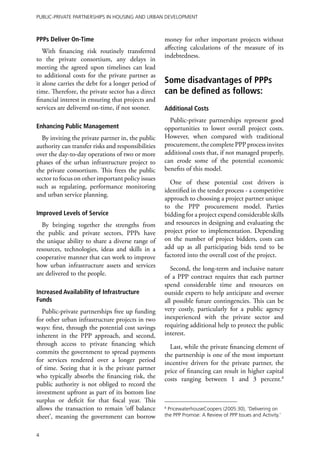
PPPs Deliver On-Time                                money for other important projects without
                                                    affecting calculations of the measure of its
   With financing risk routinely transferred
                                                    indebtedness.
to the private consortium, any delays in
meeting the agreed upon timelines can lead
to additional costs for the private partner as
it alone carries the debt for a longer period of    Some disadvantages of PPPs
time. Therefore, the private sector has a direct    can be defined as follows:
financial interest in ensuring that projects and
services are delivered on-time, if not sooner.      Additional Costs
                                                      Public-private partnerships represent good
Enhancing Public Management                         opportunities to lower overall project costs.
  By inviting the private partner in, the public    However, when compared with traditional
authority can transfer risks and responsibilities   procurement, the complete PPP process invites
over the day-to-day operations of two or more       additional costs that, if not managed properly,
phases of the urban infrastructure project to       can erode some of the potential economic
the private consortium. This frees the public       benefits of this model.
sector to focus on other important policy issues
                                                      One of these potential cost drivers is
such as regulating, performance monitoring
                                                    identified in the tender process - a competitive
and urban service planning.
                                                    approach to choosing a project partner unique
                                                    to the PPP procurement model. Parties
Improved Levels of Service                          bidding for a project expend considerable skills
  By bringing together the strengths from           and resources in designing and evaluating the
the public and private sectors, PPPs have           project prior to implementation. Depending
the unique ability to share a diverse range of      on the number of project bidders, costs can
resources, technologies, ideas and skills in a      add up as all participating bids tend to be
cooperative manner that can work to improve         factored into the overall cost of the project.
how urban infrastructure assets and services           Second, the long-term and inclusive nature
are delivered to the people.                        of a PPP contract requires that each partner
                                                    spend considerable time and resources on
Increased Availability of Infrastructure            outside experts to help anticipate and oversee
Funds                                               all possible future contingencies. This can be
   Public-private partnerships free up funding      very costly, particularly for a public agency
for other urban infrastructure projects in two      inexperienced with the private sector and
ways: first, through the potential cost savings     requiring additional help to protect the public
inherent in the PPP approach, and second,           interest.
through access to private financing which             Last, while the private financing element of
commits the government to spread payments           the partnership is one of the most important
for services rendered over a longer period          incentive drivers for the private partner, the
of time. Seeing that it is the private partner      price of financing can result in higher capital
who typically absorbs the financing risk, the       costs ranging between 1 and 3 percent.8
public authority is not obliged to record the
investment upfront as part of its bottom line
surplus or deficit for that fiscal year. This
allows the transaction to remain ‘off balance       8
                                                     PricewaterhouseCoopers (2005:30), ‘Delivering on
sheet’, meaning the government can borrow           the PPP Promise: A Review of PPP Issues and Activity.’


4
Chapter Three THE ADVANTAGES AND DISADVANTAGES OF PPPs


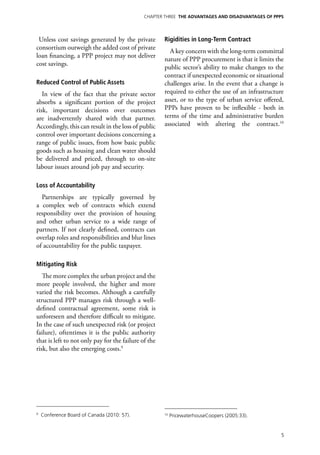
 Unless cost savings generated by the private         Rigidities in Long-Term Contract
consortium outweigh the added cost of private
                                                        A key concern with the long-term committal
loan financing, a PPP project may not deliver
                                                      nature of PPP procurement is that it limits the
cost savings.
                                                      public sector’s ability to make changes to the
                                                      contract if unexpected economic or situational
Reduced Control of Public Assets                      challenges arise. In the event that a change is
   In view of the fact that the private sector        required to either the use of an infrastructure
absorbs a significant portion of the project          asset, or to the type of urban service offered,
risk, important decisions over outcomes               PPPs have proven to be inflexible - both in
are inadvertently shared with that partner.           terms of the time and administrative burden
Accordingly, this can result in the loss of public    associated with altering the contract.10
control over important decisions concerning a
range of public issues, from how basic public
goods such as housing and clean water should
be delivered and priced, through to on-site
labour issues around job pay and security.

Loss of Accountability
  Partnerships are typically governed by
a complex web of contracts which extend
responsibility over the provision of housing
and other urban service to a wide range of
partners. If not clearly defined, contracts can
overlap roles and responsibilities and blur lines
of accountability for the public taxpayer.

Mitigating Risk
   The more complex the urban project and the
more people involved, the higher and more
varied the risk becomes. Although a carefully
structured PPP manages risk through a well-
defined contractual agreement, some risk is
unforeseen and therefore difficult to mitigate.
In the case of such unexpected risk (or project
failure), oftentimes it is the public authority
that is left to not only pay for the failure of the
risk, but also the emerging costs.9


9
    Conference Board of Canada (2010: 57).            10
                                                           PricewaterhouseCoopers (2005:33).


                                                                                                    5
Public-Private Partnerships in Housing and Urban Development


Chapter 4: CHALLENGES FOR PPPs IN HOUSING
           AND URBAN DEVELOPMENT


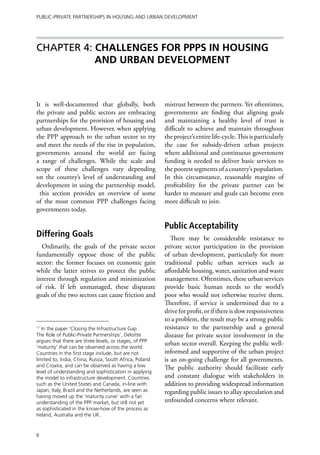
It is well-documented that globally, both                mistrust between the partners. Yet oftentimes,
the private and public sectors are embracing             governments are finding that aligning goals
partnerships for the provision of housing and            and maintaining a healthy level of trust is
urban development. However, when applying                difficult to achieve and maintain throughout
the PPP approach to the urban sector to try              the project’s entire life-cycle. This is particularly
and meet the needs of the rise in population,            the case for subsidy-driven urban projects
governments around the world are facing                  where additional and continuous government
a range of challenges. While the scale and               funding is needed to deliver basic services to
scope of these challenges vary depending                 the poorest segments of a country’s population.
on the country’s level of understanding and              In this circumstance, reasonable margins of
development in using the partnership model,              profitability for the private partner can be
  this section provides an overview of some              harder to measure and goals can become even
of the most common PPP challenges facing                 more difficult to join.
governments today.

                                                         Public Acceptability
Differing Goals                                             There may be considerable resistance to
  Ordinarily, the goals of the private sector            private sector participation in the provision
fundamentally oppose those of the public                 of urban development, particularly for more
sector: the former focuses on economic gain              traditional public urban services such as
while the latter strives to protect the public           affordable housing, water, sanitation and waste
interest through regulation and minimization             management. Oftentimes, these urban services
of risk. If left unmanaged, these disparate              provide basic human needs to the world’s
goals of the two sectors can cause friction and          poor who would not otherwise receive them.
                                                         Therefore, if service is undermined due to a
                                                         drive for profit, or if there is slow responsiveness
                                                         to a problem, the result may be a strong public
11
   In the paper ‘Closing the Infrastructure Gap:         resistance to the partnership and a general
The Role of Public-Private Partnerships’, Deloitte       distaste for private sector involvement in the
argues that there are three levels, or stages, of PPP
                                                         urban sector overall. Keeping the public well-
‘maturity’ that can be observed across the world.
Countries in the first stage include, but are not        informed and supportive of the urban project
limited to, India, China, Russia, South Africa, Poland   is an on-going challenge for all governments.
and Croatia, and can be observed as having a low         The public authority should facilitate early
level of understanding and sophistication in applying
the model to infrastructure development. Countries       and constant dialogue with stakeholders in
such as the United States and Canada, in-line with       addition to providing widespread information
Japan, Italy, Brazil and the Netherlands, are seen as    regarding public issues to allay speculation and
having moved up the ‘maturity curve’ with a fair
understanding of the PPP market, but still not yet       unfounded concerns where relevant.
as sophisticated in the know-how of the process as
Ireland, Australia and the UK.


6
Chapter four CHALLENGES FOR PPPs IN HOUSING AND URBAN DEVELOPMENT


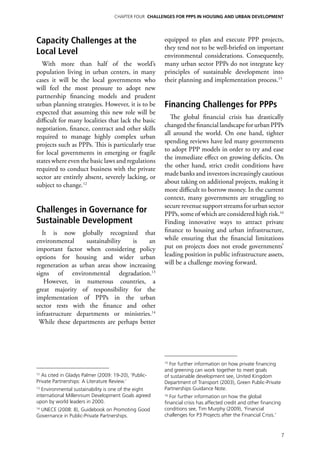
Capacity Challenges at the                             equipped to plan and execute PPP projects,
                                                       they tend not to be well-briefed on important
Local Level                                            environmental considerations. Consequently,
  With more than half of the world’s                   many urban sector PPPs do not integrate key
population living in urban centers, in many            principles of sustainable development into
cases it will be the local governments who             their planning and implementation process.15
will feel the most pressure to adopt new
partnership financing models and prudent
urban planning strategies. However, it is to be        Financing Challenges for PPPs
expected that assuming this new role will be
                                                          The global financial crisis has drastically
difficult for many localities that lack the basic
                                                       changed the financial landscape for urban PPPs
negotiation, finance, contract and other skills
                                                       all around the world. On one hand, tighter
required to manage highly complex urban
                                                       spending reviews have led many governments
projects such as PPPs. This is particularly true
                                                       to adopt PPP models in order to try and ease
for local governments in emerging or fragile
                                                       the immediate effect on growing deficits. On
states where even the basic laws and regulations
                                                       the other hand, strict credit conditions have
required to conduct business with the private
                                                       made banks and investors increasingly cautious
sector are entirely absent, severely lacking, or
                                                       about taking on additional projects, making it
subject to change.12
                                                       more difficult to borrow money. In the current
                                                       context, many governments are struggling to
                                                       secure revenue support streams for urban sector
Challenges in Governance for                           PPPs, some of which are considered high risk.16
Sustainable Development                                Finding innovative ways to attract private
   It is now globally recognized that                  finance to housing and urban infrastructure,
environmental     sustainability  is     an            while ensuring that the financial limitations
important factor when considering policy               put on projects does not erode governments’
options for housing and wider urban                    leading position in public infrastructure assets,
regeneration as urban areas show increasing            will be a challenge moving forward.
signs of environmental degradation.13
    However, in numerous countries, a
great majority of responsibility for the
implementation of PPPs in the urban
sector rests with the finance and other
infrastructure departments or ministries.14
 While these departments are perhaps better


                                                       15
                                                         For further information on how private financing
                                                       and greening can work together to meet goals
12
  As cited in Gladys Palmer (2009: 19-20), ‘Public-    of sustainable development see, United Kingdom
Private Partnerships: A Literature Review.’            Department of Transport (2003), Green Public-Private
13
  Environmental sustainability is one of the eight     Partnerships Guidance Note.
international Millennium Development Goals agreed      16
                                                          For further information on how the global
upon by world leaders in 2000.                         financial crisis has affected credit and other financing
 UNECE (2008: 8), Guidebook on Promoting Good
14                                                     conditions see, Tim Murphy (2009), ‘Financial
Governance in Public-Private Partnerships.             challenges for P3 Projects after the Financial Crisis.’


                                                                                                                  7
Public-Private Partnerships in Housing and Urban Development


Chapter 5: RELATIONSHIPS WITH LENDERS
           AND OTHER PARTIES


   Typically, a PPP involves not just the             separate contracts providing additional
relationship between the public authority and         guarantees between the lender and the public
the private partner responsible for the delivery      authority to allow for closer monitoring
of the project, but also a consortium of third        of construction timelines and budgetary
party interests such as lenders, equity investors     conditions are not uncommon. In the event
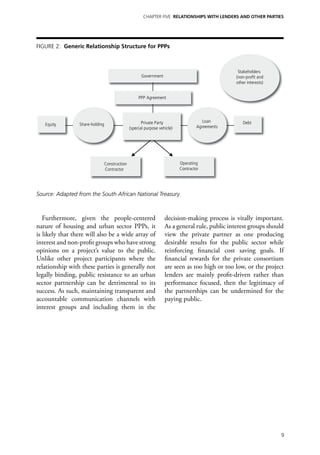
and other interests or non-profit groups (see         that a private company does not perform the
figure 2), many of whom have a large stake in         project agreement obligations, under such
the successful outcome of the project.                contracts, lenders can rectify the problem by
                                                      going as far as to replace the private partner.19
  Arguably, one of the more important                  Therefore, given the significant sway lenders
relationships that the partnership needs to           have in overall contract change and approval, it
nurture is with project lenders responsible for       is imperative to the success of the partnership
providing the long-term debt financing for the        that a close relationship with these actors be
infrastructure asset. This can account for up         forged.
to 80 percent of a project’s overall funding.17
 A partnership generally seeks project financing         The partnership also needs to build good
from banks and lenders whose willingness to           working relations with equity investors
provide funding for the project will depend on        who make up the remainder of the funding
the financial viability and predictability of the     for the cost of the project. Equity is usually
asset. As an aside, most lenders will not grant       provided by private contractors involved in
loans for urban projects that have not carried        the project, but can also be made available
out a rigorous assessment of all project risks,       through third-party equity investors who
or which are potentially open-ended and not           have no other contractual relationship with
well-defined in their objective.18                    the partnership. Because the return on equity
                                                      is received only after the financing debt has
  Nevertheless, once a loan has been secured,         been serviced, equity financing is considered
lenders play a useful role in reviewing and           high risk for investors and therefore is one of
overseeing the overall performance of the urban       the most expensive forms of project funding.
infrastructure project. Stringent standards on        Nevertheless, equity funders play a useful
the part of the lender usually result in lenders      role in securing debt financing from lenders
seeking out their own set of technical, legal,        that may require some collateral for the loan,
and other advisors to monitor the progress            as well as providing advice in the event that
of the project. In riskier sectors or projects,       problems do arise amongst the other private
                                                      sector partners.20

17
  Peter Farlam (2005), ‘Working Together: Assessing
Public-Private Partnerships in Africa.’
18
  World Bank (2009:25-26), ‘Attracting Investors
to African Public-Private Partnerships: A Project
                                                      19
                                                           Murphy (2009:16).
Preparation Guide.’                                   20
                                                           The World Bank (2009:27). ‘Attracting Investors...’


8
Chapter five RELATIONSHIPS WITH LENDERS AND OTHER PARTIES


Figure 2: Generic Relationship Structure for PPPs


                                                                                                  Stakeholders
                                                       Government                                (non-profit and
                                                                                                 other interests)


                                                     PPP Agreement


                                                       Private Party                   Loan         Debt
   Equity        Share-holding
                                                (special purpose vehicle)           Agreements


                                 Construction                               Operating
                                 Contractor                                 Contractor


Source: Adapted from the South African National Treasury


   Furthermore, given the people-centered                           decision-making process is vitally important.
nature of housing and urban sector PPPs, it                         As a general rule, public interest groups should
is likely that there will also be a wide array of                   view the private partner as one producing
interest and non-profit groups who have strong                      desirable results for the public sector while
opinions on a project’s value to the public.                        reinforcing financial cost saving goals. If
Unlike other project participants where the                         financial rewards for the private consortium
relationship with these parties is generally not                    are seen as too high or too low, or the project
legally binding, public resistance to an urban                      lenders are mainly profit-driven rather than
sector partnership can be detrimental to its                        performance focused, then the legitimacy of
success. As such, maintaining transparent and                       the partnerships can be undermined for the
accountable communication channels with                             paying public.
interest groups and including them in the


                                                                                                                    9
Public-Private Partnerships in Housing and Urban Development


Chapter 6: KEY PRINCIPLES, INSTRUMENTS
           AND METHODS


   Based on best practices and lessons learned,           •	 An urban sector PPP must reflect the
all PPPs for housing and urban development                   needs of the affected community and must
should be founded on the following key                       integrate into the project key stakeholder
principles, methods and instruments (most of                 priorities.
which are discussed at length in later sections           •	 The project must be responsibly managed
of this report) in order to raise the likelihood             throughout the term of the agreement, with
of project success.                                          predictability and priority as determined
                                                             by the partnership.

Key Principles
  Public-private partnerships should adopt
                                                          Methods and Instruments
the following eight governing principles:                  Governments should consider the following
                                                          methods and instruments when applying PPPs:
•	 The public interest is paramount.21
•	 Good practices in accountability and                   PPP Suitability
   transparency measures must be maintained
   throughout the lifecycle of the project.                 In the initial planning stages of a housing and
                                                          urban sector project, it is important to realize
•	 A PPP project needs to be carefully planned,           that not all urban projects should be obtained
   well-defined in scope and fundamentally                through a partnership model approach.
   clear in its objectives.                               Diversity between the urban sectors exists with
•	 The viability of the project needs                to   each project being characterized by a unique
   be measured against a criteria set                by   set of distinct operating requirements, means
   the initiating partner to assist it               in   of service delivery, and mode of payment
   determining its potential suitability            for   for service. As such, the degree of private
   PPP procurement.                                       involvement for a proposed project needs to
                                                          be carefully matched against the goals of the
•	 The selected PPP model must provide
                                                          affected public and deemed suitable for PPP
   value for money in terms of cost and time              procurement before further consideration is
   savings with appropriate consideration of              given.
   risk transfer.
•	 The PPP tendering process must be                      Project Screening Instruments
   competitive, fair and subject to proper due
   diligence on the part of the partnership.                 After the project’s goals have been carefully
                                                          aligned with public interests, rigorous
                                                          screening instruments need to be developed
                                                          to better measure its monetary value against
                                                          alternative methods of delivery. One of the
21
  City of Calgary (2008:3), Public-Private Partnerships   best means of measuring project suitability
Calgary Council Policy Framework.                         is by conducting a Value for Money (VfM)

10
Chapter six KEY PRINCIPLES, INSTRUMENTS AND METHODS


test. Used widely, the VfM test focuses on                   PPP Units
outputs by identifying risk and appropriately
                                                               The development of PPP units on the local or
allocating it, and by calculating internal costs
                                                             national level that house the skills required to
to governments through the implementation
                                                             instigate and manage urban sector partnerships
of the Public Sector Comparator (PSC) test.
                                                             can be used as an effective instrument to
Designed to quantify value, the PSC captures
                                                             build the expertise of governments, thereby
then compares all necessary costs and savings
                                                             bolstering the development of PPPs in
of PPP procurement against the most efficient
                                                             housing and urban development. For the
form of public procurement.22 As one would
                                                             private partner, the units can provide a
expect, screening instruments need to be fair
                                                             gateway on the information about partnership
and objective and therefore, responsibility for
                                                             opportunities, as well as a single point of
drafting the VfM and the PSC should lie in
                                                             coordination and decision-making for greater
the hands of an independent body.
                                                             transparency and consistency. For the public
                                                             stakeholders, the units can assume many
Applying Lessons Learned                                     functions including: Facilitate PPP projects,
   Where a PPP approach to infrastructure                    share expertise and knowledge and provide
and service delivery has been adequately                     education and skills training on a wide array of
measured, a good working method to apply                     PPP concerns. Ultimately, creating units that
when thinking about implementation is                        keep participants informed and well-trained is
that while standardized PPP processes are                    part of the responsible management needed
important, and have served governments well,                 for effective PPP implementation on the part
stark community differences in such factors                  of the public sector.
as population and geographic size, as well as
a country’s economic and cultural stability, do              Adopting a Holistic Approach
exist and need to be considered.23 Applying
                                                                Taking a holistic approach of the PPP
lessons learned from countries with similar
                                                             project that accurately considers all aspect of
experiences in a specified sector that may have
                                                             the project’s implementation phases is a useful
more advanced knowledge in PPP development
                                                             method to adopt to help drive down costs and
shows due diligence on the part of the public
                                                             alleviate potential structural problems in the
authority in trying to avoid mistakes.
                                                             long-term. It may be more cost-friendly, for
                                                             example, to build an infrastructure asset using
Disciplined Planning                                         materials that are more expensive at the outset
   A disciplined approach to planning outlining              but which prove more reliable and robust for
                                                             the long-term.24 Furthermore, while much
a sound roadmap for implementation early on
                                                             focus should be put on the transaction stage
in the process is essential. Initial time spent
                                                             of the project, success of an urban sector PPP
fully exploring objectives and core values
                                                             actually needs to consider the long-term effects
regarding the purpose of the project and how
                                                             of the project on the wider public community
it intends to benefit the public will avoid
                                                             and how it connects with other urban sectors
missteps later in the process. This can also
                                                             such as roads and hospitals, as well as other
provide a degree of certainty and reassurance                policies and institutions surrounding the
to all parties involved.                                     project.

22
   Canadian Council for Public-Private Partnerships has
published helpful guidelines for determining how and
when to employ the PSC, made available at http://
strategis.ic.gc.ca/epic/internet/
23
     Deloitte (2006:6).                                      24
                                                                  Conference Board of Canada (2010:25).


                                                                                                          11
Public-Private Partnerships in Housing and Urban Development


Chapter 7: DIFFERENT APPROACHES
           AND MODELS OF PPPS


  Partnerships with the private sector come                                              deal of responsibility over the provision of the
in many forms with a wide array of delivery                                              public service to the private partner.
frameworks to choose from. In helping to
identify the many arrangements of PPPs, the
following section provides a brief assessment                                            Approaches
of the varied approaches and type of PPP
                                                                                            While it is commonly cited that a ‘true’ form
models. The choice of model and/or approach
                                                                                         of PPP is a collaborative model where both the
to PPPs varies depending on the market sector
                                                                                         private and public sectors agree to share the
and type of project, but is usually structured
                                                                                         risks and rewards of a particular project, there
to try and improve efficiency, quality of service
                                                                                         are a variety of approaches that illustrate the
and price.
                                                                                         possible power-sharing and decision-making
                                                                                         arrangements. A partnership with the private
                                                                                         sector can fall under a consultative approach
Models and their Structure                                                               whereby the government seeks out expert advice
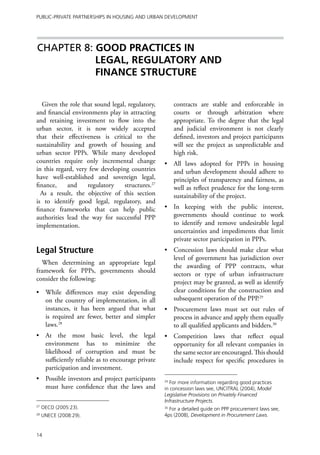
  There is a spectrum of organizational models                                           from the private sector or community groups.
under which PPPs are typically implemented.                                              There are also contributory arrangements
As figure 3 below indicates, partnerships can                                            which are identified as ones where the public
range from being under the direct control                                                sector provides funding to the private partner
of the level of government involved in the                                               that is in turn responsible for carrying out
partnership, to a model that transfers a great                                           the development and management of the


Figure 3: The Public-Private Spectrum and Model Definitions

     The Scale of Public-Private Partnerships: Risk Transfer and Private Sector Involvement


                                                  								 Privatization
     Degree of Private Sector Risk


                                                  							 Concession
                                                  						 Build-Own-Operate
                                     PPP Models


                                                  					 Design-Build-Finance-Maintain-Operate
                                                  				 Design-Build-Finance-Operate Build-Finance
                                                  			 Operation and Maintenance
                                                  		 Finance
                                                  	   Design-Build
                                                  Degree of Private Sector Involvement


12
Chapter sEVEN DIFFERENT APPROACHES AND MODELS OF PPPS


                                                                     project. Last, under community development
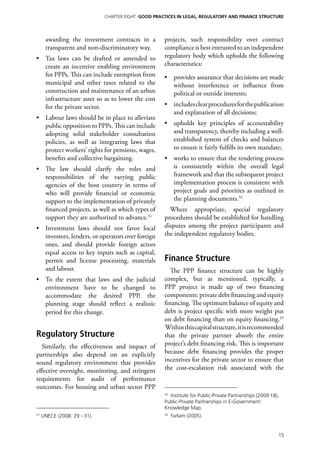
  Design-Build: The private sector designs and builds
  infrastructure to meet public sector performance                   approaches, the private and public sectors
  specifications, often for a fixed price, so the risk of cost       come together in a particular community and
  overruns is transferred to the private sector. (Many do not        jointly contribute their strengths to achieve a
  consider Design-Build Models to be within the spectrum
  of PPPs).
                                                                     common goal.25

  Finance Only: A private entity, usually a financial                   There is also a combination of hybrid
  service industry, funds a project directly or uses various         approaches to PPP delivery that have been
  mechanisms such as long-term lease or bond issues.                 developed in recent years to address the
  Operation and Maintenance Contract: A private                      unique challenges facing local governments
  operator, under contract, operates a publicly-owned asset          around the world. Bundling several small
  for a specified term. Ownership of the asset remains with          scale projects into a contract with one private
  the public entity.
                                                                     partner is often used in order to attract more
  Build-Finance: The private sector constructs an asset              private sector competitors to the table and
  and finances the capital cost only during the construction         reduce transaction costs. In other cases, a
  period.
                                                                     joint venture company is set up with the
  Design-Build-Finance-Operate: The private sector                   public sector through a competitive process
  designs, builds and finances an asset and provides hard            that includes a bid to carry out the first phase
  facility management or maintenance services under a
  long-term agreement.
                                                                     of work. Subsequent phases are commanded
                                                                     by the public sector but carried out by the
  Design-Build-Finance-Maintain-Operate: The private                 strategic partner using the first phase as a
  sector designs, builds and finances an asset, provides
                                                                     benchmark to determine the appropriateness
  hard and/or soft facility management services as well as
  operates under a long-term agreement.                              of future costs. Incremental partnering also
                                                                     allows for the public sector to commission
  Build-Own-Operate: The private sector finances, builds,            work gradually with certain elements of the
  owns and operates a facility or service in perpetuity. The
  public constraints are stated in the original agreement            project to be stopped or carried out by a
  and throughout on-going regulatory authority.                      different partner if deemed unproductive.
                                                                     Lastly, the public and private sectors can build
  Concession: A private sector concessionaire undertakes
  investments and operates the facility for a fixed period           an alliance model whereby both sectors agree
  of time after which the ownerships reverts back to the             to jointly build, design, finance, maintain and
  public sector.                                                     operate the facility.26

Source: Canadian Council for Public-Private
Partnerships


                                                                     25
                                                                       Boase (2000: 78-79) ‘Beyond Government?
                                                                     The Appeal of Public-Private Partnerships.’
                                                                     26
                                                                          Deloitte (2006: 15).


                                                                                                                   13
Public-Private Partnerships in Housing and Urban Development


Chapter 8: GOOD PRACTICES IN
           LEGAL, REGULATORY AND
           FINANCE STRUCTURE


   Given the role that sound legal, regulatory,         contracts are stable and enforceable in
and financial environments play in attracting           courts or through arbitration where
and retaining investment to flow into the               appropriate. To the degree that the legal
urban sector, it is now widely accepted                 and judicial environment is not clearly
that their effectiveness is critical to the             defined, investors and project participants
sustainability and growth of housing and                will see the project as unpredictable and
urban sector PPPs. While many developed                 high risk.
countries require only incremental change          •	 All laws adopted for PPPs in housing
in this regard, very few developing countries         and urban development should adhere to
have well-established and sovereign legal,            principles of transparency and fairness, as
finance,     and    regulatory    structures.27       well as reflect prudence for the long-term
  As a result, the objective of this section          sustainability of the project.
is to identify good legal, regulatory, and
finance frameworks that can help public            •	 In keeping with the public interest,
authorities lead the way for successful PPP           governments should continue to work
implementation.                                       to identify and remove undesirable legal
                                                      uncertainties and impediments that limit
                                                      private sector participation in PPPs.
Legal Structure                                    •	 Concession laws should make clear what
                                                      level of government has jurisdiction over
  When determining an appropriate legal
                                                      the awarding of PPP contracts, what
framework for PPPs, governments should
                                                      sectors or type of urban infrastructure
consider the following:
                                                      project may be granted, as well as identify
•	 While differences may exist depending              clear conditions for the construction and
   on the country of implementation, in all           subsequent operation of the PPP.29
   instances, it has been argued that what         •	 Procurement laws must set out rules of
   is required are fewer, better and simpler          process in advance and apply them equally
   laws.28                                            to all qualified applicants and bidders.30
•	 At the most basic level, the legal              •	 Competition laws that reflect equal
   environment has to minimize the                    opportunity for all relevant companies in
   likelihood of corruption and must be               the same sector are encouraged. This should
   sufficiently reliable as to encourage private      include respect for specific procedures in
   participation and investment.
•	 Possible investors and project participants     29
                                                      For more information regarding good practices
   must have confidence that the laws and          in concession laws see, UNCITRAL (2004), Model
                                                   Legislative Provisions on Privately Financed
                                                   Infrastructure Projects.
27
     OECD (2005:23).                               30
                                                     For a detailed guide on PPP procurement laws see,
28
     UNECE (2008:29).                              4ps (2008), Development in Procurement Laws.


14
Chapter EIGHT GOOD PRACTICES IN LEGAL, REGULATORY AND FINANCE STRUCTURE


      awarding the investment contracts in a         projects, such responsibility over contract
      transparent and non-discriminatory way.        compliance is best entrusted to an independent
•	 Tax laws can be drafted or amended to             regulatory body which upholds the following
   create an incentive enabling environment          characteristics:
   for PPPs. This can include exemption from         •	 provides assurance that decisions are made
   municipal and other taxes related to the             without interference or influence from
   construction and maintenance of an urban             political or outside interests;
   infrastructure asset so as to lower the cost
   for the private sector.                           •	 includes clear procedures for the publication
                                                        and explanation of all decisions;
•	 Labour laws should be in place to alleviate
   public opposition to PPPs. This can include       •	 upholds key principles of accountability
   adopting solid stakeholder consultation              and transparency, thereby including a well-
   policies, as well as integrating laws that           established system of checks and balances
   protect workers’ rights for pensions, wages,         to ensure it fairly fulfills its own mandate;
   benefits and collective bargaining.               •	 works to ensure that the tendering process
•	 The law should clarify the roles and                 is consistently within the overall legal
   responsibilities of the varying public               framework and that the subsequent project
   agencies of the host country in terms of             implementation process is consistent with
   who will provide financial or economic               project goals and priorities as outlined in
   support to the implementation of privately           the planning documents.32
   financed projects, as well as which types of        Where appropriate, special regulatory
   support they are authorized to advance.31         procedures should be established for handling
•	 Investment laws should not favor local            disputes among the project participants and
   investors, lenders, or operators over foreign     the independent regulatory bodies.
   ones, and should provide foreign actors
   equal access to key inputs such as capital,
   permit and license processing, materials          Finance Structure
   and labour.                                          The PPP finance structure can be highly
•	 To the extent that laws and the judicial          complex, but as mentioned, typically, a
   environment have to be changed to                 PPP project is made up of two financing
   accommodate the desired PPP, the                  components: private debt financing and equity
   planning stage should reflect a realistic         financing. The optimum balance of equity and
   period for this change.                           debt is project specific with more weight put
                                                     on debt financing than on equity financing.33
                                                     Within this capital structure, it is recommended
Regulatory Structure                                 that the private partner absorb the entire
  Similarly, the effectiveness and impact of         project’s debt financing risk. This is important
partnerships also depend on an explicitly            because debt financing provides the proper
sound regulatory environment that provides           incentives for the private sector to ensure that
effective oversight, monitoring, and stringent       the cost-escalation risk associated with the
requirements for audit of performance
outcomes. For housing and urban sector PPP
                                                     32
                                                       Institute for Public-Private Partnerships (2009:18),
                                                     Public-Private Partnerships in E-Government:
                                                     Knowledge Map.
31
     UNECE (2008: 29 - 31).                          33
                                                          Farlam (2005).


                                                                                                          15
Public-Private Partnerships in Housing and Urban Development


debt is properly managed and performance is        One significant effect of the recent global
in-line with project expectations. In the event    financial crisis is that credit approval for
that non-performance occurs, the government        PPP projects has become even more costly
is not required to pay the annual fee to the       and difficult to obtain. As a result, recent
private consortium. Additionally, and as           consideration has been given to replacing
discussed, the private financing component         some of the private financing component
secures due diligence on the part of lenders       with traditional financing whereby the public
who subsequently monitor the project during        provides more upfront funding for the project.
all phases of the PPP.                             Under such a structure, it is argued that the
                                                   public authority can control incentive drivers
  While private financing is often cited           by setting penalties and large fines for non-
as one of the key advantages for adopting          compliance. While in theory it may be possible
the partnership model, it is important to          to create an effective incentive framework
remember that the private sector’s cost of         which ensures cost containment and efficiency,
capital is always a more expensive alternative     in practice, it can be difficult to enforce without
to traditional public financing of urban           higher litigation and administrative costs.35
development projects. As a result, from a          As such, despite preliminary investigation
public finance perspective, the higher cost        into alternative funding options, the private
associated with using private capital for urban    financing component of PPPs remains an
sector PPPs can only be financially justified if   integral part of cost-savings for governments.
the transfer of risks and the efficiency gains
outweigh the higher costs of borrowing.34


34
     Conference Board of Canada (2010:12).         35
                                                        Conference Board of Canada (2010:38).


16
Chapter NINE PUBLIC-PRIVATE PARTNERSHIP ORGANIZATIONAL AND ADMINISTRATIVE EFFECTIVENESS


Chapter 9: PUBLIC-PRIVATE PARTNERSHIP
           ORGANIZATIONAL AND
           ADMINISTRATIVE EFFECTIVENESS


   Meeting the needs of growing urban              information about the project is instrumental
populations through successful planning            to effective relationship building and trust
and implementation of a PPP approach               management. Experience shows that a well-
requires measures beyond the establishment         structured and comprehensive communication
of appropriate legal, regulatory, and financial    plan that includes a strong public consultation
structures. In fact, many partnership problems     policy will guide communications activities
stem from non-technical challenges that            across the full range of project participants.
arise in the working relationships between         If successfully implemented, the plan can
the range of actors involved, such as a lack       positively affect the working relationship
of project leadership and insurmountable           between all parties.
communication         issues.  This     section
maintains that successful PPPs show a high
level of commitment in the following key           Clear Roles and Responsibilities
organizational and administrative areas:
                                                     A well-crafted written agreement that
                                                   formalizes the relationship between all parties,
                                                   clearly delineates roles and responsibilities for
Partner Selection                                  each partner and puts in place a system of
  Whether initiated by the government or the       checks and balances to create co-dependency
private partner, well-organized PPPs begin by      and transparency substantially increases the
identifying the central problem, then seeking      probability of success of the partnership.
out the right partners to help solve it. For the
public authority, choosing the lowest bidder
in the tendering process is not always the best    Procedures
method for partner selection. A candidate
                                                     Since not all contingencies can be foreseen
with years of experience in the urban area
                                                   in the planning stages of a partnership, it is
being considered, along with a shared vision
                                                   critically important for the partnership that
of the project’s goals, are important factors in
                                                   both the private and public sectors agree on
identifying the right partner.
                                                   key management procedures early on in the
                                                   formation of the relationship. At the most
                                                   basic level, there need to be clear procedures in
Building Strong Relationships                      place for decision-making, solving problems,
through Clear Communication                        managing conflicts, and performance
  Fundamentally important to the functioning       evaluation.
of the partnership will be its ability to build
and maintain a deep level of trust among all
partners and stakeholders. Ensuring that each      Strong Public Administration
party is exposed to on-going communication           Indeed, asking a private consortium to
channels that relay timely and reliable

                                                                                                 17
Public-Private Partnerships in Housing and Urban Development


deliver government services places more, not         Strong Leadership
less, responsibility in the hands of the public
administration. As a result, PPPs demand a              The presence of strong leadership within
strong (yet flexible) public administration -        the organization is another key element for
one that is able to quickly adapt and respond        a successful partnership. A strong leader can
to a wide array of changing circumstances.           ensure clear direction and communication for
Ensuring that there is strong in-house expertise     all partners involved, hold partners accountable,
to administer projects, as well as adequate          as well as provide strategic focus and direction
practices for hiring outside experts on technical,   to planning. Although the presence of a strong
legal, and financial matters is an asset. This       leader is important on all sides, it is imperative
requires managers who are trained and skilled        that the leadership does not reflect the narrow
not only in managing the complex web of              goals of any one partner. Partnerships should
relationships, but also skilled in negotiation,      be about joint responsibilities, shared problems
contract management, risk analysis and others        and solutions, and mutually divided resources,
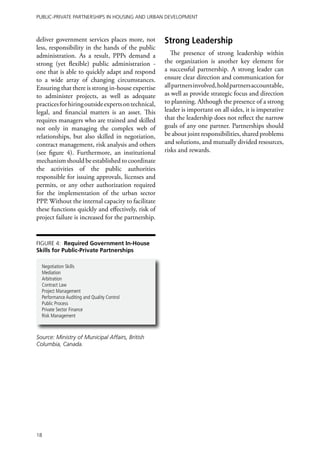
(see figure 4). Furthermore, an institutional        risks and rewards.
mechanism should be established to coordinate
the activities of the public authorities
responsible for issuing approvals, licenses and
permits, or any other authorization required
for the implementation of the urban sector
PPP. Without the internal capacity to facilitate
these functions quickly and effectively, risk of
project failure is increased for the partnership.


Figure 4: Required Government In-House
Skills for Public-Private Partnerships

  Negotiation Skills
  Mediation
  Arbitration
  Contract Law
  Project Management
  Performance Auditing and Quality Control
  Public Process
  Private Sector Finance
  Risk Management


Source: Ministry of Municipal Affairs, British
Columbia, Canada.


18
Chapter TEN IMPLEMENTING HOUSING AND URBAN SECTOR PPPs


Chapter 10: IMPLEMENTING HOUSING
            AND URBAN SECTOR PPPs


  Once the decision to move forward with                Refining the Scope of the
the PPP model for a housing or urban
development project has been made by the
                                                        Project
public authority, and the broader institutional            With a team in place, priority shifts to
and administrative preliminary work is                  refining the scope of the project. More diligent
underway, it is important to begin preparing            quantification and understanding of the
for PPP procurement and implementation.                 project’s goals and objectives, its public need,
Drawing on the experience from countries at             and its risks, along with the sophisticated
different stages of market development, this            allocation of those risks, better prepares the
section aims to provide some useful insight             project for the PPP procurement process. The
into the key activities and issues that can be          public sector should also have established a
applied to increase implementation success.             schedule that lists timeframes for the initiation
                                                        of each phase of the project with established
                                                        key milestones.
Building Capacity
   The first step in the implementation process
is to set clear guidelines that determine which
                                                        Selecting the Preferred
government department or agency will approve            Procurement Process
the project’s readiness for the procurement               Entering into the procurement phase, some
stage. Within that agency, a project team               decisions regarding the preferred method
skilled in delivering a PPP should take on the          should be made. Generally speaking, there
responsibility for the planning, procurement,           are two main methods of procurement:
and negotiation stages of the project, in               competitive       negotiation37 and         pre-
addition to establishing a role in performance          qualification. The choice of method is based on
monitoring.36 Unless the government is deeply           a range of factors, but is mainly distinguished
experienced in contracting PPPs, it will also be        by the level of competition and input required
necessary to hire a multi-dimensional team of           for the project. Whichever method is chosen,
advisors skilled in legal, financial, economic,         the procurement package must include
and sector specific areas to support the capacity       standardized bidding documents, procedures
of the team through the many PPP processes              for the announcement and subsequent
and procedures.                                         evaluation of private sector bids, and a method
                                                        for awarding contracts.38 Exposing the project
                                                        to a fair, open, and transparent procurement


                                                        37
                                                           Asian Development Bank (n.d.:73), Public-Private
36
   Ministry of Municipal Affairs (1999:46), Public      Partnerships Handbook.
Private Partnerships: A Guide for Local Governments.    38
                                                             Institute for Public-Private Partnership (2009:17).


                                                                                                                   19
Public-Private Partnerships in Housing and Urban Development


process is fundamental to the formation of a         who can provide the best overall value39 to the
strong building block upon which bidders will        project.
build their submissions. As mentioned, there
are two primary methods of procurement:                 It is important that governments take
                                                     advantage of the early procurement process and
                                                     use it as an effective two-way communication
                                                     tool between the public and private bidders
Competitive Negotiations                             to finalize what needs to be provided. Care
  When this method of procurement has                should be taken to help identify any issues
been issued, typically the public partner is         either party may have as typically, the terms
less interested in new ideas and inputs and          of the finalized contract are based on the
more focused on cost savings. The public             specifications addressed in this stage.
sector tends to have a rigidly defined scope
and thus selects a fitting group of bidders to
an open negotiation process where typically          Finalizing Contract Terms
pressure is put on them to offer the best price.
While this method tends to be quick and less            Ideally, the bulk of the contract should be
expensive than pre-qualification, where a            sorted out during the bid process; however,
“fully competitive” process takes place, it          final contract negotiations present the
may limit the public sector’s ability to view        last opportunity to discuss any final issues
other, potential cost-effective, or design           between the two sides. One of the main
enhancing approaches to project delivery.            goals of the PPP contract is to appropriately
                                                     harness the expertise and the efficiency of the
                                                     private partner without compromising the
                                                     delivery of service for the public taxpayer.
Pre-Qualification                                    To accomplish this, the public agency is
  This bidding process, usually a two-               encouraged to ensure desirable outcomes by
stage process which includes a request for           putting appropriate control mechanisms in
qualifications (RFQ) and a request for               place in addition to including highly specific
proposals (RFP), is typically adopted by the         contract terms and conditions that establish
public agency to try and harness the innovative      duties, proper allocation and management of
expertise of the private sector with the intention   risk, performance targets, rules for changing
to help it identify how to best meet project         contract conditions and procedures for
objectives. In order to attract international        dispute resolution and performance auditing.
bidders and increase competition, the public         There should also be technical and financial
agency publishes and widely disseminates the         evaluations that include clear data on the level
RFQ document. The document outlines with             of service being provided, specified timeframes
specificity the skills and market knowledge          for project mobilization, as well as financial
required for the project to help limit the           formulas with regard to capital expenditures
number of private parties eligible to participate    and revenues.
further in the process. Interested candidates
match the requested qualifications but only
the top bidders are invited to respond to the
RFP stage, which marks final partner selection.
Unlike the competitive negotiations process
which tends to select a partner based on price,
the public sector here aspires to attract bidders
                                                     39
                                                        Value can come in the form of, for example,
                                                     modern design techniques, operating efficiencies for
                                                     service delivery, innovative technologies, and so on.


20
Chapter TEN IMPLEMENTING HOUSING AND URBAN SECTOR PPPs


Stakeholder Engagement                          of key stakeholder groups and their interests
                                                greatly increase the chances of PPP success,
  Moving forward with the implementation        particularly in urban sectors traditionally under
process, a key consideration the partnership    the purview of governments.40 Therefore,
must address is the need for on-going           as the PPP moves into implementation,
communication and engagement with               as mentioned, both parties should have a
stakeholders. The importance of stakeholder     comprehensive communication plan that
relations should not be overlooked and          establishes strong ties with interested members
communication activities with these groups      of the community and includes mechanisms
should not end with contract award. In fact,    for dialogue and stakeholder consultation.
early identification and on-going involvement


                                                40
                                                   Daniele Calabrese (2008:27), ‘Strategic
                                                Communications for Private, Public-Private
                                                Partnerships, and Private Participation in Infrastructure
                                                Projects.’


                                                                                                      21
Public-Private Partnerships in Housing and Urban Development


Chapter 11: PATTERNS IN APPLYING THE
            PPP MODEL TO HOUSING AND
            URBAN DEVELOPMENT


  This section describes some global patterns       low-income housing projects that depend on
in the application of PPPs for the most             some form of public subsidy to keep prices at
prominent urban infrastructure sectors,             affordable levels.
including affordable housing, transport, water
service, schools and hospitals. As will be shown       In a number of developing countries
below, a substantial increase in the demand for     across Asia and Africa, PPPs are beginning to
the PPP approach in both the industrialized         emerge as the prominent approach to urban
and developing countries can be tracked, with       housing policy. While some success has been
most private investors tending to favor large,      documented in India and Nigeria,43 for the
wealthy, or fast growing markets, with some         most part housing PPPs in the developing
sectors, as well as some forms of PPPs, showing     world are relatively sparse, with little empirical
higher rates of success than others.                data made available to show any real trend to
                                                    successful PPP housing policy.44 Further to
                                                    the point, a distinction should be made with
                                                    wealthier countries where affordable housing
Urban Housing                                       success has been primarily based on a significant
   Partnerships have been used with great           level of government subsidy used to keep
success to construct and maintain low-income        housing costs as low as possible. Oftentimes,
housing in developed countries such as the          such subsidies are a luxury not afforded to the
United States, Australia, Ireland, and the UK.      urban poor in the cash strapped developing
For the most part, the PPP approach to housing      world. Nevertheless, to the extent that housing
projects in these countries has included a joint    PPP will flourish in poorer countries, their use
venture where the private and public sectors        is dependent, amongst other things, on the
jointly finance, own, and operate a housing         economic and political strength and housing
project, and where risk is shared according to      tradition of a particular nation.
predetermined contractual provisions. Seeing
that under this PPP model the public sector
typically contributes significant funds for the
project, it allows the public authority to retain   42
                                                       For instance, financial mechanisms such as tax
significant control over the planning and           credits and housing trust fund have been incorporated
development stages of the partnership while         into housing policy in the US and the UK in order
making use of the private sector’s resources        to secure a constant subsidy stream for low-income
                                                    housing projects. For a lengthy discussion of the
and expertise in construction and design.41         financial tools available to the private sector for
In several of the aforementioned countries, a       affordable housing projects see, Michael Lea and
range of financial mechanisms42 aid in reducing     James Wallace (1996), Current Practices for Financing
overall housing and debt services costs for the     Affordable Housing in the United States.

private partner. These are important tools for
                                                    43
                                                       See Urmi Sengupta (2005), ‘Government
                                                    Intervention and Public-Private Partnerships in
                                                    Housing Delivery in Kolkata’ and http://www.
                                                    tradeinvestnigeria.com/feature_articles/959808.htm
41
     Deloitte (2006:26).                            44
                                                         Ibid.


22
Chapter ELEVEN PATTERNS IN APPLYING THE PPP MODEL TO HOUSING AND URBAN DEVELOPMENT


Urban Transport                                       Table 1: Regional Summary of Private Sec-
   In urban transport, PPPs have emerged as an        tor Investment in Transport from 2000-2008
effective tool for the expansion, maintenance,
and construction of new roads, railways,                             Region              Number of Projects
airports, seaports and other forms of transport.       East Asia and Pacific             137
Internationally, the developing regions have           Europe and Central Asia           43
seen a veritable increase of such arrangements         Latin America and the Caribbean   164
in the last 10 years (see figure 5). Transport         Middle East and North Africa      27
is also the largest area of PPP investment in
                                                       South Asia                        154
developed countries such as Australia, Spain,
                                                       Sub-Saharan Africa                55
Italy, and the US.45 Long-term concession lease
models, which allow the public sector to retain        Total Transport Projects          580

ownership of the asset after the leasing period       Source: World Bank PPI Database
is complete, are by far the most prominent
form of PPPs in this sector. Under this PPP           * Note that the data compiled includes all forms
model, the private partner commonly limits            of private sector investment. Therefore, it may
transport access to paying customers, ensuring        include projects under complete privatization
                                                      with little or no element of PPP.
a revenue stream that can offset all, or some
of the cost of provision. Correspondingly, the
financial viability of urban transport projects
                                                      of water and wastewater systems in many
makes this sector a more attractive investment
                                                      developed countries, and a dire need for new
option to the private partner, particularly in
                                                      investment to keep up with urban population
developed countries where there is a growing
                                                      growth in the developing economies, many
public acceptance of tolls, or other user fees
                                                      governments are moving away from traditional
for roads and bridges.
                                                      state management of water service delivery
  That being said, the sheer scale and long-          and towards private sector involvement. In
term nature of some of these projects,                Canada, Australia and Ireland, along with
combined with the need for, and dependence            a slew of developing regions (see figure 6),
on, accurate traffic demand forecasting in this       fiscal shortfalls have forced local governments
sector significantly increases the financial risk     to adopt PPP structures in an urban sector
absorbed by the partnership.46 Thus, given            traditionally operated solely under the purview
the highly complex nature of transport PPPs,          of the public authority.
these arrangements can be particularly risky
                                                        Although this phenomenon has been
for developing markets that lack the resources
                                                      widely tracked, partnerships in the water and
and relative expertise on such matters.
                                                      sanitation sector are perhaps most controversial,
                                                      particularly in emerging economies. In the
                                                      last decade, large developmental institutions
Urban Water and Sanitation                            have been criticized for making development
Management                                            infrastructure loans to local governments
                                                      contingent upon long-term concession
  Water and sanitation management represents
                                                      contracts with private companies.47 While
another fast growing urban sector for PPPs
around the world. With aging conditions
                                                      47
                                                         For more information see Food & Water Watch
45
     Deloitte (2006:19).                              (2009), Dried up, Sold Out: How the World Bank Push
46
     Deloitte (2006:20).                              for Private Water Harms the Poor.


                                                                                                          23
Public-Private Partnerships in Housing and Urban Development


                                                        Netherlands, the UK and Canada - where
Table 2: Regional Summary of Private Sec-               hospitals are currently the most active sector
tor Investment in Water and Waste Man-
                                                        for PPPs, governments are realizing the need
agement from 2000-2008
                                                        for involving the private sector to help deal
              Region               Number of Projects   with the escalating costs of health and higher
 East Asia and Pacific             302
                                                        education. As expected, this problem is
                                                        particularly pervasive in developing countries
 Europe and Central Asia           43
                                                        where governments do not have the resources
 Latin America and the Caribbean   99
                                                        (financial, structural, technical, or other) to
 Middle East and North Africa      14                   adequately address the range of education
 South Asia                        11                   and health issues plaguing their growing
 Sub-Saharan Africa                15                   populations.
 Total Transport Projects          484
                                                          While partnership arrangements in these
Source: World Bank PPI Database                         sectors differ depending on the size and scale
                                                        of the project, the private sector routinely
* Note that the data compiled includes all forms        helps build, design, finance and then operate a
of private sector investment. Therefore, it may
                                                        facility under a long-term concession contract
include projects under complete privatization
with little or no element of PPP.                       with the government. Typically with these
                                                        PPPs the government retains a large role in
                                                        providing core services, namely teaching and
the result has been a significant level of              health care, with the private sector being made
overall investment in the developing world,             solely responsible for the delivery of non-core
it is argued that these contracts have allowed          services such as food, cleaning and transport.
private entities to make major management
decisions regarding water and wastewater                  It is observed that applied partnership models
services, often with limited control and input          in these sectors have had general success.
from the local governments.48 This has led              However, it is important to note that given
either to unaffordable water tariffs for the            the modest size of most school and hospital
world’s poor, or outright partnership failures          facilities, oftentimes proposed projects run
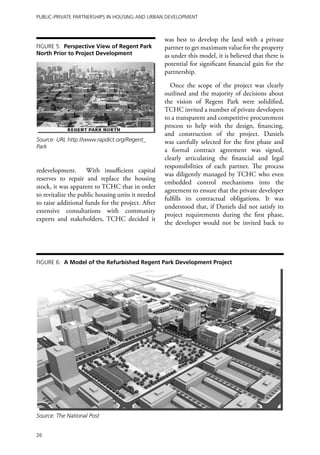
in Bolivia, Indonesia, and several regions in           the risk of high transaction costs with limited
Sub-Saharan Africa. For all the lessons that            capital returns for the private partner. To try
have been learned throughout these processes,           and circumvent such problems, bundling
the large number of high-profile failures in this       several projects into one is a common approach
sector reinforce points raised earlier that private     used to help spread procurement costs and
sector involvement in urban development                 attract a healthy amount of private investor
for all sectors, and all communities, is no             interest.49 As well, the erosion of academic or
panacea.                                                health care standards under private operated
                                                        facilities is a legitimate concern that needs to
                                                        be addressed by governments at the outset.
Urban Schools and Hospitals
  Public-private partnerships are also becoming
an accepted norm in global education and
health sectors. In Australia, India, Malaysia,


48
     Food & Water Watch (2009:2-3)                      49
                                                             Deloitte (2006:24).


24
Chapter TWELVE CASE STUDIES


Chapter 12: CASE STUDIES


  This chapter presents four case studies, one      are set to be affordable home ownership
from each of the aforementioned urban sectors:      opportunities. New parks and streets are to be
housing, transport, water and sanitation            added to the neighborhood and a full mix of
management and schools and hospitals. The           education, culture, and commercial facilities to
case studies show a range of partnership models     be established. The overall goal of the project
that have been implemented in countries at          is to redevelop the area into more than a low-
various stages of economic development. The         income supportive housing neighborhood
primary purpose of these case studies is to         by mixing together both private and public
evaluate the performance of the partnership         aspects of the industry.50
by analyzing and benchmarking each case
study against the principles and best practices        The plan will be carried out by the City of
outlined in earlier sections of this report.        Toronto, TCHC, and the Daniels Corporation,
The format for each case study is the same: a       a well-established developer in the area, in six
description of the background and context is        phases over a 12-to-15 year period that began
provided to better understand the study area        in 2005. All partners contribute and share in
followed by an outline of the key observations      the risks and rewards of the affordable housing
and issues raised.                                  project. For its part, the City of Toronto is
                                                    waiving developmental fees and realty taxes
                                                    on all supportive housing units, as well as
                                                    absorbing a great deal of the infrastructure
Regent Park (Toronto, Canada)                       costs for the creation of new parks and roads.
                                                    Toronto Community Housing undertook
Background
                                                    a number of feasibility studies to determine
  Regent Park is a culturally diverse               the best approach for the regeneration of
social housing development in downtown              the community and is providing some of the
Toronto known locally as one of the poorest         funding for the supportive housing units. As
neighborhoods in Canada. Constructed over           the private developer, Daniels has agreed to help
50 years ago under a national government’s          finance and oversee the design, construction
housing program, Regent Park’s housing stock        and completion of all the housing units.
was deteriorating and in desperate need of
redesign, replacement, and repair (see figure 5).
Under the leadership of Toronto Community           Key Observations and Issues
Housing Corporation (TCHC), owner
and operator of the property, Toronto City            The choice by TCHC to invite a private
Council approved a plan to revitalize Regent        partner to participate in the redevelopment
Park in 2003. The plan included demolishing         of Regent Park was the result of a year-long
and replacing the existing supportive housing       process that looked at various options for
units and bringing in an additional 3,300
mixed-income market units, 300 of which
                                                    50
                                                         TCHC (2007), Regent Park Social Development Plan.


                                                                                                       25
Public-Private Partnerships in Housing and Urban Development


                                                   was best to develop the land with a private
Figure 5: Perspective View of Regent Park          partner to get maximum value for the property
North Prior to Project Development                 as under this model, it is believed that there is
                                                   potential for significant financial gain for the
                                                   partnership.

                                                     Once the scope of the project was clearly
                                                   outlined and the majority of decisions about
                                                   the vision of Regent Park were solidified,
                                                   TCHC invited a number of private developers
                                                   to a transparent and competitive procurement
                                                   process to help with the design, financing,
                                                   and construction of the project. Daniels
Source: URL http://www.rapdict.org/Regent_         was carefully selected for the first phase and
Park
                                                   a formal contract agreement was signed,
                                                   clearly articulating the financial and legal
                                                   responsibilities of each partner. The process
redevelopment. With insufficient capital
                                                   was diligently managed by TCHC who even
reserves to repair and replace the housing
                                                   embedded control mechanisms into the
stock, it was apparent to TCHC that in order
                                                   agreement to ensure that the private developer
to revitalize the public housing units it needed
                                                   fulfills its contractual obligations. It was
to raise additional funds for the project. After
                                                   understood that, if Daniels did not satisfy its
extensive consultations with community
                                                   project requirements during the first phase,
experts and stakeholders, TCHC decided it
                                                   the developer would not be invited back to


Figure 6: A Model of the Refurbished Regent Park Development Project


Source: The National Post


26
Chapter TWELVE CASE STUDIES


build the remaining phases of the project.51            prices in the area and as such, it is uncertain
                                                        whether rising market pressures will translate
  Under the terms of the agreement, TCHC                into providing home ownership opportunities
and Daniels agreed to share the risks and               for low-income earners.
rewards of the new market housing units. A
clear majority of Regent Park’s residents live
below the poverty line and the public housing
project is often portrayed as a neighborhood
                                                        Yitzhak Rabin Trans-Israel
replete with violence and a range of other              Highway 6 (Tel Aviv, Israel)
social ills. Therefore, a critical challenge for
the partnership will be to transform the                Background
community into an exciting, mixed-income                   In 1999, the Government of Israel awarded
neighborhood where people choose to live                a 30-year concession agreement to Derech
(see figure 7). Another important priority              Eretz52 to build and then operate the largest
for the partnership is to manage its working            and most complex transport infrastructure
relationship with the local government to               project ever undertaken in Israel. The Yitzhak
ensure it fulfills its obligation to waive property,    Rabin Trans-Israel Highway was planned to
and other fees, for the affordable housing units        run a total of 186 miles of highway across the
in order to keep housing costs low.                     country in what was set to be the first privately
   Although the full implications of this               operated toll highway in Israel. Using the
partnership will not be known for another               latest electronic toll collection technology,
decade, in the early stages, project goals and          innovative cameras would scan user license
objectives have been effectively managed and            plates, creating a fully-automated toll highway.
executed and the process to date has relayed            It is intended that the new highway will reduce
good governing principles of transparency               congestion, pollution and car accidents on
and inclusiveness. The community is regularly           parallel routes which were experiencing high
informed on the progress of the partnership             levels of traffic flow prior to the agreement.
with continued opportunities for community              Formed as part of a larger highway network
consultation and input. Furthermore, the                connecting the rest of the country, it was
first phase of the project has been successfully        also argued that the new road would provide
completed by Daniels in accordance with                 enhanced capacity for military mobilization
contractual conditions and the developer                in a country often plagued with war. The
has been invited to complete the remaining              project was completed on time and has been
phases. That being said, concern over whether           in operation since 2002 with performance of
the partnership presents viable opportunities           the toll route, relative to traffic and revenue
for the poor in Toronto is not clear - it has           projections being positive to date. However,
not been determined how affordable the                  the project remains controversial amongst
new mixed-income market units will be and               key stakeholders, particularly environmental
whether they will meet the needs of the lowest          groups who loudly opposed the highway
income earners. A thriving real estate market           arguing that it runs through the last remaining
in Toronto has significantly raised housing             non-urban areas in the country.


51
   Alexandra Moskalyk (2008: 32-33), The Role of        52
                                                          Derech Eretz is a consortium of three companies:
Public-Private Partnerships in Funding Social Housing   Africa-Israel, Canadian Highways Infrastructure
in Canada.                                              Corporation and Housing and Construction Limited.


                                                                                                             27
Public-Private Partnerships in Housing and Urban Development


Figure 7: A View of Highway 6 in Israel


Source: US Department of Transport


Key Observations and Issues                             successfully assume necessary project risk that
                                                        would otherwise have been taken up by the
  In accordance with the governing principles
                                                        public sector.
outlined previously, it is observed that the
Government of Israel adopted the PPP model                Although the project is credited with
for the transport project only after reviewing          reducing traffic congestion on alternative
a series of alternative financing options.              roads, it is questionable whether in this case,
Given a shortfall of available funds, it was            the public interest was adequately considered.
believed that the partnership model would               Public interest groups point out that the
deliver the project in a timely manner, allow           road gives privilege to the rich, or those who
for appropriate risk sharing between the                can afford to use the highway, while others
private and public partners, and provide the            are forced to use the “regular roads”. Others
most up-to-date toll collection technology              question the figures and statistical projections
to minimize the time required to pay the                used to frame the public need for the highway
tolls - a feature especially important due to           project. They argue that demand forecasting
the fact that this would be the first toll road         was intentionally inaccurate and then widely
in Israel.53 The project was carefully planned          distributed to try and gain public support for
and evaluated and subjected to a transparent            what is now known to be a highly profitable
and competitive tendering process. Derech               partnership.54 55More importantly, there is
Eretz was chosen based on the company’s                 genuine concern as to whether environmental
experience and its ability to appropriately and

                                                        54
                                                           In 2006, Derech Eretz reported a profit of 89
53
  US Department of Transport (2007:4-18), Case          million, an increase of 56% from 2004.
Studies of Transportation Public Private Partnerships   55
                                                            Yaakov Garb (2004:8-10). ‘Constructing the Trans-
around the World.                                       Israel Highway’s Inevitability.’


28
Chapter TWELVE CASE STUDIES


Figure 8: Ilembe District Community Water and Wastewater Plant


Source URL: www.biwater.com/casestudies/detail.aspx?id=13


stakeholders, who were keenly opposed to             Ilembe District Municipality
the project, were given adequate access to
discussion and debate during the project’s
                                                     - Siza Water Company (South
critical planning stages. According to               Africa)
some, appeals for project variations by the
community were dismissed, leaving a sense            Background
that the public authority, in partnership with
                                                        In 1999, Suez Corporation, through a joint
Derech Eretz, was primarily concerned with
                                                     venture with Siza Water Company (SWC), was
assuming, rather than justifying its position in
                                                     awarded a 30-year concession contract with
support of the infrastructure project.56
                                                     the then Borough of Dolphin Coast (BODC)
   In conclusion, while formally the project was     to become the first private company to manage
more or less well designed and executed, there       and implement a water and wastewater
is some concern over the levels of participation     utility in the Southern Africa region. High
and transparency in the partnership. Given the       growth projections for the areas, combined
controversy surrounding its implementation,          with poor stock of existing infrastructure,
it is uncertain whether the PPP can be               financial shortfalls, and lack of experience
qualified as a ‘successful’ partnership              and managerial capacity in water provision
project. When thinking about a PPP, a more           left BODC to investigate PPP options for
balanced, transparent, and inclusive approach        alternative service delivery in 1996.
is recommended, especially for transport
                                                       Initially, the partnership was welcomed
projects so large in scale that they affect a
                                                     by the city council and senior levels of
broad spectrum of a country’s population.
                                                     government; however, by 2001, the company
                                                     began facing significant financial challenges
                                                     due to a combination of the following factors:
                                                     external currency shocks, faltering technology,
                                                     and incorrect demand estimates for the initial
                                                     concession design, which grossly overestimated
56
     Garb (2004).                                    population growth.57 Unable to pay its
57
  USAID (2005:3-5), Case Studies of Bankable Water   annual concession fees to the municipality,
and Sewerage Utilities.


                                                                                                 29
Public-Private Partnerships in Housing and Urban Development


SWC fought for a renegotiation of the terms           feasibility studies when evaluating the basis
of contract and won. The new agreement                of PPP suitability in the region, particularly
trimmed down the annual concession fees               with regard to the demand data collected in
paid to the municipality by SWC for five              projections. In addition, while the agreement
years, increased water prices for the local           outlined a system for project oversight by the
community, and cut promised investment in             municipality, it is clear that the public partner
maintaining and upgrading services by more            did not have the necessary skills to fulfill
than half.58 Following renegotiations, SWC            this role. An emphasis on providing training
slowly climbed back to profitable numbers             for municipal staff so they could adequately
while Suez reportedly obtained a 21 percent           oversee the management of the water utility
return on its investment, mainly due to a fixed       might have achieved more reliable service
annual fee SWC pays each year.59                      delivery with fewer price increases for the
                                                      community.61 Lastly, given that the contract
Key Observations and Issues                           did not include a specific provision for
                                                      community consultation, better integration
   A brief overview of this case study presents a     of stakeholders into the process could have
mixed picture of the performance and reliability      ensured that more adequate information
of the water and wastewater partnership.              was available when formulating contract
The procurement process initiated a fair and          decisions.
competitive tender process with SWC chosen
only after lengthy evaluation of the partner’s          It should be noted that to date, community
suitability as outlined by the municipality.60        members have expressed considerable
Additionally, there appeared to have been             dissatisfaction and mistrust of the partnership’s
considerable due diligence taken on the part          ability to provide quality water service
of the partnership to ensure reliability and          for the region. Since the beginning of the
viability in the planning stages of the project.      concession agreement, there have been several
Advisors on both sides were called in to help         interruptions of water services with little or
consult on complex negotiation and contract           no warning, and many communities still
issues with the final concession agreement            suffer sewage overflow, causing health hazards
providing considerable details on matters of          for surrounding communities.62 Reported
price, performance parameters, the rights and         unresponsiveness on the part of SWC on
responsibilities of various partners, as well as      these, and other community complaint issues
provisions for performance monitoring and             are a pointed concern despite the fact that the
evaluation.                                           company operates a well-equipped call center
                                                      that tracks complaints data.63 Residents also
  In hindsight, however, it is clear that a           report confusing communication channels on
greater effort and investment was needed in           important information regarding service and
testing the information that formed the basis         other provisions. For instance, policy clarity
of the contract to ensure better performance          on the accommodation of a national free
and monitoring of the project. For example,           water requirement for the poor, along with
more information was required in the                  conflicting information regarding the cost and
                                                      approaches for service delivery, were reportedly

58
     Ibid.
                                                      61
                                                           Farlam (2005:26).
59
     Ibid.
                                                      62
                                                           Robbins (2004).
60
   Glen Robbins (2004:12), A Water Sector Public-
Private Partnership Case Study: Ilembe Municipality
                                                      63
                                                           Ibid.
(formerly Dolphin Coast) Siza Water Company.          64
                                                           Ibid.


30
Chapter TWELVE CASE STUDIES


Figure 9: Manipal University Medical Col-
                                                    Meleka-Manipal Medical
lege in Manipal, India                              College (Malaysia-India).
                                                    Background
                                                       Formalized in 1993, Melaka-Manipal
                                                    Medical College (MMMC) is the first
                                                    joint venture partnership in professional
                                                    education between the Malaysian and Indian
                                                    governments. Prior to the agreement, a lack of
                                                    financial and managerial capacity impeded the
                                                    Malaysian government’s ability to meet the
                                                    rising demand for more well-trained doctors
                                                    in Malaysia. Recognizing this deficiency,
                                                    medical students traveled abroad to receive
                                                    high quality medical training but at a great
Source: Manipal University                          financial cost. The objective of the partnership
                                                    is to meet the rising demand for more doctors
                                                    in Malaysia by affording students access to
poorly channeled to the community.64 Greater        higher medical education at a lower price.
transparency and accountability on the part of      The university offers students a twinning
the partnership, along with meaningful service      Bachelor of Medicine and Bachelor of Surgery
channels, could have led to a higher level of       Degree with pre-clinical training received at
trust and acceptance amongst members of the         Manipal University, a private learning institute
community.                                          operating in Manipal, India, and clinical
                                                    training awarded in Melaka, Malaysia.
  More significantly, this case study illustrates
the controversy and difficulty of water                As a partner, the Government of Malaysia
concession partnerships in the developing           donates the hospital and health centres for
countries. The concession is now a third            medical teaching, some part-time faculty for
complete and while there have been some             clinical training, as well as financial assistance to
high priority investments to the quality of         deserving students admitted to the institution.
the partnership since 2001, the partnership         Additionally, its regulatory bodies, the
cannot yet be considered an unqualified             Medical Malaysian Council and the National
success. Financial challenges that arose in the     Accreditation Board, partner to supervise and
beginning of the partnership make it difficult      provide advisory services to ensure educational
to measure whether value for money has been         requirements meet minimal standards of
achieved for the local population and SWC has       conformity with government regulations.
yet to meet all of its obligations in maintaining   For its role, a private consortium under the
and upgrading basic water services. Therefore,      leadership of Manipal Group, provides the
notwithstanding the fact that the concession        infrastructure and educational component for
today is showing some signs of maturity,            the Manipal campus in India, along with the
expectations from all stakeholders remain           facilities, faculty, and management needed to
high with a considerable measure of hesitation      augment patient care at these hospitals and
from the community as to whether or not the         health care centres.
partnership will create new opportunities for         In 2003, the medical degree which is
the local people, particularly for the poor.        conferred by Manipal University, was formally

                                                                                                      31
Public-Private Partnerships in Housing and Urban Development


recognized by the Malaysian government                partnership in order to entrench consistency
and the institution now plays a larger role in        and fairness across the two curriculums.
attracting international students to study in         Further to the point, the regulatory bodies
Malaysia. Today the university and its programs       responsible for overseeing MMMC are well-
are continually expanding and the partnership         equipped with appropriate policy and legal
has helped meet the medical and educational           powers as well as the resource capacity to
needs for Malaysia’s growing population.              adequately monitor and protect the public
                                                      interest in the practice of medicine.66
Key Observations and Issues                              In many aspects the institution today is
   The choice to invite Manipal Group, along          regarded as exemplifying a true partnership
with its flagship university, to partner with         between the two countries and the private
the Malaysian government in the provision             sector. Good governing principles, combined
of higher medical education was a customary           with a realistic approach towards PPPs on the
one. Manipal University has a long history            part of the Malaysian government has allowed
of training Malaysian doctors in India and            for greater accountability and transparency to
Manipal Group enjoys a healthy reputation for         occur. Manipal Group has expressed that it has
being involved in joint venture partnerships          been a rewarding experience to work with the
both within India and abroad. In addition, an         public sector in Malaysia and the cooperative
enabling economic environment in Malaysia             and prudent efforts by the partners seems
provided great opportunities for PPPs in the          to facilitate a participatory process on the
health and education sector: the demand for           ground.67 The partnership has also worked to
doctors was high and was expected to grow as          spread the cost of education between the two
population and affluence rose steadily and the        sectors. The Government of Malaysia provides
fundamentals of the economic and political            subsidies to the existing private school
climate remained strong. As such, it seemed           program by funding some student enrollment
only natural that the partnership between the         and providing teaching supports while
two countries be formalized.                          Manipal absorbs the cost of delivering medical
                                                      education to students. This cost sharing feature
  That being said, the Malaysian government           has worked to eliminate institutional start-
took prudent measures to ensure the strength          up expenses for the Malaysian government
and viability of the partnership. Before              while better positioning the private partner
formalizing the agreement, the Malaysian              to accrue financial gains in the future. More
government recognized that the role of                significantly, the incremental cost-saving for
privately managed institutions like MMMC              each partner has allowed for high-quality
must “not be at the expense of proper                 education to become more accessible for
maintenance of expected norms and standards           Malaysian students, many of whom would
of teaching.”65 It was made clear early on that       otherwise not be afforded the opportunity to
the intention of inviting the private sector to       study medicine.
higher medical education was to complement,
not replace, public medical schools and
therefore, the government set strict criteria for
the implementation and monitoring of the

                                                      66
                                                         See http://mmc.gov.my/v1/index.php?option=com_
65
  Physicians for Peace and Social Responsibility      frontpage&Itemid=1
(2008:14), “Training Future Doctors: Have We Got it   67
                                                         Physicians for Peace and Social Responsibility
Right?”                                               (2008).


32
Chapter THIRTEEN CONCLUSION


Chapter 13: CONCLUSION


   The infrastructure challenges facing            objective is to raise awareness of the partnership
governments around the world today are             approach and show how it can be used to try
enormous. A significant increase in the urban      and meet the housing and infrastructure needs
population over the last decade, combined with     of governments around the world. It further
sluggish economic growth across many regions       identifies four sector-specific case studies
has resulted in major gaps in infrastructure and   drawn from PPPs around the globe in hopes
urban service delivery. The goal of this report    that the examples would highlight lessons
was to investigate the role that public-private    learned that might strengthen future efforts to
partnerships can play as one possible financing    initiate PPPs. While the case studies show that
tool for facilitating urban infrastructure and     the level of PPP success can vary depending on
service delivery for countries at all levels of    a range of factors, they reinforce the thinking
economic development. The research outlines        presented here that with careful application of
a range of key PPP ideas and principles that can   the partnerships process, housing and urban
be used to provide guidance for governments        infrastructure can be effectively delivered and
on the application of the PPP model to wider       managed.
urban development. In doing so, the main


                                                                                                  33
Public-Private Partnerships in Housing and Urban Development


REFERENCES


Asian Development Bank. (n.d.). Public-            Farlam, Peter. (2005). ‘Working Together:
     Private Partnerships Handbook.                     Assessing Public-Private Partnerships
                                                        in Africa’, Nepad Policy Focus Series.
Askey, Stacy. ‘What Makes the New Regent                Netherlands: The South African Institute
    Park Hot (and Cool)’, The National Post.            of International Affairs.
    January 30, 2009.
                                                   Finlayson, Jock A. (2002). ‘The What and
Boase, Joan Price. (2000). ‘Beyond                      Why of Public-Private Partnerships’,
    Government? The Appeal of Public-                   Policy Perspectives Vol. 9 No.1. Vancouver:
    Private Partnerships’, Canadian Public              Business Council of British Columbia.
    Administration Vol. 42, No. 1: 75-92.
                                                   Food &Water Watch. (2009). Dried Up,
Bult-Spiering, Mirjam, and Geert Dewulf.               Sold Out: How the World Bank’s Push
     (2006). Strategic Issues in Public-Private        for Private Water Pushes Harms the Poor.
     Partnerships: An International Perspective.       Washington: Food & Water Watch.
     Oxford: Blackwell Publishing.
                                                   Garb, Yaakov. (2004). Constructing the Trans-
Calabrese, Daniele. (2008). ‘Strategic                 Israel Highway’s Inevitability. Jerusalem:
    Communication        for    Privatization,         Floersheimer Institute for Policy Studies.
    Public-Private Partnerships, and Private
    Participation in Infrastructure Projects’,     Institute for Public-Private Partnerships.
    World Bank Working Paper No. 139.                    (2009). Public-Private Partnerships in
    Washington: World Bank.                              E-government: Knowledge Map.

Canadian Council for Public-Private                Lea, Michael J., and James E. Wallace. 1996.
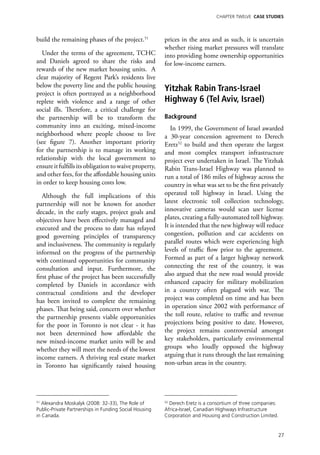
    Partnerships Website. (2005). http://               Current Practices for Financing Affordable
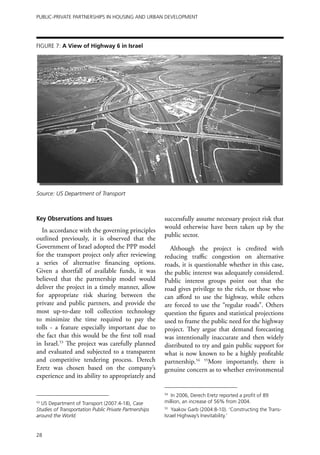
    www.pppcouncil.ca/. Accessed March                  Housing in the United States. A paper
    16, 2010.                                           prepared for the Fannie Mae Foundation
                                                        Office of Housing Research and the 1996
City of Calgary. (2008). Public-Private                 Tri-Country Conference on Housing and
    Partnerships Calgary Council Policy                 Urban Issues.
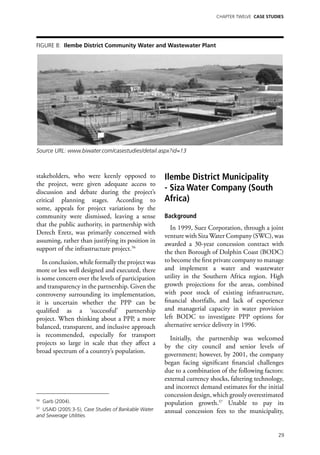
    Framework.
                                                   Mackintosh, M. (1992). ‘Partnership: Issues
Conference Board of Canada. (2010).                   of Policy and Negotiation’, Local Economy
    Dispelling the Myths: A Pan Canadian              Vol. 7,
    Assessment of Public-Private Partnerships
    for Infrastructure Investment. Ottawa:         No. 3: 210-224.
    Conference Board of Canada.
                                                   Malaysia    Medical     Council   Website
Deloitte. (2006). ‘Closing the Infrastructure          (n.d.)     http://mmc.gov.my/v1/index.
    Gap: The Role of Public-Private                    php?option=com_frontpage&Itemid=1
    Partnerships’, A Deloitte Research Study.          Accessed July 10, 2010.

34
REFERENCES


Ministry of Municipal Affairs. (1999). Public         Weaknesses of Public-Private Policy
    Private Partnerships: A Guide for Local           Partnerships,’ American Behavioural
    Governments. British Columbia: Ministry           Scientists Vol. 43, No.1: 10-34.
    of Municipal Affairs.
                                                  Sengupta, Urmi. (2004). ‘Government
Moskalyk, Alexandra. (2008). The Role of              Intervention      and Public-Private
   Public-Partnerships in Funding Social              Partnerships in Housing Delivery
   Housing in Canada. Ottawa: Canadian                in Kolkata’, Habitat International.
   Policy Research Networks.                          Newcastle: Elsevier.

Moszoro, Marian, and Paweł Gąsiorowski.           South African National Treasury Website.
    (2008). ‘Optimal Capital Structure of             (n.d.).      http://www.treasury.gov.za.
    Public-Private                                    Accessed June 3, 2010.

Partnerships’, IMF Working Paper. Washington:     Stiglitz, Joseph E., and Scott J. Wallsten.
     International Monetary Fund.                       (1999). ‘Public-Private Technology
                                                        Partnerships: Promises and Pitfalls’,
Murphy, Tim. (2009). ‘Financial challenges              American Behavioural Scientist Vol. 43,
   for P3 Projects after the Financial Crisis’,         No.1: 52-73.
   A McMillian Report.
                                                  TCHC [Toronto Community Housing
OECD [Organization for Economic Co-                  Corporation]. (2002). Regent Park
   operation and Development]. (2005).               Revitalization Study. Toronto: TCHC.
   ‘Investment for African Development:
   Making It Happen’, Discussion Paper for        TCHC [Toronto Community Housing
   the OECD Investment Committee.                    Corporation]. (2003). Regent Park
                                                     Revitalization Plan: Financial Plan and
4ps. (2008). Developments in Procurement             Proposed Strategies. Toronto: TCHC.
    Law. London: Public Private Partnerships
    Programme.                                    TCHC [Toronto Community Housing
                                                     Corporation]. (2007). Regent Park Social
Palmer, Glady. (2009). ‘Public-Private               Development Plan. Toronto: TCHC.
    Partnerships: Literature Review’, Aids
    Delivery Methods Programme.                   Trade Investment Nigeria Website. (2009).
                                                      http://www.tradeinvestnigeria.com/
Physicians for Peace and Social Responsibility.       feature_articles/959808.htm Accessed
    (2008). Prepared for a Forum on Training          March 25, 2010.
    Future Doctors: Have We Got it Right?
                                                  UNCITRAL [United Nations Commission
PricewaterhouseCoopers. (2005). ‘Delivering          on International Trade Law]. (2004).
     on the PPP Promise: A Review of PPP             Model Legislative Provisions on Privately
     Issues and Activity’, A Research Study.         Financed Infrastructure Projects. New
Robbins, Glen. (2004). A Water Sector Public-        York: United Nations.
    Private Partnerships Case Study: Ilembe       UNECE [United Nations Economic
    Municipality (formerly Dolphin Coast)            Commission for Europe]. (2008).
    Siza Water Company. Prepared for the             Guidebook on Promoting Good Governance
    National Business Initiative.                    in Public-Private Partnerships. Geneva:
Rosenau, Pauline      Vaillancourt. (1999).          United Nations.
    ‘Introduction:    The Strengths and

                                                                                             35
Public-Private Partnerships in Housing and Urban Development


United Kingdom Department for Transport.          World Bank. (2009). ‘Attracting Investors to
    (2003). ‘Green Public-Private Partnerships:       African Public-Private Partnerships’, A
    A Guidance Note. United Kingdom:                  project Preparation Guide. Washington:
    Office of the Deputy Prime Minister.              World Bank.

United States [U.S.] Department of Transport.     World Bank. (2009). Private Participation in
    (2007). Case Studies of Transportation            Infrastructure Database Website (2009).
    Public-Private Partnerships around the            Accessed March 15, 2010.
    World’, prepared for Office of Policy
    and Government Affairs. Washington:           World Bank. (2009). Systems of Cities:
    Federal Highway Administration.                   Harnessing Urbanization for Growth and
                                                      Poverty Alleviation. Washington: World
USAID. (2005). Case Studies of Bankable Water         Bank.
   and Sewerage Utilities, prepared for the
   United States Agency for International
   Development.

Wallace, James, Steve Pomery, Greg Lampert,
    and Robert Sheehan. (1998). ‘The Role of
    Public- Private Partnerships in Funding
    Affordable Housing’, Prepared for the
    CMHC [Canadian Mortgage and Housing
    Corporation] Housing Affordability and
    Finance Series. Ottawa: Canada Mortgage
    and Housing Corporation.


36
The Global Urban economic DialoGUe SerieS


This report examines how the public-private partnership (PPP)
model can be applied to help promote sustainable housing and
urban development for countries around the world. The report has
two main parts. First, it identifies key opportunities and challenges
faced by PPPs in general, and provides PPP best practices and
guiding principles adopted by governments at various levels of
economic development. Second, it describes global patterns in the
most prominent urban PPP sectors followed by case studies that
have been adopted and implemented by various governments
around the globe. The case studies evaluate the performance of
the partnership by analyzing and cross-referencing each against
the key ideas and best practices presented in preceding chapters
of this report.


HS Number: HS/062/11E
ISBN Number (Series): 978-92-1-132027-5
ISBN Number (Volume): 978-92-1-132356-6


UNITED NATIONS HUMAN SETTLEMENTS PROGRAMME
P.O.Box 30030,Nairobi 00100,Kenya;
Tel: +254-20-7623120;
Fax: +254-20-76234266/7 (Central office)
infohabitat@unhabitat.org
www.unhabitat.org/publications

Public-Private Partnerships in Housing and Urban Development

  • 2.
    United Nations HumanSettlements Programme Nairobi 2011 Sec1:i
  • 3.
    The Global UrbanEconomic Dialogue Series Public-Private Partnerships in Housing and Urban Development First published in Nairobi in 2011 by UN-HABITAT. Copyright © United Nations Human Settlements Programme 2011 HS Number: HS/062/11E ISBN Number (Series): 978-92-1-132027-5 ISBN Number (Volume): 978-92-1-132356-6 Disclaimer The designations employed and the presentation of the material in this publication do not imply the expression of any opinion whatsoever on the part of the Secretariat of the United Nations concerning the legal status of any country, territory, city or area or of its authorities, or concerning the delimitation of its frontiers of boundaries. Views expressed in this publication do not necessarily reflect those of the United Nations Human Settlements Programme, the United Nations, or its Member States. Excerpts may be reproduced without authorization, on condition that the source is indicated. Acknowledgements: Director: Oyebanji Oyeyinka Chief Editor and Manager: Xing Quan Zhang Principal Author: Alexandra Moskalyk English Editor: Eric Orina Layout: Irene Juma Cover design: Victor Mgendi Cover Photo ©: 1971yes /Shutterstock ii
  • 4.
    FOREWORD Ur b a n i z a t i o n are essential for poverty reduction and the is one of the provision of adequate housing, infrastructure, most powerful, education, health, safety, and basic services. irreversible forces in the world. It The Global Urban Economic Dialogue series is estimated that presented here is a platform for all sectors 93 percent of of the society to address urban economic the future urban development and particularly its contribution population growth to addressing housing issues. This work carries will occur in the many new ideas, solutions and innovative cities of Asia and best practices from some of the world’s Africa, and to a lesser extent, Latin America leading urban thinkers and practitioners and the Caribbean. from international organisations, national governments, local authorities, the private We live in a new urban era with most of sector, and civil society. humanity now living in towns and cities. This series also gives us an interesting Global poverty is moving into cities, mostly insight and deeper understanding of the wide in developing countries, in a process we call range of urban economic development and the urbanisation of poverty. human settlements development issues. It will serve UN member States well in their quest The world’s slums are growing and growing for better policies and strategies to address as are the global urban populations. Indeed, increasing global challenges in these areas. this is one of the greatest challenges we face in the new millennium. The persistent problems of poverty and slums are in large part due to weak urban economies. Urban economic development is fundamental to UN-HABITAT’s mandate. Joan Clos Cities act as engines of national economic Under-Secretary-General, United Nations, development. Strong urban economies Executive Director, UN-HABITAT iii
  • 5.
    Public-Private Partnerships inHousing and Urban Development Contents FOREWORD iii Contents iv PART I: INTRODUCTION 1 Chapter 1: Introduction 1 Chapter 2: THE IMPORTANCE OF PUBLIC-PRIVATE PARTNERSHIPS 2 Cost Savings 3 Whole of Life-Cycle 3 Output-Based Contracts 3 Risk sharing 3 Chapter 3: THE ADVANTAGES AND DISADVANTAGES OF PPPs 3 PPPs Deliver On-Time 4 Enhancing Public Management 4 Improved Levels of Service 4 Increased Availability of Infrastructure Funds 4 Some disadvantages of PPPs can be defined as follows: 4 Additional Costs 4 Reduced Control of Public Assets 5 Loss of Accountability 5 Mitigating Risk 5 Rigidities in Long-Term Contract 5 Differing Goals 6 Public Acceptability 6 Chapter 4: CHALLENGES FOR PPPs IN HOUSING AND URBAN DEVELOPMENT 6 Capacity Challenges at the Local Level 7 Challenges in Governance for Sustainable Development 7 Financing Challenges for PPPs 7 Chapter 5: RELATIONSHIPS WITH LENDERS AND OTHER PARTIES 8 iv
  • 6.
    Key Principles 10 Methods and Instruments 10 PPP Suitability 10 Project Screening Instruments 10 Chapter 6: KEY PRINCIPLES, INSTRUMENTS AND METHODS 10 Applying Lessons Learned 11 Disciplined Planning 11 PPP Units 11 Adopting a Holistic Approach 11 Models and their Structure 12 Approaches 12 Chapter 7: DIFFERENT APPROACHES AND MODELS OF PPPS 12 The Scale of Public-Private Partnerships: Risk Transfer and Private Sector Involvement 12 Legal Structure 14 Chapter 8: GOOD PRACTICES IN LEGAL, REGULATORY AND FINANCE STRUCTURE 14 Regulatory Structure 15 Finance Structure 15 Partner Selection 17 Building Strong Relationships through Clear Communication 17 Clear Roles and Responsibilities 17 Procedures 17 Strong Public Administration 17 Chapter 9: PUBLIC-PRIVATE PARTNERSHIP ORGANIZATIONAL AND ADMINISTRATIVE EFFECTIVENESS 17 Strong Leadership 18 Building Capacity 19 Refining the Scope of the Project 19 Selecting the Preferred Procurement Process 19 Chapter 10: IMPLEMENTING HOUSING AND URBAN SECTOR PPPs 19 Competitive Negotiations 20 Pre-Qualification 20 Finalizing Contract Terms 20 Stakeholder Engagement 21 Urban Housing 22 v
  • 7.
    Public-Private Partnerships inHousing and Urban Development Chapter 11: PATTERNS IN APPLYING THE PPP MODEL TO HOUSING AND URBAN DEVELOPMENT 22 Urban Transport 23 Urban Water and Sanitation Management 23 Urban Schools and Hospitals 24 Regent Park (Toronto, Canada) 25 Background 25 Key Observations and Issues 25 Chapter 12: CASE STUDIES 25 Yitzhak Rabin Trans-Israel Highway 6 (Tel Aviv, Israel) 27 Background 27 Key Observations and Issues 28 Ilembe District Municipality - Siza Water Company (South Africa) 29 Background 29 Key Observations and Issues 30 Meleka-Manipal Medical College (Malaysia-India). 31 Background 31 Key Observations and Issues 32 Chapter 13: CONCLUSION 33 REFERENCES 34 vi
  • 8.
    ABBREVIATIONS Public-Private Partnerships (PPPs) UnitedKingdom (UK) United States (US) Value for Money (VfM) Public Sector Comparator (PSC) Request for Proposal (RFP) Request for Qualifications (RFQ) Toronto Community Housing Corporation (TCHC) Siza Water Company (SWC) Melaka-Manipal Medical College (MMMC) LIST OF TABLES Table 1. Regional Summary of Private Sector Investment in Transport from 2000-2008 Table 2. Regional Summary of Private Sector Investment in Water and Waste Management from 2000-2008 LIST OF FIGURES Figure 1. Common Risk Sharing Areas for PPPs Figure 2. Generic Relationship Structure for PPPs Figure 3. The Public-Private Spectrum and Model Definitions Figure 4. Required Government In-House Skills for Public-Private Partnerships Figure 5. Perspective View of Regent Park North Prior to Project Development Figure 6. A Model of the Refurbished Regent Park Development Project Figure 7. A View of Highway 6 in Israel Figure 8. Ilembe District Community Water and Wastewater Plant Figure 9. Manipal University Medical College in Manipal, India vii
  • 9.
    Public-Private Partnerships inHousing and Urban Development viii
  • 10.
    chapter one Introduction Chapter1: Introduction It is estimated that more than half of the facing enormous urban challenges. Economic world’s six billion people now live in cities, growth has not kept pace with the rise in the towns and other urban spaces. Current trends urban population. As a result, there is a severe predict that this number will continue to shortage of adequate housing and much of the rise with urban population growth being basic infrastructure so desperately needed to significantly more pervasive and rapid in the sustain urban growth is either deteriorating, or developing world than that of the developed. non-existent. According to the World Bank, over 90 percent of recent urbanization has occurred This study, prepared for the United Nations in developing countries, with urban areas Human Settlement Programme, aims to provide gaining an estimated 70 million new residents insight into how the public-private partnership each year. This trend is especially prevalent in (PPP) model can help promote sustainable South Asia and Sub-Saharan Africa, the two housing and urban development for countries poorest regions in the world, where the urban at all levels of economic development. The population is expected to double by 2030.1 selected case studies illustrated towards the end of this study cross-reference against PPP best Adequate, well-managed cities are an practices and governing principles outlined in important element of a sound, prosperous sections throughout this report. While the key national economy and a significant contributor ideas and guidelines presented here can be used to quality of life. Consequently, as cities grow to help shape future government policy, it is and the urbanization process continues, there important to recognize that the application of is rising pressure on governments to house the the PPP model is not described in full detail. world’s poor and provide them with access Much more resources and skills are needed for to basic human needs such as healthcare, governments looking to apply this approach clean water, and sanitation. As it stands, a to housing and wider urban development majority of the developing cities expected projects in their communities. to absorb the greatest number of people are 1 World Bank (2009:1), Systems of Cities: Harnessing Urbanization for Growth and Poverty Alleviation. 1
  • 11.
    Public-Private Partnerships inHousing and Urban Development Chapter 2: THE IMPORTANCE OF PUBLIC- PRIVATE PARTNERSHIPS While urban areas across the globe are being solely provided by the public authority. characterized by their own set of complex It is also important not to confuse PPPs with issues, the financial challenges are notably the privatization - a situation where responsibility same; at all levels of economic development, over the delivery of the public service is fully there is a far greater financing need for urban transferred to the private partner with little or development projects than can be provided by no government oversight. the traditional public purse alone. Recognizing this, governments around the world are turning Almost all countries around the world have to PPPs as one possible financing option for large witnessed some form of PPP investment scale investments in the provision of affordable in the provision of housing and urban housing and other basic infrastructure assets.2 infrastructure since the early 1990s. Although A finance model entirely driven by the level and success of PPPs varies sharply, collaboration between the public, private, and particularly in the developing world,3 at times nonprofit sectors, PPPs take many their well-documented potential in forms (shown below), but generally represent a consistently generating efficiency gains more dynamic, long-term agreement between in developed countries like Canada, the various parties in which each sector contributes Netherlands and the United Kingdom (UK) and shares some level of risk. cannot be overlooked. In these countries, partnerships have been a significant Broadly speaking, a typical PPP allows a contributor to lowering costs and increasing private consortium to assume the financing operating efficiencies for urban development risk and two or more phases of the project’s projects ranging from affordable housing to life-cycle. This may include the design and water treatment facilities, roads and hospitals. construction phases of the project and the As such, there is a growing body of evidence subsequent maintenance and operation of the that indicates that PPPs are an important government facility under a carefully contrived instrument that can be used to help extend long-term lease. This is in contrast to the private infrastructure assets, along with basic urban sector’s traditional role in urban infrastructure services, to the poorest neighborhoods of some development where its involvement is limited of the world’s liveliest urban centers. to providing skilled labour under short-term contracts, with the delivery of the services 3 See OECD (2005:2), ‘Investment for African Development: Making It Happen.’ 2 For the purposes of this report, basic infrastructure 4 Conference Board of Canada (2010:i), Dispelling the refers to social assets such as affordable housing, Myths: A Pan Canadian Assessment of Public-Private schools and hospital facilities as well as infrastructure Partnerships for Infrastructure Investment and Deloitte development for basic utilities including water, waste (2006: 21-26), ‘Closing the Infrastructure Gap: The management, sanitation and transport systems. Role of Public-Private Partnerships.’ 2
  • 12.
    Chapter Three THEADVANTAGES AND DISADVANTAGES OF PPPs Chapter 3: THE ADVANTAGES AND DISADVANTAGES OF PPPs The principal reason for adopting a PPP Output-Based Contracts model for the provision of housing and urban Public-private partnership projects typically development is that, where project suitability adopt an output-focused contract which links is correctly measured and implemented, this payments to performance. This specifies project approach can offer greater value for money results in terms of the quality delivered, rather when compared with traditional procurement. than how assets or services are provided.6 While this section highlights this and other Emphasis on outputs also encourages important key advantages associated with this innovation to take place by motivating the model, it also considers some of the arguments private partner to develop new methods and made against PPP procurement for wider approaches for project delivery that meets urban development. requirements at lower costs. Some of the advantages of Risk sharing PPPs can be defined as follows: Public-private partnerships are designed so that risk is transferred between the public and Cost Savings private sectors, allocating particular project risk (see figure 1) to the partner best able to Cost savings materialize in several different manage that risk cost-effectively. forms (discussed below) but are mainly due to the private sector’s role as a mutual partner in the project. Generally speaking, the private Figure 1: Common Project Risk Sharing partner’s fundamental drive for economic gain Areas for PPPs yields it an incentive to continually improve its performance, thereby cutting overall project Procurement costs. Design Construction Operation Whole of Life-Cycle Permit and Approval Political Public-private partnerships combine two or Commissioning more of the project’s phases in a single bundle Technical Policy and Legislative for the private consortium to deliver over the Financing long-term. This creates economies of scale by Maintenance and Operational motivating the private sector to organize its Devaluation of Currency (applicable to projects financed by international lenders) activities in a way that drives efficiencies and maximizes returns on investments.5 Source: Canadian Council for Public Private Partnerships 5 Conference Board of Canada (2010: 24). 6 Conference Board of Canada (2010: 3). 3
  • 13.
    Public-Private Partnerships inHousing and Urban Development PPPs Deliver On-Time money for other important projects without affecting calculations of the measure of its With financing risk routinely transferred indebtedness. to the private consortium, any delays in meeting the agreed upon timelines can lead to additional costs for the private partner as it alone carries the debt for a longer period of Some disadvantages of PPPs time. Therefore, the private sector has a direct can be defined as follows: financial interest in ensuring that projects and services are delivered on-time, if not sooner. Additional Costs Public-private partnerships represent good Enhancing Public Management opportunities to lower overall project costs. By inviting the private partner in, the public However, when compared with traditional authority can transfer risks and responsibilities procurement, the complete PPP process invites over the day-to-day operations of two or more additional costs that, if not managed properly, phases of the urban infrastructure project to can erode some of the potential economic the private consortium. This frees the public benefits of this model. sector to focus on other important policy issues One of these potential cost drivers is such as regulating, performance monitoring identified in the tender process - a competitive and urban service planning. approach to choosing a project partner unique to the PPP procurement model. Parties Improved Levels of Service bidding for a project expend considerable skills By bringing together the strengths from and resources in designing and evaluating the the public and private sectors, PPPs have project prior to implementation. Depending the unique ability to share a diverse range of on the number of project bidders, costs can resources, technologies, ideas and skills in a add up as all participating bids tend to be cooperative manner that can work to improve factored into the overall cost of the project. how urban infrastructure assets and services Second, the long-term and inclusive nature are delivered to the people. of a PPP contract requires that each partner spend considerable time and resources on Increased Availability of Infrastructure outside experts to help anticipate and oversee Funds all possible future contingencies. This can be Public-private partnerships free up funding very costly, particularly for a public agency for other urban infrastructure projects in two inexperienced with the private sector and ways: first, through the potential cost savings requiring additional help to protect the public inherent in the PPP approach, and second, interest. through access to private financing which Last, while the private financing element of commits the government to spread payments the partnership is one of the most important for services rendered over a longer period incentive drivers for the private partner, the of time. Seeing that it is the private partner price of financing can result in higher capital who typically absorbs the financing risk, the costs ranging between 1 and 3 percent.8 public authority is not obliged to record the investment upfront as part of its bottom line surplus or deficit for that fiscal year. This allows the transaction to remain ‘off balance 8 PricewaterhouseCoopers (2005:30), ‘Delivering on sheet’, meaning the government can borrow the PPP Promise: A Review of PPP Issues and Activity.’ 4
  • 14.
    Chapter Three THEADVANTAGES AND DISADVANTAGES OF PPPs Unless cost savings generated by the private Rigidities in Long-Term Contract consortium outweigh the added cost of private A key concern with the long-term committal loan financing, a PPP project may not deliver nature of PPP procurement is that it limits the cost savings. public sector’s ability to make changes to the contract if unexpected economic or situational Reduced Control of Public Assets challenges arise. In the event that a change is In view of the fact that the private sector required to either the use of an infrastructure absorbs a significant portion of the project asset, or to the type of urban service offered, risk, important decisions over outcomes PPPs have proven to be inflexible - both in are inadvertently shared with that partner. terms of the time and administrative burden Accordingly, this can result in the loss of public associated with altering the contract.10 control over important decisions concerning a range of public issues, from how basic public goods such as housing and clean water should be delivered and priced, through to on-site labour issues around job pay and security. Loss of Accountability Partnerships are typically governed by a complex web of contracts which extend responsibility over the provision of housing and other urban service to a wide range of partners. If not clearly defined, contracts can overlap roles and responsibilities and blur lines of accountability for the public taxpayer. Mitigating Risk The more complex the urban project and the more people involved, the higher and more varied the risk becomes. Although a carefully structured PPP manages risk through a well- defined contractual agreement, some risk is unforeseen and therefore difficult to mitigate. In the case of such unexpected risk (or project failure), oftentimes it is the public authority that is left to not only pay for the failure of the risk, but also the emerging costs.9 9 Conference Board of Canada (2010: 57). 10 PricewaterhouseCoopers (2005:33). 5
  • 15.
    Public-Private Partnerships inHousing and Urban Development Chapter 4: CHALLENGES FOR PPPs IN HOUSING AND URBAN DEVELOPMENT It is well-documented that globally, both mistrust between the partners. Yet oftentimes, the private and public sectors are embracing governments are finding that aligning goals partnerships for the provision of housing and and maintaining a healthy level of trust is urban development. However, when applying difficult to achieve and maintain throughout the PPP approach to the urban sector to try the project’s entire life-cycle. This is particularly and meet the needs of the rise in population, the case for subsidy-driven urban projects governments around the world are facing where additional and continuous government a range of challenges. While the scale and funding is needed to deliver basic services to scope of these challenges vary depending the poorest segments of a country’s population. on the country’s level of understanding and In this circumstance, reasonable margins of development in using the partnership model, profitability for the private partner can be this section provides an overview of some harder to measure and goals can become even of the most common PPP challenges facing more difficult to join. governments today. Public Acceptability Differing Goals There may be considerable resistance to Ordinarily, the goals of the private sector private sector participation in the provision fundamentally oppose those of the public of urban development, particularly for more sector: the former focuses on economic gain traditional public urban services such as while the latter strives to protect the public affordable housing, water, sanitation and waste interest through regulation and minimization management. Oftentimes, these urban services of risk. If left unmanaged, these disparate provide basic human needs to the world’s goals of the two sectors can cause friction and poor who would not otherwise receive them. Therefore, if service is undermined due to a drive for profit, or if there is slow responsiveness to a problem, the result may be a strong public 11 In the paper ‘Closing the Infrastructure Gap: resistance to the partnership and a general The Role of Public-Private Partnerships’, Deloitte distaste for private sector involvement in the argues that there are three levels, or stages, of PPP urban sector overall. Keeping the public well- ‘maturity’ that can be observed across the world. Countries in the first stage include, but are not informed and supportive of the urban project limited to, India, China, Russia, South Africa, Poland is an on-going challenge for all governments. and Croatia, and can be observed as having a low The public authority should facilitate early level of understanding and sophistication in applying the model to infrastructure development. Countries and constant dialogue with stakeholders in such as the United States and Canada, in-line with addition to providing widespread information Japan, Italy, Brazil and the Netherlands, are seen as regarding public issues to allay speculation and having moved up the ‘maturity curve’ with a fair understanding of the PPP market, but still not yet unfounded concerns where relevant. as sophisticated in the know-how of the process as Ireland, Australia and the UK. 6
  • 16.
    Chapter four CHALLENGESFOR PPPs IN HOUSING AND URBAN DEVELOPMENT Capacity Challenges at the equipped to plan and execute PPP projects, they tend not to be well-briefed on important Local Level environmental considerations. Consequently, With more than half of the world’s many urban sector PPPs do not integrate key population living in urban centers, in many principles of sustainable development into cases it will be the local governments who their planning and implementation process.15 will feel the most pressure to adopt new partnership financing models and prudent urban planning strategies. However, it is to be Financing Challenges for PPPs expected that assuming this new role will be The global financial crisis has drastically difficult for many localities that lack the basic changed the financial landscape for urban PPPs negotiation, finance, contract and other skills all around the world. On one hand, tighter required to manage highly complex urban spending reviews have led many governments projects such as PPPs. This is particularly true to adopt PPP models in order to try and ease for local governments in emerging or fragile the immediate effect on growing deficits. On states where even the basic laws and regulations the other hand, strict credit conditions have required to conduct business with the private made banks and investors increasingly cautious sector are entirely absent, severely lacking, or about taking on additional projects, making it subject to change.12 more difficult to borrow money. In the current context, many governments are struggling to secure revenue support streams for urban sector Challenges in Governance for PPPs, some of which are considered high risk.16 Sustainable Development Finding innovative ways to attract private It is now globally recognized that finance to housing and urban infrastructure, environmental sustainability is an while ensuring that the financial limitations important factor when considering policy put on projects does not erode governments’ options for housing and wider urban leading position in public infrastructure assets, regeneration as urban areas show increasing will be a challenge moving forward. signs of environmental degradation.13 However, in numerous countries, a great majority of responsibility for the implementation of PPPs in the urban sector rests with the finance and other infrastructure departments or ministries.14 While these departments are perhaps better 15 For further information on how private financing and greening can work together to meet goals 12 As cited in Gladys Palmer (2009: 19-20), ‘Public- of sustainable development see, United Kingdom Private Partnerships: A Literature Review.’ Department of Transport (2003), Green Public-Private 13 Environmental sustainability is one of the eight Partnerships Guidance Note. international Millennium Development Goals agreed 16 For further information on how the global upon by world leaders in 2000. financial crisis has affected credit and other financing UNECE (2008: 8), Guidebook on Promoting Good 14 conditions see, Tim Murphy (2009), ‘Financial Governance in Public-Private Partnerships. challenges for P3 Projects after the Financial Crisis.’ 7
  • 17.
    Public-Private Partnerships inHousing and Urban Development Chapter 5: RELATIONSHIPS WITH LENDERS AND OTHER PARTIES Typically, a PPP involves not just the separate contracts providing additional relationship between the public authority and guarantees between the lender and the public the private partner responsible for the delivery authority to allow for closer monitoring of the project, but also a consortium of third of construction timelines and budgetary party interests such as lenders, equity investors conditions are not uncommon. In the event and other interests or non-profit groups (see that a private company does not perform the figure 2), many of whom have a large stake in project agreement obligations, under such the successful outcome of the project. contracts, lenders can rectify the problem by going as far as to replace the private partner.19 Arguably, one of the more important Therefore, given the significant sway lenders relationships that the partnership needs to have in overall contract change and approval, it nurture is with project lenders responsible for is imperative to the success of the partnership providing the long-term debt financing for the that a close relationship with these actors be infrastructure asset. This can account for up forged. to 80 percent of a project’s overall funding.17 A partnership generally seeks project financing The partnership also needs to build good from banks and lenders whose willingness to working relations with equity investors provide funding for the project will depend on who make up the remainder of the funding the financial viability and predictability of the for the cost of the project. Equity is usually asset. As an aside, most lenders will not grant provided by private contractors involved in loans for urban projects that have not carried the project, but can also be made available out a rigorous assessment of all project risks, through third-party equity investors who or which are potentially open-ended and not have no other contractual relationship with well-defined in their objective.18 the partnership. Because the return on equity is received only after the financing debt has Nevertheless, once a loan has been secured, been serviced, equity financing is considered lenders play a useful role in reviewing and high risk for investors and therefore is one of overseeing the overall performance of the urban the most expensive forms of project funding. infrastructure project. Stringent standards on Nevertheless, equity funders play a useful the part of the lender usually result in lenders role in securing debt financing from lenders seeking out their own set of technical, legal, that may require some collateral for the loan, and other advisors to monitor the progress as well as providing advice in the event that of the project. In riskier sectors or projects, problems do arise amongst the other private sector partners.20 17 Peter Farlam (2005), ‘Working Together: Assessing Public-Private Partnerships in Africa.’ 18 World Bank (2009:25-26), ‘Attracting Investors to African Public-Private Partnerships: A Project 19 Murphy (2009:16). Preparation Guide.’ 20 The World Bank (2009:27). ‘Attracting Investors...’ 8
  • 18.
    Chapter five RELATIONSHIPSWITH LENDERS AND OTHER PARTIES Figure 2: Generic Relationship Structure for PPPs Stakeholders Government (non-profit and other interests) PPP Agreement Private Party Loan Debt Equity Share-holding (special purpose vehicle) Agreements Construction Operating Contractor Contractor Source: Adapted from the South African National Treasury Furthermore, given the people-centered decision-making process is vitally important. nature of housing and urban sector PPPs, it As a general rule, public interest groups should is likely that there will also be a wide array of view the private partner as one producing interest and non-profit groups who have strong desirable results for the public sector while opinions on a project’s value to the public. reinforcing financial cost saving goals. If Unlike other project participants where the financial rewards for the private consortium relationship with these parties is generally not are seen as too high or too low, or the project legally binding, public resistance to an urban lenders are mainly profit-driven rather than sector partnership can be detrimental to its performance focused, then the legitimacy of success. As such, maintaining transparent and the partnerships can be undermined for the accountable communication channels with paying public. interest groups and including them in the 9
  • 19.
    Public-Private Partnerships inHousing and Urban Development Chapter 6: KEY PRINCIPLES, INSTRUMENTS AND METHODS Based on best practices and lessons learned, • An urban sector PPP must reflect the all PPPs for housing and urban development needs of the affected community and must should be founded on the following key integrate into the project key stakeholder principles, methods and instruments (most of priorities. which are discussed at length in later sections • The project must be responsibly managed of this report) in order to raise the likelihood throughout the term of the agreement, with of project success. predictability and priority as determined by the partnership. Key Principles Public-private partnerships should adopt Methods and Instruments the following eight governing principles: Governments should consider the following methods and instruments when applying PPPs: • The public interest is paramount.21 • Good practices in accountability and PPP Suitability transparency measures must be maintained throughout the lifecycle of the project. In the initial planning stages of a housing and urban sector project, it is important to realize • A PPP project needs to be carefully planned, that not all urban projects should be obtained well-defined in scope and fundamentally through a partnership model approach. clear in its objectives. Diversity between the urban sectors exists with • The viability of the project needs to each project being characterized by a unique be measured against a criteria set by set of distinct operating requirements, means the initiating partner to assist it in of service delivery, and mode of payment determining its potential suitability for for service. As such, the degree of private PPP procurement. involvement for a proposed project needs to be carefully matched against the goals of the • The selected PPP model must provide affected public and deemed suitable for PPP value for money in terms of cost and time procurement before further consideration is savings with appropriate consideration of given. risk transfer. • The PPP tendering process must be Project Screening Instruments competitive, fair and subject to proper due diligence on the part of the partnership. After the project’s goals have been carefully aligned with public interests, rigorous screening instruments need to be developed to better measure its monetary value against alternative methods of delivery. One of the 21 City of Calgary (2008:3), Public-Private Partnerships best means of measuring project suitability Calgary Council Policy Framework. is by conducting a Value for Money (VfM) 10
  • 20.
    Chapter six KEYPRINCIPLES, INSTRUMENTS AND METHODS test. Used widely, the VfM test focuses on PPP Units outputs by identifying risk and appropriately The development of PPP units on the local or allocating it, and by calculating internal costs national level that house the skills required to to governments through the implementation instigate and manage urban sector partnerships of the Public Sector Comparator (PSC) test. can be used as an effective instrument to Designed to quantify value, the PSC captures build the expertise of governments, thereby then compares all necessary costs and savings bolstering the development of PPPs in of PPP procurement against the most efficient housing and urban development. For the form of public procurement.22 As one would private partner, the units can provide a expect, screening instruments need to be fair gateway on the information about partnership and objective and therefore, responsibility for opportunities, as well as a single point of drafting the VfM and the PSC should lie in coordination and decision-making for greater the hands of an independent body. transparency and consistency. For the public stakeholders, the units can assume many Applying Lessons Learned functions including: Facilitate PPP projects, Where a PPP approach to infrastructure share expertise and knowledge and provide and service delivery has been adequately education and skills training on a wide array of measured, a good working method to apply PPP concerns. Ultimately, creating units that when thinking about implementation is keep participants informed and well-trained is that while standardized PPP processes are part of the responsible management needed important, and have served governments well, for effective PPP implementation on the part stark community differences in such factors of the public sector. as population and geographic size, as well as a country’s economic and cultural stability, do Adopting a Holistic Approach exist and need to be considered.23 Applying Taking a holistic approach of the PPP lessons learned from countries with similar project that accurately considers all aspect of experiences in a specified sector that may have the project’s implementation phases is a useful more advanced knowledge in PPP development method to adopt to help drive down costs and shows due diligence on the part of the public alleviate potential structural problems in the authority in trying to avoid mistakes. long-term. It may be more cost-friendly, for example, to build an infrastructure asset using Disciplined Planning materials that are more expensive at the outset A disciplined approach to planning outlining but which prove more reliable and robust for the long-term.24 Furthermore, while much a sound roadmap for implementation early on focus should be put on the transaction stage in the process is essential. Initial time spent of the project, success of an urban sector PPP fully exploring objectives and core values actually needs to consider the long-term effects regarding the purpose of the project and how of the project on the wider public community it intends to benefit the public will avoid and how it connects with other urban sectors missteps later in the process. This can also such as roads and hospitals, as well as other provide a degree of certainty and reassurance policies and institutions surrounding the to all parties involved. project. 22 Canadian Council for Public-Private Partnerships has published helpful guidelines for determining how and when to employ the PSC, made available at http:// strategis.ic.gc.ca/epic/internet/ 23 Deloitte (2006:6). 24 Conference Board of Canada (2010:25). 11
  • 21.
    Public-Private Partnerships inHousing and Urban Development Chapter 7: DIFFERENT APPROACHES AND MODELS OF PPPS Partnerships with the private sector come deal of responsibility over the provision of the in many forms with a wide array of delivery public service to the private partner. frameworks to choose from. In helping to identify the many arrangements of PPPs, the following section provides a brief assessment Approaches of the varied approaches and type of PPP While it is commonly cited that a ‘true’ form models. The choice of model and/or approach of PPP is a collaborative model where both the to PPPs varies depending on the market sector private and public sectors agree to share the and type of project, but is usually structured risks and rewards of a particular project, there to try and improve efficiency, quality of service are a variety of approaches that illustrate the and price. possible power-sharing and decision-making arrangements. A partnership with the private sector can fall under a consultative approach Models and their Structure whereby the government seeks out expert advice There is a spectrum of organizational models from the private sector or community groups. under which PPPs are typically implemented. There are also contributory arrangements As figure 3 below indicates, partnerships can which are identified as ones where the public range from being under the direct control sector provides funding to the private partner of the level of government involved in the that is in turn responsible for carrying out partnership, to a model that transfers a great the development and management of the Figure 3: The Public-Private Spectrum and Model Definitions The Scale of Public-Private Partnerships: Risk Transfer and Private Sector Involvement Privatization Degree of Private Sector Risk Concession Build-Own-Operate PPP Models Design-Build-Finance-Maintain-Operate Design-Build-Finance-Operate Build-Finance Operation and Maintenance Finance Design-Build Degree of Private Sector Involvement 12
  • 22.
    Chapter sEVEN DIFFERENTAPPROACHES AND MODELS OF PPPS project. Last, under community development Design-Build: The private sector designs and builds infrastructure to meet public sector performance approaches, the private and public sectors specifications, often for a fixed price, so the risk of cost come together in a particular community and overruns is transferred to the private sector. (Many do not jointly contribute their strengths to achieve a consider Design-Build Models to be within the spectrum of PPPs). common goal.25 Finance Only: A private entity, usually a financial There is also a combination of hybrid service industry, funds a project directly or uses various approaches to PPP delivery that have been mechanisms such as long-term lease or bond issues. developed in recent years to address the Operation and Maintenance Contract: A private unique challenges facing local governments operator, under contract, operates a publicly-owned asset around the world. Bundling several small for a specified term. Ownership of the asset remains with scale projects into a contract with one private the public entity. partner is often used in order to attract more Build-Finance: The private sector constructs an asset private sector competitors to the table and and finances the capital cost only during the construction reduce transaction costs. In other cases, a period. joint venture company is set up with the Design-Build-Finance-Operate: The private sector public sector through a competitive process designs, builds and finances an asset and provides hard that includes a bid to carry out the first phase facility management or maintenance services under a long-term agreement. of work. Subsequent phases are commanded by the public sector but carried out by the Design-Build-Finance-Maintain-Operate: The private strategic partner using the first phase as a sector designs, builds and finances an asset, provides benchmark to determine the appropriateness hard and/or soft facility management services as well as operates under a long-term agreement. of future costs. Incremental partnering also allows for the public sector to commission Build-Own-Operate: The private sector finances, builds, work gradually with certain elements of the owns and operates a facility or service in perpetuity. The public constraints are stated in the original agreement project to be stopped or carried out by a and throughout on-going regulatory authority. different partner if deemed unproductive. Lastly, the public and private sectors can build Concession: A private sector concessionaire undertakes investments and operates the facility for a fixed period an alliance model whereby both sectors agree of time after which the ownerships reverts back to the to jointly build, design, finance, maintain and public sector. operate the facility.26 Source: Canadian Council for Public-Private Partnerships 25 Boase (2000: 78-79) ‘Beyond Government? The Appeal of Public-Private Partnerships.’ 26 Deloitte (2006: 15). 13
  • 23.
    Public-Private Partnerships inHousing and Urban Development Chapter 8: GOOD PRACTICES IN LEGAL, REGULATORY AND FINANCE STRUCTURE Given the role that sound legal, regulatory, contracts are stable and enforceable in and financial environments play in attracting courts or through arbitration where and retaining investment to flow into the appropriate. To the degree that the legal urban sector, it is now widely accepted and judicial environment is not clearly that their effectiveness is critical to the defined, investors and project participants sustainability and growth of housing and will see the project as unpredictable and urban sector PPPs. While many developed high risk. countries require only incremental change • All laws adopted for PPPs in housing in this regard, very few developing countries and urban development should adhere to have well-established and sovereign legal, principles of transparency and fairness, as finance, and regulatory structures.27 well as reflect prudence for the long-term As a result, the objective of this section sustainability of the project. is to identify good legal, regulatory, and finance frameworks that can help public • In keeping with the public interest, authorities lead the way for successful PPP governments should continue to work implementation. to identify and remove undesirable legal uncertainties and impediments that limit private sector participation in PPPs. Legal Structure • Concession laws should make clear what level of government has jurisdiction over When determining an appropriate legal the awarding of PPP contracts, what framework for PPPs, governments should sectors or type of urban infrastructure consider the following: project may be granted, as well as identify • While differences may exist depending clear conditions for the construction and on the country of implementation, in all subsequent operation of the PPP.29 instances, it has been argued that what • Procurement laws must set out rules of is required are fewer, better and simpler process in advance and apply them equally laws.28 to all qualified applicants and bidders.30 • At the most basic level, the legal • Competition laws that reflect equal environment has to minimize the opportunity for all relevant companies in likelihood of corruption and must be the same sector are encouraged. This should sufficiently reliable as to encourage private include respect for specific procedures in participation and investment. • Possible investors and project participants 29 For more information regarding good practices must have confidence that the laws and in concession laws see, UNCITRAL (2004), Model Legislative Provisions on Privately Financed Infrastructure Projects. 27 OECD (2005:23). 30 For a detailed guide on PPP procurement laws see, 28 UNECE (2008:29). 4ps (2008), Development in Procurement Laws. 14
  • 24.
    Chapter EIGHT GOODPRACTICES IN LEGAL, REGULATORY AND FINANCE STRUCTURE awarding the investment contracts in a projects, such responsibility over contract transparent and non-discriminatory way. compliance is best entrusted to an independent • Tax laws can be drafted or amended to regulatory body which upholds the following create an incentive enabling environment characteristics: for PPPs. This can include exemption from • provides assurance that decisions are made municipal and other taxes related to the without interference or influence from construction and maintenance of an urban political or outside interests; infrastructure asset so as to lower the cost for the private sector. • includes clear procedures for the publication and explanation of all decisions; • Labour laws should be in place to alleviate public opposition to PPPs. This can include • upholds key principles of accountability adopting solid stakeholder consultation and transparency, thereby including a well- policies, as well as integrating laws that established system of checks and balances protect workers’ rights for pensions, wages, to ensure it fairly fulfills its own mandate; benefits and collective bargaining. • works to ensure that the tendering process • The law should clarify the roles and is consistently within the overall legal responsibilities of the varying public framework and that the subsequent project agencies of the host country in terms of implementation process is consistent with who will provide financial or economic project goals and priorities as outlined in support to the implementation of privately the planning documents.32 financed projects, as well as which types of Where appropriate, special regulatory support they are authorized to advance.31 procedures should be established for handling • Investment laws should not favor local disputes among the project participants and investors, lenders, or operators over foreign the independent regulatory bodies. ones, and should provide foreign actors equal access to key inputs such as capital, permit and license processing, materials Finance Structure and labour. The PPP finance structure can be highly • To the extent that laws and the judicial complex, but as mentioned, typically, a environment have to be changed to PPP project is made up of two financing accommodate the desired PPP, the components: private debt financing and equity planning stage should reflect a realistic financing. The optimum balance of equity and period for this change. debt is project specific with more weight put on debt financing than on equity financing.33 Within this capital structure, it is recommended Regulatory Structure that the private partner absorb the entire Similarly, the effectiveness and impact of project’s debt financing risk. This is important partnerships also depend on an explicitly because debt financing provides the proper sound regulatory environment that provides incentives for the private sector to ensure that effective oversight, monitoring, and stringent the cost-escalation risk associated with the requirements for audit of performance outcomes. For housing and urban sector PPP 32 Institute for Public-Private Partnerships (2009:18), Public-Private Partnerships in E-Government: Knowledge Map. 31 UNECE (2008: 29 - 31). 33 Farlam (2005). 15
  • 25.
    Public-Private Partnerships inHousing and Urban Development debt is properly managed and performance is One significant effect of the recent global in-line with project expectations. In the event financial crisis is that credit approval for that non-performance occurs, the government PPP projects has become even more costly is not required to pay the annual fee to the and difficult to obtain. As a result, recent private consortium. Additionally, and as consideration has been given to replacing discussed, the private financing component some of the private financing component secures due diligence on the part of lenders with traditional financing whereby the public who subsequently monitor the project during provides more upfront funding for the project. all phases of the PPP. Under such a structure, it is argued that the public authority can control incentive drivers While private financing is often cited by setting penalties and large fines for non- as one of the key advantages for adopting compliance. While in theory it may be possible the partnership model, it is important to to create an effective incentive framework remember that the private sector’s cost of which ensures cost containment and efficiency, capital is always a more expensive alternative in practice, it can be difficult to enforce without to traditional public financing of urban higher litigation and administrative costs.35 development projects. As a result, from a As such, despite preliminary investigation public finance perspective, the higher cost into alternative funding options, the private associated with using private capital for urban financing component of PPPs remains an sector PPPs can only be financially justified if integral part of cost-savings for governments. the transfer of risks and the efficiency gains outweigh the higher costs of borrowing.34 34 Conference Board of Canada (2010:12). 35 Conference Board of Canada (2010:38). 16
  • 26.
    Chapter NINE PUBLIC-PRIVATEPARTNERSHIP ORGANIZATIONAL AND ADMINISTRATIVE EFFECTIVENESS Chapter 9: PUBLIC-PRIVATE PARTNERSHIP ORGANIZATIONAL AND ADMINISTRATIVE EFFECTIVENESS Meeting the needs of growing urban information about the project is instrumental populations through successful planning to effective relationship building and trust and implementation of a PPP approach management. Experience shows that a well- requires measures beyond the establishment structured and comprehensive communication of appropriate legal, regulatory, and financial plan that includes a strong public consultation structures. In fact, many partnership problems policy will guide communications activities stem from non-technical challenges that across the full range of project participants. arise in the working relationships between If successfully implemented, the plan can the range of actors involved, such as a lack positively affect the working relationship of project leadership and insurmountable between all parties. communication issues. This section maintains that successful PPPs show a high level of commitment in the following key Clear Roles and Responsibilities organizational and administrative areas: A well-crafted written agreement that formalizes the relationship between all parties, clearly delineates roles and responsibilities for Partner Selection each partner and puts in place a system of Whether initiated by the government or the checks and balances to create co-dependency private partner, well-organized PPPs begin by and transparency substantially increases the identifying the central problem, then seeking probability of success of the partnership. out the right partners to help solve it. For the public authority, choosing the lowest bidder in the tendering process is not always the best Procedures method for partner selection. A candidate Since not all contingencies can be foreseen with years of experience in the urban area in the planning stages of a partnership, it is being considered, along with a shared vision critically important for the partnership that of the project’s goals, are important factors in both the private and public sectors agree on identifying the right partner. key management procedures early on in the formation of the relationship. At the most basic level, there need to be clear procedures in Building Strong Relationships place for decision-making, solving problems, through Clear Communication managing conflicts, and performance Fundamentally important to the functioning evaluation. of the partnership will be its ability to build and maintain a deep level of trust among all partners and stakeholders. Ensuring that each Strong Public Administration party is exposed to on-going communication Indeed, asking a private consortium to channels that relay timely and reliable 17
  • 27.
    Public-Private Partnerships inHousing and Urban Development deliver government services places more, not Strong Leadership less, responsibility in the hands of the public administration. As a result, PPPs demand a The presence of strong leadership within strong (yet flexible) public administration - the organization is another key element for one that is able to quickly adapt and respond a successful partnership. A strong leader can to a wide array of changing circumstances. ensure clear direction and communication for Ensuring that there is strong in-house expertise all partners involved, hold partners accountable, to administer projects, as well as adequate as well as provide strategic focus and direction practices for hiring outside experts on technical, to planning. Although the presence of a strong legal, and financial matters is an asset. This leader is important on all sides, it is imperative requires managers who are trained and skilled that the leadership does not reflect the narrow not only in managing the complex web of goals of any one partner. Partnerships should relationships, but also skilled in negotiation, be about joint responsibilities, shared problems contract management, risk analysis and others and solutions, and mutually divided resources, (see figure 4). Furthermore, an institutional risks and rewards. mechanism should be established to coordinate the activities of the public authorities responsible for issuing approvals, licenses and permits, or any other authorization required for the implementation of the urban sector PPP. Without the internal capacity to facilitate these functions quickly and effectively, risk of project failure is increased for the partnership. Figure 4: Required Government In-House Skills for Public-Private Partnerships Negotiation Skills Mediation Arbitration Contract Law Project Management Performance Auditing and Quality Control Public Process Private Sector Finance Risk Management Source: Ministry of Municipal Affairs, British Columbia, Canada. 18
  • 28.
    Chapter TEN IMPLEMENTINGHOUSING AND URBAN SECTOR PPPs Chapter 10: IMPLEMENTING HOUSING AND URBAN SECTOR PPPs Once the decision to move forward with Refining the Scope of the the PPP model for a housing or urban development project has been made by the Project public authority, and the broader institutional With a team in place, priority shifts to and administrative preliminary work is refining the scope of the project. More diligent underway, it is important to begin preparing quantification and understanding of the for PPP procurement and implementation. project’s goals and objectives, its public need, Drawing on the experience from countries at and its risks, along with the sophisticated different stages of market development, this allocation of those risks, better prepares the section aims to provide some useful insight project for the PPP procurement process. The into the key activities and issues that can be public sector should also have established a applied to increase implementation success. schedule that lists timeframes for the initiation of each phase of the project with established key milestones. Building Capacity The first step in the implementation process is to set clear guidelines that determine which Selecting the Preferred government department or agency will approve Procurement Process the project’s readiness for the procurement Entering into the procurement phase, some stage. Within that agency, a project team decisions regarding the preferred method skilled in delivering a PPP should take on the should be made. Generally speaking, there responsibility for the planning, procurement, are two main methods of procurement: and negotiation stages of the project, in competitive negotiation37 and pre- addition to establishing a role in performance qualification. The choice of method is based on monitoring.36 Unless the government is deeply a range of factors, but is mainly distinguished experienced in contracting PPPs, it will also be by the level of competition and input required necessary to hire a multi-dimensional team of for the project. Whichever method is chosen, advisors skilled in legal, financial, economic, the procurement package must include and sector specific areas to support the capacity standardized bidding documents, procedures of the team through the many PPP processes for the announcement and subsequent and procedures. evaluation of private sector bids, and a method for awarding contracts.38 Exposing the project to a fair, open, and transparent procurement 37 Asian Development Bank (n.d.:73), Public-Private 36 Ministry of Municipal Affairs (1999:46), Public Partnerships Handbook. Private Partnerships: A Guide for Local Governments. 38 Institute for Public-Private Partnership (2009:17). 19
  • 29.
    Public-Private Partnerships inHousing and Urban Development process is fundamental to the formation of a who can provide the best overall value39 to the strong building block upon which bidders will project. build their submissions. As mentioned, there are two primary methods of procurement: It is important that governments take advantage of the early procurement process and use it as an effective two-way communication tool between the public and private bidders Competitive Negotiations to finalize what needs to be provided. Care When this method of procurement has should be taken to help identify any issues been issued, typically the public partner is either party may have as typically, the terms less interested in new ideas and inputs and of the finalized contract are based on the more focused on cost savings. The public specifications addressed in this stage. sector tends to have a rigidly defined scope and thus selects a fitting group of bidders to an open negotiation process where typically Finalizing Contract Terms pressure is put on them to offer the best price. While this method tends to be quick and less Ideally, the bulk of the contract should be expensive than pre-qualification, where a sorted out during the bid process; however, “fully competitive” process takes place, it final contract negotiations present the may limit the public sector’s ability to view last opportunity to discuss any final issues other, potential cost-effective, or design between the two sides. One of the main enhancing approaches to project delivery. goals of the PPP contract is to appropriately harness the expertise and the efficiency of the private partner without compromising the delivery of service for the public taxpayer. Pre-Qualification To accomplish this, the public agency is This bidding process, usually a two- encouraged to ensure desirable outcomes by stage process which includes a request for putting appropriate control mechanisms in qualifications (RFQ) and a request for place in addition to including highly specific proposals (RFP), is typically adopted by the contract terms and conditions that establish public agency to try and harness the innovative duties, proper allocation and management of expertise of the private sector with the intention risk, performance targets, rules for changing to help it identify how to best meet project contract conditions and procedures for objectives. In order to attract international dispute resolution and performance auditing. bidders and increase competition, the public There should also be technical and financial agency publishes and widely disseminates the evaluations that include clear data on the level RFQ document. The document outlines with of service being provided, specified timeframes specificity the skills and market knowledge for project mobilization, as well as financial required for the project to help limit the formulas with regard to capital expenditures number of private parties eligible to participate and revenues. further in the process. Interested candidates match the requested qualifications but only the top bidders are invited to respond to the RFP stage, which marks final partner selection. Unlike the competitive negotiations process which tends to select a partner based on price, the public sector here aspires to attract bidders 39 Value can come in the form of, for example, modern design techniques, operating efficiencies for service delivery, innovative technologies, and so on. 20
  • 30.
    Chapter TEN IMPLEMENTINGHOUSING AND URBAN SECTOR PPPs Stakeholder Engagement of key stakeholder groups and their interests greatly increase the chances of PPP success, Moving forward with the implementation particularly in urban sectors traditionally under process, a key consideration the partnership the purview of governments.40 Therefore, must address is the need for on-going as the PPP moves into implementation, communication and engagement with as mentioned, both parties should have a stakeholders. The importance of stakeholder comprehensive communication plan that relations should not be overlooked and establishes strong ties with interested members communication activities with these groups of the community and includes mechanisms should not end with contract award. In fact, for dialogue and stakeholder consultation. early identification and on-going involvement 40 Daniele Calabrese (2008:27), ‘Strategic Communications for Private, Public-Private Partnerships, and Private Participation in Infrastructure Projects.’ 21
  • 31.
    Public-Private Partnerships inHousing and Urban Development Chapter 11: PATTERNS IN APPLYING THE PPP MODEL TO HOUSING AND URBAN DEVELOPMENT This section describes some global patterns low-income housing projects that depend on in the application of PPPs for the most some form of public subsidy to keep prices at prominent urban infrastructure sectors, affordable levels. including affordable housing, transport, water service, schools and hospitals. As will be shown In a number of developing countries below, a substantial increase in the demand for across Asia and Africa, PPPs are beginning to the PPP approach in both the industrialized emerge as the prominent approach to urban and developing countries can be tracked, with housing policy. While some success has been most private investors tending to favor large, documented in India and Nigeria,43 for the wealthy, or fast growing markets, with some most part housing PPPs in the developing sectors, as well as some forms of PPPs, showing world are relatively sparse, with little empirical higher rates of success than others. data made available to show any real trend to successful PPP housing policy.44 Further to the point, a distinction should be made with wealthier countries where affordable housing Urban Housing success has been primarily based on a significant Partnerships have been used with great level of government subsidy used to keep success to construct and maintain low-income housing costs as low as possible. Oftentimes, housing in developed countries such as the such subsidies are a luxury not afforded to the United States, Australia, Ireland, and the UK. urban poor in the cash strapped developing For the most part, the PPP approach to housing world. Nevertheless, to the extent that housing projects in these countries has included a joint PPP will flourish in poorer countries, their use venture where the private and public sectors is dependent, amongst other things, on the jointly finance, own, and operate a housing economic and political strength and housing project, and where risk is shared according to tradition of a particular nation. predetermined contractual provisions. Seeing that under this PPP model the public sector typically contributes significant funds for the project, it allows the public authority to retain 42 For instance, financial mechanisms such as tax significant control over the planning and credits and housing trust fund have been incorporated development stages of the partnership while into housing policy in the US and the UK in order making use of the private sector’s resources to secure a constant subsidy stream for low-income housing projects. For a lengthy discussion of the and expertise in construction and design.41 financial tools available to the private sector for In several of the aforementioned countries, a affordable housing projects see, Michael Lea and range of financial mechanisms42 aid in reducing James Wallace (1996), Current Practices for Financing overall housing and debt services costs for the Affordable Housing in the United States. private partner. These are important tools for 43 See Urmi Sengupta (2005), ‘Government Intervention and Public-Private Partnerships in Housing Delivery in Kolkata’ and http://www. tradeinvestnigeria.com/feature_articles/959808.htm 41 Deloitte (2006:26). 44 Ibid. 22
  • 32.
    Chapter ELEVEN PATTERNSIN APPLYING THE PPP MODEL TO HOUSING AND URBAN DEVELOPMENT Urban Transport Table 1: Regional Summary of Private Sec- In urban transport, PPPs have emerged as an tor Investment in Transport from 2000-2008 effective tool for the expansion, maintenance, and construction of new roads, railways, Region Number of Projects airports, seaports and other forms of transport. East Asia and Pacific 137 Internationally, the developing regions have Europe and Central Asia 43 seen a veritable increase of such arrangements Latin America and the Caribbean 164 in the last 10 years (see figure 5). Transport Middle East and North Africa 27 is also the largest area of PPP investment in South Asia 154 developed countries such as Australia, Spain, Sub-Saharan Africa 55 Italy, and the US.45 Long-term concession lease models, which allow the public sector to retain Total Transport Projects 580 ownership of the asset after the leasing period Source: World Bank PPI Database is complete, are by far the most prominent form of PPPs in this sector. Under this PPP * Note that the data compiled includes all forms model, the private partner commonly limits of private sector investment. Therefore, it may transport access to paying customers, ensuring include projects under complete privatization with little or no element of PPP. a revenue stream that can offset all, or some of the cost of provision. Correspondingly, the financial viability of urban transport projects of water and wastewater systems in many makes this sector a more attractive investment developed countries, and a dire need for new option to the private partner, particularly in investment to keep up with urban population developed countries where there is a growing growth in the developing economies, many public acceptance of tolls, or other user fees governments are moving away from traditional for roads and bridges. state management of water service delivery That being said, the sheer scale and long- and towards private sector involvement. In term nature of some of these projects, Canada, Australia and Ireland, along with combined with the need for, and dependence a slew of developing regions (see figure 6), on, accurate traffic demand forecasting in this fiscal shortfalls have forced local governments sector significantly increases the financial risk to adopt PPP structures in an urban sector absorbed by the partnership.46 Thus, given traditionally operated solely under the purview the highly complex nature of transport PPPs, of the public authority. these arrangements can be particularly risky Although this phenomenon has been for developing markets that lack the resources widely tracked, partnerships in the water and and relative expertise on such matters. sanitation sector are perhaps most controversial, particularly in emerging economies. In the last decade, large developmental institutions Urban Water and Sanitation have been criticized for making development Management infrastructure loans to local governments contingent upon long-term concession Water and sanitation management represents contracts with private companies.47 While another fast growing urban sector for PPPs around the world. With aging conditions 47 For more information see Food & Water Watch 45 Deloitte (2006:19). (2009), Dried up, Sold Out: How the World Bank Push 46 Deloitte (2006:20). for Private Water Harms the Poor. 23
  • 33.
    Public-Private Partnerships inHousing and Urban Development Netherlands, the UK and Canada - where Table 2: Regional Summary of Private Sec- hospitals are currently the most active sector tor Investment in Water and Waste Man- for PPPs, governments are realizing the need agement from 2000-2008 for involving the private sector to help deal Region Number of Projects with the escalating costs of health and higher East Asia and Pacific 302 education. As expected, this problem is particularly pervasive in developing countries Europe and Central Asia 43 where governments do not have the resources Latin America and the Caribbean 99 (financial, structural, technical, or other) to Middle East and North Africa 14 adequately address the range of education South Asia 11 and health issues plaguing their growing Sub-Saharan Africa 15 populations. Total Transport Projects 484 While partnership arrangements in these Source: World Bank PPI Database sectors differ depending on the size and scale of the project, the private sector routinely * Note that the data compiled includes all forms helps build, design, finance and then operate a of private sector investment. Therefore, it may facility under a long-term concession contract include projects under complete privatization with little or no element of PPP. with the government. Typically with these PPPs the government retains a large role in providing core services, namely teaching and the result has been a significant level of health care, with the private sector being made overall investment in the developing world, solely responsible for the delivery of non-core it is argued that these contracts have allowed services such as food, cleaning and transport. private entities to make major management decisions regarding water and wastewater It is observed that applied partnership models services, often with limited control and input in these sectors have had general success. from the local governments.48 This has led However, it is important to note that given either to unaffordable water tariffs for the the modest size of most school and hospital world’s poor, or outright partnership failures facilities, oftentimes proposed projects run in Bolivia, Indonesia, and several regions in the risk of high transaction costs with limited Sub-Saharan Africa. For all the lessons that capital returns for the private partner. To try have been learned throughout these processes, and circumvent such problems, bundling the large number of high-profile failures in this several projects into one is a common approach sector reinforce points raised earlier that private used to help spread procurement costs and sector involvement in urban development attract a healthy amount of private investor for all sectors, and all communities, is no interest.49 As well, the erosion of academic or panacea. health care standards under private operated facilities is a legitimate concern that needs to be addressed by governments at the outset. Urban Schools and Hospitals Public-private partnerships are also becoming an accepted norm in global education and health sectors. In Australia, India, Malaysia, 48 Food & Water Watch (2009:2-3) 49 Deloitte (2006:24). 24
  • 34.
    Chapter TWELVE CASESTUDIES Chapter 12: CASE STUDIES This chapter presents four case studies, one are set to be affordable home ownership from each of the aforementioned urban sectors: opportunities. New parks and streets are to be housing, transport, water and sanitation added to the neighborhood and a full mix of management and schools and hospitals. The education, culture, and commercial facilities to case studies show a range of partnership models be established. The overall goal of the project that have been implemented in countries at is to redevelop the area into more than a low- various stages of economic development. The income supportive housing neighborhood primary purpose of these case studies is to by mixing together both private and public evaluate the performance of the partnership aspects of the industry.50 by analyzing and benchmarking each case study against the principles and best practices The plan will be carried out by the City of outlined in earlier sections of this report. Toronto, TCHC, and the Daniels Corporation, The format for each case study is the same: a a well-established developer in the area, in six description of the background and context is phases over a 12-to-15 year period that began provided to better understand the study area in 2005. All partners contribute and share in followed by an outline of the key observations the risks and rewards of the affordable housing and issues raised. project. For its part, the City of Toronto is waiving developmental fees and realty taxes on all supportive housing units, as well as absorbing a great deal of the infrastructure Regent Park (Toronto, Canada) costs for the creation of new parks and roads. Toronto Community Housing undertook Background a number of feasibility studies to determine Regent Park is a culturally diverse the best approach for the regeneration of social housing development in downtown the community and is providing some of the Toronto known locally as one of the poorest funding for the supportive housing units. As neighborhoods in Canada. Constructed over the private developer, Daniels has agreed to help 50 years ago under a national government’s finance and oversee the design, construction housing program, Regent Park’s housing stock and completion of all the housing units. was deteriorating and in desperate need of redesign, replacement, and repair (see figure 5). Under the leadership of Toronto Community Key Observations and Issues Housing Corporation (TCHC), owner and operator of the property, Toronto City The choice by TCHC to invite a private Council approved a plan to revitalize Regent partner to participate in the redevelopment Park in 2003. The plan included demolishing of Regent Park was the result of a year-long and replacing the existing supportive housing process that looked at various options for units and bringing in an additional 3,300 mixed-income market units, 300 of which 50 TCHC (2007), Regent Park Social Development Plan. 25
  • 35.
    Public-Private Partnerships inHousing and Urban Development was best to develop the land with a private Figure 5: Perspective View of Regent Park partner to get maximum value for the property North Prior to Project Development as under this model, it is believed that there is potential for significant financial gain for the partnership. Once the scope of the project was clearly outlined and the majority of decisions about the vision of Regent Park were solidified, TCHC invited a number of private developers to a transparent and competitive procurement process to help with the design, financing, and construction of the project. Daniels Source: URL http://www.rapdict.org/Regent_ was carefully selected for the first phase and Park a formal contract agreement was signed, clearly articulating the financial and legal responsibilities of each partner. The process redevelopment. With insufficient capital was diligently managed by TCHC who even reserves to repair and replace the housing embedded control mechanisms into the stock, it was apparent to TCHC that in order agreement to ensure that the private developer to revitalize the public housing units it needed fulfills its contractual obligations. It was to raise additional funds for the project. After understood that, if Daniels did not satisfy its extensive consultations with community project requirements during the first phase, experts and stakeholders, TCHC decided it the developer would not be invited back to Figure 6: A Model of the Refurbished Regent Park Development Project Source: The National Post 26
  • 36.
    Chapter TWELVE CASESTUDIES build the remaining phases of the project.51 prices in the area and as such, it is uncertain whether rising market pressures will translate Under the terms of the agreement, TCHC into providing home ownership opportunities and Daniels agreed to share the risks and for low-income earners. rewards of the new market housing units. A clear majority of Regent Park’s residents live below the poverty line and the public housing project is often portrayed as a neighborhood Yitzhak Rabin Trans-Israel replete with violence and a range of other Highway 6 (Tel Aviv, Israel) social ills. Therefore, a critical challenge for the partnership will be to transform the Background community into an exciting, mixed-income In 1999, the Government of Israel awarded neighborhood where people choose to live a 30-year concession agreement to Derech (see figure 7). Another important priority Eretz52 to build and then operate the largest for the partnership is to manage its working and most complex transport infrastructure relationship with the local government to project ever undertaken in Israel. The Yitzhak ensure it fulfills its obligation to waive property, Rabin Trans-Israel Highway was planned to and other fees, for the affordable housing units run a total of 186 miles of highway across the in order to keep housing costs low. country in what was set to be the first privately Although the full implications of this operated toll highway in Israel. Using the partnership will not be known for another latest electronic toll collection technology, decade, in the early stages, project goals and innovative cameras would scan user license objectives have been effectively managed and plates, creating a fully-automated toll highway. executed and the process to date has relayed It is intended that the new highway will reduce good governing principles of transparency congestion, pollution and car accidents on and inclusiveness. The community is regularly parallel routes which were experiencing high informed on the progress of the partnership levels of traffic flow prior to the agreement. with continued opportunities for community Formed as part of a larger highway network consultation and input. Furthermore, the connecting the rest of the country, it was first phase of the project has been successfully also argued that the new road would provide completed by Daniels in accordance with enhanced capacity for military mobilization contractual conditions and the developer in a country often plagued with war. The has been invited to complete the remaining project was completed on time and has been phases. That being said, concern over whether in operation since 2002 with performance of the partnership presents viable opportunities the toll route, relative to traffic and revenue for the poor in Toronto is not clear - it has projections being positive to date. However, not been determined how affordable the the project remains controversial amongst new mixed-income market units will be and key stakeholders, particularly environmental whether they will meet the needs of the lowest groups who loudly opposed the highway income earners. A thriving real estate market arguing that it runs through the last remaining in Toronto has significantly raised housing non-urban areas in the country. 51 Alexandra Moskalyk (2008: 32-33), The Role of 52 Derech Eretz is a consortium of three companies: Public-Private Partnerships in Funding Social Housing Africa-Israel, Canadian Highways Infrastructure in Canada. Corporation and Housing and Construction Limited. 27
  • 37.
    Public-Private Partnerships inHousing and Urban Development Figure 7: A View of Highway 6 in Israel Source: US Department of Transport Key Observations and Issues successfully assume necessary project risk that would otherwise have been taken up by the In accordance with the governing principles public sector. outlined previously, it is observed that the Government of Israel adopted the PPP model Although the project is credited with for the transport project only after reviewing reducing traffic congestion on alternative a series of alternative financing options. roads, it is questionable whether in this case, Given a shortfall of available funds, it was the public interest was adequately considered. believed that the partnership model would Public interest groups point out that the deliver the project in a timely manner, allow road gives privilege to the rich, or those who for appropriate risk sharing between the can afford to use the highway, while others private and public partners, and provide the are forced to use the “regular roads”. Others most up-to-date toll collection technology question the figures and statistical projections to minimize the time required to pay the used to frame the public need for the highway tolls - a feature especially important due to project. They argue that demand forecasting the fact that this would be the first toll road was intentionally inaccurate and then widely in Israel.53 The project was carefully planned distributed to try and gain public support for and evaluated and subjected to a transparent what is now known to be a highly profitable and competitive tendering process. Derech partnership.54 55More importantly, there is Eretz was chosen based on the company’s genuine concern as to whether environmental experience and its ability to appropriately and 54 In 2006, Derech Eretz reported a profit of 89 53 US Department of Transport (2007:4-18), Case million, an increase of 56% from 2004. Studies of Transportation Public Private Partnerships 55 Yaakov Garb (2004:8-10). ‘Constructing the Trans- around the World. Israel Highway’s Inevitability.’ 28
  • 38.
    Chapter TWELVE CASESTUDIES Figure 8: Ilembe District Community Water and Wastewater Plant Source URL: www.biwater.com/casestudies/detail.aspx?id=13 stakeholders, who were keenly opposed to Ilembe District Municipality the project, were given adequate access to discussion and debate during the project’s - Siza Water Company (South critical planning stages. According to Africa) some, appeals for project variations by the community were dismissed, leaving a sense Background that the public authority, in partnership with In 1999, Suez Corporation, through a joint Derech Eretz, was primarily concerned with venture with Siza Water Company (SWC), was assuming, rather than justifying its position in awarded a 30-year concession contract with support of the infrastructure project.56 the then Borough of Dolphin Coast (BODC) In conclusion, while formally the project was to become the first private company to manage more or less well designed and executed, there and implement a water and wastewater is some concern over the levels of participation utility in the Southern Africa region. High and transparency in the partnership. Given the growth projections for the areas, combined controversy surrounding its implementation, with poor stock of existing infrastructure, it is uncertain whether the PPP can be financial shortfalls, and lack of experience qualified as a ‘successful’ partnership and managerial capacity in water provision project. When thinking about a PPP, a more left BODC to investigate PPP options for balanced, transparent, and inclusive approach alternative service delivery in 1996. is recommended, especially for transport Initially, the partnership was welcomed projects so large in scale that they affect a by the city council and senior levels of broad spectrum of a country’s population. government; however, by 2001, the company began facing significant financial challenges due to a combination of the following factors: external currency shocks, faltering technology, and incorrect demand estimates for the initial concession design, which grossly overestimated 56 Garb (2004). population growth.57 Unable to pay its 57 USAID (2005:3-5), Case Studies of Bankable Water annual concession fees to the municipality, and Sewerage Utilities. 29
  • 39.
    Public-Private Partnerships inHousing and Urban Development SWC fought for a renegotiation of the terms feasibility studies when evaluating the basis of contract and won. The new agreement of PPP suitability in the region, particularly trimmed down the annual concession fees with regard to the demand data collected in paid to the municipality by SWC for five projections. In addition, while the agreement years, increased water prices for the local outlined a system for project oversight by the community, and cut promised investment in municipality, it is clear that the public partner maintaining and upgrading services by more did not have the necessary skills to fulfill than half.58 Following renegotiations, SWC this role. An emphasis on providing training slowly climbed back to profitable numbers for municipal staff so they could adequately while Suez reportedly obtained a 21 percent oversee the management of the water utility return on its investment, mainly due to a fixed might have achieved more reliable service annual fee SWC pays each year.59 delivery with fewer price increases for the community.61 Lastly, given that the contract Key Observations and Issues did not include a specific provision for community consultation, better integration A brief overview of this case study presents a of stakeholders into the process could have mixed picture of the performance and reliability ensured that more adequate information of the water and wastewater partnership. was available when formulating contract The procurement process initiated a fair and decisions. competitive tender process with SWC chosen only after lengthy evaluation of the partner’s It should be noted that to date, community suitability as outlined by the municipality.60 members have expressed considerable Additionally, there appeared to have been dissatisfaction and mistrust of the partnership’s considerable due diligence taken on the part ability to provide quality water service of the partnership to ensure reliability and for the region. Since the beginning of the viability in the planning stages of the project. concession agreement, there have been several Advisors on both sides were called in to help interruptions of water services with little or consult on complex negotiation and contract no warning, and many communities still issues with the final concession agreement suffer sewage overflow, causing health hazards providing considerable details on matters of for surrounding communities.62 Reported price, performance parameters, the rights and unresponsiveness on the part of SWC on responsibilities of various partners, as well as these, and other community complaint issues provisions for performance monitoring and are a pointed concern despite the fact that the evaluation. company operates a well-equipped call center that tracks complaints data.63 Residents also In hindsight, however, it is clear that a report confusing communication channels on greater effort and investment was needed in important information regarding service and testing the information that formed the basis other provisions. For instance, policy clarity of the contract to ensure better performance on the accommodation of a national free and monitoring of the project. For example, water requirement for the poor, along with more information was required in the conflicting information regarding the cost and approaches for service delivery, were reportedly 58 Ibid. 61 Farlam (2005:26). 59 Ibid. 62 Robbins (2004). 60 Glen Robbins (2004:12), A Water Sector Public- Private Partnership Case Study: Ilembe Municipality 63 Ibid. (formerly Dolphin Coast) Siza Water Company. 64 Ibid. 30
  • 40.
    Chapter TWELVE CASESTUDIES Figure 9: Manipal University Medical Col- Meleka-Manipal Medical lege in Manipal, India College (Malaysia-India). Background Formalized in 1993, Melaka-Manipal Medical College (MMMC) is the first joint venture partnership in professional education between the Malaysian and Indian governments. Prior to the agreement, a lack of financial and managerial capacity impeded the Malaysian government’s ability to meet the rising demand for more well-trained doctors in Malaysia. Recognizing this deficiency, medical students traveled abroad to receive high quality medical training but at a great Source: Manipal University financial cost. The objective of the partnership is to meet the rising demand for more doctors in Malaysia by affording students access to poorly channeled to the community.64 Greater higher medical education at a lower price. transparency and accountability on the part of The university offers students a twinning the partnership, along with meaningful service Bachelor of Medicine and Bachelor of Surgery channels, could have led to a higher level of Degree with pre-clinical training received at trust and acceptance amongst members of the Manipal University, a private learning institute community. operating in Manipal, India, and clinical training awarded in Melaka, Malaysia. More significantly, this case study illustrates the controversy and difficulty of water As a partner, the Government of Malaysia concession partnerships in the developing donates the hospital and health centres for countries. The concession is now a third medical teaching, some part-time faculty for complete and while there have been some clinical training, as well as financial assistance to high priority investments to the quality of deserving students admitted to the institution. the partnership since 2001, the partnership Additionally, its regulatory bodies, the cannot yet be considered an unqualified Medical Malaysian Council and the National success. Financial challenges that arose in the Accreditation Board, partner to supervise and beginning of the partnership make it difficult provide advisory services to ensure educational to measure whether value for money has been requirements meet minimal standards of achieved for the local population and SWC has conformity with government regulations. yet to meet all of its obligations in maintaining For its role, a private consortium under the and upgrading basic water services. Therefore, leadership of Manipal Group, provides the notwithstanding the fact that the concession infrastructure and educational component for today is showing some signs of maturity, the Manipal campus in India, along with the expectations from all stakeholders remain facilities, faculty, and management needed to high with a considerable measure of hesitation augment patient care at these hospitals and from the community as to whether or not the health care centres. partnership will create new opportunities for In 2003, the medical degree which is the local people, particularly for the poor. conferred by Manipal University, was formally 31
  • 41.
    Public-Private Partnerships inHousing and Urban Development recognized by the Malaysian government partnership in order to entrench consistency and the institution now plays a larger role in and fairness across the two curriculums. attracting international students to study in Further to the point, the regulatory bodies Malaysia. Today the university and its programs responsible for overseeing MMMC are well- are continually expanding and the partnership equipped with appropriate policy and legal has helped meet the medical and educational powers as well as the resource capacity to needs for Malaysia’s growing population. adequately monitor and protect the public interest in the practice of medicine.66 Key Observations and Issues In many aspects the institution today is The choice to invite Manipal Group, along regarded as exemplifying a true partnership with its flagship university, to partner with between the two countries and the private the Malaysian government in the provision sector. Good governing principles, combined of higher medical education was a customary with a realistic approach towards PPPs on the one. Manipal University has a long history part of the Malaysian government has allowed of training Malaysian doctors in India and for greater accountability and transparency to Manipal Group enjoys a healthy reputation for occur. Manipal Group has expressed that it has being involved in joint venture partnerships been a rewarding experience to work with the both within India and abroad. In addition, an public sector in Malaysia and the cooperative enabling economic environment in Malaysia and prudent efforts by the partners seems provided great opportunities for PPPs in the to facilitate a participatory process on the health and education sector: the demand for ground.67 The partnership has also worked to doctors was high and was expected to grow as spread the cost of education between the two population and affluence rose steadily and the sectors. The Government of Malaysia provides fundamentals of the economic and political subsidies to the existing private school climate remained strong. As such, it seemed program by funding some student enrollment only natural that the partnership between the and providing teaching supports while two countries be formalized. Manipal absorbs the cost of delivering medical education to students. This cost sharing feature That being said, the Malaysian government has worked to eliminate institutional start- took prudent measures to ensure the strength up expenses for the Malaysian government and viability of the partnership. Before while better positioning the private partner formalizing the agreement, the Malaysian to accrue financial gains in the future. More government recognized that the role of significantly, the incremental cost-saving for privately managed institutions like MMMC each partner has allowed for high-quality must “not be at the expense of proper education to become more accessible for maintenance of expected norms and standards Malaysian students, many of whom would of teaching.”65 It was made clear early on that otherwise not be afforded the opportunity to the intention of inviting the private sector to study medicine. higher medical education was to complement, not replace, public medical schools and therefore, the government set strict criteria for the implementation and monitoring of the 66 See http://mmc.gov.my/v1/index.php?option=com_ 65 Physicians for Peace and Social Responsibility frontpage&Itemid=1 (2008:14), “Training Future Doctors: Have We Got it 67 Physicians for Peace and Social Responsibility Right?” (2008). 32
  • 42.
    Chapter THIRTEEN CONCLUSION Chapter13: CONCLUSION The infrastructure challenges facing objective is to raise awareness of the partnership governments around the world today are approach and show how it can be used to try enormous. A significant increase in the urban and meet the housing and infrastructure needs population over the last decade, combined with of governments around the world. It further sluggish economic growth across many regions identifies four sector-specific case studies has resulted in major gaps in infrastructure and drawn from PPPs around the globe in hopes urban service delivery. The goal of this report that the examples would highlight lessons was to investigate the role that public-private learned that might strengthen future efforts to partnerships can play as one possible financing initiate PPPs. While the case studies show that tool for facilitating urban infrastructure and the level of PPP success can vary depending on service delivery for countries at all levels of a range of factors, they reinforce the thinking economic development. The research outlines presented here that with careful application of a range of key PPP ideas and principles that can the partnerships process, housing and urban be used to provide guidance for governments infrastructure can be effectively delivered and on the application of the PPP model to wider managed. urban development. In doing so, the main 33
  • 43.
    Public-Private Partnerships inHousing and Urban Development REFERENCES Asian Development Bank. (n.d.). Public- Farlam, Peter. (2005). ‘Working Together: Private Partnerships Handbook. Assessing Public-Private Partnerships in Africa’, Nepad Policy Focus Series. Askey, Stacy. ‘What Makes the New Regent Netherlands: The South African Institute Park Hot (and Cool)’, The National Post. of International Affairs. January 30, 2009. Finlayson, Jock A. (2002). ‘The What and Boase, Joan Price. (2000). ‘Beyond Why of Public-Private Partnerships’, Government? The Appeal of Public- Policy Perspectives Vol. 9 No.1. Vancouver: Private Partnerships’, Canadian Public Business Council of British Columbia. Administration Vol. 42, No. 1: 75-92. Food &Water Watch. (2009). Dried Up, Bult-Spiering, Mirjam, and Geert Dewulf. Sold Out: How the World Bank’s Push (2006). Strategic Issues in Public-Private for Private Water Pushes Harms the Poor. Partnerships: An International Perspective. Washington: Food & Water Watch. Oxford: Blackwell Publishing. Garb, Yaakov. (2004). Constructing the Trans- Calabrese, Daniele. (2008). ‘Strategic Israel Highway’s Inevitability. Jerusalem: Communication for Privatization, Floersheimer Institute for Policy Studies. Public-Private Partnerships, and Private Participation in Infrastructure Projects’, Institute for Public-Private Partnerships. World Bank Working Paper No. 139. (2009). Public-Private Partnerships in Washington: World Bank. E-government: Knowledge Map. Canadian Council for Public-Private Lea, Michael J., and James E. Wallace. 1996. Partnerships Website. (2005). http:// Current Practices for Financing Affordable www.pppcouncil.ca/. Accessed March Housing in the United States. A paper 16, 2010. prepared for the Fannie Mae Foundation Office of Housing Research and the 1996 City of Calgary. (2008). Public-Private Tri-Country Conference on Housing and Partnerships Calgary Council Policy Urban Issues. Framework. Mackintosh, M. (1992). ‘Partnership: Issues Conference Board of Canada. (2010). of Policy and Negotiation’, Local Economy Dispelling the Myths: A Pan Canadian Vol. 7, Assessment of Public-Private Partnerships for Infrastructure Investment. Ottawa: No. 3: 210-224. Conference Board of Canada. Malaysia Medical Council Website Deloitte. (2006). ‘Closing the Infrastructure (n.d.) http://mmc.gov.my/v1/index. Gap: The Role of Public-Private php?option=com_frontpage&Itemid=1 Partnerships’, A Deloitte Research Study. Accessed July 10, 2010. 34
  • 44.
    REFERENCES Ministry of MunicipalAffairs. (1999). Public Weaknesses of Public-Private Policy Private Partnerships: A Guide for Local Partnerships,’ American Behavioural Governments. British Columbia: Ministry Scientists Vol. 43, No.1: 10-34. of Municipal Affairs. Sengupta, Urmi. (2004). ‘Government Moskalyk, Alexandra. (2008). The Role of Intervention and Public-Private Public-Partnerships in Funding Social Partnerships in Housing Delivery Housing in Canada. Ottawa: Canadian in Kolkata’, Habitat International. Policy Research Networks. Newcastle: Elsevier. Moszoro, Marian, and Paweł Gąsiorowski. South African National Treasury Website. (2008). ‘Optimal Capital Structure of (n.d.). http://www.treasury.gov.za. Public-Private Accessed June 3, 2010. Partnerships’, IMF Working Paper. Washington: Stiglitz, Joseph E., and Scott J. Wallsten. International Monetary Fund. (1999). ‘Public-Private Technology Partnerships: Promises and Pitfalls’, Murphy, Tim. (2009). ‘Financial challenges American Behavioural Scientist Vol. 43, for P3 Projects after the Financial Crisis’, No.1: 52-73. A McMillian Report. TCHC [Toronto Community Housing OECD [Organization for Economic Co- Corporation]. (2002). Regent Park operation and Development]. (2005). Revitalization Study. Toronto: TCHC. ‘Investment for African Development: Making It Happen’, Discussion Paper for TCHC [Toronto Community Housing the OECD Investment Committee. Corporation]. (2003). Regent Park Revitalization Plan: Financial Plan and 4ps. (2008). Developments in Procurement Proposed Strategies. Toronto: TCHC. Law. London: Public Private Partnerships Programme. TCHC [Toronto Community Housing Corporation]. (2007). Regent Park Social Palmer, Glady. (2009). ‘Public-Private Development Plan. Toronto: TCHC. Partnerships: Literature Review’, Aids Delivery Methods Programme. Trade Investment Nigeria Website. (2009). http://www.tradeinvestnigeria.com/ Physicians for Peace and Social Responsibility. feature_articles/959808.htm Accessed (2008). Prepared for a Forum on Training March 25, 2010. Future Doctors: Have We Got it Right? UNCITRAL [United Nations Commission PricewaterhouseCoopers. (2005). ‘Delivering on International Trade Law]. (2004). on the PPP Promise: A Review of PPP Model Legislative Provisions on Privately Issues and Activity’, A Research Study. Financed Infrastructure Projects. New Robbins, Glen. (2004). A Water Sector Public- York: United Nations. Private Partnerships Case Study: Ilembe UNECE [United Nations Economic Municipality (formerly Dolphin Coast) Commission for Europe]. (2008). Siza Water Company. Prepared for the Guidebook on Promoting Good Governance National Business Initiative. in Public-Private Partnerships. Geneva: Rosenau, Pauline Vaillancourt. (1999). United Nations. ‘Introduction: The Strengths and 35
  • 45.
    Public-Private Partnerships inHousing and Urban Development United Kingdom Department for Transport. World Bank. (2009). ‘Attracting Investors to (2003). ‘Green Public-Private Partnerships: African Public-Private Partnerships’, A A Guidance Note. United Kingdom: project Preparation Guide. Washington: Office of the Deputy Prime Minister. World Bank. United States [U.S.] Department of Transport. World Bank. (2009). Private Participation in (2007). Case Studies of Transportation Infrastructure Database Website (2009). Public-Private Partnerships around the Accessed March 15, 2010. World’, prepared for Office of Policy and Government Affairs. Washington: World Bank. (2009). Systems of Cities: Federal Highway Administration. Harnessing Urbanization for Growth and Poverty Alleviation. Washington: World USAID. (2005). Case Studies of Bankable Water Bank. and Sewerage Utilities, prepared for the United States Agency for International Development. Wallace, James, Steve Pomery, Greg Lampert, and Robert Sheehan. (1998). ‘The Role of Public- Private Partnerships in Funding Affordable Housing’, Prepared for the CMHC [Canadian Mortgage and Housing Corporation] Housing Affordability and Finance Series. Ottawa: Canada Mortgage and Housing Corporation. 36
  • 46.
    The Global Urbaneconomic DialoGUe SerieS This report examines how the public-private partnership (PPP) model can be applied to help promote sustainable housing and urban development for countries around the world. The report has two main parts. First, it identifies key opportunities and challenges faced by PPPs in general, and provides PPP best practices and guiding principles adopted by governments at various levels of economic development. Second, it describes global patterns in the most prominent urban PPP sectors followed by case studies that have been adopted and implemented by various governments around the globe. The case studies evaluate the performance of the partnership by analyzing and cross-referencing each against the key ideas and best practices presented in preceding chapters of this report. HS Number: HS/062/11E ISBN Number (Series): 978-92-1-132027-5 ISBN Number (Volume): 978-92-1-132356-6 UNITED NATIONS HUMAN SETTLEMENTS PROGRAMME P.O.Box 30030,Nairobi 00100,Kenya; Tel: +254-20-7623120; Fax: +254-20-76234266/7 (Central office) infohabitat@unhabitat.org www.unhabitat.org/publications