• DEVELOPMENT PLAN: ACCESSIBILITY TO PERI-URBAN
AREAS
Presentation By
School of Planning and Architecture,
New Delhi
ACCESSIBILITY OF PERI- URBAN AREAS
City for All
School of Planning and Architecture,
New Delhi
By: Apoorva Kumar, Isha Rana, Malvika Palival,
Saneera Dev, Shreya Mangla, Yathartha Singh
Structure of Presentation
INTRODUCTION
CHARACTERISTICS OF PERI-URBAN AREAS
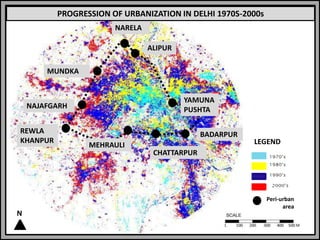
PROGRESSION OF URBANIZATION IN DELHI
1970s-2000s
ASSESSMENT OF MASTER PLAN PROVISIONS
IDENTIFIED ISSUES
PROPOSALS
Introduction
 The provision of mobility and accessibility are the main outputs of a
transport system.
 Accessibility depends on infrastructure and available and affordable modes
of transport for the movement of people and their loads.
 Accessibility therefore depends on physical proximity and mobility.
 Since peri-urban settlements are located away from the city core, they
often receive less attention and priority.
 The urban poor locate themselves in the available places in the periphery of
the city due their inability to access to the formal sector housing since they
are economically poor.
 This calls for a focus on improving and meeting local transportation needs
more effectively.
Relationship between mobility, transport and accessibility
Characteristics of Peri-Urban Areas
 Exist beyond the city’s administrative
limits, i.e. territorial jurisdiction of
the city authority.
 Transition zone between fully
urbanized land in cities and areas in
predominantly agricultural use.
 Characterized by mixed land uses
 Split between different
administrative areas.
 Areas of rural-urban linkages.
 Characterized by flows of people,
produce, finance, labour, services
and waste moving outwards from
the urban area.
ALIPUR
BADARPUR
CHATTARPUR
MEHRAULI
MUNDKA
NAJAFGARH
NARELA
REWLA
KHANPUR
YAMUNA
PUSHTA
PROGRESSION OF URBANIZATION IN DELHI 1970S-2000s
LEGEND
Peri-urban
area
N
ALIPUR
BADARPUR
CHATTARPUR
MEHRAULI
MUNDKA
NAJAFGARH
NARELA
REWLA
KHANPUR
YAMUNA
PUSHTA
LEGEND
Peri-urban area
 The Squatter households locate their shelter (mostly on the public land
found vacant) in the periphery of the city due their inability to access to
the formal sector housing since they are economically poor.
 Access to land and proximity to friends and relatives determine the
place they choose to live.
 The spatial access to work and livelihood needs remains a nightmare
for the many squatter households in the per-urban Delhi.
 Spatial mobility comprises considerable movement by foot or bi-cycle
or bus and construct an inward pattern to the city from the periphery.
 Mobility is work based, recreation based, livelihood based and social
networking
Assessment Of Master Plan Provisions
Transportation policy of Master Plan focuses on:
1. Inter linkages with other transport modes .
2. An easy access and connectivity within urban and Peri- urban areas.
3. Ensuring access to all the areas for all the sections of society.
Modal Split:
• It gives the share of different modes of transportation for 2021.
• Since the share of public transport is large ,we need to promote public
transport and give connectivity to the outer most parts of the city as
well.
80%
20%
PERCENTAGE SHARE
Public
transport
Personal
Modes
S. No MPD Provisions APPRAISAL
1 MRTS: It focuses on 15-minute
walking distance from the proposed
MRTS stations, after full development
of the system.
Preparation of detailed multi-modal
transport plans .
1. Will cater to all sections of society.
2. Plans not flexible enough to integrate
with various upcoming projects.
3. Does not relate with density of
population covered in 15 mins of
radius.
S. No MPD Provisions APPRAISAL
2 RAIL: To facilitate improvement in the
movement between Delhi and
surrounding towns through:
i. Extension of MRTS.
ii. Provision of dedicated railway
corridor with supplementary feeder
bus services for linking with other
modes of transport (IRBT Corridors).
Example: Metropolitan passenger
terminal in Narela.
1. Fuel efficient.
2. Increase the floating population within
the city.
S. No MPD Provisions APPRAISAL
3 NMT Lanes: Cycle tracks should be
provided at the sub-arterial and
local level roads and streets.
1. Promotes low carbon mobility.
2. Helps in balancing modal share.
3. Not compatible with the existing
transportation networks.
S. No MPD Provisions APPRAISAL
4 Bus ( BRTS)
Bus connectivity would need to be
planned to a considerable extent in
the form of feeder services to the
Metro Rail Stations and the Ring
Rail System.
New bus terminals need to be
planned and developed in strategic
locations to make the use of BRTS
and Metro Stations convenient for
all commuters.
1. Reduces dependency on private
vehicles for last mile connectivity.
2. Difficult to integrate with the existing
infrastructure.
Assessment Of Master Plan Provisions
Master Plan Provisions:
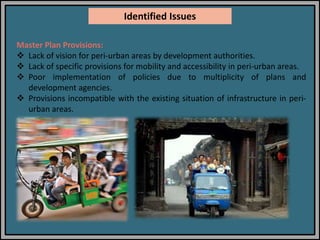
 Lack of vision for peri-urban areas by development authorities.
 Lack of specific provisions for mobility and accessibility in peri-urban areas.
 Poor implementation of policies due to multiplicity of plans and
development agencies.
 Provisions incompatible with the existing situation of infrastructure in peri-
urban areas.
Identified Issues
Administrative Issues:
 There is no department within DDA or MCD that is responsible for village
development plans and peri-urban transportation plans.
 In the absence of a detailed village development plan, the acquired
village land is often gets allocated to less desirable uses or get
encroached upon thus lack of planning for development priorities resulting
in poor accessibility.
 The Rural Development Board, created by Delhi Government, proposed
the rural areas under ‘special zone’ for planning. But their planning
proposals finally needs approval from DDA and the conflict in interest
of these bodies ultimately delays finalisation as well as implementation
of plans.
Identified Issues
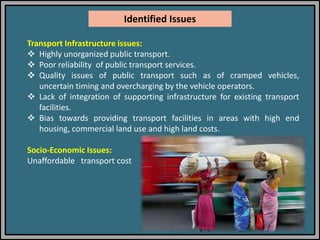
Transport Infrastructure issues:
 Highly unorganized public transport.
 Poor reliability of public transport services.
 Quality issues of public transport such as of cramped vehicles,
uncertain timing and overcharging by the vehicle operators.
 Lack of integration of supporting infrastructure for existing transport
facilities.
 Bias towards providing transport facilities in areas with high end
housing, commercial land use and high land costs.
Socio-Economic Issues:
Unaffordable transport cost
Identified Issues
Proposals
 Livelihood and Mobility interconnections: Expanding the Sustainable
Livelihoods Approach(SLA)
 The development objectives are first and foremost the enhancement
of people’s livelihoods and poverty eradication.
 The suggested livelihood outcomes relate primarily to improved
economic well-being, increased income, food security, reduced
vulnerability and environmental sustainability.
 Policies to promote ‘efficient mobility’: combining a consideration of access
and mobility
 Ensuring access through planning- good access to work, educational
and health services, recreation, shops and basic utilities like water and
energy, should underpin regional and local authorities’ policies.
 Sensitivity to income-differentiated mobility –
 The poor’s walking burden could be eased by the construction and
maintenance of dedicated walking and cycling paths that are smooth
and safely positioned away from traffic hazards along main roads.
 The poor in peri-urban areas rely on motorised transport far less than
medium and high-income groups. Hence, mobility and access measures
should concentrate on strengthening the non-motorised forms of
transport that the poor can afford.
 The lowering of public transport costs for the poor could be facilitated
by local and other governmental authorities.
 Horizontal integration of various organisations and departments.
 Provision of separate department for sustainable development of peri-
urban areas.
 Extension of Public Transportation to the Peri Urban Ring.
 Integration of Different modes of Transportation: NMTs-Metros, Bus stands.
Proposals
THANK YOU…

Development Plan -Planning Interventions by School of Planning and Architecture, New Delhi (SPA Delhi)

  • 1.
    • DEVELOPMENT PLAN:ACCESSIBILITY TO PERI-URBAN AREAS Presentation By School of Planning and Architecture, New Delhi
  • 2.
    ACCESSIBILITY OF PERI-URBAN AREAS City for All School of Planning and Architecture, New Delhi By: Apoorva Kumar, Isha Rana, Malvika Palival, Saneera Dev, Shreya Mangla, Yathartha Singh
  • 3.
    Structure of Presentation INTRODUCTION CHARACTERISTICSOF PERI-URBAN AREAS PROGRESSION OF URBANIZATION IN DELHI 1970s-2000s ASSESSMENT OF MASTER PLAN PROVISIONS IDENTIFIED ISSUES PROPOSALS
  • 4.
    Introduction  The provisionof mobility and accessibility are the main outputs of a transport system.  Accessibility depends on infrastructure and available and affordable modes of transport for the movement of people and their loads.  Accessibility therefore depends on physical proximity and mobility.  Since peri-urban settlements are located away from the city core, they often receive less attention and priority.  The urban poor locate themselves in the available places in the periphery of the city due their inability to access to the formal sector housing since they are economically poor.  This calls for a focus on improving and meeting local transportation needs more effectively. Relationship between mobility, transport and accessibility
  • 5.
    Characteristics of Peri-UrbanAreas  Exist beyond the city’s administrative limits, i.e. territorial jurisdiction of the city authority.  Transition zone between fully urbanized land in cities and areas in predominantly agricultural use.  Characterized by mixed land uses  Split between different administrative areas.  Areas of rural-urban linkages.  Characterized by flows of people, produce, finance, labour, services and waste moving outwards from the urban area.
  • 6.
  • 7.
  • 8.
     The Squatterhouseholds locate their shelter (mostly on the public land found vacant) in the periphery of the city due their inability to access to the formal sector housing since they are economically poor.  Access to land and proximity to friends and relatives determine the place they choose to live.  The spatial access to work and livelihood needs remains a nightmare for the many squatter households in the per-urban Delhi.  Spatial mobility comprises considerable movement by foot or bi-cycle or bus and construct an inward pattern to the city from the periphery.  Mobility is work based, recreation based, livelihood based and social networking
  • 9.
    Assessment Of MasterPlan Provisions Transportation policy of Master Plan focuses on: 1. Inter linkages with other transport modes . 2. An easy access and connectivity within urban and Peri- urban areas. 3. Ensuring access to all the areas for all the sections of society. Modal Split: • It gives the share of different modes of transportation for 2021. • Since the share of public transport is large ,we need to promote public transport and give connectivity to the outer most parts of the city as well. 80% 20% PERCENTAGE SHARE Public transport Personal Modes
  • 10.
    S. No MPDProvisions APPRAISAL 1 MRTS: It focuses on 15-minute walking distance from the proposed MRTS stations, after full development of the system. Preparation of detailed multi-modal transport plans . 1. Will cater to all sections of society. 2. Plans not flexible enough to integrate with various upcoming projects. 3. Does not relate with density of population covered in 15 mins of radius. S. No MPD Provisions APPRAISAL 2 RAIL: To facilitate improvement in the movement between Delhi and surrounding towns through: i. Extension of MRTS. ii. Provision of dedicated railway corridor with supplementary feeder bus services for linking with other modes of transport (IRBT Corridors). Example: Metropolitan passenger terminal in Narela. 1. Fuel efficient. 2. Increase the floating population within the city. S. No MPD Provisions APPRAISAL 3 NMT Lanes: Cycle tracks should be provided at the sub-arterial and local level roads and streets. 1. Promotes low carbon mobility. 2. Helps in balancing modal share. 3. Not compatible with the existing transportation networks. S. No MPD Provisions APPRAISAL 4 Bus ( BRTS) Bus connectivity would need to be planned to a considerable extent in the form of feeder services to the Metro Rail Stations and the Ring Rail System. New bus terminals need to be planned and developed in strategic locations to make the use of BRTS and Metro Stations convenient for all commuters. 1. Reduces dependency on private vehicles for last mile connectivity. 2. Difficult to integrate with the existing infrastructure. Assessment Of Master Plan Provisions
  • 11.
    Master Plan Provisions: Lack of vision for peri-urban areas by development authorities.  Lack of specific provisions for mobility and accessibility in peri-urban areas.  Poor implementation of policies due to multiplicity of plans and development agencies.  Provisions incompatible with the existing situation of infrastructure in peri- urban areas. Identified Issues
  • 12.
    Administrative Issues:  Thereis no department within DDA or MCD that is responsible for village development plans and peri-urban transportation plans.  In the absence of a detailed village development plan, the acquired village land is often gets allocated to less desirable uses or get encroached upon thus lack of planning for development priorities resulting in poor accessibility.  The Rural Development Board, created by Delhi Government, proposed the rural areas under ‘special zone’ for planning. But their planning proposals finally needs approval from DDA and the conflict in interest of these bodies ultimately delays finalisation as well as implementation of plans. Identified Issues
  • 13.
    Transport Infrastructure issues: Highly unorganized public transport.  Poor reliability of public transport services.  Quality issues of public transport such as of cramped vehicles, uncertain timing and overcharging by the vehicle operators.  Lack of integration of supporting infrastructure for existing transport facilities.  Bias towards providing transport facilities in areas with high end housing, commercial land use and high land costs. Socio-Economic Issues: Unaffordable transport cost Identified Issues
  • 14.
    Proposals  Livelihood andMobility interconnections: Expanding the Sustainable Livelihoods Approach(SLA)  The development objectives are first and foremost the enhancement of people’s livelihoods and poverty eradication.  The suggested livelihood outcomes relate primarily to improved economic well-being, increased income, food security, reduced vulnerability and environmental sustainability.  Policies to promote ‘efficient mobility’: combining a consideration of access and mobility  Ensuring access through planning- good access to work, educational and health services, recreation, shops and basic utilities like water and energy, should underpin regional and local authorities’ policies.
  • 15.
     Sensitivity toincome-differentiated mobility –  The poor’s walking burden could be eased by the construction and maintenance of dedicated walking and cycling paths that are smooth and safely positioned away from traffic hazards along main roads.  The poor in peri-urban areas rely on motorised transport far less than medium and high-income groups. Hence, mobility and access measures should concentrate on strengthening the non-motorised forms of transport that the poor can afford.  The lowering of public transport costs for the poor could be facilitated by local and other governmental authorities.  Horizontal integration of various organisations and departments.  Provision of separate department for sustainable development of peri- urban areas.  Extension of Public Transportation to the Peri Urban Ring.  Integration of Different modes of Transportation: NMTs-Metros, Bus stands. Proposals
  • 16.