How to Be More Than Merely Presentable

© Michael Neaylon 2010

PresentAbility is a division of MCME Pty Ltd

P + 61 2 9331 8135

info@mcme.com.au

www.mcme.com.au


                                               PresentAbility   Page 1
Hello. My name’s Michael Neaylon. As a terrified teenage actor I was abysmal at speaking in public. Since
wishing the stage would swallow me whole over 20 years ago, I’ve gone on to build a successful career as
an MC, actor, facilitator and speaker. These are just some of the things I’ve learnt, applied, and reshaped
along the way.

Let me start by asking you with 3 simple questions.

   1. Would you say you’re presenting at your best?

   2. Do you think other people would say that you’re a world class speaker?

   3. Would you like others to recognize you as an expert in your field?


Personally, my answers to these questions would be…


   1. Many of us want to present at our best.

   2. People want us to be world class presenters.

   3. Many of us are experts in our field.


So what’s stopping us from presenting as the world class experts we – and others - know we are?

I’m glad you asked.


                                                                     PresentAbility      Page 2
World Class Presentation Skills


For World Class People

                      PresentAbility   Page 3
I have no doubt that your present ability is far greater than you think; especially if it’s true that we only
use 5% of our brains. Margaret Mead said 6%. Others have said less. But even if we only use 10% that
leaves a lot of grey matter that could matter a whole lot more.

I do think, however, that too much thinking gets in the way of a good presentation. Counterproductive
thinking. We often worry ourselves with needless concerns far beyond our control:

      Will they like me?

      Is there enough detail?

      Is it the right detail?

      Perhaps it’s too much detail?

      Have they heard it all before?

      Do they care?

      Should they care?

      Do I? Of course I do. But who the hell am I to get up here and preach?

      Why didn’t I just tell them I was sick and get someone else to do it?

These are just a few of the symptoms of presenter’s dis-ease. What we’re going to treat are some of the
causes.


                                                                       PresentAbility       Page 4
Fear
Public speaking is widely reported by many as a fear greater than death. There
are countless theories as to why. Jerry Seinfeld says that most people giving a
eulogy ‘would rather be the guy in the box’. The great orator of Springfield,
Homer Simpson, says ‘If I could just say a few words: I’d be a better speaker’.
One of the more curious ones I’ve heard is that the mere act of being in front of
a group of people taps into our primal fear of being segregated from a group by
being apart from the tribe.

Whilst there might be truth in all of these statements, each person’s fear will be
personal to them, that’s why coaching can be helpful. It gives people the
opportunity to not only conquer fears but also locate their strengths – and build
on them. Whilst we might not be able to delve into your specific fear here, I find
the most effective fear fighters are the ones that take the focus off of yourself
and onto 3 key things:

   1. The audience.

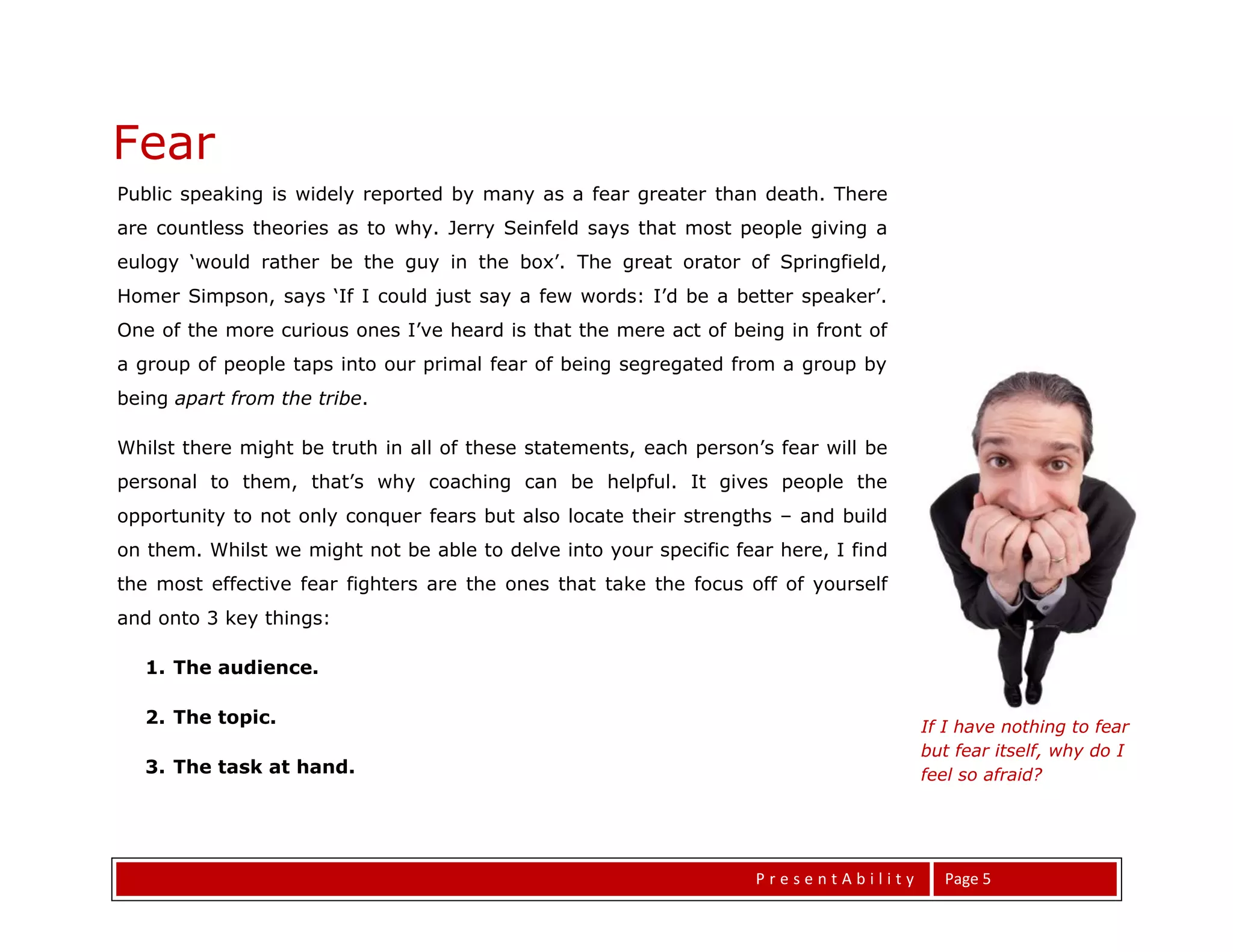
   2. The topic.                                                                     If I have nothing to fear
                                                                                     but fear itself, why do I
   3. The task at hand.                                                              feel so afraid?


                                                                   PresentAbility      Page 5
The Audience
We’ll look at the audience first, because, without a doubt, they are the most
important point of focus. I’m sure you’ve worked that out already, however
there are a few things that can get between us and them in the process,
despite our good intentions.

This can be broken down into 3 main areas:
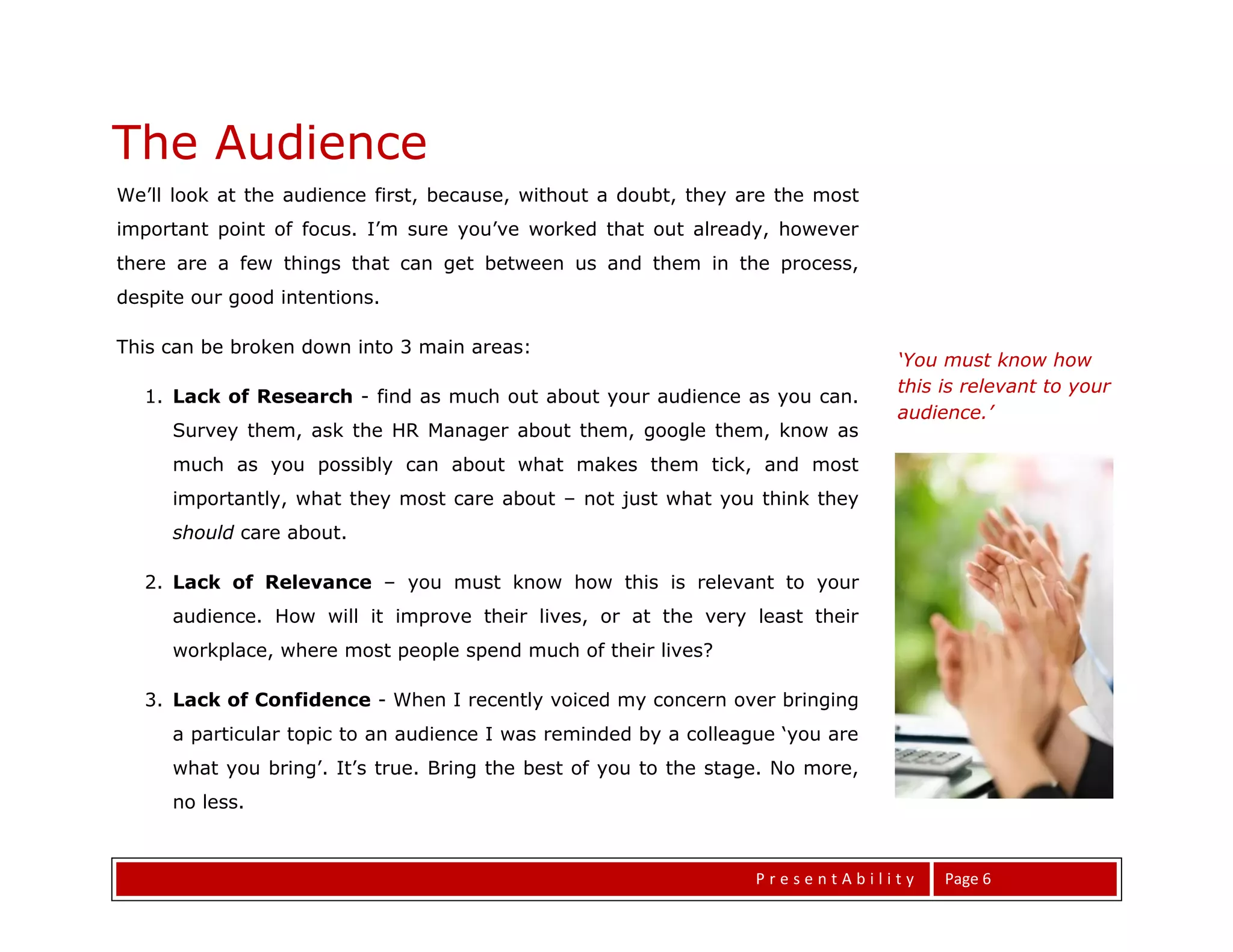
                                                                                ‘You must know how
                                                                                this is relevant to your
  1. Lack of Research - find as much out about your audience as you can.
                                                                                audience.’
     Survey them, ask the HR Manager about them, google them, know as
     much as you possibly can about what makes them tick, and most
     importantly, what they most care about – not just what you think they
     should care about.

  2. Lack of Relevance – you must know how this is relevant to your
     audience. How will it improve their lives, or at the very least their
     workplace, where most people spend much of their lives?

  3. Lack of Confidence - When I recently voiced my concern over bringing
     a particular topic to an audience I was reminded by a colleague ‘you are

The Topic
     what you bring’. It’s true. Bring the best of you to the stage. No more,
     no less.


                                                                  PresentAbility     Page 6
The Topic
A surefire way to be relevant for your audience is to have a hot topic. If it’s an
industry seminar, research what’s wrong in the marketplace. Where are the gaps?
Where are we falling down? Where could we improve? How could we serve more
people? How could we create profit and retain integrity?

But what if you have no say over the topic? What if the topic’s been chosen for
you?

The solution’s easy. If you can’t present a new topic in a new way, present and
                                                                                       ‘Find a hot angle.’
old topic in a new way. In short, find a hot angle. You actually have an added
advantage here. As the audience’s expectations are low, you’ll surprise them with
a rigorous, fresh approach, automatically exceeding their expectations.

One of our clients, Steensen Varming, recently did this in a Presentation Skills
Workshop by starting their presentation with a scene from a movie. The MD had
rewritten the scene to address an old issue in a new way; he even acted it out. It
was brave and bold, and it captivated and engaged the audience.

The Task at Hand
Ask others for their perspective on an issue. They’ll appreciate it, and you’ll find
better material. Google it. Oppose it. Imagine you’re debating the issue for the
opposition. You’ll surprise yourself, and engage your audience.

You might be surprised If your topic is workplace motivation, rather than try to
rally the troops with empty ra-ra, could you instead give           PresentAbility      Page 7
The Task at Hand
If you’re the MC, your overall objective would be to fulfil the event brief. Yet your
task at hand for a particular session might be to energize people after lunch. This
results in an outcome: an alert, responsive audience for the afternoon’s speakers.

If you’re sponsoring a conference, your overall objective might be to raise your
company profile. Your task at hand, however, might be to give the audience a
case study. The outcome is you establish your reputation as a trusted source.
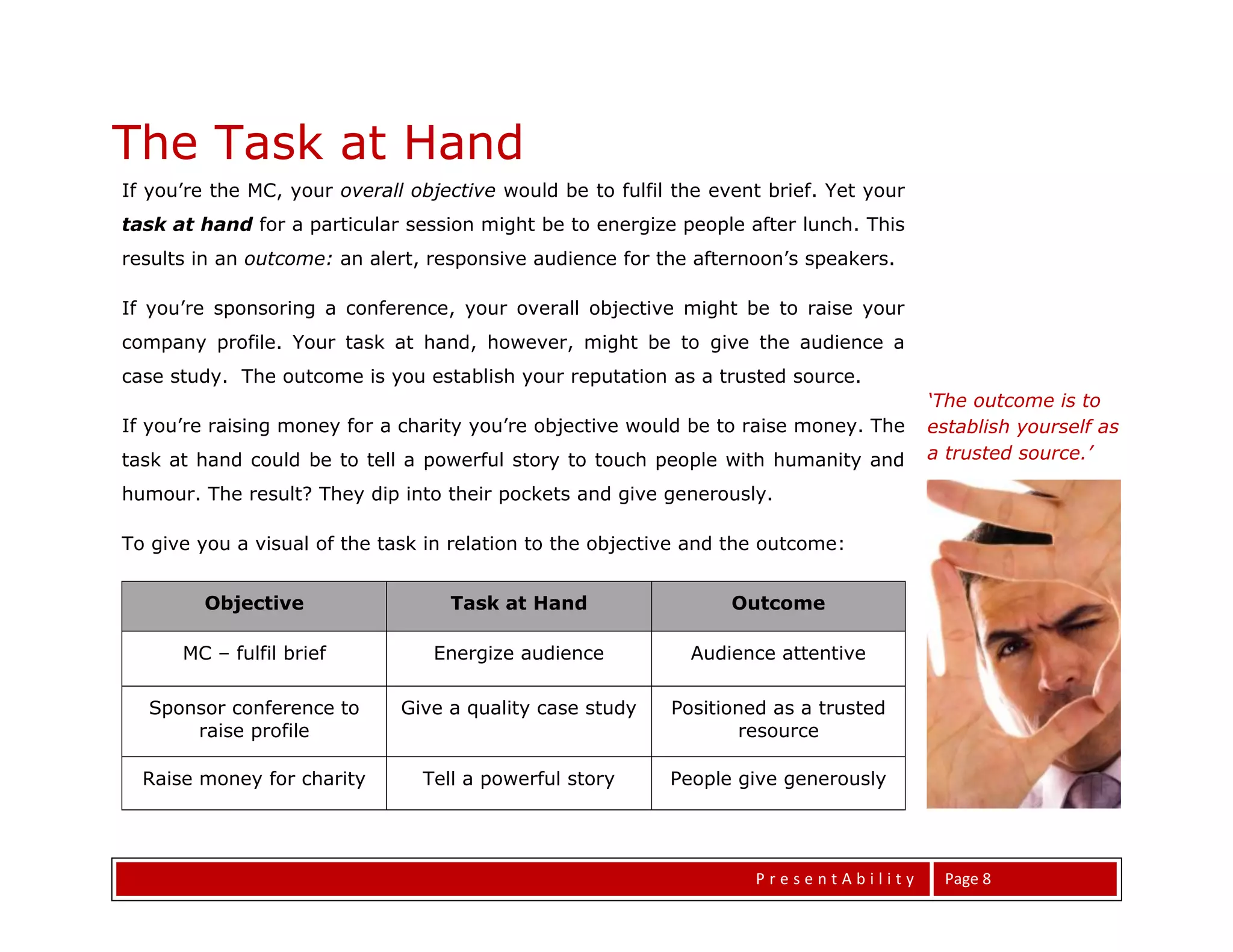
                                                                                        ‘The outcome is to
If you’re raising money for a charity you’re objective would be to raise money. The     establish yourself as
task at hand could be to tell a powerful story to touch people with humanity and        a trusted source.’

humour. The result? They dip into their pockets and give generously.

To give you a visual of the task in relation to the objective and the outcome:


        Objective                  Task at Hand                   Outcome

      MC – fulfil brief          Energize audience           Audience attentive

  Sponsor conference to       Give a quality case study    Positioned as a trusted
      raise profile                                               resource

  Raise money for charity       Tell a powerful story      People give generously


                                                                    PresentAbility       Page 8
Surely There’s More to It
Yes, there is more. A lot more.

Often the best ways to reach an audience is find as many touch points using as
many tactics as you can. Why? What resonates with one person might not
necessarily resonate with another.

What we’ve looked are just 3 tools in an expansive toolbox. To be a master
                                                                                      ‘What we’ve looked
craftsperson, you need to keep unpacking those tools, trying them on for size,        at are just 3 tools
experimenting a little and practicing a lot.                                          in an expansive
                                                                                      toolbox.’
Before we explore some effective ways to do just that, here’s a quick overview of
just some of the tools you have at your disposal:

    Anecdotes             Demonstrations             Interview a Guest


All The World’s a Stage
    Analogies             Quotes                     Personal Stories

    Metaphors             Slides                     Stories from History

    Case Studies          Music                      Video


All The World’s a Stage
    Clichés               Inter-activities           Myths


                                                                     PresentAbility   Page 9
All The World’s A Stage
One way to conquer the fear of speaking is simply to speak more. Not just on the
stage, at the conference or when pitching to clients, but in everyday life. By
practicing consciously, your ‘speaking’ becomes habitual. Then, when you step up
onto stage it doesn’t feel like such a massive leap into a unknown void.
                                                                                        ‘Presenting is
As the best presentations are conversations, I invite our clients to practice the art   focused speaking
                                                                                        – amplified by
of conversation at every opportunity. I don’t suggest just idle chit chat. I do
                                                                                        your personality
suggest speaking with focus. If networking is focused socialising, then presenting      and expertise.’
is focused speaking – amplified by your personality and expertise.

To help that process, we often encourage our clients to pick a simple topic or area
of expertise they’re highly familiar with and explore these techniques in:

      Heighten & Extend: expand key points of a topic by highlighting key areas,
       and ensuring those points hit home.

      Elevator Statements: distil your message into an elevator statement that
       gives someone its essence in one or two sentences.

      Same, Same, But Different: say the same mini-speeches in different ways.

Heighten & Extend
                                                                      PresentAbility     Page 10
Heighten & Extend
This exercise is excellent for testing a story’s impact. It’s tough. It’s fun. It works.

This is your opportunity to road test your material for your audience, without them
even being in the room. Simply tell a story from a presentation you’re working on
to a colleague or friend. This person is now your story buddy. Using an accurate
snapshot your audience, brief your buddy so they understand the attendees’ key
areas, issues and concerns. They need to listen as if from that person’s point of
view. Then tell your story. But before you do…
                                                                                           ‘It’s tough. It’s fun.
Your buddy has 2 words they can interject with at any time.
                                                                                           It works.’
1. Heighten. 2. Extend.

If they say ‘heighten’ then this is a cue that they need more detail delivered
in a more interesting or entertaining way. Keep them engaged. Watch their body
language, their face, and adjust your delivery to keep their interest.

Once your buddy is engaged, they say ‘extend’. This means you’ve made your
point and can keep going to deliver the next points in your presentation, until they


Elevator Statements
say heighten again. Keep having fun.

Debrief at the end, asking your buddy what worked, what didn’t, and why.


                                                                        PresentAbility     Page 11
Elevator Statements
Elevator Statements are built on the concept of elevator pitches, made famous in
Hollywood by scriptwriters who only have a few floors in an elevator to pitch their
concept to a Producer.

Some screenwriters call this sentence the central idea, controlling idea or the spine.
Advertisers might call it a tagline. In a business plan the sentence might be the
mission statement. Whichever of those strike a chord with you, the key is that the
line needs forward motion, and ideally, emotion. The line needs to be catchy, active,
compelling and concise.                                                                     ‘The line needs to
                                                                                            be catchy, active,
Use this line to encourage, uplift, inspire, influence, intrigue or entertain your          compelling and
                                                                                            concise.’
audience. Give it energy. Make it fun. It’s also effective if the line has that effect on
you. In fact I see it as. Here are some other examples:


      Rich Dad Poor Dad’s Mission: To elevate the financial wellbeing of humanity.
      Coke: The real thing.
      This e-book: How to Be More Than Merely Presentable.


So, what’s your presentation’s concept? Can you explain it in one sentence?
But hang on, is one sentence really enough? Yes. And no.


                                                                       PresentAbility       Page 12
Same Same. But Different.
Just as you’d tailor a CV for different roles and different companies, you also need to
tailor your Elevator Statement for different audiences and environments. The
following table is a snapshot of a concept developed by Matt Church and the
Thought Leaders network, giving the 3 ways you pitch yourself in any situation.


          SITUATION          FOCUS                                                        ‘Tailor your
                                                                                          Elevator
Dinner Party                 Personal                     YOU                             Statement for
                                                                                          different
Networking event             Activity                     IT                              audiences and
                                                                                          environments.’
Prospect’s boardroom         Outcomes                     THEM


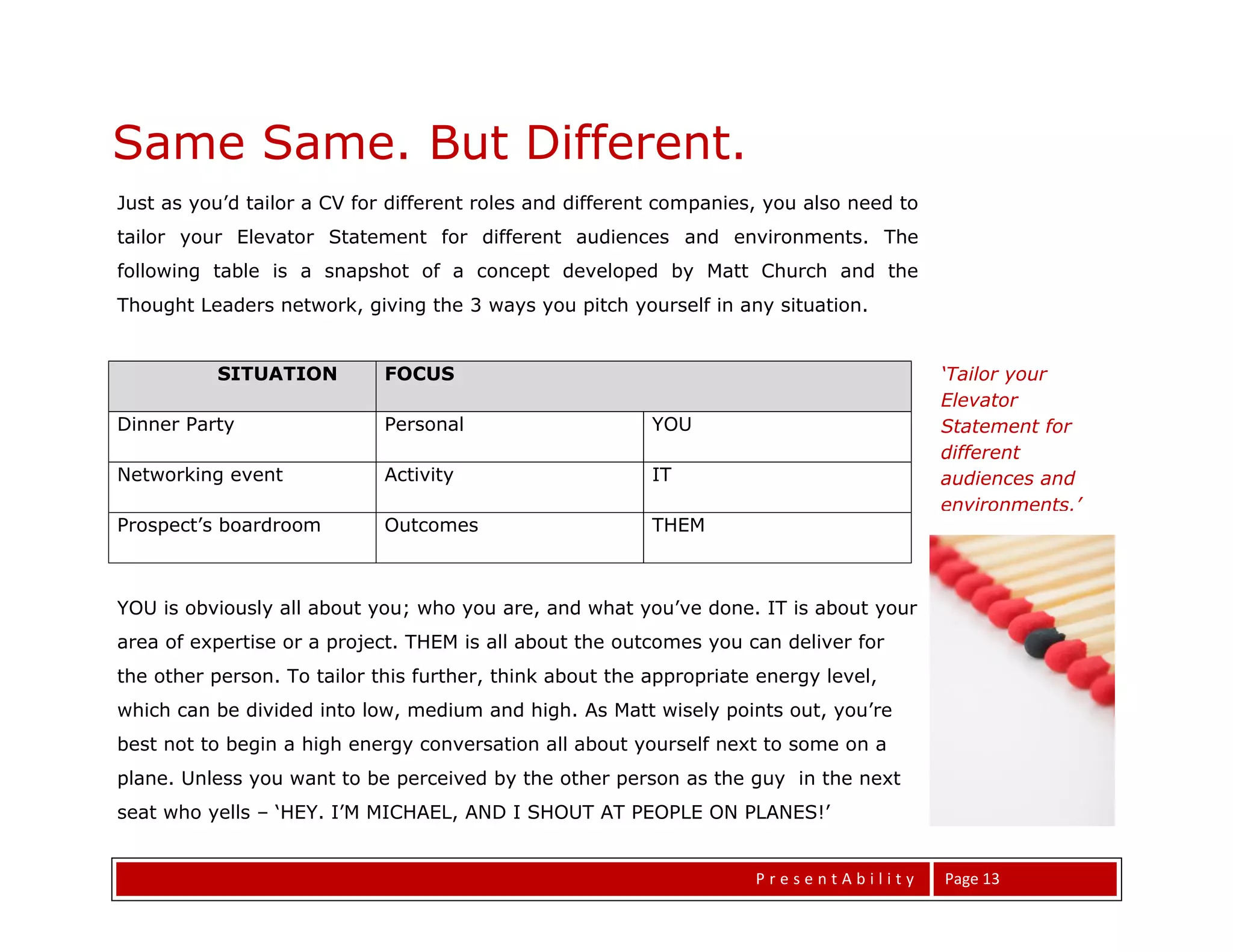
YOU is obviously all about you; who you are, and what you’ve done. IT is about your
area of expertise or a project. THEM is all about the outcomes you can deliver for
the other person. To tailor this further, think about the appropriate energy level,
which can be divided into low, medium and high. As Matt wisely points out, you’re
best not to begin a high energy conversation all about yourself next to some on a
plane. Unless you want to be perceived by the other person as the guy in the next
seat who yells – ‘HEY. I’M MICHAEL, AND I SHOUT AT PEOPLE ON PLANES!’


                                                                     PresentAbility       Page 13
In Closing
One of the areas we work on in detail with many of our clients is the art of closing
Same Same. But Different.
their presentation. In general, people fall into two camps.

   1. They rush the ending.

   2. They drag out the ending.

From the audience’s point of view it can feel like a badly executed 3rd act of a movie.
These are just some of the ways you can finish strong.

   1. Summarise – review your 3 key points – or more if you have them.                    ‘…finish strong.’

                                                                                          ’
   2. Quick Q & A, asking for comments, questions or thoughts. You don’t want to
      make this the very last thing though, as there are too many variables.

   3. Call to Action – a great one for sales, giving people a strong cue for what to do
      next.

So, in closing we’ve covered quite a lot here. We’ve looked at your audience, how to
engage them and how to deliver your message in ways that ensure they’ll be
receptive, responsive and entertained. If you have any questions, comments or
thoughts please email me at michael@mcme.com.au Thanks for reading and all the
best for your presentations. I look forward to hearing from you soon.

                                                                     PresentAbility       Page 14
About Michael Neaylon

Michael Neaylon is an MC, Presenter, Entertainment Consultant and Presentation Skills Trainer.

He has over 20 years in the entertainment industry, many of which have been spent

performing, designing and marketing events. Michael is the founder and director or MCME, an

interactive marketing, performance and training company that supports you in making your

event, your brand and your people a success.


Share This

Distribute this freely to anybody you like, as long as you distribute it in its entirety, don’t

change it in any way, and don’t charge money for it.

Copyright © 2010 Michael Neaylon


Disclaimer

The material contained in this report is general and is not intended as advice on any

particular matter. The author expressly disclaims all and any liability to any persons

whatsoever in respect of anything done by any such person in reliance, whether in whole

or in part, on this report. Please take appropriate legal advice before acting on any

information in this report.


                                                                               PresentAbility     Page 15

PresentAbility

  • 1.
    How to BeMore Than Merely Presentable © Michael Neaylon 2010 PresentAbility is a division of MCME Pty Ltd P + 61 2 9331 8135 info@mcme.com.au www.mcme.com.au PresentAbility Page 1
  • 2.
    Hello. My name’sMichael Neaylon. As a terrified teenage actor I was abysmal at speaking in public. Since wishing the stage would swallow me whole over 20 years ago, I’ve gone on to build a successful career as an MC, actor, facilitator and speaker. These are just some of the things I’ve learnt, applied, and reshaped along the way. Let me start by asking you with 3 simple questions. 1. Would you say you’re presenting at your best? 2. Do you think other people would say that you’re a world class speaker? 3. Would you like others to recognize you as an expert in your field? Personally, my answers to these questions would be… 1. Many of us want to present at our best. 2. People want us to be world class presenters. 3. Many of us are experts in our field. So what’s stopping us from presenting as the world class experts we – and others - know we are? I’m glad you asked. PresentAbility Page 2
  • 3.
    World Class PresentationSkills For World Class People PresentAbility Page 3
  • 4.
    I have nodoubt that your present ability is far greater than you think; especially if it’s true that we only use 5% of our brains. Margaret Mead said 6%. Others have said less. But even if we only use 10% that leaves a lot of grey matter that could matter a whole lot more. I do think, however, that too much thinking gets in the way of a good presentation. Counterproductive thinking. We often worry ourselves with needless concerns far beyond our control:  Will they like me?  Is there enough detail?  Is it the right detail?  Perhaps it’s too much detail?  Have they heard it all before?  Do they care?  Should they care?  Do I? Of course I do. But who the hell am I to get up here and preach?  Why didn’t I just tell them I was sick and get someone else to do it? These are just a few of the symptoms of presenter’s dis-ease. What we’re going to treat are some of the causes. PresentAbility Page 4
  • 5.
    Fear Public speaking iswidely reported by many as a fear greater than death. There are countless theories as to why. Jerry Seinfeld says that most people giving a eulogy ‘would rather be the guy in the box’. The great orator of Springfield, Homer Simpson, says ‘If I could just say a few words: I’d be a better speaker’. One of the more curious ones I’ve heard is that the mere act of being in front of a group of people taps into our primal fear of being segregated from a group by being apart from the tribe. Whilst there might be truth in all of these statements, each person’s fear will be personal to them, that’s why coaching can be helpful. It gives people the opportunity to not only conquer fears but also locate their strengths – and build on them. Whilst we might not be able to delve into your specific fear here, I find the most effective fear fighters are the ones that take the focus off of yourself and onto 3 key things: 1. The audience. 2. The topic. If I have nothing to fear but fear itself, why do I 3. The task at hand. feel so afraid? PresentAbility Page 5
  • 6.
    The Audience We’ll lookat the audience first, because, without a doubt, they are the most important point of focus. I’m sure you’ve worked that out already, however there are a few things that can get between us and them in the process, despite our good intentions. This can be broken down into 3 main areas: ‘You must know how this is relevant to your 1. Lack of Research - find as much out about your audience as you can. audience.’ Survey them, ask the HR Manager about them, google them, know as much as you possibly can about what makes them tick, and most importantly, what they most care about – not just what you think they should care about. 2. Lack of Relevance – you must know how this is relevant to your audience. How will it improve their lives, or at the very least their workplace, where most people spend much of their lives? 3. Lack of Confidence - When I recently voiced my concern over bringing a particular topic to an audience I was reminded by a colleague ‘you are The Topic what you bring’. It’s true. Bring the best of you to the stage. No more, no less. PresentAbility Page 6
  • 7.
    The Topic A surefireway to be relevant for your audience is to have a hot topic. If it’s an industry seminar, research what’s wrong in the marketplace. Where are the gaps? Where are we falling down? Where could we improve? How could we serve more people? How could we create profit and retain integrity? But what if you have no say over the topic? What if the topic’s been chosen for you? The solution’s easy. If you can’t present a new topic in a new way, present and ‘Find a hot angle.’ old topic in a new way. In short, find a hot angle. You actually have an added advantage here. As the audience’s expectations are low, you’ll surprise them with a rigorous, fresh approach, automatically exceeding their expectations. One of our clients, Steensen Varming, recently did this in a Presentation Skills Workshop by starting their presentation with a scene from a movie. The MD had rewritten the scene to address an old issue in a new way; he even acted it out. It was brave and bold, and it captivated and engaged the audience. The Task at Hand Ask others for their perspective on an issue. They’ll appreciate it, and you’ll find better material. Google it. Oppose it. Imagine you’re debating the issue for the opposition. You’ll surprise yourself, and engage your audience. You might be surprised If your topic is workplace motivation, rather than try to rally the troops with empty ra-ra, could you instead give PresentAbility Page 7
  • 8.
    The Task atHand If you’re the MC, your overall objective would be to fulfil the event brief. Yet your task at hand for a particular session might be to energize people after lunch. This results in an outcome: an alert, responsive audience for the afternoon’s speakers. If you’re sponsoring a conference, your overall objective might be to raise your company profile. Your task at hand, however, might be to give the audience a case study. The outcome is you establish your reputation as a trusted source. ‘The outcome is to If you’re raising money for a charity you’re objective would be to raise money. The establish yourself as task at hand could be to tell a powerful story to touch people with humanity and a trusted source.’ humour. The result? They dip into their pockets and give generously. To give you a visual of the task in relation to the objective and the outcome: Objective Task at Hand Outcome MC – fulfil brief Energize audience Audience attentive Sponsor conference to Give a quality case study Positioned as a trusted raise profile resource Raise money for charity Tell a powerful story People give generously PresentAbility Page 8
  • 9.
    Surely There’s Moreto It Yes, there is more. A lot more. Often the best ways to reach an audience is find as many touch points using as many tactics as you can. Why? What resonates with one person might not necessarily resonate with another. What we’ve looked are just 3 tools in an expansive toolbox. To be a master ‘What we’ve looked craftsperson, you need to keep unpacking those tools, trying them on for size, at are just 3 tools experimenting a little and practicing a lot. in an expansive toolbox.’ Before we explore some effective ways to do just that, here’s a quick overview of just some of the tools you have at your disposal:  Anecdotes  Demonstrations  Interview a Guest All The World’s a Stage  Analogies  Quotes  Personal Stories  Metaphors  Slides  Stories from History  Case Studies  Music  Video All The World’s a Stage  Clichés  Inter-activities  Myths PresentAbility Page 9
  • 10.
    All The World’sA Stage One way to conquer the fear of speaking is simply to speak more. Not just on the stage, at the conference or when pitching to clients, but in everyday life. By practicing consciously, your ‘speaking’ becomes habitual. Then, when you step up onto stage it doesn’t feel like such a massive leap into a unknown void. ‘Presenting is As the best presentations are conversations, I invite our clients to practice the art focused speaking – amplified by of conversation at every opportunity. I don’t suggest just idle chit chat. I do your personality suggest speaking with focus. If networking is focused socialising, then presenting and expertise.’ is focused speaking – amplified by your personality and expertise. To help that process, we often encourage our clients to pick a simple topic or area of expertise they’re highly familiar with and explore these techniques in:  Heighten & Extend: expand key points of a topic by highlighting key areas, and ensuring those points hit home.  Elevator Statements: distil your message into an elevator statement that gives someone its essence in one or two sentences.  Same, Same, But Different: say the same mini-speeches in different ways. Heighten & Extend PresentAbility Page 10
  • 11.
    Heighten & Extend Thisexercise is excellent for testing a story’s impact. It’s tough. It’s fun. It works. This is your opportunity to road test your material for your audience, without them even being in the room. Simply tell a story from a presentation you’re working on to a colleague or friend. This person is now your story buddy. Using an accurate snapshot your audience, brief your buddy so they understand the attendees’ key areas, issues and concerns. They need to listen as if from that person’s point of view. Then tell your story. But before you do… ‘It’s tough. It’s fun. Your buddy has 2 words they can interject with at any time. It works.’ 1. Heighten. 2. Extend. If they say ‘heighten’ then this is a cue that they need more detail delivered in a more interesting or entertaining way. Keep them engaged. Watch their body language, their face, and adjust your delivery to keep their interest. Once your buddy is engaged, they say ‘extend’. This means you’ve made your point and can keep going to deliver the next points in your presentation, until they Elevator Statements say heighten again. Keep having fun. Debrief at the end, asking your buddy what worked, what didn’t, and why. PresentAbility Page 11
  • 12.
    Elevator Statements Elevator Statementsare built on the concept of elevator pitches, made famous in Hollywood by scriptwriters who only have a few floors in an elevator to pitch their concept to a Producer. Some screenwriters call this sentence the central idea, controlling idea or the spine. Advertisers might call it a tagline. In a business plan the sentence might be the mission statement. Whichever of those strike a chord with you, the key is that the line needs forward motion, and ideally, emotion. The line needs to be catchy, active, compelling and concise. ‘The line needs to be catchy, active, Use this line to encourage, uplift, inspire, influence, intrigue or entertain your compelling and concise.’ audience. Give it energy. Make it fun. It’s also effective if the line has that effect on you. In fact I see it as. Here are some other examples:  Rich Dad Poor Dad’s Mission: To elevate the financial wellbeing of humanity.  Coke: The real thing.  This e-book: How to Be More Than Merely Presentable. So, what’s your presentation’s concept? Can you explain it in one sentence? But hang on, is one sentence really enough? Yes. And no. PresentAbility Page 12
  • 13.
    Same Same. ButDifferent. Just as you’d tailor a CV for different roles and different companies, you also need to tailor your Elevator Statement for different audiences and environments. The following table is a snapshot of a concept developed by Matt Church and the Thought Leaders network, giving the 3 ways you pitch yourself in any situation. SITUATION FOCUS ‘Tailor your Elevator Dinner Party Personal YOU Statement for different Networking event Activity IT audiences and environments.’ Prospect’s boardroom Outcomes THEM YOU is obviously all about you; who you are, and what you’ve done. IT is about your area of expertise or a project. THEM is all about the outcomes you can deliver for the other person. To tailor this further, think about the appropriate energy level, which can be divided into low, medium and high. As Matt wisely points out, you’re best not to begin a high energy conversation all about yourself next to some on a plane. Unless you want to be perceived by the other person as the guy in the next seat who yells – ‘HEY. I’M MICHAEL, AND I SHOUT AT PEOPLE ON PLANES!’ PresentAbility Page 13
  • 14.
    In Closing One ofthe areas we work on in detail with many of our clients is the art of closing Same Same. But Different. their presentation. In general, people fall into two camps. 1. They rush the ending. 2. They drag out the ending. From the audience’s point of view it can feel like a badly executed 3rd act of a movie. These are just some of the ways you can finish strong. 1. Summarise – review your 3 key points – or more if you have them. ‘…finish strong.’ ’ 2. Quick Q & A, asking for comments, questions or thoughts. You don’t want to make this the very last thing though, as there are too many variables. 3. Call to Action – a great one for sales, giving people a strong cue for what to do next. So, in closing we’ve covered quite a lot here. We’ve looked at your audience, how to engage them and how to deliver your message in ways that ensure they’ll be receptive, responsive and entertained. If you have any questions, comments or thoughts please email me at michael@mcme.com.au Thanks for reading and all the best for your presentations. I look forward to hearing from you soon. PresentAbility Page 14
  • 15.
    About Michael Neaylon MichaelNeaylon is an MC, Presenter, Entertainment Consultant and Presentation Skills Trainer. He has over 20 years in the entertainment industry, many of which have been spent performing, designing and marketing events. Michael is the founder and director or MCME, an interactive marketing, performance and training company that supports you in making your event, your brand and your people a success. Share This Distribute this freely to anybody you like, as long as you distribute it in its entirety, don’t change it in any way, and don’t charge money for it. Copyright © 2010 Michael Neaylon Disclaimer The material contained in this report is general and is not intended as advice on any particular matter. The author expressly disclaims all and any liability to any persons whatsoever in respect of anything done by any such person in reliance, whether in whole or in part, on this report. Please take appropriate legal advice before acting on any information in this report. PresentAbility Page 15